What Are the Objectives of Ensuring Data Integrity
|
6
min read

A finance team can publish a quarterly report with polished charts, reconciled totals, and an executive sign-off, yet still base it on a table whose meaning changed during a pipeline update. A renamed column, a missing file, or an overwritten correction can make a trusted metric describe the wrong business event. By the time someone notices, the same data may already support an operational dashboard, an AI feature, and a regulatory submission.
That's why the answer to what are the objectives of ensuring data integrity can't stop at “keep data accurate.” A workable program must preserve accuracy, completeness, consistency, traceability, security, and recoverability. It must also produce evidence that those properties survived transformation, correction, schema change, and incident response.
Table of Contents
Why Data Integrity Is a Set of Objectives, Not a Single Checkbox
How Objectives Differ Across Regulatory, Operational, and AI Use Cases
Why Data Integrity Is a Set of Objectives, Not a Single Checkbox
Data integrity is often treated like a status light: green means trusted, red means broken. Real data platforms don't work that way. A dataset can contain accurate values but lack an audit trail, arrive late but remain complete, or pass structural checks while using an inconsistent business definition.
Consider a quarterly revenue table. The values may be correct for the records that arrived, but one regional file was never loaded. The report is now incomplete. If a source system changed net_revenue to represent revenue after a different adjustment, the table is also inconsistent with prior periods. If nobody can identify when the change happened or which transformation applied it, the team can't defend the result.
This is the practical distinction between data quality and data integrity. Quality asks whether information is fit for a particular use. Integrity asks whether it remained trustworthy, controlled, and explainable throughout its lifecycle.
Practical rule: A passing quality check tells you what the data looks like now. Integrity evidence helps you explain how it got there.
The objectives therefore form a stack:
Accuracy: Values represent the underlying event.
Completeness: Required records, fields, and evidence haven't disappeared.
Consistency: The same definition and rules hold across systems and time.
Traceability: People can reconstruct who changed what, when, and why.
Security: Unauthorized access or alteration is prevented or detected.
Recoverability: The organization can restore and verify a trustworthy state.
These objectives support analytics, AI, financial reporting, operations, and compliance at the same time. The right question isn't whether a dataset has a single integrity score. It's which objective is exposed at each handoff, and what evidence proves that the control worked.
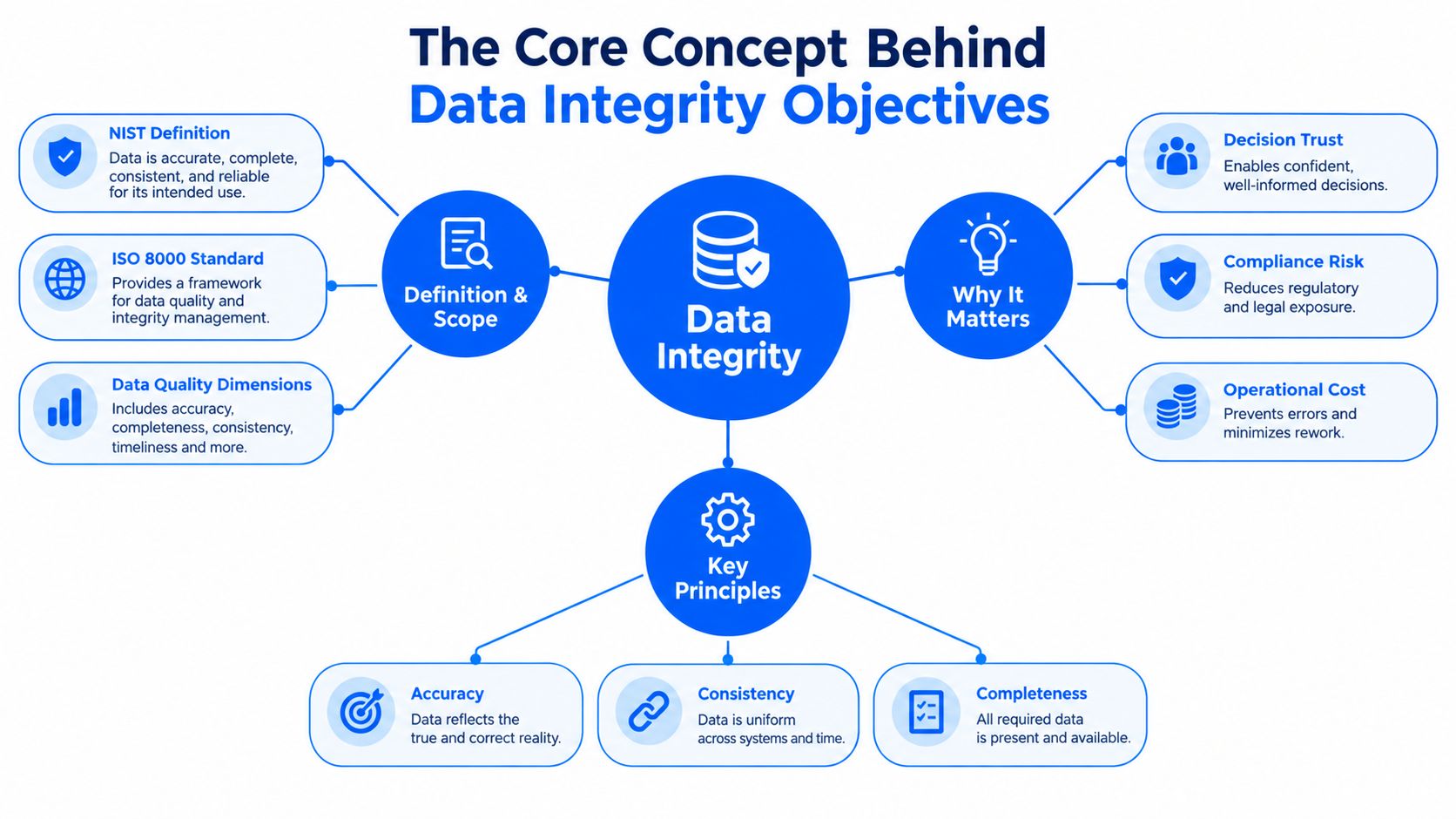
The Core Concept Behind Data Integrity Objectives
NIST defines integrity as the property that data has not been altered, destroyed, or lost through unauthorized or accidental means, while also linking integrity to authenticity and nonrepudiation. In plain language, the record should still represent what happened, and the organization should be able to establish that fact.
The dimensions of data quality help describe whether information is usable, but integrity adds lifecycle control. A value can look plausible in a warehouse and still be untrustworthy if its source, timestamp, transformation, or correction history is missing.
Turning ALCOA into everyday controls
FDA guidance describes data integrity through the five ALCOA attributes: attributable, legible, contemporaneously recorded, original or a true copy, and accurate. These terms become more useful when translated into questions a data team can answer.
Attributable: Can you identify the person, system, instrument, or service that created or changed the record?
Legible: Can an authorized reviewer read and interpret the record and its metadata later?
Contemporaneous: Was the event recorded when it occurred, rather than reconstructed from memory?
Original: Do you retain the source record or a verified true copy, not only a transformed output?
Accurate: Does the value faithfully describe the underlying event?
A streaming event that arrives late illustrates the difference between capture time and event time. Recording both helps reviewers understand whether the source generated the event late, the network delayed it, or the ingestion process failed.
Integrity is broader than “the data looks right.” It includes the evidence around the data, the controls that protect it, and the ability to reconstruct the sequence of events after a correction or incident.
The Primary Objectives Every Program Must Cover
FDA guidance describes data integrity as the completeness, consistency, and accuracy of data and expects records to be attributable, legible, contemporaneously recorded, original or a true copy, and accurate, the five ALCOA attributes. Those attributes provide a strong foundation, but enterprise pipelines also need controls for security, traceability, and recovery.
Six objectives in practical terms
Accuracy means a value represents the event it claims to represent. If an invoice is recorded with the wrong currency conversion, a range check may catch an implausible result, but only a business-rule validation or reconciliation may establish what the correct value should be. Useful signals include failed record checks, unexpected distributions, and mismatches with a trusted source.
Completeness means required records, fields, and supporting evidence are present. A successful file load can still be incomplete if the source produced only part of the expected extract. Missing-load alerts, row-count comparisons, null checks, and checks for failed tests or retests help expose the gap.
Consistency means a business concept retains the same meaning across systems and over time. A status value such as “active” shouldn't mean “paid” in one application and “not cancelled” in another. Schema tracking, reference-data checks, and cross-system reconciliation provide evidence when definitions drift.
Traceability means reviewers can reconstruct the record's history. A finance analyst who corrects a value should leave the original, the reason, the timestamp, the identity, and the resulting version available for review. Audit logs, lineage, version history, and change context supply that trail.
Security protects data from unauthorized access, modification, loss, and destruction. Role-based access, least privilege, protected logs, and change monitoring reduce the chance that an unauthorized action becomes an invisible data change.
Recoverability means the team can restore a trustworthy state and demonstrate that it's trustworthy. NIST guidance calls for the ability to restore data to its last known good state, identify the correct uncontaminated backup, and determine the identity and timing of alterations. Backups alone aren't enough if restoration hasn't been tested or the team can't identify which version is safe.
Objective | What failure looks like | Representative control |
|---|---|---|
Accuracy | A metric represents the wrong transaction value | Record-level validation and reconciliation |
Completeness | A source file or required record is missing | Freshness, load, row-count, and null monitoring |
Consistency | One system interprets a field differently | Schema tracking and shared business rules |
Traceability | A corrected value has no documented history | Immutable audit trail and lineage |
Security | An unauthorized user changes a critical table | Access controls and protected change logs |
Recoverability | A bad backfill overwrites trusted history | Versioned backups and restoration testing |
These objectives overlap, but they don't substitute for one another. A secure dataset can still be incomplete, and a recoverable dataset can still contain inaccurate business logic.
A Walkthrough of the Objectives in a Real Data Pipeline
Take a daily revenue feed from a billing system. The source sends transactions to a warehouse, where transformations prepare a dataset for a business intelligence dashboard.
At ingestion, accuracy starts with validating types, currencies, identifiers, and business rules. A record with a negative amount might be valid for a refund, so the rule needs business context rather than a simplistic “positive values only” check. Completeness appears when the file arrives with fewer records than expected or when the delivery is late. The pipeline should distinguish an empty business day from a failed transfer.
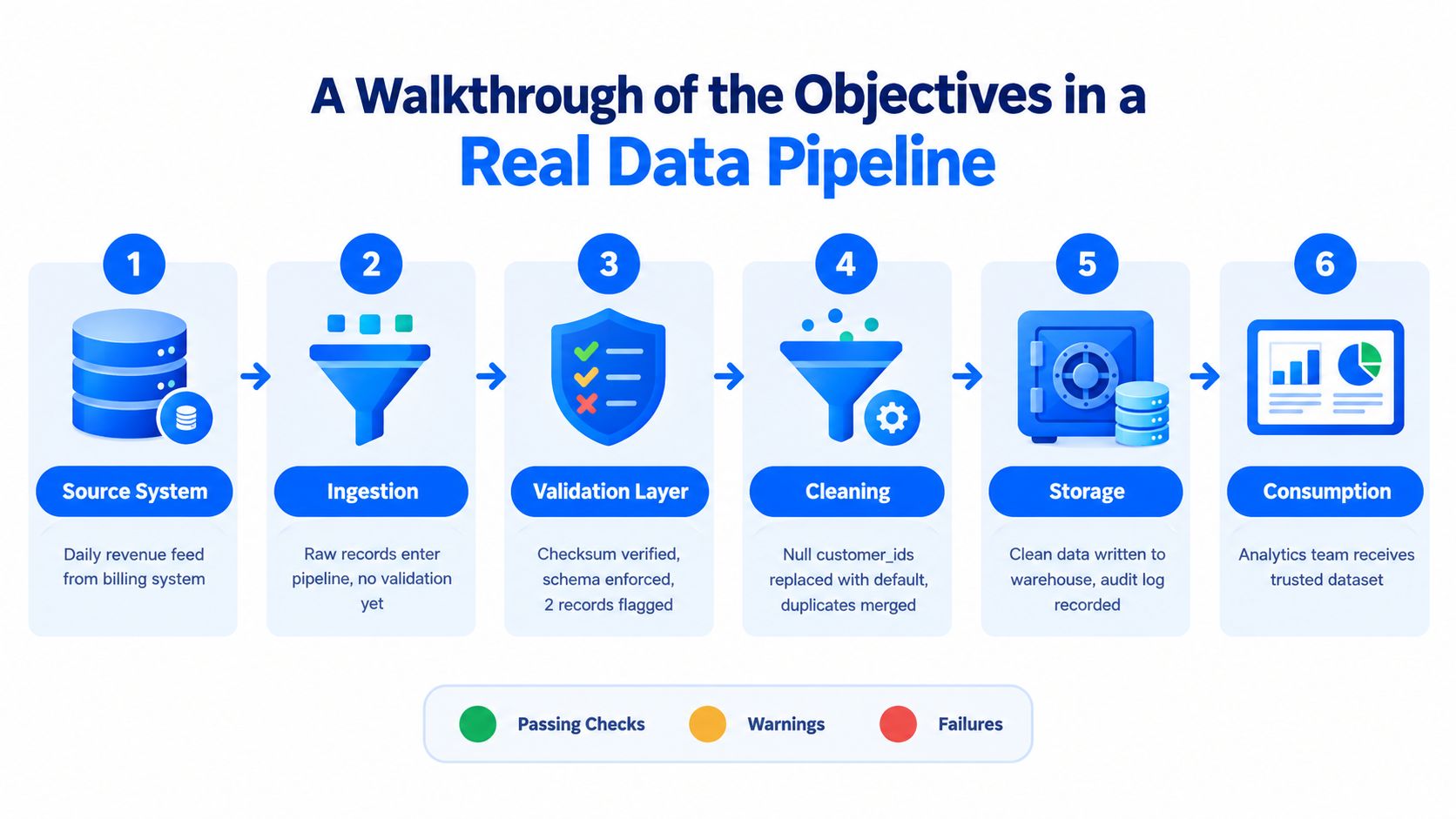
A source schema change then renames a column. The transformation still runs, but it maps the wrong field into the dashboard. Consistency requires structural and semantic change detection, not merely a successful job status. Teams designing these handoffs can also review a data pipeline architecture guide to make ownership and control points explicit.
Next, a finance analyst finds a legitimate correction and updates a value. Traceability requires the original value, new value, reason, identity, and timestamp. Without that context, a later reviewer can't tell whether the change corrected a billing issue or masked a failed process.
An analyst's role then changes. Security controls determine whether the person can still view or modify sensitive fields. Access should follow the current role, not an old entitlement that remains active indefinitely.
Finally, a bad backfill overwrites three days of warehouse data. Recoverability requires a known-good version, protected backup evidence, and a way to identify what changed. NIST's practice guidance also emphasizes determining the identity and timing of alterations, so restoration and investigation belong in the same operating process.
For teams collecting external information before it enters a pipeline, a web scraping api can be evaluated alongside validation, provenance, and source-change controls. Acquisition doesn't remove the need to verify what arrived.
How Objectives Differ Across Regulatory, Operational, and AI Use Cases
Integrity controls should match the consequence of failure and the way people consume the data. A regulatory report needs durable evidence and reviewability. A live operational KPI may prioritize timely detection and clear freshness status. An AI training dataset needs provenance, representativeness checks, versioning, and a way to identify stale or semantically changed inputs.
Article 5 of the EU GDPR requires personal data to be accurate and, where necessary, kept up to date, and requires processing that ensures appropriate security, including protection against unauthorized or unlawful processing and accidental loss, destruction, or damage. That obligation makes correction workflows, access controls, and incident evidence important for personal-data products, not just compliance reports.
Use case | Dominant objectives | Acceptable check latency | Human review |
|---|---|---|---|
Regulatory report | Accuracy, completeness, traceability, security, recoverability | Before submission and after material changes | Required for exceptions, corrections, and sign-off |
Operational KPI | Timeliness, accuracy, consistency, availability | Near the point of ingestion or publication | Focused on material anomalies and outages |
AI training dataset | Provenance, completeness, consistency, accuracy, versioned recoverability | Before dataset release and after source or schema changes | Required for labeling, exclusions, drift, and sensitive use |
The controls shouldn't be identical. A delayed operational metric may be more harmful than a temporarily held record if teams use it to respond to an active event. A regulatory dataset may tolerate a longer review window, but it must preserve original records and decision evidence.
The distinction between compliance and governance is useful here. Compliance defines obligations that must be met. Governance assigns ownership and operating rules so teams can meet those obligations consistently.
Translating the Objectives into Operational Practices
Objectives become useful when each one has an observable control and an owner. Lineage and audit trails support traceability by recording sources, transformations, versions, identities, and timestamps. Record-level validation supports accuracy and consistency by testing exact values, ranges, reference lists, null handling, and cross-column relationships.
Completeness needs more than a row-count check. Timeliness monitoring can identify missing loads, delayed arrivals, and unexpected delivery patterns. Schema tracking can expose added or removed columns and data-type changes before a downstream consumer changes meaning without warning.
Anomaly detection adds another layer. Deterministic rules catch known failures, while behavioral baselines can highlight unusual volume, distributions, or business metrics that a fixed rule doesn't anticipate.
A practical control map
Accuracy: Validate records against business rules and reconcile critical totals.
Completeness: Monitor expected arrivals, required fields, and failed or rejected records.
Consistency: Track schemas, reference values, definitions, and cross-system relationships.
Traceability: Preserve lineage, audit events, versions, and change reasons.
Security: Apply least privilege, protected logging, and reviewable access changes.
Recoverability: Maintain versioned backups and test restoration to a known-good state.
NIST's practice guide identifies outcomes such as restoring a last known good configuration, identifying the correct backup, determining what changed and when, and correlating an alteration with related events. A small team can start with the highest-risk tables, then extend coverage as ownership and evidence improve.
A platform such as digna's data quality implementation approach can combine anomaly detection, validation, timeliness monitoring, and schema tracking. The important design choice is not choosing one feature. It's connecting statistical signals, deterministic rules, structural awareness, and recovery evidence to the same data product.
The Trade-off Most Integrity Guides Skip
More controls don't automatically produce more integrity. Excessive alerts create fatigue, slow validation can make information unusable, and restrictive access can push analysts toward ungoverned copies.
A global survey of more than 550 data and analytics professionals identified data quality as the leading data-integrity challenge. Only 12% reported that their data was AI-ready, and shortages of skills and staff were the biggest obstacle to improving quality, according to Precisely's survey discussion.
The practical objective is dependable data at an appropriate speed and cost. Rank controls by business impact, freshness requirements, regulatory exposure, and intended use. A data enrichment checklist from looot can help teams examine enrichment steps without forgetting provenance, validation, and ownership.
FAQ and a Quick Integrity Objectives Checklist
How can we prove data stayed trustworthy after a pipeline change?
Keep versioned schemas, lineage, audit events, validation results, timestamps, ownership, and change context. For a material change, compare pre-change and post-change behavior, document affected records, and retain the evidence with the release or incident record.
How should a small team prioritize controls?
Start with datasets that support regulatory reporting, critical operations, or high-impact models. Apply freshness, validation, schema, access, and recovery controls there first, then expand based on observed risk rather than trying to monitor every table equally.
How do integrity objectives differ from data quality KPIs?
A quality KPI measures a property such as completeness or validity at a point in time. An integrity objective also asks whether the result is attributable, protected, explainable, and recoverable across the lifecycle.
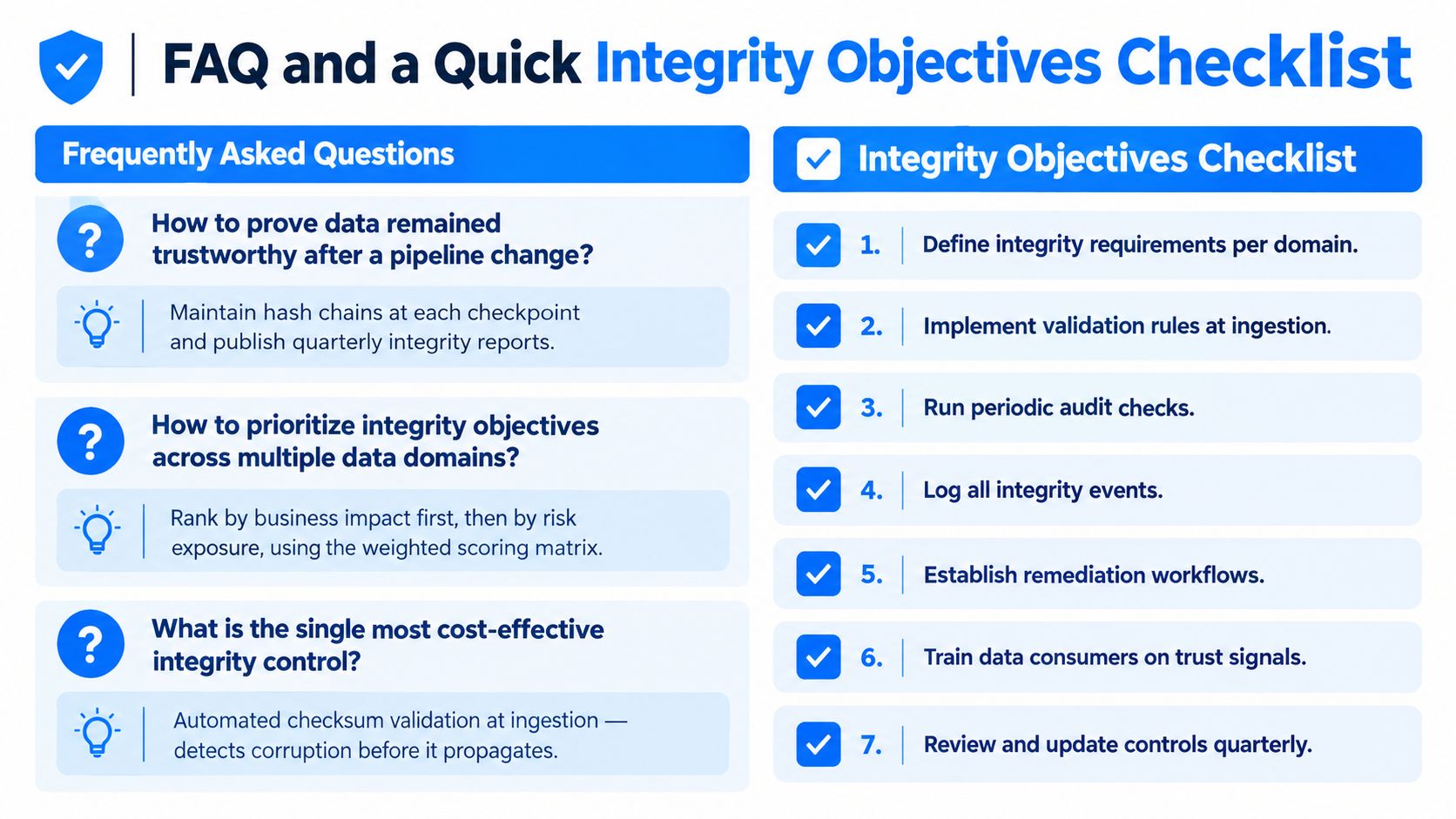
Use this checklist for a critical data product:
Accuracy: Validate values against business rules.
Completeness: Detect missing records, fields, and loads.
Consistency: Monitor definitions, schemas, and cross-system meaning.
Traceability: Record who changed what, when, and why.
Security: Restrict access and detect unauthorized modification.
Recoverability: Test restoration to a verified known-good state.
digna helps data teams monitor data behavior, validate records, track timeliness, detect schema changes, and investigate anomalies inside their own environment. Visit digna to connect these controls across the pipelines and datasets that support your reporting, operations, and AI use cases.
Once these objectives are defined, the next step is checking them continuously on live pipelines. Our practical guide to data integrity monitoring shows how to turn accuracy, completeness and consistency goals into automated checks.
Frequently asked questions
What are the main objectives of ensuring data integrity?
The main objectives are accuracy, completeness, consistency, traceability, security and recoverability. Each one covers a different failure, so a dataset can be secure yet incomplete, or recoverable yet logically wrong. A working program needs an observable control and evidence for all six, not a single integrity score.
What does ALCOA stand for in data integrity?
ALCOA stands for attributable, legible, contemporaneously recorded, original or a true copy, and accurate. These five attributes come from FDA guidance. For data teams they become practical questions, such as whether you can identify the person or service that changed a record and whether the source record is retained.
Why are backups not enough to make data recoverable?
Backups only help if you know which version is trustworthy and restoration has actually been tested. NIST guidance asks teams to restore the last known good state, pick the correct uncontaminated backup and determine who changed the data and when, so recovery and investigation belong in one process.
How do data integrity objectives differ for regulatory reports and AI training data?
Regulatory reports put the weight on traceability, durable evidence and human sign-off before submission. AI training datasets need provenance, versioned recoverability and fresh checks after every source or schema change. Operational KPIs differ again, favoring fast detection and a clear freshness status close to the point of ingestion.
Can adding more data integrity controls make things worse?
Yes, piling on controls can reduce trust instead of raising it. Excessive alerts cause fatigue, slow validation can make data unusable and strict access rules push analysts toward ungoverned copies. A better approach is to rank controls by business impact, freshness needs, regulatory exposure and intended use.