Data Quality vs Data Integrity: The Definitive 2026 Guide
|
6
min read

Your revenue dashboard looked normal yesterday. This morning it shows a sharp drop, the sales team is escalating, and nobody agrees on what broke. One engineer checks the pipeline logs and says the jobs all passed. An analyst points to missing source records. A platform owner suspects a schema change that didn't fail anything but shifted the meaning of a key field.
That confusion is where many organizations get stuck on data quality vs data integrity. They treat the terms as interchangeable, then assign the issue to the wrong team, use the wrong controls, and repeat the failure a month later. The difference isn't academic. It determines whether you fix a database constraint, a source process, a freshness rule, a semantic contract, or an ML monitoring gap.
It also changes how you build trust. Teams that care about driving decisions with data usually invest in dashboards first. The harder part is keeping the numbers trustworthy when pipelines keep running but the meaning of the data drifts. That's why early detection matters, especially for silent issues such as late arrivals, unusual volume shifts, and unexpected field behavior, which is exactly what anomaly detection in modern pipelines is meant to surface before finance or operations sees the damage.
Table of Contents
The Dashboard Is Wrong But Why
A bad dashboard usually starts a bad argument.
Sales sees a drop and assumes the business changed overnight. Analytics checks the model and finds that the SQL still runs. Engineering reviews orchestration and confirms the pipeline completed. Then the meeting splits into two camps. One side says the data was damaged in motion. The other says the data arrived intact but incomplete, outdated, or contextually wrong.
Those are different failure classes.
If a write operation, transfer, or schema relationship broke the dataset, you're looking at an integrity problem. If the records are structurally valid but missing business fields, delayed, stale, or semantically off for the use case, you're looking at a quality problem. In practice, teams often lose hours because they start with tool logs when they should've started with a more basic question: did the system preserve the data correctly, or did it preserve the wrong data perfectly?
Practical rule: If the warehouse accepted the records and the joins still work, don't assume the dataset is usable.
A familiar example is a revenue dashboard that suddenly drops after a source system changes how discounts are populated. The table still lands. Column types still match. Referential links still hold. Nothing in the pipeline screams failure. But net revenue is now understated because the business rule behind one field changed upstream. That's low quality, not broken integrity.
The opposite case is just as common. A migration introduces partial writes or silent corruption during transfer. The dashboard is wrong because parts of the dataset are no longer in the original state, even if the business definitions haven't changed. That's integrity.
What the debate usually sounds like
Engineering says: “The job succeeded, so the pipeline is fine.”
Analytics says: “The numbers don't reconcile to the source.”
Business says: “We can't trust the dashboard.”
All three can be right at once. The job can succeed, the dashboard can be wrong, and the root cause can still sit outside the orchestration layer.
Defining the Core Concepts
The cleanest way to think about this distinction is simple. Data quality asks whether data is fit for use. Data integrity asks whether data remained whole, correct in structure, and unaltered through storage, transfer, and processing.
A library analogy helps. Quality is whether the book is useful for the reader. Is it current, complete, and the right edition for the question being asked? Integrity is whether all the pages are present, in order, and unchanged from the original copy. You can have one without the other. A book can be perfectly preserved and still be outdated. It can also be current in content but damaged in a way that makes parts of it unreliable.

For teams that work close to revenue, inventory, or pricing, this distinction matters fast. A useful explanation of data quality for pricing teams shows why “correct enough for action” depends on context, not just technical validity. And when the concern is structural trust across modern platforms, the controls around protecting data integrity across systems sit in a different layer from business-facing quality rules.
A simple way to separate them
Data quality is business-facing. It covers dimensions such as accuracy, completeness, consistency, and timeliness. One practical benchmark framing is that quality can be assessed through dimensions like accuracy at ≥99% for gold-tier data and timeliness such as arrival within a <5-minute delay window, while data integrity focuses on preserving the original state through measures such as change-record accuracy at ≥99.9% and tamper-detection latency, as described in OvalEdge's breakdown of data quality dimensions.
Data integrity is systems-facing. It's enforced through constraints, transaction guarantees, access controls, auditability, and checks that verify data wasn't altered, dropped, or corrupted without authorization.
Where teams usually blur the line
The confusion usually comes from one wrong assumption. Teams think that if data is accurate to the source, it must also be useful to the business. That isn't true.
A customer table can preserve every row exactly as received and still be low quality because half the records are outdated for the campaign running today. A feature store can preserve training inputs exactly and still be low quality for a model because the distribution shifted in a way nobody monitored.
Preserved data isn't automatically trustworthy data. Trust requires both structural soundness and fitness for use.
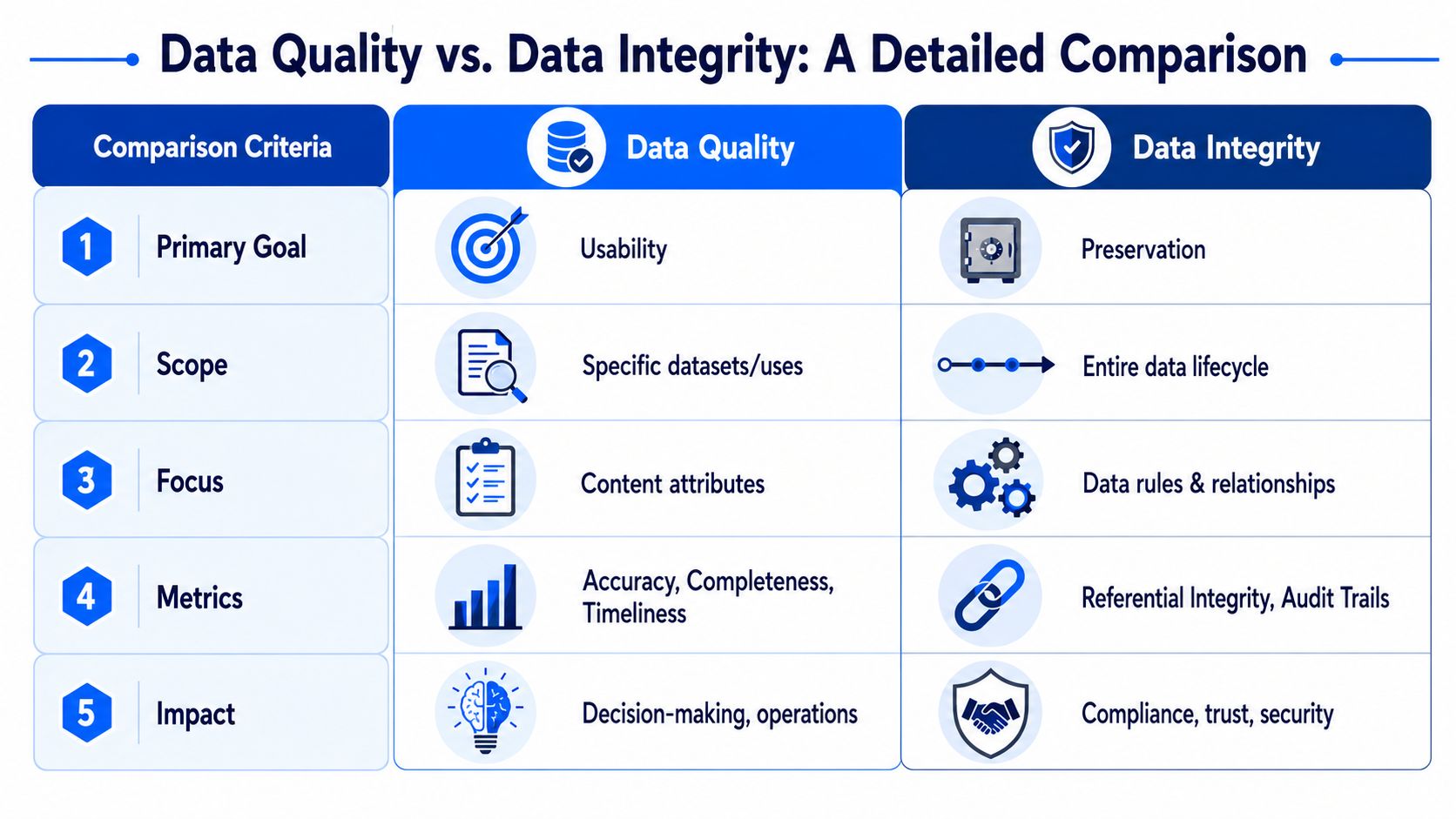
A Detailed Comparison of Data Quality and Data Integrity
The easiest way to make the distinction operational is to compare them across how teams operate: what each protects, who owns it, and how failures show up.
Comparison table
Criteria | Data quality | Data integrity |
|---|---|---|
Primary goal | Make data usable for a decision, workflow, or model | Preserve data's original state and structural trust |
Scope | Depends on the use case and business definition | Applies across storage, transfer, and processing |
Typical owner | Analysts, analytics engineers, data stewards, domain teams | Data engineers, platform engineers, DBAs, security teams |
Typical checks | Accuracy, completeness, timeliness, consistency, validity | Constraints, audit trails, reconciliation, checksums, access control |
Failure signal | Reports are misleading, models degrade, operations act on stale inputs | Records are corrupted, altered, lost, or structurally inconsistent |
This ownership split matters because teams often send quality failures to platform teams only, or integrity failures to business stewards only. Neither approach works. Quality issues need domain definitions. Integrity issues need hard technical controls.
The high integrity low quality trap
The most misunderstood case is the one that hurts AI and analytics programs the most. The data is intact, secure, and structurally valid. Nothing was corrupted. No unauthorized change occurred. Yet the model performs poorly because the meaning of the data shifted in a way the system never treated as a failure.
That's the high integrity, low quality trap.
A common example is schema or semantic drift that doesn't violate integrity rules. A field remains present, values still conform to type, and the table lands on time. But the distribution changes, a category mapping shifts, or a source application starts populating a field differently. Traditional integrity checks stay green. The model still consumes the data. The business still gets outputs. They're just less reliable.
According to Atlan's analysis of data integrity vs data quality, over 60% of AI model failures stem from data quality issues that are invisible to traditional integrity checks, including schema changes that alter statistical distribution without breaking integrity rules. That's the exact gap where data is “true to the source” but “false to the model.”
If your controls only answer “Was the data preserved?” they won't catch “Did the data still mean the same thing?”
That's why data quality vs data integrity can't be managed as two isolated definitions in a glossary. They have to be treated as two layers of one trust model. Integrity is the floor. Quality decides whether the dataset is still worth using.
Real-World Failure Modes and Business Impact
Teams don't need another abstract definition. They need to recognize the pattern while it's happening.
When quality fails but systems look healthy
A regional marketing team pulls customer locations from the warehouse to allocate campaign spend. The tables load on schedule. Primary keys are fine. The joins work. No alerts fire from orchestration.
The problem appears later. A large share of location fields are incomplete or inconsistent because upstream capture standards weren't enforced. The dashboard still renders. The segmentation logic still runs. Budget gets routed to the wrong geographies and underperforms because the data was usable only in a technical sense, not a business sense.
That pattern is expensive. According to IBM's summary of the Mitre Corporation research, data quality failures cost U.S. organizations an average of $12.9 million annually, 68% of errors stem from incomplete or inconsistent data, and 30% of business decisions are based on flawed information in affected environments, as noted in IBM's discussion of data integrity versus data quality.
When integrity breaks underneath the system
A different failure starts lower in the stack. During a migration, a financial records pipeline experiences write issues while moving data between systems. Some records are altered or lost during transfer. Downstream tables still populate enough to keep reports alive, but reconciliation starts failing. Audit trails no longer match source transactions. Finance now has a structural trust problem.
This kind of issue usually requires engineering controls, not business cleanup. You don't solve it by redefining a KPI. You solve it by validating movement, enforcing relationships, reconciling copies, and catching unauthorized or unintended change fast.
A useful way to separate the impact is this:
Quality failures distort decisions. Teams run the wrong campaign, trust the wrong KPI, or feed stale features into a model.
Integrity failures distort the record itself. Teams lose confidence in whether the dataset still represents what was originally stored or transferred.
Combined failures are the worst case. A structurally damaged dataset can also be stale, incomplete, or semantically wrong.
Clean dashboards can still hide bad business inputs. Stable pipelines can still hide damaged records.
The practical consequence is ownership. Quality problems usually surface first in analytics, operations, or ML behavior. Integrity problems usually surface first in reconciliation, audit, migration, or cross-system mismatch. If your incident process doesn't distinguish those paths, response time slows down and root cause analysis drifts.
How to Measure and Monitor Both
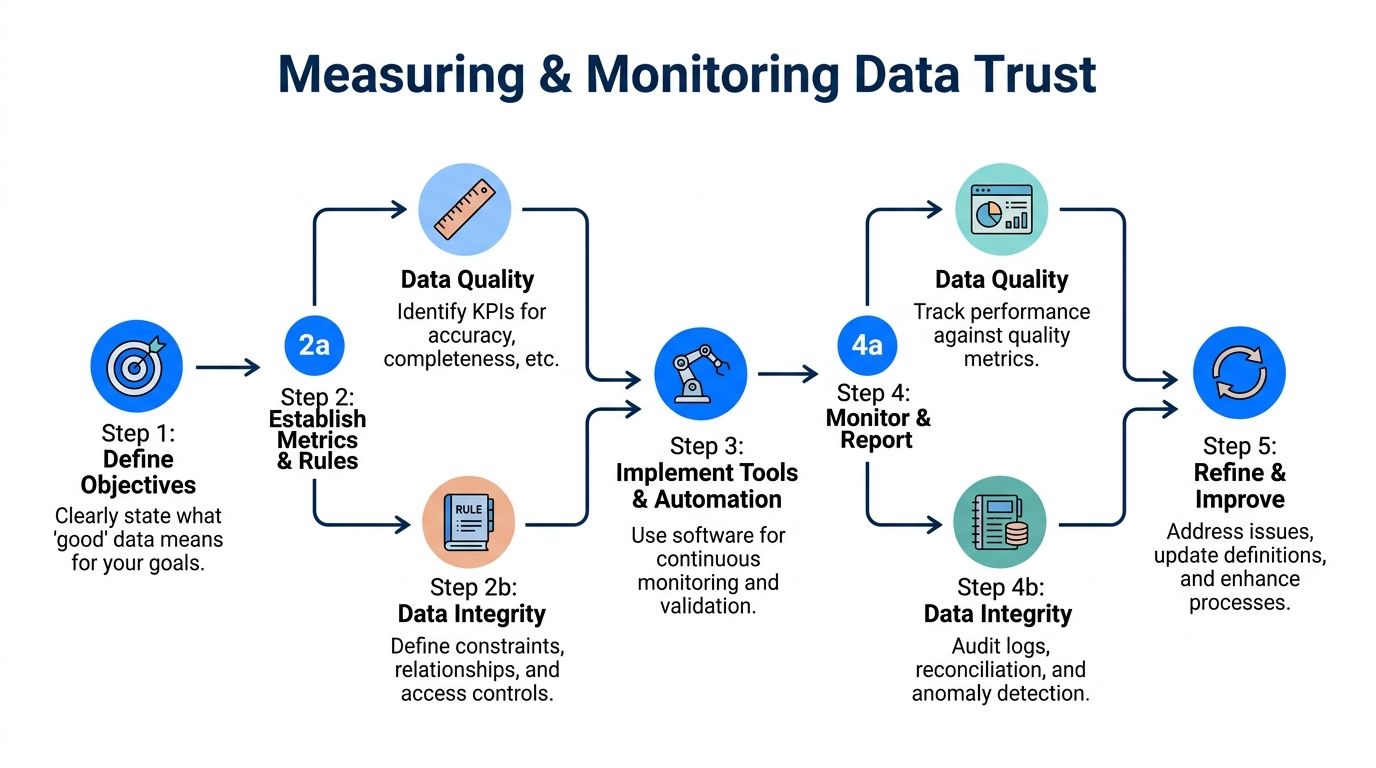
Once teams understand the distinction, the next mistake is using one monitoring pattern for both. That doesn't work. Quality and integrity require different signals, different thresholds, and different escalation paths.
What to monitor for quality
Quality monitoring starts with the business use case. A gold-tier finance table needs tighter expectations than an exploratory dataset. A feature store for a production model needs distribution and freshness checks that a back-office archive may not.
Good quality monitoring usually combines several layers:
Profile the data first. Establish normal ranges, common null patterns, distinct counts, and field distributions before writing strict rules.
Monitor drift continuously. Look for shifts in volume, category frequency, null rates, freshness, and distribution shape.
Validate records against business logic. Check rules such as valid status combinations, required fields, or impossible value combinations.
Track timeliness explicitly. A correct record that arrives too late is still low quality for many workflows.
Teams that want a practical scorecard approach usually start with a small set of data quality metrics that map to business risk, then tighten controls around the datasets that drive reporting, operations, and ML.
What to enforce for integrity
Integrity controls belong closer to storage and movement. They answer whether data remained structurally correct and unaltered across its lifecycle.
That usually means:
Database constraints such as primary keys, foreign keys, uniqueness, and referential checks.
Transaction protections for systems where partial writes or concurrency conflicts can create structural inconsistencies.
Checksums and reconciliation during transfer so teams can verify what left one system is what arrived in another.
Audit trails and access control to detect unauthorized or unexplained changes.
Schema change detection so structural modifications don't pass undetected into downstream systems.
This isn't optional in complex pipelines. According to Dataversity's review of data integrity versus data quality, data integrity is compromised in 60% of enterprise data pipelines, and 67% of these issues remain undetected until they impact downstream analytics, which is exactly why automated monitoring matters.
What works and what doesn't
What works is pairing observability with enforcement. Quality needs anomaly detection, profiling, and rule-based validation. Integrity needs constraints, auditability, reconciliation, and schema controls.
What doesn't work is relying on passed jobs as proof of trust. An orchestrator can tell you a task completed. It can't tell you whether the data stayed meaningful or structurally sound unless you build those checks into the system.
Unifying Quality and Integrity with digna
Separate teams often buy separate solutions. One tool watches pipeline health. Another handles validation rules. A third tracks schema changes. A fourth supports governance dashboards. The result is usually fragmented ownership and alert fatigue.
Why separate tools leave blind spots
A schema change might be visible in one system while the resulting quality drift shows up somewhere else. A timeliness issue may get flagged by orchestration while the business impact appears only in reporting. When those signals live in separate places, teams waste time stitching together the incident after trust is already broken.
That's why the more useful operating model treats quality and integrity as one reliability layer with different control types. Integrity tells you whether the data remained structurally trustworthy. Quality tells you whether it remained fit for the workload that consumes it.
How one operating model covers both
A platform such as digna can sit across those two layers without conflating them. Schema Tracker maps to integrity by flagging structural changes such as added or removed columns and data type changes. Data Validation supports quality by enforcing record-level business rules. Timeliness monitoring catches late arrivals. AI-based anomaly detection helps surface distribution shifts, unusual volumes, and silent behavioral changes that don't break integrity rules but still degrade trust.
The architectural detail that matters here is in-database execution. According to Lumenalta's benchmark discussion of data integrity and data quality, modern data platforms improve decision reliability by 40% to 60% when they combine integrity controls such as real-time schema tracking with quality observability such as AI-based anomaly detection, while reducing data movement by over 90% through in-database computation. That model matters because copying data into more tools can create new trust and governance problems of its own.
The practical target isn't “more monitoring.” It's one place where teams can see structural change, behavioral drift, lateness, and rule violations together.
That unified view is what closes the high integrity, low quality gap. The platform doesn't just ask whether data arrived. It asks whether the dataset still behaves like the thing your dashboard, model, or decision process expects.
A Practical Checklist for Data Teams
Use this as a working checklist, not a maturity model. If a critical dataset fails two or three of these, trust is already weaker than the dashboard suggests.
For integrity, enforce relationships early. Put primary key, uniqueness, and referential checks as close to ingestion and storage as possible.
For integrity, verify movement. Reconcile row counts and use transfer verification so silent corruption or loss doesn't wait for a finance report to expose it.
For integrity, track schema changes. Don't let added columns, renamed fields, or type changes slip into downstream systems unnoticed.
For quality, define fitness by use case. A board KPI table, a product analytics mart, and an ML feature table should not share the same expectations.
For quality, monitor freshness and drift. Late data, shifted distributions, and unusual null patterns are some of the fastest ways to lose trust without a failed job.
For quality, validate business rules at the record level. The warehouse may accept a value that the business cannot use.
For identity-heavy datasets, deduplicate intentionally. Customer and entity data often fail quality before teams notice it in BI. A practical reference is SourceLoop's dedup process, which shows how identity stitching and duplicate handling affect downstream reliability.
For both, assign owners. Every trusted dataset needs an engineering owner for structural controls and a business or domain owner for fitness rules.
For both, escalate by impact. The right response path for a broken audit trail isn't the same as the path for stale marketing attributes.
Teams that handle data quality vs data integrity well don't argue about definitions during incidents. They know which layer failed, which controls should've caught it, and which owner fixes it.
If your team needs one operating view across schema changes, anomalies, timeliness, and record-level validation, digna is built for that kind of data trust workflow while keeping analysis inside your environment.
To enforce the record-level business rules that decide whether structurally sound data is actually fit for use, see how digna Data Validation applies them directly inside your database.
Frequently asked questions
What is the difference between data quality and data integrity?
Data quality asks whether data is fit for a specific use, covering accuracy, completeness, consistency and timeliness. Data integrity asks whether data stayed whole, structurally correct and unaltered through storage, transfer and processing. In the article's library analogy, quality is having the right edition; integrity is every page present and unchanged.
Can data have high integrity but low quality?
Yes, and the article calls this the high integrity, low quality trap. Data can be intact, secure and structurally valid while a category mapping or value distribution shifts silently. Citing Atlan, it notes that over 60 percent of AI model failures stem from quality issues invisible to traditional integrity checks.
Who owns data quality and who owns data integrity?
Ownership usually splits by layer. Quality typically sits with analysts, analytics engineers, data stewards and domain teams, because it depends on business definitions. Integrity usually belongs to data engineers, platform engineers, DBAs and security teams, who enforce constraints, audit trails, reconciliation, checksums and access control. Every trusted dataset needs both owners.
How do you monitor data integrity in data pipelines?
Enforce integrity close to storage and movement: primary key, foreign key and uniqueness constraints, transaction protections against partial writes, checksums and row-count reconciliation during transfer, audit trails, and schema change detection. Dataversity figures cited in the article say integrity is compromised in 60 percent of enterprise pipelines, with 67 percent of issues undetected.
How does digna cover both data quality and data integrity?
digna maps its modules to both layers without conflating them. Schema Tracker supports integrity by flagging added or removed columns and data type changes, Data Validation enforces record-level business rules, Timeliness catches late arrivals, and AI-based anomaly detection surfaces distribution shifts, all executed inside the database.