Fuzzy Matching Algorithms: A Practitioner's Guide
|
7
min read

At a confidence level of 0.95 or higher, an ensemble human-in-the-loop approach achieved 88.0% precision, while Jaccard similarity achieved 85.0% in the same high-score range. The practical answer is that no single fuzzy matching algorithm is universally best, because reliable identity resolution depends on normalization, candidate generation, field evidence, thresholds, and review.
You're probably dealing with this already. A customer appears under slightly different names in billing, support, and product systems. A supplier's address changes format between subsidiaries. A patient record uses one script in one system and a transliterated version in another. Exact joins miss legitimate links, while an overly permissive fuzzy rule can merge people who only look similar.
The hard part isn't producing a similarity score. It's deciding what that score means, proving why a match was approved, and detecting when the matching process starts failing without warning.
Table of Contents
The Hidden Cost of Imprecise Data Matching
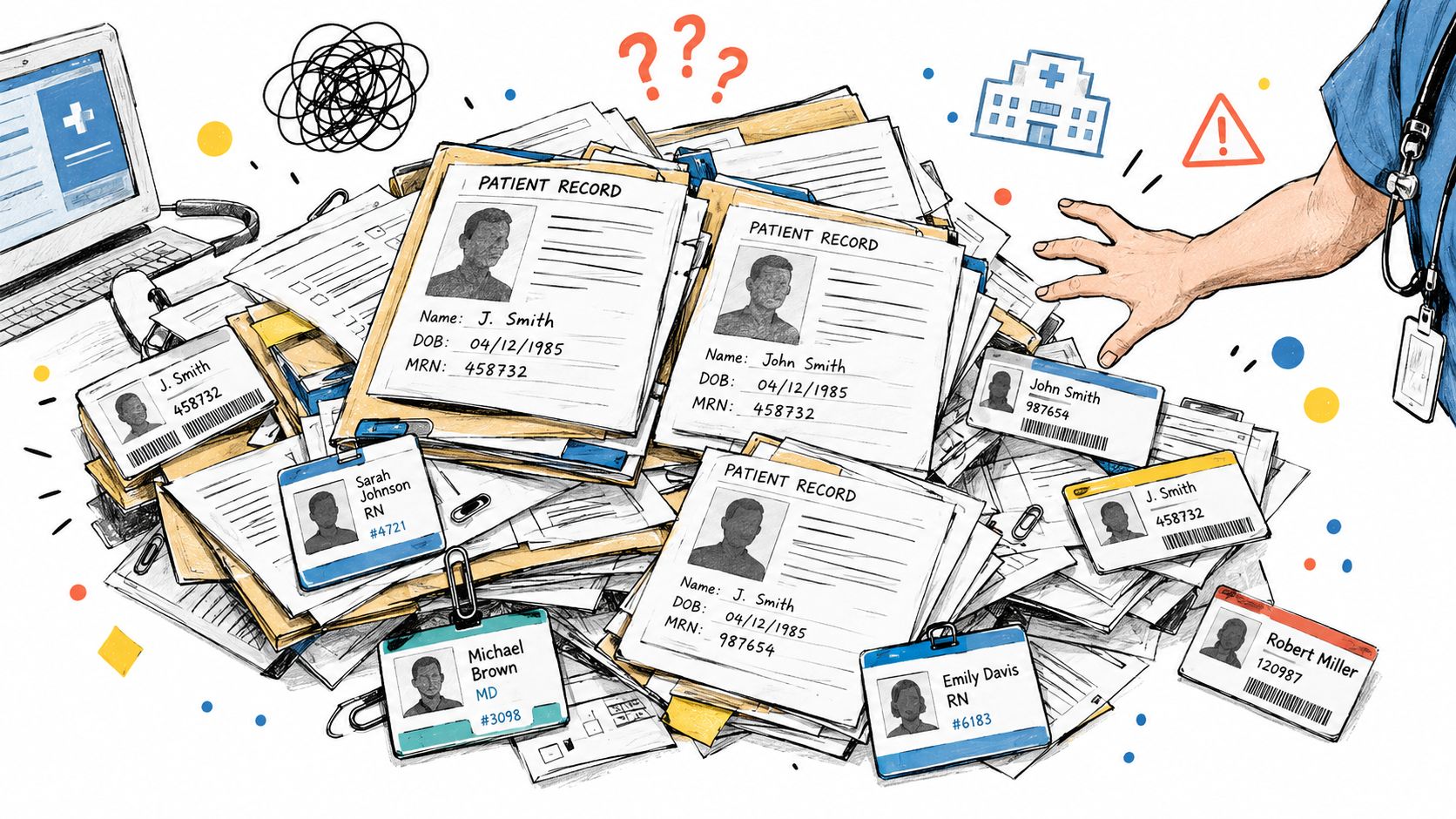
A global healthcare provider might build a patient view from registration, laboratory, billing, and clinical systems. One source stores “Muller,” another stores “Miller,” and a third includes a middle name or a different address format. An equality join treats these as separate records, even when staff can recognize the likely connection immediately.
The reverse error is more dangerous. Two patients can share a surname, address, or similar first name without being the same person. An incorrect merge can attach laboratory results or clinical history to the wrong profile. An unresolved duplicate can fragment care information, create repeated administrative work, and weaken reporting.
Why exact joins fail
Exact matching assumes that values were entered consistently and transported without meaningful variation. Enterprise data rarely meets that assumption. Names contain spelling differences, addresses contain abbreviations and reordered components, and identifiers can be incomplete or copied with formatting noise.
Fuzzy matching algorithms help by measuring resemblance rather than demanding character-for-character equality. But resemblance is only evidence. A name score can identify a candidate pair, yet it can't establish identity without context from other fields and the business consequences of being wrong.
Production rule: Treat fuzzy matching as a decision workflow, not as a smarter version of an equality join.
That distinction matters across finance, healthcare, public services, and customer operations. A false match links unrelated records. A false nonmatch leaves the same entity fragmented. The cost of each error depends on the domain, the field, and what downstream systems do with the resulting identity.
Teams should therefore connect matching design to broader data quality decision-making. The right question isn't “Which strings look alike?” It's “What evidence supports this identity link, what risk does an incorrect merge create, and can another person audit the decision later?”
Foundations From Edit Distance to Probabilistic Linkage
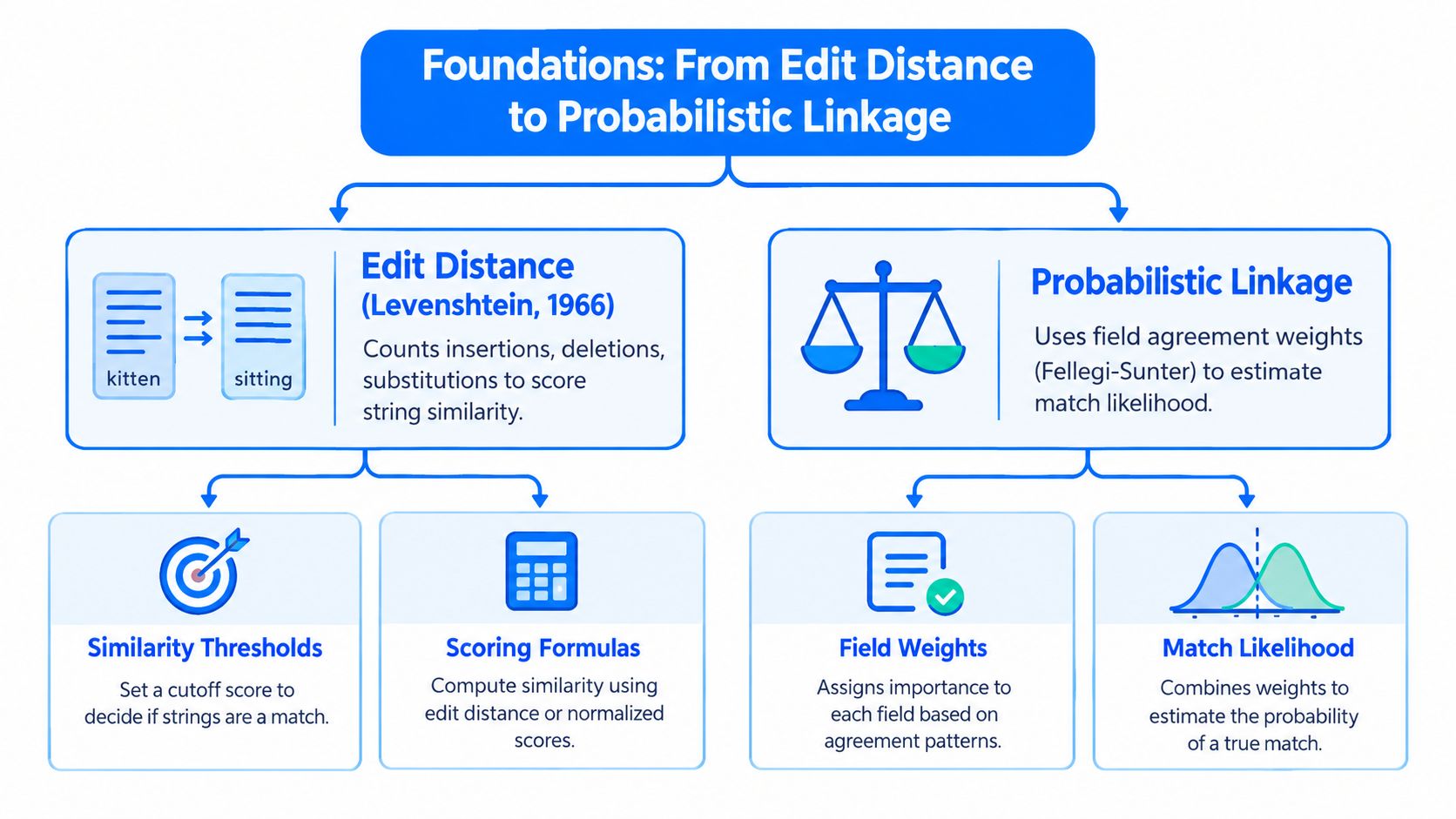
Fuzzy matching developed from edit-distance methods into formal probabilistic record linkage. In 1966, Vladimir Levenshtein introduced the distance now bearing his name, the minimum number of single-character insertions, deletions, or substitutions needed to transform one string into another, as described in the foundational record-linkage literature published by Fellegi and Sunter.
A one-character typo has distance 1. Strings requiring more edits receive larger distances. Because the operation is language-independent, it became useful for spell-checking, deduplication, address normalization, and entity resolution.
Distance measures difference
Levenshtein distance answers a narrow but valuable question: how much text must change to produce the other value? It doesn't know whether the values belong to the same person, company, account, or address.
That makes it a useful comparison layer. It can catch a typo in a name or a small alteration in an identifier, but it shouldn't make an irreversible merge by itself. The same distance can carry different meaning for a short name, a long address, or a high-risk identifier.
Linkage makes a decision
In 1969, Ivan Fellegi and Alan Sunter published “A Theory for Record Linkage.” Their framework treated matching as a statistical decision problem rather than a single similarity cutoff. It combines evidence from fields such as names, addresses, dates of birth, and identifiers, then classifies candidate pairs as matches, nonmatches, or uncertain cases for review.
The framework explicitly separates false matches from false nonmatches and selects thresholds around desired upper bounds for those error types. That separation remains central to enterprise matching because automation and review involve a measurable trade-off.
Layer | Main question | Typical output |
|---|---|---|
Edit distance | How different are these values? | Distance or similarity |
Field comparison | Which attributes agree? | Evidence by field |
Probabilistic linkage | How should the evidence be interpreted? | Match, nonmatch, or review |
Governance | Can the decision be defended later? | Versioned evidence and audit trail |
The practical lesson is simple: use distance to measure textual difference, then use multi-field evidence and governed thresholds to make an identity decision. That is the bridge between statistical pattern recognition and production data operations.
Comparing Core Algorithm Families and Performance Trade-offs
Production matching rarely has a single best algorithm. The right choice depends on the field, its error patterns, the candidate volume, and the cost of an incorrect decision. A comparative study evaluated seven approaches, Jaccard similarity, Jaro-Winkler, longest common subsequence, Levenshtein distance, cosine similarity, n-gram matching, and Damerau-Levenshtein, using precision, recall, F-measure, accuracy, and computational performance in its published comparison.
The experiment found that n-gram matching delivered the strongest precision, F-measure, and accuracy, while cosine similarity was fastest. N-gram and Damerau-Levenshtein were the slowest in that comparison. These results are benchmark evidence, not a deployment rule. They show the practical trade-off: preserving more local character detail can improve match quality, but it also increases processing cost.
Match the family to the data
Levenshtein suits short strings affected by insertion, deletion, or substitution errors. Damerau-Levenshtein adds adjacent transpositions, making it useful when typing mistakes such as swapped characters occur frequently.
Jaro-Winkler often works well for names and short identifiers because matching prefixes can carry useful signal. Jaccard measures token overlap, which fits company names and address components when word order matters less. Cosine similarity represents text as vectors and can process longer fields efficiently.
Algorithm family | Strengths | Best use case | Computational cost |
|---|---|---|---|
Levenshtein | Clear edit-based comparison | Typos and short identifiers | Moderate |
Damerau-Levenshtein | Handles adjacent transpositions | Typing errors in names and codes | High |
Jaro-Winkler | Rewards matching prefixes | Person names and short fields | Moderate |
Jaccard | Measures token-set overlap | Addresses and company names | Moderate |
Cosine similarity | Fast vector comparison | Longer text fields | Low in the cited comparison |
N-gram matching | Captures local character structure | Noisy text and partial overlap | High in the cited comparison |
Longest common subsequence | Preserves shared sequence structure | Ordered textual variation | Data-dependent |
Why hybrid scoring usually wins
Records combine fields with different failure modes. A name may need character similarity, an address may benefit from token comparison, and an identifier may require deterministic validation. Applying one metric everywhere creates avoidable errors and wastes compute on fields that need a different treatment.
Assign algorithms by field, then combine their evidence under rules tied to identity risk. Run expensive comparisons only after blocking has reduced the candidate set. Benchmark results can guide the initial design, but labeled pairs from your own data should determine whether the extra computation improves decisions enough to justify its operational cost. Keep the selected algorithms, versions, thresholds, and review outcomes in an audit trail so later changes remain explainable.
Why Similarity Scores Are Not Probabilities
A production matcher can assign two customer records a similarity score of 0.87 and still provide no direct answer about identity. The score measures resemblance under a selected metric. It does not represent the probability that the records belong to the same entity, identify which fields produced the result, or quantify the cost of merging them incorrectly.
Thresholds expose the gap between measurement and decision. At 0.95 or higher, an ensemble human-in-the-loop approach achieved 88.0% precision, compared with 85.0% for Jaccard similarity in that high-score range. Jaccard precision dropped to 53.0% for scores between 0.90 and 0.95, according to the reported fuzzy-matching study. As the benchmark showed, a high score can still produce unsafe matches.
The threshold belongs to the population
A cutoff tuned for customer names may be unsafe for supplier addresses. Transliteration can change score behavior across countries, while healthcare identities and marketing contacts carry different consequences when records are merged incorrectly.
Tune thresholds with labeled pairs from the population the system will process. Measure precision and recall at the cutoffs used in operations, then break results down by field, entity type, geography, language, and source system. An aggregate score can conceal a serious failure affecting one language or one source.
Use abstention deliberately
A production matcher needs a controlled path for uncertainty. Set an abstention band that sends ambiguous pairs to an authorized reviewer instead of forcing an automatic decision.
Auto-link: Require evidence that has passed the applicable risk controls.
Review: Show the candidate values, field-level evidence, threshold, and rule version.
Reject: Keep records separate when the available evidence does not justify a link.
Reviewer decisions should become governance data, not disappear into a queue. Store candidate and normalized values, field scores, the decision threshold, algorithm version, reviewer outcome, and timestamp. This audit trail supports investigation, threshold changes, and reproducible decisions.
A high score is a measurement. An approved identity link is a governed decision.
False-positive and false-negative costs become operational here. In a high-risk domain, leaving a possible duplicate unresolved may be safer than creating an incorrect merge. Elsewhere, broad candidate generation followed by human review may provide better control. The right policy depends on the entity, evidence, and consequences of error.
Multilingual Matching and the Blocking Bottleneck
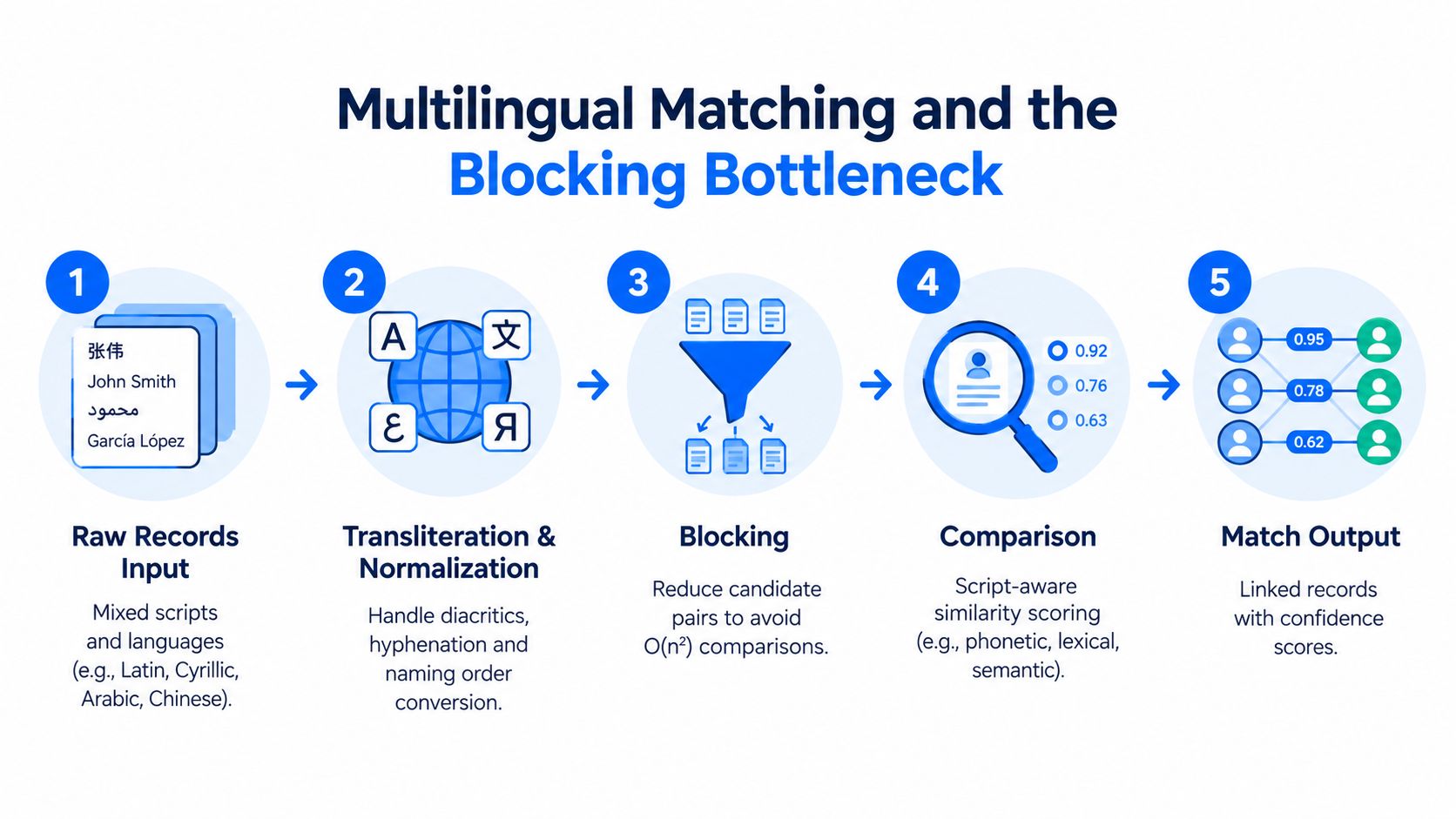
English-style typos are the easy demonstration. Production data introduces transliteration, multiple scripts, naming-order changes, diacritics, hyphenation, and country-specific identifiers. These variations affect both recall and false-positive risk before a scoring algorithm evaluates the pair.
Candidate generation is the hidden bottleneck. If a blocking strategy places two true records in different buckets, no downstream fuzzy matching algorithm can recover that relationship.
Normalize without destroying evidence
Keep the original values and create normalized representations alongside them. Transliteration can support cross-script comparison, while the original script remains essential for review and audit. Normalize diacritics, punctuation, hyphenation, and naming order with rules appropriate to the language and entity type.
Country or jurisdiction can provide useful context, but it shouldn't become an absolute identity rule. A cross-border match may be legitimate, while an apparently local match can still be wrong. Low-confidence cross-script pairs deserve explicit review rather than silent rejection or automatic approval.
Recent record-linkage work reports that hierarchical blocking produces the largest improvement for multilingual party matching, and that country blocking can reduce cross-country false positives in the described study.
Blocking trades speed for recall
Naive pairwise comparison grows quadratically as the number of records increases. Blocking and indexing reduce the candidate set, but they introduce a new failure mode: a true pair can be excluded before scoring.
Use layered candidate generation rather than one brittle key:
Primary block: Use reliable contextual signals such as jurisdiction, entity type, or normalized identifier fragments.
Fallback block: Allow broader combinations for missing or uncertain values.
Cross-script path: Compare transliterated representations when scripts differ.
Review path: Preserve low-confidence candidates that cross important boundaries.
Measure blocking recall separately from scoring quality. A scoring model can look excellent on the candidates it receives while the blocking layer has already discarded valid matches. Testing by language, script, country, and source will expose those silent losses.
For preprocessing, even seemingly minor tokens can distort comparison, so teams should define field-specific cleanup rules rather than blindly applying a universal stop-word list. A practical reference for that work is this stop-word resource, used once as part of the normalization design rather than as a substitute for language-aware rules.
Implementation Strategies for Production Environments
Production matching succeeds through control, not algorithm selection alone. Start with a narrow workflow, create labeled examples, and define what the system may auto-link, what requires review, and what must remain separate.
Build the decision pipeline
Profile sources first. Identify missing fields, common variations, duplicate patterns, and source-specific noise.
Normalize into parallel fields. Retain raw values for audit and create normalized values for comparison.
Block conservatively. Measure how many known true pairs survive candidate generation.
Score by field. Choose metrics according to field behavior instead of applying one universal function.
Classify with abstention. Separate automatic links, review candidates, and nonmatches.
Capture decisions. Store evidence, rule versions, thresholds, and reviewer outcomes.
A candidate match isn't an approved identity link. That distinction should exist in the data model, the user interface, and downstream APIs. It prevents tentative recommendations from being consumed as authoritative master data.

Monitor the errors that matter
Report precision and recall at operational thresholds, then split the results by geography, source, entity type, and language. Measure false matches and false nonmatches separately. Reviewers should see the fields and rules that influenced each recommendation, not just a single opaque score.
In-database execution can reduce data movement and align matching with security and governance requirements. Private-cloud or on-premises deployment can also keep the process inside the customer's environment when compliance constraints make external processing unsuitable.
A modular approach is easier to operate than a sprawling rules engine. Add one monitoring capability, validate its usefulness, and expand as requirements mature. The governance pattern should be versioned, reviewable, and reversible when a new source changes the behavior of the matcher.
Teams evaluating customer master data management should pay particular attention to survivorship and audit design. Matching determines which records are linked, but master-data processes also need a clear account of which values become authoritative and how later corrections propagate.
Integrating Fuzzy Matching with Data Observability
A matcher can complete every scheduled job and still degrade. New source formats, changed population mix, altered naming conventions, and schema changes can shift score distributions without producing an obvious pipeline failure.
That's why monitoring should cover behavior, not only uptime. Track match rates, score distributions, review volumes, threshold crossings, blocking exclusions, and confirmed false-positive patterns. A sudden change in any of these signals may indicate upstream drift or an assumption that no longer holds.
Connect identity decisions to data behavior
Schema changes deserve special attention. Added columns, modified data types, or new entity categories can alter field availability and weighting. If the matching logic doesn't detect those changes, it may continue operating while producing less reliable links.
A broader data observability practice can connect matching outcomes with timeliness, validation, anomaly detection, and schema monitoring. That gives data engineers a shared view of whether a matching issue began in the algorithm, the source data, the pipeline, or the decision policy.
For regulated teams, the useful baseline includes:
Decision evidence: What values and fields supported each link?
Policy history: Which threshold and algorithm version was active?
Population slices: Did performance change by geography, language, or source?
Human feedback: Which candidates did reviewers accept or reject?
Operational drift: Did arrivals, schemas, or distributions change?
The strongest implementation treats fuzzy matching as one governed data product. It doesn't stop at linking records. It watches how those links behave over time and gives teams enough evidence to investigate, correct, and explain the result.
digna helps data teams monitor the quality signals around fuzzy matching, including record validation, anomalies, timeliness, and schema changes, while keeping execution inside the customer's environment. Visit digna to see how you can connect match-decision governance with broader data observability.
Because a renamed column or a changed data type can quietly alter which fields reach the matcher, it pays to watch source structures as closely as match rates - see how schema change tracking flags those changes before they skew identity decisions.
Frequently asked questions
Which fuzzy matching algorithm is the best?
None is universally best. In a published comparison of seven approaches, n-gram matching gave the strongest precision, F-measure and accuracy, while cosine similarity was the fastest. Production systems usually assign a metric per field, such as Jaro-Winkler for names and Jaccard for addresses, then combine the evidence.
What is the difference between Levenshtein and Jaro-Winkler distance?
Levenshtein counts the minimum single-character insertions, deletions or substitutions needed to turn one string into another, so it suits typos and short identifiers. Jaro-Winkler rewards matching prefixes, which makes it a strong choice for person names and other short fields where the first characters carry most of the signal.
Is a fuzzy matching similarity score the same as a match probability?
No. A score such as 0.87 only measures resemblance under one metric. It says nothing about which fields drove the result or what a wrong merge costs. In the cited study, Jaccard precision fell to 53% for scores between 0.90 and 0.95, so high scores can still be unsafe.
What is blocking in record linkage?
Blocking limits comparisons to candidate pairs that share a key, such as jurisdiction or a normalized identifier fragment, because naive pairwise comparison grows quadratically. The trade-off is recall: if two true records land in different blocks, no scoring algorithm downstream can recover the link, so blocking recall should be measured separately.
How should I set a fuzzy matching threshold?
Tune it on labeled pairs from the population the matcher will actually process, then check precision and recall by language, geography, source and entity type. Rather than one cutoff, use an abstention band that routes ambiguous pairs to a reviewer and stores the evidence, threshold and rule version for audit.