Compliance vs Governance: Key Differences for Data Platforms
|
6
min read

Most advice gets compliance vs governance backwards. It treats them like two separate workstreams, then hands data teams a policy deck on one side and an audit checklist on the other. That's the wrong model for modern data platforms, where schema drift, late-arriving rows, and broken controls show up in the pipeline first, not in a committee room.
The better question is simple, which data controls serve both. Governance sets the internal decision structure, compliance checks whether that structure satisfies external laws and standards, and the best observability controls create evidence for both as part of normal operations. That matters because by 2025 only 43% of data and analytics leaders reported having a formal data governance framework, even though 88% said AI requires new governance approaches, while 97.1% of organizations now use at least one cybersecurity framework (conversationalgeek statistics on compliance and governance).
Criterion | Governance | Compliance |
|---|---|---|
Primary goal | Internal control, ownership, and decision traceability | Adherence to external rules and standards |
Scope | Broad, platform-wide, lifecycle-wide | Narrow, obligation-specific |
Ownership | Leadership, business owners, data teams | Legal, privacy, security, audit |
Evidence style | Operational telemetry, maintained state, decision trail | Documentation, attestation, audit artifacts |
Failure mode | Drift, ambiguity, uncontrolled change | Regulatory exposure, penalties, failed audits |
Best fit | Continuous assurance | Point-in-time verification |
Table of Contents
How Data Observability Turns Into Governance and Compliance Evidence
Splitting Ownership Between Data Engineering and Governance Teams
Why Compliance vs Governance Is the Wrong Question
The textbook split sounds neat, but it breaks down fast in a real data stack. Compliance is usually framed as a check against an external requirement at a specific moment, while governance is the internal system that keeps the requirement true over time. That distinction matters because live pipelines don't stay frozen between audits.
A control that only works at audit time is a liability in a platform with constant schema changes and distributed ownership. A warehouse can look clean in a quarterly review and still drift the next day if nobody owns the table, nobody tracks the change, and no telemetry proves the state stayed valid. That's why the useful question isn't whether you need compliance or governance, it's whether the control you're buying generates continuous evidence.
Practical rule: if a control can't produce proof during normal operation, it's not strong enough for regulated data work.
AI-heavy environments sharpen the problem. Recent governance guidance around AI keeps moving toward ongoing monitoring and documented decision trails, not one-time signoff, and regulated sectors can't rely on static evidence packs anymore (industry analysis on compliance and governance). The operational gap is the primary challenge. A team can pass a review and still ship broken data downstream because the system never captured the change when it happened.
The senior mistake is treating governance as policy and compliance as paperwork. In practice, the best controls create both at once, so audit evidence falls out of the platform as a byproduct of normal work. That's the model worth building.
Defining Governance and Compliance in a Data Platform
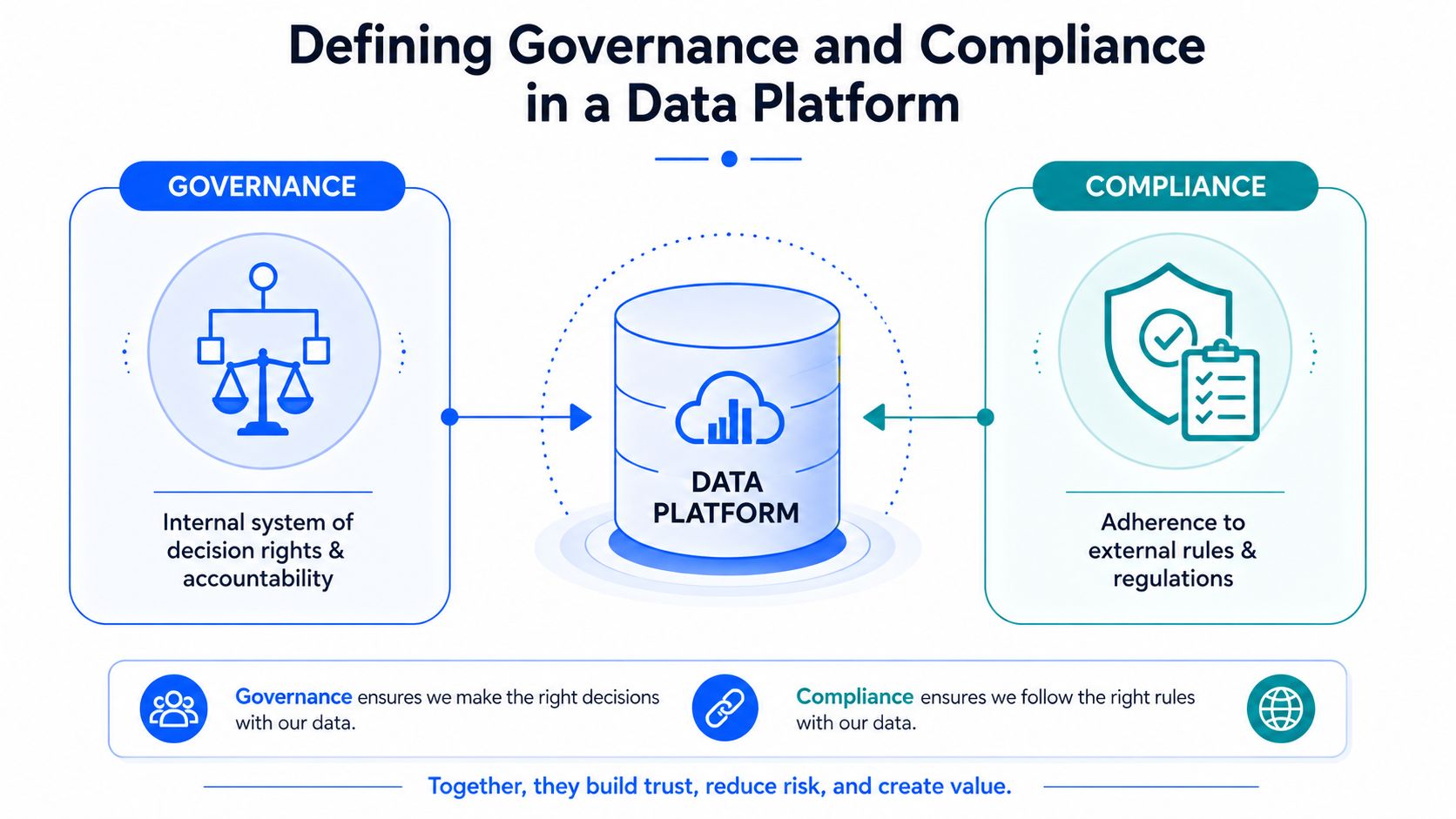
Governance is the internal system of decision rights, accountability, and policy enforcement that decides who can change data, who owns risk, and how trade-offs get resolved. Compliance is the set of internal processes used to adapt behavior to applicable external norms, including state laws, federal laws, and industry regulations (legal scholarship on compliance, DFIN on governance, risk, and compliance).
That definition is more useful than “following the rules,” because it points to implementation. Compliance isn't a PDF on a shared drive. It's the operational process that translates an outside requirement into controls, monitoring, and evidence. Governance is broader, because it shapes the entire data lifecycle, not just the parts a regulator names.
For data teams, the cleanest way to remember the split is this. Governance decides who owns the table, who approves the change, and what evidence must exist. Compliance checks whether the handling of that table meets a defined external obligation.
The same split shows up in platform work. In a pipeline, governance lives in ownership metadata, approval paths, change control, and evidence capture. Compliance lives in the rule that says access must be restricted, data must be retained, or a transformation must be documented in a way an auditor can verify. A platform that only supports compliance creates artifacts. A platform with governance built in creates artifacts and traceability.
For teams building out controls, digna's implementation guidance on data governance is useful because it frames governance as an operational program, not a policy binder. If you also need a broader market view of where oversight is heading, enterprise AI agent oversight controls show how the same logic is spreading into AI workflows.
Compliance is operational, not decorative. If it doesn't change how data is handled, it won't survive contact with an audit.
Comparing Objectives, Scope, and Ownership Side by Side
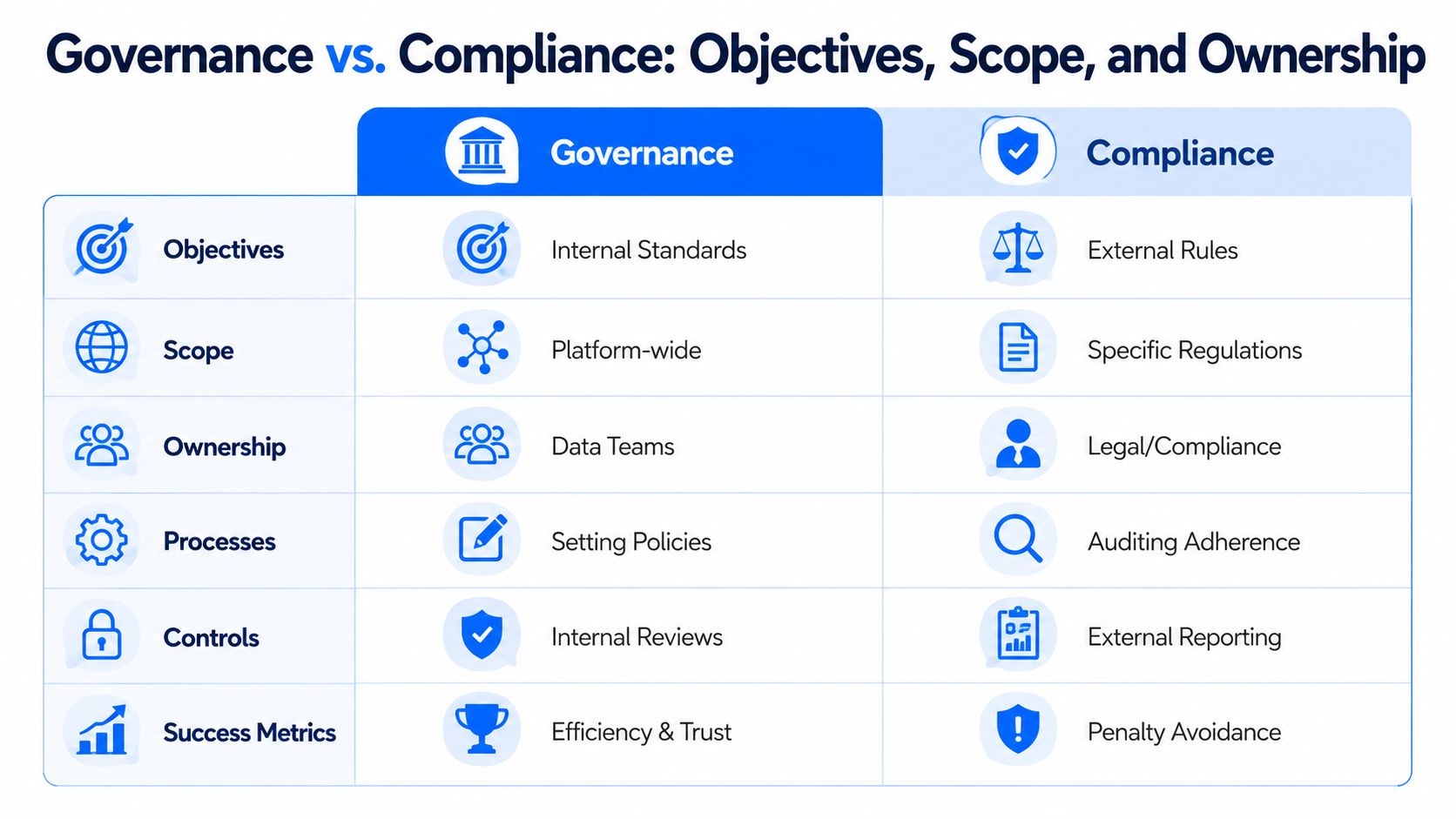
Criterion | Governance | Compliance |
|---|---|---|
Objectives | Internal standards, accountability, decision rights | External rules, legal adherence, evidence of conformity |
Scope | Platform-wide, lifecycle-wide, broad ownership | Specific obligations, narrower in scope |
Ownership | Data leadership, business owners, engineering, governance stakeholders | Legal, privacy, security, audit |
Processes | Policy setting, approvals, issue escalation, change control | Auditing adherence, documentation, attestation |
Controls | Internal reviews, lineage, ownership metadata, telemetry | External reporting, control testing, evidence packs |
Success metrics | Trust, stability, faster decisions, lower drift | Audit pass rate, reduced penalties, fewer control gaps |
The table is useful, but the core difference shows up in the pipeline. Governance has to keep the system understandable while data is moving, changing, and being used. Compliance has to prove that specific obligations were met at the point where the obligation matters. In other words, governance is about keeping control inside the operating model, compliance is about proving control against an outside rule.
In ingestion, governance should capture who owns the feed, whether the source is approved, and whether freshness is inside the tolerated window. That same stage can produce compliance evidence if the control requires timeliness checks, source approval, or restricted access to incoming data. If the ingest layer only logs incidents after something breaks, it is too late for both.
Transformation is where the overlap gets sharper. A schema change, a failed validation rule, or an undocumented mapping can be a governance problem because it breaks decision rights and traceability. It can also be compliance evidence because it shows whether the required control was active at the time of change. That is the part teams miss when they split governance and compliance into separate review queues.
Serving is the last place the difference matters. Governance cares whether the right data product is being published, whether consumers know what they are using, and whether drift is visible before it reaches downstream users. Compliance cares whether the output can be defended, retained, and reconstructed under audit. The same telemetry, lineage, and validation signals can support both, which is why a platform like digna is more useful than a folder of screenshots.
InformationWeek on governance and compliance scope and Sprinto on governance and compliance ownership both point to the same practical split, but the pipeline view is the part that matters in real operations. Ownership and scope only become useful when they are tied to an actual event, a real control, and evidence that survives review.
Where the Two Overlap in Real Regulated Data Pipelines
A financial reporting pipeline makes the overlap clear fast. A schema change lands in a critical table, a source feed arrives late, and a record-level validation fails on a rule tied to downstream reporting. None of those signals belongs only to compliance or only to governance. Each one can serve both, if the control is designed properly.
Take the schema change first. Governance needs to know who changed it, whether it was approved, and where the decision trail lives. Compliance may need the same event as evidence that structural-change controls were active during the review window. The late-arriving feed works the same way. Governance treats it as an ownership and escalation issue. Compliance treats it as proof that timeliness controls existed and were being monitored.
The same pattern shows up with record-level validation failures. Governance cares because the failure exposes a broken rule, a missing owner response, or a traceability gap in the pipeline. Compliance cares because the failure shows whether required checks were running and whether exceptions were captured in a way an auditor can review. That is the overlap. A single event can support both sides when the platform keeps policy, accountability, and telemetry together.
A healthcare pipeline follows the same logic. A missing or malformed record can affect clinical or operational decisions, and it can also show whether handling stayed inside the required boundary. The monitoring event is only useful if the ownership model is clear and the evidence is preserved in a form that survives review.
Bottom line: a monitoring signal is most valuable when it shows who owns the problem, what changed, and how the control stayed active.
That is why the practical question is not governance versus compliance. It is whether the control produces one evidence layer that the platform team, the governance team, and the auditor can all trust.
How Data Observability Turns Into Governance and Compliance Evidence
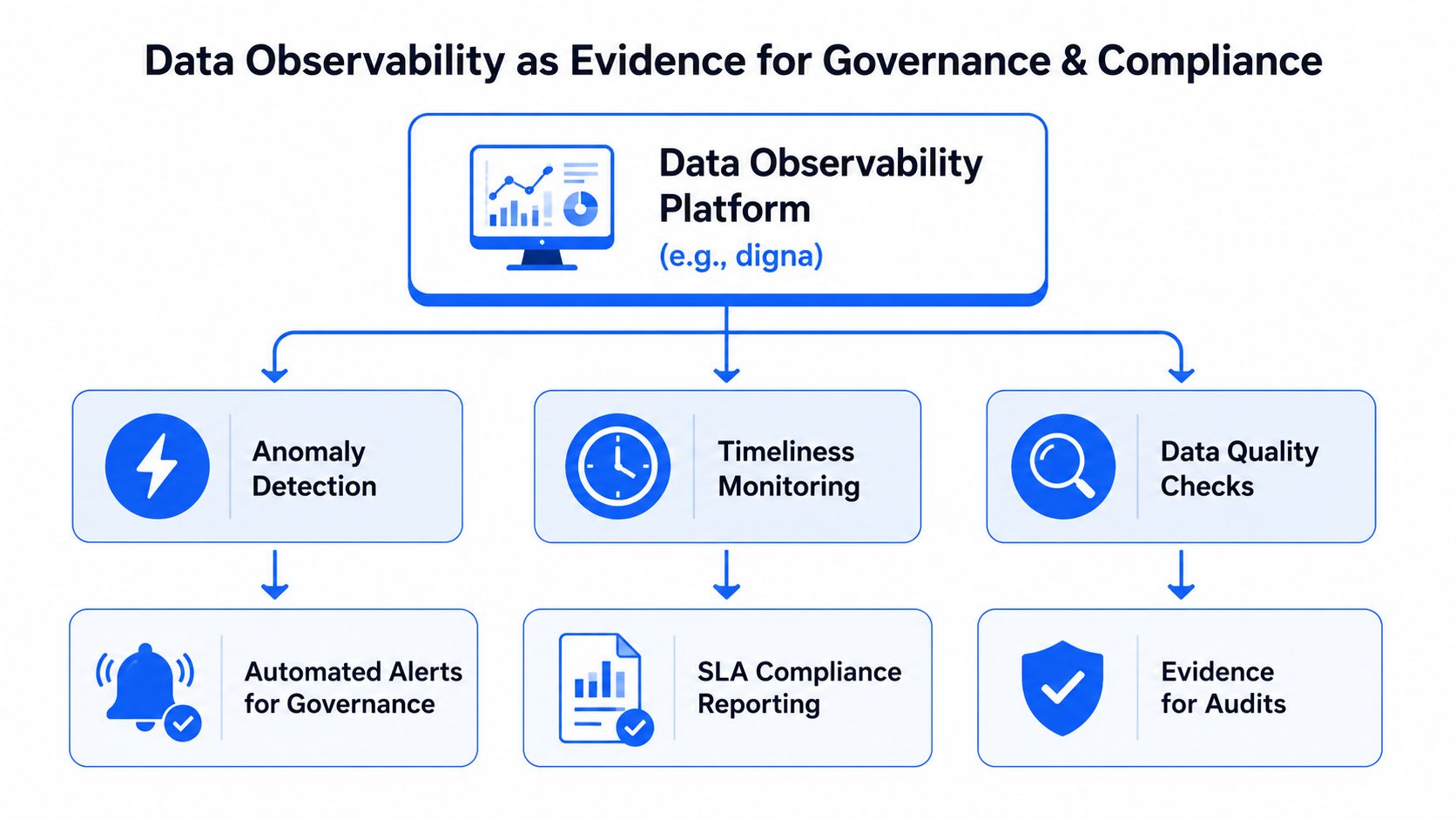
A strong observability layer turns everyday control signals into proof. Anomaly detection tells governance that a dataset moved outside its normal baseline, and it gives compliance a dated event trail that can be reviewed later. Timeliness monitoring shows whether expected deliveries arrived on time, which is operational evidence for ownership and also useful for SLA and control reporting. Schema tracking catches structural change before downstream consumers break, which is one of the cleanest examples of a control serving both jobs.
That's where a platform like digna fits naturally. It monitors data anomalies, timeliness, data validation, schema changes, and business metrics inside the customer's own environment, with in-database execution and deployment options that stay in the customer's cloud, VPC, or data center. For sensitive finance workflows, that matters because the team can capture evidence without moving production data around. For teams building finance controls at scale, this finance automation agency resource is a good reminder that data reliability and process automation usually rise or fall together.
The value of these controls is not the dashboard. It's the evidence chain.
Anomaly detection supports governance by flagging volatile behavior early, and supports compliance by preserving a record of the abnormal event.
Timeliness monitoring supports governance because the owner sees delivery failures immediately, and supports compliance because the team can show the control was active during the period in question.
Record-level validation supports governance by enforcing business rules consistently, and supports compliance by proving the rule was applied, not just documented.
Schema tracking supports governance by making change ownership visible, and supports compliance by showing structural drift was monitored.
For data quality teams, digna's observability overview is relevant because it maps those controls to a single operational layer instead of scattering them across tools. The key design choice is to keep measurement close to the data. When checks run in place, evidence is cleaner, and sensitive data stays where it already lives.
Sensitive data pipelines need controls that leave a trail without creating more movement than necessary. That's the standard, not the exception.
Splitting Ownership Between Data Engineering and Governance Teams

Use a simple rule. Governance and legal define what must be true and why. Data engineering defines how it's measured, where the telemetry lives, and how evidence is captured. That split keeps everyone honest and prevents the usual handoff mess where policy exists, but nobody implemented the control.
When a new dataset lands, data engineering owns the pipeline hooks, validation, and monitoring. Governance owns the approval path, the ownership metadata, and the policy call on whether the dataset is allowed into production. When a new regulatory control appears, governance interprets the obligation and defines the evidence standard, while engineering builds the check and stores the logs. When an incident happens, engineering preserves the telemetry first, then governance and legal decide what needs to be reported and how.
Many teams go wrong when they assign control to a committee, then expect the platform to make evidence appear later. That never works for long. The engineering team has to instrument the data flow, and the governance team has to certify the result.
A useful way to keep the line clean is to ask three questions:
Who defines the rule? Governance or legal.
Who implements the measurement? Data engineering.
Who signs off on the evidence? Governance, legal, or compliance.
If you need an operating model for roles, digna's data governance roles guide gives a practical starting point for the split between ownership and implementation. The important part is not the org chart. It's the handoff discipline. If the control lives in the pipeline, the pipeline team owns the instrumentation. If the obligation lives in the policy, governance owns the decision.
That's the handoff that keeps regulated data work from turning into a weekly fire drill.
A Practical Checklist for Building Both at Once
Control | Governance Signal | Compliance Signal |
|---|---|---|
Timeliness monitoring | Owner sees delivery drift and acts on it | Evidence that expected data arrival was monitored |
Schema tracking | Change is visible, traceable, and assigned | Structural change is documented during the control window |
Record-level validation | Business rule enforcement is consistent | Rule application can be demonstrated in an audit |
Anomaly detection | Baseline deviations trigger ownership review | Dated exception trail exists for review |
Access review | Ownership and accountability are current | Access restrictions meet defined obligations |
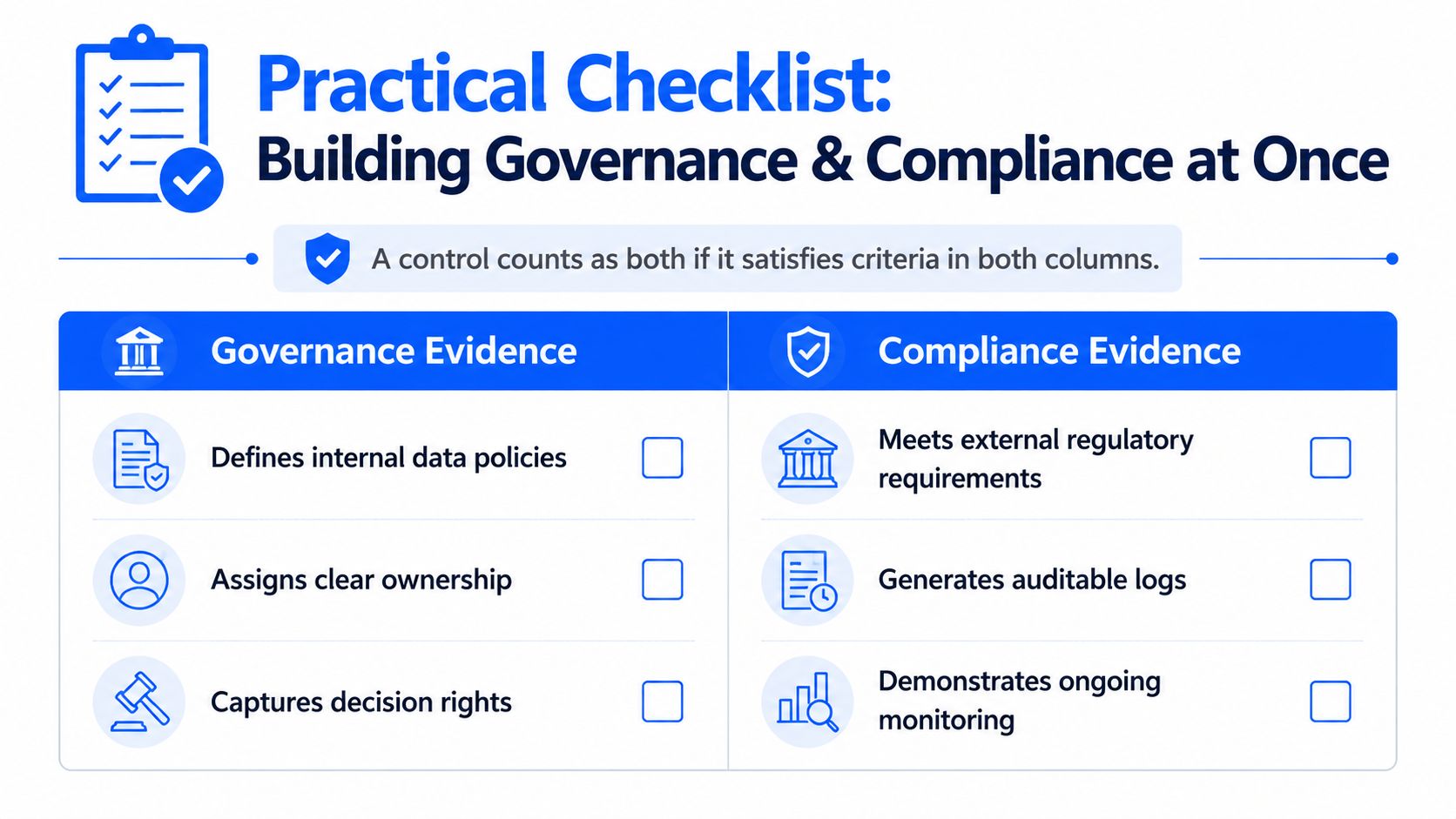
Treat compliance as a byproduct of governance, not a parallel project. If a control doesn't create internal ownership, decision traceability, and operational telemetry, it's too thin to carry regulated work. If it does all three, compliance usually becomes much easier because the evidence already exists.
Use this checklist when you design a new control:
Define the business rule first: If nobody can explain why the control exists, it won't survive contact with a regulator.
Instrument the pipeline, not just the policy: Capture the event where the data lives, not in a separate spreadsheet.
Store evidence automatically: Logs, alerts, and validation outcomes should be produced as part of normal operations.
Assign a real owner: Every control needs a person or team that can act when it fails.
Keep the control reusable: Timeliness, schema, and validation checks should support both governance review and compliance review whenever possible.
The hard truth is that teams don't need more compliance theater. They need controls that work in production and hold up in an audit. That's why the right question is never compliance vs governance in the abstract. It's which control will serve both jobs without creating duplicate process debt.
If you're building that evidence layer now, visit digna and look at how its observability and validation modules fit inside the data environment you already run. It's the kind of setup that turns governance into something operational and makes compliance a byproduct instead of a separate scramble.
Frequently asked questions
What is the better question than compliance versus governance?
Which data controls serve both. Framing them as competitors produces two programmes with overlapping work, while asking which control satisfies an internal decision right and an external rule at once produces one.
How do their primary goals differ?
Governance aims at internal control, ownership and decision traceability. Compliance aims at adherence to external rules and standards. The first is defined inside the organization, the second is handed to it.
How do their scopes differ?
Governance is broad, platform-wide and lifecycle-wide, while compliance is bounded by the rules that apply. That difference is why a governance gap can be invisible to an audit and a compliance gap can be invisible to a governance review.
How common is a formal governance framework?
By 2025 only 43% of data and analytics leaders reported having one, even though 88% said AI requires new governance approaches. Meanwhile 97.1% of organizations use at least one cybersecurity framework.
Why does that gap matter?
Because it shows where the pressure has been. Security frameworks are near-universal while governance frameworks are not, so the same organization can be well drilled on external attestations and improvised on internal decision rights.