Data Quality Management: What It Is and How It Works
|
6
min read

Every enterprise runs on data, but not every enterprise can trust its data. A dashboard shows numbers that don't match finance's report. A machine learning model degrades because the input data drifted last month. Nobody notices until a customer complains or an auditor asks a question you can't answer. This is what happens without data quality management, and it's why more data teams are building it into their operations rather than treating it as a one-time cleanup project.
So what is data quality management, exactly? It's the discipline of defining, measuring, and maintaining the accuracy, completeness, consistency, and timeliness of data across its lifecycle. It's not a single tool or a spreadsheet of validation rules. It's a structured framework that combines processes, ownership, and technology to catch problems before they reach a report or a model.
In this article, we'll break down the core components of a data quality management framework, walk through the processes that keep data trustworthy day to day, and cover the best practices that separate teams who catch issues early from those who find out the hard way. If you manage pipelines, warehouses, or lakes at scale, this is the groundwork for everything else you build on top of your data.
Why data quality management matters for your organization
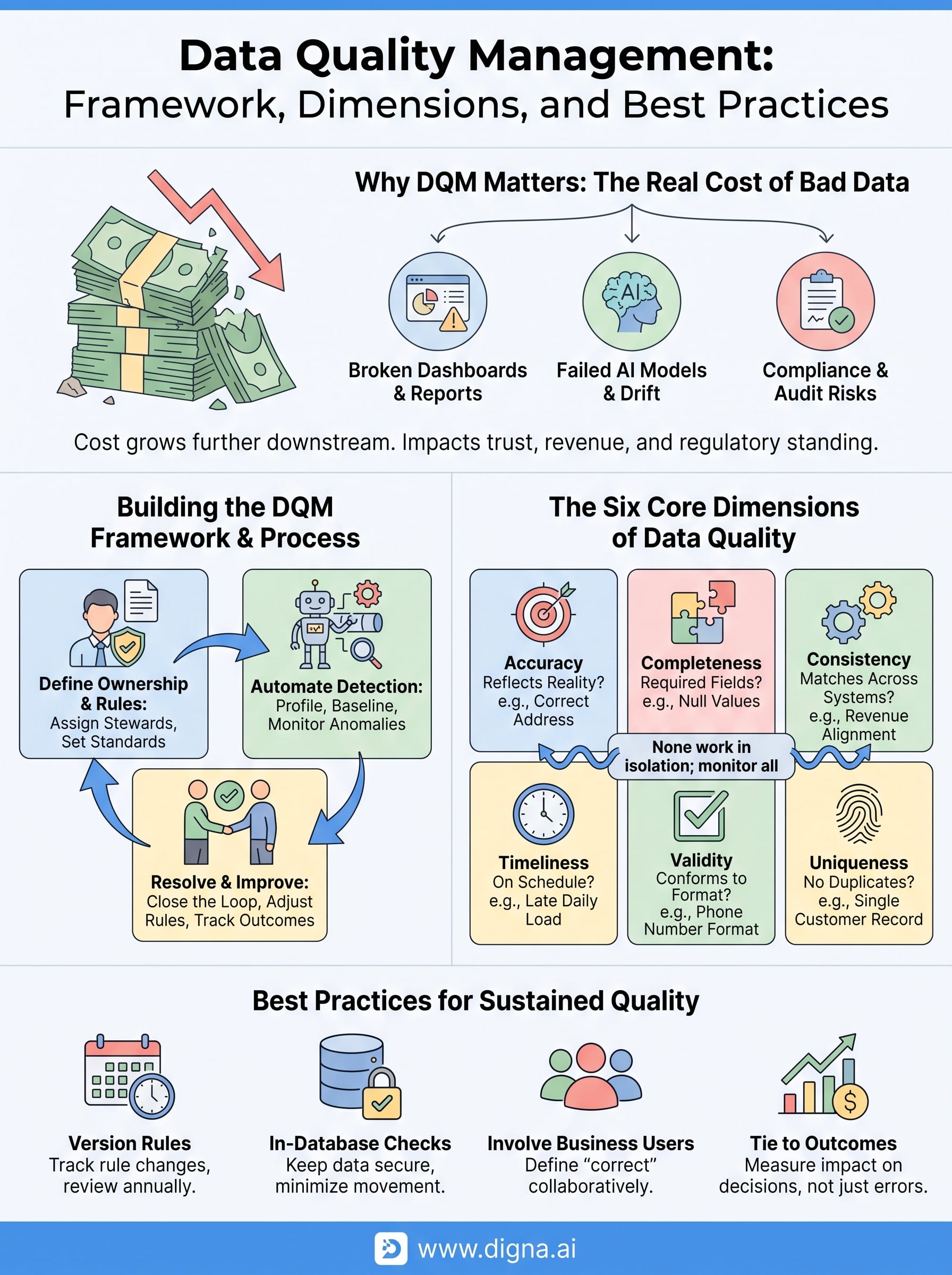
Bad data doesn't announce itself. It hides in a pipeline until a quarterly report goes out with the wrong revenue figure, or an AI model trained on drifted data starts making decisions nobody can explain. Data quality management matters because the cost of catching a problem grows the further downstream it travels. A missing column caught at ingestion costs an engineer ten minutes. The same issue caught after it's shaped a board presentation costs credibility, and sometimes a lot more.
The real cost of bad data
Gartner has estimated that poor data quality costs organizations an average of $12.9 million a year, a figure that covers wasted labor, missed opportunities, and outright errors in decision-making. That number doesn't even capture the slower damage: analysts who stop trusting dashboards, executives who fall back on gut instinct because the numbers "never seem right," and engineering teams who burn hours firefighting instead of building. Organizations that manage data quality systematically catch these issues at the source instead of paying for them three times over, once when the error happens, once when someone finds it, and once when someone has to explain it.

Every dollar spent catching a data error at the source saves far more than fixing it after it reaches a decision.
Where poor data quality actually shows up
The damage rarely stays contained to one team. Here's how it typically ripples through an organization:
Broken dashboards: Executives lose confidence in reporting after seeing conflicting numbers across departments.
Failed AI models: Machine learning systems trained on inconsistent or incomplete data drift silently, producing outputs nobody flags until performance drops.
Compliance exposure: Regulated industries face fines or audit failures when records don't match source systems.
Operational waste: Engineers spend hours tracing a bad number back to its origin instead of building new features.
Customer trust: Errors in billing, records, or communications erode confidence faster than almost anything else.
Since these failures rarely stay isolated, a problem in one pipeline can quietly surface in five different reports before anyone traces it back.
Regulatory and compliance pressure
Finance, healthcare, telecommunications, and public sector organizations operate under regulations that demand traceable, accurate data. Frameworks like GDPR in Europe require organizations to demonstrate control over personal data, including its accuracy and how it's processed. Auditors don't just want a clean report, they want evidence of a repeatable process that catches errors before they reach a filing or a regulator's desk. Without that process, every audit becomes a scramble instead of a checklist.
Trust in AI and automated decisions
As more organizations lean on AI and automated pipelines to make decisions at scale, the tolerance for bad input data shrinks. A model doesn't know the difference between a real trend and a data entry error, it just learns from what it's given. Teams that skip data quality management end up debugging model behavior when the real issue was a schema change three pipelines upstream. Building quality checks into the pipeline itself, rather than trusting a human to notice, is the only way to keep automated systems from making confidently wrong decisions at scale.
The core dimensions of high-quality data
Quality isn't a single attribute you either have or don't. It's a set of measurable dimensions, and data quality management treats each one as its own metric to track, not a vague feeling that "the data looks fine." Most frameworks converge on six dimensions that cover accuracy, structure, and freshness, and each one catches a different kind of failure.
The six dimensions teams measure
Here's how the dimensions break down in practice, with the kind of failure each one is designed to catch:

Dimension | What it measures | Example failure |
|---|---|---|
Accuracy | Does the value reflect reality? | Customer address matches an old record, not the current one |
Completeness | Are required fields populated? | 15% of orders arrive with a null shipping date |
Consistency | Do values match across systems? | Revenue in the warehouse doesn't match the source ERP |
Timeliness | Does data arrive when expected? | A daily load lands six hours late, breaking a morning report |
Validity | Does data conform to defined formats or rules? | A phone number field contains letters |
Uniqueness | Are records duplicated? | The same customer appears three times under slightly different names |
Why no single dimension tells the whole story
None of these dimensions works in isolation. Data can be perfectly complete and still be wrong, every field filled in with a stale value. It can be timely and still be invalid, arriving on schedule but in the wrong format. Treating dimensions separately is exactly why so many quality efforts stall: a team fixes completeness, declares victory, and gets blindsided three months later by a consistency failure nobody was watching for.
Data quality isn't one score, it's six different questions you have to keep asking at once.
Schema changes deserve a mention here too, since they quietly break several dimensions at once. A column dropped upstream doesn't just hurt completeness, it can silently corrupt validity and consistency checks that assumed the old structure. This is why mature data quality frameworks pair dimension-level metrics with structural monitoring, catching the root cause instead of chasing symptoms one dimension at a time.
How to build a data quality management process
Building a data quality management process starts with a decision most teams skip: someone has to own it. Without a named owner, quality checks turn into a side project that gets dropped the moment a sprint gets busy. A working process needs four pieces that reinforce each other: clear ownership, defined rules, automated detection, and a resolution workflow that closes the loop instead of just logging the problem.
Define ownership and rules before you write a single check
Start by assigning a data steward or owner to each critical dataset, someone who understands what "correct" looks like for that data and who gets pinged when something breaks. Pair that ownership with documented business rules: what fields are required, what ranges are valid, what formats are acceptable. Skipping this step is the most common shortcut teams take, and it's why so many quality programs collapse within a year, nobody agreed on what "good" meant in the first place.
A quality process without a named owner is a checklist nobody is responsible for.
Automate detection instead of relying on manual reviews
Manual spot-checks catch what someone remembers to look for, which means they miss everything else. Automated monitoring, especially anomaly detection that learns normal data behavior, catches the failures nobody thought to write a rule for. A practical rollout usually follows this order:
Profile your data to understand current volume, distribution, and null rates.
Set baseline rules for the dimensions that matter most to your business.
Layer in anomaly detection to flag deviations rules alone won't catch.
Monitor schema changes continuously, since structural shifts break multiple checks at once.
Close the loop with a resolution workflow
Detecting an issue means nothing if it dies in a dashboard nobody checks. Every alert needs a destination: a ticket, a Slack channel, an owner who's expected to respond within a set window. Resolution should feed back into the rule set too, if the same anomaly keeps triggering false alerts, the threshold needs adjusting, not silencing. Teams that treat this feedback loop as optional end up drowning in alert fatigue within a quarter.
Best practices and common pitfalls to avoid
Knowing the framework is one thing. Running it without falling into the same traps every team hits is another. Data quality management succeeds or fails less on the technology you pick and more on the habits you build around it. The practices below separate teams that keep quality high for years from teams that fix things once and watch quality quietly erode again.
Practices that actually hold up over time
Versioning your business rules matters more than most teams expect, since rules that made sense last year often stop matching reality once a source system changes. Treat your rule set the same way you treat code: track changes, review updates, and roll back when a new rule causes more false alerts than it catches. Pair that discipline with monitoring that runs in-database, so sensitive records never have to leave your environment just to get checked, which matters most for finance, healthcare, and public sector teams under strict compliance rules.
Involve business users, not just engineers, when defining what "correct" means for a dataset.
Review thresholds quarterly so rules stay aligned with actual data behavior instead of assumptions from a year ago.
Document every override, since a rule someone silently disabled is a rule nobody is checking anymore.
Tie quality metrics to business outcomes, like report accuracy or model performance, not just raw error counts.
Rules that never get revisited become blind spots dressed up as safeguards.
The pitfalls that quietly undo good work
Alert fatigue is the most common failure mode, and it starts innocently: a team sets rules too tight, gets flooded with false positives, and starts ignoring the channel entirely. Once that happens, a real issue slips through unnoticed right alongside the noise. Overcorrecting toward manual review is just as damaging, since it doesn't scale past a handful of tables and burns out the analysts doing the checking.
Siloed ownership causes just as much damage as no ownership at all. When five teams each patch their own corner of a pipeline without talking to each other, the same anomaly gets "fixed" five different ways, and none of them address the root cause. Chasing every dimension with the same intensity is another trap: not every field needs the same scrutiny, and treating a low-risk log field like a regulatory record wastes attention that should go toward the data that actually drives decisions.
Making data quality an everyday habit
Good data quality isn't a project you finish. It's a habit you build into the way your teams work, the same way code review became a habit once teams got burned by bad deployments. The dimensions, ownership, and workflows covered here only hold up if someone keeps them running after the initial rollout excitement fades. Data quality managementworks when it's boring: checks run automatically, owners get pinged before a customer notices, and rules get revisited before they turn into blind spots.
You don't have to build this from scratch or staff a team to babysit dashboards. Platforms that combine anomaly detection, schema tracking, and validation in one place, running directly inside your own database, get you from install to actionable insight in hours instead of months. If you're ready to stop firefighting bad data and start catching it at the source, see how digna can help.