10 Best Data Quality Tools for Enterprise Teams in 2026
|
5
min read

You're probably dealing with one of two problems right now. Either your team has dashboards that look fine until a stakeholder spots a number that's obviously wrong, or you've already bought observability and still don't have confidence in record-level correctness. That gap is why choosing among data quality tools gets messy fast.
The category is expanding because the problem is real. The global data quality tools market reached USD 2.30 billion in 2024 and is projected to reach USD 8.0 billion by 2033, growing at a CAGR of 14.9% from 2025 to 2033, according to IMARC Group's data quality tools market analysis. Buyers are responding to stale reports, broken dashboards, silent drift, and AI systems fed by bad inputs.
The mistake I see most often is evaluating tools as if they all solve the same problem. They don't. Some monitor metadata. Some query live data. Some are code-first validation frameworks. Some are governance suites with data quality attached. Some run as SaaS. Some run inside your environment. If privacy, compute control, and auditability matter, architecture matters as much as features.
If you need a quick operational baseline before evaluating vendors, this guide on improve reporting with data hygiene is a good companion.
Table of Contents
1. digna
A familiar enterprise scenario: the warehouse dashboards are green, the pipeline finished on time, and finance still finds incorrect numbers in the board pack. That usually happens when a team bought observability first and only later realized metadata and freshness checks do not prove data is correct. digna is built for that gap.
Its architecture is the first thing buyers should pay attention to. digna runs in-database and in customer-controlled environments, including private cloud and on-prem. That changes the buying process as much as the feature set. Security review is usually simpler, sensitive data stays inside your boundary, and teams avoid shipping production records into a vendor-managed SaaS environment. The trade-off is operational ownership. Someone on the platform side still needs to manage access, compute usage, and deployment standards.
That architectural difference is also the clearest way to frame the product against the broader category. Teams comparing observability vendors often blur anomaly detection, metadata monitoring, and business-rule enforcement into one bucket, but they solve different problems. This breakdown of data observability vs. data quality is a useful way to separate those concerns before shortlisting tools.
Why digna stands out
digna combines automated monitoring with explicit validation in one system. In practice, that means a team can catch late-arriving data, detect unusual metric behavior, validate record-level business rules, and track schema changes without stitching together separate products or custom checks.
That matters most in environments where “something changed” is not a sufficient answer. Analysts need to know whether a spike is normal seasonality, an upstream defect, or a broken transformation. Data leaders need to show whether controls exist for audit, compliance, and business-critical reporting.
The platform groups its capabilities into five modules:
Data Anomalies detects unexpected shifts with AI and statistical methods, which reduces the maintenance burden of hand-built thresholds.
Data Analytics gives historical context so teams can distinguish noisy variation from a real incident.
Timeliness tracks delays, missed arrivals, and freshness issues that lead to stale dashboards and downstream SLA misses.
Data Validation applies record-level checks for business logic, compliance controls, and known failure modes.
Schema Tracker flags column additions, removals, and type changes before they break models or downstream applications.
Practical rule: If a vendor can show anomaly detection but not how it enforces known business rules, you are looking at partial coverage, not a full data quality strategy.
Where it fits best
digna fits best in enterprise warehouses, lakehouse environments, and pipeline estates where privacy, auditability, and deployment control shape the tool choice as much as alerting quality. Regulated industries are the obvious fit, but the same logic applies to any company that does not want broad third-party access to live production data.
There are trade-offs. Pricing is not public, so evaluation requires a sales process. In-database execution also shifts more responsibility to the customer than a lightweight SaaS monitor would. For large organizations, that is often acceptable because control and data residency matter. For smaller teams that want fast setup and can live with lighter validation depth, a SaaS-first product may feel easier to adopt.
If your main problem is the gap between monitoring pipelines and verifying actual data correctness, digna deserves a close look.
2. Monte Carlo
Monte Carlo helped define the modern data observability category, and that shows in the product. It's built for broad monitoring across warehouses, pipelines, and BI, with lineage and incident workflows that make it easier to understand impact when something breaks.
This is usually the tool large enterprises shortlist first when they want wide coverage and a mature observability operating model. Freshness, volume, schema, and distribution monitoring are table stakes here. The more important strength is context. Monte Carlo gives teams lineage-driven clues about what changed and what downstream assets are affected.
Best use case
Monte Carlo makes the most sense when your stack is already large, cloud-heavy, and operationally complex. If you have many pipelines, several consuming teams, and a real incident process, the alerting and impact analysis are useful. It's also one of the clearer examples of the distinction between observability and full data quality, which this breakdown of data observability vs data quality explains well.
There's a practical trade-off, though. A Monte Carlo article points out that many tools in the category lean on metadata ingestion instead of direct querying, and that can create blind spots for silent drift and business-rule violations, as discussed in Monte Carlo's analysis of when you need data quality tools. That doesn't make observability less valuable. It means you shouldn't confuse it with full validation on live records.
Observability finds a lot of issues fast. It doesn't automatically replace explicit business-rule enforcement.
Monte Carlo is enterprise-oriented, sales-led, and usually requires proper onboarding to reach full coverage. If you want a mature observability layer with strong lineage and incident handling, it belongs on the list. Start with Monte Carlo.
3. Bigeye
Bigeye is a good example of a warehouse-centric observability product that tries to balance coverage with a cleaner privacy posture. Its positioning around aggregated statistics matters because some teams want anomaly detection without shipping raw data to a vendor service.
That design can be attractive in cloud data warehouse and lakehouse environments. You still get monitoring on freshness, volume, and distributions, plus lineage-aware alerting and downstream dashboard visibility. But the collection model is more constrained than tools that inspect live values more thoroughly.
What the architecture means in practice
For many teams, Bigeye's architecture is the point. Aggregated metric collection can lower privacy concerns and simplify approvals with security teams. If your organization is sensitive about vendor access to production data, that's a meaningful advantage.
The trade-off is depth. The market has moved toward observability platforms that continuously monitor freshness, schema changes, and pipeline performance, while other tools emphasize validation embedded into engineering workflows, according to Research and Markets coverage of data quality tools and observability evolution. Bigeye fits more naturally on the observability side of that spectrum.
Good fit for cloud warehouse teams that want automated monitoring with limited raw-data exposure.
Less ideal when audit cases require direct, record-level rule enforcement inside the database.
Most effective when paired with stronger validation processes elsewhere in the stack.
If you need observability with a security-conscious posture, Bigeye is worth evaluating at Bigeye.
4. Anomalo
Anomalo leans hard into the idea that data quality should be as automatic as possible. That's the appeal. It learns behavior patterns across datasets and tries to cut down the endless rule-writing cycle that burns out data teams.
For teams drowning in manual checks, that promise is attractive. Fast time-to-coverage is real value. New datasets appear, the tool learns baselines, and you start getting anomaly signals without building a test suite first.
Where ML helps and where it doesn't
Buyers need to stay disciplined. AI-assisted anomaly detection is useful, but it's not a replacement for all rule maintenance. An academic review notes that the AI-for-data-quality trend is often oversold, and that many teams still need custom rules for audit compliance and regulated workflows, as discussed in the systematic review on AI for data quality and data observability.
That lines up with what practitioners see on the ground. Anomalo is strong when the problem is unknown unknowns. It's weaker when the requirement is deterministic enforcement of business logic such as “this field must follow a domain-specific standard” or “these records must reconcile under a policy.”
Use ML to discover surprises. Use rules to enforce obligations.
Anomalo also has practical deployment appeal because it can run in customer VPCs and works well in modern platforms such as Databricks. Pricing is still sales-led, and heavily regulated buyers should closely examine audit workflows before choosing it as a primary control system.
If your main problem is broad anomaly detection at scale with less manual setup, Anomalo is a serious option at Anomalo.
5. Soda
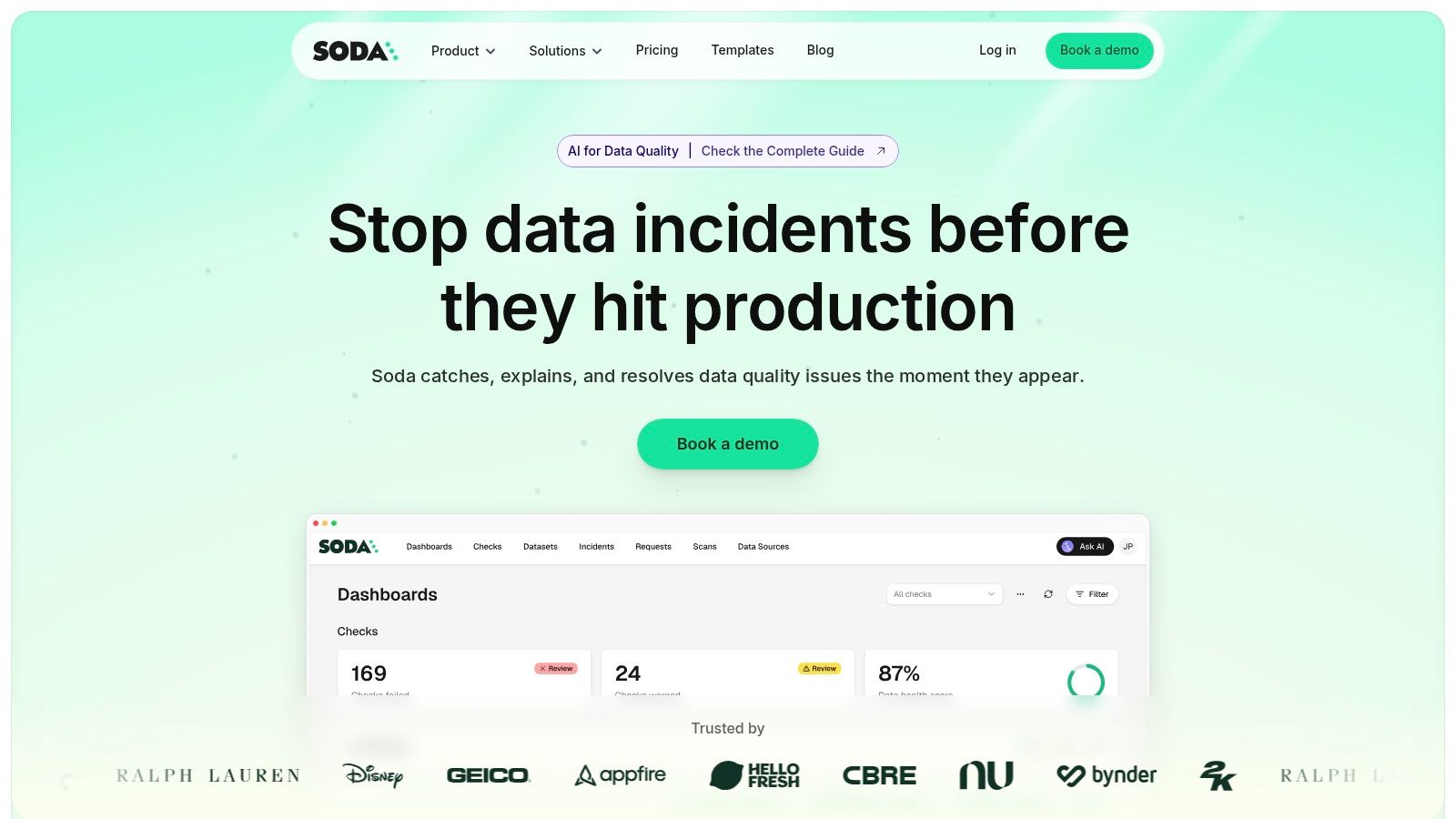
A familiar buying scenario goes like this. The data team wants checks in code, stewards want a place to review incidents, and security wants clarity on where data gets processed. Soda gets shortlisted because it sits between pure observability and traditional data quality tooling, with enough structure for operating discipline and enough flexibility for engineering teams to adopt it without a long platform program.
That positioning matters. Soda is less about passive monitoring and more about running an active data quality practice. Teams can define checks, investigate failures, route alerts, and formalize expectations between data producers and consumers. For buyers comparing architecture, the key question is not just feature coverage. It is whether you want a tool centered on test-driven validation with observability layered in, or a tool centered on anomaly detection with rules added later.
Where Soda fits best
Soda tends to work well for teams that already accept a simple truth. Data quality improves when someone is explicitly responsible for writing expectations and responding to failures.
Its strengths are practical:
Checks and contracts give teams a concrete way to encode business expectations instead of relying only on inferred baselines.
Diagnostics help analysts and engineers investigate why a failure happened, which matters more than a red alert in isolation.
Collaborative workflows make Soda easier to use across engineering and data governance groups than tools built only for one audience.
Accessible entry pricing lowers the cost of a real evaluation, especially for mid-market teams trying to avoid a long enterprise sales cycle.
The trade-off is maintenance. Rule-based systems age with the business. Metrics change, definitions shift, and ownership moves across teams. Soda can be a strong fit if you want that control. It is a weaker fit if your team expects the product to discover and manage most quality logic for you.
Architecture should stay part of the evaluation. Buyers should ask how checks execute, where metadata and results live, and how well the product fits privacy requirements. Teams with strict data residency or in-database execution preferences may prefer platforms designed around those constraints from the start, which is one reason architecture-first comparisons often surface digna for privacy-sensitive environments.
Soda is a sensible choice for organizations that want to operationalize data quality without buying a broad governance suite on day one. Evaluate it at Soda.
6. Great Expectations (GX Core and GX Cloud)
Great Expectations remains one of the clearest choices for teams that want data quality expressed as code. If your engineers think in tests, version control, and pipeline gates, GX still feels natural in a way many UI-first tools don't.
The open-source core is a major reason it persists in serious enterprise stacks. Teams can define expectation suites for schema, nullability, uniqueness, distributions, and custom logic, then run those checks wherever they need them. GX Cloud adds a web interface, orchestration support, and collaboration for teams that don't want to build every operational layer themselves.
Where GX is strongest
GX is strongest when the organization already believes data quality is a software engineering problem. It works especially well in CI/CD pipelines, dbt-heavy environments, and regulated workflows where explicit tests matter more than automated guesswork.
The downside is maintenance. The same report that highlights AI-first observability leaders such as Monte Carlo and Metaplane also notes that tools like Great Expectations and Soda Core are optimized for data engineering teams embedding validation directly into CI/CD pipelines. That's powerful, but it assumes you have the engineering ownership to keep tests current over time.
Best for teams that want code-first, explicit, reproducible validation.
Less suited for organizations hoping to get broad automated coverage with minimal setup.
Often paired with observability tooling for anomaly detection in production.
If your team wants control, transparency, and open-source flexibility, start with Great Expectations.
7. Collibra Data Quality & Observability
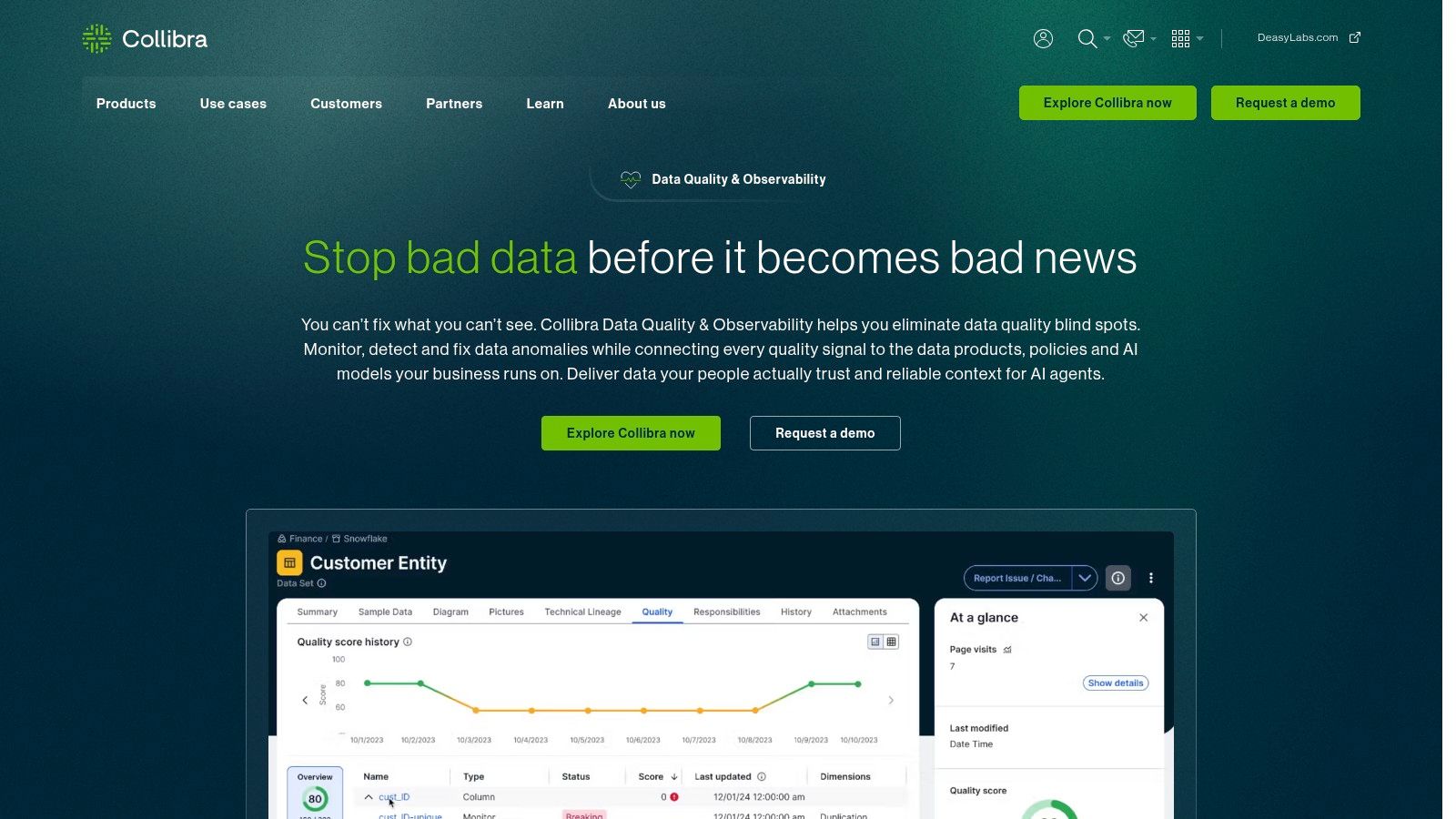
A common enterprise scenario looks like this: the data team already has a catalog, defined owners, policy controls, and stewardship workflows. Then quality incidents start surfacing across reports, pipelines, and regulated data sets. At that point, a standalone monitoring tool can solve part of the problem while creating a second operating model beside governance. Collibra appeals to teams that want those functions connected from the start.
That architectural choice matters more than another feature checklist. Collibra Data Quality & Observability makes the most sense when quality is treated as part of governance execution, not just anomaly detection. If your buyers include governance leaders, risk teams, and domain stewards, Collibra usually fits the buying process better than a pure observability product. If your goal is fast deployment for a small data platform team, it can feel heavier than tools built primarily for engineers.
Where Collibra fits best
Collibra combines profiling, rules, automated monitors, job management, and APIs with its broader governance platform. Push-down execution is a meaningful design choice because it keeps more processing close to the warehouse or source system. For buyers comparing data quality tools across different operating models, that in-platform alignment is one of Collibra's clearest strengths.
The trade-off is adoption effort.
Suite products reduce tool sprawl and give governance teams shared context, but they also ask for cleaner ownership, clearer workflows, and more cross-functional coordination. I would shortlist Collibra when the organization already believes data quality issues should route through stewardship, lineage, and policy controls. I would be more cautious when the need is straightforward: detect pipeline issues quickly, assign them to engineers, and move on.
If you already use Collibra, adding data quality is usually a logical expansion. If you do not, evaluate the architecture first. You may need an integrated governance operating model, or you may only need focused observability with less rollout friction.
For governance-led organizations, Collibra Data Quality & Observability is worth a serious shortlist.
8. Informatica Data Quality (IDQ and Cloud DQ within IDMC)
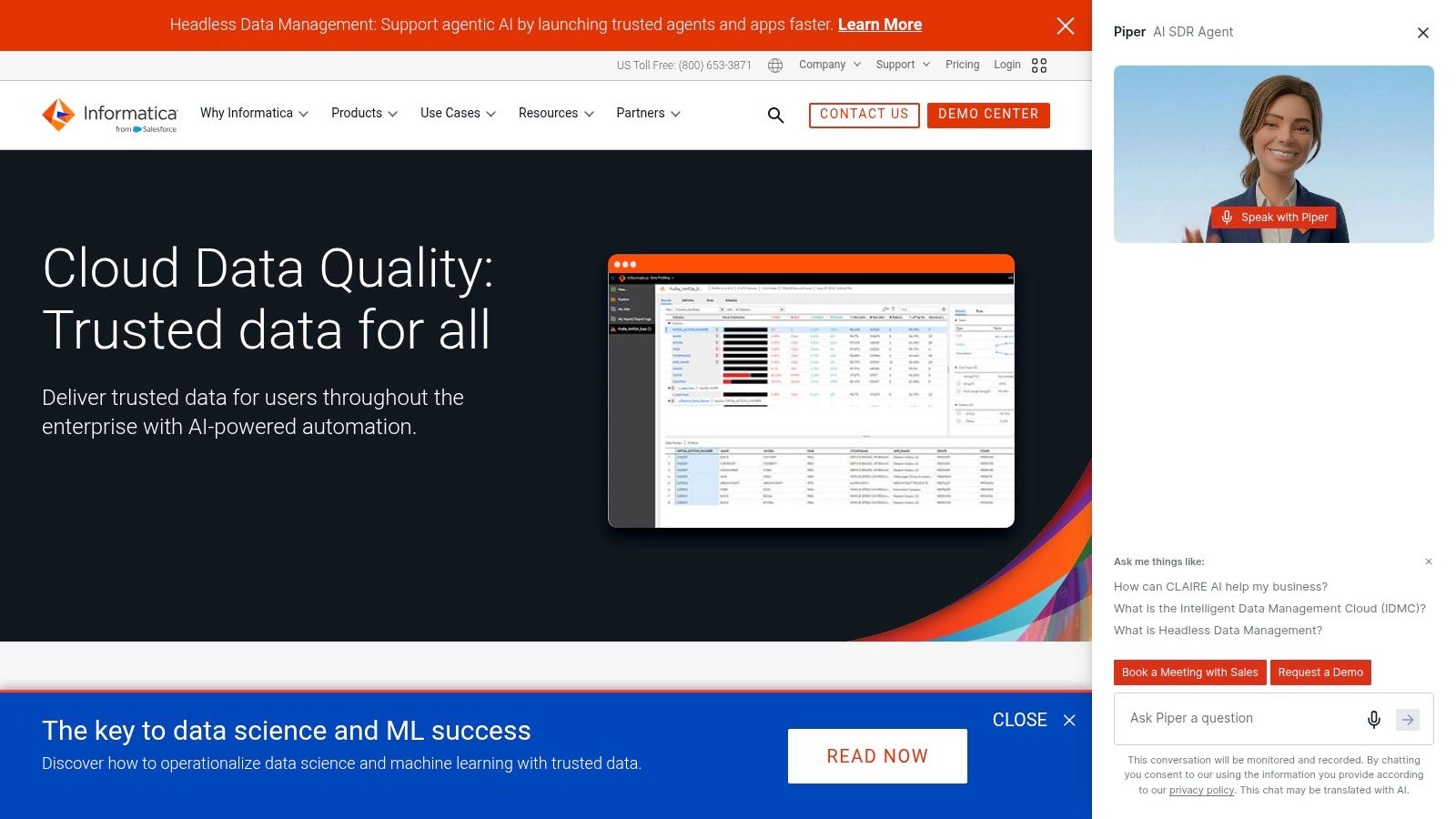
Informatica is the veteran in this list, and that matters more than some buyers admit. When an enterprise needs profiling, parsing, standardization, matching, deduplication, governance adjacency, and MDM alignment, Informatica still checks boxes that newer observability vendors don't even try to cover.
The product is broad by design. That breadth is useful if your quality problems include entity resolution, reference data, and classic mastering issues, not just pipeline freshness and anomaly detection. It's less attractive if you want a fast, lightweight deployment with minimal platform overhead.
Why enterprises still buy Informatica
A lot of mature data programs still rely on Informatica because it supports the foundational functions long associated with enterprise data quality, and because it fits larger governance and MDM initiatives. If you're comparing categories, this guide to broader data quality tools is helpful because Informatica sits at the deep-enterprise end of the spectrum.
There are real trade-offs:
Strength comes from depth in classic data quality functions and integration with broader enterprise data management.
Cost can be harder to predict because licensing and packaging are often more complex than pure-play SaaS products.
Operational burden is higher than lighter tools built mainly for cloud-native monitoring.
Informatica is still a sensible choice when the organization wants one vendor to cover much more than anomaly detection. If that's your world, look at Informatica Data Quality.
9. Talend Data Quality (Qlik Talend)
Talend Data Quality is most compelling when your team wants integration, quality, and governance under one umbrella. That's been Talend's long-running value proposition, and under Qlik it still appeals to organizations trying to simplify vendor sprawl.
The core capabilities are what you'd expect from a mature data quality product. Profiling, validation rules, stewardship workflows, trust-oriented scoring, and catalog integration are all there. The advantage is operational continuity if your pipelines already run through Talend or adjacent Qlik services.
Who should shortlist it
Talend works best when data quality is tightly coupled to integration and stewardship processes. If one team owns ingestion, transformation, and remediation workflows, the platform can feel coherent. If your stack is already standardized elsewhere, Talend can feel more like an all-or-nothing bet.
What usually lands well with buyers is the stewardship layer. Quality work doesn't end at detection. Someone needs to own the issue, review it, and resolve it. Talend is stronger there than many observability-first tools.
The trade-off is flexibility outside its ecosystem. As a standalone pick, it's less compelling than products built specifically for modern warehouse observability or code-first validation. As part of a broader Qlik Talend strategy, it makes more sense.
If consolidation under one vendor is the goal, evaluate Qlik Talend data quality and governance.
10. IBM Databand (IBM Data Observability by Databand)
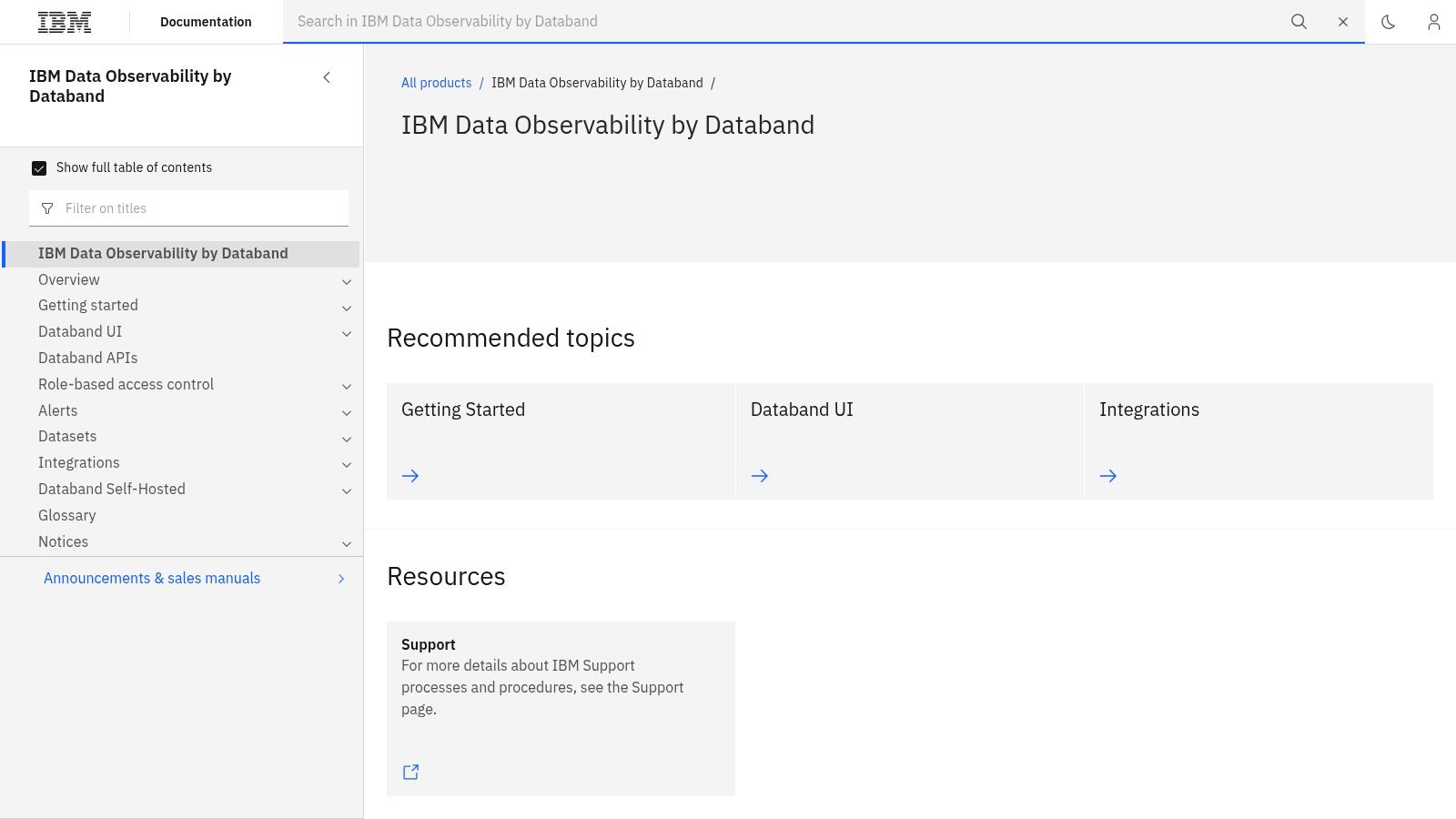
IBM Databand is more pipeline reliability product than classic record-level data quality system. That's not a criticism. It's the right tool if your biggest pain is missed SLAs, failed jobs, delayed data, and poor visibility into operational health.
This distinction matters because a lot of teams say they need data quality when what they really need first is production reliability. Databand focuses on flows, timing, alerts, and operational anomalies. It can run as SaaS or self-hosted, which helps organizations with stricter hosting policies.
Where it's strongest
Databand is strongest in environments where orchestration, operations, and uptime are the central concern. If the business impact shows up as stale reports because jobs ran late or upstream dependencies failed, this type of observability pays off quickly.
Its limits are clear too. Deep record-level rules and domain-specific validations aren't the core story here. You'd usually pair Databand with another layer if you need rigorous enforcement of business logic inside datasets.
Choose Databand when pipeline reliability and SLA monitoring are the urgent problem.
Don't choose it alone if auditors or regulated workflows require detailed record-level validation.
Value the self-hosted option if metadata residency matters inside your network.
For IBM-centric environments or teams focused on data operations reliability, review IBM Databand documentation.
Top 10 Data Quality Tools, Feature Comparison
Product | Core features / Strengths | Unique selling points ✨ | Target audience 👥 | Deployment & Price / Rating 💰★ |
|---|---|---|---|---|
digna 🏆 | AI + statistical anomaly detection; in‑database metrics, timeliness, validation, schema tracker | ✨ In‑DB execution & privacy; unified observability+quality; fast time‑to‑insight | 👥 Enterprises (finance, healthcare, telecom), data engineers, ML & analytics teams | 💰Contact sales · On‑prem / private cloud · ★★★★★ |
Monte Carlo | Automated monitors (freshness, volume, schema, distribution); lineage & incident mgmt | ✨ Lineage-driven RCA & mature enterprise references | 👥 Large enterprises, analytics & ops teams | 💰Quote-based SaaS · ★★★★★ |
Bigeye | Out‑of‑box anomaly detection, lineage-aware alerts, SLA tracking | ✨ Aggregated‑metrics privacy model; cloud DW/lakehouse fit | 👥 Cloud DW/lakehouse teams; security‑sensitive orgs | 💰Contact sales · SaaS · ★★★★ |
Anomalo | ML‑driven unsupervised anomaly detection, validations, lineage; unstructured options | ✨ Fast coverage; deploy in VPC; Databricks integrations | 👥 Data platform & ML teams | 💰Quote · VPC/SaaS · ★★★★ |
Soda | Automated checks, data contracts, diagnostics, AI‑assisted tools | ✨ Published entry pricing; collaboration & guided remediation | 👥 Engineers, data stewards, mid→enterprise teams | 💰Published entry tiers · SaaS · ★★★★ |
Great Expectations (GX) | Declarative expectations, extensive integrations (Python, dbt, Airflow) | ✨ OSS core (Apache 2.0) + optional hosted GX Cloud | 👥 Code‑first teams, regulated workflows, devs | 💰OSS free; GX Cloud plans · ★★★★ |
Collibra Data Quality & Observability | Automated & custom monitors, profiling, push‑down exec | ✨ Unified governance + catalog + DQ; vertical offerings | 👥 Large enterprises, governance & catalog teams | 💰Quote · Enterprise · ★★★★ |
Informatica Data Quality | Profiling, cleansing, matching, Cloud DQ in IDMC | ✨ Deep classic DQ features; MDM & governance adjacency | 👥 Large enterprises, MDM/governance programs | 💰Quote · Enterprise · ★★★★ |
Talend (Qlik Talend) | Automated profiling, validation, stewardship, trust scoring | ✨ Tight integration with Talend/Qlik integration stack | 👥 Integration-centric orgs using Talend/Qlik | 💰Quote · Cloud · ★★★ |
IBM Databand | SLA tracking, pipeline reliability, self‑learning anomalies | ✨ IBM ecosystem integrations; self‑host option for strict policies | 👥 Ops & pipeline reliability teams, IBM customers | 💰Quote · SaaS & self‑host · ★★★ |
Final Thoughts
A data incident usually exposes the buying mistake fast. The alerts are firing, stakeholders are asking whether the numbers are usable, and the team realizes the tool can detect change but cannot verify whether the underlying records are actually correct.
That is why architecture should lead the shortlist. A metadata-heavy SaaS product can be faster to roll out and easier for a lean team to operate. The trade-off is visibility. If the failure sits inside business logic, field relationships, or record-level correctness, those platforms may point to symptoms without proving the defect.
In-database and in-environment platforms make a different trade. They ask for more planning around deployment, permissions, and compute. In return, they let teams run checks closer to the data, keep sensitive datasets inside their own boundary, and support controls that stand up better in regulated environments.
For buyers, the practical filter is simple:
Pick observability-first tools if the immediate problem is incident detection across pipelines, freshness, schema changes, lineage, and operational response.
Pick validation-first or code-first tools if the team needs deterministic rules, test coverage tied to business logic, and clearer audit trails.
Pick governance-centered suites if stewardship, ownership, cataloging, and policy management need to sit in the same operating model as data quality.
Pick in-environment platforms if privacy, residency, and vendor-access limits are part of procurement from day one.
Strong teams often use more than one approach. The important decision is not breadth for its own sake. It is role clarity. Observability should surface unexpected failures early. Validation should confirm whether data meets defined rules. Governance should make ownership and remediation obvious.
That is the gap digna addresses well in this category. As noted earlier, its design combines automated monitoring with record-level validation in the customer environment, including private cloud and on-prem deployments. For enterprise teams, that matters when security review, audit evidence, and data access policy carry as much weight as alert coverage.
If you are narrowing a shortlist, ask harder questions than which product has the longest feature grid. Where does it run? What leaves your environment? Can it test live values or only infer issues from metadata and pipeline behavior? Who owns maintenance after rollout? Which failures will it catch early, and which ones will still reach a dashboard or executive report?
Those answers usually decide fit more accurately than a feature matrix.
If your team needs observability and record-level validation without sending production data to a vendor, digna is worth a closer look. It fits enterprise teams trying to improve audit readiness, catch correctness issues earlier, and reduce tool sprawl.
Frequently asked questions
What should you look for in a data quality tool?
Look at where it runs, what it detects without hand-written rules, and how it routes a finding to an owner. A tool that only lists failed checks adds work; one that learns baselines, correlates incidents and connects to your response process reduces it.
What is the difference between data quality and data observability tools?
Quality tools evaluate whether data meets defined rules. Observability tools watch how datasets and pipelines behave over time and surface unexpected changes. Most enterprise teams need both, because rules cover the failures you predicted and observability covers the ones you did not.
Does a data quality tool need to move your data?
No, and for regulated data it should not. In-database approaches push computation to where the data already lives, so records never leave their existing security perimeter. That matters for teams with residency constraints or sensitive customer information.
How much rule-writing should a data quality tool require?
As little as possible for baseline coverage. Hand-written rules are essential for hard business constraints, but a tool that requires a rule for every column becomes a maintenance project. Learned baselines should provide the default coverage and rules should express intent.
How do you evaluate data quality tools fairly?
Test against a real incident you have already had. Can the tool detect it, attribute it to a source, name the affected downstream reports and reach the right owner? Feature lists rarely distinguish products; replaying a known failure does.