Mastering Data Quality Certification in 2026
|
6
min read

A report is due in an hour. Finance sees one revenue number in the dashboard, operations sees another in a spreadsheet, and the data team gets pulled into a familiar loop of Slack threads, ad hoc SQL, and uneasy explanations. Nobody is asking for more philosophy about governance in that moment. They're asking a simpler question: can this dataset be trusted right now?
That's where data quality certification becomes useful. Not as a credential for a person, and not as a vague policy document, but as a practical way to certify that a dataset, table, feed, or pipeline meets defined quality conditions and continues to meet them over time. For analytics teams and ML teams, that shift matters. It turns “we think this is fine” into “we've tested this against standards, assigned ownership, and can prove its status.”
Table of Contents
Why Your Data Needs a Certified Fresh Stamp
A dataset usually loses trust before it fails outright. The report still runs. The dashboard still loads. But someone notices a missing region, a late refresh, or customer counts that don't reconcile with another system. Once business users start second-guessing the data, every decision slows down.

Data quality certification is the discipline of putting a formal approval process around that trust. In practice, it means a team defines quality requirements for a data asset, tests the asset against those requirements, records the result, and keeps monitoring it after release. The point isn't bureaucracy. The point is to stop arguing about whether data feels reliable and start proving whether it meets agreed standards.
The business case is already strong. Poor data quality costs organizations an average of $12.9 million annually, according to Gartner research cited by Integrate.io's industry analysis. That cost shows up in reconciliations, delayed decisions, broken customer experiences, and compliance exposure.
What certification changes in day-to-day work
Without certification, teams often work reactively. They find issues after a stakeholder escalates them. They patch rules in one pipeline but leave similar failure modes untouched elsewhere. They rely on tribal knowledge, which disappears the moment the one engineer who knows the quirks goes on leave.
With certification, teams create a repeatable control layer around critical assets:
For dashboards: certify freshness, completeness, and accepted calculation logic before executive reporting.
For operational pipelines: certify schema stability, delivery timing, and null tolerance before data lands downstream.
For ML features: certify input validity and drift-sensitive fields before training or inference jobs depend on them.
Practical rule: If a dataset influences revenue, compliance, customer communication, or model behavior, it needs explicit certification criteria.
What certification is not
It isn't a one-time badge.
It also isn't the same thing as certifying a person or buying a data quality tool. A person can understand quality methods and still work in an environment where no pipeline is formally validated. A tool can detect anomalies and still leave ownership undefined. Certification only works when standards, controls, and accountability all exist together.
That's why strong data quality certification programs focus on the assets themselves. They answer concrete questions. What exactly must be true for this dataset to be considered trustworthy? Who approves it? What happens when it drifts? How fast must the issue be resolved? Those answers create the “fresh stamp” stakeholders care about.
Designing Your Certification Criteria and Governance
Most failed certification efforts start with a tool purchase or a policy memo. Both are backwards. The first job is to define what “certified” means for each data asset in business terms, then translate that definition into enforceable controls.
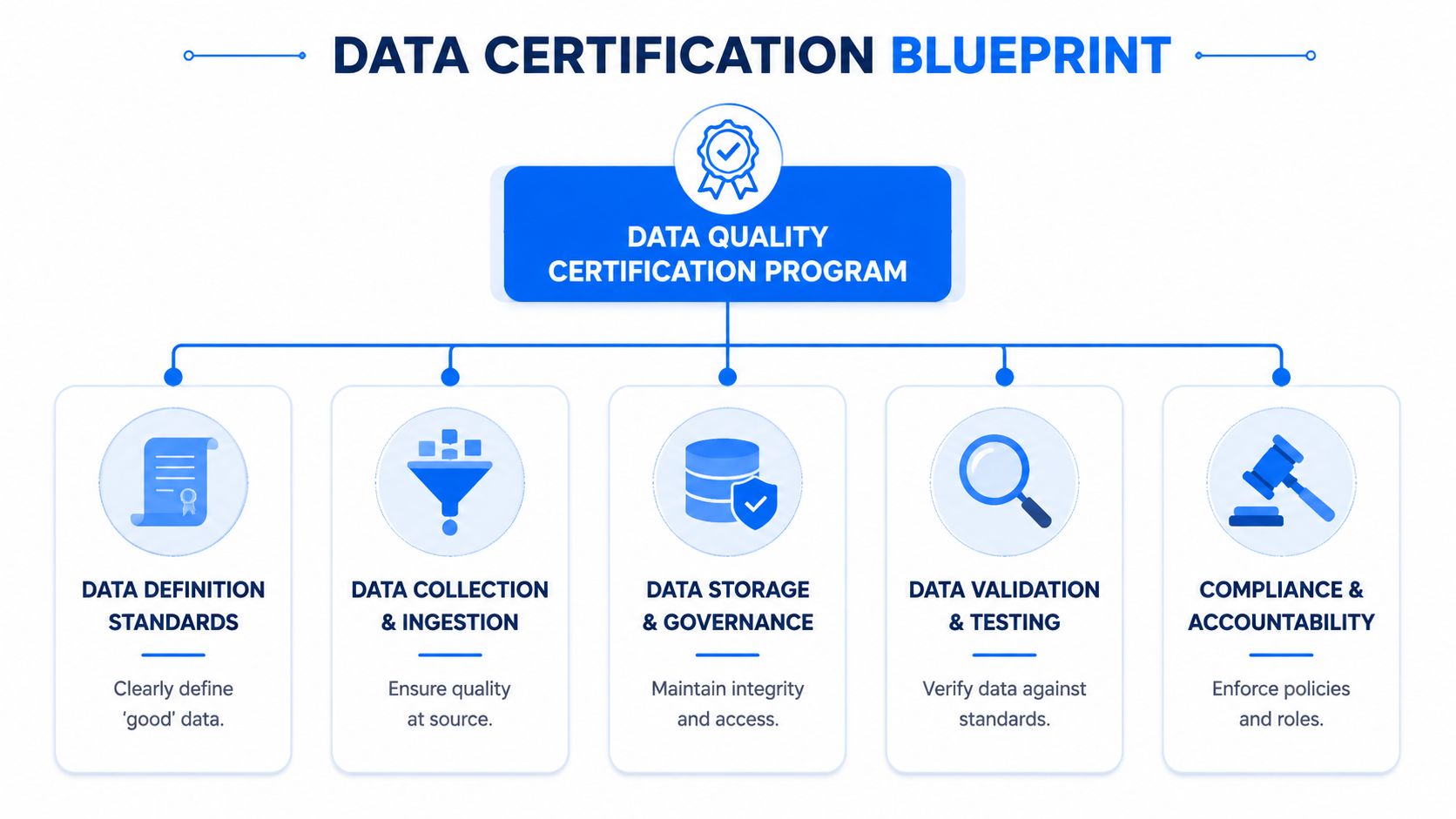
The operational sequence is well established. The standard methodology described by 6sigma.us follows a four-phase framework: data profiling, data standardization, data validation, and data cleansing. That order matters because teams can't enforce standards they haven't first observed and defined.
Start with fit-for-purpose criteria
Five dimensions usually matter most in practice. The wording can vary, but the substance shouldn't.
Dimension | What it means in certification | Practical example |
|---|---|---|
Accuracy | Values match trusted business reality | Invoiced amount aligns with the system of record |
Completeness | Required fields and records are present | Every order has a customer ID and order date |
Timeliness | Data arrives when the business needs it | Daily sales table is updated before morning reporting |
Consistency | The same concept agrees across systems | Country codes match between CRM and billing |
Validity | Values conform to defined formats and rules | Contract status only contains accepted values |
Don't define these at an enterprise slogan level. Define them at the dataset and use-case level. A customer support table and an executive finance mart can both be “high quality” while having very different timeliness expectations. Certification fails when teams pretend one universal threshold will fit every pipeline.
Assign ownership before you automate
Quality controls without ownership become noise. Someone has to decide the standard, someone has to monitor exceptions, and someone has to approve remediation when trade-offs appear.
A practical governance split looks like this:
Data owner: accountable for the business definition of quality and for accepting risk when standards aren't met.
Data steward: translates business expectations into usable rules, triages issues, and drives resolution.
Platform or engineering team: implements checks in pipelines, alerting, lineage, and monitoring infrastructure.
Consumers: analysts, finance leads, operations managers, or ML teams who confirm whether the asset remains fit for use.
Quality breaks fastest when ownership is collective in theory and absent in practice.
Many teams tend to overcomplicate governance. You don't need a giant council to certify a sales fact table. You need a named owner, a steward who understands the field logic, and an engineering path to enforce the standard. If your broader operating model is still taking shape, a practical resource for structuring controls is this SMB data security framework, especially for teams that need to align quality expectations with access, handling, and accountability.
Turn policy into an operating model
Once the dimensions and owners are defined, document each certifiable asset in a compact form. I've seen this work best as a short registry rather than a heavy policy packet.
Include:
Asset scope
Identify the table, pipeline, or feature set being certified.Critical fields and failure conditions
List the columns, joins, time windows, and dependencies that matter.Quality rules
Record both technical and business checks. Keep them testable.Approval path
Name who grants certification and who gets notified on failure.Review cadence
Set when criteria must be re-evaluated after business or schema changes.
Teams that need a starting blueprint can adapt a formal data quality framework model into this asset-level certification registry. The important part isn't the template. It's that every certified asset has documented criteria tied to an owner and a pipeline control.
Implementing Automated Testing and Validation
Manual spot checks feel responsible until volume, velocity, and change expose how fragile they are. An analyst samples a few rows. An engineer runs a validation query before release. A steward reviews a monthly scorecard. Then a schema changes on Tuesday night, an upstream load comes in late, and nobody sees the issue until a downstream report breaks.

Automation is the dividing line between a certification program that survives and one that turns into ceremonial paperwork.
Manual checks break under real workload
Manual validation has a place during discovery and root-cause analysis. It's weak as a standing control. People get tired, business logic changes, and hand-maintained checklists rarely keep pace with modern pipelines.
The weak points are predictable:
Coverage gaps: reviewers check obvious fields but miss interaction effects across tables.
Timing lag: data can degrade hours or days before anyone notices.
Rule drift: controls written for an older process gradually become outdated.
Inconsistent enforcement: one team validates rigorously, another relies on memory.
This is why certification must include machine-executed checks inside pipelines or directly against the stored data. If a rule matters, it should run automatically and repeatedly.
Use both rule-based and behavior-based testing
Strong certification combines two approaches rather than forcing one to replace the other.
Rule-based validation is best for explicit business requirements. Use it when you know exactly what should or should not happen. Examples include accepted code sets, mandatory fields, valid date relationships, and record-level assertions such as “premium customer orders cannot be zero.”
Behavior-based monitoring is better for the failures you didn't predefine. That includes silent drift, unusual volume patterns, shifting distributions, and timing anomalies. These issues often pass schema checks and simple rule tests while still damaging dashboards and models.
A useful way to view it:
Approach | Best for | Weakness |
|---|---|---|
Rule-based checks | Known business logic and compliance controls | Brittle when rules multiply and processes change |
Anomaly detection | Unknown deviations and drift-like behavior | Needs good baselining and human review for context |
That second category matters more than many teams admit. digna's AI-powered anomaly detection can eliminate the need for manual rule maintenance. One 12-month enterprise deployment replaced thousands of traditional data quality rules while maintaining reliable monitoring by learning normal data behavior and adapting to changes automatically, according to this deployment summary.
What to automate first
Don't try to certify everything in one wave. Start with the assets that create the most downstream damage when they fail. In most environments, that means executive reporting tables, shared dimensions, core event streams, model input datasets, and regulatory extracts.
A practical rollout sequence looks like this:
Schema and structural checks first
Catch missing columns, type changes, and broken table assumptions. These are high-impact and relatively straightforward.Freshness and arrival monitoring next
If the data is late, every downstream “quality” conversation becomes misleading.Critical field validation after that
Focus on nulls, accepted values, duplicate-sensitive keys, and business-critical thresholds.Distribution and trend monitoring last
Add anomaly detection to catch drift and subtle behavioral changes that hard rules won't spot.
A certified dataset should fail fast when the structure breaks and warn early when the behavior changes.
For teams building this layer, a practical companion resource is this guide to validity checker tools for modern data quality. The key is to treat validation as executable policy. Not documentation. Not intent. Executable policy.
Monitoring KPIs and Managing Service Level Agreements
A dataset isn't “certified” because it passed checks once. It stays certified only if the team can see its condition continuously, measure whether it's meeting expectations, and act when it falls outside the agreed range.

Monitoring isn't just about charts. It's the operational layer that tells engineering, governance, and business stakeholders whether the certified asset is still behaving as promised.
Choose KPIs that change behavior
A long metric catalog won't help if nobody can tie it to action. The best certification KPIs are narrow, owned, and connected to a response path.
Examples that work well:
Certification status by asset
Is the dataset currently passing all required controls, under review, or suspended for use?Freshness adherence
Is the asset arriving within its required reporting or operational window?Critical rule pass rate
Are the highest-priority business validations succeeding consistently?Open quality incidents
How many unresolved issues affect certified assets right now?Time to acknowledge and resolve
Are failures being addressed quickly enough to protect downstream use?
These KPIs become more useful when rolled up by domain, owner, and business process. Finance doesn't need every row-level exception. Finance needs to know whether the certified ledger feed is fit for reporting today.
Write SLAs that business users can understand
A service level agreement should describe the promise in plain language. If the consumer can't understand the commitment, the SLA won't govern real behavior.
A strong SLA for certified data usually answers four questions:
SLA element | What to define |
|---|---|
Scope | Which dataset, table, or feed the promise applies to |
Expectation | What quality condition must hold true |
Measurement | How the team determines compliance |
Response | What happens when the commitment is missed |
This is the same logic legal and procurement teams apply when they track obligations and performance in contracts. If you want a cross-functional reference point, these insights for legal teams on contract metrics are useful because they show how clear KPI design supports accountability, not just reporting.
Make monitoring operational, not ceremonial
The monitoring architecture matters. If the observability layer requires constant data extraction, separate handling exceptions, or vendor-side access to production data, many regulated teams will slow down or block deployment.
That's why the architecture itself becomes part of the certification operating model. digna executes all metric computation and baseline learning directly inside the customer's database. This “In-database Execution” architecture ensures data remains in its environment, minimizing data movement and enabling efficient monitoring at scale, as described on the digna platform site.
That design choice solves a practical problem. Engineers get continuous metrics and learned baselines where the data already lives. Security teams avoid unnecessary movement. Business users still get dashboard views and status tracking without turning monitoring into a separate data export project.
The best monitoring setup reduces debate. Everyone sees the same health signals, the same exceptions, and the same ownership path.
Maintaining Auditability and Continuous Improvement
A certification program becomes credible when it can answer uncomfortable questions months later. Why was this dataset considered approved last quarter? Which rule failed before that reporting incident? Who accepted the exception? When was the schema change introduced? If those answers depend on memory or scattered tickets, the certification isn't durable.
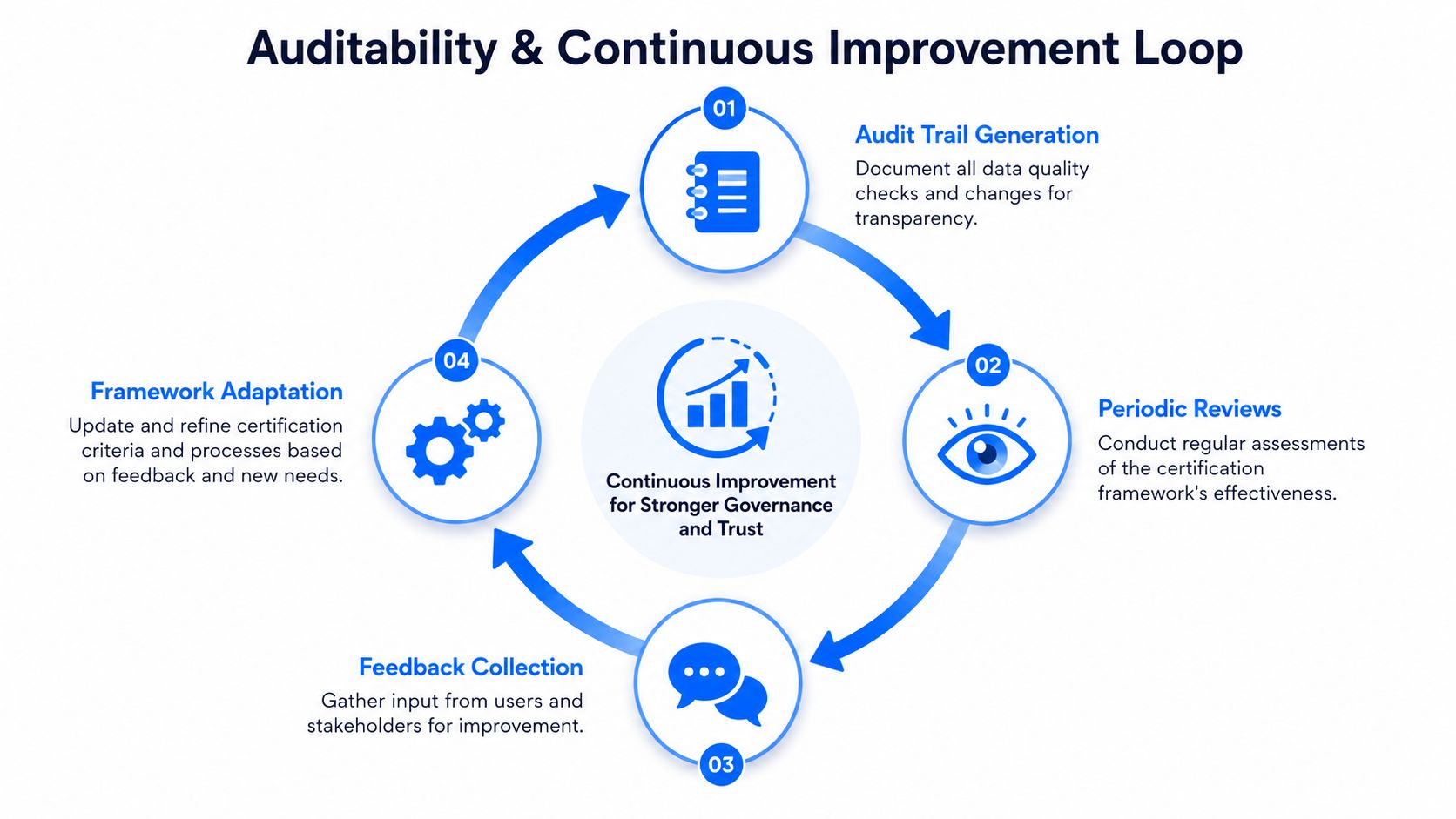
Audit trails are part of the certification itself
Auditability isn't a side benefit. It is the proof layer for data quality certification.
At minimum, retain a history of:
Control definitions and when they changed
Execution results for validations, anomaly checks, and freshness monitoring
Incidents and triage notes tied to affected assets
Approvals, waivers, and exceptions granted by named owners
Schema and pipeline changes that could alter certification status
This matters most in regulated environments, but it's just as valuable in internal operations. Audit history lets teams separate a one-off upstream incident from a recurring control gap. It also prevents the common problem where each new issue gets treated as if nobody has seen it before.
Static certification fails in live systems
The classic model of certification treats quality as a point-in-time event. A dataset passes a review, gets marked approved, and the organization moves on. That model doesn't hold up in environments with active pipelines, schema evolution, and ML workloads.
The clearest warning sign comes from AI systems. Contrarian data suggests that 65% of data quality failures in AI models occur after initial certification due to schema changes or timeliness delays, according to DataKitchen's certification discussion. That's the operational reality many teams already feel. The dangerous failures often happen after launch, not before it.
So the right model is continuous certification. The asset remains certified only while its controls, freshness, and structural assumptions keep passing. Certification status should be able to change automatically when evidence changes.
Build a feedback loop that actually changes controls
Continuous improvement only works when users can feed signal back into the system and that signal leads to revised controls. Otherwise, “feedback loop” becomes a meeting label.
A useful pattern is simple:
Collect issue reports close to use
Analysts, ML engineers, and business users should be able to flag suspect data quickly.Triage by business impact
Separate cosmetic issues from failures that affect decisions, automation, or compliance.Trace to root cause
Decide whether the problem came from source entry, transformation logic, schema change, or timing.Update the certification layer
Add, revise, or retire rules and thresholds based on what the issue revealed.Record the learning
Keep the rationale with the asset so the next owner doesn't repeat the same debate.
Good certification programs don't chase perfection. They get better each time the data surprises the team.
Herein lies the advantage of many mature teams over merely compliant ones. They don't treat incidents as isolated defects. They use them to harden the certification framework itself.
From Distrusted Data to Decision Confidence
Data quality's importance is well-understood, rendering further reminders unnecessary. A workable method is instead required to prove a pipeline, dataset, or feature set is reliable enough for use. This is what effective data quality certification delivers.
The pattern is straightforward. Define quality in terms the business can defend. Assign ownership before issues appear. Turn the rules into automated checks. Monitor health continuously. Keep an audit trail. Adapt the controls when real usage exposes gaps. None of that is glamorous, but it's what moves an organization out of reactive firefighting.
The payoff is decision confidence. Analysts stop hedging every presentation with caveats about freshness. Data engineers stop carrying hidden operational risk in undocumented checks. Governance teams stop relying on policies that nobody can enforce in production. ML teams gain a better chance of catching drift and structural breakage before models produce misleading output.
There's also a strategic shift buried inside this work. Certified data changes the conversation from “can we trust the numbers?” to “what should we do next?” That's a major operational advantage. It shortens reconciliation cycles, gives owners a clear response path, and lets leaders treat data assets more like managed products than hopeful outputs.
A modern approach matters because the old model of static certification doesn't fit live warehouses, lakes, and AI pipelines. Data changes too fast. Schemas evolve. Freshness issues ripple downstream quickly. Certification has to function as a living control system, not a quarterly ritual.
That level of trust is achievable. It takes engineering discipline, governance that names real owners, and monitoring that stays close to the data instead of drifting into manual review theater.
If you're building a practical certification layer for warehouses, lakes, and production pipelines, digna - own website is worth evaluating. It combines anomaly detection, validation, timeliness monitoring, schema tracking, and in-database execution in a platform designed for teams that need continuous assurance without moving production data outside their environment.