What Is Data Quality: Essential Guide for 2026
|
6
min read

Your dashboard says revenue is pacing to plan. Sales says the pipeline feels weak. Marketing just launched a major campaign based on a “high intent” segment, then learns half the audience already churned, some records were duplicated, and key firmographic fields were stale. Nobody argues that the SQL ran correctly. The problem is that the data wasn't fit for the decision.
That's usually the moment people start asking what data quality is. Not in the abstract. In the very practical sense of why a report looked fine, why the model trained successfully, and why the business still got the wrong answer.
In real teams, data quality isn't a side topic for the platform group. It sits underneath finance forecasts, customer operations, AI outputs, executive dashboards, and compliance reviews. If the underlying data is wrong, incomplete, late, structurally inconsistent, or detached from business context, every downstream tool becomes less trustworthy. Even a strong operating model in marketing depends on the basics, which is why a solid guide for B2B marketing operations matters. Good execution starts with dependable data foundations.
Table of Contents
Data Quality Is More Than Just 'Clean' Data
A lot of teams still reduce data quality to “clean data.” That phrase sounds fine until you ask a harder question. Clean for what?
A customer address can be spelled correctly and still be useless for logistics if apartment numbers are missing. A finance table can be internally consistent and still be unfit for executive reporting if the refresh arrives after the board pack is already locked. A feature table can look complete and still break an ML workflow if the structure changed in a way downstream consumers didn't expect.
That's why the better definition is fitness for purpose. Data quality is the degree to which data is accurate, complete, valid, consistent, timely, unique, and usable for the decision or process it supports. The same dataset can be high quality for one job and poor quality for another.
Good data isn't data with the fewest visible errors. It's data that reliably supports the action someone needs to take.
That distinction matters because it changes how teams work. If you treat quality as a cleanup project, you focus on isolated defects. If you treat it as fitness for purpose, you focus on downstream impact. You ask whether a pipeline supports planning, whether a dashboard supports decisions, and whether a model input remains structurally trustworthy over time.
The operational reality is messier than most definitions admit. Data changes in motion. Sources evolve. Business meanings drift. New teams consume old tables in ways the original owner never intended. So the right question isn't whether data is clean in some universal sense. The right question is whether the data can be trusted for this use case, by this team, at this moment.
The Seven Core Dimensions of Data Quality
Teams typically need a shared language before they can solve anything. Without that, one group says “the data is bad,” another says “the pipeline passed,” and nobody is talking about the same failure mode.
The seven dimensions below are the practical vocabulary that makes quality discussable.
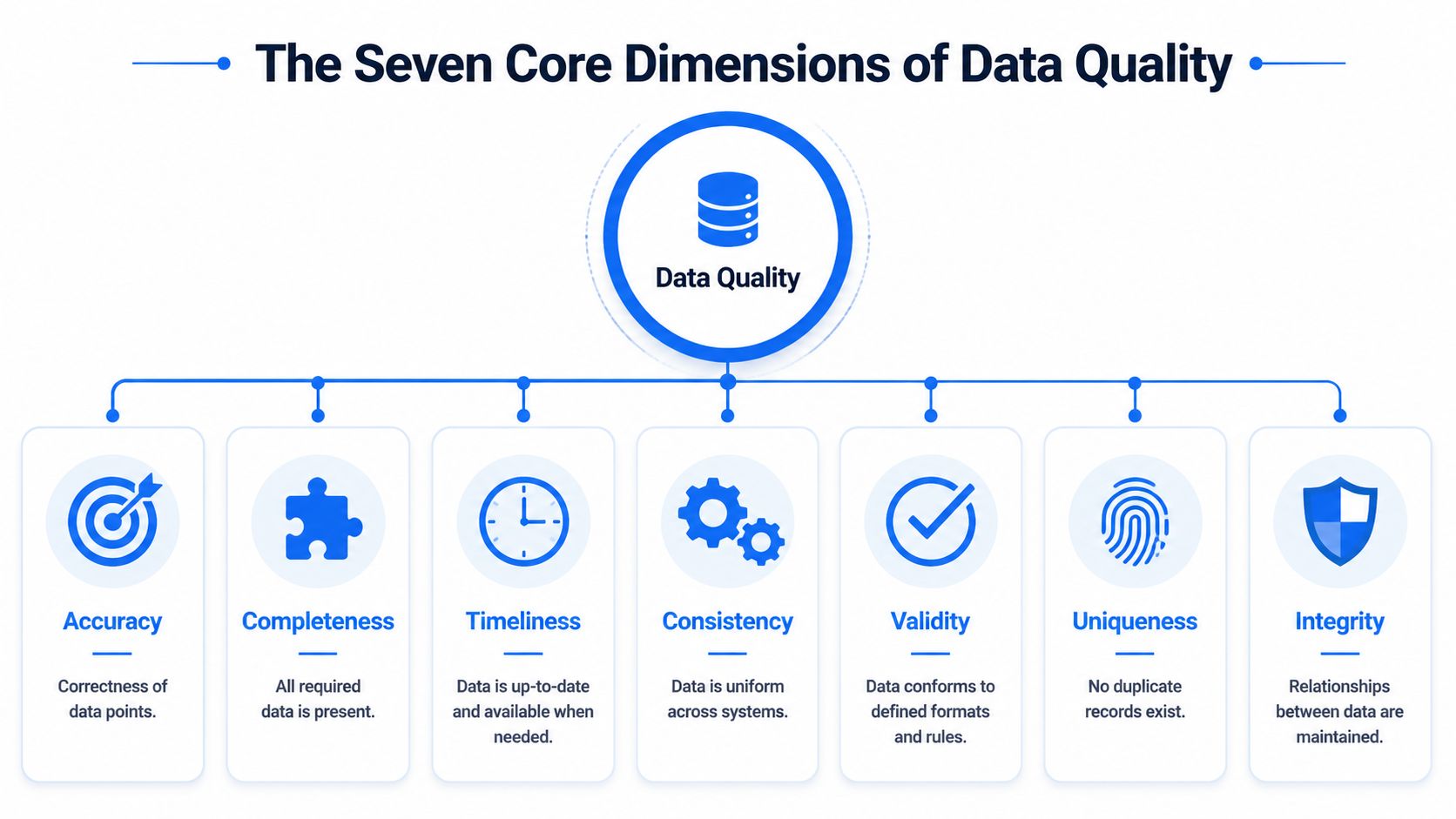
Accuracy means the values match reality
Accuracy is the most intuitive dimension. The data should reflect the actual thing it claims to describe.
Consider a map. A map is only useful if the roads are where the map says they are. In business systems, that means the customer address is current, the contract value is correct, and the event timestamp reflects when the event occurred.
When accuracy fails, the damage is immediate. Orders go to the wrong destination. Revenue gets attributed to the wrong account. Segmentation logic targets the wrong people.
Completeness and timeliness determine usefulness
Completeness means you have the pieces you need. It's the puzzle analogy. A few missing pieces can make the whole picture unreadable.
A sales record without region, owner, or close date might exist, but it won't support forecasting. A claims dataset without key status fields won't support operational triage. In analytics, missingness often hides inside “successful” loads, which is why teams miss it until a metric starts looking odd.
Timeliness is freshness. Fresh produce is still produce after a week in the warehouse, but it's no longer useful for dinner service. Data works the same way.
A daily executive KPI can tolerate some lag. Fraud monitoring can't. Customer support staffing decisions can't. Timeliness isn't one standard. It depends on the process. What matters is that the expected arrival and actual availability match the need of the consumer.
Practical rule: Every critical dataset should have an explicit freshness expectation tied to a business decision, not an arbitrary schedule.
Consistency validity uniqueness and lineage keep systems aligned
Consistency means the same concept behaves the same way across systems. If finance defines “active customer” one way and product analytics defines it another, the problem isn't cosmetic. It creates operational friction and debate over whose number is real.
Validity means the data conforms to the rules you set. Dates should be real dates. Country codes should follow the expected format. Status values should belong to an approved set. Validity is usually where teams start because it's easy to codify, but passing format checks doesn't guarantee business usefulness.
Uniqueness means records that should be singular stay singular. Duplicate customer rows inflate counts, fragment history, and trigger awkward operational mistakes. This is one of the fastest ways to lose trust in CRM, billing, and marketing systems.
Lineage tells you where the data came from, what changed it, and who depends on it. Strictly speaking, lineage is different from the core six dimensions commonly measured in scorecards, but in practice it's essential because you can't fix what you can't trace. When a metric shifts unexpectedly, lineage is how a team identifies whether the issue started at ingestion, transformation, enrichment, or downstream semantic modeling.
Here's a compact way to think about the seven:
Dimension | Simple test | Typical failure |
|---|---|---|
Accuracy | Is the value true? | Wrong customer status |
Completeness | Is anything required missing? | Nulls in key fields |
Timeliness | Did it arrive when needed? | Stale dashboard |
Consistency | Does the definition match elsewhere? | Conflicting KPIs |
Validity | Does it follow the rules? | Invalid codes or formats |
Uniqueness | Is the record duplicated? | Double-counted entities |
Lineage | Can we trace source and changes? | Slow root-cause analysis |
For teams operating at scale, quality becomes measurable discipline rather than a vague aspiration. AtScale's data quality overview notes that organizations achieving 98%+ across six core dimensions (accuracy, completeness, consistency, validity, uniqueness, timeliness) reduce pipeline incidents by 65% and cut remediation costs by $2.5M annually in large-scale data warehouses.
The Real Business Impact of Poor Data
The expensive part of poor data quality isn't the bad row. It's the decision made from it, the time spent arguing over it, and the operational churn that follows.
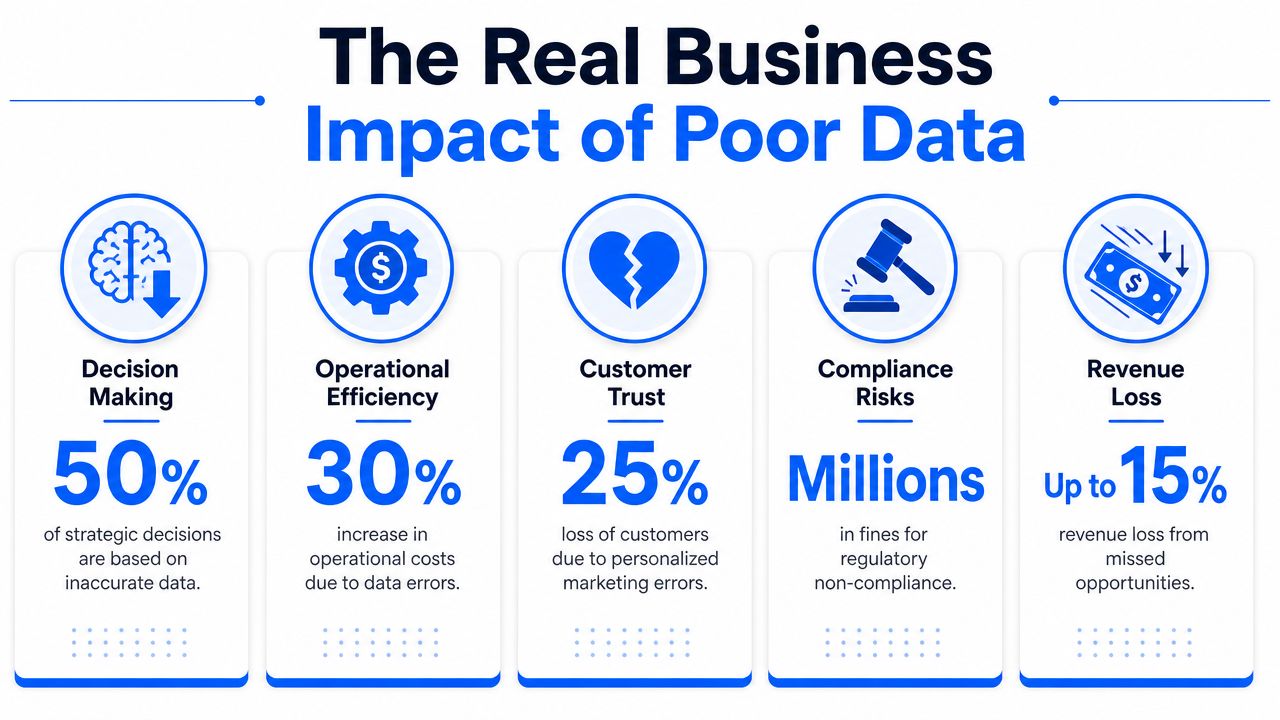
Poor data breaks decisions before it breaks systems
Most systems don't fail loudly when quality slips. The pipeline still runs. The dashboard still renders. The model still produces output. That's what makes data quality dangerous. It often fails unnoticed, inside business logic rather than infrastructure.
The financial exposure is not theoretical. Dataversity's analysis of the cost of bad data states that poor data quality costs organizations an average of $12.9 million annually. The same source also notes that 77% of IT leaders report they do not trust their own data.
That trust problem is usually the first symptom executives recognize. Teams start carrying side spreadsheets. Analysts rebuild metrics independently. Leadership meetings shift from decision-making to number reconciliation. When trust drops, the company doesn't become less data-driven in theory. It becomes less data-driven in practice.
Trust erosion is an operating problem
Poor quality also blocks newer initiatives, especially AI. Precisely's 2024 research announcement reports that 64% of global respondents identified data quality as their top data integrity challenge in 2024, up from 50% in 2023. That tracks with what engineering teams see on the ground. AI systems don't “fix” weak data foundations. They amplify them.
A stale dashboard changes a meeting. Faulty model inputs change product behavior, forecasts, risk assessments, and customer interactions. That's why quality work shouldn't be framed as back-office cleanup. It protects revenue operations, planning accuracy, customer experience, and model reliability.
A few patterns show up repeatedly:
Revenue leakage: Sales and marketing target the wrong accounts, suppress the wrong audience, or misclassify opportunities.
Operational waste: Engineers and analysts spend cycles validating outputs that should have been trustworthy by default.
Compliance exposure: Inconsistent records and weak validation make audit trails harder to defend.
Customer friction: Duplicate or stale records lead to repeated outreach, missed service expectations, and broken personalization.
Executive drag: Leaders delay action because they don't trust the numbers in front of them.
If a business can't tell whether a KPI moved because reality changed or because the pipeline changed, it doesn't have a reporting problem. It has a control problem.
That's the business case in plain terms. Data quality determines whether systems produce confidence or confusion.
Common Causes of Data Quality Decay
Data quality rarely collapses because of one dramatic incident. It decays through ordinary work. A new field gets added. An integration changes behavior. A form accepts junk input. A team adopts a metric without aligning the definition with upstream owners.

Human input and weak controls
Manual entry still breaks plenty of otherwise modern stacks. Sales reps type freeform values into fields that were supposed to be standardized. Support teams skip mandatory attributes when they're under pressure. Operations teams import spreadsheets with inconsistent naming and date formats.
Not every issue begins with malice or negligence. Sometimes the workflow itself invites bad input. If the form design is poor or the business rules are unclear, people improvise. The result is usually a mix of validity, completeness, and consistency problems.
There's a close parallel in customer-facing systems too. Weak front-end validation allows spam, malformed submissions, and junk records to enter operational databases, which is why practical resources like this guide for frontend developers to block spam matter beyond security alone. Bad inbound data becomes downstream cleanup work.
Pipelines integrations and silent structural change
System-driven decay is harder because it often looks healthy until a consumer notices the impact. ETL jobs can load partial data successfully. APIs can change response shapes. Transformations can continue running while semantically important fields shift underneath them.
The most dangerous category is structural drift. Sifflet's discussion of data quality and schema change notes a critical relationship here: unmonitored schema changes, such as adding a new column, cause 30% of AI model failures in production by introducing feature drift.
That failure mode matters because it often bypasses traditional checks. A pipeline can still produce rows. Unit tests can still pass. But the meaning or arrangement of the data has changed in a way downstream logic wasn't built to handle.
Ownership gaps turn isolated issues into systemic ones
Some quality failures aren't technical at all. They're governance failures with technical symptoms.
Common examples include:
No clear owner: Nobody is responsible for defining acceptable quality or approving schema changes.
Siloed standards: Different departments create different definitions for the same business concept.
Weak change management: Producers alter tables without notifying downstream consumers.
Legacy friction: Older systems export formats that newer pipelines interpret inconsistently.
When ownership is fuzzy, remediation becomes slow and political. Teams debate blame instead of restoring trust. In mature environments, quality incidents are handled like product or reliability incidents. There is an owner, an escalation path, and a documented resolution pattern.
From Measurement to Mastery Modern Best Practices
The old model of data quality was simple. Write a lot of rules. Run them on a schedule. Send alerts when a threshold breaks. That approach still has a place, especially for explicit business logic, but it stops scaling quickly.
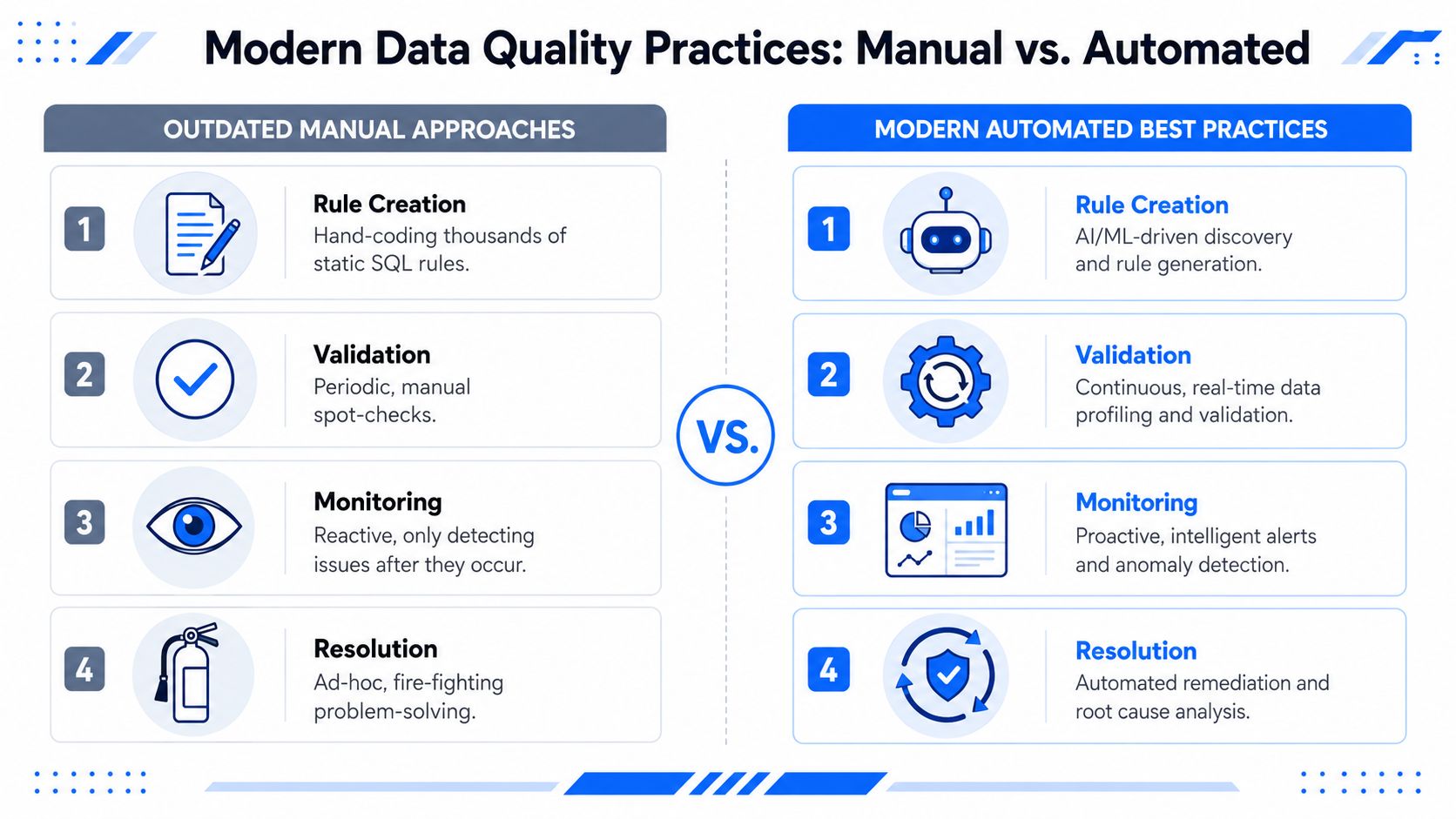
Why static rules stop scaling
Static rules are good at known, stable expectations. They're much weaker at evolving behavior, cross-table drift, and temporary anomalies that matter operationally but don't fit a hand-coded assertion.
That's where many teams burn time. Amplitude's analysis of poor data quality reports that 82% of data issues are detected only after they impact downstream dashboards, yet 60% of those issues self-correct within minutes. The same source adds that teams relying on static thresholds waste 15-20 hours weekly triaging these self-healing alerts.
This is the hidden cost of transient quality issues. Not every anomaly is a true incident. Some are brief delays, retry behaviors, late-arriving partitions, or temporary source stalls that resolve without intervention. But if your monitoring system can't distinguish transient noise from meaningful degradation, engineers still have to inspect them. Over time, that creates alert fatigue, slower response to real failures, and lower confidence in the monitoring layer itself.
What modern observability adds
Modern practice combines validation with observability. Validation checks whether data conforms to declared expectations. Observability monitors how data behaves over time, including freshness, volume, schema, distributions, and unusual shifts that weren't manually encoded in advance.
That changes the operating model in several ways:
Automated profiling: Systems learn what normal looks like across columns, tables, and load patterns.
Dynamic anomaly detection: Alerts are driven by behavior changes, not only hard-coded thresholds.
Freshness monitoring: Teams know when data is late relative to learned schedules and consumer expectations.
Schema tracking: Structural changes are surfaced before they break reports or models.
Root-cause support: Lineage and historical signals help teams trace whether the issue started upstream or downstream.
AI-powered platforms are useful here because they reduce manual rule maintenance and adapt to changing patterns. Ataccama's platform description describes this shift qualitatively through automated profiling, rule generation, and anomaly detection. Teams that want a practical framework for deciding what to monitor can start with a clear set of data quality metrics.
The goal isn't perfect data. The goal is a system that keeps trust high while handling change without constant human babysitting.
A mature setup still keeps hard validation rules for contractual or regulatory requirements. But it stops pretending that static assertions alone can cover a living data platform.
Building a Culture of Data Governance and Remediation
Technology catches issues. Governance decides what they mean, who owns them, and how the business responds.
Governance should clarify not slow down
Many teams hear “governance” and expect committees, ticket queues, and blocked delivery. Useful governance does the opposite. It reduces ambiguity.
A workable governance model answers a short list of operational questions:
Question | What a mature team decides |
|---|---|
Who owns the dataset? | A named producer and a named business stakeholder |
What quality matters most? | The dimensions tied to actual usage |
What changes require review? | Schema, semantics, SLAs, and critical rule updates |
How are incidents escalated? | Clear severity and routing paths |
What evidence supports trust? | Tests, lineage, monitoring history, and signoff rules |
Data contracts provide a solution. They make producer expectations explicit and give downstream consumers something firmer than tribal knowledge. For teams implementing that pattern, this piece on why data contracts matter and how to implement them is a useful reference.
Good architecture decisions also reduce governance pain later. Naming, normalization choices, key strategy, and relationship design all affect how cleanly data behaves over time. For that reason, practical insights on database architecture are directly relevant to quality work.
Remediation needs explicit patterns
When an issue is detected, teams need repeatable handling rather than improvisation. The usual patterns are straightforward:
Quarantine it: Hold suspect records out of downstream consumption when using them would be riskier than delaying them.
Enrich it: Repair missing or malformed values when there's a trusted source of truth.
Drop it: Reject records that fail critical validity or integrity checks.
Pass with warning: Allow non-critical issues through while marking downstream outputs appropriately.
Escalate upstream: Push the issue back to the producing system when the consumer cannot safely infer intent.
The strongest cultural shift is simple. Data quality becomes a shared operating responsibility rather than a cleanup queue owned only by data engineers.
Modern Tooling and Architecture for Data Quality
Modern stacks need tooling that assumes change is normal. Data comes from SaaS systems, operational apps, batch jobs, streams, reverse ETL, partner feeds, notebooks, semantic layers, and ML feature pipelines. In that environment, quality can't rely on isolated scripts and scattered alerts.
The architecture shift teams actually need
The architectural trend is toward unified platforms that combine validation, observability, and operational context. The reason is practical. Splitting these concerns across too many tools creates blind spots.
A modern setup should support several capabilities at once. It should monitor freshness, volume anomalies, schema changes, and rule violations continuously. It should also give teams enough lineage and historical context to understand whether an alert is a business issue, a pipeline issue, or a temporary fluctuation.
That's especially important for AI and ML workflows. Semarchy's overview of data quality states that 73% of AI model failures stem from undiscovered schema changes or feature distribution shifts that occur undetected during data ingestion, and it also notes that schema alterations disrupt 40% of production ML models. Those aren't failures a dashboard QA checklist will catch reliably.
Why unified observability and quality controls matter
A strong platform architecture now tends to include:
In-database execution: Metrics and checks run where the data already lives, which helps with privacy, performance, and operational simplicity.
Behavioral baselining: The system learns normal volume, distribution, and timing patterns.
Schema awareness: Structural changes are monitored as first-class events.
Business-rule enforcement: Teams still need deterministic validation for finance, compliance, and contractual requirements.
Shared visibility: Engineers, analysts, and business stakeholders need the same incident context, not disconnected views.
One example of that model is digna, which combines anomaly detection, timeliness monitoring, record-level validation, schema tracking, and historical analytics while executing inside the customer environment rather than moving production data out of it. That matters in private cloud and on-prem settings where governance, privacy, and data residency are essential. For teams comparing the boundary between these categories, this explanation of data observability vs data quality is useful.
The practical standard for 2026 isn't a giant library of brittle checks. It's a resilient architecture that can learn patterns, surface meaningful deviations, preserve privacy, and still enforce explicit business rules where required.

What is data quality, then, in the form that matters operationally? It's the ongoing ability to keep data trustworthy for the work it supports. Not once. Continuously.
If your team is dealing with stale reports, noisy alerts, silent schema drift, or low trust in downstream analytics, digna is worth evaluating. It's built for modern data quality and observability, with in-database execution, anomaly detection, timeliness monitoring, validation, and schema tracking designed for enterprise environments.
For a concrete look at how validation, anomaly detection, timeliness and schema tracking combine into one operating model, see data quality management with digna.
Frequently asked questions
What is data quality?
Data quality is fitness for purpose: the degree to which data is accurate, complete, valid, consistent, timely, unique, and usable for the decision or process it supports. The same dataset can be high quality for one job and poor for another, like a finance table arriving after the board pack is locked.
What are the dimensions of data quality?
The article uses seven: accuracy, completeness, timeliness, consistency, validity, uniqueness, and lineage. Each comes with a simple test, for example asking whether a value is true for accuracy or whether a record is duplicated for uniqueness. Lineage sits outside the six scorecard dimensions but is essential for root-cause analysis.
How much does poor data quality cost a company?
According to Dataversity figures cited in the article, poor data quality costs organizations an average of $12.9 million per year, and 77% of IT leaders say they do not trust their own data. The larger costs come from decisions made on bad data and hours spent reconciling numbers.
What causes data quality to decline over time?
Decay usually comes from ordinary work, not one dramatic incident. Typical causes include freeform manual entry and weak form validation, integrations that change response shapes, silent schema drift, and unclear ownership. Sifflet data cited in the article says unmonitored schema changes cause 30% of AI model failures in production.
Why are static data quality rules not enough?
Static rules only catch known, stable expectations. Amplitude figures in the article show 82% of data issues are detected only after they hit dashboards, and teams relying on static thresholds waste 15-20 hours weekly triaging self-healing alerts. Modern practice adds learned baselines, dynamic anomaly detection, freshness monitoring, and schema tracking.