ISO 25012 Explained and How to Apply It in Practice
|
7
min read

A dashboard can be green while the decision behind it is wrong. A finance team may receive a complete-looking regulatory report even though a source system changed a code value. Analysts may compare two customer metrics that use different definitions. An operations team may act on yesterday's data because the pipeline delivered late without raising an alert.
These failures are difficult to discuss when every team uses “data quality” to mean something different. One person means accuracy, another means freshness, and a third means whether the table was available when a job ran. ISO/IEC 25012 gives those conversations a shared vocabulary, then provides a structured way to connect quality expectations with measurable checks.
The useful question isn't whether a dataset is “good.” It's whether the dataset is fit for a particular purpose, and whether the organization can prove that fitness over time. The path from model to practice involves definitions, priorities, controls, scorecards, exception workflows, and audit evidence.
Table of Contents
Introduction Why Data Quality Needs a Shared Model
The hidden cost of vague quality language
From vocabulary to operational evidence
What ISO 25012 Is and Why It Exists
Think of it as a building code
What the model helps teams do
The 15 Data Quality Characteristics Explained Simply
Inherent quality
System-dependent quality
Interpreting ISO 25012 for Enterprise Data Programs
From characteristics to requirements
A scorecard needs context
Mapping ISO 25012 to Observability and Validation Controls
A practical control map
Separate data defects from platform defects
Industry Examples Where ISO 25012 Prevents Costly Failures
Financial services
Healthcare
Telecommunications
Public sector
Implementation Checklist and Audit Reporting Essentials
Introduction Why Data Quality Needs a Shared Model
A data engineer notices that a daily customer table loaded successfully. The pipeline status is green, row counts look familiar, and the BI dashboard refreshed without errors. Later, the commercial team discovers that a source application has started sending a new status code. The records are present, but the business logic interprets them incorrectly.
Nothing in that incident necessarily looks like a missing file or a failed job. The data may be available but not accurate for the decision. It may be complete at the record level but inconsistent with another system. It may be credible in origin yet no longer current enough for the process that consumes it.
The hidden cost of vague quality language
When teams lack a common model, they often create local definitions. A finance dataset may have a completeness rule, while a healthcare dataset uses a different interpretation. Engineering may monitor delivery time, analysts may inspect values manually, and governance may request evidence after an incident. Each activity can be reasonable, but the organization struggles to compare results or assign responsibility.
A shared model helps teams separate different failure types. Accuracy failures point toward incorrect values. Consistency failures indicate contradictions. Currentness failures concern outdated information, while availability failures concern whether authorized consumers can access data when needed.
Practical rule: Never ask whether data is “high quality” without naming the use case, characteristic, and evidence expected.
From vocabulary to operational evidence
ISO/IEC 25012 matters because it can serve as a bridge between business expectations and technical observability. A governance lead can define what “current” means for a reporting dataset. An engineer can implement delivery monitoring. An analyst can review a scorecard, and an auditor can inspect the recorded exceptions and remediation history.
That progression is more valuable than a static checklist. The model supplies the categories. The enterprise decides which characteristics matter most, defines thresholds, selects controls, and records the results. In-database monitoring can support that process by evaluating data where it already resides, while validation and anomaly detection distinguish business-rule failures from unexpected platform behavior.
What ISO 25012 Is and Why It Exists
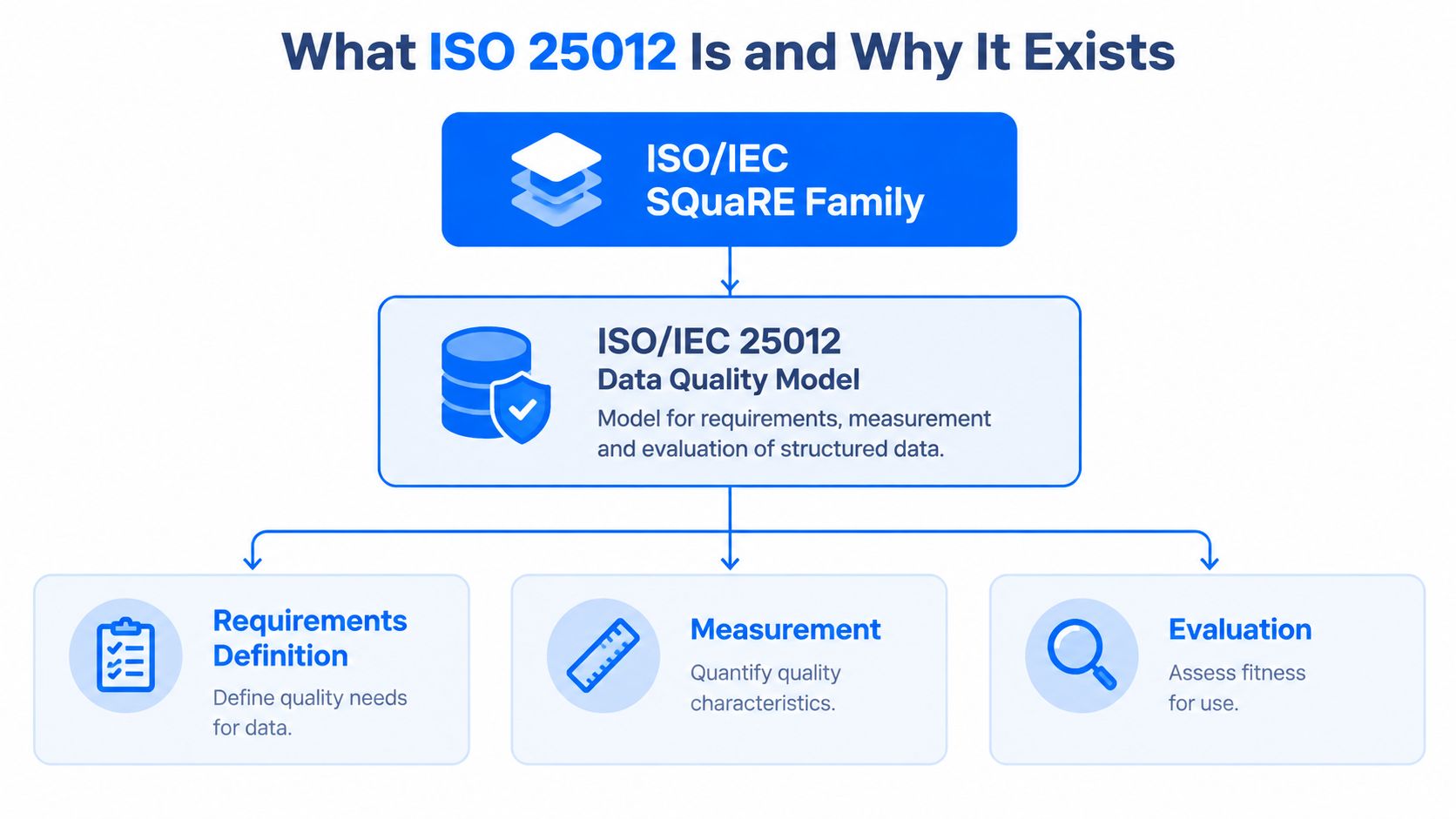
ISO/IEC 25012 is a general data quality model for structured data in computer systems. It was published in December 2008 as part of the ISO/IEC SQuaRE family, and the ISO catalog entry for ISO/IEC 25012 identifies it as a 13-page International Standard.
The standard exists to support three related activities: defining data quality requirements, measuring data quality, and evaluating whether data is suitable for its intended use. It focuses on structured data, which makes it relevant to databases, information systems, analytics environments, and reporting processes.
Think of it as a building code
A building code doesn't tell every architect exactly how to design a hospital, warehouse, or home. It identifies safety concerns and constraints that a design must address. The project team still decides how those requirements apply to the building's purpose, location, materials, and risk profile.
ISO/IEC 25012 works in a similar way. It gives organizations a structured vocabulary of data quality characteristics, rather than a universal score that every dataset must achieve. A customer address, a clinical measurement, and a regulatory transaction may require different priorities even when they're stored in similar database structures.
This is why the model shouldn't be treated as a turnkey implementation guide. It doesn't provide one set of thresholds, weights, monitoring schedules, or ownership assignments for every enterprise. Those decisions belong to the evaluator and the business context.
What the model helps teams do
A practical adoption sequence looks like this:
Define the requirement. State what quality means for a dataset and its intended use.
Select the relevant characteristics. Choose dimensions that reflect business, regulatory, analytical, and operational risk.
Specify evidence. Decide which measurements, validation results, lineage records, or system observations will demonstrate compliance.
Evaluate fitness for use. Determine whether the dataset can support the process, report, model, or decision.
Organizations can use the model as a foundation for data quality standards and governance practices, but implementation still requires local decisions. The distinction prevents a common mistake: assuming that naming a characteristic is the same as controlling it.
The 15 Data Quality Characteristics Explained Simply
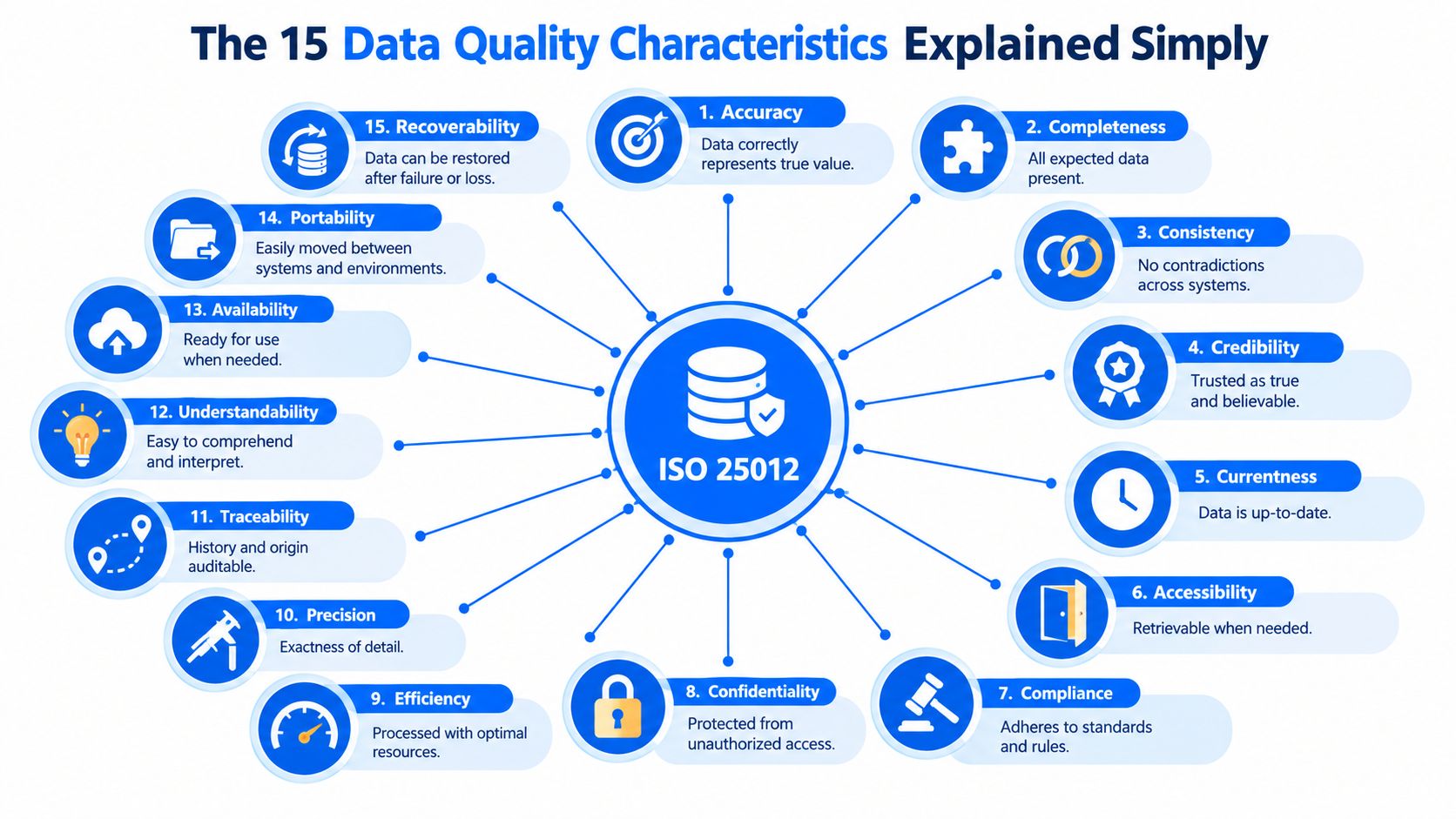
ISO/IEC 25012 defines 15 data quality characteristics. A neutral summary lists them as accuracy, completeness, consistency, credibility, currentness, accessibility, compliance, confidentiality, efficiency, precision, traceability, understandability, availability, portability, and recoverability. The same list appears in the NPL good-practice material on data quality characteristics.
The model groups characteristics around two perspectives. Inherent quality concerns the data itself. System-dependent quality concerns how the surrounding system enables people and applications to access, protect, process, move, and restore that data. Some characteristics can depend on both.
Inherent quality
Accuracy means the value represents the real-world object, event, or condition correctly. A recorded customer address should reflect the customer's actual address.
Completeness means the expected information is present for the intended use. A supplier record missing a required identifier may be unusable even if every populated field is valid.
Consistency means the data doesn't contradict itself or conflict across systems. A customer shouldn't have incompatible lifecycle states in connected applications without a defined reason.
Credibility concerns whether users can reasonably trust the data as believable and reliable, considering its source and collection process.
Currentness means the data reflects the required time horizon. A value can be accurate historically but unsuitable for a process that needs the latest state.
Precision describes whether the data has the appropriate level of exact detail. A rounded value may work for a summary but fail a calculation requiring finer granularity.
System-dependent quality
Accessibility means authorized users and applications can retrieve and use the data.
Compliance means the data and its handling follow applicable rules, standards, contracts, and policies.
Confidentiality protects data from unauthorized access or disclosure.
Efficiency concerns the resources and processing behavior required to use the data effectively.
Traceability allows teams to follow data origins, transformations, changes, and responsible actors.
Understandability makes fields, codes, labels, and meanings clear to their intended users.
Availability means the data and supporting service can be used when required.
Portability supports movement between systems without losing meaning or quality.
Recoverability concerns restoration after loss, corruption, failure, or disruption.
A useful distinction is that accuracy and currentness aren't interchangeable. A timestamped value may have been accurate when captured but stale for today's decision. Likewise, accessibility and availability aren't identical. A system can be running while a user lacks authorized access, or a table can be accessible in principle while the service is unavailable during a critical workflow.
For a broader discussion of how these dimensions work together, see the dimensions of data quality.
Interpreting ISO 25012 for Enterprise Data Programs
A model becomes useful when an organization turns its characteristics into decisions. The same dataset may need strong traceability for an audit, high currentness for operational dispatch, and strict confidentiality for sensitive records. Treating every characteristic as equally important creates noise and makes teams spend effort where the business risk may be lower.
ISO/IEC 25012 leaves weighting, thresholds, and context-specific prioritization to the evaluator. That flexibility is necessary, but it also creates implementation work. A data program must define what each characteristic means for a particular dataset, then connect the definition to a measurable indicator and an owner.
From characteristics to requirements
Start with the use case, not the monitoring tool. For a regulatory report, a requirement might connect compliance, traceability, completeness, and consistency. For a near-real-time operational table, currentness, availability, and recoverability may deserve more attention.
A dataset can appear acceptable overall while failing in a business-critical dimension. An average score can hide semantic inconsistency, incomplete attributes, or data that has become too old for the process. A research study applying ISO/IEC 25012 highlights this practical challenge and the need to evaluate specific characteristics rather than relying only on an aggregate impression.
A scorecard needs context
A useful scorecard should show more than a single grade. Include the characteristic, metric, observed result, threshold, business owner, technical owner, evaluation period, and exception status. Keep the underlying evidence available so a reviewer can move from a summary to the failed records, rule execution, delivery event, or schema change.
ISO/IEC 25024:2015 provides a companion approach for quantitative measures associated with the characteristics defined in ISO/IEC 25012. The ISO catalog entry for ISO/IEC 25024 describes its role in defining measures for data quality. It helps teams move from “monitor completeness” to a defined measurement method, while the organization still decides what result is acceptable for its use case.
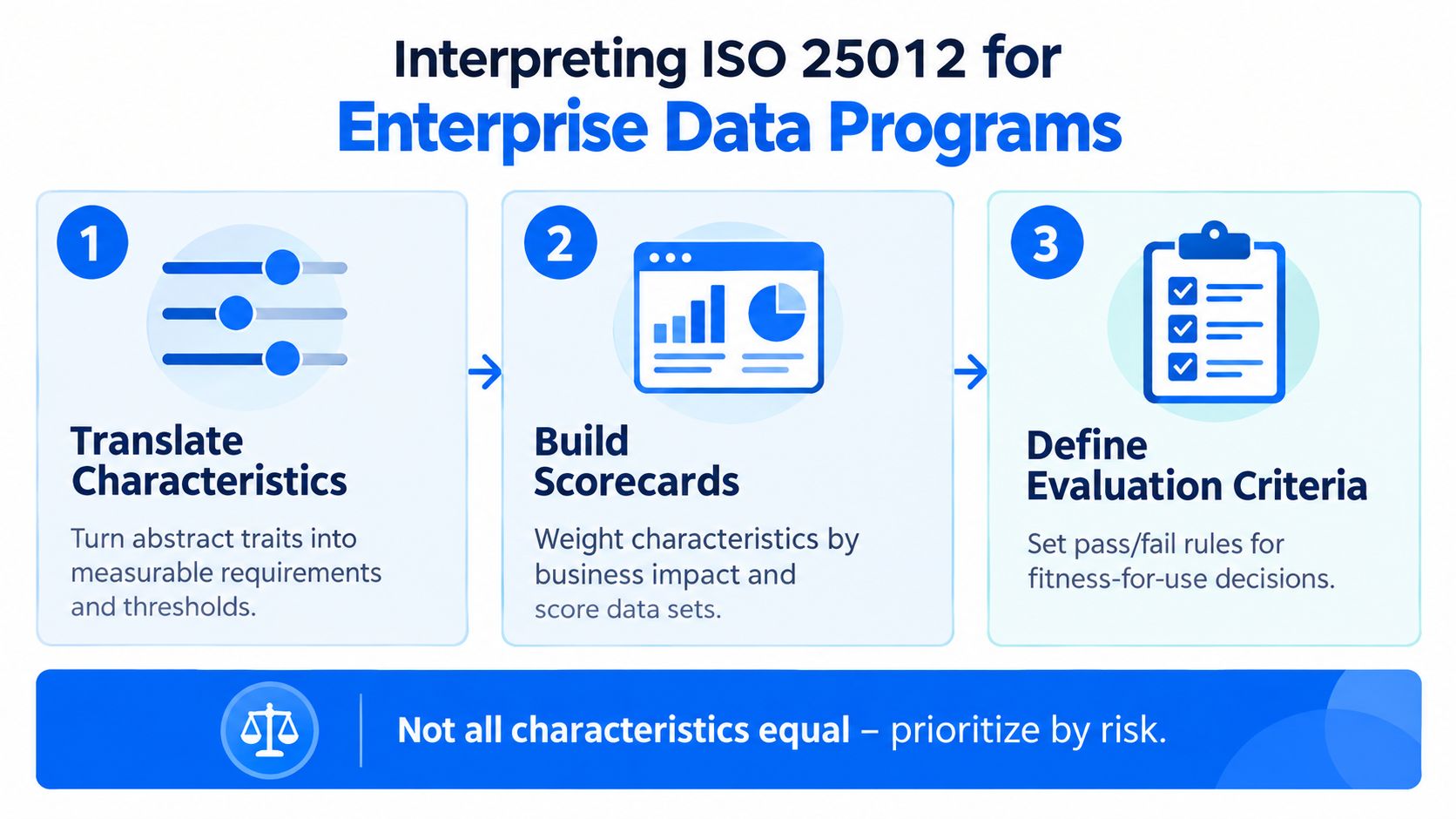
A scorecard is only credible when a reviewer can trace its status back to reproducible evidence.
An enterprise framework should therefore combine prioritization with accountability. Enterprise data quality framework guidance can help structure that operating model, but the implementation must still reflect the organization's risks, architecture, contracts, and service expectations.
Mapping ISO 25012 to Observability and Validation Controls
Operationalization starts by translating each characteristic into an observable question. Can the value be trusted? Did the expected load arrive? Did the schema change? Can the system restore the data? Each question points to a different control family, and no single test covers every dimension.
Use in-database execution where the control can be computed inside the customer's database. That approach keeps the evaluation close to the data and can support private-cloud, VPC, on-premises, and other controlled deployment patterns. The control result should include the dataset, evaluation time, rule or detector used, status, owner, and links to the relevant incident or remediation record.
A practical control map
ISO 25012 Characteristic Group | Operational Control | digna Capability Pattern |
|---|---|---|
Accuracy, credibility, precision | Compare values with trusted references, profile distributions, and detect unusual value behavior | Data Anomalies for baseline-based detection, supported by Data Analytics for historical patterns |
Completeness and consistency | Check required fields, cross-field relationships, reconciliations, and contradictions across sources | Data Validation for explicit rules, with anomaly monitoring for unexpected shifts |
Currentness and availability | Track expected arrivals, missing loads, delays, early deliveries, and access or service interruptions | Timeliness monitoring for delivery behavior and expected delivery time, combined with platform observations |
Compliance and confidentiality | Apply business, policy, and access-related controls; preserve results and ownership records | Data Validation for enforceable requirements, with governance and security controls around the environment |
Traceability and understandability | Maintain source, transformation, field meaning, change history, and documented ownership | Data catalog and shared dashboard patterns, supported by Schema Tracker and team workflows |
Portability | Track structural compatibility, data types, mappings, and semantic changes during transfers | Schema Tracker for added or removed columns and data type modifications |
Efficiency and recoverability | Observe workloads, processing behavior, failures, restoration readiness, and platform resource signals | Data Analytics and data platform observability patterns, with recovery procedures managed by the operating team |
This matrix is a starting point, not a substitute for a control design. A currentness check might inspect arrival time for one table and business-effective dates for another. A consistency check might compare two systems, or it might validate relationships within one dataset.
Separate data defects from platform defects
A useful incident workflow classifies the failure before assigning blame. A value outside a business-approved range is different from a query timeout. A missing field caused by an upstream application is different from a table made inaccessible by a platform outage.
digna offers modules for Data Anomalies, Data Analytics, Timeliness, Data Validation, and Schema Tracker, with metric computation and analysis performed in-database. Teams can use those capability patterns alongside their existing warehouse tests, orchestration alerts, catalog, access controls, backup procedures, and incident management system. The data observability platform overview provides the relevant product context.
The strongest implementation records both the detection and the response. A failed validation should show which rule failed, while a timeliness alert should show the expected delivery pattern and observed event. That evidence turns monitoring from a warning light into a repeatable governance control.
Industry Examples Where ISO 25012 Prevents Costly Failures
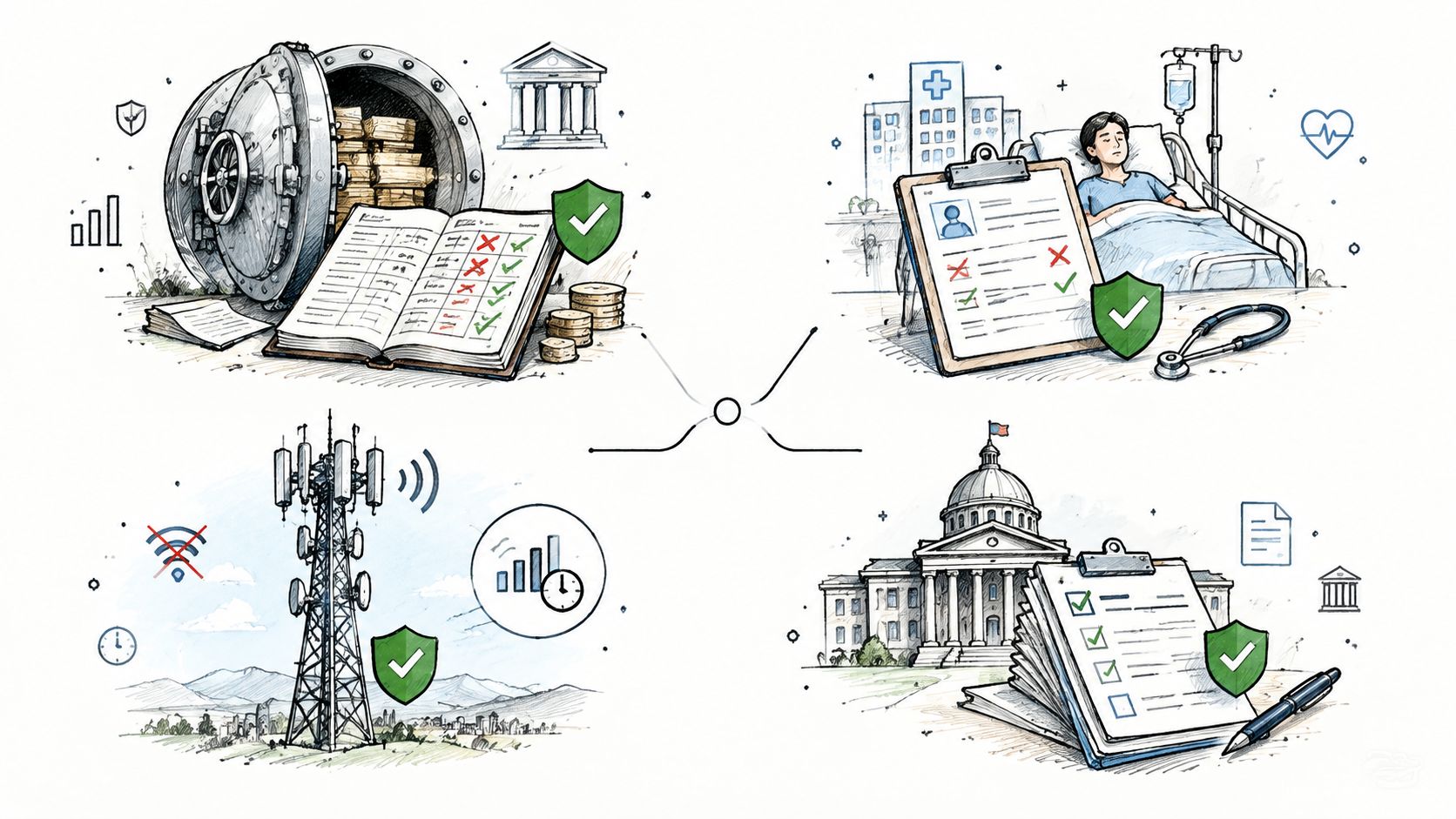
The value of ISO 25012 becomes clearer when the same model is applied to different operating environments. Each industry emphasizes different risks, even though the underlying characteristics remain recognizable.
Financial services
A regulatory reporting team reconciles transactions from several systems. The totals appear plausible, but a transformation changed how a product category is represented. The immediate concern is compliance, yet the remediation also requires traceability, consistency, and clear validation evidence.
The team can preserve the source-to-report lineage, validate approved code values, compare related measures, and route exceptions to named owners. The model helps the team describe the failure precisely instead of labeling the entire report “bad.”
Healthcare
A clinical analytics group receives patient data from multiple collection processes. One feed contains valid records but omits an important field for a subset of encounters. Another feed uses a meaningfully different code interpretation.
Here, completeness, credibility, accuracy, and understandability all matter. Record-level validation can identify missing or invalid values, while documented definitions and source history help reviewers determine whether a discrepancy is a capture problem, a mapping problem, or an interpretation problem.
Telecommunications
A network operations team depends on high-volume event data. A pipeline delay leaves the dashboard accessible, but the view no longer reflects the operating state that engineers need. A separate schema change causes downstream logic to ignore a newly introduced field.
Currentness, availability, portability, and recoverability give the team a more complete diagnosis. Timeliness monitoring can flag delivery behavior, schema tracking can expose structural changes, and recovery procedures can address the consequences of a failed or incomplete load.
Public sector
A government reporting program combines information from departments with different data conventions. Records may be present in every source, yet identifiers and status values don't align. During an audit, the organization must explain not only the published result but also how it was produced.
Consistency, traceability, compliance, and understandability become central. A shared model gives policy owners, engineers, analysts, and auditors a common way to describe the control objective and review the evidence.
Implementation Checklist and Audit Reporting Essentials
Implementation works best when teams treat ISO/IEC 25012 as a living control model rather than a document to file away. Start with the datasets that support material decisions, regulated reporting, customer processes, clinical work, or operational automation.
Use this checklist:
Scope critical data: Identify the dataset, business process, consumers, source systems, and accountable owner.
Choose characteristics: Select the dimensions that match the use case instead of applying every control indiscriminately.
Define measurements: Use ISO/IEC 25024 as a reference for quantitative measures, then document the local metric definition.
Set decision rules: Record thresholds, evaluation windows, severity, escalation, and exception handling.
Assign ownership: Separate business-rule ownership from engineering ownership for platform and pipeline behavior.
Monitor in the right environment: Consider in-database execution inside the organization's VPC, private cloud, on-premises environment, or data center.
Preserve evidence: Keep rule results, anomaly context, delivery history, schema changes, lineage, timestamps, and remediation decisions.
Report by audience: Give engineers incident detail, analysts trend context, and governance leaders a concise control view.
An audit-ready data quality approach should make every reported status explainable. Reviewers need to know what was checked, against which requirement, when it ran, what failed, who responded, and whether the issue affected downstream decisions.
digna provides an enterprise data quality and observability platform that monitors data behavior, validates records, tracks timeliness, detects schema changes, and supports business and platform monitoring inside the customer's environment. Visit digna to explore how its in-database monitoring patterns can help turn ISO 25012 characteristics into measurable controls and audit evidence.
See how digna turns these characteristics into running controls: data quality monitoring across your platforms.
Frequently asked questions
What is ISO 25012?
ISO/IEC 25012 is an international standard that defines a data quality model for information stored in a structured way. It gives teams a shared vocabulary of 15 characteristics, so that "data quality" stops meaning accuracy to one person and freshness to another.
What are the 15 data quality characteristics in ISO 25012?
They cover accuracy, completeness, consistency, credibility and currentness, plus accessibility, compliance, confidentiality, efficiency, precision, traceability, understandability, availability, portability and recoverability. Together they describe both the data itself and the system that serves it.
What is the difference between inherent and system-dependent quality?
Inherent characteristics belong to the data regardless of where it lives, such as accuracy and completeness. System-dependent characteristics depend on the platform delivering it, such as availability and recoverability. Separating them tells you whether you have a data defect or a platform defect.
How do you map ISO 25012 to real controls?
Translate each relevant characteristic into a measurable requirement, then bind it to a control that runs: currentness becomes a timeliness threshold, completeness becomes null-rate monitoring, consistency becomes cross-system reconciliation. A characteristic with no control behind it is vocabulary, not assurance.
Does ISO 25012 certification exist?
It is a reference model rather than a certifiable standard, so there is no audit badge to earn. Its value in an audit is different: it gives you defensible language and a structure for showing which characteristics you measure, how, and with what evidence.