Data Governance Operating Model Guide
|
7
min read

The most popular advice about data governance is also the least useful: create a policy, publish a RACI chart, form a council, and wait for compliance to follow. That approach produces documentation, not control. A data governance operating model has to decide what happens when a pipeline delivers late, a schema changes without notice, a business definition conflicts across domains, or an AI system consumes data faster than a committee can review it.
The practical shift is from governance as periodic administration to governance as continuous execution. Policies still matter, but they only create value when owners, stewards, engineers, and platforms apply them through repeatable workflows. The strongest operating models connect decision rights to runtime checks, issue queues, metadata, escalation paths, and business outcomes.
Table of Contents
Moving Beyond Policy Documents to Execution
The rule is not the workflow
Choosing the Right Structural Pattern
Compare authority, speed, and risk
Test the model against reality
Defining Roles and Decision Rights
Separate strategy from execution
Make stewardship continuous
Measuring Success with Operational KPIs
Connect control metrics to business outcomes
Assign ownership to the metric
Enforcing Governance Through Data Observability
Put controls inside the operating loop
Keep data in the customer environment
Implementation Roadmap for Data Teams
Assess the current failure pattern
Design the minimum operating system
Pilot, learn, then scale
Adapting to Machine-Speed Data Environments
Move controls to the point of change
Moving Beyond Policy Documents to Execution
A policy can state that critical data must be accurate, timely, secure, and properly defined. It can't identify the person who will resolve a failed validation before a downstream report runs. It can't prioritize a defect against competing engineering work, record the decision, or prove that the control operated when an auditor asks for evidence.
That gap explains why governance programs often appear complete while users still argue about definitions and data teams still discover failures through broken dashboards. The modern operating model emerged as a response to this problem. The Data Governance Institute's history shows an initial visual model in 2003, a process model in 2004, and an expanded version by 2005, while later commentary places formal governance frameworks as far back as the 1980s and identifies policy-driven enterprise repository eras across the 1990 to 2010 period and after 2010 (Data Governance Institute framework history).
The rule is not the workflow
An operating model is the execution layer that turns policy into weekly decisions. It defines who owns a data product, who approves access, who resolves a quality defect, which forum handles a cross-domain conflict, and how teams know that a fix worked. It also connects those decisions to technology platforms, so governance applies across warehouses, lakes, applications, and pipelines rather than living in a shared folder.
A useful operating model makes accountability visible:
Decision rights: A named role can approve, reject, define, or change something.
Operational routines: Teams review incidents, definitions, access requests, and policy exceptions on a predictable cadence.
Issue management: Defects enter a queue with an owner, priority, status, and escalation route.
Evidence: Metadata, lineage, validation results, and remediation history show what happened.
Measurement: KPIs track not only control activity, but the business effect of better data.
Practical rule: If a policy doesn't produce a decision, a control, or evidence of enforcement, it isn't operational governance yet.
This doesn't mean every decision belongs to a central governance office. It means every important decision needs a clear home. A practical data governance implementation approach starts with the decisions that create the most operational risk, then embeds ownership and enforcement into existing data work instead of adding a separate ceremony.
Choosing the Right Structural Pattern
The structural choice determines where authority sits and how quickly teams can act. Most enterprises describe their approach as centralized, hybrid, or distributed. A 2024 Dresner Advisory Services study cited in industry coverage found that 53% of organizations use centralized governance, 31% use a hybrid approach, and 16% use a distributed model (governance model benchmark).
That distribution matters, but it shouldn't become a template. Centralization can create consistency and a clear audit trail, yet it can also turn the governance team into an approval queue. A distributed model puts decisions close to the data, but without shared definitions and enforcement tooling, domains can create incompatible standards. Hybrid governance usually offers the most practical balance for complex enterprises, provided the central layer sets enforceable guardrails and domains have real accountability.
Compare authority, speed, and risk
Model Type | Decision Authority | Best Suited For | Primary Risk |
|---|---|---|---|
Centralized | A central governance function sets standards, approves policies, and coordinates enforcement | Organizations that need consistent control or are building foundational governance capability | Bottlenecks, slow approvals, and shadow practices |
Hybrid | An enterprise council sets common policies while domain teams execute daily governance | Large, complex organizations with shared compliance needs and distributed data ownership | Fragmented execution when roles and tooling are weak |
Distributed | Business or domain teams make most governance decisions locally | Organizations with strong domain ownership and mature data practices | Conflicting definitions, uneven controls, and isolated data practices |
Use the model that matches how your organization already makes decisions, not the model that sounds most modern. A company with unclear ownership won't become federated just by naming domain stewards. A regulated enterprise may keep classification, access principles, and audit requirements centrally controlled while allowing domains to define operational rules for their own data products.
Test the model against reality
Ask four questions before choosing:
Who has authority today? If business leaders already make data decisions, centralization may fail unless the sponsor can change incentives and funding.
Where does domain knowledge sit? The people closest to data creation usually understand its meaning and acceptable use better than a remote central team.
Which controls must be consistent? Security, privacy, regulatory evidence, and enterprise definitions may need common standards even when execution is local.
Can the organization coordinate? A hybrid model requires councils, catalogs, lineage, issue workflows, and escalation paths that domains use.
A federated approach isn't just decentralization with a better name. It needs an explicit division between enterprise guardrails and domain execution, as described in this guide to federated data governance. Without that division, the structure drifts toward either central bottlenecks or disconnected local practices.
Defining Roles and Decision Rights
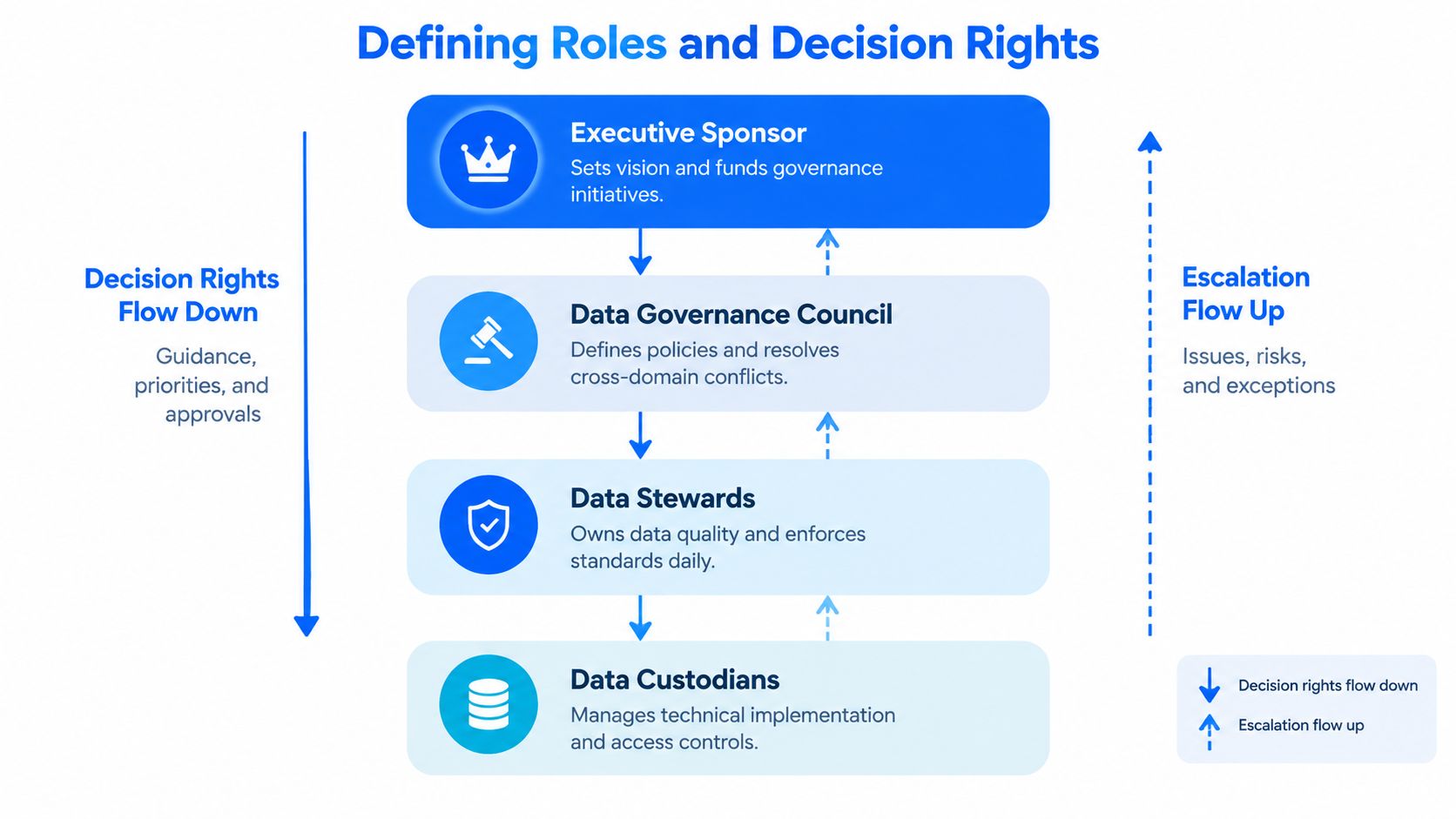
Titles don't create accountability. A role becomes operational only when the person assigned to it has authority, time, access to the right information, and a defined escalation route. The core separation is straightforward: owners decide, stewards operationalize, and custodians implement.
The data owner is accountable for decisions about a data domain or product. That includes acceptable use, access principles, quality expectations, retention decisions, and prioritization when trade-offs affect the business. The owner shouldn't be a ceremonial name in a catalog. If an owner can't approve a definition or prioritize remediation, the organization has assigned responsibility without authority.
The data steward handles daily governance. Stewards maintain metadata, clarify definitions, monitor quality, implement policies, coordinate with business stakeholders, and manage issue resolution across the data lifecycle. They translate a business requirement such as “active customer” into a definition, a rule, a validation method, and an accountable workflow.
The data custodian manages technical care. Custodians implement access controls, maintain platforms, support integrations, and apply technical safeguards. They shouldn't decide what a business term means, just as a steward shouldn't be expected to administer every database or access system.
Separate strategy from execution
A two-tier structure prevents strategic and operational decisions from competing in the same meeting. An Executive Oversight Group can approve the mission, vision, goals, and policy changes. A Data Governance Committee, Council, or Board can define and periodically review those goals, prioritize initiatives, formally adopt policies and standards, and resolve issues escalated by stewards (National Academies governance structure).
That arrangement gives the operating model a reliable escalation chain:
A steward identifies a defect, conflict, or policy exception.
The domain owner decides when the issue falls within the domain's authority.
The governance council resolves cross-domain conflicts or adopts a shared standard.
Executive oversight approves decisions that change enterprise direction, funding, or risk posture.
The custodian implements the approved technical control and records the evidence.
Make stewardship continuous
Metadata maintenance shouldn't happen only during catalog cleanup. A metadata-driven model assigns stewards responsibility for definitions, lineage context, quality monitoring, issue resolution, and policy implementation throughout the lifecycle (metadata stewardship reference).
Create a role charter for each critical domain. It should name the owner and steward, list the decisions they can make, define the issues they must escalate, identify the custodian responsible for implementation, and specify the evidence that closes an issue. More detail on practical accountability appears in this guide to data governance roles.
Measuring Success with Operational KPIs
The difficult governance question isn't whether the organization has a council or a catalog. It's whether leadership can see a business result. In a 2025 enterprise survey, 39% of data leaders said they struggle to demonstrate governance impact to leadership (2025 State of Enterprise Data Governance report).
Technical measures still have a place. Governed metadata coverage, named ownership, approved definitions, quality results, access workflow performance, and issue resolution all show whether the operating model is functioning. They don't automatically explain why that function matters to finance, risk, operations, or the board.
Connect control metrics to business outcomes
Build a metric chain rather than a dashboard of disconnected scores:
Control signal: A critical table fails a timeliness check.
Operational response: The steward receives an alert, assigns the incident, and coordinates remediation.
Business effect: A report, decision process, model, or regulatory submission avoids using stale data.
Executive outcome: The organization reduces risk, protects revenue, improves decision speed, or controls operational cost.
For example, “quality score improved” is weak executive language without context. “A validation control prevented an unreliable record set from reaching a regulated reporting workflow” communicates risk reduction. “Timeliness monitoring identified a delayed delivery before analysts consumed the dataset” connects observability to decision speed.
Assign ownership to the metric
Each KPI needs an owner, a definition, a source, a review cadence, and an action threshold. The data owner should own the business outcome. The steward should own the operational response. The custodian should own the technical availability and implementation of the control. Finance, risk, or operations should validate whether the chosen measure reflects a material outcome.
A role such as a data operations governance director illustrates why this work often sits between governance, operations, and business performance. The position needs enough reach to connect control evidence with operational priorities, rather than reporting only on the number of policies published.
Use an outcome-oriented data governance KPI framework to keep the scorecard focused. Start with a small set of critical data products and show how ownership, control performance, incident response, and business impact relate. The scorecard should help leaders decide where to invest, not merely confirm that governance activity occurred.
Enforcing Governance Through Data Observability
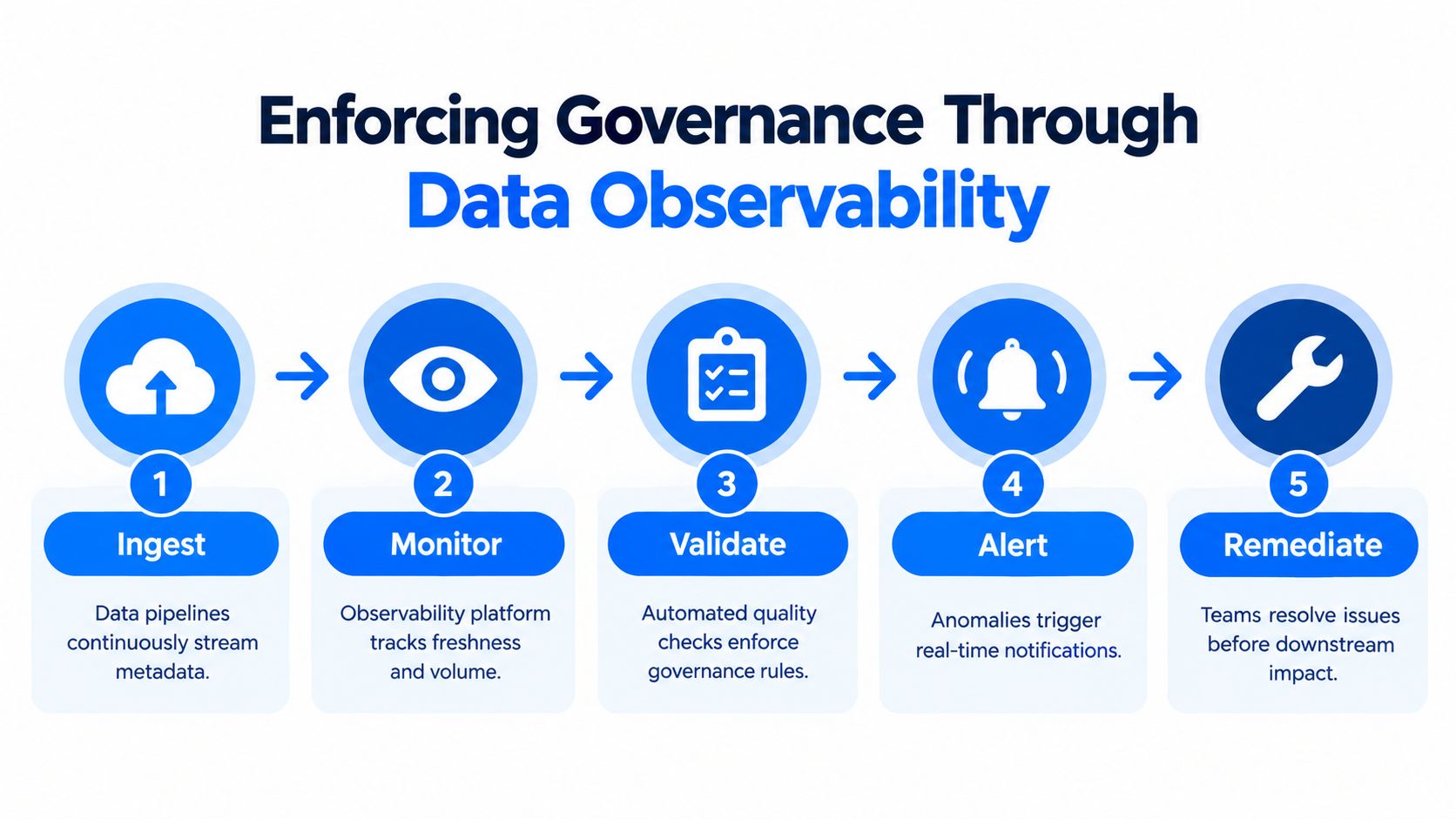
Monthly review cycles can't govern systems that change continuously. A pipeline can introduce schema drift between meetings, a source can arrive late, and a business metric can move outside its normal pattern before anyone opens the governance calendar. Runtime enforcement places controls beside the data workflows where failures occur.
A modern observability layer can monitor behavior, delivery, structure, and business rules without turning every condition into a manually maintained policy. AI-driven baseline learning can identify unusual patterns, while deterministic validation can enforce explicit record-level requirements. Timeliness monitoring can learn expected arrival behavior, and schema tracking can flag added or removed columns or data type changes.
Put controls inside the operating loop
The workflow should be concrete:
Ingest metadata: Pipelines expose operational signals about the data assets they produce.
Monitor behavior: The platform tracks freshness, volume, availability, and other relevant signals.
Validate records: Business rules test whether records meet defined requirements.
Alert accountable teams: Anomalies and failures trigger notifications tied to owners and stewards.
Remediate with evidence: Teams resolve the issue, document the action, and retain the result for review.
Governance moves beyond a meeting agenda. A steward can see that a delivery was late, a validation failed, or a structural change threatens a downstream consumer. The custodian can inspect the technical path. The owner can prioritize the response according to business impact.
Keep data in the customer environment
For enterprises in finance, healthcare, telecommunications, and the public sector, control placement matters as much as detection. An in-database design computes metrics and analysis within the customer's databases, while private cloud or on-premises deployment keeps the platform inside the customer's cloud, VPC, or data center.
digna provides one example of this pattern. Its modules cover AI-driven anomaly detection, historical observability analysis, timeliness monitoring, record-level validation, schema tracking, and in-database execution, with a shared dashboard for engineers, analysts, and stakeholders. The platform also includes a scheduler, data catalog, integrations, and collaboration features from the initial module selection, allowing teams to connect runtime evidence with governance ownership.
A tool still won't repair an unclear decision structure. Automation should route evidence into the same roles, queues, and escalation paths defined by the operating model. Explore data observability capabilities when evaluating how to place continuous controls across warehouses, lakes, and pipelines.
A short visual explanation can help technical and governance stakeholders align on the control loop:
Implementation Roadmap for Data Teams
Don't begin by trying to govern every table, policy, and business term. Start with a domain where unreliable data creates visible operational pain and where a business owner is willing to participate. A narrow implementation produces evidence, feedback, and trust before the team expands the model.

Assess the current failure pattern
Map one critical data flow from source to consumption. Identify who creates the data, who uses it, which definitions cause disputes, where delays are detected, which controls already exist, and who currently fixes incidents. Review the existing catalog, pipeline alerts, access process, and issue queues. The assessment should reveal operational gaps, not produce another abstract maturity score.
Choose a domain with a measurable consequence, such as unreliable operational reporting, inconsistent customer definitions, delayed risk data, or frequent schema-related failures. Secure an accountable data owner before design work begins.
Design the minimum operating system
Write a compact charter that names:
Decision owners: Who approves definitions, access principles, quality expectations, and exceptions.
Daily stewards: Who maintains metadata, monitors controls, and coordinates remediation.
Technical custodians: Who implements access, pipeline, and platform controls.
Forums: Which decisions belong in domain routines, governance council meetings, or executive oversight.
Evidence: Which validation results, lineage records, issue histories, and approvals must be retained.
Measures: Which operational and business KPIs will show progress.
Avoid designing a council that has no connection to engineering work. Every forum should receive inputs from real incidents and return decisions that teams can implement.
Pilot, learn, then scale
Run the model against a small set of critical data products. Establish a feedback loop between the steward who understands the business meaning, the engineer who owns the pipeline, and the owner who decides priority. Record false alerts, unclear definitions, missing metadata, and approval delays. Those observations are design input.
After the pilot, standardize reusable controls, role charters, issue categories, and escalation rules. Scale by domain, not by indiscriminate asset count. Add automation where manual review creates delay, and keep exceptions visible so local flexibility doesn't become an undocumented bypass.
Adapting to Machine-Speed Data Environments
AI agents and automated pipelines expose the limits of committee-first governance. An agent can query, transform, summarize, or write to systems faster than a monthly review cycle can approve a new use. A policy that isn't translated into machine-enforceable permissions, validation rules, lineage, and evidence leaves the organization dependent on after-the-fact investigation.
Recent governance coverage reflects this pressure. A 2025 to 2026 preview of enterprise reporting found a nearly even split between centralized and federated models, with hybrid approaches gaining traction, indicating continued experimentation rather than one settled standard (AI governance operating model analysis). The same coverage claims that only 14% of enterprises enforce AI governance enterprise-wide, a reminder that policy adoption and operational enforcement remain different achievements.
Move controls to the point of change
The future operating model won't eliminate councils or owners. It will give them a different job. Councils define the guardrails, owners determine acceptable business use, stewards maintain meaning and quality, and custodians place controls directly into pipelines, platforms, and access systems.
For AI workloads, the model should answer practical questions:
What data can an agent access?
Which actions can it perform?
What lineage and decision evidence must it retain?
Which validation rules apply before data reaches a model or agent?
Who receives an alert when behavior changes?
What happens when the system operates outside an approved pattern?
A resilient model combines central standards with local execution, but its real differentiator is control placement. Continuous validation, anomaly detection, timeliness monitoring, schema tracking, and runtime access evidence let teams govern distributed environments without forcing every decision through one office.
Governance that only reviews yesterday's data can't control tomorrow's automated decision.
The operating model should therefore be designed as a control loop. Define the rule, assign the decision right, enforce it where data moves, observe the result, route exceptions to the right person, and use the evidence to refine both policy and implementation. That approach scales better than adding meetings because it makes governance part of how data systems run.
digna helps data teams operationalize governance with in-database anomaly detection, timeliness monitoring, record-level validation, and schema change tracking inside the customer's own environment. Visit digna to see how continuous observability can connect data ownership, runtime controls, and audit-ready evidence.
For the domain-level version of this decision structure, see how federated data governance keeps standards consistent without routing every decision through a central queue.
Frequently asked questions
What is a data governance operating model?
It is the working structure that decides what actually happens when a pipeline delivers late, a schema changes without notice, two domains disagree on a definition, or an AI system consumes an unverified feed. It converts policy into repeatable decisions with named owners.
How is an operating model different from a governance policy or RACI chart?
A policy states intent and a RACI names roles in the abstract; neither tells you who can halt a feed at 2am. The operating model adds the missing half — decision rights, escalation paths, and routines — so governance runs continuously instead of being administered periodically.
How do you actually enforce data governance?
By putting controls inside the operating loop rather than in a review cycle. Validation, timeliness checks and schema-change tracking run against production data, and each finding routes to an owner with the authority to act. Enforcement is a workflow, not a committee.
Which metrics show that governance is working?
The useful ones connect a control to a business outcome: how many critical assets have named owners, how quickly a breach is detected and resolved, how often the same failure recurs, and how much of the estate is covered. A metric nobody owns measures nothing.
How should a team start building one?
Assess the failure pattern you actually have, design the minimum operating system that addresses it, then pilot on one domain before scaling. Starting with a full framework produces documentation; starting with one real failure produces a control that survives contact with production.