AI Governance Platform: Core Capabilities and Data Controls
|
6
min read

The most common advice about an AI governance platform is backwards. Teams are told to start with policies, approvals, and framework checklists, then hope the operational layer follows later. In practice, governance fails when it stops at documentation and never reaches the data, the runtime, and the evidence trail that proves controls still work after deployment.
A workable AI governance platform is not a folder of standards or a ticket queue for sign-offs. It is an operating layer that keeps ownership clear, measurements current, and escalation paths active while models, agents, and data pipelines keep changing. That is why the strongest implementations look less like static compliance repositories and more like persistent observability systems tied to risk decisions.
Table of Contents
Redefining the AI Governance Platform
The first mistake is treating governance as something finished before launch. NIST's AI RMF 1.0 was released on January 26, 2023 as a voluntary, cross-sector framework built around Govern, Map, Measure, and Manage, with a companion Playbook following on March 30, 2023 NIST AI RMF development. That structure matters because it frames governance as an ongoing operating model, not a one-time approval.
Governance has to survive production
A platform that only stores policies cannot prove anything about runtime behavior. It cannot show who owns a deployed model, what data it consumed, whether outputs drifted, or when a human override changed the result. Those are the questions regulators, auditors, and internal risk teams eventually ask, and they need time-stamped evidence, not a policy PDF.
Practical rule: if a control cannot be monitored after deployment, it is a statement of intent, not a control.
The platform model has to preserve ownership, keep inventories current, record incidents, validate data, and retain audit evidence as part of daily operations. For multinational teams, NIST's voluntary and technology-neutral design also gives a common internal control model that can travel across jurisdictions.
What an observability platform does in practice matters here because AI governance and observability address the same failure pattern from different angles. One defines accountability, the other proves what happened. A real platform has to do both.
Core Capabilities of Modern AI Governance
The four NIST functions matter only when the platform turns them into controls that operate every day. Govern means ownership, policy, and accountability. Map means knowing intended purpose, risk class, affected users, and dependencies. Measure means testing behavior with documented methods. Manage means escalating, remediating, and preserving evidence NIST AI RMF PDF.
What the platform must connect
A mature system links every deployed model to its intended purpose, accountable owner, risk classification, data lineage, evaluation results, known limitations, and remediation status. That linkage turns the AI inventory into an operational register instead of a spreadsheet. Without it, teams cannot answer a basic question quickly: can this model keep running in its current context?
Measurement matters just as much. NIST says AI risk measurement can be quantitative, qualitative, or mixed, and it should include software testing, performance assessment, uncertainty documentation, benchmark comparison, and formal reporting. In platform terms, that means versioned registries, repeatable evaluation pipelines, threshold-based alerts, and review workflows that stay live after deployment.
A platform that never measures drift after launch will eventually confuse stability with luck.
Production telemetry has to include signals governance can act on, such as accuracy proxies, drift indicators, resilience failures, response time, and override rates. Those signals should map to preset tolerances and escalation procedures. The point is not to build more dashboards. It is to make each alert traceable to an owner and a response path.
For the measurement side of this, including how to tell genuine model drift apart from upstream data changes, see our practical guide to model drift detection.
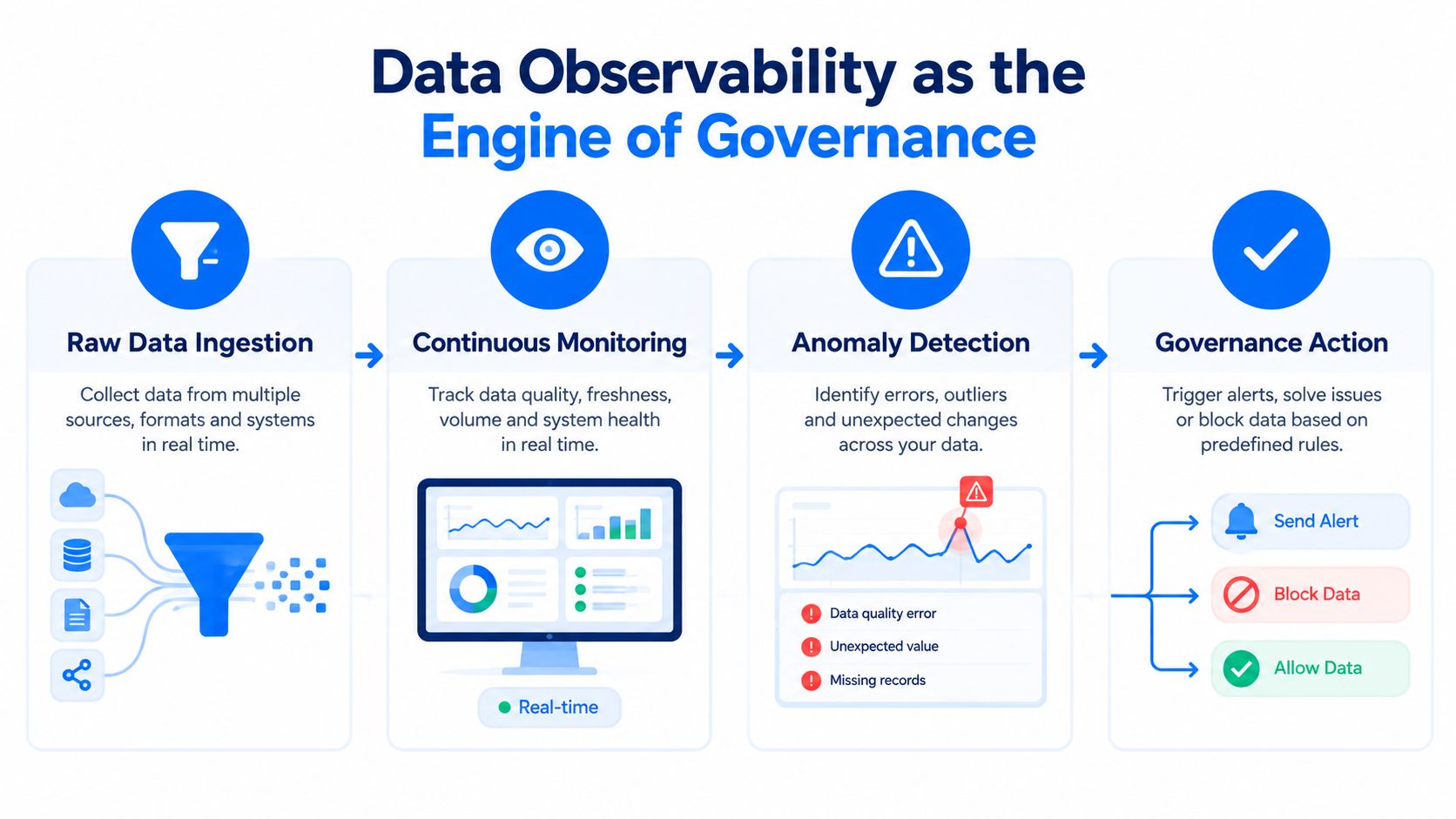
Data quality observability controls fit naturally into this layer because model monitoring without data monitoring leaves a blind spot. Most runtime failures start upstream, in records, schemas, or timeliness, not in the algorithm itself. The platform has to see both.
Data Observability as the Engine of Governance
The cleanest way to think about model risk is to stop blaming the model first. In regulated environments, the failure often begins with the data feeding it, then shows up later as a bad prediction, a broken decision, or an audit gap. That is why governance platforms need in-database observability, not just model review forms.
Why upstream data changes matter
Article 16 of the EU AI Act requires documentation, records, monitoring, and control mechanisms that let authorities assess compliance, while high-risk systems also need technical documentation covering performance, limitations, testing evidence, and monitoring strategy EU AI Act Article 16. If the underlying data changes and the platform doesn't notice, the documentation becomes stale even if the model code never changed. That is a governance failure, not a data team inconvenience.
The practical controls are straightforward, but they have to run continuously. Schema tracking catches added, removed, or modified fields before downstream reports or models consume them. Timeliness monitoring catches missing loads, late arrivals, and delivery anomalies. Record-level validation catches business-rule failures that synthetic benchmarks won't surface. When those checks run inside the customer's environment and inside the database, production records stay in place and the evidence chain stays intact.
Why in-database execution changes the evidence model
That distinction matters in regulated industries, especially when governance needs to prove what happened without copying sensitive data into another platform. In-database execution reduces movement, preserves residency, and keeps the control evidence closer to the source. It also makes continuous validation more credible because the checks run where the data lives, not on stale extracts.
Independent analysis summarized by MIT Sloan Management Review estimated that poor data can cost most companies between 15% and 25% of revenue, while only 3% of examined data collections fell within an acceptable error range, nearly 50% of newly created records contained critical errors, and knowledge workers could spend up to 50% of their time on routine data-quality problems MIT Sloan Management Review. Those figures explain why governance has to watch operational records, analytics datasets, and pipelines continuously.
The data observability framework matters because the evidence chain needs to show source data, model version, deployment context, monitoring events, incidents, and corrective actions as one connected record. In practice, that keeps compliance documentation from drifting away from reality.
Operationalizing Regulatory Compliance and Evidence
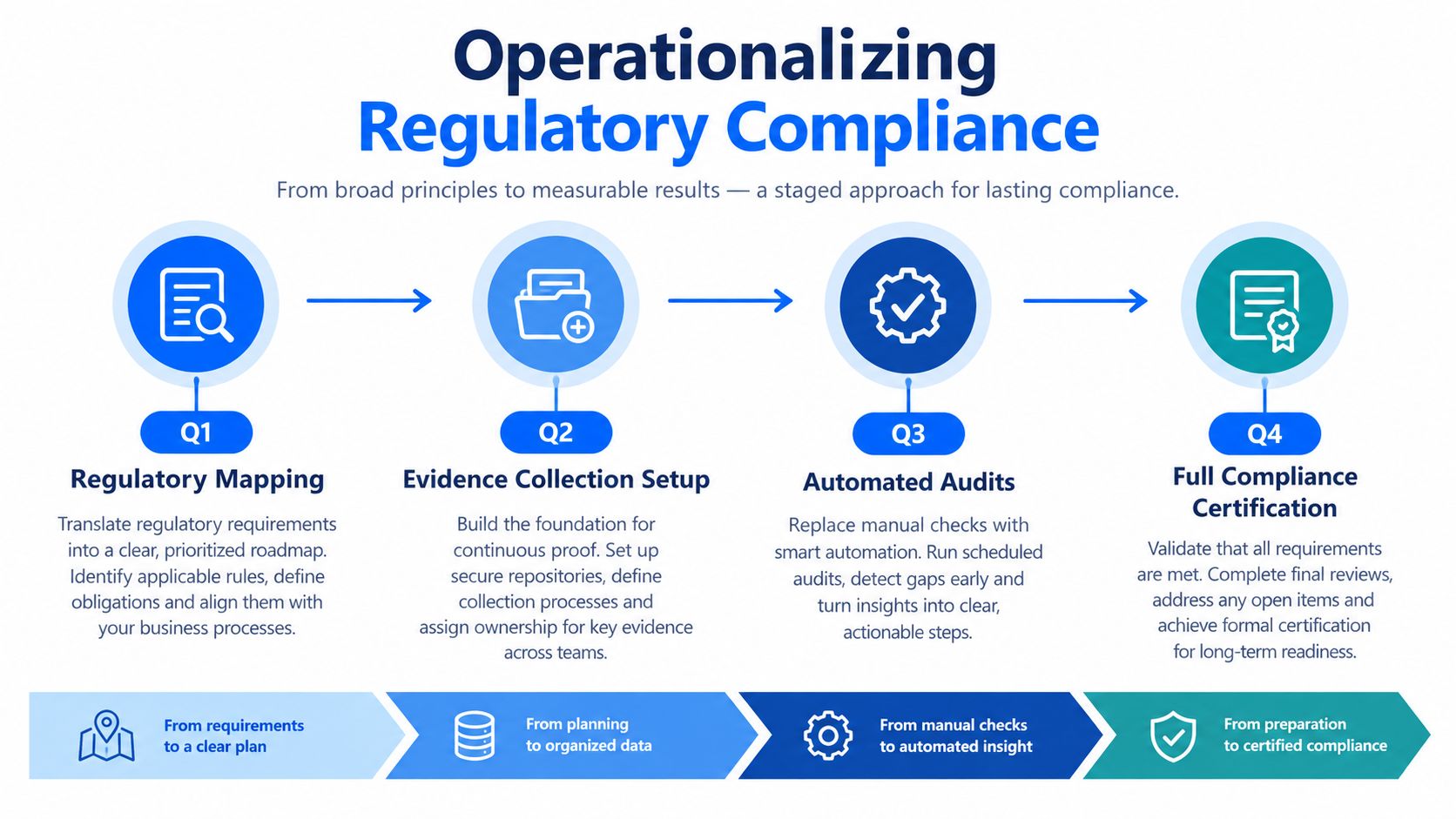
The EU AI Act turns governance into an operating discipline, not a policy memo. It entered into force on August 1, 2024, with staged obligations that applied on February 2, 2025 and August 2, 2025, and that are scheduled to apply on August 2, 2026, August 2, 2027, December 2, 2027, and August 2, 2028 depending on the obligation and system class EU AI Act timeline. That sequence forces teams to build controls, evidence trails, and reassessment windows into the platform itself.
Turn deadlines into control loops
The practical move is to treat each regulatory milestone as a workflow trigger. Classification comes first, because the organization needs to know whether a system is general-purpose, high-risk, or subject to transparency duties. The platform can then bind that class to the required documentation, testing evidence, and review cadence.
For high-risk systems, Article 10 requires training, validation, and testing datasets that are relevant, sufficiently representative, and, to the greatest extent possible, free of errors and complete for the intended purpose EU AI Act Article 10. A governance platform therefore needs immutable dataset versions, provenance records, data-quality test outputs, subgroup or scenario analysis where appropriate, and a clear change history. A one-time assessment will not survive upstream data drift.
Compliance gets brittle the moment evidence lives in email, spreadsheets, and ad hoc exports.
The stronger pattern is an evidence chain that starts with source data and ends with corrective action. Each model release should carry the dataset version, approved mitigations, evaluation protocol, and monitoring status. Each incident should link back to the affected use case, the data or model change that came before it, and the decision taken by the accountable team.
Teams that need a practical way to prepare developer workflows for review can use that approach to move audit readiness earlier in delivery, before evidence fragments across systems. The benefit is less rework when governance and engineering share the same control trail.
AI governance compliance workflow support belongs here because compliance only scales when the evidence is generated during operations, not reconstructed later. If the platform cannot retain traceability across data, model, and deployment events, the documentation will age out before the next review cycle.
Governing Agentic AI Without Creating Bottlenecks
Autonomous agents expose the weakest part of most governance programs, the approval queue. A centralized review body can handle a handful of model launches, but it gets overloaded once agents start making tool calls, chaining actions, and changing their own execution paths. The answer isn't more meetings, it's better runtime control.
What continuous oversight has to include
The minimum telemetry for agentic systems is different from static model monitoring. Governance has to track permissions, tool usage, human overrides, changing objectives, and the evidence of decisions across workflow steps. It also has to distinguish low-risk actions that can proceed automatically from actions that need escalation.
Deloitte reports that only one in five companies has a mature governance model for autonomous AI agents, while SAP's survey found that 38% lack human-in-the-loop processes for agent oversight Deloitte state of AI in the enterprise. Those numbers match what many platform teams see in practice, too much review capacity is spent approving routine activity, while too little attention goes to runtime behavior.
A better design uses threshold-based controls. Low-risk actions can move automatically when they stay inside approved policy bounds. Higher-risk actions trigger human review, logging, and escalation. That structure preserves speed without turning the governance team into a permanent bottleneck.
Why observability beats centralized approval
Agentic AI changes context quickly. A workflow that was safe yesterday can become risky when a tool permission changes, a data source shifts, or an objective gets rewritten. Traditional approval boards rarely see those changes in time. Runtime observability does, because it watches the live configuration, the data inputs, and the resulting actions.
Governance for agents works when the platform can show who did what, with which permissions, against which data, and under what fallback rule.
That is also where data observability becomes more than a nice-to-have. If an agent consumes stale, malformed, or incomplete data, the business output can look intentional while being wrong. Monitoring unusual business outputs, timeliness shifts, and schema changes gives governance the context it needs to decide whether the agent should keep running.
Deployment and Security for Regulated Industries
In finance, healthcare, telecommunications, and the public sector, deployment location is part of the control design. If a governance platform requires production data to leave the customer's environment, the architecture is already at odds with residency, confidentiality, and evidence requirements. The safer pattern is to run checks inside the customer's cloud, VPC, or data center.
Why data movement changes the risk
A platform that touches production data through external APIs or remote processing inherits the compliance burden of the data it sees. That can complicate security review, privacy review, and procurement all at once. In contrast, in-environment execution keeps sensitive records local and narrows the blast radius of the governance tool itself.
digna is one platform option that runs inside the customer's own environment with in-database computation, which fits the private-deployment model many regulated teams require. The important point is not the brand, it's the deployment pattern, because governance evidence is only as trustworthy as the system that captured it.
The architecture should also be modular. Teams rarely need every control on day one, and forcing a full-platform rollout can slow adoption. Usage-stable licensing is useful when the goal is to start with one control domain, then expand as the program matures, without redesigning procurement each time a new use case appears.
Customer data protection controls matter because governance tools themselves can become compliance actors if they sit too close to production records. In regulated environments, that risk is not theoretical, it affects how the platform is deployed, reviewed, and audited.
Building Your AI Governance Roadmap
The fastest path away from fragmented governance is to start with inventory and telemetry together. If you only document systems, you miss runtime behavior. If you only monitor runtime behavior, you miss accountability, classification, and ownership. A serious roadmap has to join both.
Start with what you can prove
Begin by assigning one owner per use case, not per model. Then record the data sources, intended purpose, risk class, and downstream business process for each use case. From there, define what evidence must exist when the system is operating normally, when it drifts, and when it fails.
Next, add the controls that expose change. Schema monitoring catches structural breakage. Timeliness monitoring catches late or missing data. Validation rules catch business-rule violations. Incident workflows preserve what happened and who responded. Those four pieces give governance a factual base instead of a narrative reconstruction.
If a governance review depends on people remembering what happened, the system is too weak to trust.
The last step is escalation design. Low-severity issues should route to operational owners automatically. High-severity issues should pause deployment, open a review, and preserve the evidence trail. That way, governance stays active without turning into a permanent manual gate.
A practical AI governance platform should help teams keep inventories evergreen, align controls to regulations, and document changes without hunting through disconnected tools. It should also support the technical layer that proves data and model behavior are still within tolerance. That combination is what makes governance auditable, scalable, and useful.
If you're trying to move from policy documents to runtime proof, digna gives data teams the observability layer that AI governance needs, with in-database monitoring, schema tracking, validation, and timeliness controls inside the customer's environment. If you want to connect data evidence to governance workflows without moving production records, visit digna and evaluate how it fits your AI control stack.
Frequently asked questions
What is an AI governance platform?
It is an operating layer that keeps ownership, measurement and escalation active after deployment, not a folder of policies. It links each deployed model to its intended purpose, accountable owner, risk class, data lineage, evaluation results and remediation status, so teams can prove their controls still work in production.
How does the NIST AI RMF relate to an AI governance platform?
NIST's AI RMF 1.0, released in January 2023, organizes AI risk work into four functions: Govern, Map, Measure and Manage. A platform turns them into daily controls - ownership and policy, risk classification and dependencies, documented testing, and escalation with preserved evidence.
Why does data observability matter for AI governance?
Most runtime failures start upstream, in records, schemas or late loads, rather than in the model itself. If the data changes and nobody notices, model documentation goes stale even though the code never changed. Schema tracking, timeliness monitoring and record-level validation keep the evidence current.
What does the EU AI Act require from training and testing data?
For high-risk systems, Article 10 requires training, validation and testing datasets that are relevant, sufficiently representative and, as far as possible, free of errors and complete. In practice that means immutable dataset versions, provenance records, data-quality test outputs and a clear change history.
How can teams govern agentic AI without slowing it down?
Replace the central approval queue with threshold-based controls. Low-risk actions inside approved policy bounds proceed automatically, while higher-risk actions trigger human review, logging and escalation. Runtime observability of permissions, tool usage, overrides and data inputs shows when a once-safe workflow has become risky.