AI Governance Compliance: EU Act & GDPR Obligations 2026
|
6
min read

Your data platform team just found a problem no one wants to own. The AI logs are incomplete, the training dataset has no clean lineage trail, and an audit review is already on the calendar. When the legal team asks who approved the last model update, the answer lives in three different systems, and none of them agree.
That's the point where AI governance compliance stops being a policy document and starts becoming an operational discipline. The essential work isn't writing principles, it's proving that every AI system is discoverable, controlled, and auditable after it goes live. For teams that build and run data pipelines, that means treating compliance like data observability for AI, with the same rigor you'd use for freshness, schema drift, and broken downstream dependencies. For a practical foundation on governance architecture, see the digna data governance strategy.
Table of Contents
Introduction to AI Governance Compliance
A data platform engineer usually feels governance pressure in a very ordinary moment. A dashboard fails to refresh, a model decision looks off, and someone realizes the supporting audit trail isn't complete. The problem isn't just missing evidence, it's that no one can prove what happened, when it happened, or who had authority to let it happen.
That's why AI governance compliance has become an operational discipline. The most credible programs don't begin with lofty statements about fairness or trust, they begin with inventories, access controls, provenance records, and logs that survive scrutiny. In practice, this is the same mindset teams already use for reliable data operations, only applied to AI systems that now influence more sensitive decisions.
The control plane matters because regulators and auditors care about repeatability. They want named accountability, documented architecture, training data sources, validation results, and monitoring after deployment, not a slide deck full of values. If your team already thinks in terms of observability, lineage, and incident response, you're closer to compliance than you might think.
The sections below turn that idea into a working model. You'll see how regulations set the boundaries, which risk domains break compliance in practical scenarios, and how practical controls map to evidence your team can retain.
Regulations Shaping AI Governance Compliance
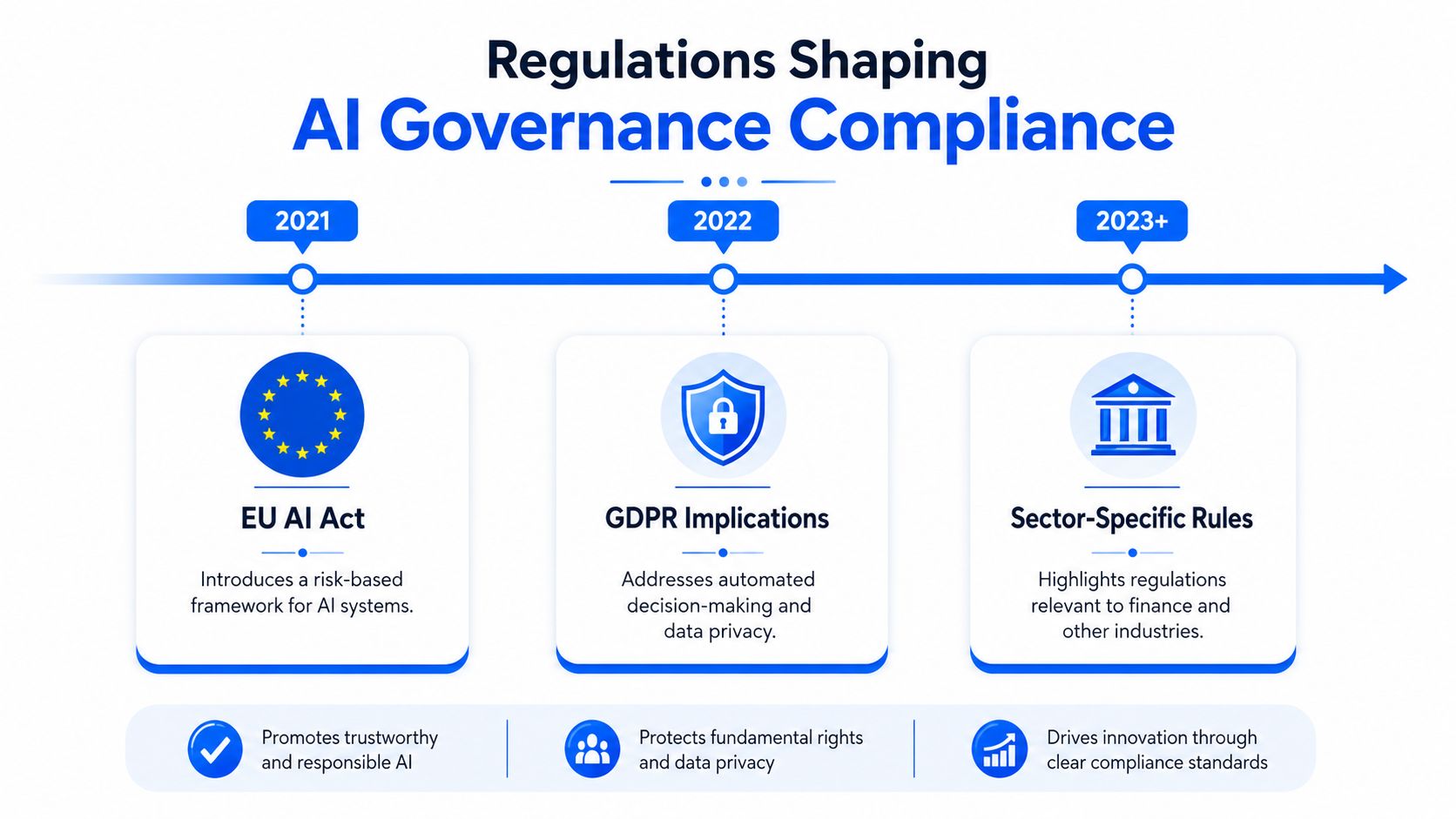
A compliance program for AI governance compliance starts with the legal floor, not with abstract policy language. The EU AI Act entered into force in 2024, and it sets some of the strictest AI obligations in the field, with penalties that can reach €35 million or 7% of global annual turnover, whichever is higher, for the most serious violations (Prefactor statistics on AI governance compliance). For engineering teams, that turns governance into a production concern with direct financial impact.
Timing controls are part of the law
The EU AI Act uses a tiered model, so deadlines behave like release gates for different system classes. Prohibited AI practices are banned starting 2 February 2025, general-purpose AI model obligations begin on 2 August 2025, and high-risk AI systems used in Annex III sectors must comply from 2 August 2026. For AI systems already covered by existing product safety laws, the high-risk obligations are scheduled to apply from 2 August 2027 (Modulos AI compliance guide). Governance teams need separate readiness plans for each class of system, because one generic checklist will miss important deadlines.
GDPR still applies wherever automated decision-making touches personal data, especially when privacy, consent, or data minimization affect AI outputs. In regulated environments like finance, healthcare, telecom, and the public sector, sector rules add another layer of documentation and oversight. For healthcare teams handling regulated data, the ARPHost technical guide for PHI is a useful reference for how storage, control, and evidence fit together in sensitive systems.
Practical rule: if a system can influence hiring, lending, care delivery, or public services, treat it as a documented compliance asset, not just a model artifact.
Readiness is still uneven
The gap between regulation and execution remains wide. Prefactor's AI governance compliance statistics show that manager readiness and active compliance work are still limited, and many organizations have not yet moved from planning to implementation (Prefactor statistics on AI governance compliance). The same source also points to a larger problem, many organizations still lack a systematic inventory of AI systems in production or development. That is a blocking issue, because inventory is usually the first control needed for classification, risk review, and audit evidence.
Data residency also shapes how teams design controls. Deployment choices, storage boundaries, and cross-border data movement affect what evidence you can produce and where that evidence lives. For teams aligning architecture and jurisdictional constraints, the digna data residency requirements provide a useful lens for deciding where compliance evidence should remain.
Identifying Critical AI Risk Domains
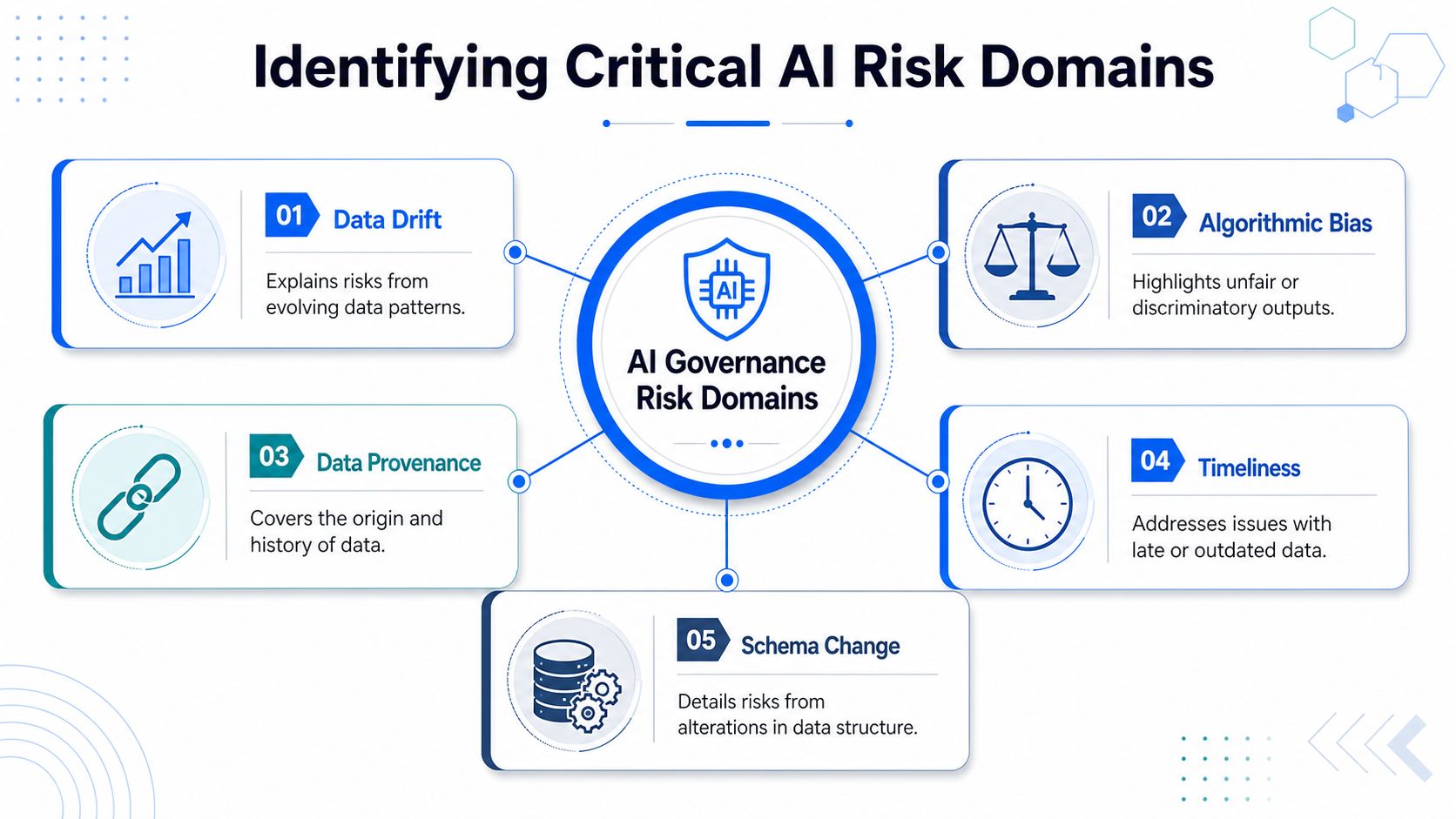
AI compliance failures usually start in the data layer, not in a policy memo. A model can look fine at launch and still drift out of compliance when upstream patterns change, customer records arrive late, or a source table changes shape without notice. That's why the strongest governance programs focus on data drift, algorithmic bias, data provenance, timeliness, and schema change as operational risk domains.
Why data lineage beats vague ethics language
A contrarian but useful view is that many organizations spend too much time on high-level AI principles and too little on the evidence needed to defend a decision later. The more important questions are concrete. Can you trace the record back to its source? Can you prove the input was complete at the time of inference? Can you show the schema version that fed the model? These are the kinds of controls that matter when an auditor asks what happened after deployment (World Bank guidance on AI governance evidence).
Data drift matters because the population your model sees in production won't stay still. If the data distribution shifts, even a well-tested model can begin producing unreliable or discriminatory outcomes. Algorithmic bias matters when the training or feature pipeline encodes structural imbalance, which is why fairness checks can't live only in model development.
Data provenance is the chain of custody for AI inputs. Without it, you can't show where training data came from, how it was transformed, or whether the right approvals existed. Timeliness is equally important, because late data can lead to decisions based on stale conditions, and stale conditions can create both operational failures and compliance exposure.
Schema changes break compliance quietly
Schema change is the easiest risk to underestimate. A column rename, data type change, or dropped field can subtly alter model inputs, downstream reports, and audit evidence. The result is often not a dramatic outage, just a slow loss of trust. That's why teams need tamper-evident logs, data lineage records, and record-level validation together, not as separate programs.
If your observability stack only tells you that data exists, it's not enough for compliance. You also need to know whether the data was complete, timely, and structurally consistent when the AI system used it.
Implementing Practical Compliance Controls
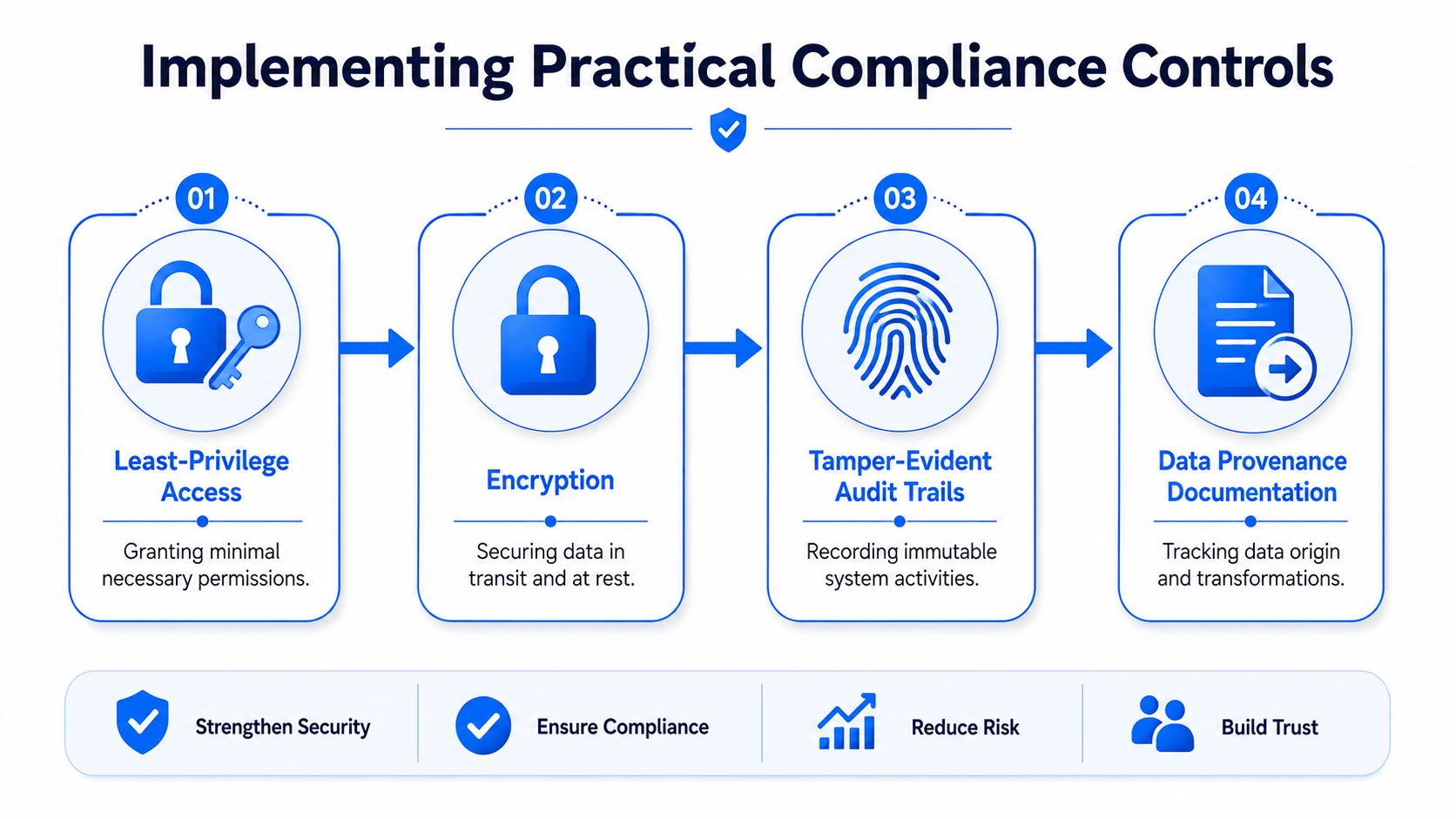
Most AI compliance frameworks converge on four technical controls, authenticated least-privilege access, FIPS 140-3 validated encryption, tamper-evident audit trails, and training-data provenance documentation (Kiteworks AI regulation guide). Those controls are not decorative. They create regulator-ready evidence of who accessed what, when they accessed it, and how the data changed.
Start with access and encryption
Least-privilege access should be tied to named identities, not shared service accounts that everyone uses and no one owns. Give each engineer, analyst, or automated workflow only the permissions required for its role, and separate read access from write access wherever possible. Encryption belongs on the same control path, because sensitive training and inference data shouldn't be readable outside approved boundaries.
Build evidence into the pipeline
Tamper-evident audit trails need to capture more than success or failure. They should record who approved a change, which data assets were touched, what version was deployed, and when the system made an AI-assisted decision. For high-risk systems, add record-level validation so each important field can be checked against business rules before it reaches the model or the decision engine.
A simple implementation pattern looks like this:
Define the control point: decide whether validation happens at ingestion, before training, before inference, or at all three points.
Write specific rules: check required fields, acceptable ranges, business cross-checks, and reference integrity.
Store the evidence: keep rule outcomes, timestamps, and approval records alongside the pipeline metadata.
Watch for drift: compare current distributions and failure patterns against the baseline you established at launch.
Add continuous monitoring, not one-time checks
AI systems need anomaly detection, schema tracking, and input monitoring because the risk doesn't stop at deployment. If a source table starts sending nulls in a critical field, or a feature feed arrives late, the model may still run and still be wrong. Documenting those incidents matters as much as the technical fix, because regulators and auditors look for repeatable monitoring, not just a postmortem.
The most useful mindset is simple. Treat every control as evidence production. If a team can't show the rule, the log, the approval, and the exception history, the control isn't complete.
Mapping Controls to digna Capabilities
High-risk AI systems should keep model cards, version history, approval records, and audit logs for oversight, and independent guidance points to those artifacts as core evidence requirements (Legal AI Insights on AI governance infrastructure). The practical question is where those controls live. For data platform engineers, the cleanest answer is usually the same one they use for data quality and observability. Keep the checks as close to the data as possible.
In-database execution changes the security model
Traditional compliance tooling often pulls data out of the environment, inspects it elsewhere, and stores findings in a separate system. That adds movement, duplication, and more places where evidence can drift out of sync. An in-database approach keeps checks where the data already lives, which reduces exposure and makes it easier to retain a single operational truth.
That matters for security teams, but it also matters for governance teams that need consistent proof. When validation, anomaly detection, schema tracking, and timeliness checks run inside the customer environment, the control evidence stays attached to the operational system instead of being scattered across ad hoc spreadsheets.
Different modules support different evidence needs
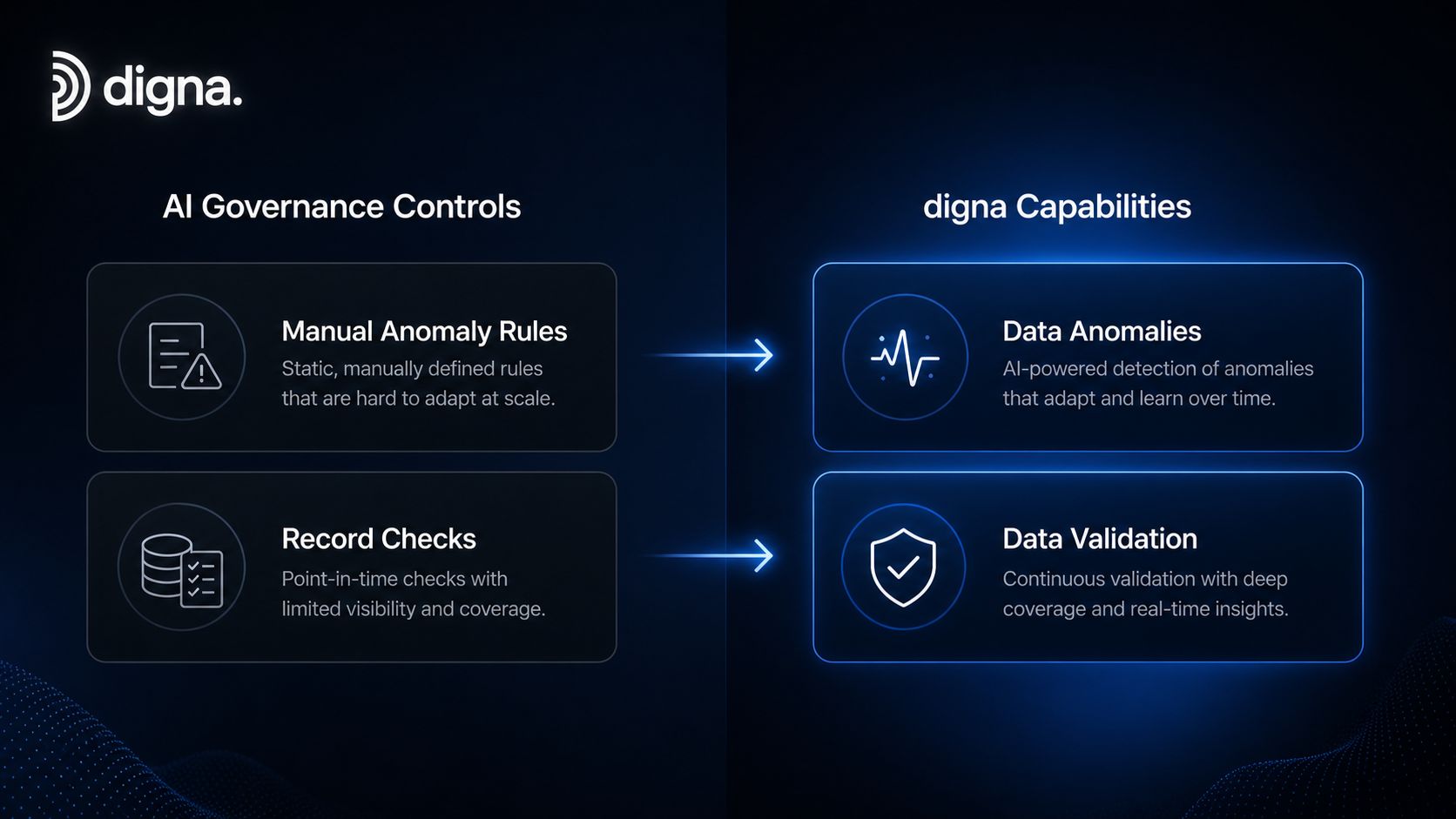
A good compliance stack shouldn't force engineers to write custom rules for every use case. Data Validation supports record-level checks for business logic and regulatory requirements. Data Anomalies helps identify unusual patterns without requiring every threshold to be hand-built. Schema Tracker flags structural changes that could invalidate a downstream control. Timeliness monitors delivery behavior so teams can see whether a critical feed arrived as expected.
The best governance tools don't replace engineering judgment. They reduce the amount of manual proof-gathering engineers have to do after the system is already in production.
Deployment and visibility matter as much as features
Private cloud and on-premises deployment options are important when data residency or internal policy keeps sensitive workloads inside controlled environments. Unified dashboards also help because compliance isn't owned by one persona. Data engineers, governance leads, and auditors all need a shared view of what changed, what failed, and what was approved.
If the control layer lives where the data lives, and if the evidence is visible in one place, compliance stops feeling like an external audit exercise and starts acting like part of normal platform hygiene.
Audit Readiness Checklist and Key Metrics
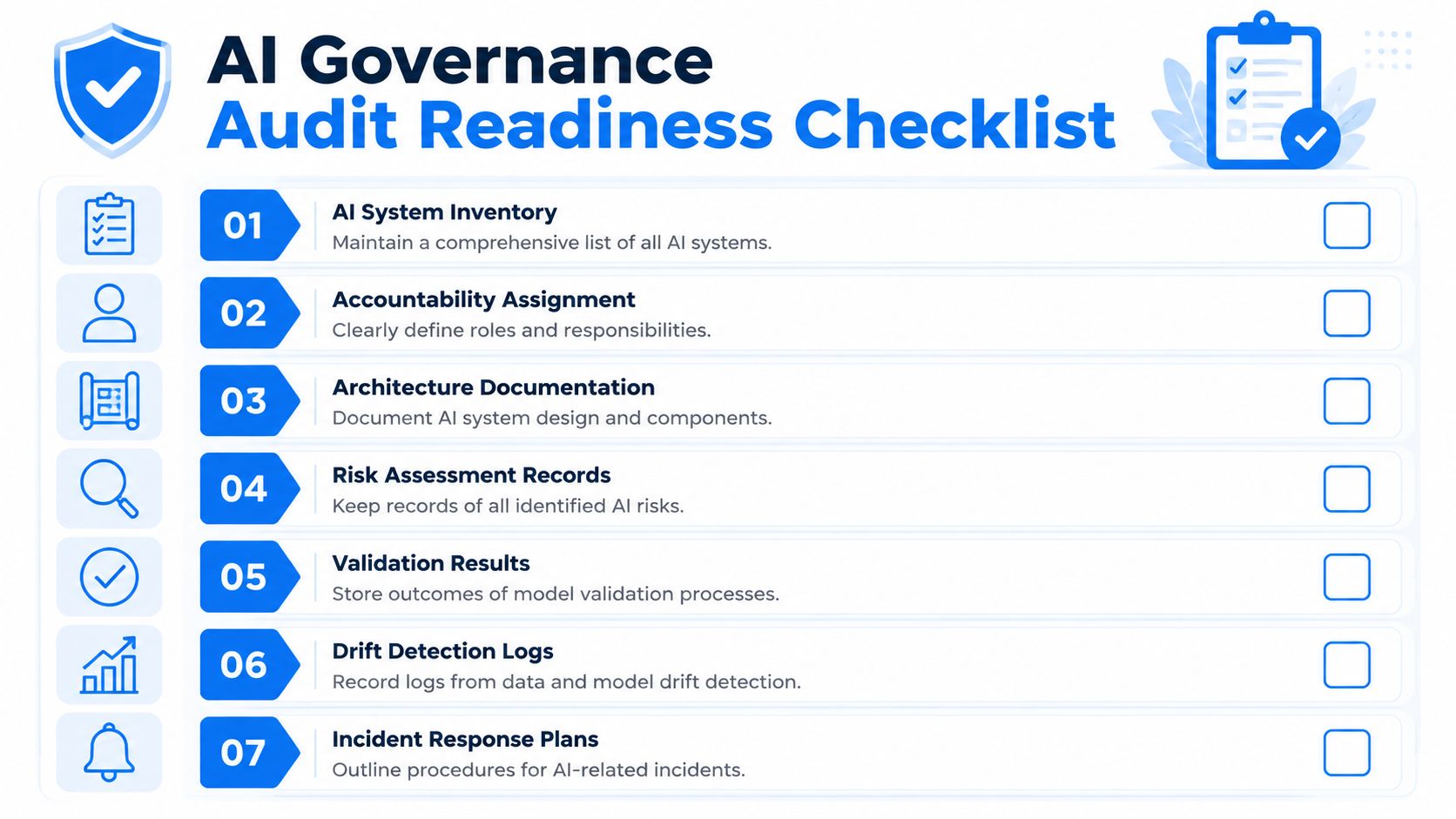
Enterprise AI compliance programs increasingly require lifecycle documentation, including an AI inventory, named accountability, system architecture documentation, training data sources, testing results, and ongoing monitoring like drift detection and incident logging (KPMG guidance on ISO 42001). That means readiness should be visible in a dashboard, not buried in policy folders.
Build the checklist first
Use this as the minimum evidence set for each high-risk system:
AI System Inventory: keep a complete catalog of every AI system, including embedded third-party tools and shadow AI.
Accountability Assignment: name the business owner, technical owner, and approval authority.
Architecture Documentation: store diagrams, dependencies, and deployment boundaries.
Risk Assessment Records: keep the current classification, assumptions, and scope.
Validation Results: preserve test outcomes, thresholds, and exceptions.
Drift Detection Logs: retain evidence of changing inputs or model behavior.
Incident Response Plans: document how the team classifies, escalates, and resolves issues.
Track metrics that auditors can interpret
A useful KPI only works if it answers a direct compliance question. Drift rate shows how often data patterns move outside the expected baseline. Anomaly frequency shows how often records or feeds violate control thresholds. SLA adherence for timeliness shows whether critical datasets arrive on time. Schema stability score tells you how often structural changes appear. Validation pass rate shows how consistently the data meets the business rules you defined.
For dashboards, keep the layout simple. Put inventory coverage, open incidents, validation status, and late-arrival trends at the top. Put approval history and schema change history just below that. If your team wants a reporting workflow that packages these artifacts for reviewers, the digna compliance reporting automation page is a helpful reference point for thinking about repeatable evidence delivery.
Audit rule of thumb: if a metric doesn't help you explain a control failure, it probably doesn't belong on the compliance dashboard.
The point is not to create a bigger spreadsheet. The point is to make compliance readiness measurable every day, so nobody has to reconstruct the last six months of evidence the night before an audit.
Conclusion and Next Steps
AI governance compliance works when it behaves like observability, not like a manifesto. The teams that stay ahead build inventories, monitor risk domains continuously, and keep evidence attached to the data systems that generate it. That's the difference between policy on paper and compliance you can defend.
If you're responsible for AI-heavy pipelines, start with one high-risk use case and map the controls to the evidence it needs. Then expand the same operating model across more systems, more teams, and more regulated decisions. That's where a platform built for in-database monitoring, validation, and auditability starts to matter.
If your team needs a practical way to turn AI governance into day-to-day evidence, visit digna and evaluate how in-database observability can support compliance-ready monitoring, validation, and reporting. Start with a high-risk AI workflow, define the controls you need, and see how much faster audit preparation gets when the evidence is already inside the data platform.
Frequently asked questions
When does AI governance compliance stop being a policy document?
At the point where a data platform team finds a problem nobody wants to own. That is the moment it becomes an operational discipline rather than a statement of intent filed somewhere.
Why does the control plane matter so much?
Because regulators and auditors care about repeatability. A control that produced the right outcome once, by someone's attention rather than by design, cannot be demonstrated as a control at all.
How does governance pressure usually arrive?
In a very ordinary moment. It rarely announces itself as a compliance event; a platform engineer notices an unowned dataset feeding a model, and the obligation becomes visible through ordinary engineering work.
What do the EU AI Act and GDPR have in common here?
Both demand evidence about data you can no longer reconstruct after the fact. That shared requirement is why AI obligations land on the data platform rather than staying with the model team.
What turns an obligation into a working model?
Controls placed where the data moves, producing their own record. Repeatability is the standard, so a governance approach that depends on someone remembering to check will not satisfy either regulation.