Customer Data Protection: A 2026 Guide for Enterprises
|
6
min read

Customer data protection stopped being a policy binder exercise years ago. Under GDPR enforcement alone, Europe had reached about €7.1 billion in cumulative fines by January 2026, and authorities were averaging more than 400 personal data breach notifications per day, a 22% year-over-year increase and the first time that daily average had crossed 400 since GDPR began, according to tracking cited by PrivacyEngine's 2026 GDPR statistics roundup. That's the operational reality now, protection is a continuous discipline, not a launch task.
The commercial side is just as unforgiving. A Termly summary reports that 75% of consumers won't buy from organizations they don't trust with their personal data, 63% of internet users believe most companies aren't transparent about how data is used, and 48% have stopped shopping with a company because of privacy concerns. The cost of getting this wrong is not abstract either, with IBM-based figures cited in 2025 and 2026 sources putting the average breach cost at about $4.4 million as summarized by Termly. In practice, weak protection hits revenue, reputation, and incident response at the same time.
Table of Contents
Why Customer Data Protection Demands Continuous Enforcement
Trust is a revenue control, not a slogan
Protection has to be a live control loop
Legal Requirements That Shape Protection Strategies
Translating rules into operational obligations
Technical Controls That Actually Reduce Risk
Access control limits blast radius
Minimization is a control, not a compromise
The Protection Gap in AI and Analytics Pipelines
Derived data creates enforcement problems
Organizational Controls That Make Protection Enforceable
Accountability only works when it has owners
In-Database Observability Without Data Movement
Why keeping checks in the database changes the risk profile
Implementing Protection Across Heterogeneous Data Platforms
A workable rollout sequence
Why Customer Data Protection Demands Continuous Enforcement
Privacy rules only matter if they are enforced where customer data moves. according to PrivacyEngine's 2026 reporting privacy laws now cover a large share of the world's population, and more than 140 countries have enacted data protection or privacy legislation. The practical implication is simple. Customer data protection is now part of market access, vendor approval, and day-to-day system design.
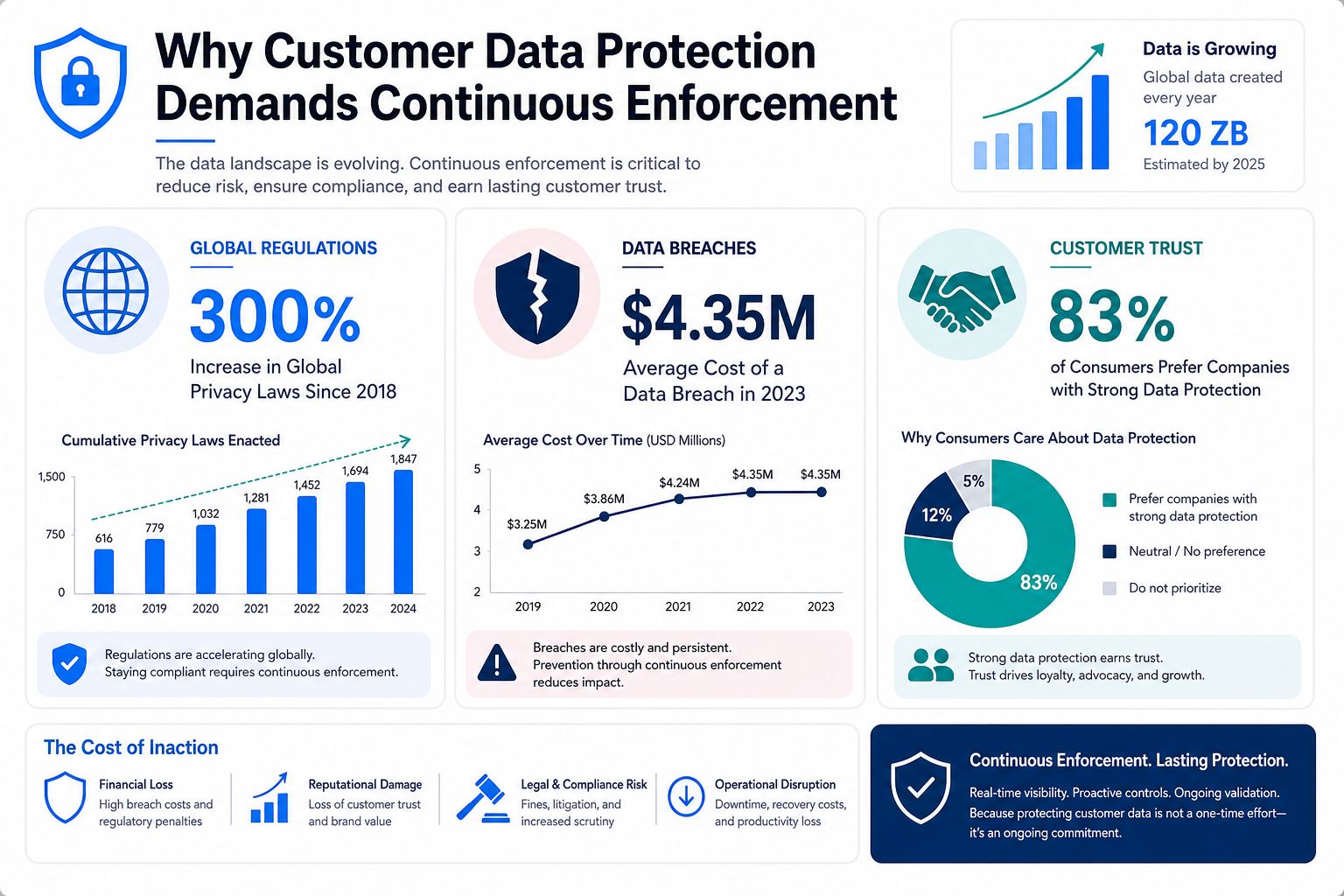
Trust is a revenue control, not a slogan
The strongest programs I've seen treat trust as an operating constraint. When customers hesitate to share data, or stop sharing it altogether, the impact shows up in conversion, retention, and the quality of downstream decisions. A weak protection posture also changes how sales, service, fraud, and analytics teams use the same records, which is where the trade-off becomes visible in production.
Practical rule: If customer data protection only shows up in legal reviews, it is already too late. It has to be visible in access control, logging, monitoring, and incident response every day.
The issue is not limited to breach headlines. Enforcement pressure keeps arriving through new systems, new integrations, and new retention decisions, which means teams rarely get a clean implementation window. A data warehouse refresh, a new model feature set, or an exported customer list can expose records that the original approval never covered. That is why customer data protection insights from regulated financial services matter here, the operating lesson is the same even outside banking.
Protection has to be a live control loop
Continuous verification is the only model that holds up. Security teams cannot assume access rules still match job functions, data teams cannot assume every pipeline still respects retention limits, and compliance teams cannot assume a once-approved process is still the process in use. Customer data protection works only when controls are checked against actual data movement, not just policy documents.
That also means auditing system behavior, not just policy existence. A policy can say customer records are restricted, but if downstream tools, extracts, or shared datasets keep spreading them, the control has already failed. In practice, the gap closes when teams can see enforcement inside the database and across the pipeline, then correct drift before it becomes an incident. For organizations dealing with regional hosting and residency rules, data residency requirements add another layer of control that has to be enforced continuously, not once at setup.
Legal Requirements That Shape Protection Strategies
Privacy laws become manageable once they are translated into operational obligations. GDPR requires personal data to be processed lawfully, fairly, and transparently, collected for specified, explicit, and legitimate purposes, limited to what is necessary, kept accurate and up to date, retained only as long as necessary, and protected with appropriate security measures as set out in the World Bank's guide to data protection laws. That is not abstract policy language. It maps directly to intake forms, retention rules, access scopes, and deletion workflows.
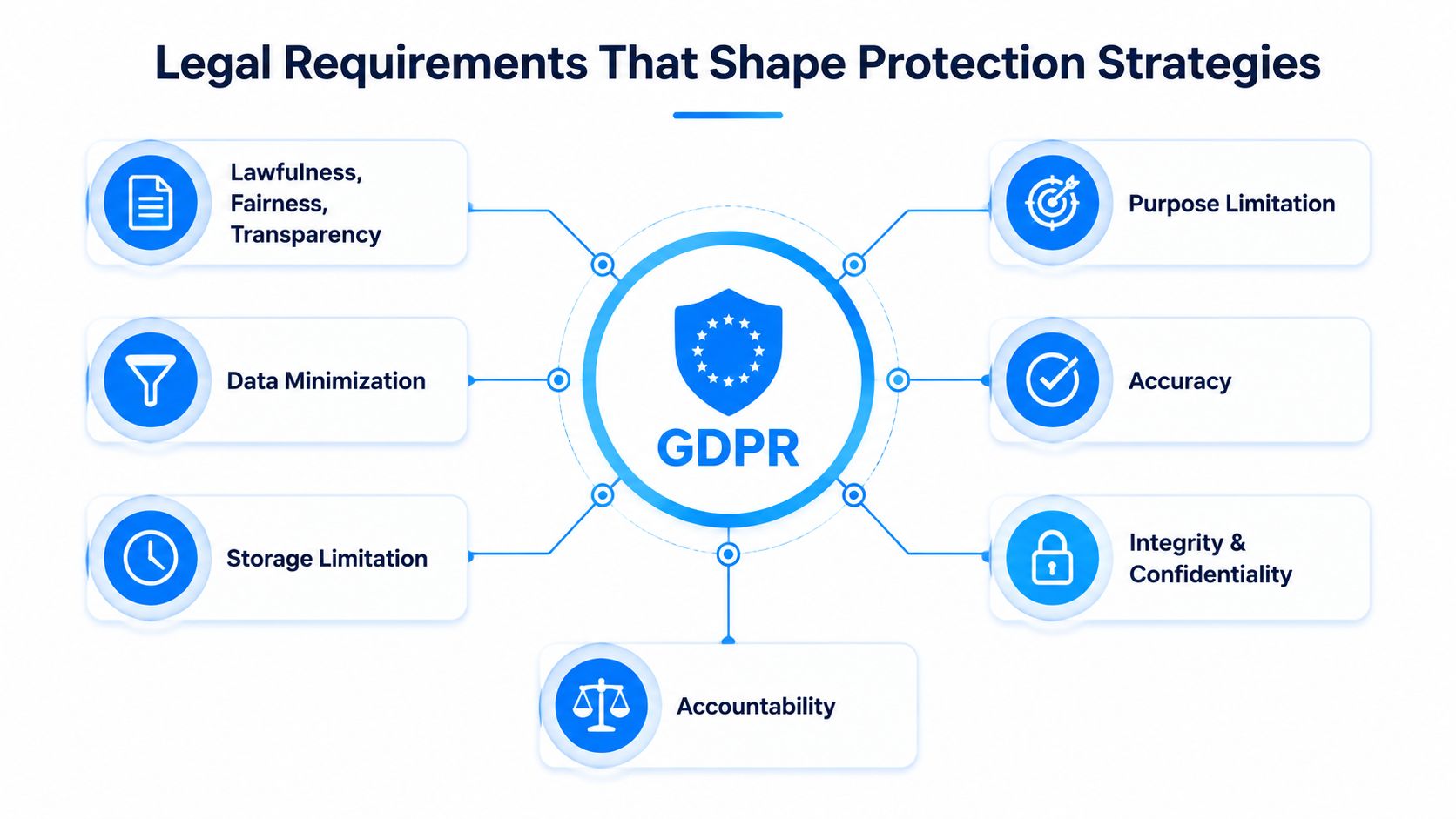
Translating rules into operational obligations
A working compliance design usually starts with data classification, because you cannot minimize or retain data correctly if you do not know what you are holding. After that, purpose limitation becomes a design constraint. Every dataset, integration, and model input should have a justified use, not a vague “future analytics” label.
The fastest way to fail privacy review is to treat all customer data the same. Sensitive fields need tighter handling, and the business needs to justify why they exist at all.
CCPA adds a different but complementary set of consumer rights. California residents can know what personal information was collected, request deletion, direct a business not to sell or share it, correct inaccurate information, and limit use and disclosure of sensitive personal information as described by the California Attorney General. It applies to certain for-profit businesses doing business in California if they cross the revenue or data-volume thresholds in the statute, so the operational takeaway is that scope needs to be checked early, not assumed.
A separate operational wrinkle in the U.S. is notice. Privacy policies and equivalent notices generally need to disclose what information is collected, how it is used and disclosed, the choices available to individuals, and contact information as summarized by DLA Piper's U.S. privacy law overview. That disclosure layer matters because external promises now shape internal architecture. If the notice says one thing and the pipeline does another, the business owns that mismatch.
For teams handling regional storage and transfer constraints, this internal guide on data residency requirements is a useful companion because residency, purpose limitation, and retention often collide in the same implementation. The practical answer is to align where data lives with where it is allowed to move, then enforce that alignment in the systems that process records.
One useful outside perspective is customer data protection insights, which reinforces a point many banks already know, if the customer cannot understand how data is handled, trust erodes quickly. That lesson travels well beyond banking.
Technical Controls That Actually Reduce Risk
Encryption is necessary, but it's not the whole answer. Customer data can still be exposed if key access is too broad, backups are reachable from production compromise, or restoration hasn't been tested after a failure. Guidance on customer data security consistently points to encryption at rest and in transit, secure key storage, encrypted offsite backups, and regular restoration tests as the operational details that make encryption real instead of symbolic as outlined by CDP.

Access control limits blast radius
Least-privilege access does different work than encryption. If a credential is stolen, the attacker's reach should stop at the minimum dataset required for that role, not spread across every customer table in the environment. Independent guidance recommends classifying data by sensitivity, restricting access to what each role needs, and using SSO with MFA for systems that store or process data per Fullstory's data protection guidance.
That difference matters in production. Encryption protects the contents, but access control shapes who can even attempt to reach them. In a real incident, the overlap between the two is what reduces the blast radius.
Minimization is a control, not a compromise
Data minimization can feel restrictive until you see how much risk disappears when unnecessary copies stop being created. Fewer exported files, fewer broad warehouse grants, and fewer secondary datasets all reduce the number of places where customer records can be leaked or misused. The strongest teams I've worked with treat minimization as a build standard, not a post-review cleanup step.
Practical rule: If a pipeline doesn't need a field to complete its task, don't move the field, don't persist it, and don't expose it downstream.
Auditing belongs in the same layer of defense. Database monitoring and auditing techniques matter because technical controls only work if teams can see how data is being touched in practice. That visibility becomes even more useful when alerting is tied to specific tables, schema changes, and usage patterns rather than generic system health.
The right stack is layered. Encryption reduces exposure, access control limits who can act, minimization reduces the amount of data at risk, and audit logging gives you a record of what happened. None of those controls replaces the others. In a production environment, the combination is what keeps a small mistake from turning into a large incident.
The Protection Gap in AI and Analytics Pipelines
The weak point in many programs shows up after collection. Once customer data moves into feature stores, model weights, derived datasets, or AI context layers, it becomes much harder to trace, delete, or explain on request. That gap is especially important because analysis from Glean on privacy concerns in AI notes that AI systems can memorize rare data points, infer sensitive attributes from innocuous inputs, and make data subject rights harder to honor when organizations can't find all downstream copies.
A lot of privacy playbooks go stale. They emphasize collection rules and storage security, then assume the hard part is done. In modern data stacks, the hard part starts when raw records are transformed, embedded, replicated, and reused by analytics or machine learning systems.
Derived data creates enforcement problems
A record can be deleted from the source system and still survive in multiple downstream forms. That's not a theoretical concern, it's how feature pipelines, BI extracts, and context windows work. Once the data is embedded in derived artifacts, the organization has to know where those artifacts live and how they're refreshed before it can answer a deletion or access request cleanly.
This also creates explainability issues. If a model responds to an input in a way that suggests it has learned something sensitive, teams need to understand whether the training path carried personal data further than intended. That's why protection in AI can't stop at ingestion controls.
The practical answer is to govern the pipeline itself. Validation, lineage, masking, and access restrictions need to apply not just to the raw table, but to the transformed products that come out of it. Otherwise, the business ends up with a policy that says one thing and a pipeline that keeps distributing hidden copies.
Organizational Controls That Make Protection Enforceable
The failure I see most often is not a missing tool, it is a broken chain of responsibility. Security teams own the controls, data teams own the pipelines, compliance owns the records, and no one owns the full loop from policy to enforcement. A Data Protection Impact Assessment helps because it forces a high-risk process to be identified, reviewed, and documented before it goes live.
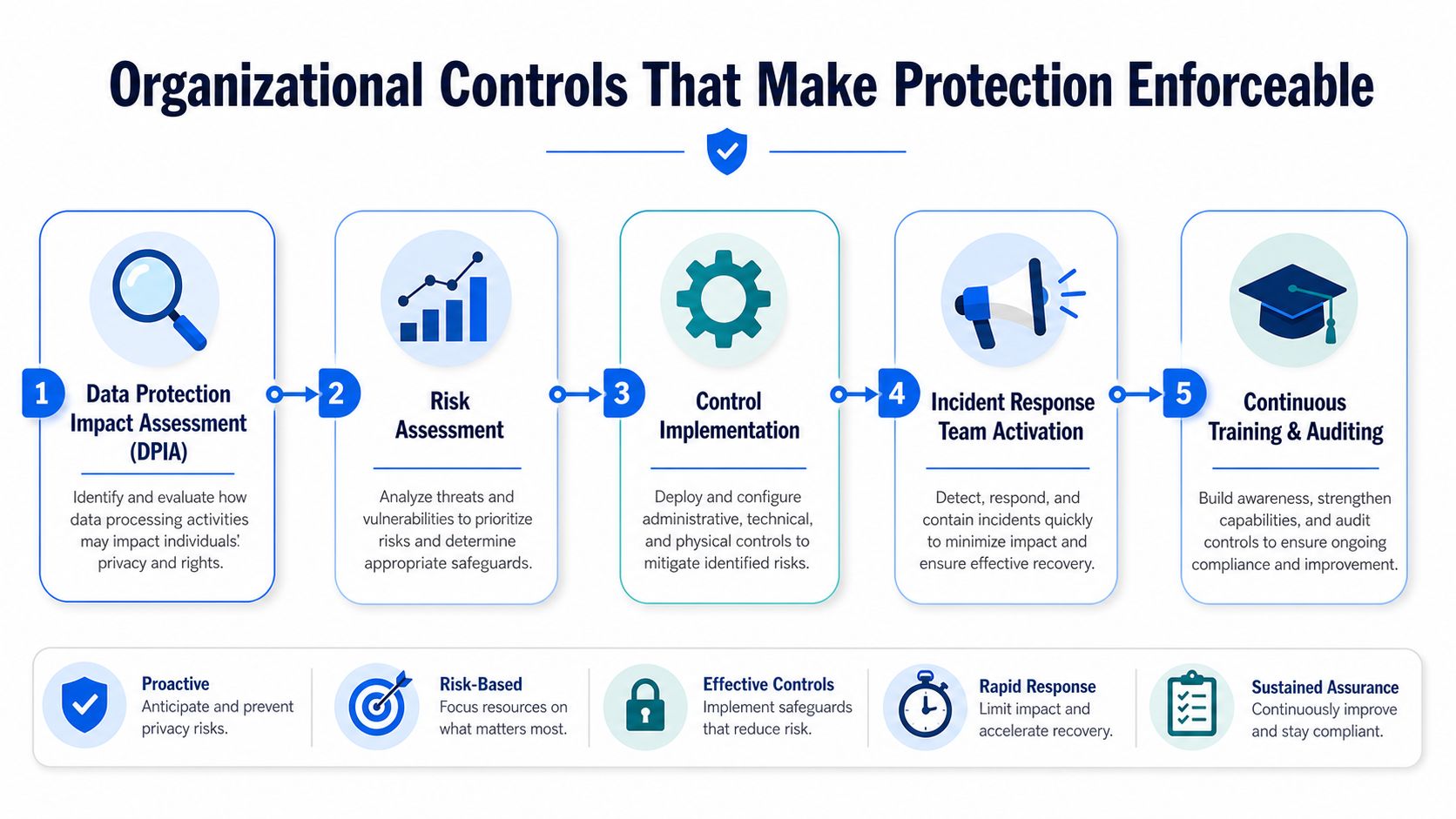
Accountability only works when it has owners
A DPIA only matters when someone is accountable for the result. In practice, the data owner, security lead, and compliance reviewer need separate responsibilities, and the escalation path has to be defined before the system changes. If the control owner is unclear, remediation drifts and exceptions stay open long after they should have been closed.
That same ownership discipline has to apply to incident response. Breaches cause less harm when teams already know who pulls logs, who isolates the system, who communicates externally, and who verifies recovery. The playbook itself matters less than whether it exists, is current, and has been rehearsed against real operational failure modes.
Monitoring keeps that accountability from becoming a paper exercise. If evidence is only gathered after something goes wrong, the organization is already reacting late. Teams need records that show how controls behaved in production, not just a policy file that says they should have worked.
Training has to match the control environment. Engineers need to know which datasets are sensitive, analysts need to know which fields are masked, and responders need to know which systems are authoritative during an incident. That is what makes customer data protection enforceable instead of aspirational. It also means the people running the pipeline have to understand where checks happen in practice, which is why teams that verify processing inside the environment, rather than after data has moved elsewhere, tend to close the gap faster, as shown in digna's in-database execution approach.
In-Database Observability Without Data Movement
The architecture choice that keeps showing up in regulated environments is simple, keep observability where the data already lives. Running validation, anomaly detection, schema tracking, and reporting inside the customer's own infrastructure avoids the exposure that comes from shipping records to another platform just to inspect them. That matters in sectors where data residency, access control, and auditability are essential.
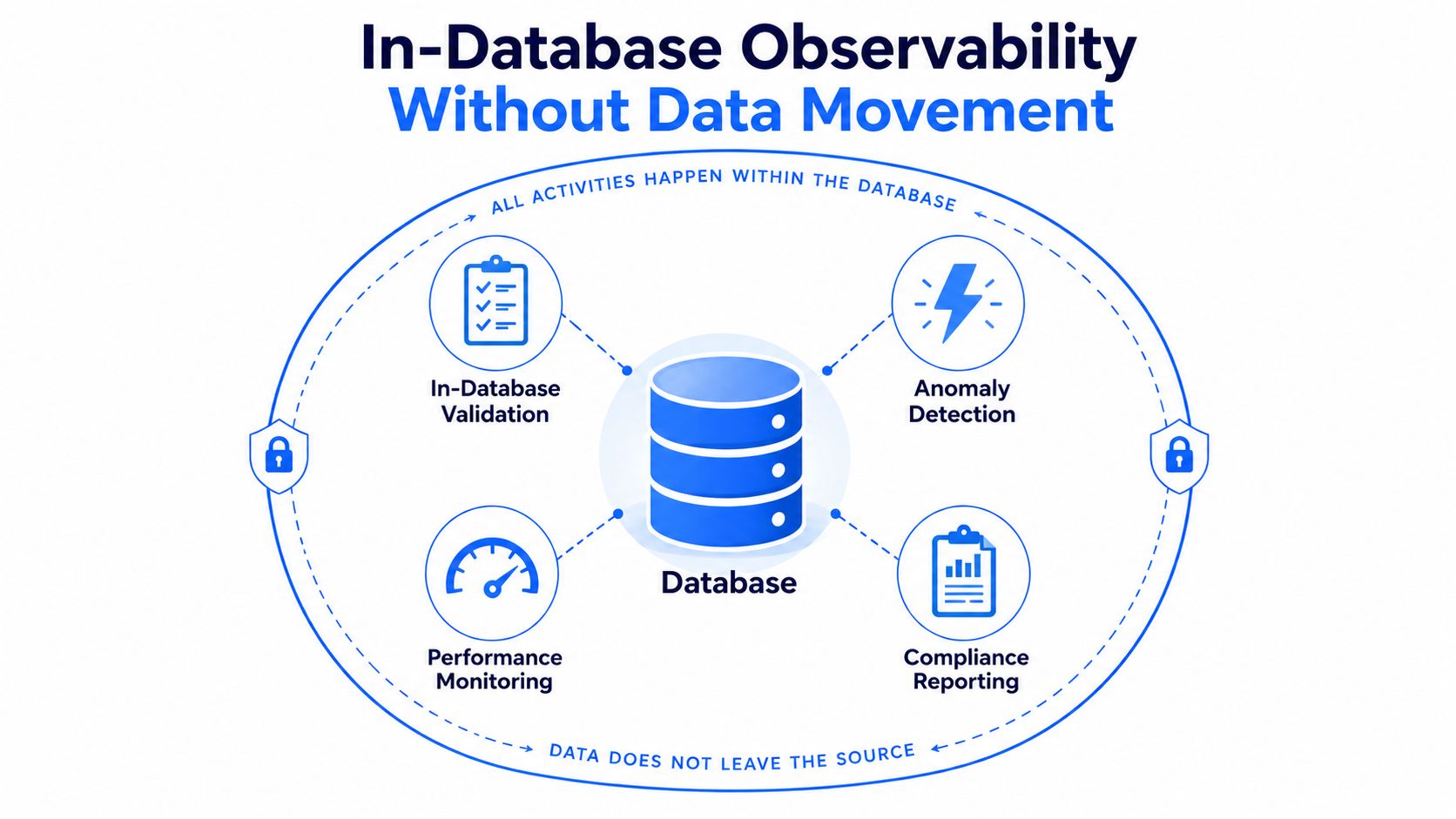
Why keeping checks in the database changes the risk profile
The operational gain is obvious once you see the trade-off. External tools often need extracts, replication, or broad connector access to inspect data thoroughly, and each of those paths creates another place where customer data can be exposed. In-database execution reduces that movement and keeps the observation surface inside the boundary the business already controls.
digna is one example of this pattern, because it runs inside the customer's own environment, including private cloud or on-premises deployments, and executes checks in-database so the vendor doesn't need access to production data. Its modular monitoring also aligns with environments where separate teams need anomaly detection, validation, timeliness monitoring, and schema tracking without introducing another data copy.
Protection and observability don't have to compete. If monitoring can run where the records already are, teams get the evidence they need without widening the exposure surface.
This matters most in regulated industries. Financial services, healthcare, telecommunications, and public sector teams often can't accept casual data movement just to gain visibility. They need controls that stay inside the boundary, generate audit evidence, and still let engineers see whether something drifted, broke, or arrived late.
For a closer look at how this pattern applies to external pipelines, this guide on in-database data quality execution is relevant because the same boundary-preserving logic applies across quality, observability, and governance.
Implementing Protection Across Heterogeneous Data Platforms
The safest way to roll out customer data protection across a large enterprise is to start with the highest-value datasets and expand from there. A realistic program usually begins in one warehouse or operational pipeline, then extends to adjacent systems once the team sees the monitoring, alerting, and audit trail working without disrupting existing workflows. That's a better pattern than trying to standardize every platform on day one.
The implementation details matter more than the slogan. Enterprises need controls that can be deployed inside private cloud, on-premises, or controlled cloud environments, then connected to the data platforms they already use. If a control layer only works after a major migration, adoption stalls.
A workable rollout sequence
A practical sequence usually looks like this:
Start with critical tables: Focus on customer, regulatory, billing, or risk datasets first, because they carry the biggest exposure if something drifts.
Attach monitoring where the data lives: Keep validation and anomaly detection close to the source so teams don't need to duplicate records for inspection.
Integrate with existing alerting: Route incidents into the tools engineers already use, so the new controls fit current response habits.
Expand module by module: Add schema tracking, timeliness checks, or business-rule validation as the next layer once the first control is stable.
That approach works because it respects how data platforms grow. Warehouses, lakes, and pipelines rarely look identical, and they don't need identical tooling to produce useful protection. Modular monitoring is easier to adopt than a platform rewrite, especially when the goal is quick operational value.
The strongest deployments also avoid turning observability into another silo. Data engineers, analysts, and governance teams need a shared view of what changed, what failed, and what needs attention. Once everyone sees the same evidence, protection stops being a compliance artifact and starts behaving like an operational control.
If you're building customer data protection into real pipelines, not just policies, visit digna to see how in-environment monitoring and in-database execution can fit your existing data stack. It's a practical way to keep observability close to the data while reducing unnecessary movement and exposure.