What Is Remediation Plan
|
6
min read

You're staring at a dashboard that looks wrong, and the timing couldn't be worse. Maybe a revenue table is off after a source change, a regulatory feed arrived late, or a model score drifted enough to make the business owner lose confidence. In that moment, the question isn't just what broke, it's what kind of response will hold up when someone asks whether the issue is fixed, contained, and unlikely to come back.
A quick rerun or patch can make the noise stop for today. A remediation plan is what turns that reaction into a controlled process with an owner, evidence, and a clear standard for closure. If you've ever had a ticket marked done while the downstream report still looked suspect, this topic is probably already sitting on your desk.
Table of Contents
When a Data Incident Forces a Real Plan
Monday starts with a message in Slack, not a tidy incident report. The finance dashboard is wrong again, the warehouse load completed, and the numbers still don't reconcile with the source system. Someone suggests rerunning the pipeline, someone else wants to patch the transformation, and the business owner just wants the report to stop changing every hour.
That's where informal ticket workflows usually fail. A rerun can be the right first move, but it only contains the symptom. It doesn't tell you whether the root cause was a schema change, a bad mapping, a missing dependency, or a validation rule that never existed in the first place.
A real plan starts by separating the temporary response from the permanent fix. It treats the incident as a workflow with evidence, not a one-off task with a status field. For teams that already maintain issue pages like digna data quality issues, the shift is simple in theory and hard in practice, the record has to move from “something failed” to “this failure is understood, assigned, corrected, and verified.”
A ticket can record activity. A remediation plan has to prove reduced risk.
That distinction matters because trust is built on closure that can be defended. If the pipeline is repaired but nobody checks the downstream refresh, the plan isn't complete, it's only quieter. The rest of the article uses a stricter standard, one that fits how senior data teams work when the pressure is real.
The Core Definition Behind Every Remediation Plan
A remediation plan is a controlled, evidence-based set of actions that removes the root cause of a detected nonconformity, restores the affected process or data, prevents recurrence, and proves the fix worked. That definition matters because it forces you to ask four different questions, not one. What happened, what caused it, what did we change, and how do we know it stayed fixed?
Think of a leaking pipe. You can mop the floor, tighten the joint, inspect the line, and then watch for more water over time. The mop is containment, the tightened joint is correction, the inspection is verification, and the watching is closure with confidence. In data work, the same sequence applies when a malformed load, stale partition, or broken schema starts affecting reporting.

The four phases that keep the work honest
Containment limits further damage. That might mean freezing a corrupted table, stopping publication to BI consumers, or routing users to a last-known-good snapshot while the team investigates.
Permanent correction removes the underlying cause. In a data platform, that could be a SQL fix, a source mapping change, a schema contract update, or a missing orchestration dependency.
Verification proves the fix holds. Here you check row counts, business rules, schema compatibility, and downstream refreshes instead of trusting that the change itself was enough.
Closure only happens after the evidence exists and the owner signs off. Anything earlier is just administrative convenience.
The clean split matters because remediation isn't the same as incident response, and it isn't the same as routine maintenance. Incident response stops the bleeding. Maintenance keeps systems healthy. Remediation lives in the middle, where something has already failed and the team has to show that the failure was resolved.
For broader data-quality operating models, digna data quality management fits naturally around this idea, because quality management gives the detection and control context while the remediation plan handles the corrective workflow.
Key Elements That Make a Plan Work
A plan falls apart fast when it's too vague to execute. “Fix the table” sounds active, but nobody can tell who owns it, what changed, or when the fix should be considered done. A working plan has to carry enough context that another engineer can pick it up without guesswork.
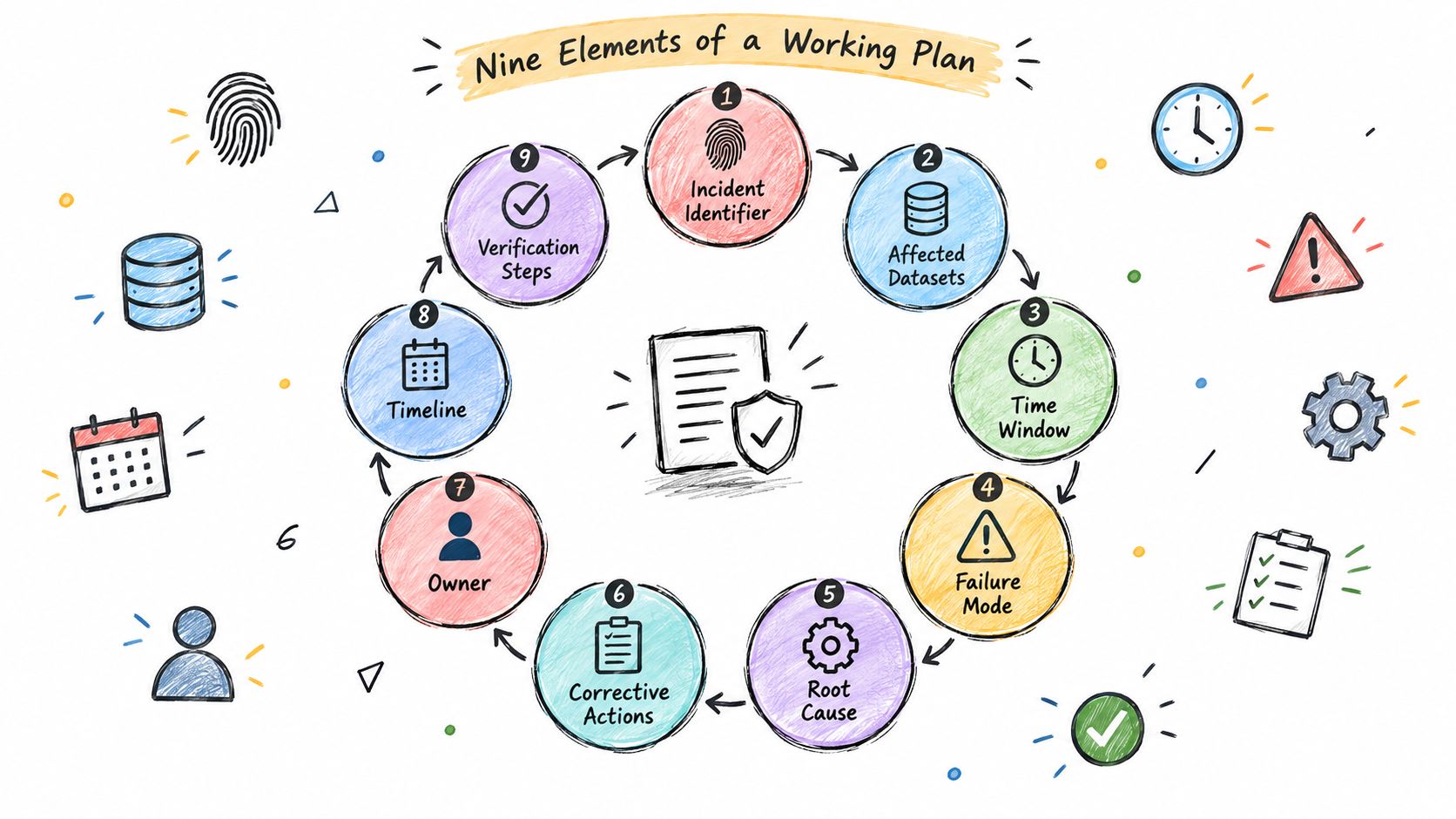
The fields that prevent ambiguity
Incident identifier. This gives the issue a stable reference, so logs, chat threads, and tickets all point to the same event.
Affected datasets and time window. Without this, you'll fix the wrong partition, miss a downstream dependency, or overcorrect historical data that wasn't impacted.
Failure mode. Name the shape of the problem, such as delayed arrival, broken schema, invalid values, or silent metric drift.
Business impact. State what the failure affected, because a broken internal metric and a late regulatory feed do not carry the same urgency.
Root-cause hypothesis. Capture what the team believes caused the failure, even if that hypothesis is still being tested.
Owner. One accountable person, not a queue of teams.
Priority. This determines sequencing when several plans are open.
Dependencies. Call out what has to happen first, such as upstream fixes, access approval, or backfill coordination.
Rollback method. If the correction makes things worse, the team needs a safe way back.
Target completion date. Deadlines force trade-offs into the open.
Acceptance criteria. This is the gate. If you can't define it, you can't prove closure.
Practical rule: if a plan doesn't say how you'll verify success, it isn't a remediation plan yet, it's a to-do list.
Two items tend to be missing in practice, and both are costly. A missing owner creates drift, because everyone assumes someone else is handling it. A missing acceptance criterion creates fake closure, because the ticket can be closed even when the issue still exists in the data.
For workflow hygiene, digna's data quality issue management process is relevant because the plan needs to survive handoffs, not just initial triage.
Prioritizing and Phasing Multiple Open Plans
Teams rarely have a single open remediation. They have several, and some compete for the same people, the same release window, and the same attention from leadership. Sorting by ticket age is easy, but it is a weak way to decide what gets fixed first.
Prioritization Criteria for Competing Remediation Plans | Why it matters | High signal of urgency |
|---|---|---|
Business impact | Affects revenue, reporting, customer trust, or decision quality | Core executive reporting is wrong or unavailable |
Regulatory exposure | Creates audit, compliance, or filing risk | A mandated feed or control is late or unreliable |
Data criticality | Some datasets power many downstream consumers | Widely reused source data is impacted |
Recurrence likelihood | A fix that won't hold creates repeat incidents | The same defect keeps reappearing |
Dependency count | More dependencies usually mean broader blast radius | Several pipelines or teams depend on the issue |
Time to harm | Some issues get worse fast | The data will become unusable within the next cycle |
Why phases matter when the fast fix isn't enough
A temporary patch may restore service today and still leave the root cause untouched. That's why containment, permanent correction, and verification need separate treatment. If a late feed is rerouted manually, the team may have kept the business moving, but the underlying gap still exists until the automation or upstream source is repaired.
The harder call is when immediate containment conflicts with durable correction. You might be able to replay events quickly, but doing so before the schema contract is fixed can create a second failure. In that case, a good plan says no to the fastest workaround and yes to the sequence that reduces risk.
Administrative closure doesn't prove remediation. Only validated evidence does.
That distinction matters in data platforms because the work can look complete long before the risk is gone. A dashboard may refresh, a pipeline may stop failing, and a ticket may close. If the outputs haven't been reconciled, the plan is still open in practical terms.
When stakeholders ask why one issue is ahead of another, explain the trade-off in business terms, not ticket counts. Prioritize the finding that can hurt you sooner, spread farther, or fail a control before you touch the cosmetic problem that merely looks messy.
Two Playbooks for Common Data Quality Failures
A good plan becomes real the moment you can apply it to an actual failure. The details vary, but the sequence stays the same. Detect, contain, correct, validate, and then prove the fix held long enough to trust it.
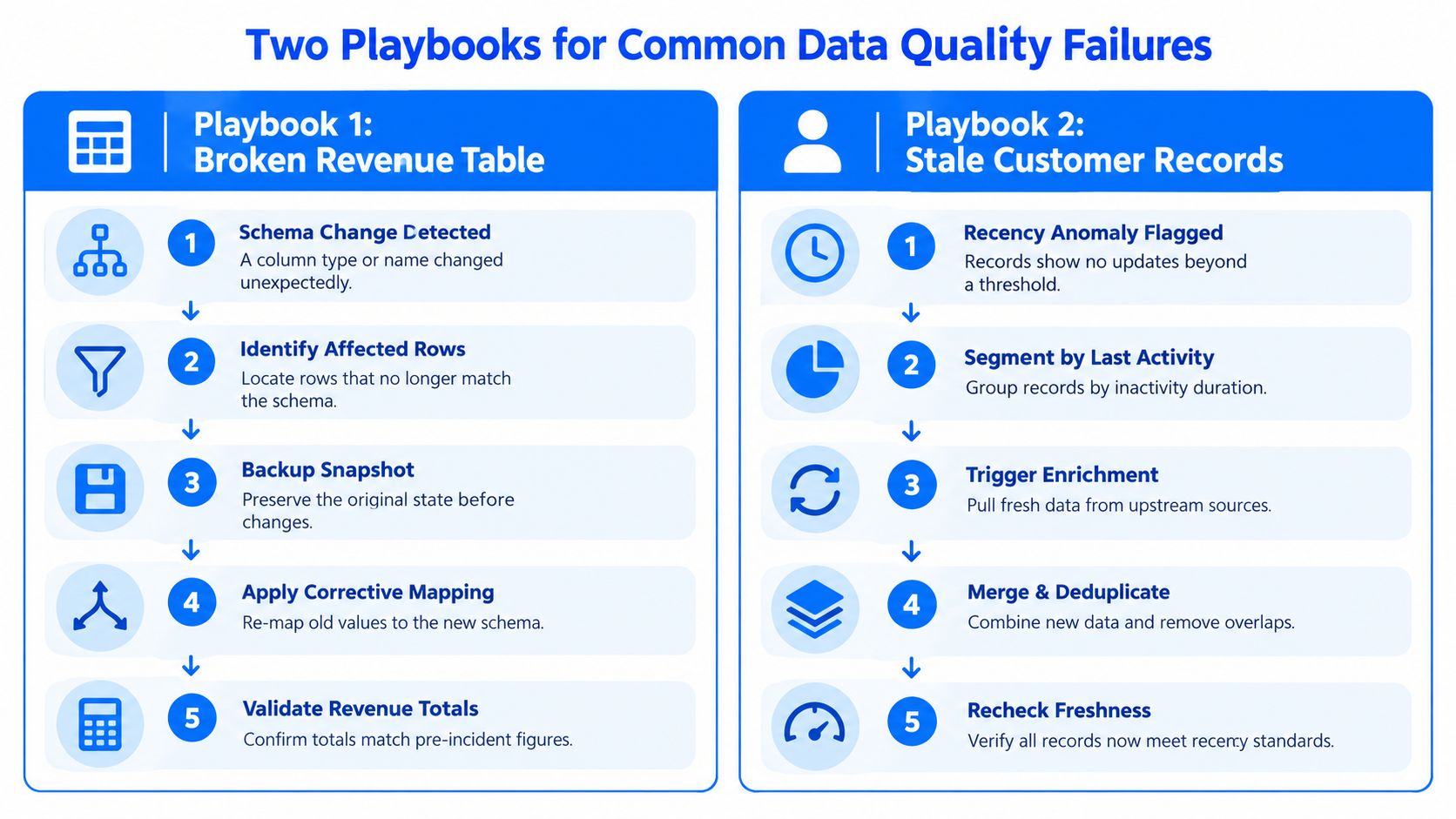
Playbook 1, broken revenue table
A source system changes a column type overnight, and the revenue table starts loading partial or invalid values. First, the team contains the blast radius by stopping downstream publication or freezing the bad partition. Then they isolate the affected rows, preserve the original state, and correct the mapping so the new schema is handled properly.
Validation comes next. The team checks whether revenue totals reconcile to the authoritative source, whether the repaired records load cleanly, and whether downstream refreshes succeed without manual intervention. Closure only happens after those checks pass and the owner signs off.
digna data completeness checks are relevant here because incomplete arrival or partial backfill can make a table look repaired when it's still missing records.
Playbook 2, stale customer records
A quiet drift in customer freshness doesn't always trigger a loud failure. The model still runs, but the input data gets older and less trustworthy. In that case, the first step is to flag the recency anomaly, then segment the affected records by inactivity duration so the team can see how far the issue extends.
After that, the owner triggers enrichment from upstream sources, merges the new information, and removes duplicates. The last step is not just “the job completed,” it's a recheck that confirms the records now meet the freshness standard and the downstream model sees the corrected inputs.
What closure evidence should look like
Broken revenue table: reconciled totals, clean backfills, no critical validation failures, and successful downstream refreshes.
Stale customer records: freshness restored, deduplication completed, and monitored runs showing the problem didn't return on the next cycle.
The difference between a closed ticket and a closed plan is simple. A ticket says someone worked on it. A plan says the outputs are reliable again.
How digna Feeds Evidence Into a Remediation Plan
A remediation plan gets much stronger when the incident signal already carries structured evidence. That doesn't mean the platform closes the problem for you, it means the plan starts with better inputs and less guesswork. The owner spends less time reconstructing what happened and more time deciding what to do about it.

Which inputs belong where
Data Anomalies and Timeliness feed the early fields in the plan. They help identify what changed, when it changed, and whether the issue is a delay, a missing load, or an unusual pattern that needs investigation.
Schema Tracker supports the root-cause hypothesis. If a column was added, removed, or changed in type, the plan can point to the exact structural change instead of guessing from downstream symptoms.
Data Validation helps define acceptance criteria. If a record-level business rule must hold before closure, the plan can point to that rule explicitly instead of relying on a human eyeballing a dashboard.
Business Monitoring and Data Platform Observability surface the signal in the first place. They show whether the business metric, workload behavior, or platform state moved outside the expected range, which gives the owner a cleaner starting point for the incident record.
For teams using digna data quality observability, the practical value is in the evidence trail. The plan can include affected datasets, expected arrival windows, schema deltas, validation outcomes, and historical context without rebuilding that context manually from scattered logs.
What changes when the evidence is there
Owners decide faster because the failure mode is clearer.
Acceptance criteria are sharper because they're tied to validation and observed behavior.
Escalation is cleaner because the plan shows whether the issue is local, systemic, or recurring.
Audit review is easier because the record includes the evidence behind the correction, not just the action taken.
Remediation stops being an informal workflow and becomes an auditable one. The evidence doesn't replace judgment, but it makes the judgment defensible.
Closing a Plan the Right Way and Common Misconceptions
A closed ticket is not the same thing as a closed remediation. Teams get into trouble when they treat action as proof, because action is only the beginning. The key question is whether the data, the process, and the downstream consumers are stable after the fix.
What genuine closure requires
A plan should only close when the acceptance criteria have been met, the evidence has been retained, and the owner has recorded sign-off. If the incident was serious enough to require containment, post-closure monitoring should also be in place. That monitoring is the safety net that tells you whether the defect stayed gone.
Common misconceptions tend to come in three forms. First, reruns are treated as fixes when they're really only a containment step. Second, schema patches are treated as permanent corrections even when no one verified downstream compatibility. Third, teams skip effectiveness monitoring and assume the absence of alerts means the issue disappeared.
If you can't explain how the fix was verified, you don't have closure, you have optimism.
A better review asks a short set of questions before anyone marks the plan done. Did the fix address the root cause, not just the symptom? Did the data recover in the affected window? Did downstream consumers validate successfully? Has the issue stayed quiet across subsequent runs, not just the first one after the change?
That standard protects the team from premature closure and gives leaders a better answer when they ask whether the work reduced risk. It also creates a better handoff to the next problem, because the pattern of evidence becomes part of how the organization learns. The next useful topic is acceptance criteria for data-quality incidents, because that's where many plans still fail at the last step.
digna helps data teams turn incidents into evidence-based remediation work, with monitoring, validation, timeliness, and schema tracking that feed clearer plans and cleaner closure. If you're trying to move from informal ticket handling to a controlled workflow, visit digna and see how the platform supports that process in your own environment.
Acceptance criteria only gate closure when they exist as executable checks, so for turning them into rules that pass or fail on real records, see how to design data validation rules.
Frequently asked questions
What is a remediation plan in data quality?
A remediation plan is a controlled, evidence-based set of actions that removes the root cause of a detected nonconformity, restores the affected data or process, prevents recurrence and proves the fix worked. Unlike a ticket, which only records activity, it has to show that risk was actually reduced.
What are the phases of a remediation plan?
There are four: containment, permanent correction, verification and closure. Containment limits damage, for example by freezing a corrupted table. Correction removes the cause, such as a SQL or mapping fix. Verification checks row counts, rules and downstream refreshes, and closure follows only once evidence exists and the owner signs off.
What should a remediation plan include?
At minimum it needs an incident identifier, affected datasets and time window, failure mode, business impact, root-cause hypothesis, a single owner, priority, dependencies, a rollback method, a target date and acceptance criteria. Owner and acceptance criteria are the fields most often missing, which leads to drift and fake closure.
How do you prioritize multiple open remediation plans?
Rank them by risk rather than ticket age. Weigh business impact, regulatory exposure, data criticality, recurrence likelihood, dependency count and time to harm, then fix the finding that can hurt sooner, spread farther or fail a control before any problem that merely looks messy.
When can a remediation plan be closed?
Only when the acceptance criteria are met, the evidence is retained and the owner has recorded sign-off. A rerun is containment, not a fix, and an absence of alerts proves nothing on its own, so serious incidents also need post-closure monitoring across subsequent runs.