What Is Federated in Data and AI
|
5
min read

Federated means data stays at the source while shared models, policies, or queries operate across independent systems. In computing and data work, that idea showed up early in federated databases and later in federated learning, where the common thread is still the same, local control with coordinated access.
What causes confusion for many is that “federated” sounds simple, but it's used in government, identity, databases, governance, and AI to mean related things with very different tradeoffs. That's why a practical definition matters more than a slogan.
Table of Contents
The Real Meaning Behind Federated Systems
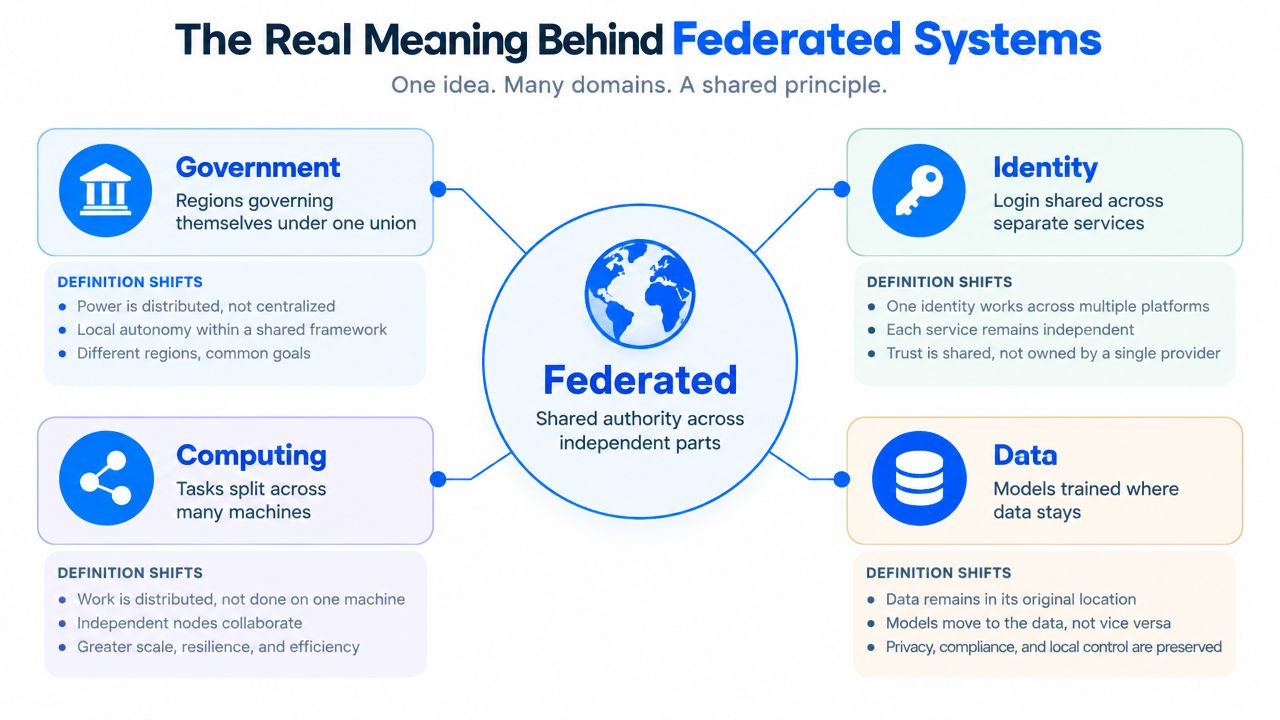
Federated means separate parts work together without surrendering ownership to one central place. In technology, that usually means an organization keeps data, identity, or processing close to the source, then connects those parts through shared rules, standards, or coordination layers. The term has been used in federated databases since the late 1970s and 1980s, and by the late 1980s and early 1990s it was already understood as a way to integrate autonomous systems into one logical view while preserving local control graphapp.ai.
A useful analogy is a network of local banks. Each branch manages its own accounts, but they agree on clearing standards so customers can move money across institutions without every bank merging into one giant ledger. Federation works the same way in data and AI, local autonomy first, shared rules second.
Practical rule: if the source system still owns the data or decision, and another layer only coordinates access or aggregation, you're probably looking at a federated design.
Four domains, one confusing word
The problem is that the word stretches across very different contexts. Dictionary usage spans political federation, identity federation, and federated computing or search, while identity federation specifically means linking a user's identity across separate systems through agreed attributes and sign-on rules Merriam-Webster. That's why a conversation about federated government, federated login, and federated analytics can sound like people are talking past each other.
In practice, the useful anchor is this, federated systems coordinate across independent parts without fully centralizing them. That definition fits federated databases, federated learning, and federated governance, even though each one applies the pattern differently. It also explains why implementation details matter more than the label.
For teams building modern data platforms, the link between federation and architectural choice becomes clearer when you compare it to other approaches. A solid primer on related design tradeoffs is understanding data mesh in modern architectures, because both patterns care about autonomy, governance, and shared standards.
Centralized Versus Federated Data Architectures
Centralized data architecture pulls data into a common warehouse or lake, then expects pipelines, modeling, and governance to happen there. Federated architecture keeps data where it already lives, then uses a federated server or access layer to coordinate queries and responses across sources. IBM's description of federated systems is clear on the mechanics, a federated server, one or more data sources, and client applications cooperate so a single SQL statement can access data spread across multiple sources IBM.
The difference is not just technical, it changes who controls what. In a centralized setup, the platform team often becomes the choke point for integration, standards, and access. In a federated model, domain teams retain ownership, while the enterprise defines interoperability rules, metadata expectations, and security boundaries. That shift is why federated architectures show up in regulated and multi-domain environments.
Operational takeaway: centralized designs optimize for control and consolidation, while federated designs optimize for autonomy and controlled coordination.
Federated versus centralized architecture comparison
Dimension | Centralized | Federated |
|---|---|---|
Data location | Moved into a shared warehouse or lake | Kept in source systems |
Ownership | Platform or central data team | Domain or source team |
Access coordination | Direct access to the central store | Queries routed through a coordinating layer |
Integration style | Consolidate first, use later | Access in place, aggregate on demand |
Governance | Centralized enforcement | Shared standards with local execution |
A federated approach emerged because large organizations hit limits with one giant pipeline model. As more teams, systems, and compliance constraints pile up, a single landing zone can become expensive to maintain and hard to align with data residency requirements. That doesn't mean centralization is wrong, it means the tradeoff changes once one team can't realistically own every dataset and every policy.
If you're evaluating the difference from a data quality angle, the distinction also shows up in operational controls. This comparison of federated and centralized data platform quality tradeoffs is useful when the question is less “which sounds cleaner?” and more “which structure can we govern?”
How Federated Learning Works Without Moving Data
Federated learning is the modern use of federated most analytics teams run into first. It trains models across remote devices or siloed data centers while keeping data localized, then uses a central server to coordinate repeated training rounds and aggregate model updates from distributed participants arXiv review. The raw records stay on the phone, hospital system, or site. What moves is the update signal, not the dataset.
That workflow matters because it changes the shape of privacy and compliance conversations. Instead of copying sensitive data into one model-building environment, each participant learns locally and contributes only what's needed for aggregation. This is why federated learning is often discussed for phones, hospitals, and other settings where data movement is tightly controlled.
The practical sequence
Local training starts on each client using the data already there.
Model updates are sent to a coordinator, not the raw dataset.
Aggregation happens centrally, producing a refined global model.
The updated model returns for another local round.
That pattern reduces unnecessary movement, but it doesn't make the process simple. Different devices may have different compute capacity, network reliability, or data quality. Coordination overhead becomes part of the design, and training schedules matter more than they do in a traditional centralized ML pipeline.
Rule of thumb: federated learning is a coordination model first, a privacy feature second.
The operational side gets even more important when teams try to monitor drift or model behavior across many participants. If you're tracking model stability in a distributed setup, model drift detection practices help frame what changes you can observe without pretending the system is static.
Federated Governance Models for Enterprise Data
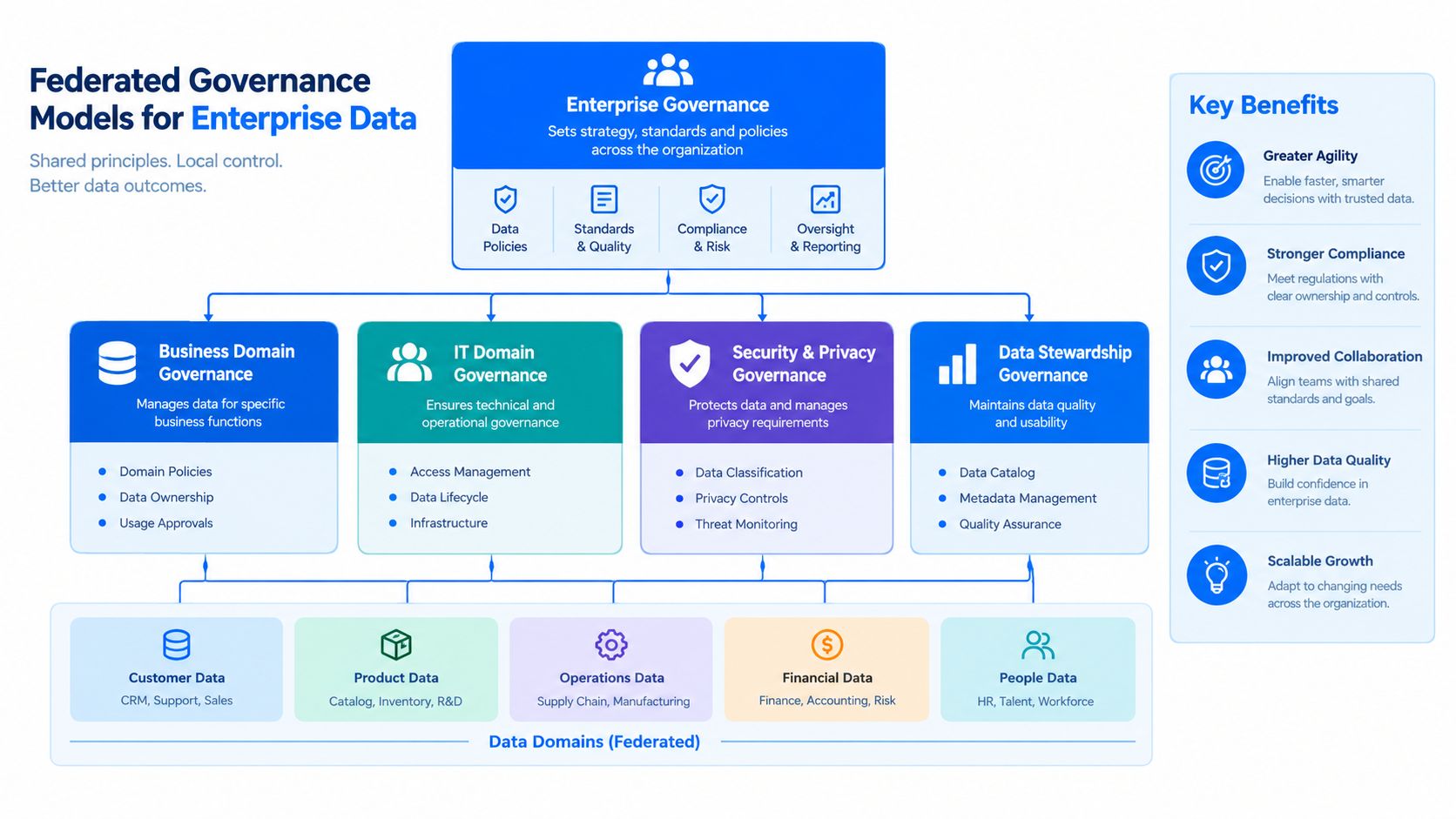
Federated governance is the organizational version of the same idea. A central body sets organization-wide policies, standards, and shared controls, while business units apply those rules within their own domains Atlan. That split is useful when the enterprise needs consistency, but the domains still need room to run their own pipelines, define local data rules, and manage domain-specific exceptions.
The key distinction is authority. Federated governance doesn't mean every decision is decentralized, and it doesn't mean central teams micromanage every dataset either. It means the center defines the guardrails, and the domains operate inside them. In practice, that usually includes shared metadata, security controls, and quality standards, plus clear ownership for enforcement.
Where the model works and where it strains
Federated governance tends to fit organizations with multiple business units, regulated data, or complex ownership lines. It's also a better match when local teams know the data better than a central platform group ever could. The tradeoff is coordination overhead, because policies have to be interpreted consistently across domains, not just written once.
It breaks down when the central policy layer is vague or when domain teams work in isolation. Then you end up with the worst of both worlds, a central rulebook no one uses and local practices no one can audit. That's why federated governance needs shared accountability, not just a chart that says “central plus local.”
For teams formalizing this operating model, federated data governance guidance is most useful when it's paired with concrete decisions about ownership, escalation, and quality evidence. Without those pieces, “federated” becomes a label with no enforcement path.
Why Federated Does Not Automatically Mean Private
The most persistent myth is that federated systems are private by default. They aren't. NIST notes that even in federated learning, information can still be extracted from model updates or from the trained model itself, which means federated learning reduces exposure but doesn't eliminate privacy risk NIST.
That's the part many explainers skip. Raw data staying local is an important control, but it isn't the whole security story. Independent research and regulatory guidance describe the same mechanism, clients keep raw data on-device or on-site, perform local computation, and send only focused updates for aggregation, sometimes with differential privacy added to reduce leakage CACM. That's better than shipping all records to a central training set, but it still leaves update leakage, model inversion, and coordination risk on the table.
What regulated teams should assume
Federated architecture should be treated as a data-movement reduction strategy, not a blanket privacy guarantee. If you work in finance, healthcare, telecom, or the public sector, that means you still need access controls, auditability, and cryptographic safeguards around the update path. The design helps with residency and autonomy, but it doesn't replace security engineering.
For teams focused on the compliance side of that equation, safeguarding your data privacy is a useful reminder that privacy protections still need layered controls, not wishful thinking. That same logic applies to federated systems, where the attack surface changes shape instead of disappearing.
Federated systems often move the risk, they don't remove it. The strongest deployments assume that model updates are sensitive assets, too.
If your organization is trying to align architecture with residency or sovereignty requirements, data sovereignty compliance becomes part of the design conversation, not an afterthought. The question is never just where the raw data sits, it's also who can infer what from the surrounding system.
When Federated Architectures Make Sense
Federated architectures make the most sense when independent teams need to keep ownership of their data while still participating in a shared operating model. They're a strong fit when privacy, sovereignty, or domain autonomy matter, because independent sources keep control while exposing interoperable access through shared policies, APIs, or algorithms MIT. That's the core value, coordination without full consolidation.
They also fit when centralized pipelines have become bottlenecks. If every new data source needs the same central team to ingest, model, approve, and publish it, the platform starts slowing down the business. A federated model can relieve that pressure, but only if the enterprise is willing to invest in standards, metadata, security, and quality oversight across domains.
Use federated designs when
Multiple domains need ownership: each team keeps control of its own data and logic.
Data residency matters: you can't, or shouldn't, move all data into one platform.
Central pipelines are overloaded: the platform team is spending more time on coordination than enablement.
Autonomy and compliance both matter: the business needs local decision-making inside global guardrails.
A purely centralized approach still makes sense for smaller datasets, single-domain workloads, or organizations that don't yet have the governance maturity to coordinate across domains. If there's one team, one workload, and one security model, federation can add more process than value. The structural tradeoff is simple, centralize for simplicity, federate for controlled independence.
digna provides data quality and observability inside the customer's own environment, which makes it relevant when federated teams need evidence from separate domains without pulling everything into one place. If you're evaluating federated architecture and need visibility into anomalies, schema changes, timeliness, and validation across domains, visit digna and see how the platform fits that operating model.
When federated domains keep their data in place but still need shared quality evidence, data platform observability that runs inside your own environment can monitor each source where it lives instead of copying it into a central store.
Frequently asked questions
What does federated mean in data and AI?
Federated means data stays at the source while shared models, policies, or queries operate across independent systems. Each part keeps ownership and local control, and a coordination layer handles access or aggregation. The idea dates back to federated databases in the late 1970s and 1980s and now underpins federated learning.
What is the difference between federated and centralized data architecture?
The core difference is where data lives and who owns it. Centralized architecture moves data into a shared warehouse or lake run by a central team, while federated architecture keeps data in source systems and routes queries through a coordinating layer, such as a federated server, with domain teams retaining ownership.
How does federated learning work without moving data?
Federated learning trains a model locally on each client, whether a phone, hospital system, or site. Only model updates travel to a coordinator, which aggregates them into a refined global model and sends it back for another local round. The raw records never leave their original location.
Is federated learning private by default?
No. NIST notes that information can still be extracted from model updates or from the trained model itself, so federated learning reduces exposure without eliminating risk. Regulated teams in finance, healthcare, telecom, or the public sector still need access controls, auditability, and cryptographic safeguards around the update path.
When should an organization use a federated architecture?
Choose federation when multiple domains need ownership of their data, data residency rules prevent consolidation, or central pipelines have become a bottleneck. For smaller datasets, single-domain workloads, or teams without the governance maturity to coordinate across domains, a purely centralized approach usually adds less process and remains the simpler option.