Achieve Data Sovereignty Compliance in 2026
|
6
min read

A lot of teams think they're covered because their customer data sits in Frankfurt, Paris, or Dublin. Then a support ticket lands, an engineer outside the jurisdiction opens a console session, and the compliance problem starts without a single row being copied to another storage region.
That's the trap. Data sovereignty compliance isn't just about where data rests. It's about which legal regime governs that data, how it is processed, and who can touch it during operations, support, incident response, and vendor maintenance. For regulated European enterprises, that distinction matters every day.
The practical risk is simple. You can satisfy a residency requirement and still fail sovereignty. If your architecture allows foreign administrative access, uncontrolled failover, or undocumented cross-border processing, your compliance posture is weaker than your cloud region diagram suggests.
Table of Contents
Introduction
A common failure mode looks harmless on the surface. Sensitive customer data remains stored in an EU region, but a support engineer outside that jurisdiction accesses it to troubleshoot an issue. Storage stayed local. Sovereignty did not.
That's why teams need a stricter definition. Data sovereignty mandates that data collected in a specific country remains governed by that country's legal frameworks regardless of where it is physically stored or processed, ensuring jurisdictional authority over data usage, access, and transfer conditions. That framing matters because it shifts the conversation from infrastructure placement to legal control, administrative access, and technical enforcement, as outlined in this 2026 perspective on cloud compliance and sovereignty.
For engineers, this changes the design target. The job isn't only to keep data in-region. The job is to build systems where unlawful cross-jurisdiction access is blocked by architecture, exposed by monitoring, and governed by repeatable operational controls.
What Data Sovereignty Really Means
Teams often mix up sovereignty, residency, privacy, and localization. That confusion creates bad architecture decisions because each term answers a different question.
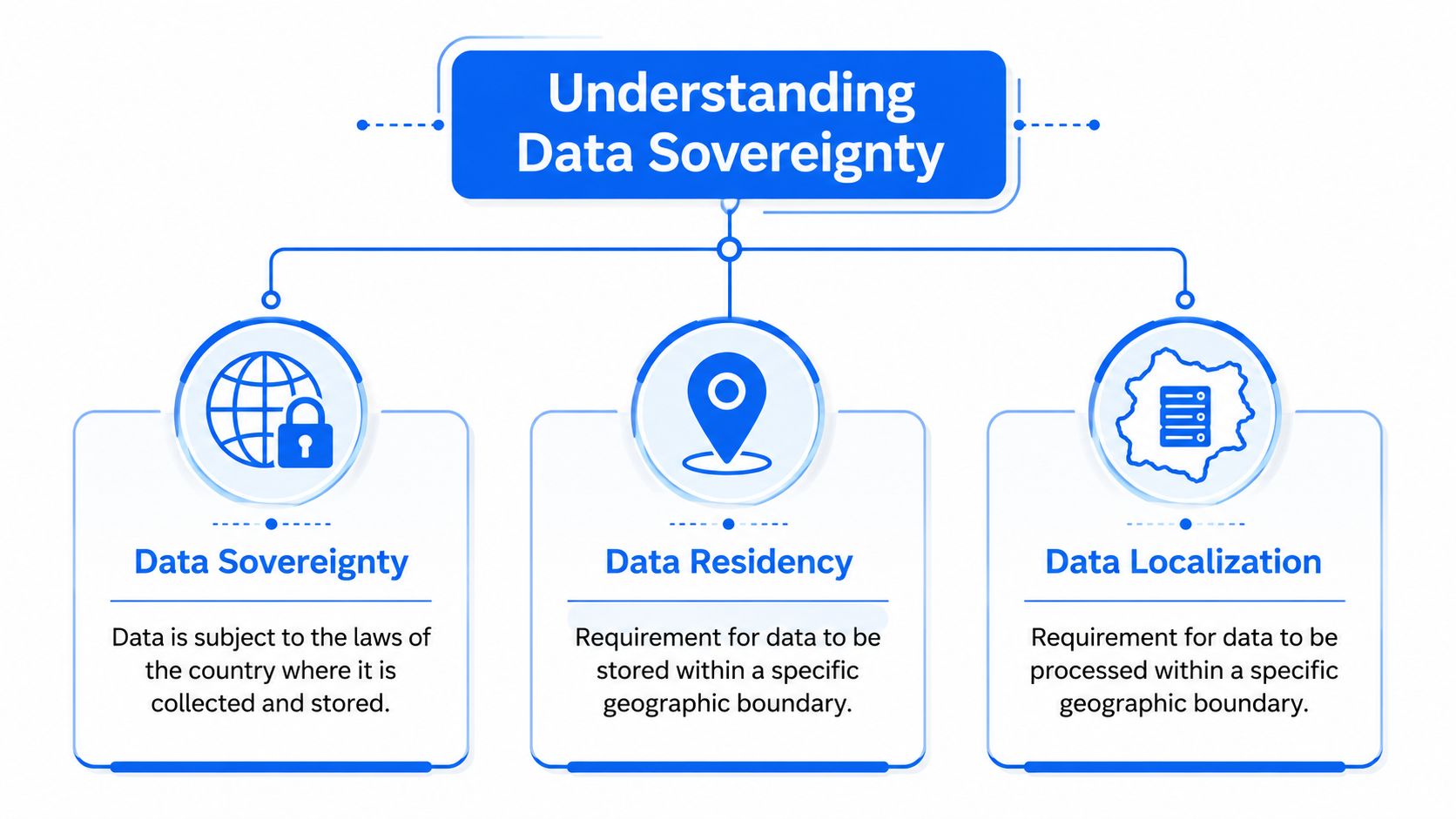
The safe, the rules, and the law above both
A simple analogy helps.
Data residency is the location of the safe. The safe sits in Germany, so the data is stored within a German boundary.
Data localization is stricter. It means the safe can't be opened and handled elsewhere for processing. Storage and processing both need to stay inside the defined geography.
Data privacy is the rules for using what's inside the safe. Who has a lawful basis to access it, what rights the person behind the data has, and what obligations apply to collection and use.
Data sovereignty sits above all of that. It is the legal authority governing the safe, its contents, and access to it. If the law says access from another jurisdiction creates exposure, then local storage alone doesn't solve the problem.
Practical rule: If your compliance design starts and ends with cloud region selection, you've designed for residency, not sovereignty.
This distinction matters because many cloud diagrams stop at location. They don't show who holds admin privileges, where support staff sit, where keys are managed, or where processing spills during recovery.
Why residency alone fails in practice
The most common misconception is that a local data center equals compliance. It doesn't.
A workload can be hosted in the right country and still be accessible by a foreign support team. A pipeline can process data in-region and still route metadata, logs, or temporary copies through another jurisdiction. A backup plan can keep primary data compliant and still fail during disaster recovery because the secondary region sits under a different legal regime.
Here's the test I use with engineering teams:
Ask who can administer the platform: If global vendor support can inspect customer environments remotely, sovereignty risk remains.
Ask where keys live: If the provider can decrypt, contractual promises aren't your strongest control.
Ask where jobs execute: Storage location doesn't matter much if sensitive transformation work runs elsewhere.
Ask what happens during failure: Outage handling often exposes the architecture you built, not the one your policy assumes.
A sovereign design doesn't rely on good intentions. It relies on technical limits.
That's also why privacy teams and platform teams need to work together. Privacy programs can be mature and still leave a sovereignty gap if infrastructure and vendor access models aren't engineered for jurisdictional control.
Mapping the Global Compliance Landscape
A common failure pattern looks like this. The workload is deployed in Frankfurt, the contract says EU hosting, and the architecture review signs off. Six months later, a support escalation allows an administrator outside the EU to inspect the tenant, and legal now has a transfer problem the deployment diagram never showed.
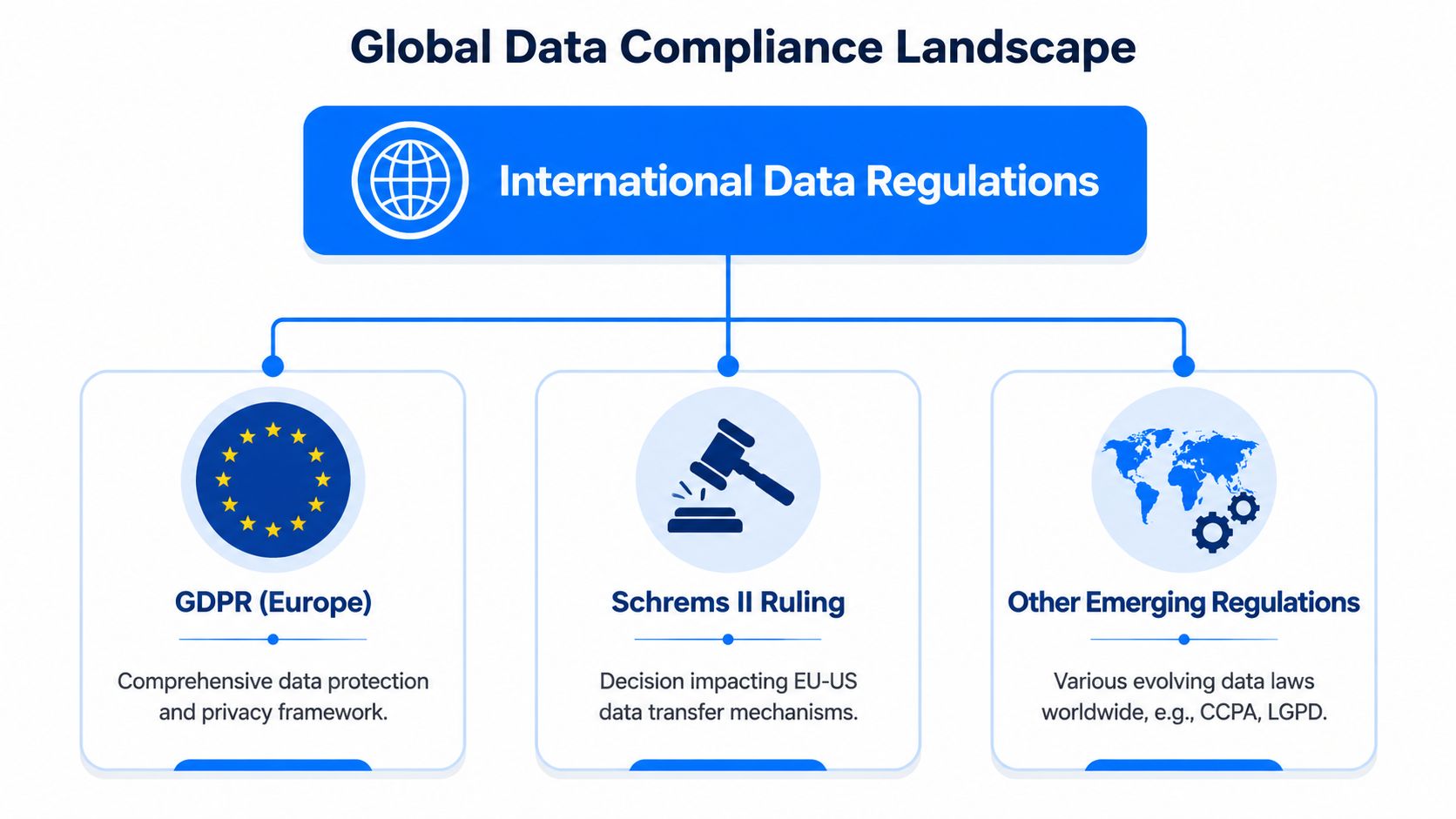
That is why engineering teams need a working model of the legal requirements. These rules shape region selection, backup design, remote support, key custody, and vendor operating access. They also keep changing. As noted in this overview of global data sovereignty regulations, many jurisdictions now enforce privacy and data protection laws, and the EU Data Act extends the discussion beyond personal data into non-personal and industrial data.
Three regulatory models engineers actually see
I group national requirements into three patterns because they drive different technical decisions.
Cross-border transfer with conditions
Data can move, but only with defined safeguards such as approved transfer mechanisms, documented assessments, and controls that hold up in practice.Localization for specific sectors or datasets
Certain records must stay in-country. Health data, public sector workloads, payment data, and critical infrastructure telemetry often fall into this category.Domestic processing expectation
Storage, processing, administration, and recovery are expected to remain inside the jurisdiction, with narrow exceptions.
The mistake is treating these as storage rules only. In regulated environments, the harder question is often whether a provider employee in another country can access the system for maintenance, incident response, or debugging.
What changed after Schrems II
Schrems II forced teams to stop treating transfer clauses as the whole answer. The destination country's access regime matters, and so does the provider's support model. If foreign authorities can compel access, or if vendor personnel outside the approved jurisdiction can reach live systems, a compliant-looking architecture can still fail review.
That changes how legal review and platform design interact. A new SaaS connector, a managed database service, or a cross-region recovery workflow can alter the organization's exposure even when the primary data store stays local. Engineers do not need to become lawyers. They do need to understand which design choices create a transfer, which ones create remote access risk, and which ones require compensating controls.
For teams building that review process, I have found it useful to compare internal policy decisions with external references such as LegesGPT recommendations for legal tools, especially when legal operations need better tracking of changing cross-border requirements.
Teams also need a clean distinction between sovereignty and residency. This guide to data residency is a good baseline, but residency alone does not answer who can administer the platform, where support sessions originate, or whether the vendor can decrypt customer data.
What engineering teams should take from the legal requirements
The practical takeaways are clear.
Data movement is broader than replication. Logs, snapshots, support bundles, telemetry, and temporary processing outputs can all create cross-border exposure.
Vendor access is part of the control surface. A platform hosted in the right region can still break sovereignty requirements if overseas support staff can reach customer environments.
Recovery design matters. Secondary regions, emergency procedures, and failover tooling need the same jurisdictional review as production.
The scope is expanding. Industrial and operational data now receive more scrutiny, not just customer PII.
If a regulator can interrupt operations because of how a system is administered or supported, that issue belongs in architecture review and service design, not only in contract review.
Architecting for True Sovereignty
If sovereignty matters, it has to show up in system design. Not in a policy wiki. Not in a vendor slide. In the actual mechanics of where code runs, where data moves, who holds keys, and who can operate the environment.
Start with deployment boundaries
The first decision is deployment model. This choice sets the ceiling for how much jurisdictional control you can realistically enforce.
Deployment Model | Data Location Control | Processing Location Control | Vendor Access Risk | Best For |
|---|---|---|---|---|
On-premise | Highest | Highest | Lowest when vendor access is fully restricted | Highly regulated workloads with strict operational control requirements |
Private cloud in customer-controlled environment | Strong | Strong | Lower if admin access is contractually and technically limited | Enterprises that need cloud flexibility without giving up sovereignty controls |
Public cloud single region | Moderate to strong depending on configuration | Moderate to strong depending on service design | Higher unless support, key control, and admin boundaries are tightly constrained | Teams that can engineer around shared responsibility limits |
Multi-cloud regional architecture | Strong for residency goals | Variable and easy to misconfigure | Medium to high if support and interconnect paths aren't governed consistently | Organizations balancing resilience with location-specific obligations |
Managed SaaS | Usually weakest | Usually opaque to the customer | Highest unless the provider offers strict no-access and local support controls | Lower-sensitivity use cases or functions with limited jurisdictional exposure |
For regulated European environments, private cloud and on-premise patterns usually make the trade-off clearer. You lose some convenience, but you gain direct control over data pathing, administrative boundaries, and evidence collection.
Use encryption as a jurisdiction control
Under GDPR after Schrems II, organizations need documented Transfer Impact Assessments, and if risk remains, transfers require supplementary measures such as client-side encryption where the customer retains sole control of keys, which the source describes as a primary recommendation from the EDPB in this analysis of post-Schrems II sovereignty controls.
That point gets misunderstood all the time. Encryption is not just a generic security best practice here. It is a jurisdiction control.
If the provider holds the keys, foreign legal compulsion aimed at the provider may still expose readable data. If the customer retains sole control of the keys, preferably through a hardware security model the provider can't bypass, the same request yields unreadable material.
The minimum pattern I'd expect for sensitive regulated data includes:
Customer-controlled keys: Not provider-managed defaults.
Separation of duties: The team that operates infrastructure shouldn't automatically decrypt application data.
Least privilege: Admin access should be narrow, role-based, and time-bounded.
Multi-factor authentication and access logs: These aren't optional if you need to prove governance in an audit.
Contracts help. Key control decides what's technically possible.
Control processing paths, not just storage
Many architectures fail when teams spend months validating storage regions, then let processing sprawl.
A stronger design uses localized compute, containerized services, and in-database execution where possible so sensitive data doesn't need to leave the governed environment for analytics, validation, or monitoring. The principle is simple. The less data you move, the fewer sovereignty decisions you have to defend.
That leads to several practical controls:
Policy-enforced geofencing: Restrict execution and access to approved jurisdictions.
Single-tenant deployments for regulated workloads: Shared planes create more administrative complexity.
Localized microservices: Keep transformations close to the data they act on.
Restricted subprocessors: Every downstream vendor expands the sovereignty surface area.
Failover design review: Backup regions, warm standby environments, and support runbooks all need sovereignty review before go-live.
Some teams also need advanced controls such as confidential computing, homomorphic encryption, or federated learning. Those aren't default answers for every stack, but they're useful when you need to reduce raw data exposure during computation.
The architectural mindset is what matters most. Don't ask only, “Where is the database?” Ask, “Where is this data ever visible, decryptable, processable, supportable, or recoverable?”
An Operational Checklist for Data Governance
Even a good architecture drifts. New tables appear. New connectors are added. A support exception gets approved during an incident and never gets removed. That's why data sovereignty compliance lives or dies in operations.
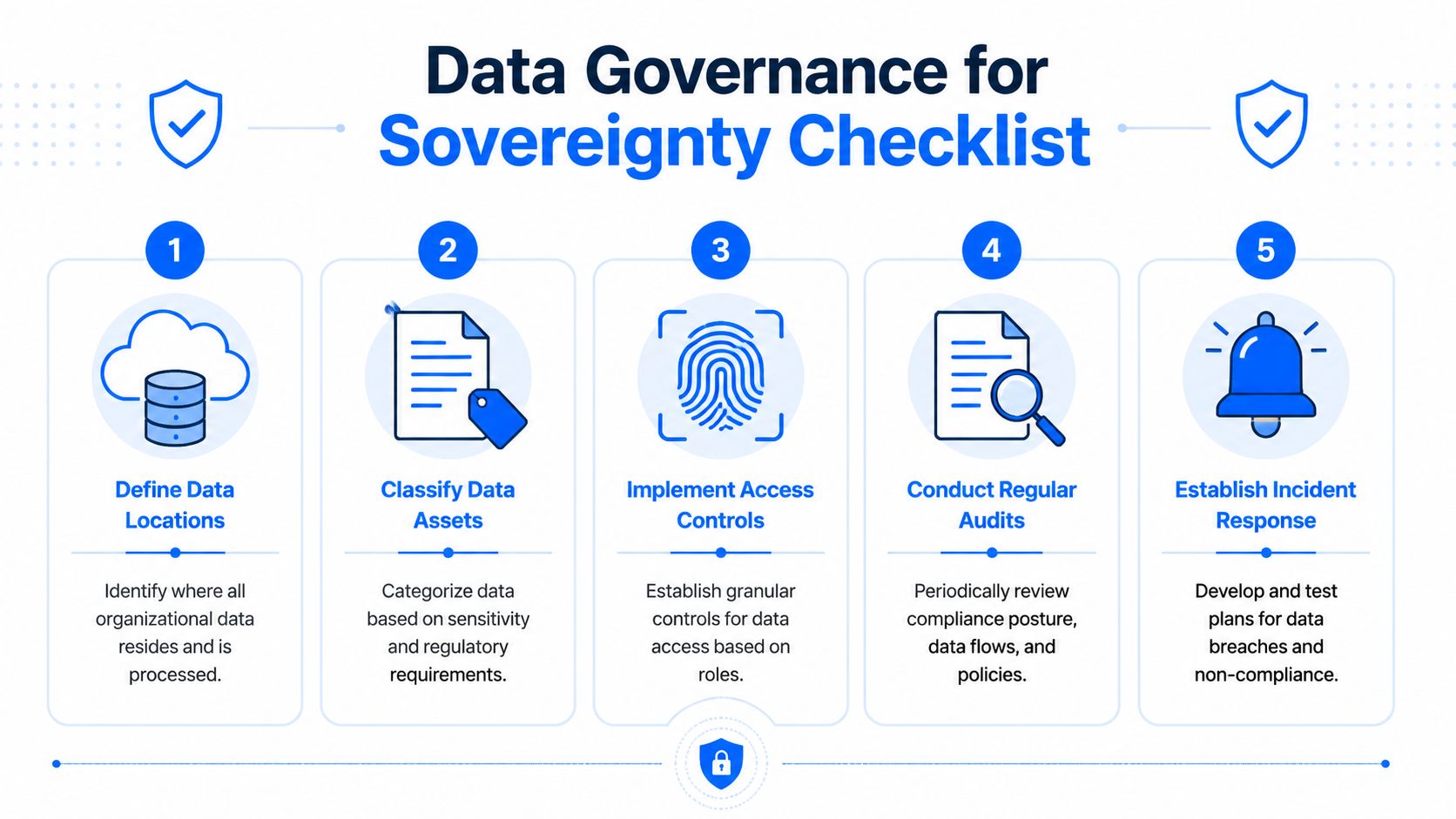
Build the inventory first
You can't govern what you haven't mapped. The first operational step is a current inventory of datasets, storage locations, processing locations, transfer paths, and subprocessor touchpoints.
I'd keep the checklist practical:
Map data flows end to end: Include ingestion, transformation, replication, backup, and support access paths.
Classify by jurisdiction and sensitivity: Personal data, regulated sector data, and industrial data don't all carry the same obligations.
Mark lawful transfer dependencies: If a flow depends on contractual clauses or a specific risk assessment, record it next to the pipeline, not in a separate legal file nobody reads.
Track administrative access paths: Human access is part of the data flow model.
This work needs regular refresh. Inventories decay fast because engineering systems change faster than governance documentation.
Treat vendor access as a design review item
The most overlooked issue is the one many teams assume is already solved. It isn't.
A data center in the right country is insufficient if support teams from foreign jurisdictions can access the data. That vendor access loophole is a growing regulatory focus, as explained in this analysis of sovereignty, privacy, and residency differences.
That means vendor review can't stop at “Which region do you host in?” You also need to ask:
Which support teams can access customer environments, and from where?
Can the vendor decrypt customer data?
Are support sessions logged, approved, and jurisdiction-restricted?
Do SLAs and DPAs restrict foreign administrative access explicitly?
Can the product run in a customer-controlled environment with no vendor data access?
Store local, process local, support local. If one of those fails, your sovereignty posture is weaker than it looks.
For engineers, this turns procurement language into technical acceptance criteria. If the vendor can't explain how they prevent cross-border support access, treat that as an unresolved design risk.
Run sovereignty as a recurring operating process
Once the inventory and vendor controls are in place, governance needs cadence. Not a one-off project board.
A workable operating rhythm usually includes:
Periodic data audits to confirm what exists, where it resides, and how it moves.
Transfer Impact Assessments for any cross-border flow or new vendor dependency.
Access reviews focused on privileged roles, emergency accounts, and vendor sessions.
Contract reviews for DPAs, SLAs, and subprocessor changes.
Policy updates when regulations or platform designs change.
This is also the place to review disaster recovery paths. A failover architecture that automatically activates another jurisdiction is not an edge case. It is part of normal operations once something breaks.
How Observability Maintains and Proves Compliance
A compliant design on paper isn't enough. You need evidence that the environment still behaves the way your policies say it should behave. That's where observability stops being an SRE-only concern and becomes part of compliance engineering.

What to monitor continuously
Sovereignty failures often begin as ordinary operational changes. A new column appears in a shared table. A pipeline starts replicating a dataset to another environment. A batch arrives late, gets reprocessed manually, and someone uses an out-of-region support path to inspect the problem.
This is why a data observability layer matters. If you want a concise foundation, this introduction to data observability is a useful reference point.
In practice, I'd monitor at least these categories:
Schema changes: New columns, type changes, and dropped fields can introduce personal or regulated data into flows that were previously harmless.
Timeliness deviations: Late jobs often trigger manual workarounds, and workarounds are where boundary violations happen.
Data anomalies: Unusual volume shifts, missing records, or unexpected values can indicate upstream processing changes that alter transfer behavior.
Validation outcomes: Record-level checks help confirm that data remains within expected structures and policy constraints.
Access and execution logs: You need a clear view of who operated what, when, and under which approval path.
How observability turns policy into evidence
An observability platform proves its worth. Consider a few concrete examples.
A schema tracking feature can flag the moment a team adds a new PII-bearing column to a shared warehouse table. That matters because a downstream export or cross-region transform that was acceptable yesterday may become a sovereignty issue today.
A timeliness monitor can highlight that an in-jurisdiction processing job didn't complete on schedule. That gives the team a chance to fix the local path instead of improvising a cross-border recovery step during an outage.
An anomaly detection layer can surface unusual movement patterns in regulated datasets. Maybe row counts spike unexpectedly, maybe a table starts changing outside its normal schedule, or maybe a downstream consumer begins pulling data from a path that hasn't been approved.
Record-level validation supports auditability from another angle. If policy says specific records must never enter a pipeline that serves another jurisdiction, validation rules can enforce that boundary before the breach becomes a legal issue.
Good observability doesn't just detect broken data. It detects broken assumptions about where data should be and how it should behave.
The strongest pattern is in-database execution. When observability analyses run inside the customer-controlled environment rather than exporting production data to an external tool, the compliance overhead drops. That model reduces movement, preserves locality, and makes it easier to defend the architecture during review.
For governance teams, the outcome is tangible. You can report on freshness, schema change frequency, validation pass status, and anomalous behavior as evidence that sovereignty controls are being monitored continuously, not just declared annually.
Sovereignty as a Continuous Discipline
The wrong mental model is “finish the compliance project.” The right one is “operate a system that keeps proving its boundaries.”
That starts with a basic shift in how teams think. Sovereignty is not equivalent to local hosting. It is the combination of jurisdiction-aware architecture, restricted access, controlled processing, and operational evidence. If your design still depends on broad vendor trust or undocumented support exceptions, the control isn't mature enough.
For regulated enterprises, the most effective pattern is consistent. Minimize data movement. Keep processing close to the governed dataset. Retain control of encryption keys. Restrict vendor and administrator access by jurisdiction. Review failover and support workflows with the same rigor you apply to production traffic.
Prioritize the vendor access loophole as a first-class issue. Many environments look compliant until someone asks who can log in from outside the host jurisdiction. That question exposes the underlying design.
A good next step is to review your current inventory, transfer paths, support model, and backup architecture against those principles. The gaps usually become obvious once you stop asking only where the data is stored and start asking who can reach it, from where, and under which law.
If you need a practical way to monitor data changes, timeliness, anomalies, and validation inside a customer-controlled environment, digna is built for that operating model. It runs in private cloud or on-prem environments, keeps analysis inside your database, and helps teams maintain evidence for governance without exposing production datasets to vendor access.