Federated Data Governance Explained in Plain English
|
7
min read

Your analytics team needs a customer dataset for a new dashboard. The request enters a central queue, waits for a steward to interpret the policy, moves to a security reviewer, then returns to the business owner for clarification. Meanwhile, the marketing domain has already created its own customer definition, finance uses another, and nobody can explain which version an executive report should use.
That tension sits at the heart of federated data governance. Organizations need consistent rules for privacy, access, quality, retention, and compliance, but they also need domain teams to make informed decisions close to the data. The model works by separating enterprise decision rights from local execution, then supporting that separation with shared technology and measurable accountability.
Table of Contents
When Central Governance Stops Scaling
A multinational retailer once described its governance committee as a small government inside the business. It had 400 people representing regions, functions, security, legal, analytics, and technology. The structure looked reassuring on paper, but every access request still followed the same route: a domain submitted it, the central committee reviewed it, and the committee debated whether a local exception would create enterprise risk.
The queue exposed the problem. Requests grew from 12 per week to more than 300 per week, while average approval time stretched to 19 days. Data stewards began leaving because their work had become administrative traffic control rather than stewardship. Analysts waited for access to data they understood better than the central reviewers, and the committee spent its time deciding matters that belonged much closer to the source.
Practical rule: A governance team shouldn't approve every decision simply because it owns the policy.
Several pressures arrived together. The retailer's data sources expanded tenfold across cloud warehouses and SaaS platforms. Privacy and regulatory expectations differed across the EU, the US, and APAC. Analytics teams wanted dashboards and machine learning models delivered in days rather than quarters. A single central queue couldn't handle that combination without sacrificing either speed or review quality.
The company faced a difficult choice. Relax central oversight and risk inconsistent definitions, weak access controls, and unclear accountability. Keep the existing process and turn governance into a delivery constraint that business teams learn to avoid.
The structural answer is to keep enterprise-wide rules in one place while moving routine interpretation and execution into the domains that understand the data. The center still protects the common boundary. Local teams gain authority inside that boundary. The rest of this operating model depends on making that division explicit, executable, and measurable.
What Federated Data Governance Actually Means
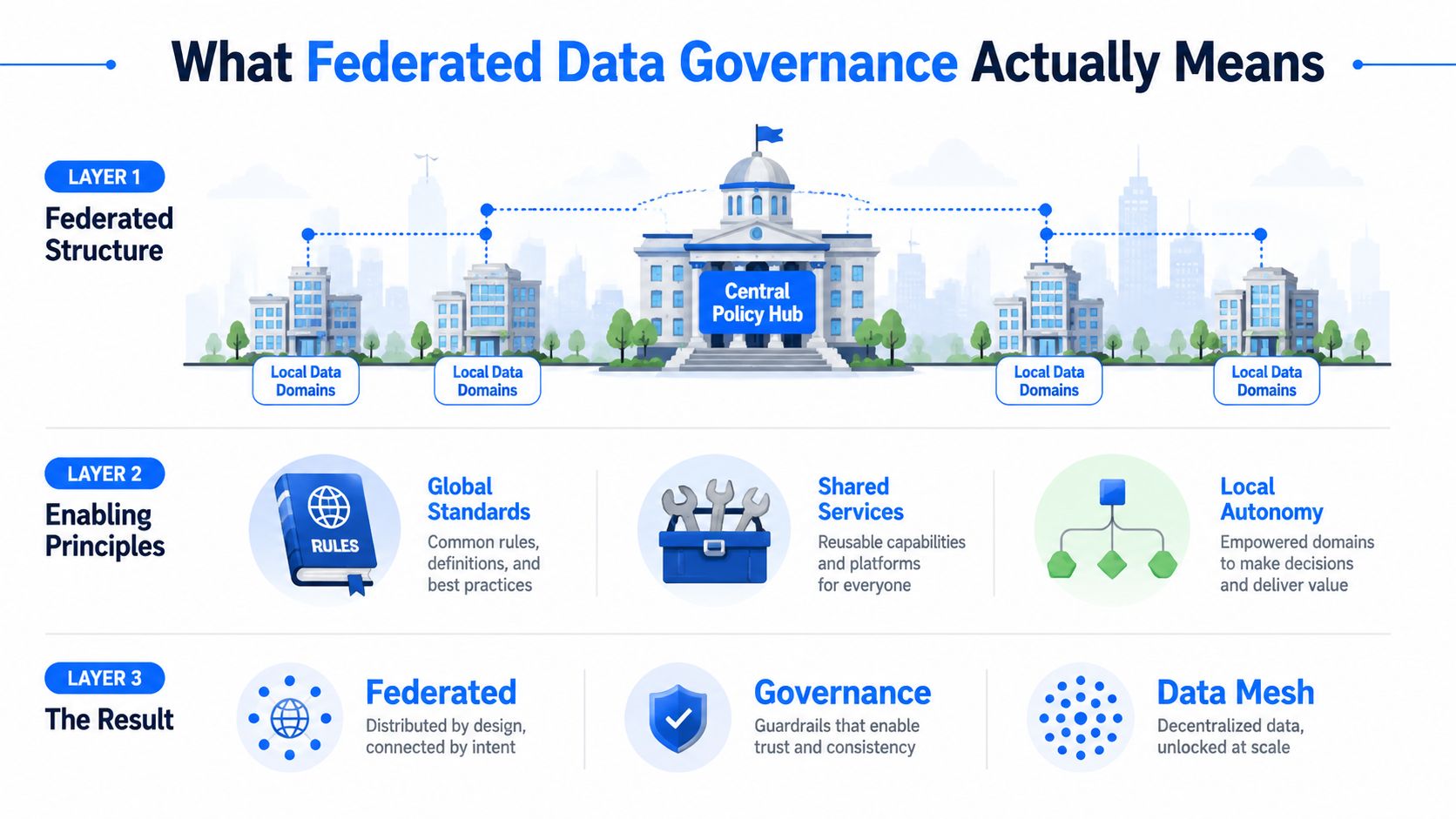
Start with a city. A central authority sets building codes, road standards, emergency requirements, and fire-safety rules. Neighborhoods still decide whether they need apartments, houses, shops, or schools, and they can arrange local streets around their needs. They aren't free to ignore the building code, but they don't need permission from city hall to choose every floor plan.
Federated data governance works the same way. A central governing body defines enterprise policies, standards, and compliance rules. Business domains retain ownership of implementation and execution within those boundaries. The model emerged as a distinct enterprise approach in the late 2000s and early 2010s, particularly as large organizations tried to balance centralized control with decentralized flexibility across increasingly complex domains (the evolution of data governance).
The structure
The first layer is the decision-right structure. The chief data office, enterprise council, or central governance body owns rules that must work across domains. Domain data product owners and stewards own the data products, workflows, definitions, and operational choices inside their boundaries.
That split prevents two common failures. Centralization stops being the approval bottleneck, while decentralization doesn't produce a collection of incompatible rules. Federated governance is therefore a hybrid architecture, with centralized standards, decentralized stewardship, and shared accountability (federated governance as a hybrid model.
The enabling platform
The second layer is a shared platform that gives domains self-service capabilities. A catalog can register data products and owners. Metadata services can carry classifications and business context. Lineage can show how a field moves across systems. Policy engines can apply access and masking rules without asking a central reviewer to interpret every request.
Policy as code matters. Governance rules become executable controls rather than documents that humans consult inconsistently. Academic work on data-mesh governance describes automatic enforcement for schemas, lineage, security, transparency, and legal-policy requirements (computational governance in data mesh).
The result
You should be able to explain the model to a teammate in one sentence: the center defines global standards, domains own local data products, and shared infrastructure enforces the agreement automatically. Local autonomy isn't the absence of governance. It's governance performed by the people closest to the data, under rules that remain visible and consistent across the enterprise.
Comparing Centralized, Decentralized, and Federated Models
The easiest way to distinguish the models is to follow one credit-risk model through a retail bank. A risk team wants to combine lending, repayment, and customer data to support a new model. The governance question isn't only who approves access. It also covers who defines the data, who validates it, who runs the platform, and who accepts responsibility when the model fails.
Dimension | Centralized | Decentralized | Federated |
|---|---|---|---|
Decision rights | One central team owns standards and approvals | Each domain decides for itself | The center owns cross-domain rules, domains decide locally within them |
Data stewardship | Central stewards manage definitions and issues | Domain teams manage their own assets independently | Domain stewards own local quality and context, with enterprise oversight |
Policy writing and enforcement | Policies are written and reviewed centrally, often manually | Policies vary by domain | Policies are shared centrally and enforced through common services |
Data products | A central team builds or controls products | Each domain builds products independently | Domains build and own products using shared platform capabilities |
Platform funding and operation | Central technology funds and runs the platform | Domains choose and fund their own tools | A central platform team provides reusable capabilities for domains |
Failure mode | Approval queues and central bottlenecks | Conflicting definitions, duplicated work, and fragmented controls | Poorly defined boundaries, weak adoption, or disputes over shared rules |
In the centralized version, the bank's central governance committee defines the approved variables, reviews the access request, validates classifications, and approves production use. The model may receive consistent treatment, but the same reviewers must understand every domain's business context.
In the decentralized version, lending, deposits, and marketing each decide how to use customer information. The credit-risk team can move quickly, but it may define “customer,” “active account,” or “revenue” differently from other teams. Security practices can also diverge.
In the federated version, the center defines identity, privacy, classification, and minimum quality requirements. The lending domain owns its credit-risk product, documents its model inputs, tests the data before publication, and grants local access within approved boundaries. A shared platform records lineage and applies the common controls.
Federation isn't a compromise where everyone gets a smaller portion of authority. It's a deliberate allocation of authority. The operating logic aligns with the broader data mesh approach to modern data architectures, but governance remains the focus: who can decide, under which rules, with what evidence.
The Decision-Right Split Between Center and Domain
Federation succeeds or fails on one practical artifact, the decision-right matrix. Without it, the center assumes it still approves everything, while domains assume they can interpret policy freely. Both groups escalate uncertainty, and the organization recreates the bottleneck it intended to remove.
The center should reserve decisions that cross business boundaries or carry enterprise risk. Domains should own decisions that require detailed knowledge of collection, transformation, and consumption. The split isn't identical for every organization, but the categories should be explicit.
Decision Area | Center Owns | Domain Owns |
|---|---|---|
Classification and privacy | Enterprise classification levels and privacy requirements | Applying classifications to domain assets and resolving local classification questions |
Identity and access | Enterprise identity rules, role principles, and control requirements | Local access decisions within approved boundaries |
Definitions | Shared definitions required for cross-domain reporting | Domain-specific calculations and business context |
Quality | Minimum quality benchmarks and shared service expectations | Tests, monitoring, issue resolution, and quality practices at source |
Metadata and lineage | Required metadata fields and interoperability standards | Product documentation, local lineage details, and maintenance |
Retention | Enterprise retention principles and regulatory constraints | Implementing retention in domain systems and handling approved local needs |
Reference data | Approved enterprise reference values | Domain mappings and operational use of those values |
Exceptions | Exception criteria, approval authority, and review process | Preparing evidence and requesting an exception |
Consider customer data. The marketing domain owns campaign attribution logic, including how it connects an interaction to a campaign. The center owns what counts as a customer for enterprise reporting, because that definition must remain stable when finance, risk, and marketing exchange data.
The contested middle includes naming conventions, retention windows, and semantic definitions. A center that dictates every local term will frustrate domain experts. A domain that changes a shared term without consultation will break interoperability. A council with representatives from affected domains can resolve these conflicts, document the decision, and record the access or policy outcome for later review. Denodo's overview of federated governance also emphasizes the split between enterprise decisions and domain decisions, including council-based resolution of cross-domain conflicts (federated governance decision rights).
The center should publish the boundary. Domains should operate inside it. The data governance roles must then name the person accountable for each decision, not just the team that participates in it.
Implementing Federated Governance Layer by Layer
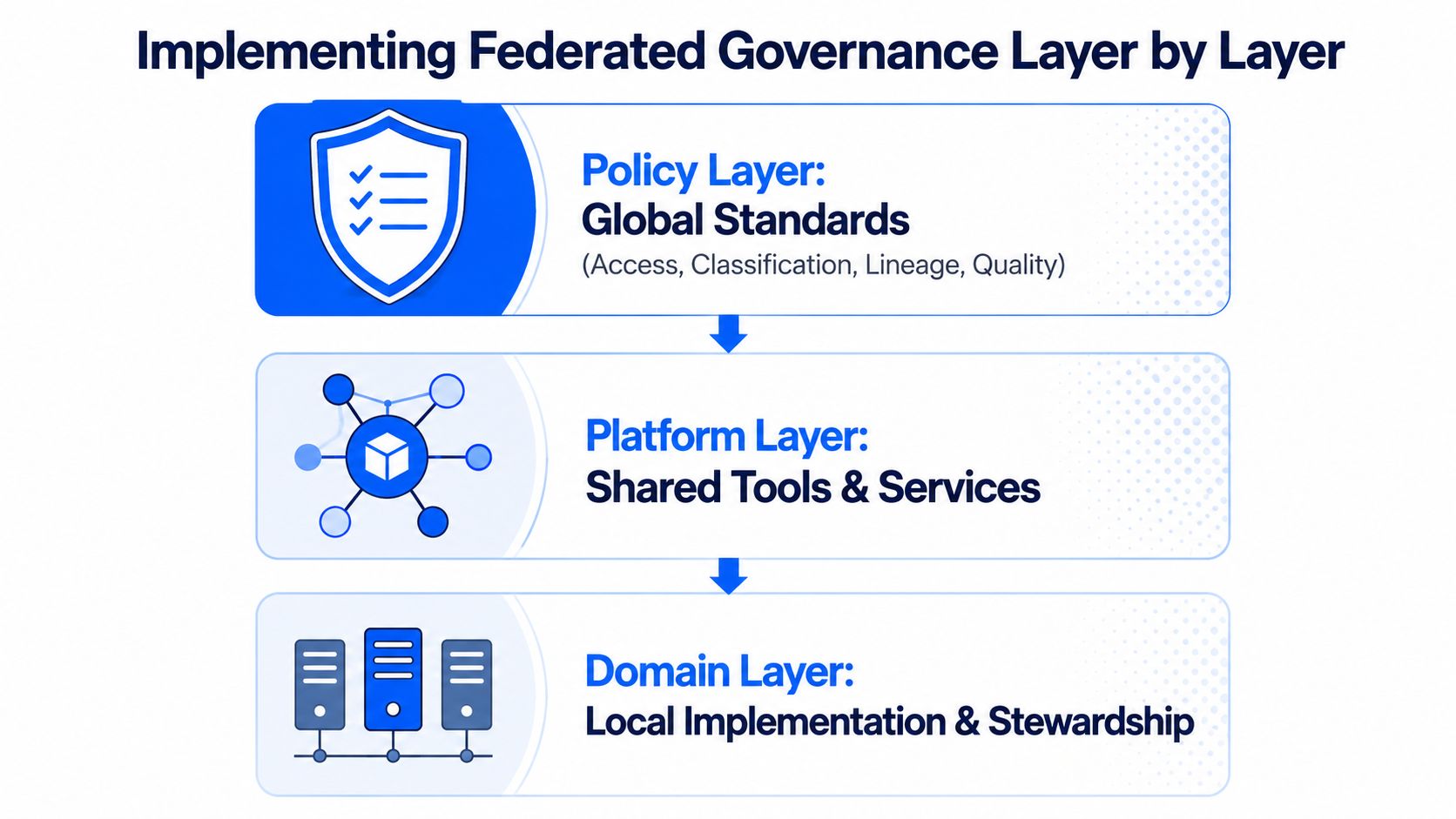
A financial-services company shouldn't announce federation and immediately assign every domain a data product backlog. The model needs an operating foundation first. A layered rollout prevents domain teams from receiving responsibility without the policies and tools needed to carry it.
The policy layer
The central team begins with a compact set of nonnegotiable standards for access, classification, lineage, and quality. The policy council brings security, privacy, legal, architecture, and domain representatives together to settle the rules. Its outputs include a policy register, a classification model, minimum metadata requirements, quality expectations, and an exception process.
The first domains don't need a perfect enterprise rulebook. They need rules that are clear enough to apply and narrow enough to enforce. A publishing gate might require an owner, classification, schema, lineage, and defined quality checks before a data product becomes discoverable.
The platform layer
The platform team turns those standards into reusable services. Domains need a way to register products, attach contracts, monitor service levels, request access, and show lineage without building separate governance pipelines. The catalog becomes the shared place where consumers find ownership, definitions, classifications, and status.
This is also where the financial-services company encodes controls. Access policy runs through the platform, schema checks run during delivery, and lineage is captured as products change. The center gets visibility without reviewing every routine transaction.
Domain enablement
Only after the first two layers are usable should enablement become the main focus. Each participating domain appoints a product owner and steward, defines its products, writes contracts, and runs quality reviews. A central enablement group coaches teams, supplies templates, and helps resolve adoption problems.
The company can convene a central policy forum for enterprise issues, a platform working group for capability gaps, and domain reviews for product quality. It should also track whether each layer is reducing work for the next one. Policy clarity should reduce exception debates. Platform automation should reduce manual checks. Domain ownership should reduce central issue triage.
A phased rollout is easier to sustain when artifacts remain visible and editable. The practical guide to implementing data governance can help teams turn broad governance principles into operational activities, owners, and controls.
Tooling and Platform Considerations
A retail company may have access controls and quality checks spread across warehouse permissions, transformation jobs, ticketing tools, and copied extracts. Every copy creates another place where classification, masking, lineage, and retention can drift. A unified governance layer embedded in the warehouse can execute controls where the data already lives, reducing the need to move data into separate governance pipelines.
Tool selection should start with the decision-right split, not with a feature checklist. The center needs visibility and control over enterprise policies. Domains need self-service tools that let them publish, document, test, and maintain products without waiting for central engineering.
The catalog and metadata layer
An active catalog should show more than table names. It should connect each asset to an owner, classification, business definition, lineage, quality status, and access path. Metadata should update through system events where possible, rather than depending entirely on manual documentation.
The enforcement layer
A policy engine should apply identity, masking, classification, and retention requirements in the systems that serve the data. In-database or in-place execution matters because it can limit data movement and preserve the controls already established in the customer environment.
The reliability layer
Contract testing catches incompatible schema or business-rule changes before consumers receive them. Observability monitors freshness, structural changes, volume behavior, and operational signals. Teams evaluating monitoring practices may also find this guide to data quality KPIs for SaaS useful when deciding which reliability signals belong in a domain service agreement.
The workflow layer
Stewardship requests still exist, but they should be lightweight. A workflow should route an exception to the accountable domain, capture the decision, record approval evidence, and make the result searchable. It shouldn't turn every normal access decision into a committee meeting.
Look for open interfaces, federation-friendly access controls, support for in-place execution, and pricing that doesn't punish responsible data sharing. A platform can expose lineage and automate checks, but it can't decide whether marketing or finance owns a disputed definition. The data observability capabilities should support governance decisions, not replace the people who make them.
Governance KPIs That Prove Federation Works
A governance committee needs evidence that the model changes how work gets done. The strongest measures connect a desired outcome to the layer responsible for producing it, then distinguish early signals from results that arrive later.
The following targets turn the operating model into a scorecard. They should be agreed before rollout, then reviewed with enough context to explain movement rather than celebrate a single favorable reading.
KPI | Owning Layer | Target Direction |
|---|---|---|
Time to publish a certified dataset | Domain and platform | Under five business days |
Datasets with an active owner and SLA | Domain | Above ninety percent |
Policy violation rate per release | Center and platform | Trending below two percent |
Mean time to remediate a data-quality incident | Domain and platform | Under twenty-four hours |
Query latency for governed access | Platform | Downward or stable as adoption grows |
Lineage coverage | Platform | Upward across critical products |
Exception resolution time | Council and center | Downward with clear evidence |
The first four targets are operational measures defined for this governance model. They attach directly to publication speed, accountability, control quality, and recovery. The last three help explain whether the shared platform can support local execution without hiding dependencies.
Market context also shows why measurement matters. One published forecast values the global data governance market at $5.6 billion in 2025 and projects $38.3 billion by 2035 (data governance market forecast). Investment alone doesn't prove that governance works. Internal KPIs must show whether the investment removes friction while preserving control.
Use leading indicators such as owner assignment, contract completion, policy coverage, and lineage capture. Use lagging indicators such as incidents, failed releases, audit findings, and delayed publications.
If domain autonomy rises while certification time stays flat, the operating model may be shifting responsibility without improving flow. If autonomy rises while incidents climb, the guardrails are too loose or the platform isn't enforcing them reliably.
Survey evidence reinforces the need for this discipline. 71% of organizations report having a governance program, yet 54% still identify governance as a top data-integrity challenge, and 39% of data leaders struggle to demonstrate governance impact to leadership (governance adoption and impact findings). A data governance KPI framework can help teams define the measures and ownership needed for that leadership conversation.
Common Mistakes and a Practical Operating Picture
The practical operating picture is simple to describe. A thin central team publishes policies and shared platform capabilities. Domains consume those capabilities through a federated catalog, own their products, and resolve issues at source. A lightweight council handles cross-domain conflicts, while KPI reviews show whether the arrangement is improving speed, accountability, and control.
The most common mistake is treating federation as a reorganization instead of a contract change. Leaders rename teams, publish a charter, and expect behavior to change. Domain teams continue escalating because nobody rewrote the decisions they can make, the exceptions they can approve, or the response time they can expect.
The fix is a signed one-page matrix covering the 12 to 15 decisions the center reserves, the person who approves exceptions, and the SLA for resolution. That matrix should live beside the catalog, where people make governance decisions, rather than in a presentation that few teams consult. The council should review it every quarter against the KPI map, changing the boundary when evidence shows that a decision belongs elsewhere.
Shadow tools are an early warning sign. If a domain creates an unapproved catalog or access workflow because the official route is too slow, leaders should address both the local behavior and the central friction. Guidance on managing shadow IT for SMBs offers useful context on why unmanaged tools can create security and compliance exposure.
Federated data governance works when accountability is visible, policy is executable, and domains have enough authority to act. The center protects shared trust. Domains maintain practical context. The platform makes the agreement observable.
digna helps data teams monitor anomalies, timeliness, record-level validation, and schema changes inside their own data environment, giving federated domains evidence for quality decisions while preserving central visibility. Visit digna to see how its modular observability platform can support governed data products across warehouses, lakes, and pipelines.
Frequently asked questions
What is federated data governance?
A model where the center defines global standards, domains own local data products, and shared infrastructure enforces the agreement automatically. If you cannot explain it to a teammate in one sentence like that, the operating model is not yet settled.
When does centralized governance stop scaling?
When approval becomes the bottleneck. One multinational retailer's governance committee grew to 400 people across regions, functions, security, legal, analytics and technology, while requests rose from 12 per week to more than 300 and average approval time stretched to 19 days.
What are the two layers of a federated model?
The decision-right structure, which splits enterprise-wide rules from routine local interpretation, and the enabling platform, which gives domains self-service capabilities. Policy as code matters here, because it is what turns an agreement into something infrastructure can enforce without a meeting.
How does it compare with centralized and decentralized models?
Centralized keeps every decision in one place and slows down; decentralized gives domains freedom and loses consistency; federated keeps enterprise-wide rules central while moving routine interpretation into the domains that understand the data. The differences show up fastest when you trace one shared asset through each model.
Where did the federated model come from?
It emerged as a distinct enterprise approach in the late 2000s and early 2010s, as large organizations tried to balance centralized control with decentralized flexibility across increasingly complex domains. The pressure that created it, too many domains for one committee, has only increased since.