What Is Data Strategy and How to Build One That Works
|
6
min read

You can feel the gap before anyone says it out loud. The executive deck says the company is becoming data-driven, the platform budget was approved, and yet the same questions keep coming back, which dashboard is right, who owns this dataset, and why did the report go stale again? That's usually the moment people realize the problem isn't a lack of tools, it's a lack of operating model.
A useful answer to what is data strategy is simple enough to say and hard enough to do well. It's the coordinated approach an organization uses to govern, manage, share, protect, and extract value from data in support of business objectives. In practice, that means deciding who can use data, under what conditions, with which quality and security controls, and how that data moves across teams and systems.
Table of Contents
Why Most Data Strategies Fail Before They Start
The failure usually starts in a boardroom, not in a pipeline. Someone presents a polished slide deck with goals, architecture boxes, and a few comforting phrases about transformation. A month later, the finance dashboard is stale, the product team has its own definition of revenue, and the data engineer still can't say who owns the critical dataset that broke after a schema change.
That's why a data strategy can't be treated like a roadmap for tools. It has to function as an operating model that ties business priorities to ownership, standards, quality measurement, lifecycle controls, metadata, and reliable delivery. If nobody knows who makes decisions when data crosses a team boundary, the strategy is already missing its spine.
The European Union's data policy history makes this point clearly. The European Strategy for Data treated data availability and trust as economic infrastructure, not just IT work, and a public consultation found that 97.2% of 806 respondents agreed the EU needed an overarching data strategy, while 91.5% supported the policy direction (European Strategy for Data and the consultation results). That's a governance signal, not a tooling signal.
Practical rule: if your strategy doesn't tell people who owns a dataset, how quality is measured, and what happens when the rules fail, it isn't strategy yet.
The strongest definition is the one teams can act on: a data strategy links business outcomes to data behavior. It defines the data that matters, how it should behave, and what evidence proves it still does. If you want a sharper warning sign, look at the organizations that keep building data-rich and information-poor environments, because that's what happens when strategy stops at ambition and never reaches accountability.
The Core Components of a Modern Data Strategy
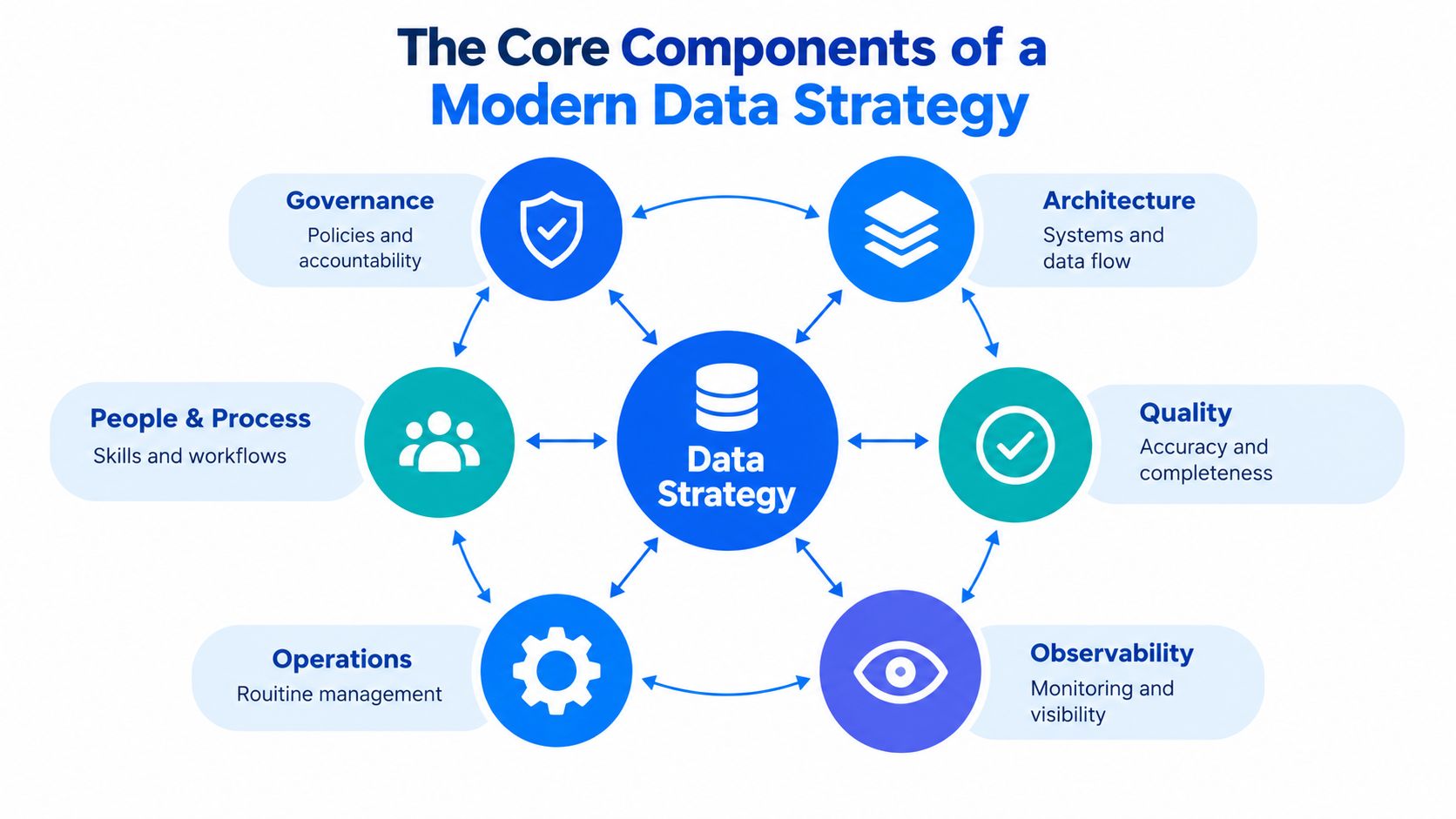
Think about a city. The roads, traffic signals, inspections, zoning rules, maintenance crews, and residents all have different jobs, but the city only works when those parts reinforce each other. A modern data strategy works the same way, because governance, architecture, quality, observability, operations, and people and process all have to line up.
Governance and architecture set the rules of movement
Governance is the zoning code. It defines decision rights, accountability, and policy, so the organization knows who can approve access, who owns the dataset, and what conditions apply. Architecture is the road network. It defines where data lives, how it moves, and how it gets accessed across warehouses, lakes, operational systems, and AI pipelines.
That matters because a strategy without architecture becomes a policy document with nowhere to go. A strategy without governance becomes a pile of infrastructure decisions with no owner and no escalation path. The two need each other.
Quality, observability, and operations make the system usable
Quality is the inspection standard. It tells each dataset what “good” means, and NIST's quality framing is useful here because it treats accuracy, bias, timeliness, completeness, relevance, and consistency as distinct factors, not one generic score (NIST quality factors and control context.pdf)). Observability is the traffic system, it shows what's happening now and surfaces deviations early. Operations is the maintenance crew, it turns policy into repeatable work.
The people and process layer is where most strategies either become durable or fade out. You need named owners, clear incentives, escalation paths, and enough shared language that analysts, engineers, and business stakeholders can talk about the same dataset without talking past each other. If you want a concrete architecture reference, data system architecture only works when those human rules are explicit too.
When ownership is unclear, teams start compensating locally. That's how one group creates its own definition, another group builds a workaround, and a third group stops trusting the numbers entirely.
Common Misconceptions That Undermine Data Strategy
A data team buys a lakehouse, a governance tool, or an AI platform and calls it strategy. What it really bought was capacity, not accountability.
A modern platform can store, move, and process data well, yet still leave no clear answer to who owns quality, who approves reuse, or how failures are escalated. MIT CISR's definition is closer to the truth, data strategy is an integrated concept for how data enables and shapes business strategy, so the business outcome comes first, not the platform choice.
Metrics create a third trap. Green tiles on a monitoring screen do not prove that a dataset is trustworthy for a specific use case, they only show that a narrow set of checks passed at a moment in time.
A one-time cleansing project creates a fourth misconception. A dataset can be clean on Friday and broken on Monday if a source system changes, a delivery arrives late, or a field is repurposed without warning.
The lasting mistake is treating cleanup as control. Strong data strategies assign accountability, identify the datasets that matter most, define how each one is measured, and keep evidence that the controls still work. Without that operating model, teams end up in the same fire drills, with the same people, the same explanations, and the same unresolved dataset-level failures.
How to Build a Data Strategy That Actually Works
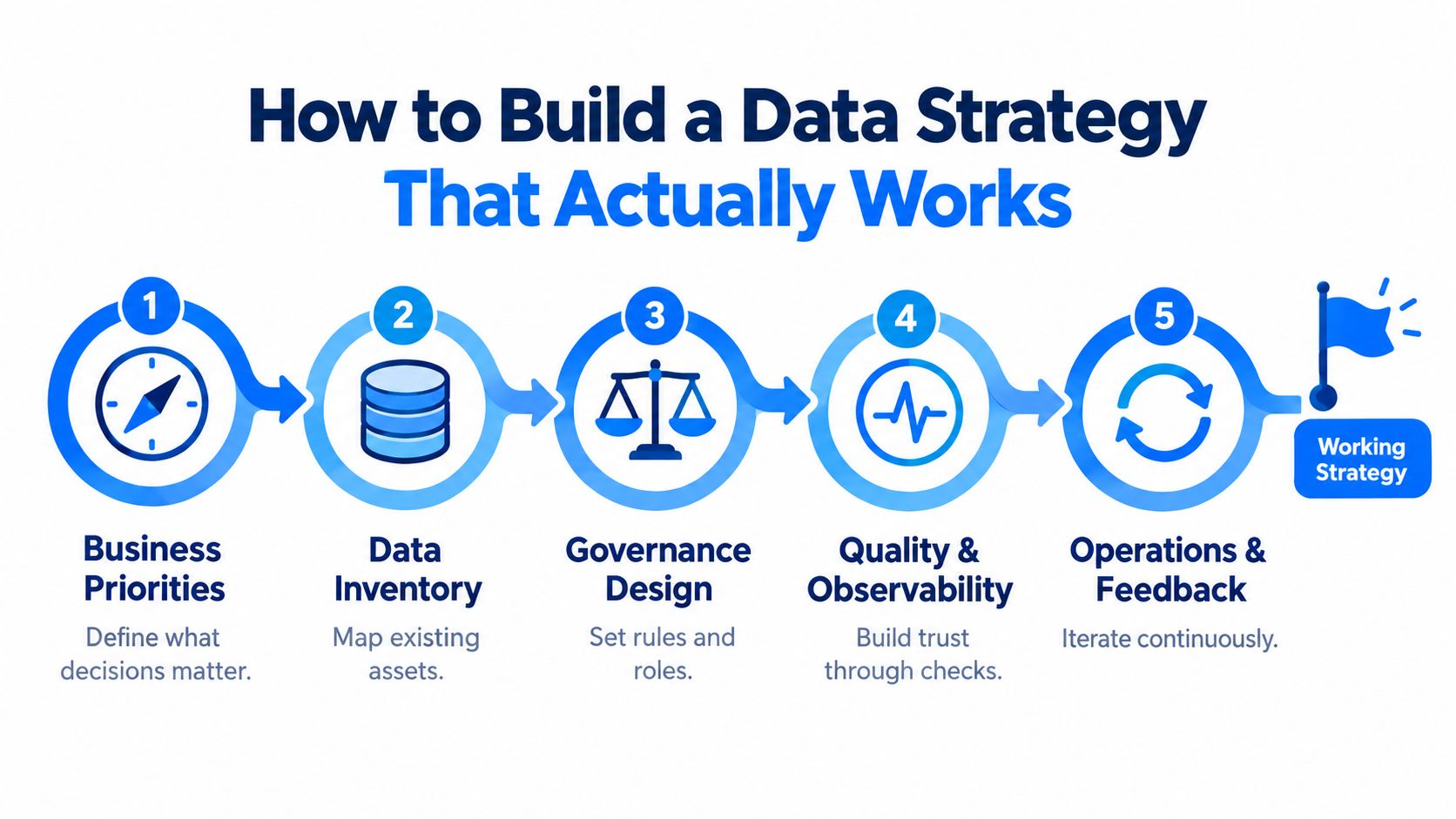
A useful data strategy starts with a business decision, not with a repository of assets. Ask which choices the organization wants to make better, faster, or with less risk, because those decisions tell you which datasets deserve attention. If the team cannot name the decisions, it cannot rank the data.
From there, narrow the scope to a small portfolio of critical datasets. Ownership should sit with the executive accountable for the related business outcome, and the operating model should document the required data, acceptable quality, known gaps, and the resources needed to keep it working. That level of specificity keeps teams from trying to govern everything and pushes effort toward the places where failure has real business cost.
For each critical dataset, write down the basics in plain language:
Named owner: the person accountable for the business outcome.
Intended consumers: the teams that rely on the dataset.
Service expectations: what “available” and “usable” mean for this use case.
Quality dimensions: which rules matter here.
Delivery timing: when the data has to arrive to remain useful.
Schema controls: what structural changes should trigger review.
Then turn that list into a working operating model. The platform team, governance leads, and business owners should all look at the same set of strategic datasets, instead of debating abstract enterprise standards that no one can maintain. A strategy works when it shapes daily decisions, not just meeting slides.
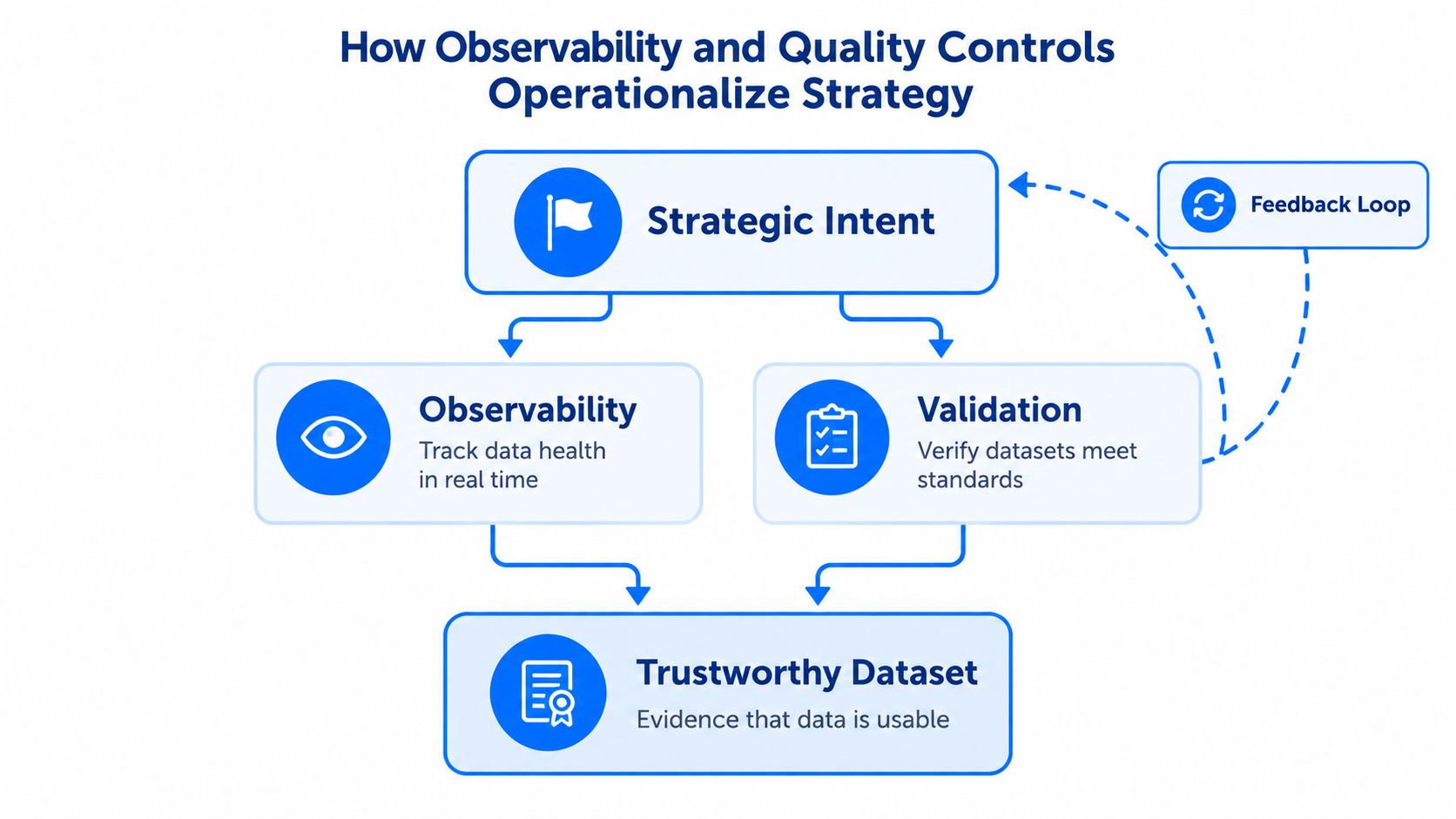
A practical example helps here. digna monitors data behavior, validates records, tracks timeliness, and detects schema changes inside the customer's own environment. The tool is secondary. What matters is the loop between policy and proof, evidence has to feed back into strategy reviews so leaders can see whether controls are working or only documented.
Why AI Readiness Changes the Stakes
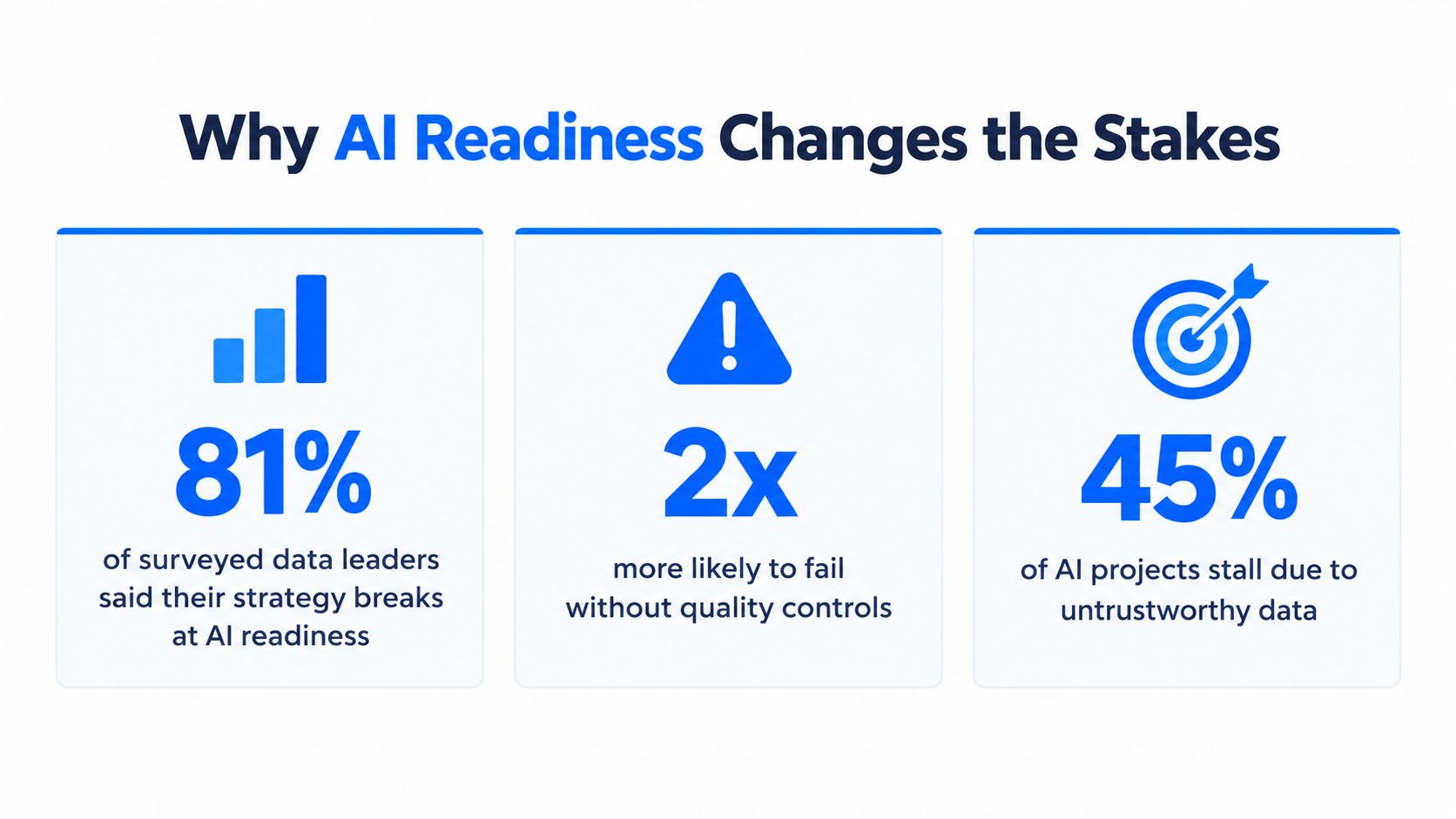
AI exposes weak strategy faster than reporting does. IBM found that 81% of surveyed data leaders said their data strategy was integrated with technology-roadmap and infrastructure investments, yet only 26% were confident their data could support new AI-enabled revenue streams (IBM research on AI readiness and strategy). That gap is the warning. Integration with the roadmap does not mean the data is ready for AI.
A separate KPMG finding said 62% of organizations viewed insufficient data governance as the main data challenge limiting AI initiatives (KPMG on data governance and AI). That does not point to one more platform project. It points to a different standard: each AI use case needs evidence that the underlying dataset is complete, accurate, timely, structurally stable, authorized, and documented.
AI readiness is a dataset problem, not a platform slogan
A platform can be modern and still fail an AI use case if the inputs are inconsistent or poorly governed. Certification has to happen at the dataset level, for a specific outcome. A fraud model, a customer-support assistant, and a forecasting workflow all need different proof, even when they run on the same stack.
That shifts the question from “Do we have an AI platform?” to “Can we continuously prove this dataset is fit for this use case?” For one dataset, freshness and lineage may matter most. For another, validation rules and schema stability may decide whether the model can be trusted. Strategy becomes real only when those differences are explicit.
Useful test: if your AI team cannot point to the exact checks that keep a dataset fit for purpose, the model is being asked to trust evidence it does not have.
AI-ready data should be treated as a controlled asset, not a static label. Tools such as digna can help monitor behavior at the dataset level, where readiness is decided.
How Observability and Quality Controls Operationalize Strategy
A strategy becomes real when someone can show the evidence. Observability and validation are the evidence layer, they turn policy into visible dataset behavior. Without them, leadership is just hoping the controls work. With them, leaders can see whether a dataset is healthy, drifting, delayed, or broken.
Four controls do most of the heavy lifting
Anomaly detection learns the normal pattern of a dataset and flags unusual behavior without asking engineers to handwrite a rule for every edge case. Timeliness monitoring checks expected delivery times, so missing loads, early arrivals, and late arrivals don't stay hidden until a user complains. Data validation enforces business rules at the record level, which is what you want when auditability matters. Schema tracking catches added columns, removed columns, and data type changes before they break downstream consumers.
European data regulation has also made this harder to ignore. The Data Governance Act entered into force on 23 June 2022 and became applicable after a 15-month transition period in September 2023, while the EU Data Act entered into force on 11 January 2024 and became applicable on 12 September 2025 (EU data rules and timing). That makes access, sharing structures, accountability, and evidence part of the operating model, not optional extras.
A good example is a critical financial dataset. A schema change adds a field, a downstream report starts failing, a late delivery makes a regulatory submission stale, and an unusual movement in a key metric goes unnoticed for days. A unified observability setup would have surfaced each issue earlier, assigned ownership, and preserved the trail needed to explain what happened.
For teams who need that control layer in practice, data observability is the discipline that connects alerting, validation, and accountability in one loop.
Measuring Whether the Strategy Is Working
A strategy without measurement is just a preference list. The right KPIs should connect dataset-level evidence to business outcomes, and they should do it in layers so leaders can tell whether the issue is technical, organizational, or financial.
Layer | Example KPIs | What It Proves |
|---|---|---|
Data reliability | Timeliness adherence, anomaly resolution time, schema-change detection lead time | The controls are catching problems early enough to matter |
Trust and adoption | Stakeholder confidence, dashboard usage, fewer ad-hoc cleanup requests | People are relying on the data instead of rebuilding it manually |
Risk and compliance | Audit evidence availability, regulatory submission timeliness, model-input certification rates | The strategy supports oversight and defensible decisions |
Business outcomes | Reporting reliability, lower incident-related cost, AI use-case readiness | The strategy is improving the work the business actually cares about |
The best metric design is specific to the dataset and its use case. A model input needs different proof than a regulatory report, and a customer-facing dashboard needs different proof than a finance close process. That's why the metric set should sit close to the critical-dataset portfolio, not in a generic scorecard that looks neat but tells you little.
If you want a practical way to think about reliability metrics in this context, how to measure reliability gives you the right kind of discipline, even if your tool stack changes later.
Putting It Together and Where to Start
A working data strategy is an operating model built on ownership, evidence, and feedback. It links business priorities to critical datasets, names accountable owners, documents expectations for quality and timeliness, and proves through continuous checks that the controls still work.

Start with the three most decision-critical datasets in your organization. Name the owners, write down the current expectations, and put basic observability and validation in place so leaders can see evidence, not slides. If that process feels hard, that's the point, strategy only matters when it changes how data is run day to day.
If you want a practical way to turn data strategy into an operating model, digna gives teams a way to monitor data behavior, validate records, track timeliness, and detect schema changes inside their own environment. Visit digna to see how that evidence layer can support your critical datasets, AI readiness, and governance without turning strategy into another slide deck.
To decide which fields inside those critical datasets deserve the tightest controls first, see our guide to critical data elements.
Frequently asked questions
What is a data strategy?
A data strategy is the coordinated approach an organization uses to govern, manage, share, protect and extract value from data in support of business objectives. In practice it decides who can use data, under which quality and security controls, and how data moves across teams and systems.
Why do most data strategies fail?
Most fail because they are treated as a roadmap for tools instead of an operating model. A polished deck lists goals and architecture, but nobody owns the critical datasets, quality is never measured, and there is no escalation path when a schema change or late delivery breaks a report.
What are the core components of a data strategy?
Six parts have to line up: governance, architecture, quality, observability, operations, and people and process. Governance sets decision rights, architecture defines where data lives and moves, quality defines what good means, observability surfaces deviations, operations turns policy into routine work, and named owners keep it durable.
How do you start building a data strategy?
Begin with the business decisions you want to improve, then pick a small portfolio of critical datasets, ideally the three most decision-critical ones. For each, record a named owner, intended consumers, service expectations, quality dimensions, delivery timing and schema controls, then add basic observability and validation.
How do you measure whether a data strategy is working?
Use KPIs in four layers: data reliability, trust and adoption, risk and compliance, and business outcomes. Examples include timeliness adherence, anomaly resolution time, fewer ad-hoc cleanup requests, audit evidence availability and AI use-case readiness, all tied to specific critical datasets rather than a generic scorecard.