Critical Data Elements: A Practical Guide for 2026
|
7
min read

Your team probably has a dashboard, model, or regulatory report that everyone treats as reliable until one Monday morning it clearly isn't. Revenue drops in a chart that should be stable. A customer operations queue doubles for no business reason. Finance asks whether the latest extract can be used, and nobody wants to answer first.
When that happens, the problem usually isn't “bad data” in the abstract. It's that one small set of fields mattered far more than the rest, and nobody had treated them differently. The customer identifier that joins systems. The transaction amount that drives reporting. The country code that affects routing, compliance, and segmentation. Those are the fields that can turn a normal incident into an executive escalation.
That's why critical data elements matter. They give data teams a way to stop trying to govern everything with equal intensity and start protecting the data that carries business risk. The old way relied on workshops, spreadsheets, and periodic reviews. It still has value, but it's slow. A more modern approach uses lineage, usage patterns, and continuous observability to surface what is critical and keep watch on it as the stack changes.
Table of Contents
The Hidden Risk in Your Data Stack
A familiar failure pattern starts with one report that looks wrong and spreads fast. Sales says the pipeline view can't be right. Finance notices a mismatch with the booked numbers. The BI team checks the semantic layer, then the warehouse tables, then the ingestion job. Data engineers search logs while business users refresh the dashboard and ask for updates every ten minutes.
The root cause is often unimpressive. A key field changed format. A late file missed a cutoff. A duplicate record slipped past a join. Significant damage comes from the blast radius. One element feeds a KPI, triggers an operational workflow, and lands in an executive dashboard all at once.
That's the hidden risk in most data stacks. Teams know some data is more important than other data, but they still operate as if every table deserves the same level of control. That sounds fair. It isn't practical.
When all data is important, nothing gets enough attention
Most organizations don't have the capacity to apply the same governance depth to every field across every system. Data owners get pulled into broad review cycles. Engineers build generic checks that create noise. Analysts learn to work around suspicious data instead of trusting the platform.
The fastest way to lose trust in a data program is to treat a broken marketing preference field and a broken account balance field as the same class of problem.
A better operating model starts by separating high-consequence elements from everything else. If a field can distort financial reporting, break a customer-facing process, or create regulatory exposure, it deserves named ownership, tighter controls, and faster detection.
Critical data elements turn chaos into focus
That's the role of critical data elements, or CDEs. They create a shortlist of fields that deserve disproportionate attention because the business consequences of getting them wrong are disproportionate too.
This isn't a theoretical governance exercise. It changes daily work:
Data engineers know which pipelines need the strongest monitoring.
Analysts know which source fields can't be casually transformed without review.
Risk and compliance teams know where control evidence should be strongest.
Leaders get clearer answers when something breaks, because the most important data already has owners and controls.
Without that focus, teams stay reactive. They chase symptoms. They rebuild confidence one incident at a time. With it, they start controlling the points in the stack that can move revenue, compliance, and customer experience.
What Are Critical Data Elements Exactly
The easiest way to understand critical data elements is to stop thinking about data as a flat inventory. Think of your data estate like a building. Some parts improve the experience. Others hold the structure up. You can repaint a room without affecting the building. You can't remove a load-bearing wall and expect the building to stand.
Critical data elements are the load-bearing walls. They're the fields whose accuracy, availability, and timeliness support core operations, reporting, compliance, or major decisions.
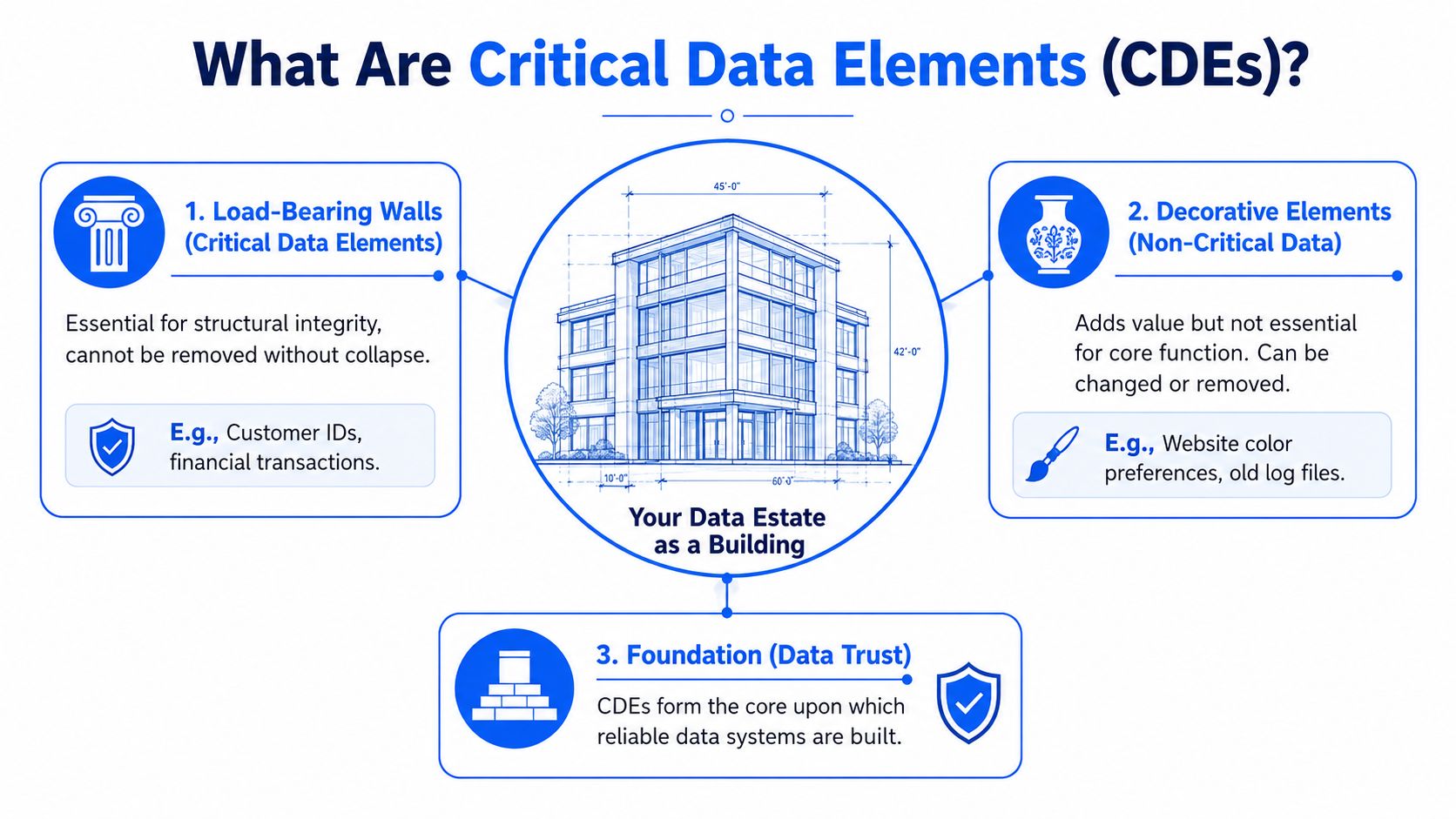
Organizations usually narrow their focus rather than trying to classify everything. Organizations typically prioritize between 200 and 250 specific data elements as Critical Data Elements for focused governance, recognizing that some data carries much higher financial, regulatory, or reputational risk than others, as described in this practical overview of CDE prioritization.
Why business context matters more than data type
A field doesn't become critical because it sounds important or because it lives in a production table. It becomes critical because the business depends on it.
A social security number, account number, transaction amount, or country code often lands in the critical category because failure there affects identity, reporting, fraud controls, downstream joins, or legal obligations. A marketing preference field may matter to a campaign team, but it usually doesn't carry the same cross-functional risk.
That distinction matters because teams often classify by intuition. They say customer data is critical, product data is medium priority, and logs are low priority. That's too broad to be useful. CDE work happens at the element level, not at the domain label.
What usually belongs in a CDE set
In practice, CDEs usually have one or more of these traits:
They drive external reporting. If a field feeds board reporting, regulatory submissions, or financial statements, errors become visible quickly and expensively.
They trigger business processes. An incorrect status, balance, or identifier can start or stop real workflows.
They link systems together. Keys and reference values often look simple, but a broken key can invalidate everything downstream.
They feed trusted KPIs or models. If executives or automated systems rely on a field, its quality becomes strategic.
Practical rule: Don't ask whether a field is important. Ask what breaks if it is wrong, late, or missing.
That's the definition. Critical data elements are the fields you can't afford to misunderstand.
Why CDEs Are the Foundation of Data Trust
Data trust doesn't come from a dashboard design, a catalog rollout, or a governance policy. It comes from repeated proof that the numbers people rely on are correct when decisions have consequences. CDEs sit at the center of that proof because they mark the fields where failure is most costly.
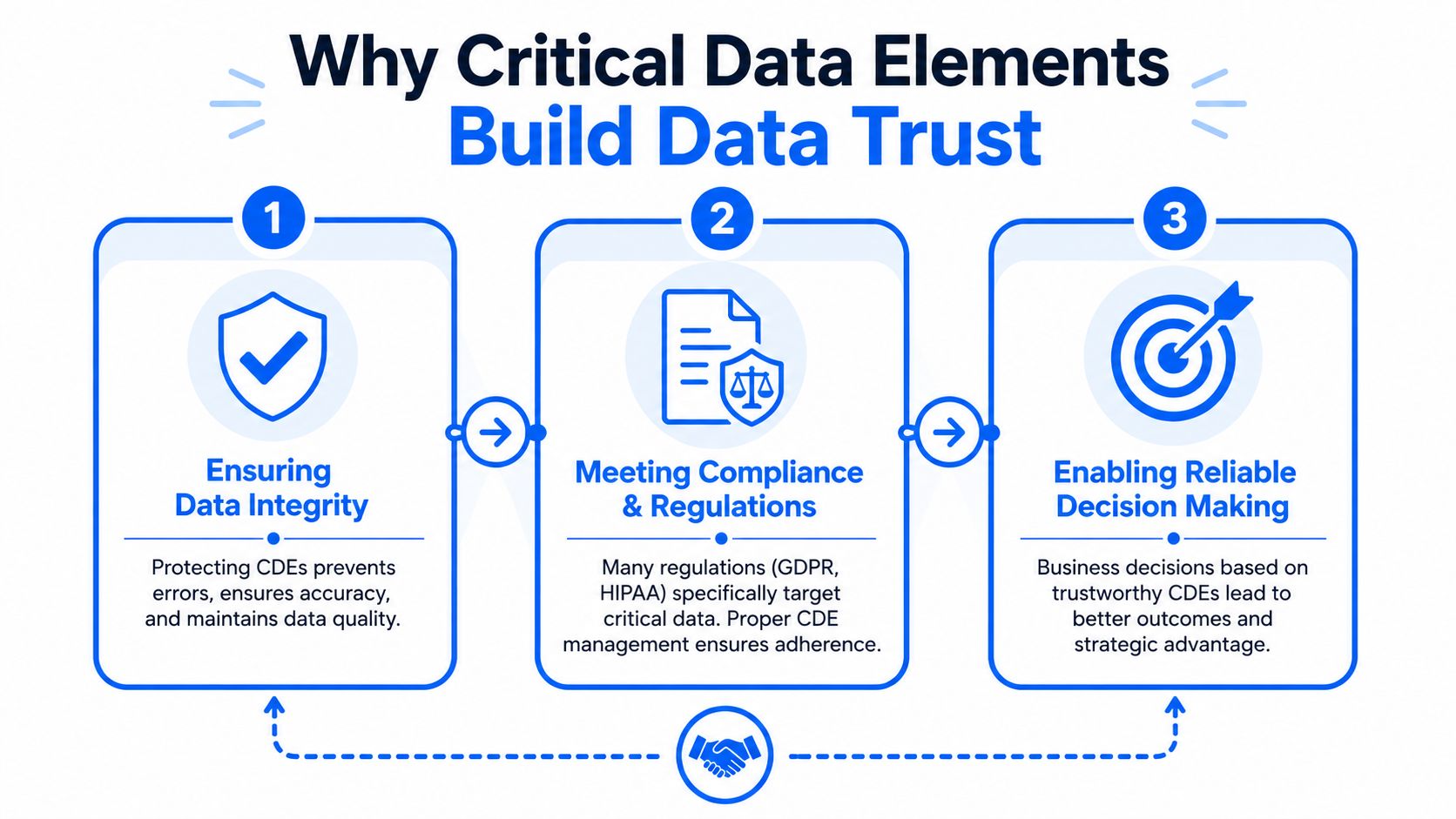
When organizations skip this prioritization step, they usually get one of two bad outcomes. Either they over-control low-value data and burn out their teams, or they spread controls so thin that critically important failures slip through. Teams dealing with solving data quality issues for B2B teams run into this constantly. The issue isn't effort. It's focus.
Trust breaks at the point of consequence
People stop trusting data when the failure affects something visible. That might be a customer statement, a revenue KPI, a compliance workflow, or a board pack. The technical cause can be small, but the trust impact is large because the wrong field sat on a critical path.
CDE governance reduces that risk by making consequences explicit. Instead of saying “improve data quality,” the team can say:
this field affects customer onboarding
this one feeds a regulated report
this one determines whether an operational process starts
this one is a model input that changes business decisions
That kind of specificity changes behavior. Owners respond faster. Controls become easier to justify. Alerting thresholds become tied to business impact instead of generic engineering preferences.
Reliable analytics start with protected inputs
A BI dashboard doesn't become reliable because the visualization layer is polished. An AI model doesn't become trustworthy because the algorithm is complex. Both depend on the inputs that feed them.
If the CDEs underneath a KPI drift imperceptibly, the dashboard still renders. It just renders the wrong answer. The same is true for feature tables and model inputs. Data products often fail without warning before they fail visibly.
That's why teams should define a small set of quality metrics for each critical element and review them continuously. A useful starting point is a documented metrics framework such as data quality metrics for operational monitoring, where teams can map fields to measurable expectations like completeness, validity, timeliness, and stability.
Strong analytics programs don't start by monitoring every field. They start by protecting the fields that can invalidate the result.
CDEs are the foundation of data trust because they connect technical controls to business risk. Without that connection, trust stays subjective. With it, trust becomes operational.
A Method to Identify and Prioritize CDEs
Organizations often don't need a perfect framework to start. They need a repeatable one. The traditional CDE method is manual, but it still works when the organization needs a shared language and a first defensible inventory.
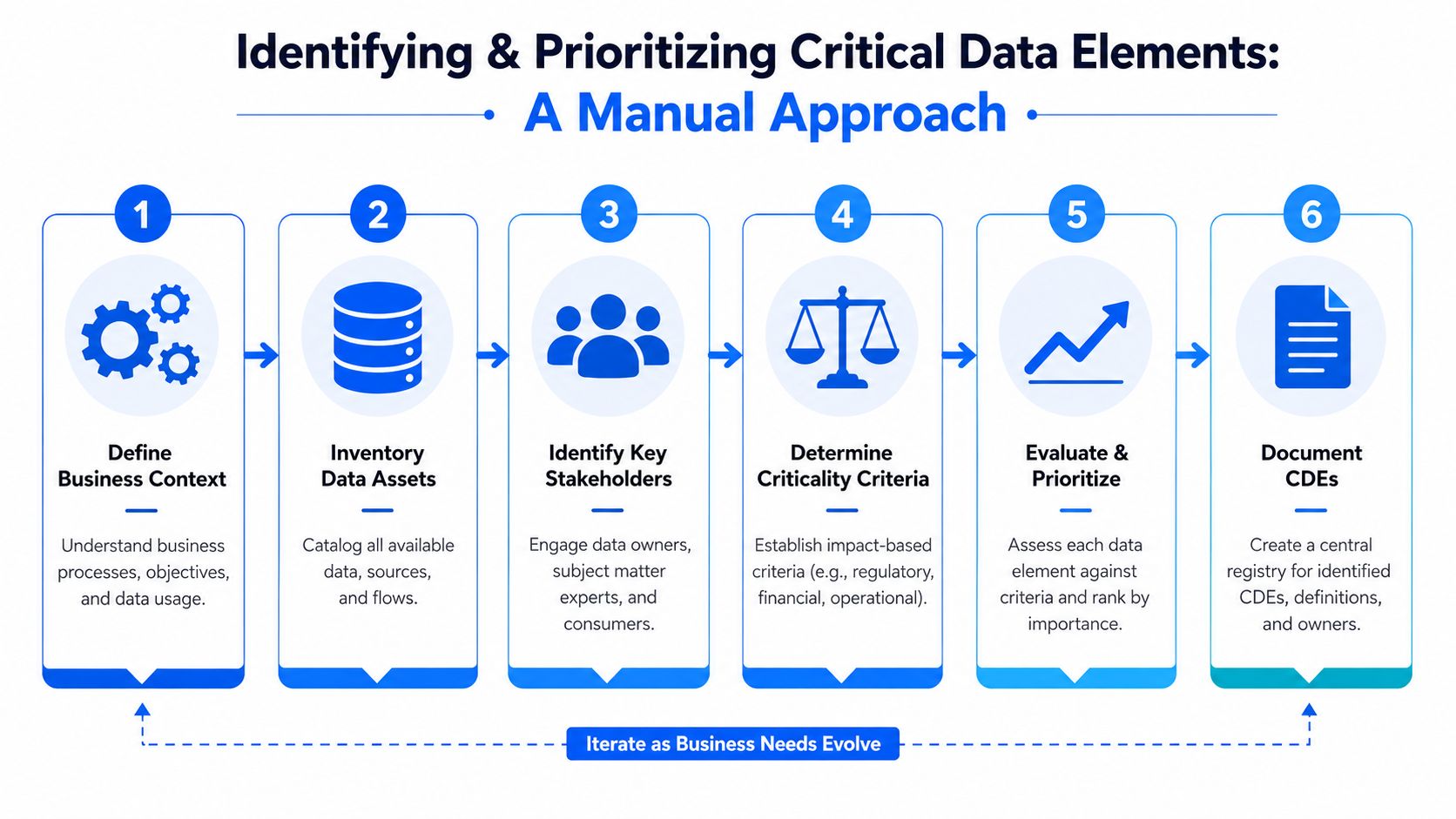
A practical manual process usually starts with a cross-functional group. That means data engineering, analytics, business owners, compliance or risk, and the people who operate core workflows. If only the data team defines criticality, the list usually skews technical. If only business stakeholders define it, the list usually gets too broad.
The manual method that still works
Start with process mapping, not table mapping. Identify the business processes that can't tolerate data failure. Examples include invoicing, claims handling, customer onboarding, regulatory reporting, treasury views, pricing, and executive KPI reporting.
Then work backward from those processes into the systems and fields they depend on. For each candidate element, document:
Where the element originates. Source system and owner.
Where it is used. Reports, APIs, models, workflows, and downstream tables.
What happens if it fails. Customer, financial, operational, or regulatory impact.
What control exists today. Validation rules, reconciliations, monitoring, or manual review.
Who is accountable. Clear data owner responsibilities prevent CDE lists from becoming orphaned documentation.
Once you have a candidate inventory, score the elements. A widely used practical rule is that a data element is typically classified as a CDE if it scores 5 or more points on a manual scoring model that evaluates impact on customer experience, regulatory reporting, KPI calculation, and downstream process triggering, as outlined in this CDE governance guide.
Manual scoring is useful because it forces teams to make risk explicit. It's limited because the scoring freezes the world as it looked during the workshop.
Sample CDE prioritization matrix
A lightweight matrix is usually enough to start.
Data Element | Business Process | Regulatory Impact (1-3) | Financial Impact (1-3) | Operational Impact (1-3) | Total Score |
|---|---|---|---|---|---|
Customer ID | Customer onboarding and system matching | 2 | 2 | 3 | 7 |
Account Balance | Financial reporting and customer statements | 3 | 3 | 3 | 9 |
Country Code | Tax handling and reporting segmentation | 2 | 2 | 2 | 6 |
Marketing Preference | Campaign execution | 1 | 1 | 1 | 3 |
This manual approach creates alignment fast. It also has obvious limits. It depends on interviews, memory, and stakeholder availability. It's hard to keep current when new dashboards, AI use cases, or pipelines appear. And it can become political when every team wants its data treated as critical.
Still, it's the right starting point because it gives you a controlled shortlist instead of a vague ambition to govern everything.
Automating CDE Governance with Data Observability
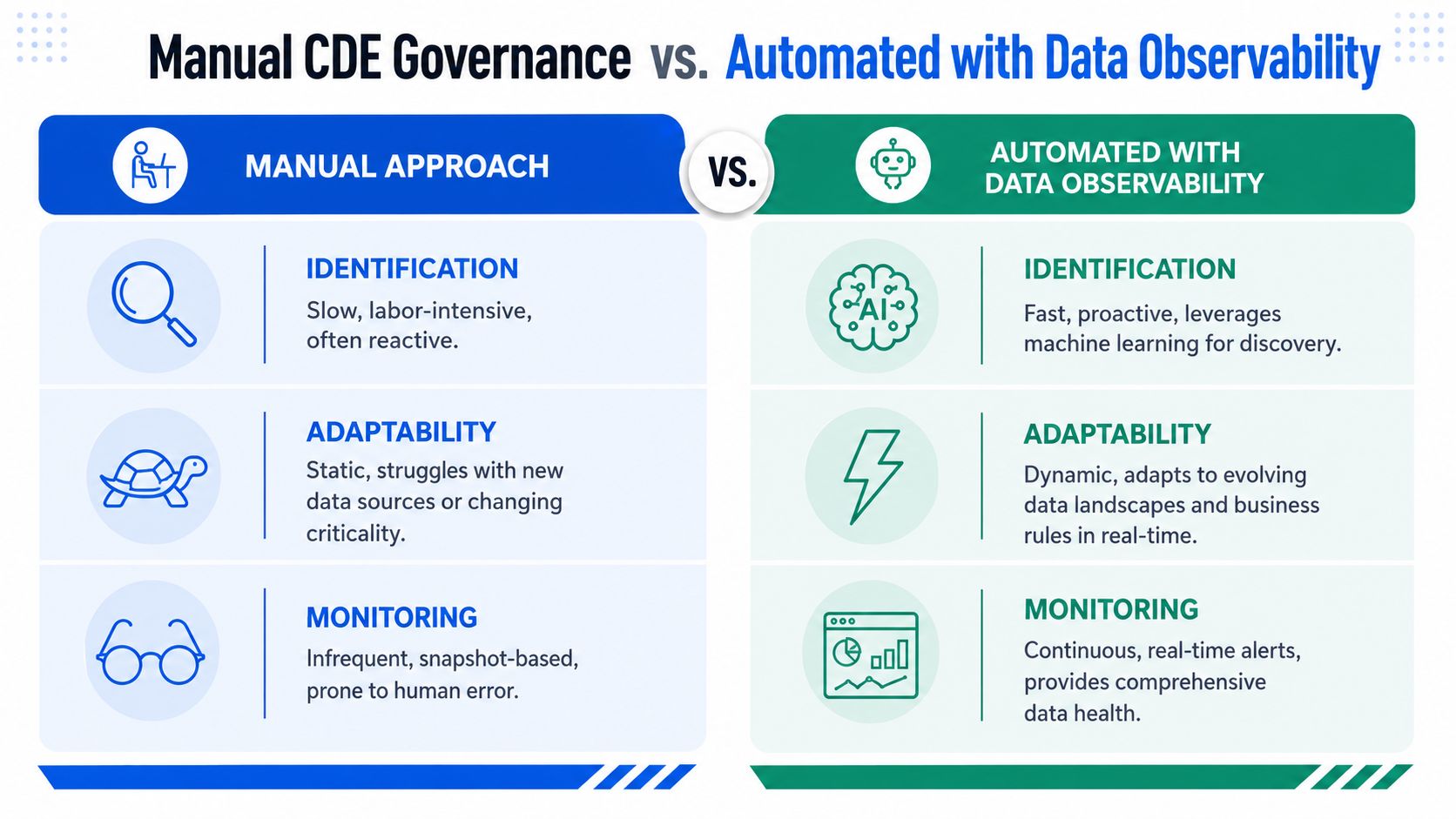
Manual CDE identification is useful for initial alignment, but it doesn't keep pace with a changing platform. A field that looked non-critical last quarter can become critical the moment a finance dashboard, ML feature pipeline, or operational workflow starts depending on it.
That's why modern teams are moving from periodic classification to continuous discovery.
Where the manual model starts to break
The traditional process assumes criticality changes slowly. In many stacks, it doesn't. New dbt models appear. A reverse ETL sync starts using a previously ignored field. A product team ships a feature that depends on a column nobody classified as important during the last governance cycle.
A practitioner view summarized in this discussion of modern CDE discovery makes the problem plain: many data teams report that manual CDE identification is too slow and prone to bias, and the more current alternative uses data lineage and metadata analytics to dynamically flag CDEs based on real-time usage patterns and business impact.
This is the gap data observability closes. Instead of asking people to remember what matters, the platform looks at what the environment is doing.
What dynamic CDE identification looks like
An automated approach combines several signals:
Lineage depth and reach. If a field feeds multiple reports, transformations, or downstream systems, its blast radius is larger.
Usage intensity. A field that appears in high-traffic dashboards, scheduled reports, or model pipelines deserves closer attention.
Business context. Tags, domain ownership, and policy metadata help separate operationally important elements from incidental ones.
Observed stability. Drift, freshness issues, or structural changes matter more when they affect high-impact paths.
A data observability layer brings those signals together and keeps them current. If you need a concise baseline on the operating model, this explainer on what data observability is in practice is a useful reference.
Good CDE governance shouldn't depend on who attended the last workshop. It should reflect the real dependency graph of your data stack.
The big shift is operational. Manual governance gives you a static list. Observability gives you a living system. It helps teams spot emerging CDEs, adjust monitoring as dependencies change, and reduce the lag between a business change and a governance response.
That doesn't eliminate human judgment. It improves where judgment gets applied. People still decide policy, ownership, and remediation. The system does the scanning, correlation, and early warning that humans are bad at doing continuously.
How digna Protects Your Critical Data Elements
Once a team knows which fields are critical, the next question is practical. How do you keep those fields from drifting, breaking, arriving late, or changing shape without someone babysitting every pipeline?
That's where a platform approach matters.

Map each CDE risk to a control type
Different CDE failures need different controls. Treating them all as generic “quality checks” creates blind spots.
For silent behavior changes, digna Data Anomalies learns normal patterns and flags unexpected shifts without relying on static rules. That matters for critical fields whose distributions, volumes, or null patterns can drift long before a dashboard fails visibly.
For schedule risk, digna Timeliness monitors expected delivery and delay behavior. Many incidents don't start with incorrect values. They start with missing or late data that gets interpreted as complete.
For hard business constraints, digna Data Validation enforces record-level rules. This is the right layer for checks such as mandatory population, allowed values, cross-field consistency, and domain-specific controls that auditors or risk teams expect to see documented.
For structural breakage, digna Schema Tracker catches added or removed columns and data type changes. That's especially useful when a critical field exists in a pipeline contract and upstream teams change it without realizing the downstream impact.
Why in-database execution changes the operating model
Architecture matters as much as detection logic. Sensitive CDEs often sit in warehouses and operational environments where teams don't want raw data copied into another vendor-managed platform.
According to digna's guide to automating anomaly detection, in-database metric computation architectures eliminate 95% of data movement costs by analyzing data directly where it resides, ensuring raw production datasets never leave the customer environment while still generating confidence scores and anomaly flags.
That changes the governance conversation in three ways:
Security teams get a model that keeps production data resident in controlled environments.
Platform teams avoid extra movement and duplicated operational complexity.
Data owners still get usable signals, trends, and alerting instead of raw technical noise.
The practical value is straightforward. A CDE program fails if protection is too expensive, too intrusive, or too difficult to maintain. A platform that runs inside the customer environment and covers anomalies, timeliness, validation, analytics, and schema changes gives teams a workable path from policy to daily control.
From Data Chaos to Data Confidence
Most organizations don't have a data quality problem. They have a prioritization problem. They ask small teams to protect an expanding universe of tables, fields, and pipelines, then wonder why trust stays fragile.
A CDE-focused strategy fixes that by narrowing the mission. Protect the fields that carry real business consequence. Give them owners. Attach controls to actual risk. Monitor them continuously. Treat everything else with proportional governance instead of equal intensity.
The manual method still belongs in the toolkit because it creates shared understanding. But it shouldn't be the end state. Static lists get old fast. Data stacks change faster than governance committees meet. That's why observability matters. It turns criticality from a workshop output into a living operational signal.
If you get this right, the culture changes. Teams stop scrambling to reconstruct lineage in the middle of an incident. Business users stop guessing whether the latest dashboard refresh can be trusted. Data leaders stop defending broad governance programs that don't clearly reduce risk.
Confidence comes from knowing which data matters most, and having controls that watch it all the time.
That's the practical path forward. Don't try to govern everything like it's equally important. Identify your critical data elements, protect them aggressively, and let automation keep the picture current as your business changes.
If your team is ready to move from static CDE lists to continuous protection, digna is worth a close look. It combines anomaly detection, validation, timeliness monitoring, schema tracking, and in-database execution so you can protect the data that matters most without moving sensitive production datasets out of your environment.
Frequently asked questions
What are critical data elements?
Critical data elements, or CDEs, are the specific fields an organisation cannot afford to get wrong — the ones feeding regulatory reports, financial statements, customer-facing processes or models. They are defined by business consequence, not by data type.
Why do organisations need CDEs?
Because treating all data as equally important means nothing gets enough attention. Naming the small set of elements where errors cause real damage lets monitoring, ownership and remediation concentrate where they pay off.
How do you identify critical data elements?
Work backwards from consequence: the reports, obligations and decisions that must be right, then the fields they depend on. The resulting set is usually far smaller than teams expect.
Who owns critical data elements?
Ownership sits with the business function that carries the consequence, supported by the data team that operates the controls. CDEs without a named owner tend to drift back into the general backlog.
How are CDEs monitored in practice?
By watching the behaviour of those specific fields continuously — completeness, distributions, freshness and relationships — so a change is caught at the field that matters rather than somewhere downstream.