Data System Architecture: A Guide for Modern Data Teams
|
11
min read

You already know the pattern. A dashboard goes quiet, an analyst finds the numbers don't reconcile, and by the time the source issue is traced, three downstream teams have made decisions on bad data. The system didn't fail loudly. It just drifted far enough from reality that trust started to erode. That's the core problem data system architecture is meant to solve, not by drawing prettier diagrams, but by making data flow predictable, governable, and resilient enough to survive growth.
Table of Contents
What Is Data System Architecture

A lot of teams call their stack an architecture when it's really just an accumulation of tools. That works for a while, until the first serious change lands, a source schema moves, a new workload appears, or governance gets stricter. Then the fragility shows up in broken reports, fragile pipelines, and model outputs nobody fully trusts.
Data system architecture is the deliberate framework that governs how data moves, transforms, and gets consumed across an organization. Carnegie Mellon's SEI frames that job plainly, it establishes common guidelines for data operations so organizations can predict, model, gauge, and control the flow of data in a system (SEI guide). That's the part many teams miss. Architecture isn't just storage and compute placement, it's the operating discipline that makes data movement understandable and manageable at scale.
Architecture is about control, not decoration
When I review a data platform, I'm looking for boundaries. Who owns ingestion? Where does schema change get detected? Which layer is responsible for quality, and which layer consumes trusted data? If those answers are vague, the platform will eventually become a coordination problem rather than a technical one.
The point of architecture is to reduce surprise. It gives you a structure that can absorb new sources, changing business rules, and growing volume without turning every release into a fire drill. That's why enterprise architecture work starts with the system's behavior under change, not with the shape of a warehouse diagram.
The other useful frame is the distinction between the user-facing conceptual view and the technical implementation. In practice, good architecture keeps those layers coordinated but separate, so users can reason about the data without being forced to understand every storage decision underneath.
enterprise data architecture guidance
Practical rule: if you can't explain how a dataset moves from source to consumption, you don't yet have architecture, you have infrastructure.
The Core Components of a Data System
A data system only feels simple when the parts are doing their jobs independently. In reality, the platform behaves like a city's water supply. Sources are the reservoirs, ingestion is the pumping network, storage is the treatment and holding infrastructure, processing is the filtration and routing, and serving is the taps people use.
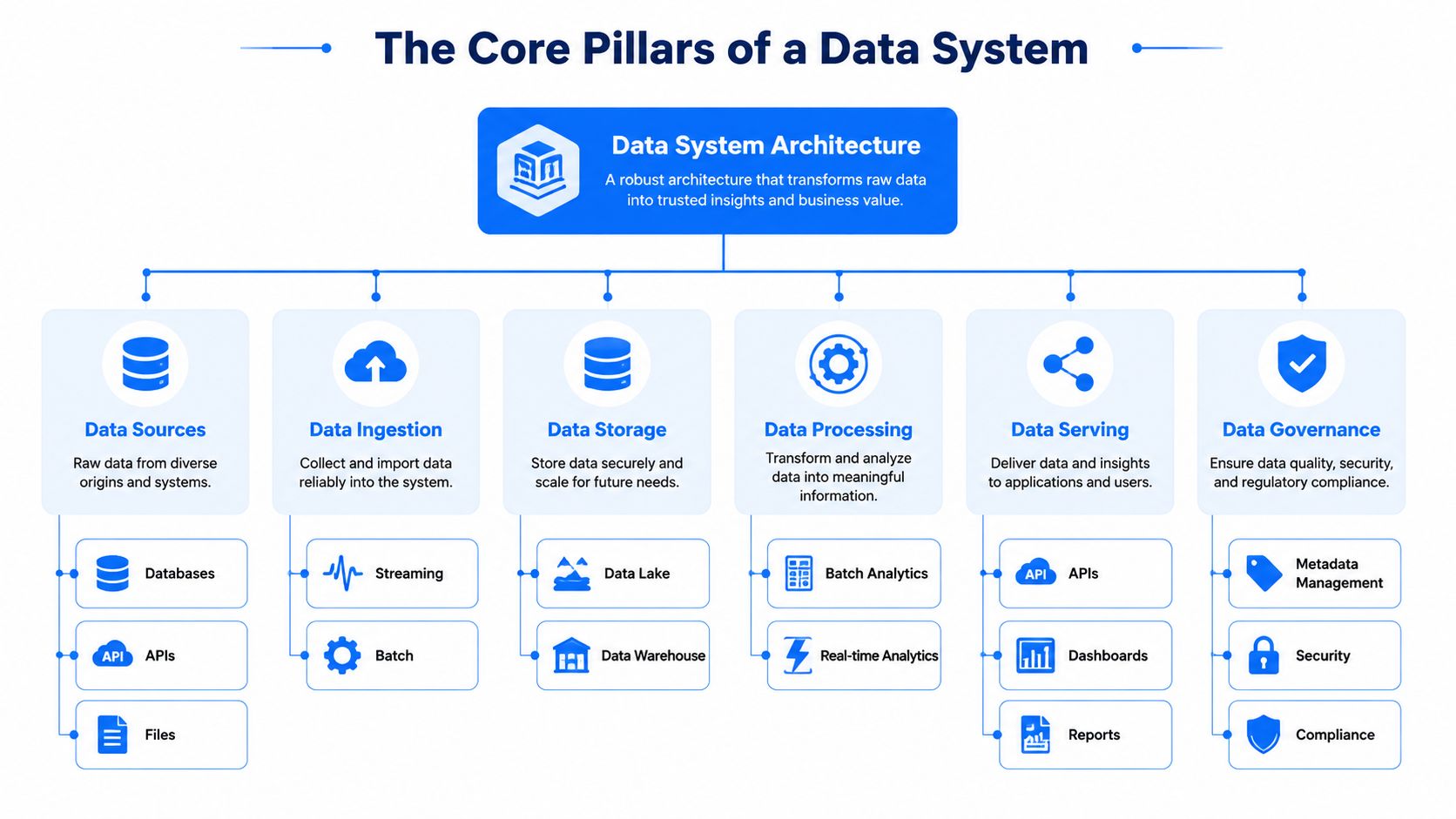
The clearest technical boundary in the system is the separation of internal and external schemas. Purdue's material describes the internal schema as the physical storage structures, like indexes, while external schemas define the different user views exposed to consumers (Purdue chapter). That separation matters because it lets the storage layer evolve without forcing every downstream consumer to change at the same time.
Ingestion and storage carry different responsibilities
Ingestion is the front door. It decides how data enters the system, whether that's streaming, batch loads, APIs, or file drops. If ingestion is sloppy, downstream layers inherit ambiguity. If it's disciplined, later steps can make stronger assumptions about completeness, ordering, and freshness.
Storage is not just a place to dump records. It's where you decide whether the system needs a lake, a warehouse, or both, and how much structure belongs at rest versus in motion. IBM's data architecture guidance ties this to the practical sequence of conceptual, logical, and physical models, then ingestion, APIs, metadata management, and consumption endpoints (IBM data architecture). That sequence works because it forces design choices to line up with how people will use the data.
Processing and serving are where architecture becomes visible to the business. Processing turns raw inputs into usable structures, while serving publishes outputs for dashboards, APIs, reports, and downstream applications. If serving is tightly coupled to ingestion, every source issue becomes a customer issue. If it's too detached, the business ends up looking at stale or inconsistent results.
Metadata is the system's memory
Metadata management is the layer teams underinvest in and then regret later. It's the recipe book, the inventory list, and the lineage record at the same time. Without it, data may still move, but nobody can reliably answer what changed, who depends on it, or whether a field means the same thing across systems.
Operational takeaway: architecture becomes durable when each layer has a narrow job, and metadata keeps the jobs aligned.
Common Data System Architecture Patterns
The right pattern depends on the problem you're solving, not on the trendiest diagram in circulation. A lakehouse helps when analytics and file-based storage need to converge. Data mesh helps when one central team can't keep pace with organizational complexity. Event-driven design fits systems where change itself is the primary signal. Lambda and Kappa patterns address the tension between batch correctness and low-latency response.
practical data pipeline architecture guidance
Four patterns solve four different kinds of pressure
A Data Lakehouse tries to reduce the split between warehouse-style analytics and lake-style storage. The appeal is operational simplicity, one logical environment for broader analytics use cases. The risk is that teams assume one platform automatically removes governance, which it doesn't. You still need clear ownership, quality controls, and data contracts.
Data Mesh is often misunderstood as a storage pattern. It's really an organizational response to scale. If domain teams own their data products, central bottlenecks shrink, but only if the enterprise accepts shared standards for interoperability, discoverability, and governance.
Event-Driven Architecture works when the business cares about state changes as they happen. It's a strong fit for operational systems, but it can become noisy if teams use events for everything, including questions that are better answered by curated analytical models.
Lambda and Kappa are different answers to the same latency problem. Lambda keeps batch and speed paths side by side, which can be practical but operationally heavy. Kappa simplifies around streaming first, which is cleaner when the organization can support that model end to end.
Pattern | Primary Use Case | Complexity | Data Latency | Governance Model |
|---|---|---|---|---|
Data Lakehouse | Unified analytics over lake and warehouse-style workloads | Medium to high | Batch to near real time, depending on implementation | Centralized with shared standards |
Data Mesh | Scaling data ownership across domains | High | Varies by domain | Federated governance |
Event-Driven Architecture | Operational workflows and change propagation | Medium | Low latency | Event contract and service ownership |
Lambda Architecture | Batch accuracy plus fast operational views | High | Mixed | Split by path |
Kappa Architecture | Stream-first processing with simpler operations | Medium | Low latency | Stream-centric governance |
Pick by friction, not fashion
A pattern that looks elegant in a slide deck can be expensive in practice. Data mesh fails when domain teams don't want the overhead of product ownership. Event-driven systems fail when teams treat every integration as a streaming problem. Lambda fails when the organization can't keep two paths in sync.
The useful question is simple. Which part of the business is under the most pressure, scale, latency, or coordination? The answer usually points to the pattern that will hold up best.
Don't start with the architecture label. Start with the failure mode you need to eliminate.
Architecting for Trust and Reliability
Trust breaks faster than throughput. A pipeline can be fast and still be worthless if it delivers stale, incomplete, or structurally shifted data. That's why quality and observability have to be designed into the system, not bolted on after the first incident.

Modern guidance is explicit that architecture needs built-in mechanisms for change detection and operational feedback. It has to account for schema drift, timeliness, and platform behavior as ongoing design concerns, not as a monitoring add-on (Streamkap best practices). That lines up with how real systems fail. They don't only go down, they slowly go wrong.
Reliability starts with the shape of the control loop
A trustworthy system defines expectations before it writes code. What does correct data look like? What freshness is acceptable? Which schema changes are safe, and which ones should block downstream use? These aren't reporting questions, they're architectural requirements.
The strongest systems also keep data locality in mind. If validation and anomaly detection happen close to the data, you reduce unnecessary movement and preserve the original context of the record. That matters in enterprise environments where copies create security, governance, and performance overhead.
Why observability belongs in the design phase
Observability should not wait for post-launch hardening. If you only monitor infrastructure health, you'll miss the data issues that matter most to analysts and business users. A platform can look healthy while still serving broken partitions, delayed feeds, or structurally changed tables.
A practical reliability stack includes a few distinct mechanisms:
Validation at ingestion: reject or flag records that violate business rules before they spread.
Anomaly detection on baselines: learn the normal shape of the data and alert on unexpected movement.
Schema tracking: detect added, removed, or changed fields before consumers break.
Timeliness checks: verify data arrives when it should, not just whether it arrived eventually.
digna is one option in this space, because it runs quality checks inside the customer's environment, tracks schema changes, and monitors timeliness and anomalies without moving the data out of place. That design choice matters more than the brand name. The architectural principle is the same, keep detection close to the system of record.
Deployment and Security in Enterprise Environments
Enterprise deployment changes the design brief. Once regulated data, internal controls, and audit requirements enter the picture, the architecture has to prove where data lives, who can touch it, and how every change is traceable. Private cloud and on-premises deployments remain relevant because security isn't only about encryption. It's also about locality, access boundaries, and operational control.

AWS describes enterprise data architecture as a living system that must be continuously monitored and re-optimized as data volumes grow, use cases evolve, and regulations shift, with governance and monitoring built into the lifecycle (AWS data architecture). That framing is useful because it treats compliance as part of ongoing operations, not as a certification exercise at launch.
Security is an architectural property
If data lands in the wrong environment, no amount of dashboard polish will fix the underlying risk. Strong architectures define clear trust zones, isolate sensitive workloads, and control movement between systems. They also make auditability a first-class requirement, so access logs, transformations, and exceptions can be reviewed without manual archaeology.
The deployment model plays a critical role. In customer-managed environments, the team controlling the data also controls the policy boundary. That simplifies conversations about sovereignty, data access, and vendor exposure, especially in finance, healthcare, and public sector settings.
Controls have to scale with the platform
Access control that works for a handful of tables often fails under a large production estate. Teams need patterns for role-based permissions, service-to-service access, and administrative oversight that don't rely on tribal knowledge. The same is true for lineage and audit trails, if they're not built into the architecture, they'll be reconstructed badly after an incident.
customer data protection guidance
The ultimate goal is not just to keep attackers out. It's to design a platform that can answer governance questions quickly when legal, compliance, or security teams ask them. If the architecture can't do that, it's not ready for enterprise use.
Making the Right Architectural Choice
Good architecture choices are usually less about elegance and more about trade-offs. ThoughtWorks describes modern data architecture as a set of trade-offs across security, compliance, discoverability, reproducibility, and measurable fitness, not as a static diagram, and that's the right lens for evaluation (ThoughtWorks architecture guidance). The best design is the one that fits the operating reality your team has.
Start with the constraints
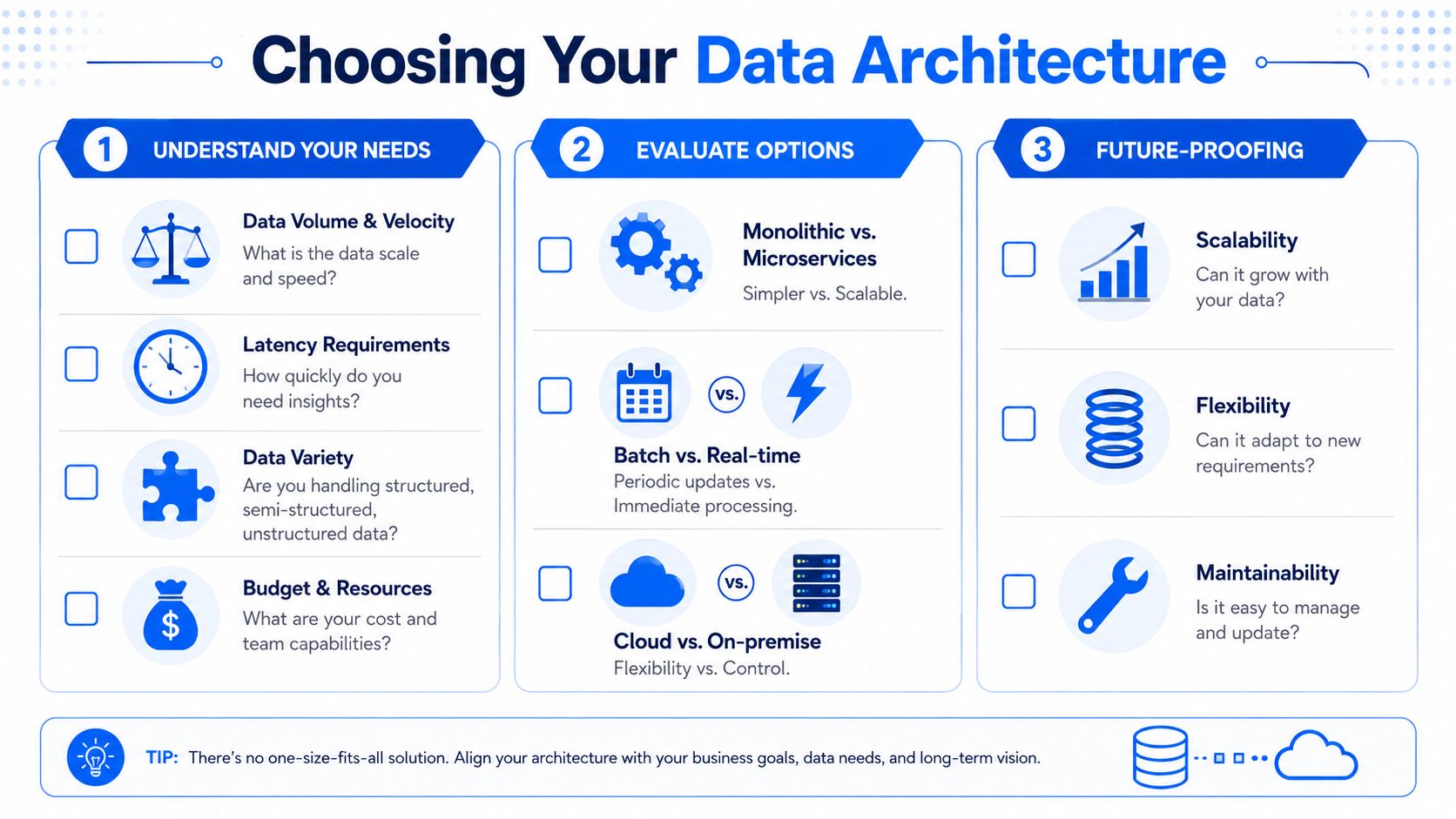
Performance and cost always pull against each other. So do scalability and operational simplicity. Batch processing is easier to govern, but real-time processing can be indispensable when the business needs immediate action. The wrong choice is usually the one that optimizes for a future workload nobody has yet committed to owning.
Use a short decision checklist with stakeholders:
Data volume and velocity: how much data is moving, and how quickly does it arrive?
Latency needs: does the business need immediate results, or are scheduled updates enough?
Data variety: are you dealing with structured records, semi-structured feeds, or unstructured content?
Budget and team capacity: can the team operate the design it chooses?
Governance burden: who owns access, retention, and auditability?
Evaluate the system you can sustain
A design is only as good as the team's ability to run it on a bad day. If the architecture depends on specialized skills that nobody on the platform team has, operational risk goes up. If it demands brittle coordination between multiple layers, the chance of silent breakage rises too.
Future-proofing is less about predicting the next buzzword and more about keeping escape hatches open. Can the platform absorb a new source without a major redesign? Can it support a stricter governance rule? Can it evolve without forcing every consumer to relearn the model?
A strong architecture gives you room to grow while keeping the moving parts understandable. A weak one looks efficient on paper and expensive in practice.
Conclusion The Blueprint for a Living System
Data system architecture is not a one-time blueprint. It's the living structure that lets data move reliably through ingestion, storage, processing, serving, and governance as the organization changes around it. The systems that last are the ones that treat reliability, observability, and control as design principles, not cleanup work.
The historical shift from rigid file structures to relational models, then from centralized warehousing to distributed and cloud-native approaches, points to the same lesson, architecture evolves when the business's data demands evolve. The difference between a brittle stack and a durable platform usually comes down to whether the team designed for change before change arrived.
The best systems are adaptable without being vague, observable without being noisy, and governed without becoming unusable. That's the standard worth aiming for.
If your team is trying to make data quality, observability, and governance part of the architecture instead of an afterthought, visit digna. It runs inside your own environment and is built to monitor data behavior where the data already lives. If you're planning a platform that has to stay reliable as it grows, that's the kind of design discipline worth putting in place early.
Frequently asked questions
What is data system architecture?
The deliberate framework that governs how data moves, transforms and gets consumed across an organization. A lot of teams call their stack an architecture when it is really an accumulation of tools.
What distinguishes architecture from accumulation?
Boundaries. Reviewing a data platform means looking for where responsibility changes hands, and a stack without those boundaries has components but no architecture to speak of.
What is architecture actually for?
Reducing surprise. It is about control rather than decoration, which is why the test of a design is not how it diagrams but how predictably it behaves when one part of it changes.
How do you tell whether you have one?
By asking what happens at each boundary when something goes wrong. If the answer differs depending on who you ask, the boundaries exist on the diagram rather than in the system.
Where does observability fit in the architecture?
At the boundaries. Instrumenting the handoffs is what turns a diagram into something you can reason about during an incident, because that is where one component's assumptions meet another's output.