What Is Data Compliance and Why It Matters Now
|
6
min read

What Is Data Compliance? It's the disciplined practice of handling data according to laws, regulations, standards, and contractual obligations, with demonstrable evidence that those obligations were met. In practice, that means your organization can show where data went, who touched it, what changed, and why the controls held.
You're probably here because someone asked for proof, not policy. A regulator, auditor, customer, or internal risk team wants evidence for a specific dataset, and the answer is buried in tickets, inboxes, and half-finished spreadsheets. That's why data compliance has become a daily operating problem for data engineers, analytics engineers, and governance teams, not just a legal review after the fact.
Table of Contents
Why Data Compliance Is Now an Engineering Problem
A regulator asks for evidence about one dataset, and the team starts hunting through email threads to reconstruct what happened. That failure mode is common because the work of compliance lives in systems, logs, catalogs, and pipeline behavior, not in a PDF sitting in legal's folder.
The stakes are no longer abstract. Data-protection laws now cover 6.3 billion people, or 79% of the world's population, and GDPR enforcement has produced more than €7.1 billion in cumulative fines since 2018. In 2025 alone, regulators issued about €1.2 billion in GDPR penalties, which is a clear signal that compliance gaps can turn into measurable financial exposure for enterprises operating across major markets.
The operational burden is just as real. Compliance professionals now spend an average of 9.5 hours per week on compliance-related tasks, up from 8.1 hours in 2023, and nearly 70% of service organizations need to demonstrate compliance against at least six security and privacy frameworks. That's not a paperwork problem. That's an ongoing engineering workload.

What changes for data teams
For a data platform team, compliance means the platform must answer questions like, “Who accessed this data?”, “What purpose was approved?”, and “Can you prove it stayed within retention limits?” If the answer depends on a person remembering an old process, the control is weak even if the policy is strong.
The clean way to think about the topic is in five parts, definition, scope, regulations, controls, and a practical checklist. That sequence matters because teams often try to buy a tool before they understand what they need to prove.
Practical rule: if you can't trace a control to a machine-checkable artifact, you don't really have compliance evidence yet.
The Core Definition and Scope of Data Compliance
A useful working definition is simple, data compliance is the disciplined practice of managing data in line with laws, regulations, standards, and contractual obligations, with evidence that the obligations were met. The hard part is that compliance is not just about one rule. It spans how data is collected, stored, accessed, processed, shared, retained, and disposed of across the full lifecycle.
Airport passport control is a useful comparison. A traveler can't just say they belong in the country, they need to pass through the right checkpoint with the right documents, at the right time, under the right rules. Data works the same way. It has to move through collection, storage, access, processing, sharing, retention, and disposal with controls that prove each stage was handled correctly.
The scope is broader than privacy law alone. Major guidance sources describe compliance as covering data integrity, access control, retention, disposal, and documentation, not only notice-and-consent obligations. That's why a team can be “privacy aware” and still fail a compliance review if it can't show retention enforcement or evidence of who was allowed to access a dataset.
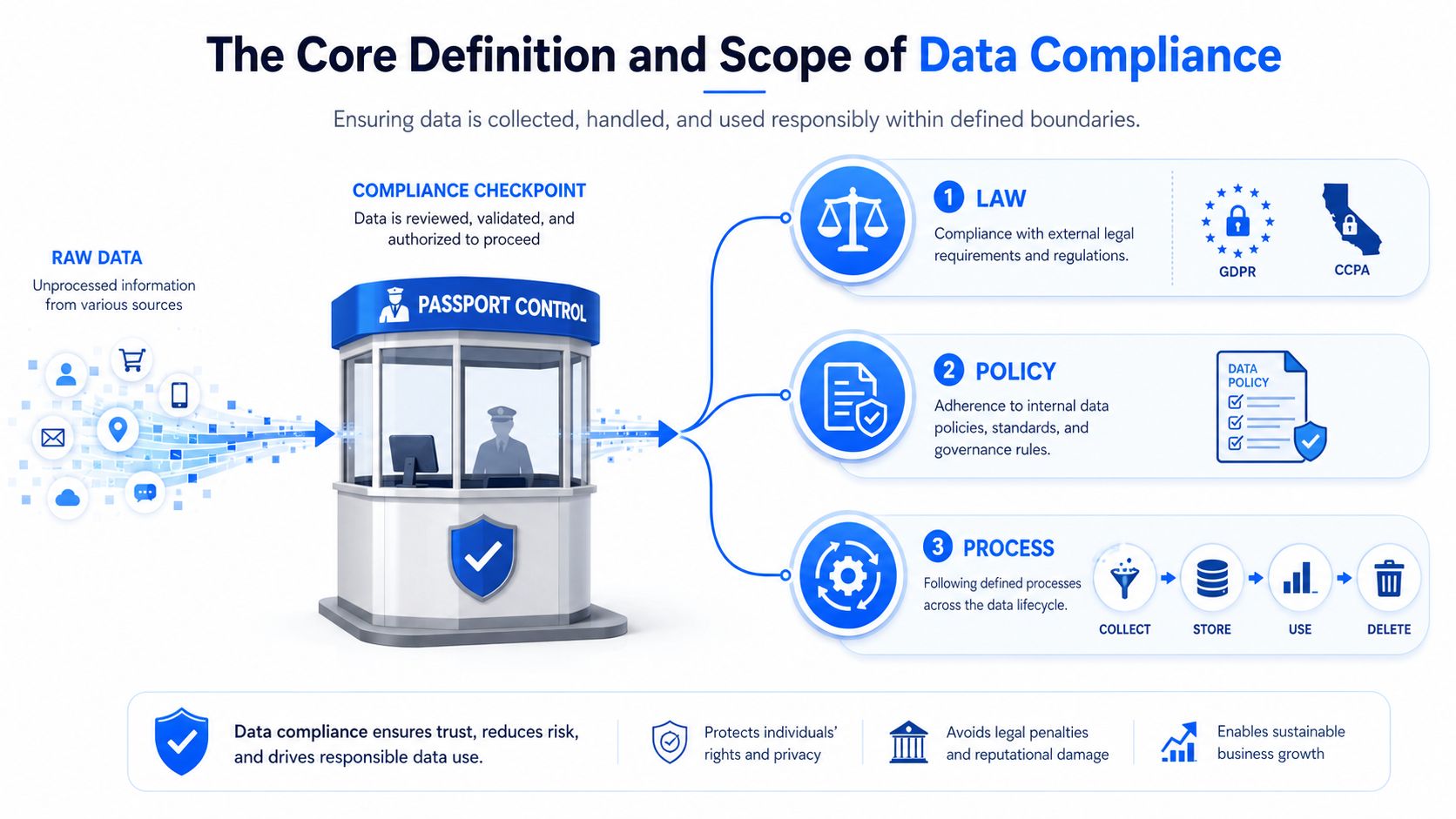
What the platform has to prove
A compliant data platform needs auditable lineage, access logging, retention enforcement, and record-level quality controls. Otherwise, the organization might know the policy, but still fail the evidence test during an audit. That's why compliance metadata has to be treated as first-class data, not as a side file in shared storage.
For a useful privacy reference, many teams keep a public policy link handy, and Vision's privacy policy is a good example of the kind of document that should map cleanly to actual operating controls. The point isn't the page itself, it's the discipline of connecting stated rules to verifiable behavior.
Data compliance is a lifecycle control system supported by evidence, not a promise to protect data.
How Data Compliance Differs from Governance and Quality
These three terms get mixed together all the time, which causes confusion inside data teams. They overlap, but each one has a different job. Governance decides who owns the data and what the rules are, compliance proves those rules were followed, and quality checks whether the data itself is fit for use.
Consider a customer PII dataset entering a warehouse. Governance says which team owns it, who can touch it, and what the rules are for use and sharing. Compliance checks whether those rules were enforced and whether the organization can prove it later. Quality asks whether the names, addresses, and identifiers are complete, accurate, and usable for the intended purpose.
That separation matters because a program can get one part right and still fail overall. A dataset can be governed by policy, but if there's no lineage or access evidence, compliance is weak. A dataset can be properly restricted, but if the records are malformed or stale, analytics quality still suffers.
A simple way to keep the roles distinct
Governance sets the rulebook. It decides ownership, approval paths, and boundaries for use.
Compliance proves the rulebook was followed. It relies on logs, lineage, retention events, and audit trails.
Quality checks the contents. It looks for missing values, broken keys, invalid records, and other defects.
In a mature program, those functions hold each other accountable. Governance defines the policy, compliance verifies execution, and quality protects the usefulness of the data. If you collapse them into one bucket, audit work gets fuzzy and analytics work gets blind spots.
The practical question to ask is blunt. If a regulator requested evidence for a single dataset tomorrow, could your governance team explain the rule, could your engineering team prove the control, and could your analytics team trust the data? If any one of those answers is no, the program isn't complete yet.
Major Regulations and Frameworks You Will Encounter
Most enterprises don't answer to just one regime. They map different datasets to different obligations, depending on geography, industry, and data type. That's why compliance teams need a framework view, not a one-regulation-at-a-time mindset.
At the data layer, the important part is not the legal label, it's the control expectation. GDPR pushes accountability, accuracy, retention limits, and traceable processing for personal data. HIPAA centers on protected health information and the safeguards around access, use, and auditability. PCI DSS applies to cardholder data and demands tight control over access and handling. CCPA focuses on consumer rights and operational handling of personal information. SOX concerns financial reporting integrity, so the data path has to stay consistent and reviewable. SOC 2 is an evidence-based trust framework, so audit trails and control proof matter throughout.
Framework | Primary Data Type | Core Data-Layer Obligation |
|---|---|---|
GDPR | Personal data | Accuracy, retention limits, traceable processing |
HIPAA | Protected health information | Access control, auditability, secure handling |
PCI DSS | Cardholder data | Strict access restriction and controlled handling |
CCPA | Consumer personal information | Rights handling and controlled sharing |
SOX | Financial reporting data | Integrity, reviewability, consistent records |
SOC 2 | Operational and customer data | Evidence of controls, logging, and monitoring |
For teams working across regions, data residency and processing location often matter too. The practical implications are worth tracking in a separate operating model, which is why many teams document them alongside controls in a resource like data residency requirements.
Why stacking matters
A single dataset can sit under multiple regimes at once. A hospital billing table may touch healthcare rules, payment rules, and consumer privacy obligations. A finance dataset may also be subject to reporting integrity controls and evidence-heavy audit expectations.
That means your compliance plan can't be a universal checklist. It has to map each dataset to the specific rules that apply, then show which control proves each rule was met.
The Practical Controls That Make Compliance Verifiable
Treat compliance metadata as first-class data. If inventory, ownership, classification, and processing proof aren't queryable, they're just documents waiting to go stale.
The engineering job is to turn broad obligations into controls that produce evidence. That usually means six capabilities working together, each one tied to a concrete audit question.
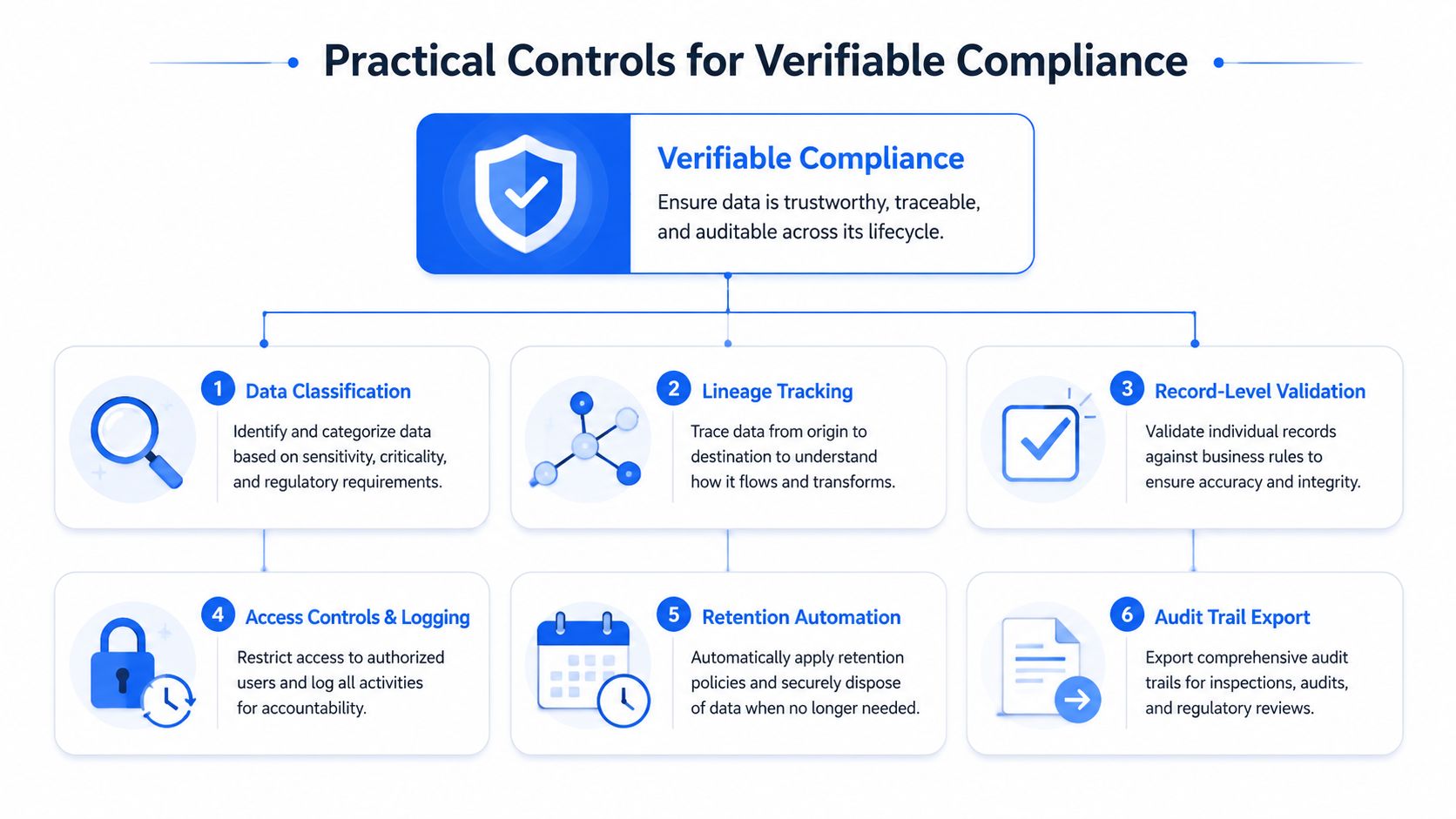
Six controls auditors can actually test
Data Classification. Label sensitive fields so policy can follow the data. The evidence is the classification catalog, and the audit question is, “Do you know which tables contain regulated data?”
Lineage Tracking. Record where data came from and where it went. The evidence is transformation history, and the audit question is, “Can you trace this report back to its source?”
Record-Level Validation. Check values, keys, and business rules on each record. The evidence is validation results, and the audit question is, “Did bad records get blocked before reporting?”
Access Controls and Logging. Restrict access and record who did what. The evidence is access logs, and the audit question is, “Who saw this data and why were they allowed?”
Retention Enforcement. Apply keep and delete rules automatically. The evidence is retention events, and the audit question is, “Can you prove the data wasn't kept longer than allowed?”
Continuous Monitoring. Watch for drift, missing data, and control failures. The evidence is alerts and trend reports, and the audit question is, “How did you know the control stopped working?”
How the controls map back to the regulations
GDPR leans heavily on classification, lineage, retention, and access proof. HIPAA and PCI DSS depend on access controls and logging. SOX cares about integrity and traceability, so validation and lineage become important. SOC 2 asks for evidence that controls are operating consistently, which makes monitoring and audit trails part of the system, not extra decoration.
One practical option for record-level checks is digna. Its modular platform runs inside the customer's own environment and can support data validation, schema tracking, timeliness monitoring, anomaly detection, and in-database execution, which fits the evidence-first pattern described here.
How Observability and In-Database Validation Reduce Compliance Risk
Paper compliance looks good until the data changes. Real compliance has to run every hour, because schema drift, late arrivals, and broken records can all break the evidence trail before anyone notices.
Data observability turns static policy into continuous proof. Instead of waiting for an annual review, teams watch for anomalies, timing failures, schema changes, and record-level issues as part of the pipeline itself. That matters because if the control only exists on paper, the audit gap opens the moment production data shifts.
Why in-database checks matter
In-database execution is a strong pattern because the checks run where the data already lives. Nothing needs to move, exposure stays lower, and lineage stays intact. That also means a validation run can produce evidence without creating new copies of sensitive data in spreadsheets or side systems.
A regulated submission can fail for something as mundane as schema drift. The dataset may still be logically correct, but if the structure no longer matches the required format, the package can be rejected before downstream consumers ever see it. That's why schema tracking, deterministic validation, and timeliness monitoring are core compliance controls, not optional observability features.
The most useful observability programs combine structure checks, business-rule checks, and delivery checks. Schema change detection catches a renamed column. Record-level validation catches a broken key or out-of-range value. Timeliness monitoring catches a late feed that would otherwise create reporting gaps.
For teams building this layer, data observability becomes the operational bridge between policy and proof. The goal isn't more alerts, it's a continuous evidence pipeline that can stand up during an audit and during a normal production incident.
An Enterprise Compliance Checklist You Can Actually Use
A checklist only helps if it matches the way engineers work. The best one starts with discovery, moves into proof, then stays alive through monitoring. That keeps the program practical instead of ceremonial.
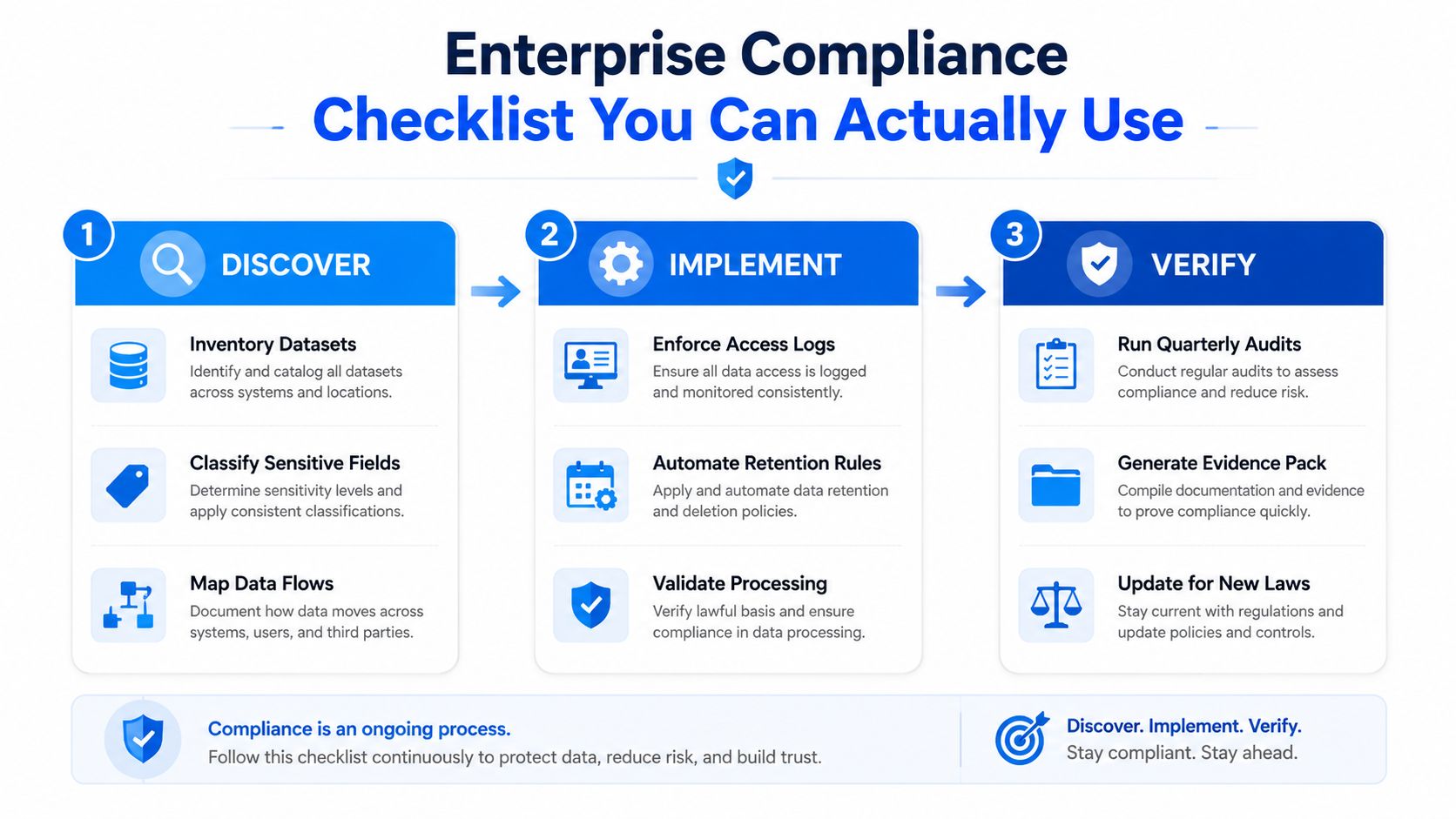
Discover
Inventory datasets. This supports GDPR-style accountability and gives you the first answer to “where is the data?”
Classify sensitive fields. It supports access restriction and retention decisions before the data spreads.
Map data flows. It shows which pipelines, reports, and downstream systems inherit the obligation.
Implement
Enforce access logs. This produces evidence for HIPAA, PCI DSS, and SOC 2 style review questions.
Automate retention rules. This supports lifecycle limits and reduces the risk of over-retention.
Validate processing. This catches malformed records and bad transformations before reports or submissions are built on them.
Verify
Run periodic audits. This confirms controls still work after pipeline or policy changes.
Generate evidence packs. This shortens the time needed to answer regulator or customer requests.
Update for new laws. This keeps dataset mappings and control logic aligned as obligations change.
If your team needs a cleaner way to move from manual evidence collection to repeatable reporting, compliance reporting automation is the kind of workflow that reduces audit scramble without weakening controls.
What to review and when
High-risk controls like access logging, lineage, and validation should be reviewed continuously or as close to real time as your stack allows. Inventory, classification, and evidence packs need scheduled review because owners, schemas, and systems change. Retention rules need ongoing checks, because a deletion policy that nobody verifies is just a wish.
Common Questions and the Compliance Mindset Going Forward
The questions get more specific once teams start wiring compliance into pipelines. People want to know how this applies to logs, prompts, and derived datasets, not just customer PII. They also want to know what counts as proof when several regulations overlap on the same table.
Logs and prompts matter because they can contain personal, operational, or regulated content. Derived datasets matter because compliance doesn't stop at the raw source, if a transformed table still carries sensitive meaning or can be traced back to regulated data, it still needs governance and evidence. That's the gap many intro explainers miss.
Another common point of confusion is evidence type. Traditional audit logs show that an event happened. Observability evidence shows that the pipeline kept working, the schema stayed stable, the values passed checks, and the data arrived on time. Those are related, but they're not interchangeable.
The 2026 privacy trend also points toward stricter rights handling and browser-level opt-out preference signals, so engineering workflows will need to recognize those signals earlier in the pipeline. That means lineage, validation, and rights handling will sit even closer to the center of compliance work than they do now.
Compliance doesn't belong only to legal or privacy teams. The data team owns the systems that create the evidence, so it also owns the operational reality of compliance.
AI and analytics pipelines will make that even more true. The more data gets combined, transformed, and reused, the more important it becomes to know where every field came from, what rules applied, and whether the outputs stayed within the declared purpose.
digna helps teams run data validation, schema tracking, timeliness monitoring, anomaly detection, and in-database checks inside their own environment, so compliance evidence stays close to the data instead of scattered across email and spreadsheets. If you're building a control layer for regulated pipelines, visit digna and see how the platform fits into your data quality and observability stack.
Frequently asked questions
Why is data compliance now an engineering problem?
Because regulators ask for evidence, not policy. When a request arrives about one dataset and the team starts hunting through email threads to reconstruct what happened, the gap is in instrumentation rather than in documentation.
How wide is the regulatory reach?
Data-protection laws now cover 6.3 billion people, or 79% of the world's population, and GDPR enforcement has produced more than €7.1 billion in cumulative fines since 2018. The scope has outgrown the idea of compliance as a regional concern.
What is the operational burden?
Compliance professionals now spend an average of 9.5 hours per week on compliance-related tasks, up from 8.1 hours in 2023, and nearly 70% of service organizations must demonstrate compliance against at least six security and privacy frameworks.
How does compliance differ from governance and quality?
By who sets the requirement. Governance decides internal control and ownership, quality measures fitness for use, and compliance answers to external rules, which is why the same control can serve all three while the evidence each needs differs.
What makes compliance verifiable rather than claimed?
Controls that produce evidence as a by-product of running. If proving a control worked requires reconstructing the past from memory and inboxes, the control exists on paper but not in a form an auditor can accept.