Data Residency Requirements: A Practical Guide for 2026
|
6
min read

You're in the middle of a routine review, and someone from legal, procurement, or a regulator asks a question that sounds simple until you try to answer it cleanly: where does this customer data live? The primary database is easy enough to point to. The harder part is proving where the replicas sit, where backups land, what your logs contain, which exports leave the region, and whether support staff can touch the data from somewhere else.
That's the true shape of data residency requirements in 2026. It's not a storage-region checkbox, it's a lifecycle control problem, and the teams that handle it well treat geography, processing, copies, access, and evidence as one system. The ones that fail usually don't fail on the master table. They fail on the export, the backup, the notebook extract, or the vendor workflow nobody mapped.
Table of Contents
When the Regulator Asks Where Your Data Lives
A finance lead at a multinational, a platform engineer at a hospital network, and a security owner at a telecom all end up in the same uncomfortable place. The questionnaire arrives, and it doesn't ask only where the primary database is hosted. It asks where the replicas, backups, logs, support attachments, and exports go, because that's where residency often breaks in practice.
That's why the broadening of residency rules matters operationally. The number of jurisdictions with some form of data localization requirement rose from 35 in 2017 to 62 in 2026 according to the Information Technology and Innovation Foundation, and only 18 of those 62 impose absolute in-country mandates while 44 use conditional models that allow cross-border transfers under defined legal mechanisms. The point for engineering is simple, the majority of regimes don't demand total confinement, but they do require control over every path data can take. Global data residency benchmark
Practical rule: if you can't trace a copy, you can't prove residency.
What the question is really testing
The person asking isn't just checking a server location. They're checking whether your architecture can tell a clean story about storage, processing, copies, and access across jurisdictions. If your answer starts and ends with “the database is in-region,” you've already admitted the blind spot.
That's especially true in regulated sectors, where residency obligations show up in finance, healthcare, telecom, and public-sector data flows. Those environments don't forgive sloppy boundaries. A single exported CSV, a late-night support dump, or a backup target in the wrong place can turn a tidy policy into a compliance event.
The best teams respond with evidence, not reassurance. They can show region maps, transfer mechanisms, and the actual copy inventory. They also know that observability has to backstop design, because architecture changes over time and new pipelines tend to create the drift that audits uncover.
Defining Data Residency and Its Closest Cousins
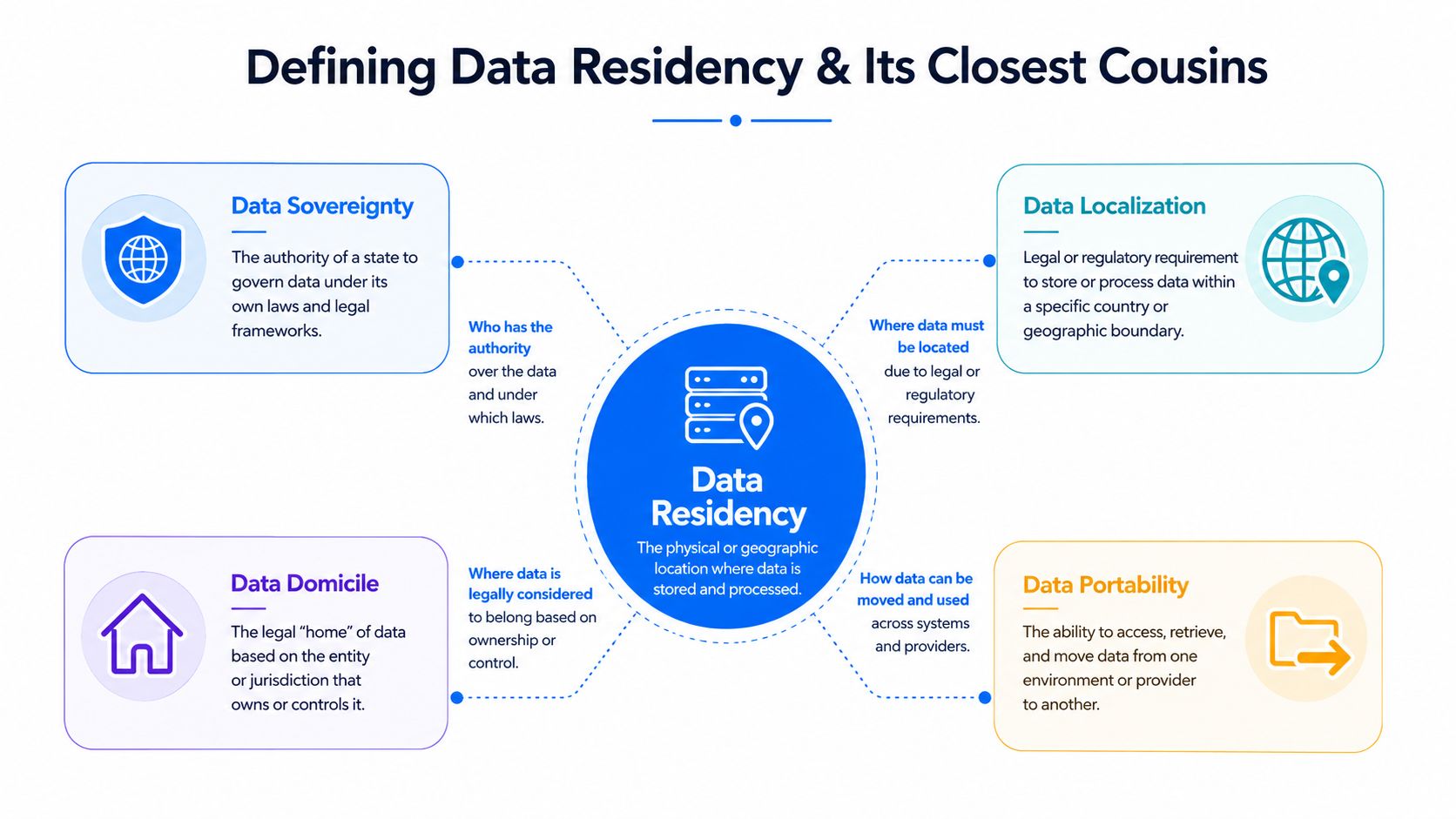
The cleanest way to separate the terms is with a mail analogy. Data residency is the address on the envelope, data sovereignty is which jurisdiction's laws govern the mail, data localization is the rule that says the mail must be sorted or retained domestically, and data processing is who opens the letter and reads it. That distinction matters because two regimes can share the same storage region while imposing completely different transfer rules.
Residency is where the data sits and moves
In practical terms, residency asks where data is stored, processed, and copied. That scope is broader than many teams assume, because encrypted data can still create residency exposure when the keys, admins, or support paths sit outside the required region. A database region tag doesn't solve that by itself.
The EU example is the first one encountered. Under GDPR, personal data can leave the European Economic Area only if the destination has an adequacy decision or the exporter uses safeguards such as Standard Contractual Clauses or Binding Corporate Rules, and when adequacy is absent, a Transfer Impact Assessment is also required. That's not a vague localization preference, it's a concrete transfer mechanism tied to cross-border design choices. EU GDPR transfer requirements explained
Why the boundary lines matter in real systems
The conceptual trap is assuming that “stored in-country” equals “resident in-country.” It doesn't. Processing, backup, logging, disaster recovery, and vendor access can all create a residency problem even when the bits never move far in the obvious sense.
A region tag helps, but it doesn't govern the rest of the lifecycle.
That's why the more useful mental model is jurisdiction plus control plane. When lawyers, auditors, and engineers use the same words differently, systems drift. A strict vocabulary keeps the architecture honest and keeps vendor claims from sounding better than they are.
The Major Regulatory Regimes You Will Actually Meet
The regimes that matter most in architecture reviews fall into two buckets, absolute localization and conditional transfer. Absolute localization says the database itself has to stay in-country. Conditional transfer lets data move, but only under specific legal mechanisms and documented safeguards.
The regimes that shape design
Russia is the clearest hard-line example in the material here. The rule cited for operators of personal data says they must localize their databases in the Russian Federation. That's a storage architecture constraint with immediate implications for replication, disaster recovery, and backup placement. Russia localization overview
India is different. Its Digital Personal Data Protection regime applies to organizations processing digital personal data of people in India regardless of where the organization is based, and the cited implementation timeline gives organizations until May 2027 to achieve full compliance, with fines up to INR 250 crore. The same source also distinguishes Significant Data Fiduciaries, which face stricter obligations including a dedicated privacy officer and risk assessments. India DPDP requirements overview
The EU sits in the conditional camp. Transfers out of the EEA hinge on adequacy or recognized safeguards, plus a Transfer Impact Assessment when adequacy isn't available. That pushes architecture toward region-aware routing, contract controls, and vendor-access discipline instead of blanket claims about “EU-only hosting.” EU transfer rules
Major Data Residency Regimes at a Glance
Regime | Scope | Localization Type | Key Mechanism |
|---|---|---|---|
EU GDPR | Personal data leaving the EEA | Conditional | Adequacy, SCCs, BCRs, Transfer Impact Assessment |
India DPDP | Digital personal data of people in India | Conditional with stricter tiers | Compliance by the cited 2027 milestone, higher duties for Significant Data Fiduciaries |
Russia | Personal data operators | Absolute | Databases localized in the Russian Federation |
Global benchmark | 62 jurisdictions with some form of localization requirement | Mixed | Conditional transfer models dominate, absolute mandates are a minority |
The broader trend matters because this is no longer a niche problem for a few compliance-heavy sectors. For teams in finance, healthcare, telecom, and public services, residency is increasingly a default architectural concern, not an exception.
For a broader policy lens, the China network security compliance 2026 resource is useful because it shows how residency, security, and governance often get tied together in practice.
If you need a companion view on governance boundaries, the internal guide on digna's data sovereignty compliance pairs well with the regional rules above.
Why Compliance Breaks at the Copies, Not the Primary
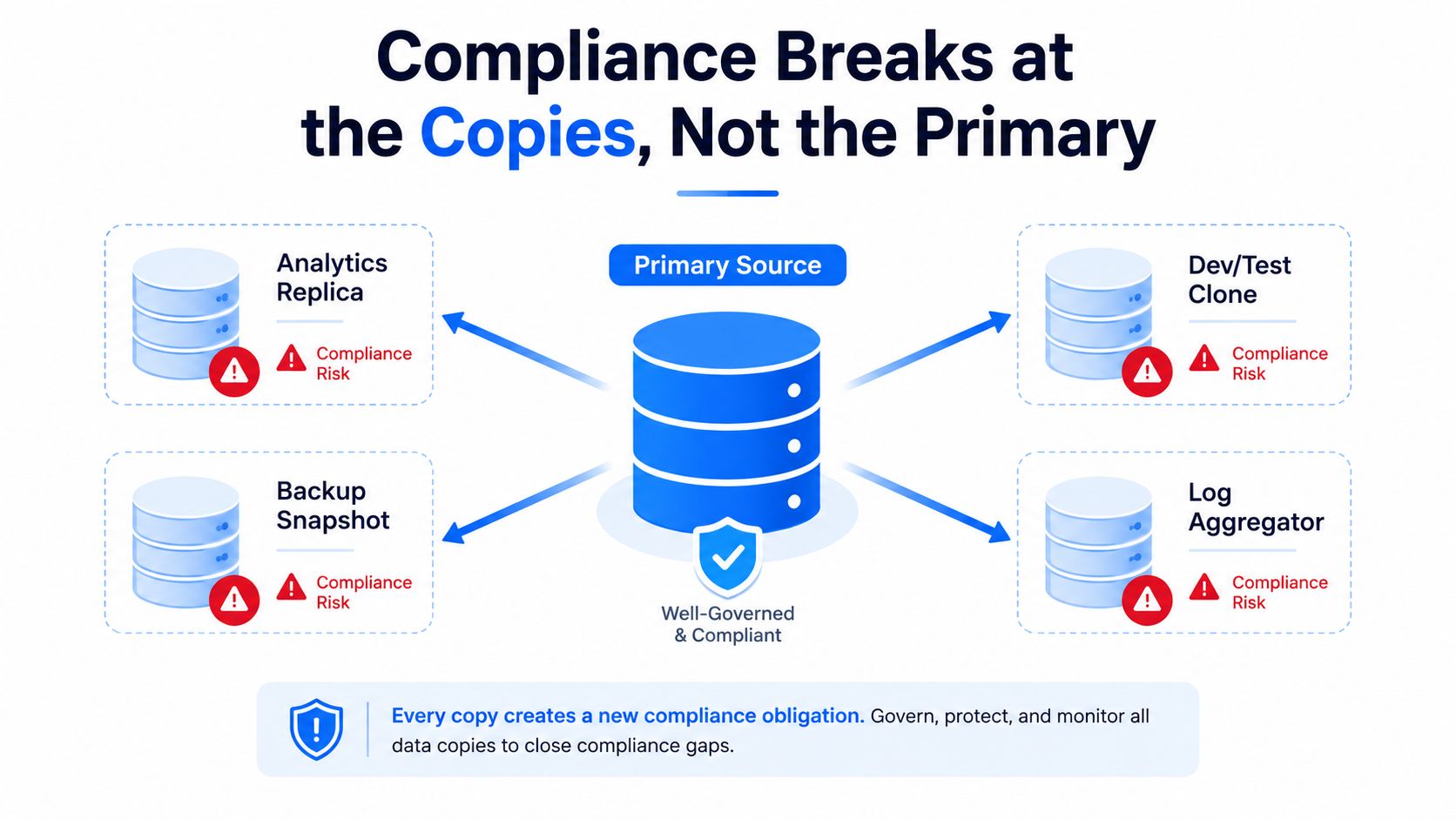
Most residency failures start with secondary data, not the source of truth. The primary table stays where it's supposed to be, then an analytics job creates a warehouse load, a support engineer saves a log bundle, or a notebook export lands somewhere the policy never approved.
The copies you have to count
The inventory has to include replicas, warehouse loads, materialized views, logs, traces, snapshots, archives, CSV downloads, spreadsheet exports, notebook extracts, and ad hoc files. That list sounds tedious because it is, but it's where boundary violations happen. A permitted master dataset can still become non-compliant the moment a derived copy crosses a border.
The practical response is a data residency matrix. It records the primary system, the derived and operational copies, the jurisdiction for each, and the legal basis for transfer where relevant. Once you build that matrix, the gaps become obvious. Region pinning by itself looks neat until you notice that the backup target, support attachment, or BI extract never inherited the same constraint.
The failure mode engineers actually see
One export is enough. A single CSV sent to a non-permitted region can turn a clean storage story into a broken residency story because the regulated data has left the jurisdictional boundary in effect, even if the source database stayed put. That's why copying is the thing to watch, not just the source system.
Operational habit: treat every pipeline that creates a new copy as a residency control point, not just a data engineering task.
The audit-ready mindset is to ask where the copy is created, where it is stored, who can read it, and whether it can be deleted on demand. If you don't know those four things, you don't know residency status yet.
On-Prem, Private Cloud, and Region-Restricted Public Cloud
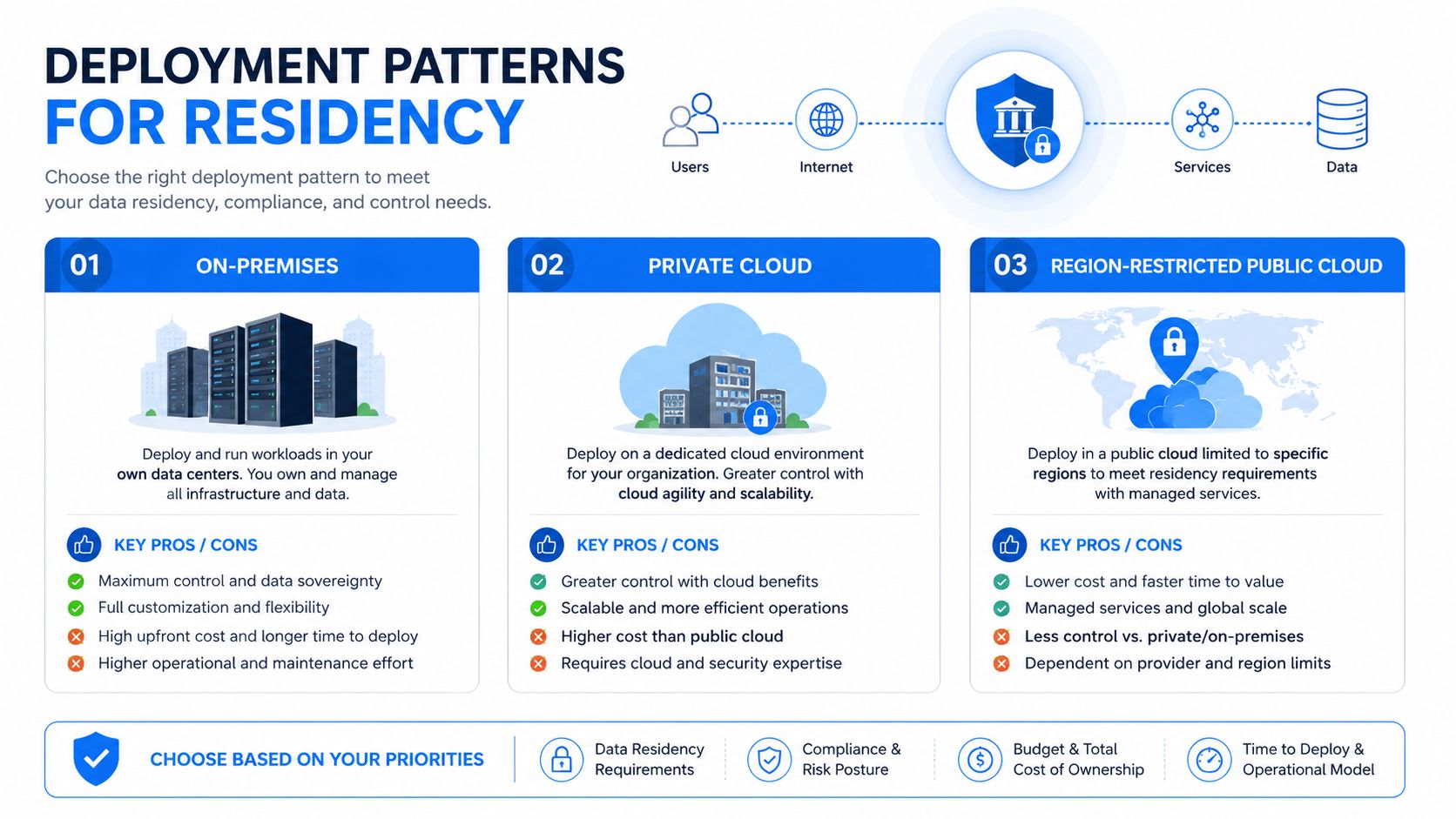
Deployment choice changes the size of the problem, not whether the problem exists. On-prem gives you the strongest physical and logical boundary, private cloud shifts that boundary to a controlled operator, and region-restricted public cloud gives you scale with a longer list of residency caveats.
The trade-offs that matter
On-premises works when the data is highly sensitive or when the regulatory story is easiest to defend with direct control. The drawback is obvious, you own more of the operational burden, from patching to capacity planning to resilience testing.
Private cloud usually makes sense when a regulated team wants elasticity without surrendering control of the environment. It's a solid middle path, but only if you do due diligence on the operator, the support model, and the location of backups and admin access.
Region-restricted public cloud is the fastest path to scale, but it's also where teams often underestimate residency spillover. Support access, telemetry, failover, and managed-service behavior can all stretch beyond the intended boundary if they aren't explicitly pinned.
Where no-vendor-access fits
The no-vendor-access model is gaining appeal because it shrinks the trust surface. Tooling executes inside the customer environment, and the vendor doesn't see production data. That pattern pairs naturally with in-database execution, which keeps analyses close to the governed dataset and avoids unnecessary movement.
digna fits that deployment style as one option. It runs analyses inside the customer environment, supports private cloud or on-prem deployment, and is designed so the vendor doesn't access production datasets. That doesn't remove residency work, but it does reduce one of the hardest parts of the trust chain.
The decision often comes down to whether your team wants a security problem or an operations problem. You can have both. Most organizations just choose which one they're better equipped to carry.
Technical Controls That Actually Enforce Residency
Policy language doesn't keep data in bounds by itself. The architecture has to make the right path the default path, and that means controlling ingestion, keys, access, and the regional footprint of every operational service around the data.
Four control layers that hold up
The first layer is geography-aware routing. Route data at ingestion so EU-origin PII lands in the EU path from the start, instead of being ingested globally and cleaned up later. That one design choice eliminates a lot of downstream risk because the wrong region never becomes the default landing zone.
The second layer is jurisdictional key management. Encryption doesn't solve residency if the keys sit elsewhere, because the security boundary still depends on who can access the data. Keep keys in the same jurisdiction as the protected data when the regime expects that, and document it clearly.
The third layer is access controls bound to tenant region or onshore admin roles. Support, SRE, and platform admin workflows can become residency leaks even when storage looks compliant. Bound those permissions tightly, and treat exception paths as controlled, auditable events.
The fourth layer is audit and monitoring. Auditors want region maps, transfer mechanisms, and evidence of key locality. They also want to see that your storage, compute, logging, backup, and disaster recovery paths are all pinned, not just the primary database.
Practical rule: residency architecture is a control plane problem, not a bucket setting.
A strong design usually combines routing, keys, IAM, and documented evidence in one operating model. If any one of those layers is vague, the compliance story gets shaky fast.
Observability Practices That Reduce Residency Risk Over Time
Residency drift usually arrives unannounced. A new pipeline exports to the wrong region, a schema change adds a sensitive column to a cross-border replicate, or a feed slows down and masks a backup mismatch until someone asks for evidence.
What to monitor continuously
The useful observability stack watches for three classes of change. Anomaly detection surfaces unexpected behavior in residency metadata or pipeline movement without forcing you to hand-maintain every rule. Schema tracking catches added columns, removed columns, and type changes before they quietly expand the sensitive footprint. Timeliness monitoring compares expected delivery patterns to actual arrivals so a stalled feed doesn't hide a failed regional handoff.
That's also where in-database execution matters. When analyses run inside the customer environment, you can inspect anomaly signals, trend changes, schema drift, and arrival timing without sending raw production data to a vendor workspace. That reduces movement and keeps the monitoring loop aligned with residency constraints.
The practical pattern is continuous proof, not periodic surprise. If the stack can tell you that a copy appeared in a non-permitted region, that a schema change introduced a restricted field, or that a region-specific feed is late, you're catching drift while it's still fixable.
For teams looking for a more operational breakdown of monitoring patterns, the observability best practices guide is a useful companion.
The IT Cloud Global LLC guidance is also worth a look if you want another angle on how security and compliance controls are usually discussed in cloud environments.
A Practical Compliance Checklist and What to Watch Next
A workable residency program starts with a short checklist and a few high-signal alerts.
Residency Matrix Coverage: map primary systems, copies, jurisdictions, and transfer basis.
Route-at-Ingestion Enforcement: send data to the correct region before it ever lands.
Jurisdictional Audit Trail: keep evidence of key locality, admin access, and transfer mechanisms.
Copy Discovery and Mapping: track replicas, exports, logs, snapshots, and backups continuously.
The monitoring signals that matter most are unexpected cross-region replication, schema changes that introduce sensitive columns, anomaly detection on residency metadata, and timeliness monitoring that spots a failover or delayed feed headed to the wrong place. Those are the signals that turn residency from a paper policy into an operational control.
The direction of travel is clear. More regimes are conditional instead of absolute, more obligations now cover the full lifecycle, and more teams will need observability tooling that proves it isn't creating the residency hole itself.
If you're building or tightening a residency program, start with the copy inventory, then harden routing, keys, and access, then add continuous drift detection. If you want a practical way to keep those controls visible inside your own environment, review how digna fits into private-cloud or on-prem monitoring workflows and use it to test whether your current residency story holds up under audit.