Compliance Reporting Automation Guide for 2026 Audit
|
5
min read

Quarter close is coming. Audit requests are already landing in shared inboxes. Someone in finance wants the latest control evidence, security needs signoff timestamps, data engineering is trying to explain why one report doesn't match another, and the compliance team is still reconciling spreadsheet versions.
That pattern is familiar in regulated enterprises because manual reporting hides risk until the deadline gets close. Teams don't just spend time gathering evidence. They spend time proving where the data came from, whether it changed, who approved it, and why the reported number can be trusted. The work is repetitive, but the harder problem is structural. Manual processes weren't designed for data estates that span warehouses, SaaS tools, pipelines, and policy systems.
Compliance reporting automation changes the operating model. Instead of treating audits as periodic fire drills, it turns reporting into a controlled, repeatable process with evidence, validation, and traceability built in from the start. That matters more in 2026 than it did a few years ago because regulations are more ambiguous, data moves faster, and static rules alone no longer catch the issues that create exam exposure.
Table of Contents
From Manual Audits to Automated Assurance
The old model looks the same almost everywhere. A regulator asks for evidence. Internal audit asks for support. Then a chain reaction starts. Analysts export files from one system, engineers patch missing fields from another, managers chase approvals in email, and someone rebuilds a final packet by hand because no source system captures the full story.
That scramble creates two kinds of failure. The first is obvious: delays, rework, and inconsistent reports. The second is harder to spot: teams normalize uncertainty. They start accepting statements like “that number should be right” or “we used the same logic as last quarter,” even when the underlying transformation changed.
Practical rule: If a report depends on tribal knowledge to explain lineage or approvals, it isn't audit-ready.
Automated assurance is different. Instead of assembling evidence after the fact, the system continuously gathers the inputs, validates them, records exceptions, and preserves the workflow history needed to defend the result. Auditors still ask questions, but the organization isn't reverse-engineering its own controls under pressure.
Three drivers are pushing firms in this direction:
Data volume growth: More source systems mean more joins, more handoffs, and more places for drift to hide.
Regulatory ambiguity: Many obligations now require judgment, not just checkbox logic.
Cost pressure: Leadership wants fewer manual hours tied up in recurring reporting cycles.
The strongest programs also connect reporting automation to risk operations, not just document production. Teams that invest in broader strategies for automated risk reviews usually make better architecture choices because they treat reporting as one output of an ongoing control environment, not a standalone quarterly task.
A well-designed platform won't remove human judgment. It will move people out of copy-paste work and into exception handling, interpretation, and remediation. That's the fundamental shift. Compliance reporting automation is less about generating PDFs faster and more about creating a durable state of continuous assurance.
What Is Compliance Reporting Automation Really
Often, what's described as automation turns out to be one of three things: a script that exports data, a workflow that routes approvals, or a dashboard that summarizes status. Those are useful pieces, but none of them alone is compliance reporting automation.
A better analogy is the move from paper ledgers to an integrated ERP. The ledger captured transactions, but it depended on people to reconcile, classify, and explain them. The ERP embedded those actions into a governed system with controls, traceability, and a reliable record of who did what. Compliance reporting automation should be understood the same way.
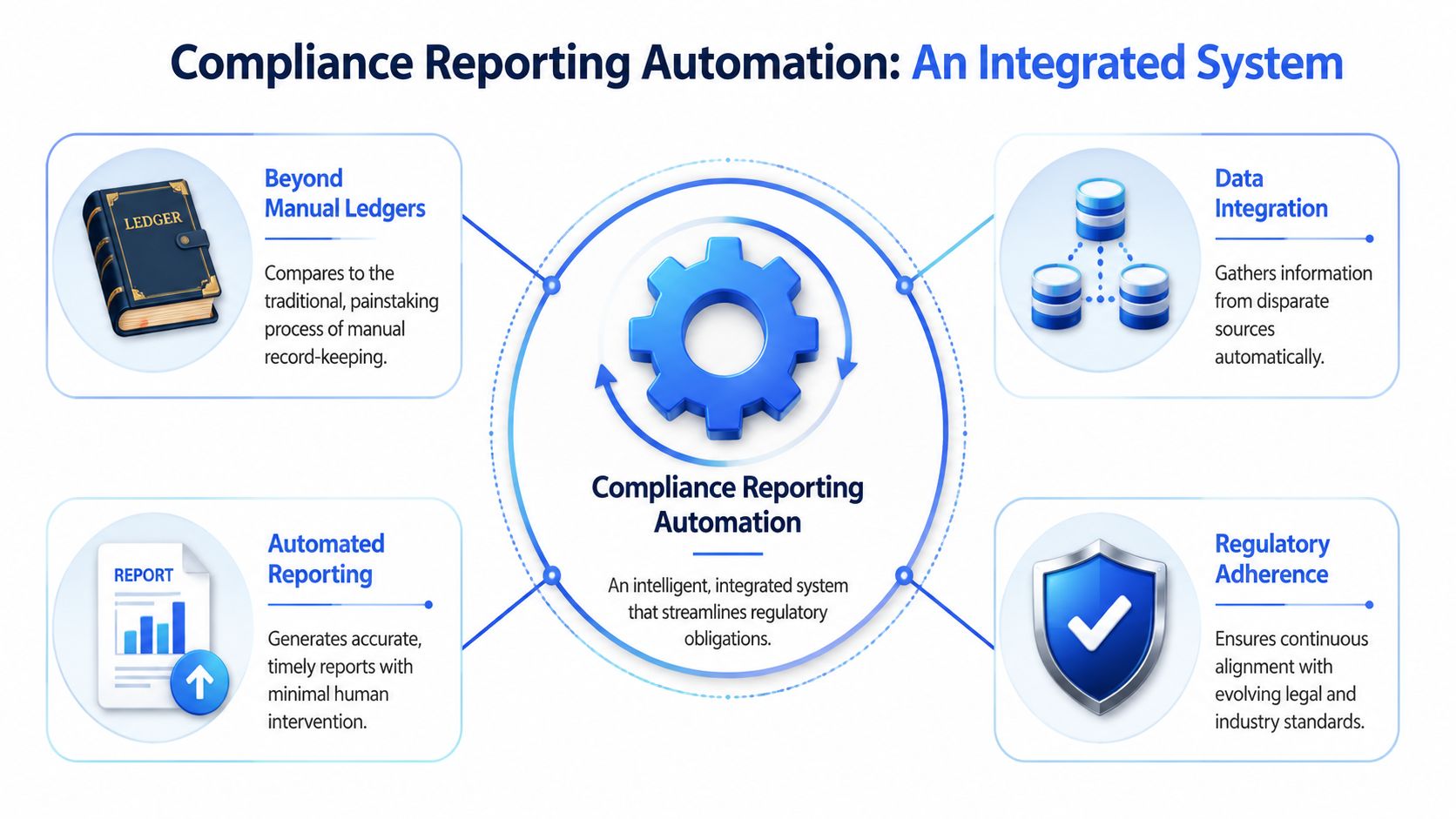
It is not just task automation
A script can pull data from a warehouse on schedule. That doesn't make it compliant. If the source schema changes, if a field is delayed, if an override occurs without attestation, or if a regulator asks how an exception was classified, a script usually has no answer.
True automation has to do more than run. It has to govern.
That's why organizations that modernize this function usually end up redesigning adjacent operations too. Reporting automation forces teams to standardize data ownership, evidence retention, and escalation paths. In practice, that often overlaps with broader efforts to optimise business workflows because brittle handoffs are where reporting quality tends to fail.
The four layers that matter
An effective platform has four working layers.
Automated data aggregation
It connects to the systems that hold the facts: transaction stores, identity systems, ticketing platforms, policy repositories, warehouse tables, and logs. The key is consistency. Data should arrive through a repeatable mechanism, not through ad hoc exports.Continuous validation
Many older tools fall short here. Traditional rule-based checks work for known conditions such as required fields, allowed values, date logic, and reconciliations. They don't work well when regulations rely on context, unusual patterns, or emerging drift. Modern designs combine configurable validation with AI-driven anomaly detection so the platform can catch both explicit violations and suspicious changes that static rules never anticipated.Auditable report generation
A report is only defensible if you can explain how it was produced. That means preserving the calculation logic, versioning the templates, and tying outputs back to source records and approvals.Secure evidence retention
Evidence must remain accessible, organized, and linked to the control workflow. If screenshots, approvals, and exception notes live in disconnected tools, the audit trail will break the moment someone asks for proof.
A strong automation framework doesn't just create a report. It creates a report you can defend six months later under scrutiny.
This distinction matters because many “set-it-and-forget-it” products automate repetitive tasks without addressing interpretive risk. In heavily regulated environments, the winner isn't the tool that removes the most clicks. It's the one that preserves context while scaling control.
Key Architecture and Implementation Patterns
Architecture decides whether compliance reporting automation will simplify your environment or create a new reporting silo. Most enterprise designs fall into one of two patterns.
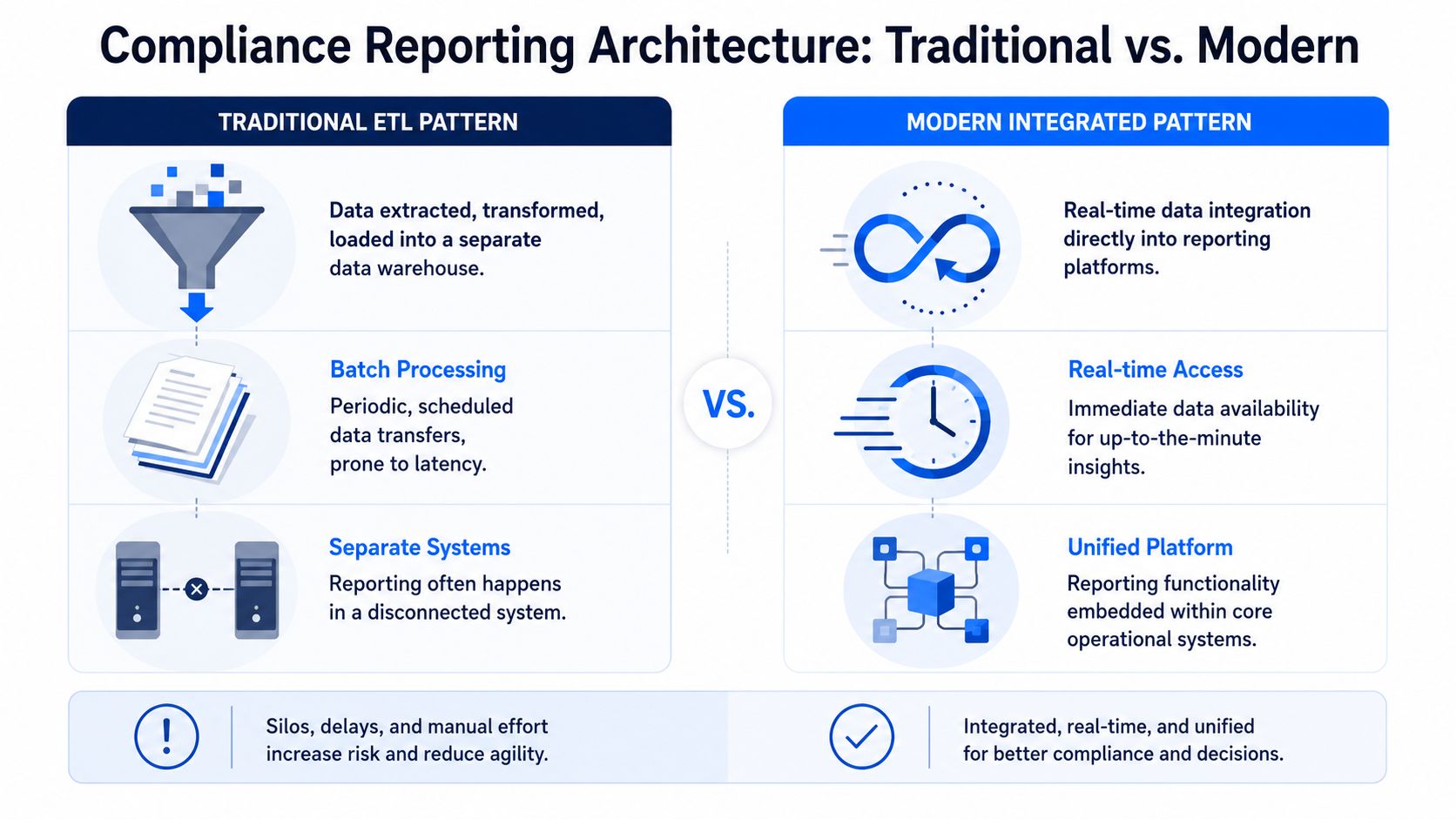
The ETL first model
In the traditional approach, teams extract data from operational systems, transform it, and load it into a separate compliance application or reporting store. This model is familiar. It can work. It also introduces predictable problems.
Each data movement step creates another place where timing, logic, or permissions can drift from the source of truth. Batch windows add latency. Duplicate storage raises residency and retention questions. And when an auditor asks why the compliance report differs from the operational record, teams often discover that the answer lives in a transformation job no one has reviewed in months.
The ETL-first pattern is usually easiest to buy and hardest to defend at scale.
The in database model
The more modern pattern runs analysis and metric computation inside the customer's own database, warehouse, or data lake. Sensitive data stays resident where governance already exists. The platform sends logic to the data rather than moving data into a separate vendor-controlled environment.
For regulated firms, that matters for practical reasons:
Security posture: Less data movement means fewer copies to secure.
Latency: Checks can run closer to source events.
Sovereignty: Data remains inside the environment the customer controls.
Operational clarity: Engineers can inspect the same data estate the business already trusts.
This pattern also supports a better mix of control types. Configurable validation handles explicit requirements. AI-driven anomaly detection surfaces drift, unusual distributions, and subtle deviations that don't fit predefined rules. That combination is what older “rules engine only” products miss. Ambiguous regulations often don't fail because a field was blank. They fail because a dataset behaved strangely and no one investigated.
What regulated teams should insist on
There is one critical requirement for any AI-enabled design. AI-powered compliance automation tools require transparent audit logs that are exportable, searchable, and linked to original workflows to explain flagged issue identification, demand timestamps for approvals, and record user attestations or overrides for regulatory compliance, as opaque "black-box" logic creates critical exam risks (Regly).
That single requirement should eliminate a surprising number of vendors from consideration.
When firms need outside help implementing these patterns, it's worth reviewing the field of leading data engineering firms for enterprises to understand who can work in regulated architectures rather than forcing generic analytics patterns onto compliance workloads.
A simple decision test helps. If the platform needs broad data replication into a separate stack, hides its detection logic, or can't connect exceptions back to source workflows, it will create audit pain later. If it computes near the data, supports explainable controls, and preserves workflow history, it is much more likely to survive real examination.
Connecting Data Observability to Compliance Needs
Compliance teams often describe the problem in policy language. Data teams experience the same problem as quality drift, broken pipelines, delayed loads, and unexplained changes. Data observability is where those two views finally meet.
Why observability belongs in compliance design
A compliance report fails long before the PDF is generated. It fails when upstream data arrives late, when a field changes type, when a transformation inadvertently drops records, or when a distribution shifts enough to distort a control metric. Manual processes rarely catch those issues early because they inspect outputs after the reporting window is already at risk.
Automated systems improve this by validating data continuously and consolidating evidence. Automated compliance reporting systems reduce human error rates by over 90% compared to manual spreadsheet-based processes by implementing real-time data validation and centralized evidence collection into a single "system of record" (ZenGRC).
That result makes sense from an engineering perspective. Spreadsheets fragment state. A governed observability layer centralizes it.
Compliance failures often look like policy failures in the board pack. In the data platform, they usually start as unnoticed pipeline failures, stale tables, or invalid records.
Mapping capabilities to obligations
When evaluating tools, I'd map technical capability directly to audit need. The exercise removes a lot of noise from vendor demos.
Compliance Requirement | Required Capability | Example Platform Feature |
|---|---|---|
Accurate reported values | Record-level enforcement of business rules | Data validation for mandatory fields, thresholds, and reconciliation checks |
Timely regulatory submissions | Monitoring of expected arrival times and delays | Timeliness tracking with schedule-based alerts |
Detection of non-obvious reporting risk | Adaptive detection beyond static thresholds | AI-driven anomaly detection for unusual volume, distribution, or pattern shifts |
Controlled change management | Visibility into structural modifications | Schema tracking for added, removed, or altered columns |
Defensible audit trail | Central evidence and workflow history | Searchable evidence store linked to approvals and exceptions |
That mapping is why observability now belongs in the compliance architecture discussion, not just in the data engineering backlog. If you want a deeper foundation, this explanation of data observability is useful because it frames monitoring as an operational discipline rather than a dashboard exercise.
The important design choice is not rule-based validation versus anomaly detection. You need both. Validation proves known requirements are enforced. Anomaly detection catches the unknowns, especially when data drift or behavioral changes create risk before anyone has written a new rule.
AI-based observability is particularly helpful where regulations rely on qualitative interpretation. A static threshold can tell you whether a field violated format. It usually can't tell you whether a population suddenly behaves in a way that makes a prior control assumption unreliable. That's where adaptive thresholds and pattern detection add value. Verified benchmarks from digna note that AI-powered anomaly detection can reduce false positives by 30 to 50% compared to static rule-based systems (digna). In practice, fewer false positives means teams investigate real issues instead of muting alerts.
An Implementation Roadmap and Success Metrics
Most failures in compliance reporting automation happen because teams start too wide. They try to automate every report, every framework, and every approval path at once. The better route is narrower and more disciplined.

Start with one report that matters
Begin with discovery and scoping. Pick a report that is high-friction, high-risk, and frequent enough to matter. You want a process that hurts today but is still contained enough to fix cleanly. Good candidates usually involve multiple source systems, recurring evidence requests, and known reconciliation pain.
Then move into pilot design. Define the source systems, data owners, validation rules, exception workflow, required approvals, and final output format. Don't skip policy interpretation. If a rule depends on business judgment, make that explicit in the workflow rather than trying to bury it inside code.
A practical phased motion looks like this:
Discovery and scoping
Inventory reporting obligations, identify the noisiest manual steps, and document where evidence currently lives.Solution design and selection
Choose where validation runs, how workflow events are logged, and whether analysis remains inside your environment.Development and integration
Connect the first report to production-grade inputs. Build exception handling before you build polished dashboards.Testing and validation
Reconcile automated outputs against historical reporting and confirm that approvers can explain every override.Deployment and optimization
Go live with one report, stabilize it, then expand by reuse rather than redesign.
The business case is usually easier to win than people expect. Organizations implementing compliance reporting automation typically achieve a 60-80% reduction in manual compliance work and see ROI within 6-12 months through reduced labor costs and 90% faster audit preparation (LinkedIn analysis).
What to measure and what to avoid
Use a small set of metrics that reflect operating reality:
Manual effort removed: Track hours previously spent collecting, reconciling, and packaging evidence.
Audit preparation cycle time: Measure whether preparation moved from months to weeks, which is a common outcome in the same analysis above.
Exception resolution quality: Look at whether issues are identified earlier and resolved with documented approvals.
Report defensibility: Test whether teams can explain lineage, validation, and overrides without side conversations.
For governance-heavy environments, this guide to implementing data governance is a useful companion because reporting automation breaks down quickly when ownership and policy stewardship are fuzzy.
The first pilot should prove trust, not feature breadth. If auditors and control owners can't follow the chain from source data to final report, you haven't automated the hard part.
Common mistakes are consistent. Teams treat the initiative as an IT project. They underestimate source data issues. They over-automate judgment calls that should remain routed to accountable reviewers. And they buy tools that look efficient in a demo but can't produce a defensible audit trail in production.
Use Cases in Finance Healthcare and Telecom
Regulated sectors adopt compliance reporting automation for different reasons, but the operational pattern is similar. Manual collection creates delay. Static rules miss context. A better control fabric combines governed validation, anomaly detection, and evidence capture.

The market momentum reflects that pressure. The global compliance automation tools market was valued at USD 2.53 billion in 2023 and is expected to grow at a CAGR of 19.7% through 2030, reflecting intense demand driven by regulatory complexity across industries like finance and healthcare (Finance Yahoo market report).
Finance
In banking and capital markets, reporting often breaks on lineage and explainability, not just data extraction. An AML workflow may collect transaction activity correctly yet still create exposure if investigators can't explain why a case was escalated, cleared, or overridden. The same pattern shows up in BCBS 239 style risk data aggregation work. Numbers matter, but traceability matters just as much.
The stronger design keeps validation close to source data, monitors for unusual shifts in transaction patterns, and preserves investigator attestations with timestamps. Rule-based checks catch explicit failures. Anomaly detection highlights populations or behaviors that deserve review even when no prewritten rule fired.
Healthcare
Healthcare organizations face a different flavor of complexity. HIPAA-related reporting often depends on proving who accessed protected health information, whether access aligned with role and process, and how exceptions were handled. Manual logs can answer some of that, but they rarely provide an easy chain from event to review to approved action.
Automation helps by correlating access events, validation logic, and evidence into one controlled record. If a data feed changes, if expected activity patterns drift, or if a required attribute goes missing, the reporting process can flag that before the audit packet is assembled. That reduces the chance that a compliance team discovers its own reporting gap at the worst possible moment.
Telecom
Telecom operators often sit at the intersection of privacy obligations, network reporting, and operational SLAs. Customer data permissions, service records, and performance metrics may come from different systems with different update cycles. A late load or schema change in one pipeline can distort a submission without any obvious failure in the final dashboard.
A more resilient setup watches both the content and the movement of data. Validation confirms required structures and policy rules. Timeliness checks show whether upstream feeds arrived when they should. Anomaly detection spots unusual swings in volumes or patterns that static checks treat as technically valid but operationally suspicious.
The common lesson across all three sectors is simple. Automation works best when it doesn't pretend every compliance question is binary. Modern reporting needs explicit controls for known requirements and adaptive detection for gray areas that static rules can't interpret on their own.
If your team is trying to reduce audit scramble without giving up data privacy, digna is worth a look. It combines AI-powered anomaly detection, record-level validation, timeliness monitoring, and schema tracking while running inside customer-controlled environments, which is exactly the pattern many regulated enterprises need when they want stronger compliance reporting automation without moving sensitive data into a vendor-managed black box.
For the record-level enforcement behind the "accurate reported values" obligation in the table above, see how digna Data Validation applies business rules inside your database.
Frequently asked questions
What is compliance reporting automation?
It is a governed process, not just a script, approval workflow or dashboard. The article describes four layers: automated data aggregation from source systems, continuous validation, auditable report generation with versioned logic, and secure evidence retention linked to the control workflow. The goal is a report you can defend six months later.
What is the difference between ETL-first and in-database compliance architectures?
ETL-first copies data into a separate compliance store, adding batch latency, duplicate storage and transformation jobs that can drift from the source of truth. The in-database model sends logic to the data instead, so sensitive records stay where governance already exists, with fewer copies to secure and checks running closer to source events.
How much manual work can compliance reporting automation save?
According to a LinkedIn analysis cited in the article, organizations typically see a 60-80% reduction in manual compliance work, ROI within 6-12 months and 90% faster audit preparation. The article also cites ZenGRC's finding that automated systems cut human error rates by over 90% compared with spreadsheet-based processes.
How does data observability support regulatory compliance?
Observability catches the upstream failures that later become compliance failures: late loads, changed field types, dropped records and distribution shifts. The article maps each obligation to a capability, for example timely submissions to arrival-time monitoring, accurate values to record-level validation, and controlled change management to schema tracking of added, removed or altered columns.
Where should a compliance reporting automation project start?
Begin with one report that is high-friction, high-risk and frequent, ideally involving multiple source systems and known reconciliation pain. Then move through scoping, solution design, integration, testing against historical reports and deployment. Build exception handling before polished dashboards, and expand by reuse once that first report is stable.