7 List Stop Words for Search and NLP
|
7
min read

Removing common words isn't a universal win. A stop word can be noise in one workflow and a vital signal in another, so the right list stop words setup depends on what you're trying to improve, search relevance, NLP features, database-native processing, or the meaning of domain text. Historical retrieval systems treated stop lists as an indexing shortcut, not a blanket rule, and modern pipelines still face the same trade-off, because removing common terms can shrink indexes and speed processing while also hurting phrase search and business-critical queries (stop word history and retrieval trade-offs). The practical rule is simple, measure relevance, model quality, and downstream data-quality outcomes before and after filtering, then document every custom addition or exclusion.
Across English text, stop words often make up a large slice of ordinary language, and that makes the decision operational, not cosmetic. NVIDIA's guidance summarizes studies showing that typical English text contains about 30 to 40% stop words, which means filtering choices can change index size, processing speed, and model behavior in a material way (NVIDIA stop-word guidance). That's why the seven resources below are best read by job, not by brand. Some are built for general NLP, some for search engines, some for machine learning, and some for database-native text handling where the data should stay put.
Table of Contents
1. NLTK English Stop Words
Use it when text supports a monitoring workflow
2. Snowflake Native Stop Words
Keep warehouse text handling close to the data
3. Apache Lucene Stop Words
Use Lucene when search behavior matters more than broad NLP
4. spaCy Default Stop Words
Use spaCy when meaning depends on grammar and context
5. PostgreSQL and BigQuery Custom Stop-Word Dictionaries
Build dictionaries around audit and reuse
6. Industry-Specific Stop-Word Lists
Treat domain vocabulary as part of control design
7. Scikit-Learn English Stop Words
Use it as a starting point for text features
Comparison of 7 Stop-Word Lists
Choose the List That Preserves Meaning
1. NLTK English Stop Words
NLTK is a solid starting point when the task is general-purpose Python NLP. Its English stop-word list is widely used in preprocessing because it gives teams a quick way to remove filler terms before tokenization, frequency analysis, or text classification. For digna teams, that makes it useful when natural-language business rule descriptions, metadata tags, or incident notes need cleanup before validation or anomaly analysis. The point isn't to trust the default forever, it's to get a readable baseline fast.
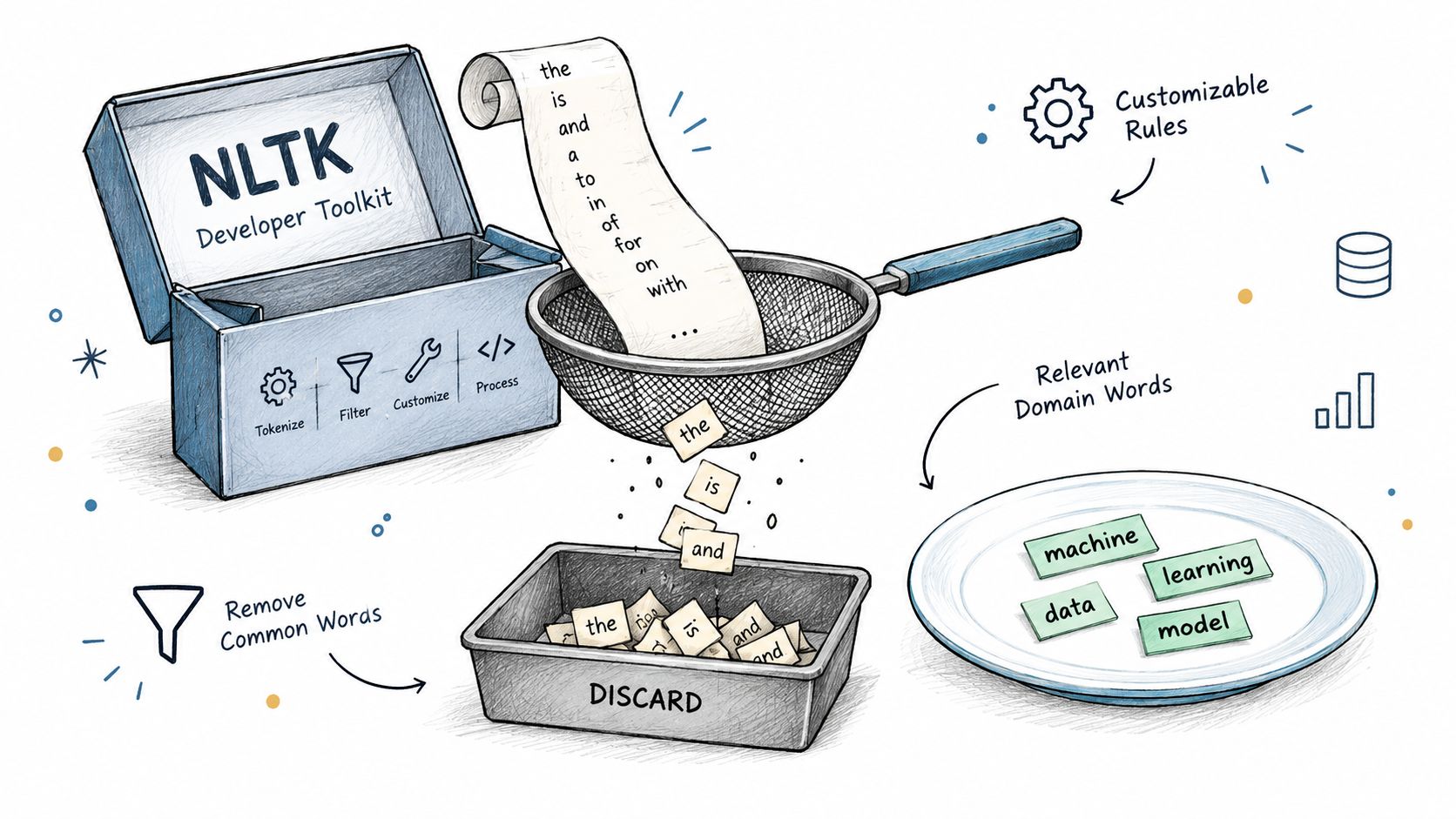
NLTK works best when you treat it as a draft list, not a final policy. If your data quality team sees terms like credit, patient, or subscriber in recurring rule text, those words may carry more meaning than a generic English list assumes. A custom list is often the safer choice in financial services, healthcare, or telecom, because domain language can be more important than grammatical filler.
Use it when text supports a monitoring workflow
A practical fit is filtering natural-language rule descriptions in digna's data cleaning guidance, where the goal is to separate syntax from signal before analysis. The same list can help clean lineage notes or incident summaries before they're clustered or counted. It can also reduce noise in free-text fields that analysts use to triage data issues.
Practical rule: start with the default list, then add or remove terms only after testing against your own business-rule vocabulary.
Preserve domain terms: Keep words that change meaning in your industry, even if they're common in general English.
Test before rollout: Compare filtered and unfiltered text against real incident and rule samples.
Document every edit: Write down every custom addition so validation logic stays consistent across teams.
2. Snowflake Native Stop Words
Snowflake belongs in the conversation when text processing has to stay inside the warehouse. Native stop-word handling fits cloud data work because it avoids moving text out to an external NLP stack just to remove common terms. For digna deployments in Snowflake, that aligns with in-database execution, since the text stays close to the records, the lineage, and the schema metadata being inspected.
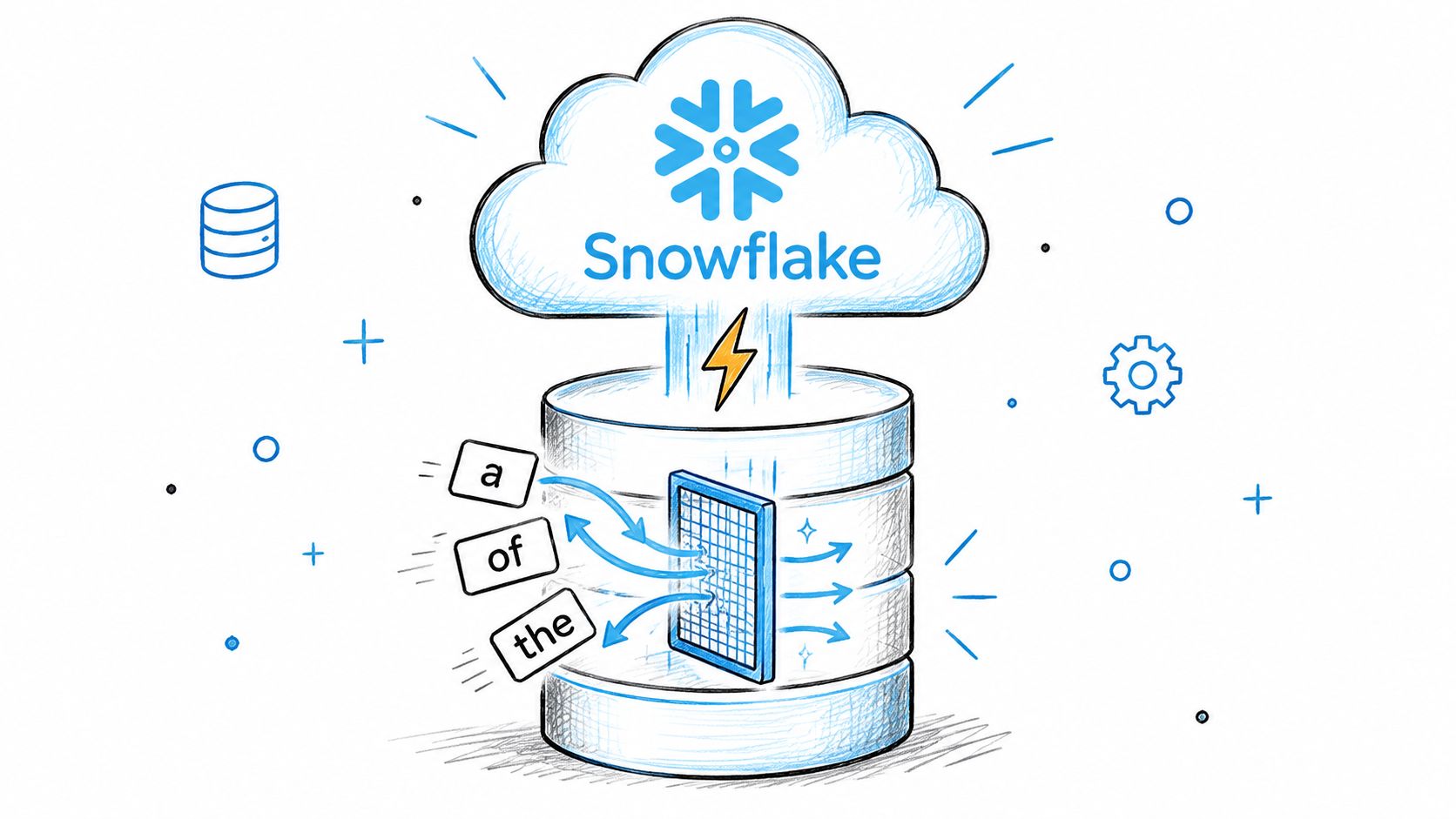
That matters in observability workflows. If a data catalog description or incident note is processed where it already lives, teams avoid extra orchestration and keep the audit trail simpler. In practice, the strongest use case is filtering human-written metadata that accompanies schemas, because the surrounding context often matters as much as the raw token list.
Snowflake is also a good reminder that stop words aren't just an NLP concern. They can sit inside the same warehouse logic that supports text search, incident triage, and schema-change review. When the same environment powers both storage and analysis, a native stop-word list becomes part of the operating model rather than a preprocessing step hidden in a notebook.
Keep warehouse text handling close to the data
For teams monitoring catalog changes, that design lines up with digna's Snowflake guidance, especially when the dashboard needs to show what changed without exporting sensitive text. A custom lookup table is often the right supplement when the warehouse text includes business terms that default lists would strip. That approach also makes versioning easier across environments.
Use native filtering first: Keep the transformation inside Snowflake when the data already lives there.
Supplement with business terms: Add a domain-specific layer for regulated or technical vocabulary.
Check release changes: Review stop-word updates before they affect existing rules or saved searches.
3. Apache Lucene Stop Words
Lucene is the sharper choice when the job is search indexing. Its English stop-word list is compact and tuned for information retrieval, which makes it a strong fit for catalog search, lineage lookup, and large-scale metadata retrieval. That kind of list is usually better when the objective is fast, focused search rather than broad linguistic analysis.
The trade-off is easy to miss. A smaller list can be great for performance, but search relevance depends on how people query your data. A term that looks trivial in a generic corpus may matter in a table name, a schema description, or an incident title. If your users search for exact phrases, removing the wrong terms can make the system feel less accurate even if the index gets smaller.
Use Lucene when search behavior matters more than broad NLP
Lucene fits situations where many people search the same metadata surface, such as a data catalog with thousands of tables. In digna deployments, that's especially relevant for schema and lineage exploration, where search speed and ranking quality are both part of the user experience. The cleaner the index, the easier it is to surface the right object quickly.
Lucene is strongest when you treat stop words as a search-tuning tool, not as a generic cleanup step.
That's why digna's wildcard search guidance belongs in the same workflow. Wildcard search and stop-word filtering affect different parts of retrieval, but they interact in practice when users type partial names, mixed phrases, or noisy metadata labels. If the search surface is operationally important, test it against real query logs before standardizing the list.
4. spaCy Default Stop Words
spaCy is a better fit when the pipeline needs broader language coverage and tighter linguistic processing. Its default English stop-word set is larger than search-focused lists, and it also supports stop-word resources across many languages. That matters when text is parsed, lemmatized, and analyzed, not just tokenized.
For digna users, the practical test is whether language still carries risk signals in data-quality rules, incident summaries, and schema descriptions. A rule explanation can hinge on wording such as whether a field is required only under certain conditions. In that setting, removing common words too aggressively can erase the logic that analysts need to inspect.
Use spaCy when meaning depends on grammar and context
spaCy works well for extracting key concepts from incident descriptions and spotting recurring patterns in rule text. It also fits teams that need consistent handling across languages or a central configuration for a broader data-quality framework. In regulated environments, that consistency can matter as much as raw model quality.
The best pattern is to extend the default list only after testing against real text. In finance, terms like credit and debit may need to stay. In healthcare, patient and drug can be too important to remove. In telecom, subscriber may be a core signal rather than filler.
Good practice: use spaCy's language pipeline and stop words together, then decide whether the domain vocabulary needs a separate exclusion layer.
That approach aligns with digna's historical data guidance when business-rule text needs to stay interpretable for analysts and auditors.
5. PostgreSQL and BigQuery Custom Stop-Word Dictionaries
Database-native dictionaries are the right choice when text processing has to stay inside the platform. PostgreSQL's full-text search and BigQuery's configurable text functions let teams place stop-word rules closer to the data, which reduces movement and keeps governance easier to trace. For teams already working in those systems, that placement often decides the design.
The trade-off is simple: stop-word handling moves from general language cleanup to platform control. A healthcare team may keep clinical terms in one dictionary and remove generic English in another. A financial services team may document each edit for compliance. The value is not only filtering, it is keeping the text policy aligned with the environment where the text is queried.
Build dictionaries around audit and reuse
For digna deployments, database-native lists fit the in-database execution model well. They also support repeatable workflows for schema-change descriptions, business rule text, and catalog metadata that would otherwise be copied into separate tools. That makes them easier to audit and easier to keep aligned across environments. For BigQuery-specific workflows, digna's BigQuery data quality page is a useful reference point, while PostgreSQL teams can use digna's PostgreSQL data quality page to keep filtering and validation in the same operational flow.
Split by domain: Use separate dictionaries for operational, regulated, and analytical text.
Track changes formally: Version dictionary edits so reviews and rollbacks are straightforward.
Test with representative text: Validate against real descriptions, not toy examples.
The main advantage is control. Teams know which rules are active, where they run, and how they shape results. That matters because removing the wrong word can damage search relevance or blur business meaning, especially when the same term carries different weight across database, analytics, and compliance workflows.
6. Industry-Specific Stop-Word Lists
Generic lists break down fastest in regulated industries. A word that looks unimportant in plain English can be central to financial reporting, patient safety, or telecom KPI monitoring. That's why industry-specific stop-word lists are less about removing more words and more about preserving the terms that carry business meaning.
Financial services usually needs terms such as debit, credit, transaction, and settlement to remain visible. Healthcare teams often need patient, diagnosis, treatment, and medication to survive filtering. Telecom teams may rely on words like subscriber, churn, revenue, and arpu for accurate monitoring. In each case, the wrong stop list can blur the signal that operators need.
Treat domain vocabulary as part of control design
Governance matters here. Compliance teams should review the list, because the decision to keep or remove a term can affect audit trails, KPI interpretation, and anomaly detection. If a business rule or monitoring threshold depends on domain wording, that word shouldn't be casually dropped from analysis.
If a common word changes the interpretation of a regulated metric, it isn't a stop word for your use case.
That principle fits naturally with digna's finance governance guidance, since finance teams often need tight control over terminology, validation, and reviewability. The same logic extends to healthcare and public sector data, where traceability can matter as much as convenience.
7. Scikit-Learn English Stop Words
Scikit-learn belongs in the machine learning layer, not the search layer. Its English stop words are designed for feature extraction, which makes them a sensible baseline for vectorization, classification, and anomaly-related text features. If the job is to turn incident notes or schema descriptions into features, this is the list that fits the pipeline.
The big advantage is compatibility. Scikit-learn stop words plug neatly into Python ML workflows, especially when teams are building TF-IDF features or other sparse representations. For digna users, that makes them useful in baseline learning, statistical pattern analysis, and model-driven triage of text that accompanies data-quality events.
Use it as a starting point for text features
The key is to think like a model builder, not a search engineer. A machine learning pipeline often benefits from removing high-frequency filler, but the value comes from whether the remaining terms improve prediction, clustering, or drift detection. If the terms are too aggressive, the model can lose useful distinctions. If they're too loose, the features stay noisy.
That's why the best practice is to start with the base list, then add domain terms only after checking model behavior on real examples from your environment. A schema-change note in one company may use language that's generic in another, and the list should reflect that difference.
Use a baseline first: Keep the default list before introducing custom terms.
Align with vectorization: Pair it with TF-IDF or similar feature extraction methods.
Review model output: Check whether removed terms changed predictions, not just token counts.
Comparison of 7 Stop-Word Lists
Item | Implementation Complexity 🔄 | Resource Requirements ⚡ | Expected Outcomes 📊 & Quality ⭐ | Ideal Use Cases 💡 | Key Advantages ⭐ |
|---|---|---|---|---|---|
NLTK English Stop Words | Low, simple list; easy to customize | Low, lightweight Python package | Moderate impact; reduces noise but needs tuning, ⭐⭐⭐ | General NLP preprocessing, metadata cleaning | Open-source, widely adopted, easy customization |
Snowflake Native Stop Words | Low, native setup, minimal config | Minimal, in-database, no external deps, high throughput | High for in-warehouse filtering; fast & governance-friendly, ⭐⭐⭐⭐ | Digna on Snowflake; in-database text filtering and tokenization | No data movement, optimized performance, keeps data in place |
Apache Lucene Stop Words | Low, plug into search stacks easily | Low, small list, minimal overhead | High for search relevance and indexing efficiency, ⭐⭐⭐⭐ | Full-text search, large-scale index optimization (ES/Solr) | Very compact list, improves search speed and reduces index size |
spaCy Default Stop Words | Medium, requires spaCy install and models | Medium, Python + NLP models; more compute | High for linguistic tasks and entity-aware filtering, ⭐⭐⭐⭐ | Advanced NLP, business-rule complexity analysis, semantic parsing | Curated, integrated with NLP pipeline, customizable at runtime |
PostgreSQL & BigQuery Custom Dictionaries | Medium–High, DB-specific setup and admin rights | In-database resources; requires DBA knowledge | High for compliant, scalable in-warehouse processing, ⭐⭐⭐⭐ | Regulated environments, per-table/schema custom dictionaries | Fully customizable in-db, no external dependencies, audit-friendly |
Industry-Specific Stop-Word Lists (Finance, Healthcare, Telecom) | High, needs domain expertise and ongoing maintenance | Medium, teams, possible vendor/licensing costs | Very high domain accuracy; reduces false positives, ⭐⭐⭐⭐⭐ | Industry-regulated anomaly detection, rule validation, KPI monitoring | Preserves critical terms, improves detection accuracy and compliance |
Scikit-learn English Stop Words | Medium, integrated in ML pipelines | Medium, Python ML stack (TF-IDF, models) | High for ML feature extraction and model prep, ⭐⭐⭐⭐ | ML-driven anomaly detection, feature engineering, TF-IDF workflows | Optimized for ML, reproducible, works with scikit-learn tools |
Choose the List That Preserves Meaning
The best list stop words choice depends on the job in front of you. Use Lucene when the priority is focused search indexing. Use NLTK or spaCy for general Python NLP, especially when you're cleaning metadata, incident text, or rule descriptions. Use scikit-learn when the text is feeding a model, not a search box. Use database-native dictionaries when processing has to stay in place. Add industry-specific extensions whenever business terms carry signal and generic lists would erase it.
The selection workflow should stay practical. Test precision, recall, search relevance, model behavior, and downstream data-quality outcomes before you standardize anything. Then version the list, review changes, and keep domain-critical words out of the stop-word set unless you've proved they don't matter in your data.
That discipline is exactly why stop-word management belongs in the same conversation as observability and validation. If a word changes search ranking, model output, or incident interpretation, it belongs in governance, not in a default list. Keep the policy close to the people who own the data, and update it when the business vocabulary changes.
digna helps teams keep that discipline inside the same environment where the data already lives. Its data quality, schema tracking, timeliness monitoring, and anomaly detection modules make it easier to test text rules against real operational data instead of guessing. Visit digna if you want to connect stop-word choices to monitoring, validation, and in-database observability in one platform.
If your stop-word filtering runs inside the warehouse, as the Snowflake section above recommends, data quality monitoring for Snowflake can run in the same place, so text rules and the tables they describe are checked without exporting data.
Frequently asked questions
What is a stop word list used for?
A stop word list tells a search engine or NLP pipeline which common words to drop before indexing or analysis. Typical English text is about 30 to 40% stop words, so the list you choose can change index size, processing speed and model behavior in a material way.
Which stop word list should I use for search indexing?
Apache Lucene is the better fit when the job is search indexing. Its English list is compact and tuned for information retrieval, which suits catalog search and metadata lookup. Test it against real query logs first, because removing the wrong terms can hurt exact phrase searches.
What is the difference between NLTK, spaCy and scikit-learn stop words?
Each library targets a different job. NLTK is a quick baseline for general Python NLP, spaCy offers a larger default set and many languages for grammar-aware pipelines, and scikit-learn's list is built for feature extraction such as TF-IDF vectorization when text feeds a model rather than a search box.
Should I remove domain-specific words like credit or patient as stop words?
Usually not. Generic lists can strip terms that carry business meaning, such as debit, credit and settlement in finance, patient and diagnosis in healthcare, or subscriber, churn and ARPU in telecom. If a common word changes the interpretation of a regulated metric, it is not a stop word for you.
How do I customize a stop word list safely?
Start with a default list, then add or remove terms only after testing filtered and unfiltered text against real samples. Measure relevance, model quality and downstream outcomes, document every custom edit, and version dictionaries such as PostgreSQL or BigQuery ones so reviews and rollbacks stay straightforward.