Virtual Legal Assistant: What It Is and How Firms Use It
|
9
min read

Your associate has just spent four hours drafting a routine NDA. A paralegal is chasing signatures, updating the matter system, and answering status calls, while an in-house lawyer is still building a research memo that could have started with the firm's approved authorities. The pressure to “use AI” is understandable, but the wrong deployment moves risk from a crowded inbox into a confidential data environment.
A virtual legal assistant should be treated as a supervised productivity layer. It can retrieve, classify, summarize, draft, organize, and flag issues. It can't replace legal judgment, assume responsibility for advice, or make jurisdiction-sensitive decisions. The practical question isn't whether firms will use one. It's which tasks belong in the system, what review is mandatory, and what evidence proves the workflow is safe.
Table of Contents
Why Firms Are Hiring a Virtual Legal Assistant Right Now
The first test is simple. If qualified lawyers are spending their best hours on repeatable administration, document comparison, intake, status updates, or first drafts, your firm has work ready for structured delegation. A solo practitioner may need coverage for scheduling and matter intake. A litigation team may need a queue for document review and chronology building. An in-house department may value an always-available first layer for contract triage and internal requests.
That doesn't mean handing a chatbot the file and asking for an answer. It means separating work into three categories: tasks that can run under written procedures, drafts that require lawyer approval, and decisions that stay with counsel. Your controls should be as deliberate as your prompts. The quality of the underlying information matters too, which is why a data-quality perspective on AI models is relevant before you connect a system to matter records.
Start with workload, not novelty
Begin with one queue that has a clear input, a defined output, and a named reviewer. Contract clause comparison is a better starting point than autonomous legal advice because the firm can identify the source document, the playbook, the deviations, and the person responsible for approval.
The benefit compounds as matter volume grows. A reliable workflow can reduce repetitive handling across many files, while an unreliable one creates duplicated review, client confusion, confidentiality exposure, and malpractice risk. Your first deployment should therefore optimize for traceability, not the most impressive demonstration.
Practical rule: If nobody can say who approves the output, the task isn't ready for automation.
The adoption curve explains why this decision has become urgent. Firms aren't evaluating a distant experiment anymore. They're deciding how to govern tools already appearing in research, drafting, intake, and administrative workflows.
How Legal AI Adoption Reached the Tipping Point
The shift is visible in the ABA survey record. The American Bar Association's 2024 Legal Technology Survey Report found that 30% of responding lawyers were using AI-based tools in 2024, compared with 11% in 2023, 12% in 2022, and 10% in 2021. The figures appear in the ABA Legal Technology Survey Report coverage.
That jump matters operationally. A firm can no longer treat AI use as an isolated preference of one associate. Procurement needs approved tools. Professional-responsibility policies need to address confidentiality and review. Training needs to cover source verification, prohibited uses, and escalation. The firm also needs a way to discover unsanctioned use, because a policy that ignores actual behavior won't protect the practice.
Adoption differs sharply by firm size. 46% of firms with 100 or more lawyers reported using AI, compared with 30% of firms with 10 to 49 lawyers and 18% of solo practitioners, according to the same ABA report. A large firm may need identity, matter, and vendor controls across many teams. A solo lawyer may need a simpler approved workflow with a clear manual review gate.
Maturity is rising, but confidence isn't complete
Only 4% of lawyers considered AI mainstream in 2023, while 13% held that view in the later survey, and 45% expected AI to become mainstream within three years, as reported by the ABA Journal's discussion of the survey history. At the same time, approximately three-quarters of respondents remained concerned about hallucinations, meaning confident but incorrect outputs. ABA Journal reporting on AI adoption and hesitation provides that context.
Treat those figures as a governance signal. Adoption is moving faster than institutional comfort, so the firm should make supervision part of the product design rather than leaving it to individual judgment. The right question isn't “Does the tool work?” It is “For which task, against which sources, with what review evidence?”

A practical AI governance and compliance framework should reflect this uneven maturity. Large firms may need centralized controls and monitoring. Smaller firms can still meet the same ethical standard through narrower scope, approved sources, individual accountability, and documented review.
Human Remote Assistant Versus AI-Powered Assistant
A remote human assistant and an AI-powered assistant solve different problems. Treating them as interchangeable leads to bad hiring decisions, misleading client communications, and weak supervision.
A human remote assistant is a person who can learn the firm's procedures, recognize an unusual client interaction, ask a clarifying question, and stop when a task exceeds the playbook. Depending on the role and jurisdiction, that person may be a legal assistant, paralegal, contract attorney, or administrative professional. The firm can train them on its documents, assign permissions, inspect their work, and correct behavior directly.
An AI-powered assistant is software. Its strengths are speed, retrieval, classification, comparison, summarization, and draft generation across structured inputs. It doesn't understand professional responsibility in the way a lawyer does, and it shouldn't be presented to clients as a source of legal advice.
Compare the operating model
Dimension | Human remote assistant | AI-powered assistant |
|---|---|---|
Best use | Intake, case management, scheduling, document preparation, supervised research | Retrieval, classification, comparison, summarization, draft triage |
Working pattern | Scheduled availability and assigned queues | Continuous processing within configured limits |
Error response | Can explain, ask, and correct | May produce a plausible but unsupported answer |
Training | Firm procedures, templates, systems, confidentiality rules | Approved sources, retrieval rules, prompts, validation, access policies |
Supervision | Manager or lawyer reviews work and conduct | Lawyer reviews outputs, sources, uncertainty, and system logs |
Client label | Staff member or contractor, never implied to be counsel | Automated support, never legal advice |
Main control | Vetting, access restriction, written delegation | Source grounding, citation checks, jurisdiction filters, audit logs |
The cost structure differs too. Human support is usually tied to hours or engagement terms. AI support may be tied to seats, usage, integrations, or modules. Neither model removes supervision. A human requires onboarding and quality management. An AI system requires technical controls and lawyer review.
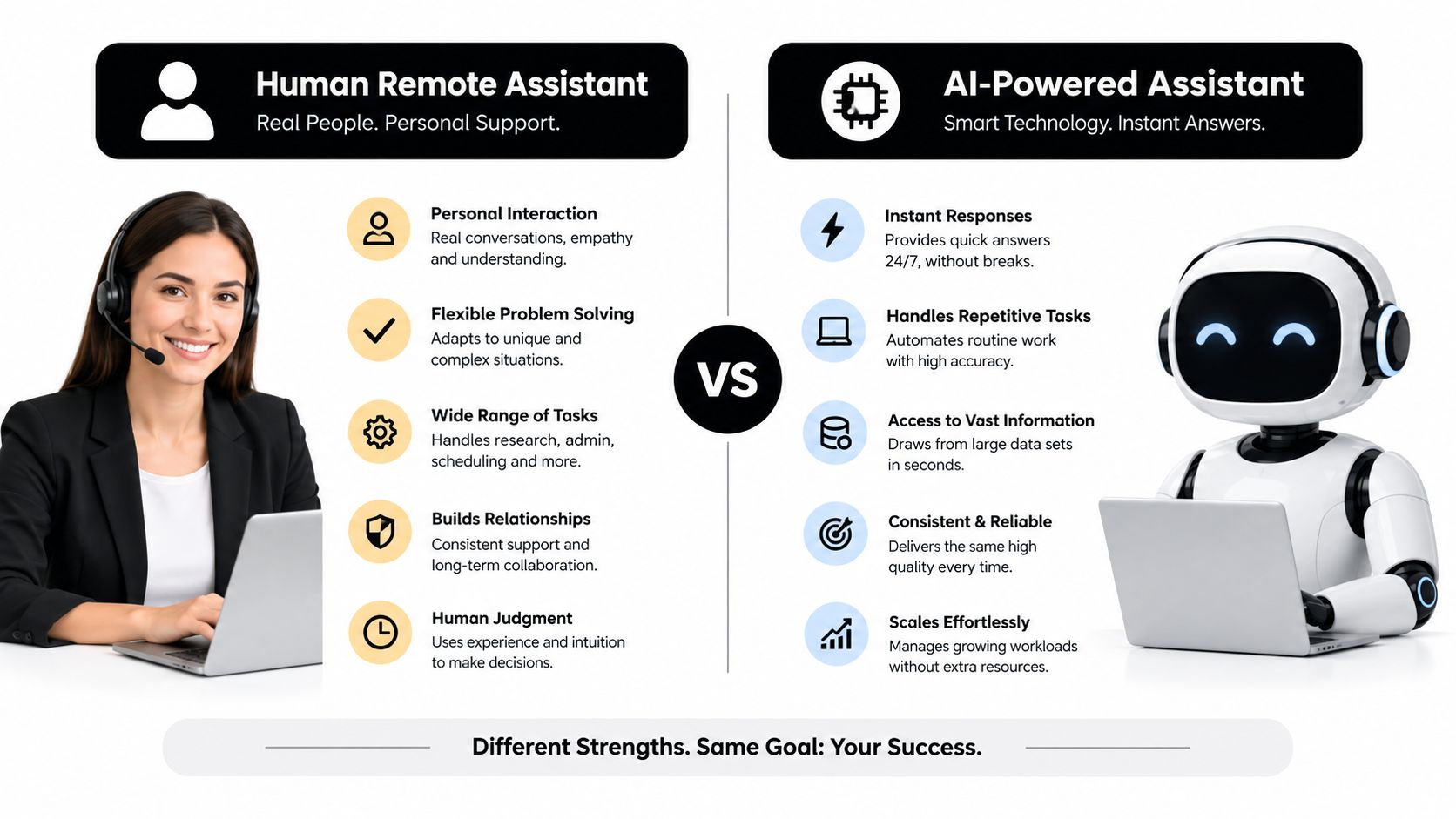
The strongest model is often hybrid. A human assistant manages the queue, checks whether the request is complete, and escalates unusual facts. The AI assistant retrieves authorities or compares clauses. A lawyer approves anything used for advice, representation, negotiation, or filing. This human and AI collaboration model works because each layer has a defined responsibility.
High-Value Tasks and Workflows to Hand Over First
Start with work that has a repeatable sequence and an observable result. Don't begin with the task that carries the highest legal consequence.
A commercial lease review illustrates the right division. The assistant can extract renewal terms, compare indemnity language against the firm's playbook, identify missing exhibits, and produce a redline summary. The partner still interprets the business risk, decides the negotiation position, and leads the client call.
Build the first queue
Document review and redaction: A human assistant can apply a defined redaction procedure, while an AI system can locate names, account details, and repeated terms. A lawyer or designated reviewer must inspect the complete document because missed context can expose confidential information.
Clause comparison: AI is useful for locating deviations from approved language. Counsel must decide whether a deviation is acceptable in the matter's jurisdiction and commercial context.
Due-diligence checklists: A human can chase missing documents and update status. AI can classify incoming files against the checklist. The reviewer must confirm that a document satisfies the requirement.
Calendaring and deadline support: A human assistant can maintain calendars under written procedures. Any deadline derived from a rule, order, or service event needs verification against the controlling authority and matter facts.
Matter intake triage: The system can collect structured facts and route requests. A lawyer must decide whether to accept the matter, identify conflicts, set terms, or give advice.
First-draft correspondence: AI can prepare a draft from approved facts and templates. Counsel must check tone, factual accuracy, privilege, legal position, and recipient.
Research retrieval: AI can retrieve source-linked authorities and summarize passages. A lawyer must read the authority, confirm jurisdiction and effective date, and determine whether it supports the proposition.
Task | Human Remote Assistant | AI-Powered Assistant | Required Lawyer Review |
|---|---|---|---|
Contract comparison | Apply playbook and organize deviations | Find and summarize differences | Confirm legal and commercial significance |
Intake | Collect facts and schedule follow-up | Classify request and route it | Decide acceptance, conflicts, and advice |
Research | Search, collect authorities, prepare memo structure | Retrieve sources and draft cited summary | Verify every authority and conclusion |
Calendaring | Maintain entries under procedure | Flag dates from structured records | Confirm deadlines and consequences |
Correspondence | Draft from approved templates | Generate initial draft | Approve content before sending |
Never delegate client-facing legal advice, final court filings, legal conclusions, or work that crosses an unauthorized-practice boundary. If the task requires choosing a legal position rather than preparing information for counsel, move it to the attorney-only category.
How LatHire Can Help
LatHire is an AI-powered hiring platform connecting US and Canadian companies with pre-vetted Latin American professionals across technology, marketing, sales, and operations. For a firm considering a human layer around its virtual legal assistant workflow, its value is in sourcing and operational support rather than replacing the firm's professional supervision.
The platform uses AI assessments, skills evaluations, and human-led background checks to curate a talent pool of more than 800,000 candidates, according to the company description provided for this service. It lets businesses import an existing job description or generate one with AI, match with candidates as fast as 24 hours, and obtain support for HR, international payroll, benefits, and legal compliance. LatHire states that its model can cut hiring costs by up to 80% and reduce time-to-hire by over 80%. Those are vendor claims, so ask for the assumptions and scope before using them in a budget.
Where the platform fits
LatHire is most useful when the bottleneck is finding and administering a remote human assistant, not when the firm needs autonomous legal analysis. A candidate may support intake, case management, document preparation, scheduling, or administrative coordination. The firm still owns task allocation, confidentiality safeguards, client communication standards, and lawyer review.
The platform offers specialist and generalist profiles, including AI engineers, DevOps professionals, UX/UI designers, customer support staff, recruiters, and administrative assistants. Profiles include validated skills, time-zone availability, and flexible engagement models. That can help a firm assemble a human-in-the-loop team around an AI workflow, especially when the managing partner doesn't want to manage international recruitment, payroll, and benefits separately.
If the immediate need is staffing rather than software, review the process for hire legal assistants and ask candidates to complete a real, non-confidential task. Confirm their confidentiality obligations, system experience, language capability, and willingness to follow a written delegation ladder. LatHire may be the right choice when speed, cross-border administration, and candidate screening are the constraint. It isn't a substitute for a vendor security review or a lawyer's supervision policy.
The Hallucination Problem and How to Engineer Around It
Retrieval helps, but it doesn't make legal AI reliable by itself. In a preregistered evaluation of AI legal-research systems, retrieval-augmented tools reduced hallucinations relative to GPT-4, but still produced misleading or false answers in approximately 17% to 33% of queries. The strongest tested system answered only 65% accurately, according to the evaluation of AI legal-research systems.
That result should change your vendor questions. A system can retrieve an authentic case and still select the wrong jurisdiction, misread an exception, ignore an effective date, or generate a conclusion the passage doesn't support. Retrieval is a foundation, not a legal approval mechanism.
Put these requirements in writing
Authoritative retrieval: Require jurisdiction-specific primary sources, not an untracked web index.
Version awareness: Preserve publication, amendment, and effective-date metadata.
Evidence exposure: Show the supporting passages and the source used for each material proposition.
Separate metrics: Measure citation precision, answer completeness, jurisdiction and date accuracy, abstention quality, and hallucination rate independently.
Escalation: Route low-confidence, citation-mismatched, or source-conflicted outputs to a qualified reviewer.
High-risk behavior: Return source-linked drafts and uncertainty indicators for deadlines, legal conclusions, filings, and client advice.
Your acceptance test should use realistic matters and deliberately difficult exceptions. Don't rely on user satisfaction. A confident answer that saves time but misstates the controlling rule is a failed result.
The same evidence chain that exposes a bad citation supports governance. A data-quality approach for generative AI reinforces the point: the firm needs to know not only what the model produced, but which inputs, records, and sources shaped the output.
Confidentiality, Audit Trails, and ABA Formal Opinion 512
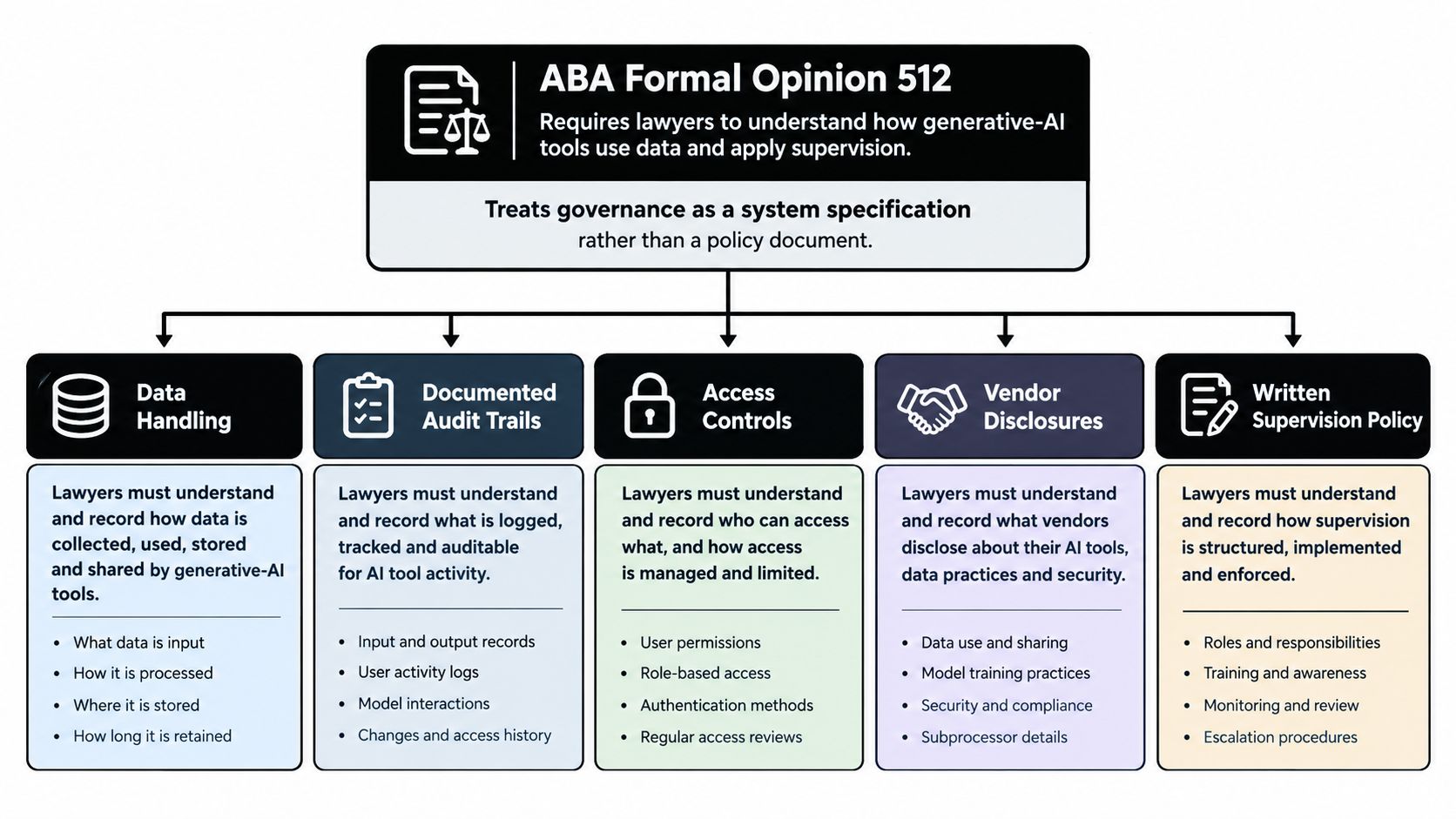
ABA Formal Opinion 512 makes the lawyer's responsibility concrete. Lawyers must understand how generative-AI tools use data and apply safeguards against unauthorized disclosure. Informed client consent may be required before confidential information is entered into such systems, as described in the ABA guidance on generative AI and ethics.
That obligation isn't satisfied by signing an NDA and moving on. The firm needs a technical and contractual chain of custody for prompts, retrieved documents, outputs, approvals, and deletion.
The control stack
Tenant isolation: Matter data must remain separated from other customers and unrelated internal work.
Encryption: Protect information in transit and at rest.
Least privilege: Give each user and service access only to the matters and systems needed for the task.
Retention controls: Define how prompts, retrieved documents, and outputs are retained, exported, and deleted.
Immutable logs: Record who accessed data, what the system retrieved, what it generated, and who approved the result.
Training restrictions: Contractually prohibit provider training on client content unless the firm has deliberately approved that use.
Cross-border restrictions: Identify where processing occurs and restrict transfers that conflict with client, regulatory, or jurisdictional requirements.
The FDA's data-integrity model offers a useful discipline for legal operations. Records should be attributable, legible, contemporaneously recorded, original or a true copy, and accurate, known as ALCOA. The FDA also defines an audit trail as a secure, computer-generated, time-stamped electronic record that reconstructs creation, modification, or deletion. Legal teams can apply that logic to matter activity even when the applicable rule isn't an FDA rule.
Sector-specific accountability
For healthcare and pharmaceutical work, the FDA expects monitoring, auditing, and inspection access for relevant application and study records. A quality check that produces only a pass or fail result isn't enough. The firm should preserve the rule, the input, the exception, the investigation, and the decision.
Financial institutions face a parallel operational-resilience expectation. From January 17, 2025, DORA applies to EU financial entities and designated critical ICT third-party providers, covering incident reporting, resilience testing, ICT third-party risk management, internal governance, and continuous ICT-risk monitoring, as summarized by Microsoft's DORA overview. A legal workflow supporting that environment needs observable availability, changes, access, and control evidence.
Ask for a data processing agreement that matches the actual deployment. It should cover roles, permitted processing, sub-processors, retention, deletion verification, security measures, incident response, and audit rights.

Pricing Models and How to Read the Quote
A quote is useful only when it shows the supervision burden. Firms usually encounter three models.
Pricing Model | Best Fit For | Hidden Cost to Watch | Predictability |
|---|---|---|---|
Hourly human support | Solo and smaller firms with variable queues | Onboarding, review time, backup coverage, and access administration | Moderate |
Per-seat AI subscription | Teams with repeatable usage and defined users | Usage tiers, integrations, retrieval setup, extra matters, and review labor | Moderate to high |
Outcome-based engagement | Narrow workflows with measurable deliverables | Definition of acceptance, exceptions, rework, and scope expansion | Low until terms are precise |
Hourly billing fits a firm that needs flexible human capacity. It also makes the cost of lawyer review visible, which is healthy. Per-seat pricing can look efficient until the firm adds a human reviewer, integration work, source curation, and jurisdiction-specific controls. You may end up paying for the AI seat and the review hour without recognizing that both are necessary.
Ask whether the vendor charges for alerts, scans, active matters, retrieval volume, additional modules, or support. A usage-stable model is preferable in regulated work because it doesn't create an incentive to silence alerts or avoid monitoring. Outcome-based pricing can work for a tightly defined document queue, but only if the contract specifies accuracy standards, exclusions, rework, and approval responsibility.
The budgeting rule
Solo practices should favor a narrow workflow with predictable human review. Mid-size teams can consider a combined human and AI model if the source set and approval path are stable. Large firms need enterprise controls, matter isolation, identity integration, audit exports, and a procurement review that includes professional responsibility.
Before signing, calculate the full cost of processing, supervision, source maintenance, security review, training, and exception handling. The cheapest license is rarely the cheapest controlled workflow.
A 30/60/90 Implementation Plan and Red Flags to Avoid
A disciplined rollout is more valuable than a broad feature list. Keep the first practice area narrow, define the reviewer, and preserve evidence from the first matter.
Days 1 to 30
Scope one workflow: Select document comparison, intake triage, or research retrieval. Define inputs, outputs, exclusions, and the approval owner.
Vet the provider: Confirm data location, retention, deletion, sub-processors, training restrictions, access controls, incident handling, and audit-log availability.
Write the supervision policy: Ground it in ABA Formal Opinion 512. State what the assistant may draft, what requires review, and what it must never do.
Map jurisdictions: Identify every country, state, or region involved in the workflow, including the client, lawyer, data, and recipient.
Days 31 to 60
Run a controlled pilot in one practice area. Measure hallucination rate, citation accuracy, jurisdiction and effective-date accuracy, completeness, abstention quality, and time saved per matter. Review difficult and failed examples, not only successful outputs.
The cross-border boundary requires particular care. A 2025 comparative survey examined unauthorized-practice and access-to-justice rules across 13 jurisdictions, including the United States, Canada, the United Kingdom, the European Union, India, Australia, Brazil, and Singapore. Its analysis found that legal advice, interpretation, representation, and some document work are commonly reserved for licensed lawyers, while some systems propose certification or explicit exemptions for bounded AI assistance to unrepresented litigants. Use the comparative survey of unauthorized-practice rules to build a task-and-jurisdiction matrix rather than assuming that an approved workflow travels across borders.
Days 61 to 90
Expand only after the pilot passes its acceptance criteria. Train lawyers and staff, publish client-facing language where appropriate, configure recurring audits, and review access when matters close or personnel change.
Pause the rollout if any of these conditions exists:
No reliable audit trail: You can't reconstruct access, retrieval, generation, approval, or deletion.
No jurisdiction control: The system can't constrain sources and workflows by applicable law.
Unclear data use: The vendor won't explain retention, sub-processors, or whether client content trains its models.
Unsupervised client output: The assistant communicates legal advice, conclusions, filings, or commitments without lawyer approval.
Unmeasured performance: The vendor offers confidence scores but no separate citation, completeness, date, jurisdiction, abstention, and hallucination measures.
Undefined ownership: Nobody is accountable for the task, the review, or the incident response.

Give operations a one-page handoff: approved tasks, prohibited tasks, source requirements, reviewer names, logging rules, client notice language, and escalation contacts. Start with one queue, prove the evidence chain, and expand only when the firm can defend both the output and the process.
If your firm is ready to evaluate data reliability before connecting AI to confidential workflows, review how digna supports in-environment validation, anomaly detection, timeliness monitoring, schema tracking, and audit-ready observability at digna.ai. Use the platform as part of a broader governance program, then make your first deployment narrow, supervised, and measurable.
If you are building the audit trail described above, our guide to data quality auditing shows how to run a repeatable audit of the records your legal workflows depend on.
Frequently asked questions
What is a virtual legal assistant?
A virtual legal assistant is a remote human or AI-powered system that handles retrieval, classification, summarizing, drafting and admin work for a law firm under supervision. It can flag issues and prepare first drafts, but it cannot replace legal judgment, take responsibility for advice or make jurisdiction-sensitive decisions.
Which tasks should a law firm hand to a virtual legal assistant first?
Start with a queue that has a clear input, a defined output and a named reviewer, such as contract clause comparison, intake triage, due-diligence checklists or research retrieval. Client-facing advice, final court filings and legal conclusions stay with counsel, because they fall into the attorney-only category.
How often do AI legal research tools hallucinate?
More often than most firms expect. In a preregistered evaluation, retrieval-augmented legal research tools still gave misleading or false answers in roughly 17% to 33% of queries, and the best system answered only 65% accurately. Retrieval reduces errors, but a lawyer still has to verify every authority.
What does ABA Formal Opinion 512 require from lawyers using AI?
It requires lawyers to understand how a generative AI tool uses their data and to apply safeguards against unauthorized disclosure. Informed client consent may be needed before confidential information enters such a system, so firms need contractual and technical controls over prompts, outputs, retention and deletion.
How should a firm roll out a virtual legal assistant?
Follow a 30/60/90 plan. In the first 30 days, scope one workflow, vet the provider and write a supervision policy. Days 31 to 60 run a controlled pilot that measures hallucination rate and citation accuracy. Expand after day 61 only if the pilot passes its acceptance criteria.