Data Quality Auditing How to Run a Reliable Audit
|
0
min read

You usually don't get asked for a data audit when things are calm.
It starts when a dashboard stops matching finance, a regulator asks how a number was produced, or a model starts behaving oddly after a source-system change nobody documented. At that point, teams discover they've been doing spot checks, not data quality auditing. They can say a table “looked fine last week,” but they can't show what criteria were used, what evidence was collected, who reviewed the result, or whether the same control would produce the same conclusion next month.
That gap matters more than many expect. A one-off query can catch a defect. An audit has to hold up when someone asks for proof.
Table of Contents
Why Data Quality Auditing Matters Before You Check a Single Record
What teams actually need from an audit
What a complete audit delivers
Scoping Your Audit and Inventorying What Actually Needs Checking
Start with fitness for use
Build the inventory from the output backward
Set boundaries before anyone tests anything
Document lineage while the system is still fresh in people's heads
Choosing the Right Checks and Deciding How to Test Them
Start with dimensions, then turn them into controls
Sampling, full scans, and continuous monitoring each have a place
Pilot the checks before treating them as evidence
Running the Audit and Capturing Evidence That Holds Up
Run as close to the data as possible
Treat lineage and traceability as evidence, not decoration
Capture near-misses and source changes too
Turning Findings Into Fixes With Clear Ownership and Tracking
The report needs to do more than summarize defects
Assign ownership by control point, not by blame
Track to closure with verification, not just status
Making Audits Repeatable and Ready for Continuous Monitoring
Keep the audit cycle small and evidence-rich
Watch the failure modes that audits repeatedly uncover
Scale by standardizing the control model
Why Data Quality Auditing Matters Before You Check a Single Record
The pressure moment is familiar. A stakeholder wants to know whether a report is trustworthy, and the instinct is to jump straight into row counts, null checks, and duplicates. That's useful, but it's not yet an audit. If you don't define the criteria first, the result is just technical activity without a defensible conclusion.
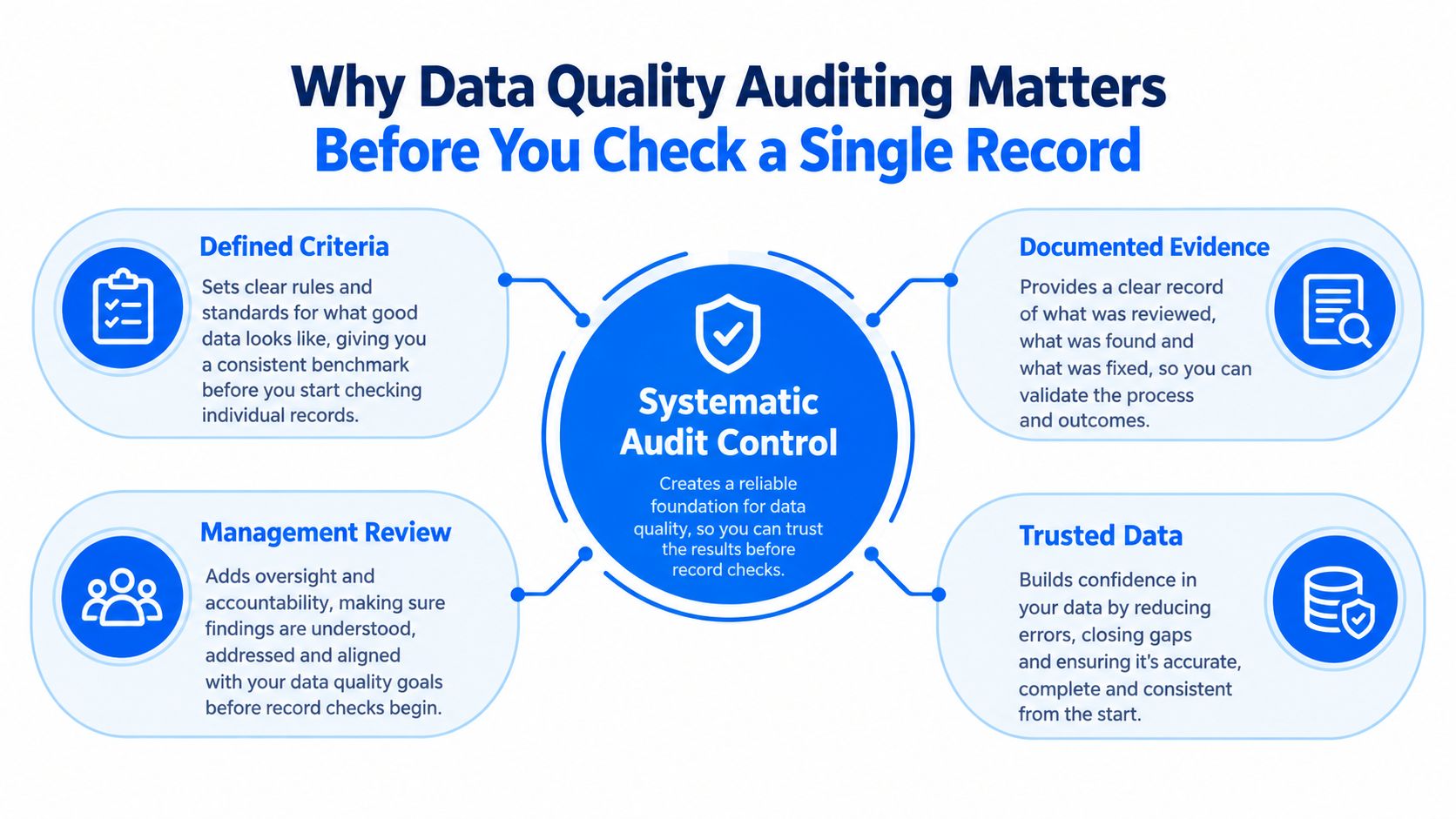
A durable standard exists for this. ISO defines an audit as a “systematic, independent and documented process” for obtaining evidence and evaluating it against criteria, which is the basis for repeatable data quality audits across industries and governments, as summarized in the UN and Eurostat handbook on data quality assessment methods and tools. That definition is more practical than it sounds. It tells you what a real audit must prove:
Systematic means the checks aren't improvised.
Independent means findings can survive review outside the delivery team.
Documented means someone else can inspect the evidence later and reach the same conclusion.
What teams actually need from an audit
In practice, the first win is shared language. Public-sector audit programs commonly structure findings around accuracy, completeness, consistency, timeliness, validity, and uniqueness. Those dimensions aren't academic. They stop the usual argument where engineering says “the pipeline succeeded” while finance says “the report is wrong” and compliance says “the data was late.”
A team that audits by dimension can separate distinct failure modes:
Accuracy asks whether the value reflects the thing.
Completeness asks whether expected records or fields are missing.
Timeliness asks whether the data arrived in time for the decision.
Consistency asks whether the same fact agrees across systems.
Validity asks whether values conform to rule and format.
Uniqueness asks whether one entity appears once when it should.
If your organization is still treating those as abstract quality labels, it helps to connect them to why data quality is important to an organization in the first place. Every executive question about trust eventually lands on one of those dimensions.
What a complete audit delivers
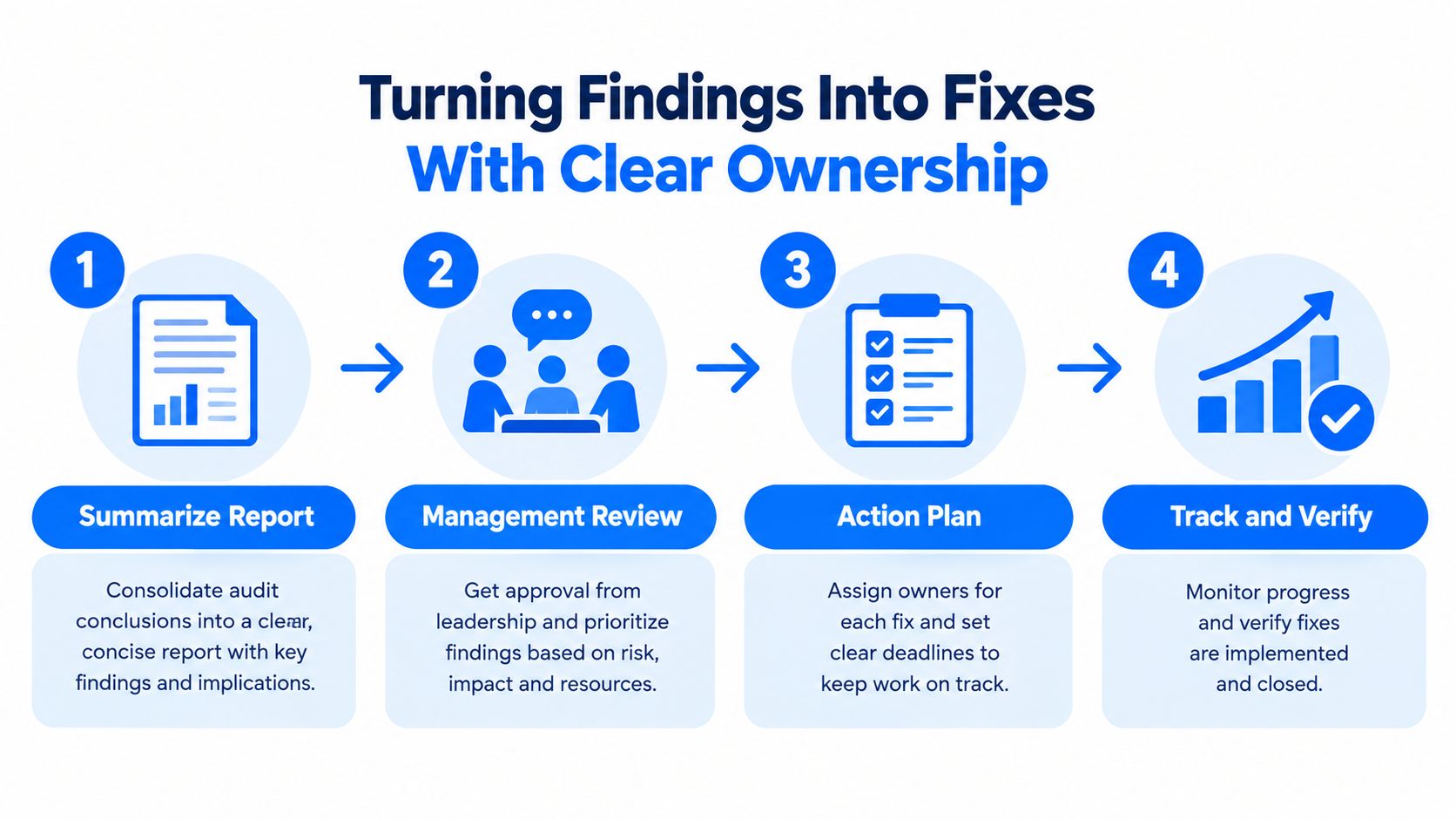
A complete audit doesn't end with “we found bad rows.” The same UN and Eurostat handbook emphasizes that audit conclusions should be summarized in a report, reviewed by management, and turned into an action plan. That's the control loop many teams skip.
Practical rule: If the output of the work is only a spreadsheet of issues, you ran an inspection. If the output is evidence, conclusions, review, and corrective action, you ran an audit.
That distinction is why data quality auditing matters before anyone checks a single record. The audit framework determines what evidence counts, what failure means, who signs off, and what happens next. Without that, even good technical checks won't produce trusted results.
Scoping Your Audit and Inventorying What Actually Needs Checking
A weak audit usually fails before testing starts. The scope is vague, the owners are fuzzy, and half the data in the report isn't even in the inventory. Teams then waste time validating columns that don't matter while missing the exact transformation that drives the decision everyone cares about.
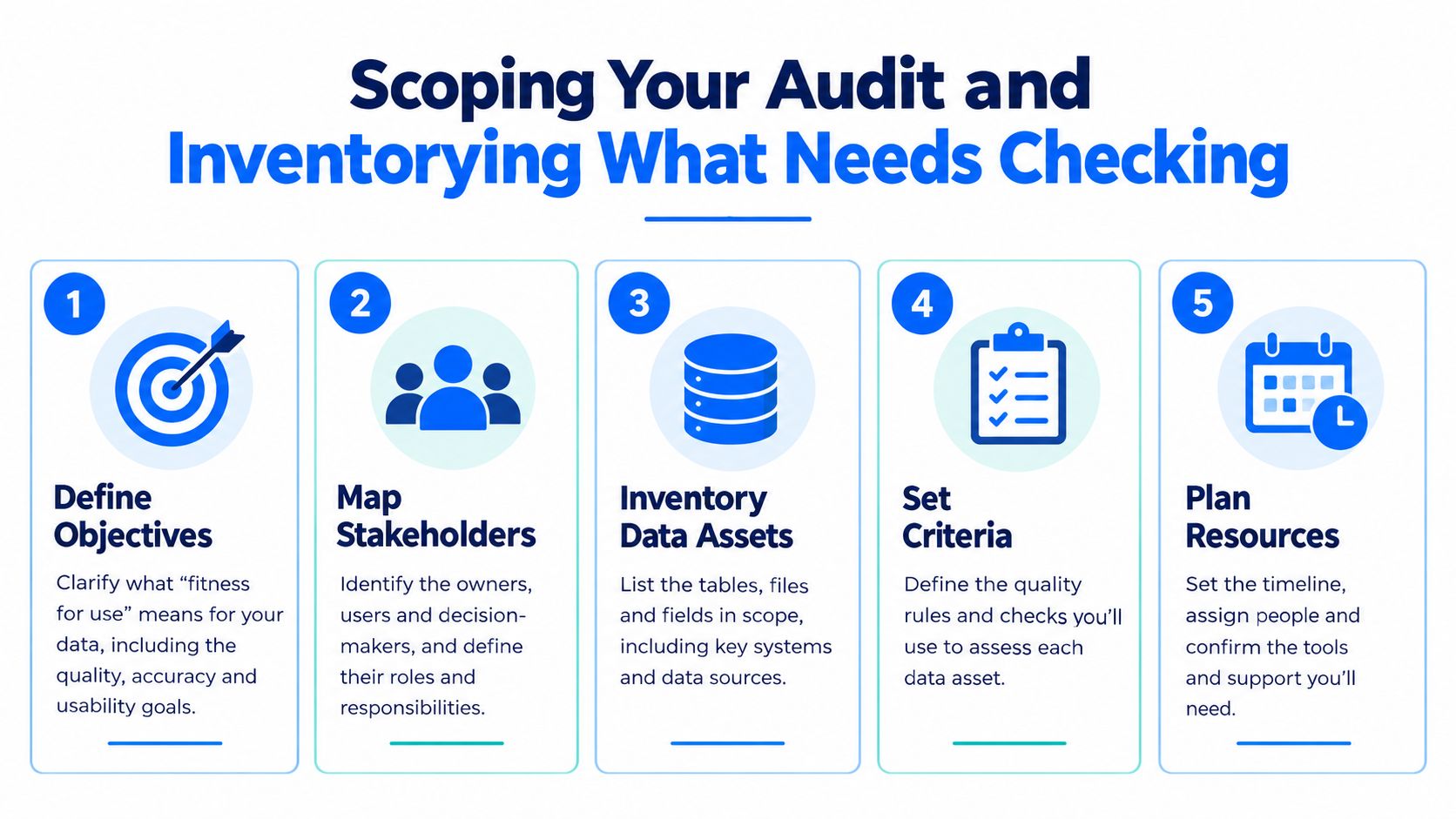
The first discipline is simple. Scope the audit around intended use, not around whichever tables are easiest to access.
Start with fitness for use
NIST's data quality work emphasizes that quality is contextual and should be evaluated against the intended use, not an abstract universal score, with quality defined in terms of fitness for use and tied to business requirements in the NIST-oriented discussion of data quality context and assessment. That means a dataset can pass one audit and fail another if the decision context changes.
A regulatory submission, for example, needs different completeness and traceability criteria than an internal performance dashboard. A model-training dataset may tolerate some lag but not mislabeled classes. A customer operations feed may need strict freshness even when some enrichment fields are optional.
Before listing assets, write down three things:
The business decision or obligation the data supports.
The specific output being trusted or challenged.
The consequence of failure if the data is late, wrong, incomplete, or structurally changed.
Build the inventory from the output backward
Don't start with the warehouse catalog and hope relevance appears. Start with the report, dashboard, model feature set, or submission artifact, then trace backward into source tables, joins, transformations, reference data, and delivery jobs.
A workable inventory includes more than table names:
Critical outputs such as reports, models, alerts, or external filings.
Upstream assets including source tables, staging layers, transformation logic, and business reference tables.
Operational dependencies such as schedules, delivery expectations, and downstream consumers.
Named owners for source data, transformation logic, and business acceptance.
For teams trying to formalize this, a defined list of critical data elements is usually the fastest way to stop scope creep. Not every dataset deserves the same audit depth. The ones that drive regulated reporting, customer decisions, financial posting, or production AI usually do.
Set boundaries before anyone tests anything
Most audit friction comes from boundary mistakes. A team says “customer revenue pipeline” is in scope, but nobody states whether that includes source-system extracts, enrichment logic, slowly changing dimensions, manual overrides, or exception handling.
Use explicit boundaries such as these:
Scope area | What to define |
|---|---|
Business boundary | Which decision, report, filing, or model is covered |
Data boundary | Which datasets, fields, and time periods are included |
Process boundary | Which transformations, schedules, and handoffs are included |
Ownership boundary | Who approves rules, who remediates, who signs off |
The audit scope should be narrow enough to execute and broad enough to explain the number at the end.
Document lineage while the system is still fresh in people's heads
Lineage documentation gets deferred because teams assume they can reconstruct it later. They usually can't. The person who knows why a fallback join exists leaves, or the emergency workaround from six months ago becomes invisible normal behavior.
When inventorying assets, capture:
where each critical field originates
which transformation creates or modifies it
whether a manual adjustment exists
what schedule or event delivers it
who is expected to notice if it stops arriving
That level of inventory feels heavy only until the first review meeting. Then it becomes the difference between a short investigation and a week of guesswork.
Choosing the Right Checks and Deciding How to Test Them
Once the scope is real, the next mistake is choosing checks by habit. Teams often default to null percentages, duplicate counts, and a few regex rules because those are easy to script. That's fine for basic hygiene. It's not enough for a defensible audit.
You need checks that match the audit goal, and you need a test approach that matches the data's risk, volume, and rate of change.
Start with dimensions, then turn them into controls
The DAMA data-quality framework commonly used in enterprise governance identifies six core dimensions: accuracy, completeness, consistency, timeliness, uniqueness, and validity, and the same material defines timeliness operationally as whether data is fresh enough to use, with example checks framed as measurable thresholds such as time since last update being under a chosen limit, for example less than one hour since ingest, as described in this overview of data quality dimensions and operational checks.
That matters because it turns fuzzy expectations into testable controls. “Data should be current” isn't auditable. “This table must update within the agreed freshness threshold for the report run” is.
Here's a compact way to choose.
Audit Goal | Recommended Checks | Testing Approach |
|---|---|---|
Regulatory or management reporting | Completeness, accuracy, timeliness, reconciliation checks | Full scans for key fields and records, plus scheduled timeliness monitoring |
Customer or entity master data | Uniqueness, validity, cross-system consistency | Full duplicate detection for core identifiers, targeted rule checks on critical attributes |
Fast-moving operational dashboards | Timeliness, schema stability, record-volume anomalies | Continuous monitoring with threshold and drift checks |
Model features or AI input datasets | Validity, completeness, label or attribute consistency | Continuous checks on critical fields, periodic deeper review on representative slices |
Newly onboarded source systems | Format validity, null patterns, referential consistency | Pilot tests first, then wider execution after patterns stabilize |
Sampling, full scans, and continuous monitoring each have a place
Sampling still works when data volumes are large and the process is stable, but it breaks down when schemas change often or when a rare defect has high impact. Full scans are stronger for deterministic rules on critical data, especially inside modern warehouses where in-database execution is practical. Continuous monitoring is the right choice when late loads, structural drift, or operational changes can break trust between formal audit cycles.
Independent audit frameworks also support this idea that method choice matters. The latest literature summarized in the FAO framework describes four high-level approaches and 15 distinct methods, which is a useful reminder that mature auditing is method-selection work, not one fixed checklist, as outlined in the FAO material on data quality assessment methods.
A few trade-offs show up repeatedly:
Sampling is lighter when records are expensive to inspect manually, but it won't catch every edge case.
Full scans are stronger for completeness, validity, uniqueness, and deterministic business rules.
Continuous controls are necessary when freshness and schema changes can invalidate downstream outputs between scheduled reviews.
Pilot the checks before treating them as evidence
One of the most common failures in audits is bad test design. Clinical audit guidance flags incomplete or inaccurate records as a recurring pitfall and recommends pilot testing before collection, cleaning data as they arrive, identifying bias patterns such as systematically excluded records, and revising forms or protocols when errors repeat, as summarized in the same FAO audit framework reference.
That's good engineering advice too. Pilot your checks on a smaller but representative slice before running them at scale. You'll catch bad assumptions fast:
a validity rule that fails legacy but accepted values
a duplicate rule that confuses history tables with active-state tables
a timeliness rule that ignores known business calendars
a completeness test that mistakes intentionally sparse fields for defects
For practical examples of rule design and always-on enforcement, this guide to data validation rules, checks, and continuous data quality is useful because it stays close to implementation rather than theory.
A check isn't good because it runs. It's good because a reviewer can see why it exists, what failure means, and whether the threshold matches the business use.
Running the Audit and Capturing Evidence That Holds Up
Execution is where many audits become fragile. The checks run, findings appear, and then nobody can answer basic review questions: Which version of the rule ran? Against what dataset state? Was the source late? Did the schema change before the failure? Was this an isolated defect or the result of a known upstream change?
That's why evidence design matters as much as test design.
Run as close to the data as possible
For most warehouse and lake environments, the cleanest pattern is to execute checks in-database. It reduces movement, preserves security boundaries, and avoids the side problem of creating yet another copy of sensitive data for audit work.
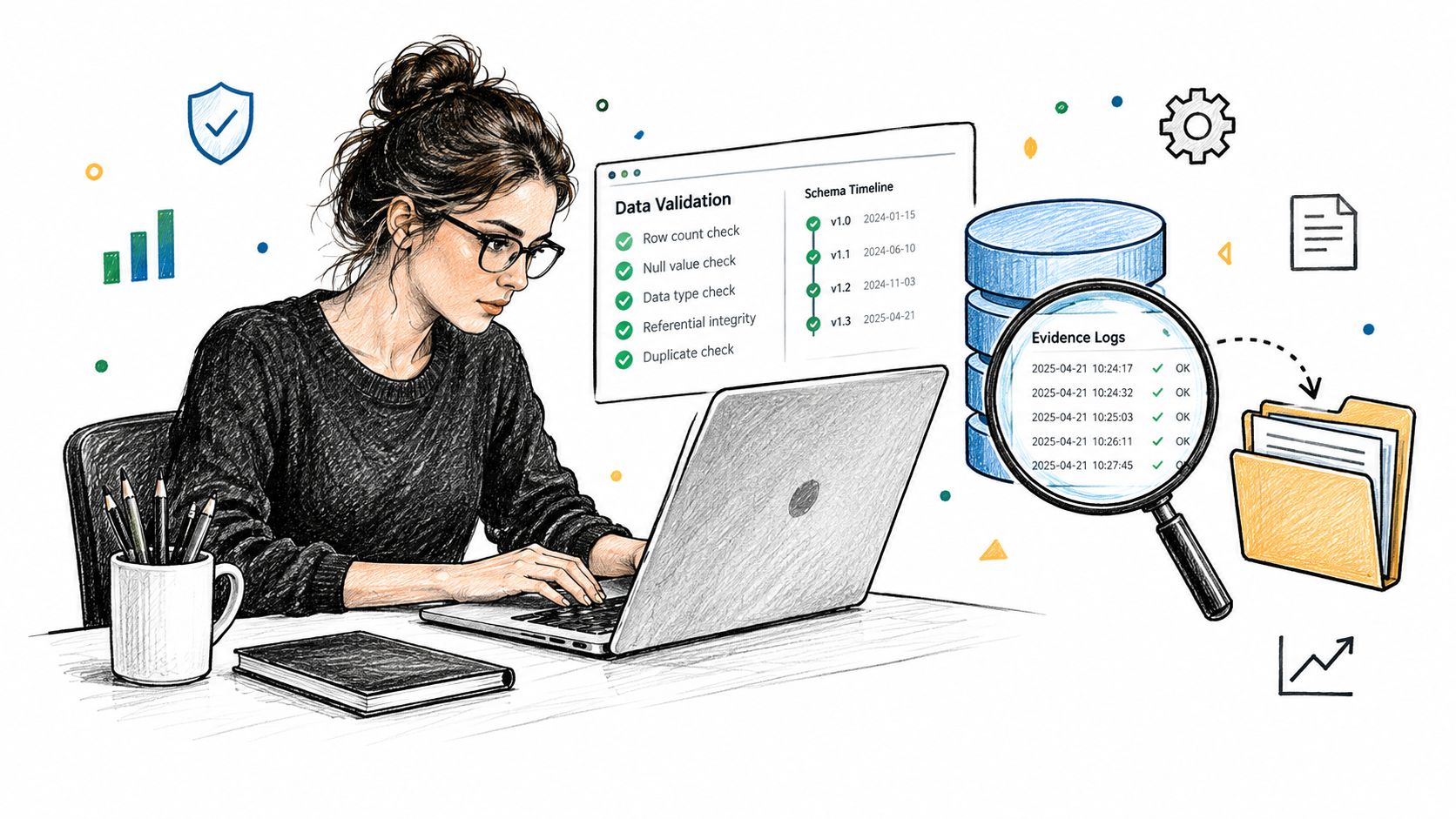
During execution, capture more than pass or fail:
Dataset context such as environment, schema, table, and partition or time window
Rule context including logic version, threshold, and approval status
Execution context such as run time, source delivery state, and any dependency warnings
Result context including affected counts, examples, and severity classification
If you're using a platform approach, one mention is warranted: digna runs inside the customer environment, executes monitoring and validation in-database, and surfaces incidents, trends, timeliness issues, and schema changes in a shared interface. That deployment model fits audits well because evidence stays close to the systems being reviewed rather than being rebuilt externally.
Treat lineage and traceability as evidence, not decoration
Enterprise data-quality practice literature treats traceability and lineage as core audit mechanics rather than optional metadata. DAMA-derived dimension lists include traceability among commonly cited quality dimensions, and governance sources describe lineage as essential for understanding how data is transformed, where it originates, and how it flows across systems, as discussed in this paper on selecting the right dimensions of data quality.
Without lineage, a failed field-level check tells you there's smoke. It doesn't tell you where the fire started.
A solid evidence record should let a reviewer answer these questions quickly:
Review question | Evidence needed |
|---|---|
Where did this field come from | Source table, source field, ingestion path |
What changed before the issue appeared | Schema history, deployment log, source-process notice |
How did the field get transformed | Transformation logic, job or model reference |
Who owns the fix | Source owner, pipeline owner, business approver |
For teams that need a practical discipline around evidence quality, Rivul AI's piece on how to audit unsupported claims before submission is worth reading. It's about claims rather than pipelines, but the core habit is identical: tie every conclusion back to verifiable support before anyone signs off.
Capture near-misses and source changes too
A lot of damaging incidents start as near-misses. A source delivers late but still lands before the report deadline. A nullable field suddenly becomes sparsely populated. A lookup table changes semantics without breaking schema. If you only record hard failures, you miss the pattern that would have made the next failure predictable.
The strongest evidence sets therefore include:
hard failures
warnings and near-misses
source-process change notices
schema modifications
freshness breaches
remediation status linked back to the original finding
For implementation patterns around rule-based checks and audit trails, a dedicated data integrity checker can help anchor the evidence to actual datasets and execution history rather than analyst notes scattered across tickets and chats.
Turning Findings Into Fixes With Clear Ownership and Tracking
A finished audit with no ownership model is just well-organized frustration. Teams often do the hard part, identify real defects, prove the impact, and even suggest fixes. Then the findings stall because ownership is split across source-system teams, data engineering, analytics, and business operations.
That control gap is common. 44% of respondents said data quality ownership is shared across multiple teams, 61% still rely on manual checks or SQL-based validation, and only 14% enforce SLAs organization-wide, according to Thomson Reuters' discussion of the data validation gap in audit data trust. Shared ownership isn't bad, but unassigned sign-off is.
The report needs to do more than summarize defects
The UN and Eurostat audit handbook makes an important operational point: audit conclusions should be summarized in a report, reviewed by management, and converted into an action plan. That sequence matters because it turns findings into controlled change rather than informal cleanup.
A usable findings report should answer:
what failed
why it matters to the decision or obligation
whether the issue is intrinsic data quality or system behavior
what temporary mitigation exists
who owns permanent remediation
how closure will be verified
Assign ownership by control point, not by blame
The fastest way to lose momentum is to ask, “Whose fault is this?” Better question: “Which control point can prevent recurrence?”
Use the failure type to assign action:
Source capture issue. The owner is usually the upstream process or form owner.
Transformation defect. The pipeline or analytics engineering owner takes the fix.
Definition mismatch. Business governance or metric ownership has to resolve it.
Delivery or freshness failure. The platform or job owner handles the operational control.
Repeat manual override. The control itself needs redesign, not another exception note.
Operational advice: Every finding needs one remediation owner and one sign-off owner. They can be different people. They shouldn't be a committee.
If repeated errors keep appearing in the same form, extract, or protocol, revise the form or process. Don't just clean the output again. That's one of the clearest patterns in clinical and operational audits alike.
Track to closure with verification, not just status
A ticket that says “done” isn't audit closure. Closure means the defect was fixed, the control was updated if needed, and the check now passes under the same criteria that produced the original finding.
Role clarity pays off. A documented framework for data quality roles and responsibilities helps teams separate stewards, engineers, domain owners, and approvers so findings don't disappear into shared inboxes.
The most reliable tracking model is simple:
Tracking element | What it should show |
|---|---|
Finding ID | Stable reference back to the evidence |
Assigned owner | Named person accountable for remediation |
Sign-off owner | Named reviewer who accepts closure |
Due date or SLA | Expected remediation timing |
Verification method | Which re-test or evidence confirms closure |
That's how findings become fixes instead of folklore.
Making Audits Repeatable and Ready for Continuous Monitoring
The test of data quality auditing isn't whether you can run one strong review under pressure. It's whether the same controls still work six months later when the schema has shifted, a source-system team changed field behavior, and no one remembered to update the documentation.
Repeatability comes from turning audit logic into operating rhythm.
Keep the audit cycle small and evidence-rich
A practical pattern is to keep formal audit scope focused and run lighter controls continuously around it. Periodic deep review still matters, especially for regulated outputs and high-impact datasets. But the day-to-day reliability work should watch for the kinds of change that break trust between review cycles: late arrivals, missing records, structural drift, and repeated near-misses.
Many teams overbuild. They design giant quarterly exercises that produce polished decks and little operational learning. Smaller, evidence-rich cycles hold up better because teams can maintain them.
Watch the failure modes that audits repeatedly uncover
Traditional audit methods also strain under modern volume and change rates. Recent summaries note that manual sampling and spreadsheet methods struggle to verify large audit data volumes, and adoption of dedicated observability and SLA enforcement is still early, as described in this overview of data quality audit gaps and continuous monitoring challenges. That lines up with what shows up in practice: the controls don't fail because the idea was wrong, they fail because the method doesn't keep pace.
A repeatable monitoring rhythm usually includes:
Freshness controls for critical deliveries and downstream dependencies
Schema monitoring so structural changes are visible before consumers fail
Rule execution history to show whether quality is improving or degrading
Exception review so warnings and near-misses aren't ignored
Scheduled revalidation after upstream process changes
Good audits get lighter over time because teams reuse criteria, evidence patterns, and ownership paths. Bad audits get heavier because every cycle starts from scratch.
Scale by standardizing the control model
You don't need every domain to use identical rules. You do need every domain to use the same control model: explicit criteria, documented evidence, named ownership, managed exceptions, and verification after remediation.
That standardization is what lets one organization audit finance feeds, clinical records, telecom operations data, or public reporting datasets without reinventing the method each time. The checks differ. The control system doesn't.
A repeatable audit program is the point where quality work stops being reactive cleanup and starts acting like infrastructure.
If you need that control system to work inside your own environment, digna offers in-database validation, timeliness monitoring, schema tracking, anomaly detection, and audit-ready evidence across warehouses, lakes, and pipelines. It's built for teams that need repeatable data quality auditing without moving production data out of their stack. Visit digna to see how the platform supports continuous, defensible audit controls.