Data Processing Agreement: Clauses & Negotiation
|
7
min read

A vendor finally clears security review. Procurement is ready. Engineering wants the integration live this week. Then a data processing agreement lands in your inbox and everything stops.
It's long, dense, and full of clauses that look interchangeable until you read closely. One version gives the vendor broad sub-processor rights. Another limits breach support to vague “commercially reasonable efforts.” A third looks polished but misses terms that matter if your team ever has to investigate a security incident or answer a regulator. That's why treating a DPA as paperwork is a mistake.
The stakes are real. As of March 2025, EU data protection authorities have issued fines totaling approximately 5.6 billion euros under the GDPR, and organizations lacking a valid DPA are exposed to penalties of up to 10 million euros or 2% of global annual turnover under Article 83(4), as summarized in this GDPR DPA overview. For data teams, that legal rule translates into something simple. If another company handles personal data on your behalf, the contract governing that relationship has to be structurally sound.
That matters far beyond legal. A strong DPA forces clarity on who can access data, how incidents get escalated, what happens when the contract ends, and whether your team can verify any of it. It also matters when you review vendor privacy terms like a published privacy policy from digna, because public commitments and contractual commitments need to line up.
Table of Contents
Introduction The DPA in Your Inbox
The usual pattern is familiar. A business owner says the vendor is low risk because it's “just software.” Security asks whether the vendor stores customer data. Legal asks for the DPA. Nobody agrees on what the actual risk is, so the deal stalls.
A good DPA review starts by rejecting two bad instincts. The first is signing the vendor paper as-is because the project feels urgent. The second is redlining every clause without understanding which points are legally mandatory, which are market practice, and which depend on architecture.
Why this document matters operationally
A DPA decides how your team will work together when things go wrong, not just when everything works. If a processor uses a new sub-processor, suffers an incident, or keeps data longer than expected, the DPA is the document that determines whether you have influence or excuses.
That's why mature teams treat the DPA as part of vendor governance, not just contract cleanup. Data engineering, security, privacy, procurement, and platform owners all need to read it through their own lens.
Practical rule: If your team can't explain in plain language what the vendor may do with your data, the DPA isn't ready to sign.
What smart teams look for first
Before anyone edits wording, confirm three basics:
Role clarity: Is the vendor acting as a processor, or is it operating under a different legal role?
Data flow realism: Does the contract describe what the product really does, including access paths, hosting model, and support model?
Enforceable detail: Are the obligations specific enough to test later through evidence, logs, reports, or audit materials?
That last point gets missed often. Contracts fail in practice when they rely on broad promises with no verification path.
What Is a Data Processing Agreement
A data processing agreement is the binding contract that sets the rules when one organization processes personal data on behalf of another. The controller decides why and how personal data should be processed. The processor carries out that work under the controller's instructions.
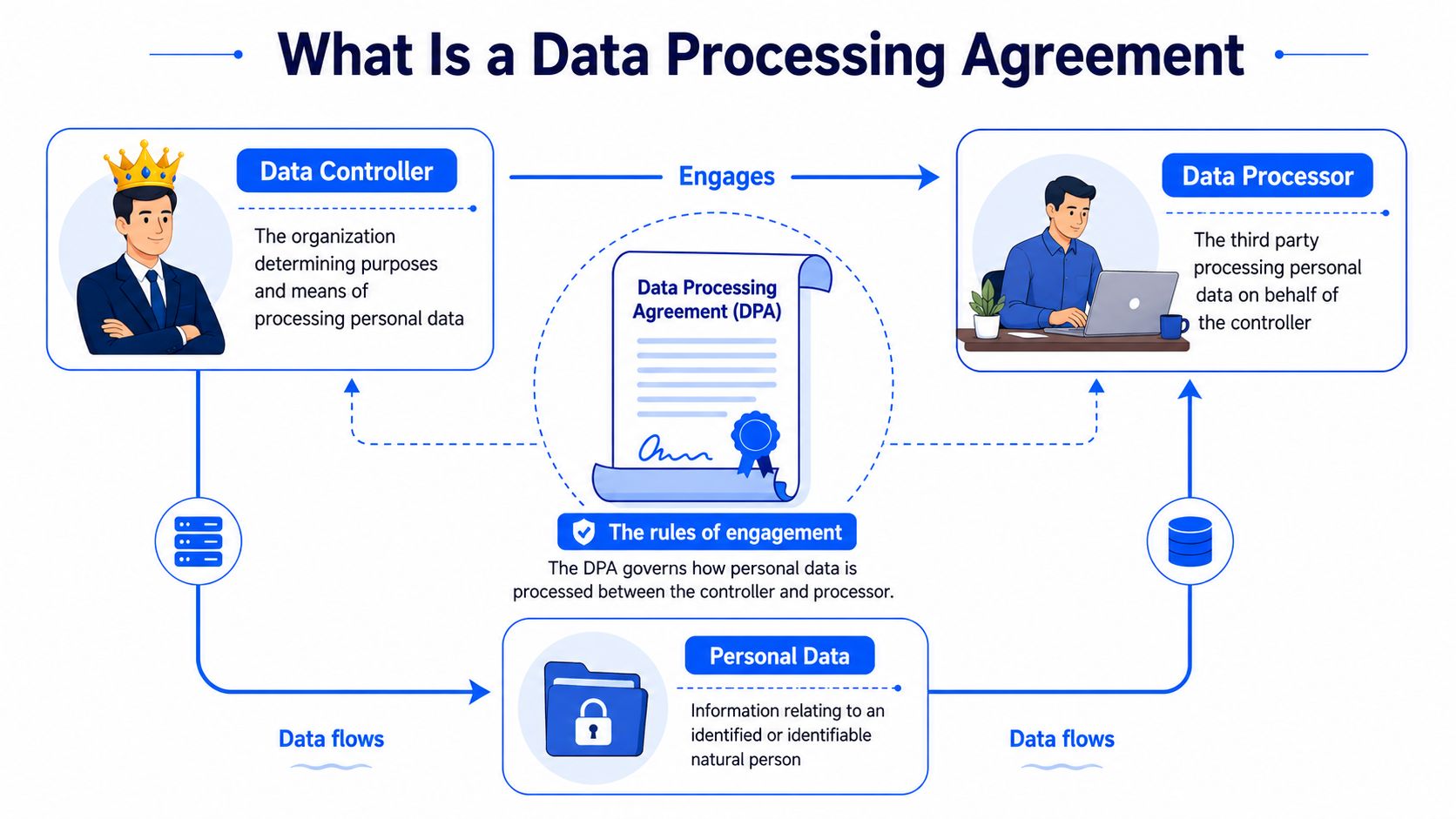
Think of it as the operating manual for delegated data handling
The simplest way to explain a DPA is this. You're handing another company limited authority to handle data that you still remain responsible for. The DPA defines the boundaries of that authority.
If the vendor hosts a CRM, payroll platform, support tool, analytics service, or cloud data environment that touches personal data on your behalf, the DPA tells them what they can do, what they must protect, who else they can involve, and how they must help if a data subject or regulator comes knocking.
The controller and processor split
This distinction sounds legalistic, but it has practical consequences.
Role | What they decide | Main practical responsibility |
|---|---|---|
Controller | Purpose and means of processing | Chooses the vendor, sets instructions, checks compliance |
Processor | How it operationally performs the service within those instructions | Protects data, follows the contract, supports the controller |
A controller can't outsource accountability just because a vendor is reputable. A processor can't accept vague instructions and assume that's someone else's problem. Both parties need a DPA that reflects the actual service.
What counts as processing in real life
Processing isn't limited to obvious storage or analytics. It can include access during support, backup handling, alerting, transformation, enrichment, monitoring, and deletion workflows. The practical question is whether the vendor handles personal data on your behalf in any of those motions.
That's why engineers should be in the room. Legal teams often review the words. Engineers know whether the product copies rows, runs inside your environment, or only sees metadata. Those differences matter.
A DPA is the difference between “we assumed the vendor handled this” and “the contract says exactly who must do what.”
When teams skip that technical grounding, they sign contracts that describe a very different system from the one that's deployed.
The Eight Mandatory DPA Clauses Under GDPR
Under GDPR Article 28(3), a DPA is legally mandatory and must explicitly include eight specific provisions, including documented instructions, confidentiality, security measures, sub-processor rules, assistance with data subject rights, breach support, data deletion or return, and rights to audit, as outlined in this Article 28 DPA requirements summary.

The legal minimum that can't be hand-waved away
If one of these elements is missing, the DPA isn't just weak. It can be non-compliant. That's the baseline issue before you even get to negotiation preferences.
Here's what each clause really means in practice.
Documented instructions only
The processor can't decide on its own to repurpose your data. If it wants to use customer data for model training, internal analytics, or product improvement, that has to be expressly authorized or excluded.Confidentiality obligations
Anyone with access to the data must be bound by confidentiality. In practice, you want this to cover employees, contractors, and support personnel, not just a generic company promise.Security measures under Article 32
The DPA should tie security commitments to real controls. That includes access control, encryption, monitoring, and incident handling. If your team works across regions, it also helps to align this with your data residency requirements.Sub-processor authorization
Vendors rarely operate alone. Cloud hosting, support platforms, and infrastructure providers can all sit downstream. The DPA needs a rule for prior written authorization, notification, and flow-down obligations.
The clauses that shape day-two operations
The remaining clauses become critical once the product is live.
Assistance with data subject rights: If someone asks for access, correction, deletion, or restriction, the processor has to help the controller respond.
Breach and DPIA support: The processor must assist with breach response and, where relevant, data protection impact assessment work.
Deletion or return at termination: A contract without clear exit mechanics often becomes a retention problem later.
Audit and information rights: You need some path to verify compliance, whether through documents, reports, or deeper review.
If a processor says “trust our security team” but resists giving evidence, the DPA is carrying more confidence than proof.
What good drafting looks like
The strongest DPAs don't just repeat the law. They operationalize it. They say who receives incident notifications, how sub-processor changes are communicated, and what happens to backups at termination.
They also fit the context. A healthcare analytics vendor, a Web3 infrastructure provider, and an HR platform won't all need the same annexes or review path. That's why teams operating in adjacent high-regulation environments often borrow ideas from sector-specific materials such as this guía de cumplimiento para empresas Web3, then tailor the contract language to their own processing reality instead of relying on a generic SaaS template.
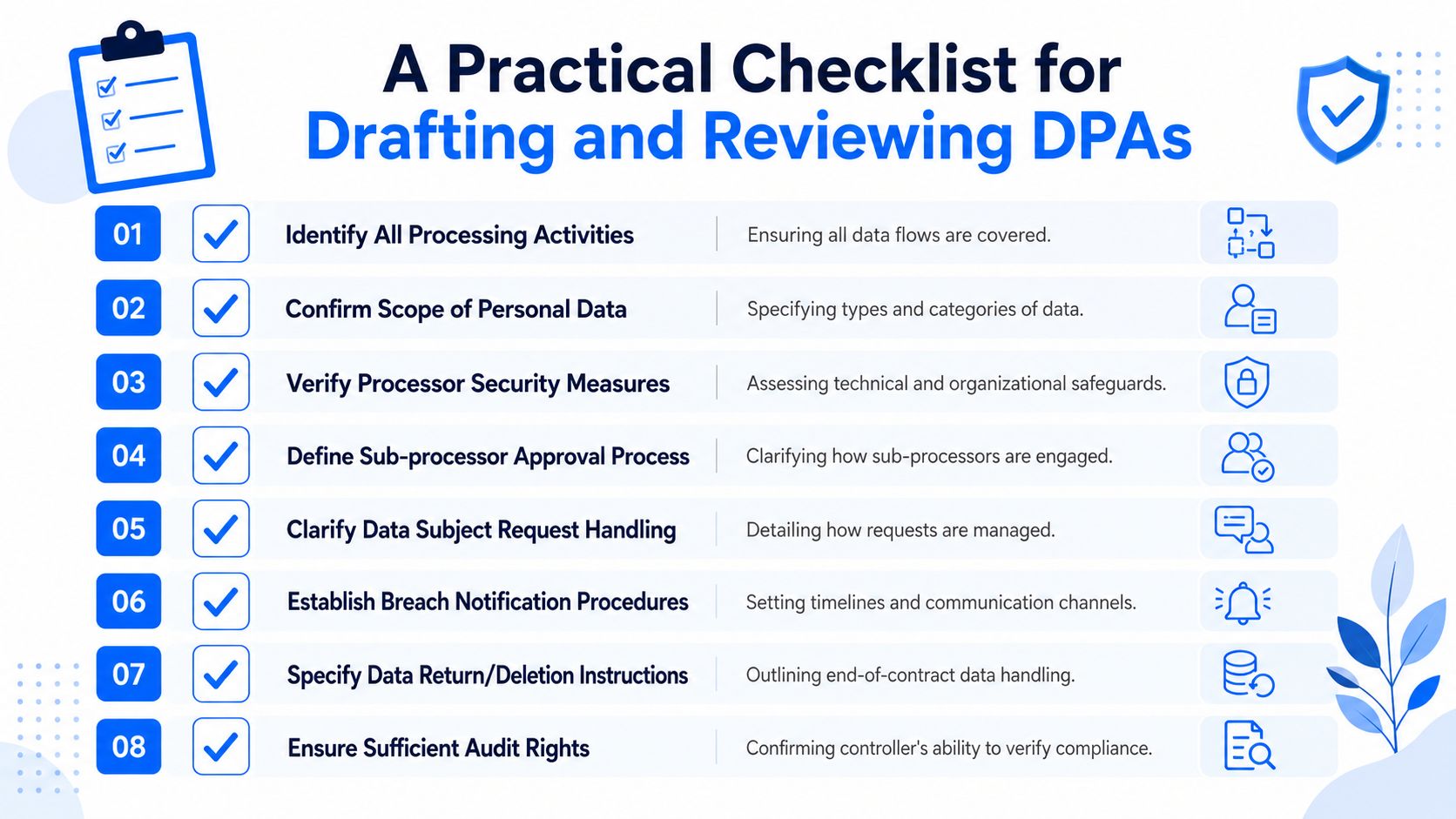
A Practical Checklist for Drafting and Reviewing DPAs
Most DPA problems aren't caused by missing buzzwords. They come from vague scope, loose security wording, and terms that nobody can execute once the agreement is signed.
Start with the processing reality, not the template
Before you review clauses, map the service:
What data is involved: Identify whether the vendor handles customer records, employee data, log data, support tickets, or only technical metadata.
Where the data moves: Confirm whether data is copied, cached, exported, remotely accessed, or kept entirely in your environment.
Who touches it: Include internal teams, subprocessors, support access paths, and admin tooling.
That exercise prevents a common failure mode. Teams negotiate redlines on a document that doesn't describe the product correctly in the first place.
The review checklist I'd use in practice
Use this as an operational review, not just a legal pass.
Processing description is specific: The DPA should identify the nature and purpose of processing with enough detail that a security reviewer can validate it.
Personal data scope is bounded: Data categories and data subject categories shouldn't be so broad that they authorize more than the service requires.
Security language is testable: Look for references to concrete controls, documented procedures, and available evidence.
Sub-processor process is usable: Notice periods, objection paths, and downstream obligations should be clear enough to administer.
Data subject request support is assigned: Someone must own intake, escalation, and response support.
Breach handling is operationally credible: Notice triggers, communication channels, and minimum content should be workable under pressure.
Exit terms are explicit: Data return, deletion, residual copies, and backup handling shouldn't be left to informal follow-up.
Audit rights are balanced: You need verification rights, but they should fit the service model and risk level.
Where teams should push beyond the bare minimum
The law gives you a floor. Risk management often requires more.
A mature review asks whether liability treatment matches the sensitivity of the data, whether security annexes are current, and whether cross-functional owners know their obligations. In HR-heavy environments, for example, many of the same review questions appear in broader operational resources like this ultimate data protection guide for HR leaders, even though the contract language still needs to be adapted to the vendor relationship.
Working test: If your security lead, privacy counsel, and platform owner would interpret a clause three different ways, rewrite it before signature.
Negotiating Your DPA The Audit and Security Showdown
Most DPA negotiations don't break on the existence of audit rights. They break on what an audit means in practice.
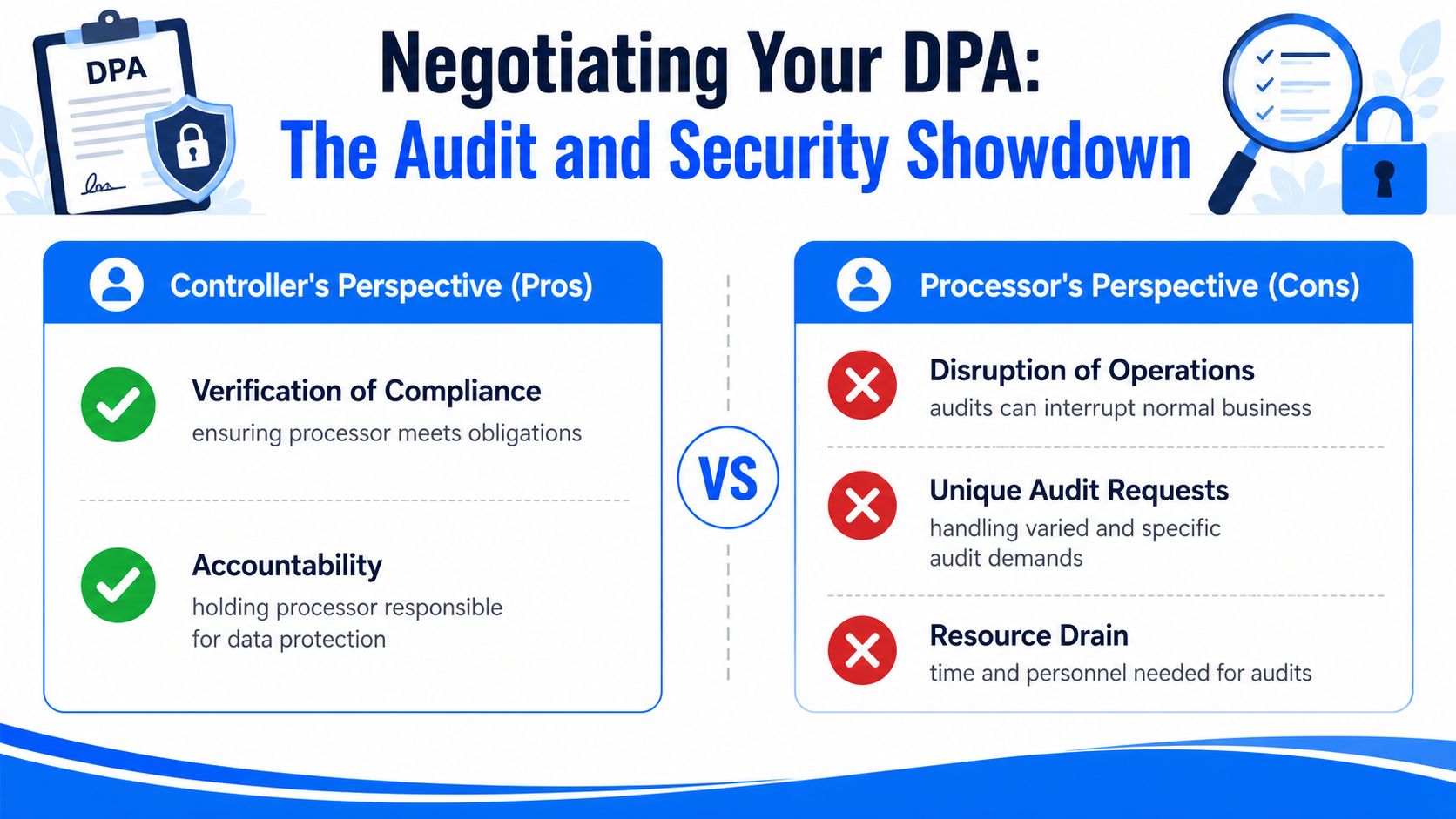
Controllers want direct verification. Processors want a scalable review model that doesn't let every customer run a bespoke assessment into live operations. Both positions are understandable. The problem starts when each side treats its preference as the only compliant answer.
Why the audit clause causes so much friction
Approximately 80% of DPA negotiations stall on the audit clause, and a practical compromise is for processors to provide certifications like SOC 2 or ISO upfront while reserving onsite audits only for documented insufficiency, according to this analysis of common DPA pain points.
That compromise works because it separates routine assurance from exceptional escalation. A controller gets meaningful evidence quickly. A processor avoids constant operational disruption.
A workable negotiation model
I've found this structure gets deals unstuck without gutting controller rights:
Issue | Controller concern | Processor concern | Practical compromise |
|---|---|---|---|
Routine assurance | Need proof of compliance | Too many custom audits | Share certifications, summaries, and security documentation first |
Deeper inspection | Need recourse if evidence is weak | Onsite reviews are disruptive | Permit targeted audits for documented insufficiency or incidents |
Scope and timing | Need timely access | Open-ended requests drain teams | Define notice periods, frequency, scope, and confidentiality |
This approach also aligns better with how modern security programs operate. Many risks can be validated through controls evidence, access governance, testing artifacts, and logging materials rather than repeated physical visits. Teams that build strong database monitoring and auditing techniques usually have a much better foundation for these discussions because they can show traceability instead of relying on assurances.
Security annexes matter as much as audit rights
The audit clause gets attention, but the security annex often deserves the harder review. A credible annex should address encryption at rest and in transit, regular security testing such as penetration testing and vulnerability scans, documented breach response procedures, sub-processor flow-down obligations, authorization chains for transfers including SCCs, and audit trails for data access and processing activities, as described in this practical overview of DPA security specifications.
That's where outside technical review can help. If a vendor claims strong safeguards in a regulated environment, independent services such as Affordable Pentesting HIPAA services can help teams pressure-test whether the controls described in contracts are reflected in actual security practice.
Don't negotiate for a dramatic audit clause and then accept a thin security annex. The annex is where most of the real risk lives.
DPAs for In-Database Platforms Like digna
A lot of teams still assume every data tool needs the same DPA structure. That assumption doesn't hold once you look at architecture.
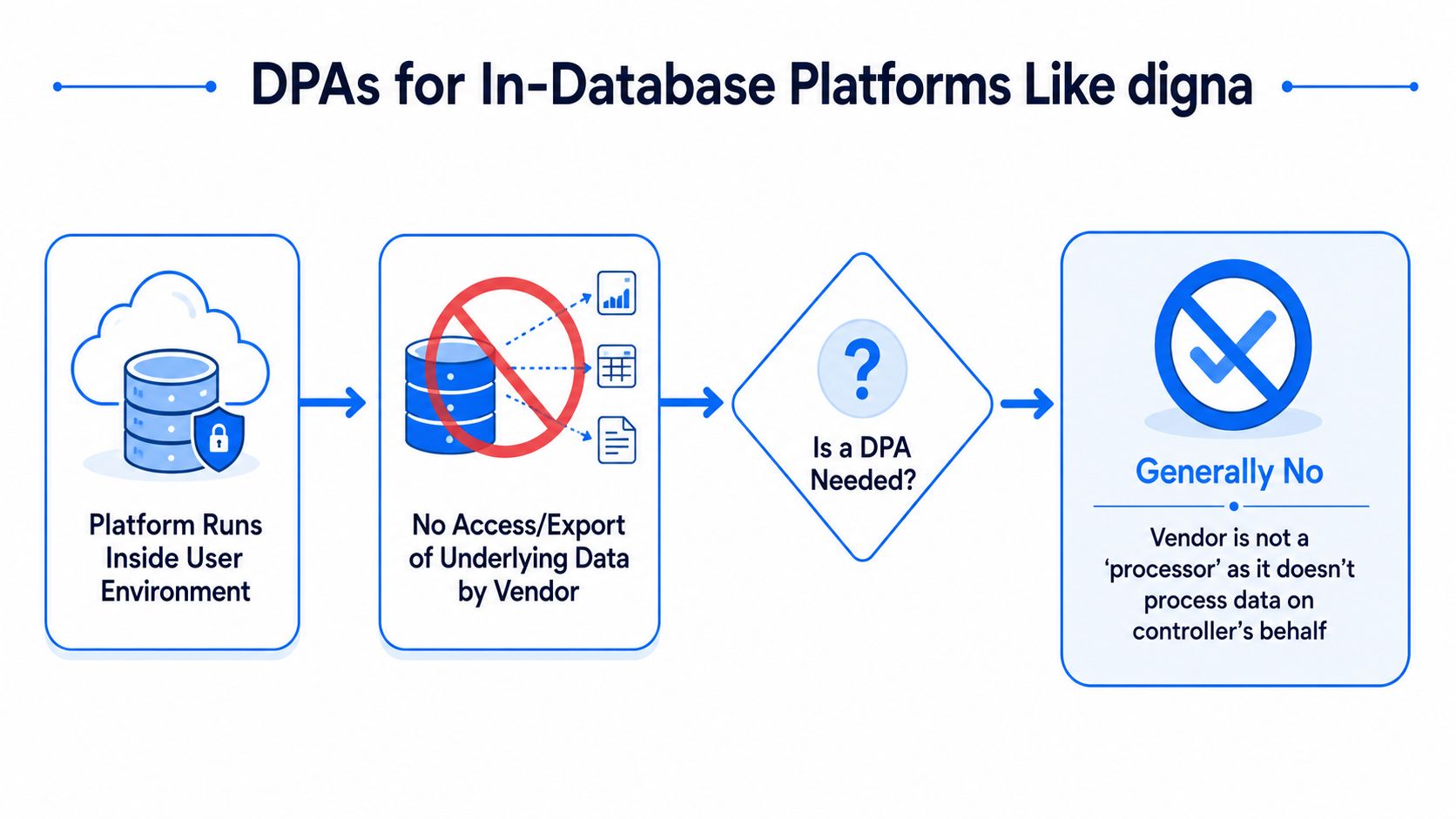
The threshold question most templates ignore
If a platform runs inside your environment, doesn't export rows, and the vendor doesn't access production datasets, are you dealing with the same processor model as a conventional SaaS platform that copies and hosts customer data in its own cloud?
Often, no. That distinction matters. A common gap in DPA coverage is the treatment of tools that don't process PII, and 60% of enterprises incorrectly assume a DPA is needed for all data tools, while platforms where the vendor does not access production datasets are often mishandled by generic templates, as noted in this discussion of DPA applicability questions.
The issue isn't whether a DPA is always bad or unnecessary. The issue is that the legal and operational analysis changes when the vendor's architecture changes.
Why in-database execution shifts the risk model
Traditional SaaS DPAs are built around a transfer model. Data leaves your environment. The vendor stores or processes it in infrastructure they control. That creates obvious DPA obligations around access, storage, sub-processors, transfer mechanisms, and deletion.
In-database systems are different. The logic runs where the data already resides. That can materially narrow the vendor's role if the vendor doesn't access or extract the underlying records.
That matters especially for observability and quality use cases. Data anomaly detection is the process of identifying data points that deviate significantly from expected patterns or trends within a dataset, as described in this definition of anomaly detection. Modern platforms often use AI-powered anomaly detection, which applies machine learning to identify unusual patterns without relying only on static rules, as explained in this overview of AI anomaly detection. A common method is unsupervised learning, which identifies deviations from discovered patterns without requiring labeled data, according to this summary of anomaly detection techniques. In practice, that lets a monitoring system learn normal behavior and surface unusual changes quickly across large volumes, which is the core value described in this AI anomaly detection explainer.
From a contract perspective, though, the key question is narrower than the technical method. Does the vendor process personal data on your behalf, or does the software execute inside your environment without vendor access to that data?
What to review instead of defaulting to a generic SaaS DPA
For in-database tools, the contract review should focus on architecture-aligned questions:
Vendor access model: Can the vendor see production rows during support, troubleshooting, or telemetry collection?
Metadata handling: Does the platform export schema details, metrics, alerts, or logs that could still qualify as personal data in context?
Remote administration: Are there break-glass access mechanisms, and who approves them?
Execution boundary: Does all computation stay within the customer-controlled environment?
Output profile: Are results aggregated, statistical, or otherwise detached from direct row-level personal data?
A tool may still need contractual data protection terms for metadata, support channels, or limited admin access. But that's different from blindly dropping in the same DPA you'd use for a hosted customer-data SaaS.
The smarter compliance posture
The practical answer for these platforms is usually not “never use a DPA.” It's “use the right document for the actual processing.” Sometimes that will be a narrower DPA. Sometimes it will be strong security and access terms in the main agreement plus a limited privacy annex.
That's why teams evaluating modern observability architectures should review the product model itself, not just the procurement checklist. An in-database data quality platform approach changes how data moves, where risk sits, and what a reasonable contract should cover.
If the vendor never accesses production datasets, your contract should reflect that reality instead of pretending the service works like a standard hosted processor.
Conclusion The DPA as a Strategic Asset
The best teams don't treat a data processing agreement as a legal obstacle. They use it as a control surface.
A strong DPA forces a vendor relationship into the open. It clarifies instructions, locks down access, sets incident expectations, governs sub-processors, and gives your team a way to verify that the contract maps to the system you're buying. That's why the quality of the agreement matters more than the mere existence of one.
It also pays to stop treating all vendors the same. A conventional SaaS platform that hosts customer data needs one kind of scrutiny. An in-database tool with no vendor access to production datasets may need a different contractual approach altogether. If your team misses that architectural distinction, you'll either create unnecessary legal overhead or leave a real exposure under-documented.
The practical posture is straightforward. Know the mandatory clauses. Push for operationally usable language. Negotiate audit rights with evidence in mind, not theatre. And always test the paper against the technical design.
That's how a DPA becomes useful. Not as a signed PDF in a contract repository, but as a working part of your data governance model.
If your team is evaluating modern data quality and observability tools, digna is worth a close look. It's built for in-database execution, anomaly detection, validation, timeliness monitoring, and schema tracking inside customer-controlled environments, which makes it especially relevant for organizations that want stronger data oversight without expanding vendor access to production datasets.
If you want to see what an execution boundary inside a customer-controlled environment looks like for monitoring, read how digna data platform observability analyzes data where it already resides.
Frequently asked questions
What is a data processing agreement?
A data processing agreement is the binding contract that sets the rules when one organization processes personal data on behalf of another. The controller decides why and how personal data is processed, the processor carries out that work under the controller's instructions, and the DPA defines the boundaries of that authority.
What clauses must a GDPR data processing agreement include?
GDPR Article 28(3) requires eight provisions: documented instructions, confidentiality, security measures under Article 32, sub-processor rules, assistance with data subject rights, breach and DPIA support, deletion or return of data at termination, and audit rights. If one is missing, the DPA can be non-compliant, not merely weak.
What is the penalty for not having a DPA under GDPR?
Organizations lacking a valid DPA are exposed to fines of up to 10 million euros or 2 percent of global annual turnover under Article 83(4). The article adds that, as of March 2025, EU data protection authorities had issued GDPR fines totaling approximately 5.6 billion euros.
How do you negotiate the audit clause in a DPA?
A practical compromise is for the processor to share certifications such as SOC 2 or ISO, summaries and security documentation upfront, reserving onsite audits for documented insufficiency or incidents. Define notice periods, frequency, scope and confidentiality. The article cites analysis that roughly 80 percent of DPA negotiations stall on this clause.
Do in-database data quality tools need a DPA?
It depends on vendor access, not the tool category. If computation stays in your environment and the vendor never accesses production rows, a generic SaaS DPA often misdescribes the service. Review support access, exported metadata, break-glass administration and output profile; sometimes a narrower DPA or a limited privacy annex fits better.