Master Data Management (MDM): What It Is and How It Works
|
8
min read
If you've ever pulled a customer count from two different systems and gotten two different answers, you already know why master data management (MDM) exists. Every large organization ends up with the same problem: the same customer, product, or supplier gets entered, edited, and stored slightly differently across CRM, ERP, and analytics platforms until nobody trusts the numbers anymore. MDM is the discipline and set of tools that fixes this at the source instead of patching it downstream.
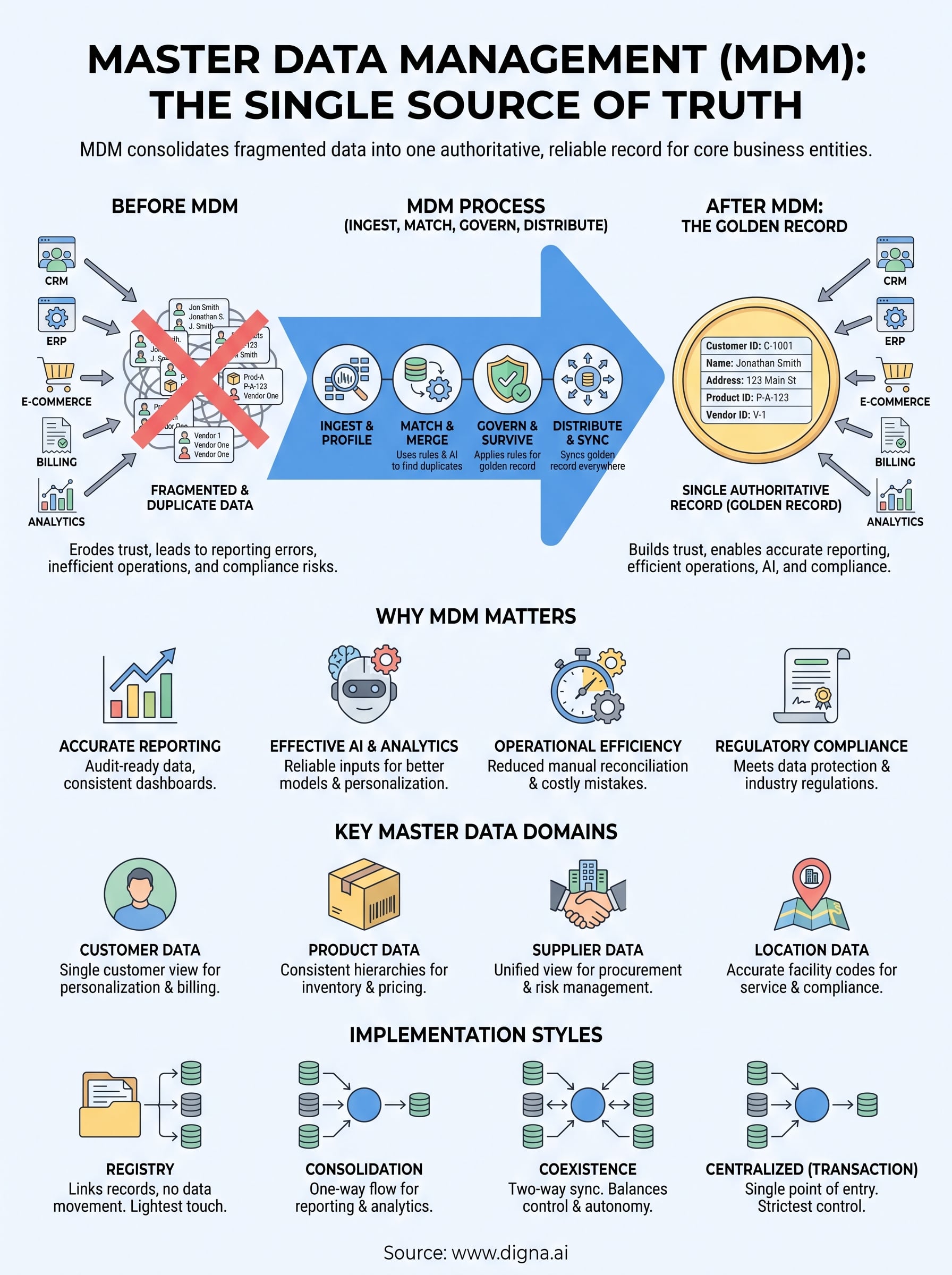
In plain terms, MDM creates a single, authoritative record for your core business entities, customers, products, locations, whatever matters most to your operations, and keeps every system synchronized against it. It combines governance rules, matching logic, and often machine learning to merge duplicates, resolve conflicts, and enforce consistency automatically. Done well, it turns scattered, contradictory data into one reliable source of truth.
This article breaks down what MDM actually involves: the core components of a working MDM program, how the matching and governance process functions day to day, and why data-intensive companies in finance, healthcare, and telecom treat it as foundational infrastructure rather than an optional project. We'll also look at how MDM connects to broader data quality and observability practices, since clean master data only stays clean if you keep monitoring it.
Why master data management matters for organizations
Enterprises don't set out to create messy data. It happens gradually, as teams add new systems, acquire companies, or let regional offices manage their own customer lists. Fragmented master data quietly erodes trust in every report that touches it. A sales team celebrating a win might not realize the same customer already churned in another region under a slightly different name. Multiply that across thousands of records and dozens of systems, and you get the kind of confusion that makes executives stop trusting dashboards altogether.
Regulated industries feel this pressure hardest. Banks need a single view of a customer to comply with anti-money-laundering rules. Healthcare providers need consistent patient identifiers to avoid dangerous mix-ups in treatment records. Telecom operators need accurate subscriber data to bill correctly and meet regulatory reporting requirements set by bodies like national data protection authorities. When master data is inconsistent, compliance teams spend weeks reconciling records instead of doing actual oversight work, and the risk of reporting errors to regulators climbs with every manual fix.
Clean master data isn't a nice-to-have report, it's the foundation every accurate report depends on.
Good master data also determines whether your AI and analytics investments actually pay off. Machine learning models trained on duplicate customer records or mismatched product hierarchies learn the wrong patterns. A recommendation engine that treats the same shopper as three different people can't personalize anything well. Forecasting models built on inconsistent supplier data will misjudge lead times and inventory needs. MDM gives these systems a stable, deduplicated foundation to learn from, which matters more as organizations lean harder on automation for decisions that used to involve a human double-checking the numbers.
Operationally, the savings are concrete. Sales reps stop wasting time reconciling account records before a call. Supply chain teams stop over-ordering because the same supplier appears under two different vendor IDs. Customer service agents pull up one accurate profile instead of guessing which of five records is current. These aren't abstract efficiency gains, they show up directly in reduced headcount spent on manual data cleanup and fewer costly mistakes that stem from acting on bad information.
Here's a quick comparison of what organizations typically experience with and without a functioning MDM program:
Business Area | Without MDM | With MDM |
|---|---|---|
Customer records | Duplicate profiles across CRM and support tools | One authoritative customer record shared everywhere |
Regulatory reporting | Manual reconciliation before every audit | Consistent, audit-ready data on demand |
Analytics and AI | Skewed models from duplicate or mismatched entities | Reliable inputs that reflect reality |
Supply chain | Redundant vendor entries causing overordering | Single supplier view supporting accurate planning |
Customer service | Agents guessing which record is current | Instant access to the correct, complete profile |
Ultimately, organizations invest in MDM because the alternative costs more, just less visibly. Every duplicate record, every mismatched product code, every inconsistent customer ID generates small frictions that add up to missed revenue, compliance exposure, and decisions made on faulty assumptions. Treating master data as core infrastructure, the same way you'd treat network security or system uptime, is what separates companies that scale smoothly from those that keep firefighting data problems long after they should have been solved.
How master data management works step by step
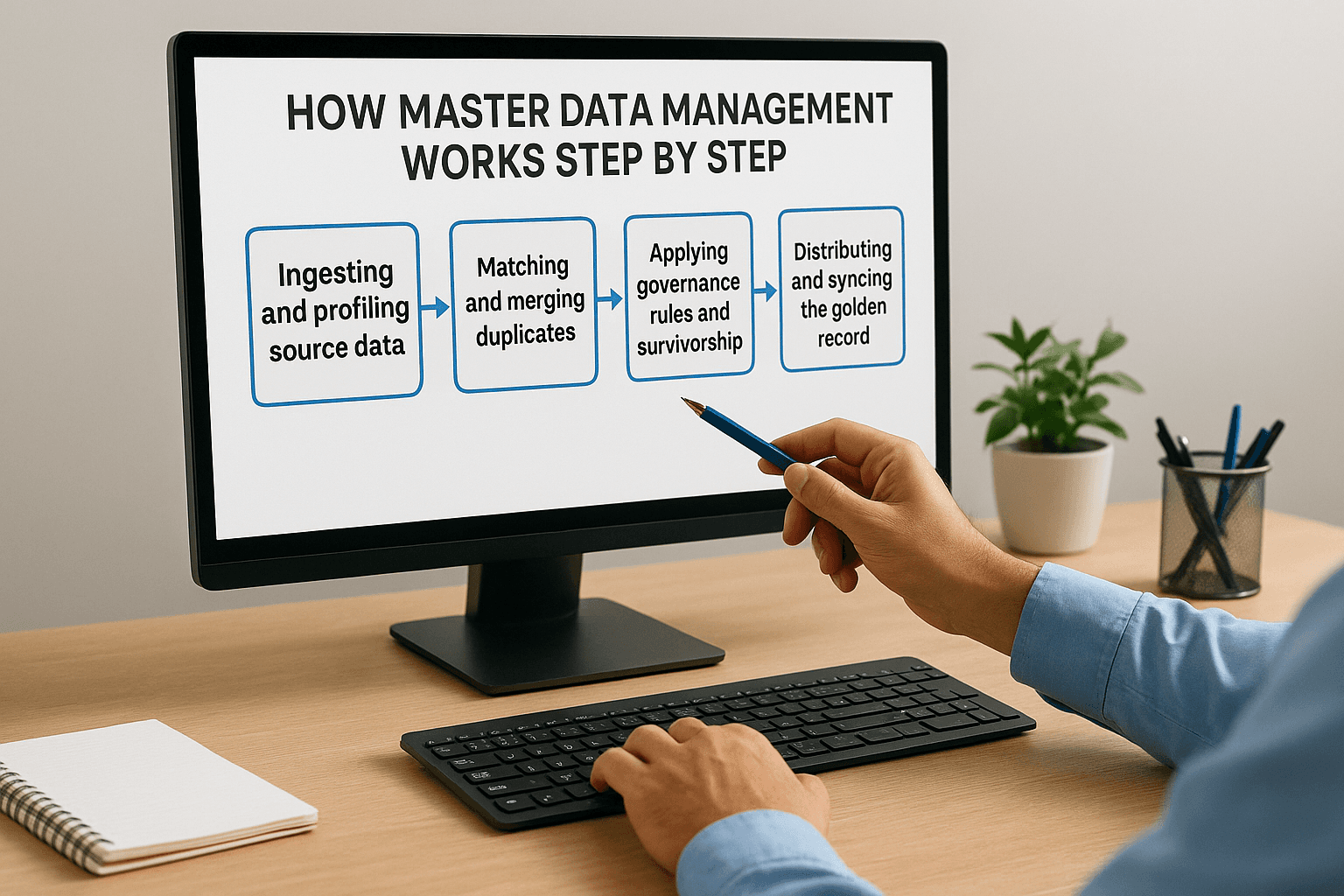
MDM sounds abstract until you watch it run against real data. Underneath the concept sits a fairly mechanical process: pull data in from every system that touches a given entity, decide which version of each field is correct, merge everything into one golden record, and push that record back out to every connected system. The magic isn't in any single step, it's in doing all of them continuously instead of as a one-time cleanup project.
Ingesting and profiling source data
First, the platform connects to your source systems, CRM, ERP, e-commerce platforms, billing tools, and pulls in every record tied to the entity you're managing, whether that's customers, products, or suppliers. Profiling tools scan these records for structure, completeness, and obvious quality issues before anything gets merged. Skipping this step is how bad data ends up baked permanently into your golden record.
Matching and merging duplicates
Next, matching algorithms compare records across systems to find likely duplicates, using techniques ranging from exact key matching to fuzzy logic that catches typos, abbreviations, and formatting differences. A record for "Jon Smith, 123 Main St" and "Jonathan Smith, 123 Main Street" needs to resolve to the same person, and modern MDM platforms increasingly use machine learning models trained on historical match decisions to get this right without hardcoding every rule.
A golden record is only as trustworthy as the matching logic that built it.
Applying governance rules and survivorship
Once duplicates are identified, governance rules decide which values "survive" into the merged record. Typical survivorship logic includes:
Most recently updated source wins for contact details
System of record (like the ERP) wins for financial fields
Manual review queue for conflicts that automated rules can't resolve confidently
Distributing and syncing the golden record
Finally, the finalized record gets synchronized back to every connected system, so a sales rep, a billing platform, and an analytics dashboard all reference the same version of the truth. This isn't a one-time push. As new transactions and edits arrive, the whole cycle repeats, which is why ongoing monitoring and data observability matter just as much as the initial matching work.
Types of MDM implementation styles
Not every organization needs the same level of control over its master data. MDM implementations generally fall into four architectural styles, and the right one depends on how centralized your systems already are and how much risk your industry can tolerate. Picking the wrong style either wastes budget on infrastructure you don't need or leaves gaps that let bad data slip right back in.

Registry style
Registry style keeps source systems untouched and simply builds an index that links matching records together. It's the lightest-touch option, useful when systems can't easily be modified but you still need a way to see the full picture of a customer or product across platforms.
Consolidation style
Consolidation pulls data from source systems into a central hub for reporting and analytics without pushing changes back out. This works well for organizations that mainly need accurate dashboards and don't require every operational system to reflect the golden record in real time.
Coexistence style
Coexistence goes a step further: the golden record lives centrally, but source systems keep their own copies and sync bidirectionally. Changes made anywhere flow back to the hub, and the hub pushes updates out again. Most mid-sized enterprises land here because it balances control with the reality that fully centralizing every system is disruptive and expensive.
Centralized (transaction) style
Centralized, or transactional, MDM makes the hub the single point of entry for creating and editing master records. Source systems no longer manage their own copies; they read and write directly against the central platform. This is the most rigorous style, and it's the one regulated industries tend to adopt once compliance requirements make anything less strict too risky.
The tighter your compliance obligations, the less room you have for a loosely coupled MDM style.
Style | Data movement | Best fit |
|---|---|---|
Registry | None, just linked references | Legacy systems that can't be changed |
Consolidation | One-way into a central hub | Reporting and analytics needs |
Coexistence | Two-way sync | Enterprises balancing autonomy and control |
Centralized | All edits happen in the hub | Regulated, high-risk environments |
Most organizations don't pick one style forever. They often start with consolidation to prove value quickly, then migrate toward coexistence or centralized control as governance maturity grows and the cost of inconsistent data becomes harder to justify.
Key master data domains and real-world examples
MDM programs rarely try to fix every dataset at once. Most organizations start by identifying which master data domains actually drive revenue, compliance, or risk, then build governance around those first. The four domains below cover the vast majority of real-world MDM projects, though the exact mix depends on your industry.
Customer data
Banks, telecoms, and retailers all live or die by an accurate customer 360 view. A telecom operator merging billing records from three regional systems needs one subscriber profile, not three partial ones, to calculate usage correctly and avoid billing disputes. Retailers use the same logic to stop emailing the same shopper five different promotions under five slightly different name spellings.
Product data
Manufacturers and e-commerce companies depend on consistent product hierarchies across catalogs, ERP systems, and supplier feeds. A single SKU listed under different attributes in two systems leads to mismatched inventory counts and pricing errors that customers notice immediately. Getting product master data right also speeds up new product launches, since teams aren't reconciling specs across spreadsheets before going live.
Supplier and vendor data
Procurement teams often discover the same supplier registered under multiple vendor IDs, sometimes with different tax numbers or bank details attached. That duplication creates real financial exposure, from duplicate payments to failed audits. Consolidating supplier master data gives procurement one accurate view for negotiating contracts and tracking spend.
Every duplicate vendor record is a small crack where fraud, overpayment, or audit failure can slip through.
Location and reference data
Healthcare networks and public sector agencies rely on accurate location master data to route patients, services, or benefits correctly. A hospital system with inconsistent facility codes risks sending records to the wrong department entirely.
Domain | Common issue | Business impact |
|---|---|---|
Customer | Duplicate profiles across systems | Poor personalization, billing errors |
Product | Inconsistent hierarchies and SKUs | Pricing mistakes, inventory mismatches |
Supplier | Multiple vendor IDs for one entity | Duplicate payments, audit risk |
Location | Inconsistent facility or site codes | Misrouted services, compliance gaps |
Addressing these domains individually, rather than treating master data as one giant blob, makes MDM projects far more manageable and gives teams measurable wins early in the rollout.
Common MDM challenges and how to overcome them
Most master data management (MDM) initiatives stall for the same handful of reasons, not because the technology fails but because the surrounding processes and people aren't ready for it. Recognizing these patterns early saves months of rework and keeps stakeholders from writing MDM off as "just another IT project."
Organizational resistance and unclear ownership
Departments often resist giving up control of "their" data, especially when regional teams have managed customer or product records independently for years. Without a clear data governance council empowered to make final calls, matching rules become political battles instead of technical decisions. Solve this by assigning explicit domain ownersbefore implementation starts, not after conflicts appear:
Name one accountable owner per master data domain
Give that owner authority to approve survivorship rules
Route escalations through a governance council, not ad hoc emails
Data quality at scale
Legacy systems rarely store data in formats that match cleanly. Free-text address fields, inconsistent date formats, and missing identifiers all make automated matching harder than vendor demos suggest, and the gap only shows up once real production data hits the platform.
No MDM platform can fix data quality problems it was never designed to detect in the first place.
Pairing MDM with dedicated anomaly detection and validation tools catches these issues before they corrupt the golden record, rather than after customers or auditors find them first.
Integration complexity
Connecting a dozen source systems, each with its own API quirks and refresh schedules, turns into the hardest technical piece of most rollouts. Phasing integrations by business priority instead of trying to connect everything at once keeps the project moving and delivers visible wins early, which matters when leadership is deciding whether to fund the next phase.
Governance drift over time
Rules that made sense at launch stop matching reality as new systems, acquisitions, and products get added. Scheduling quarterly governance reviews keeps survivorship rules and ownership assignments aligned with how the business actually operates today, not how it operated when the program first launched.
Choosing tools to support your MDM strategy
Picking an MDM platform is less about feature checklists and more about matching the tool to how your data actually moves. A vendor demo with clean sample data tells you nothing about how the matching engine performs against your messy production records, so evaluate tools against your own data whenever possible, not the polished dataset in the sales pitch.
Deployment and data residency
Regulated industries often can't let customer or patient data leave their environment for processing, which rules out purely cloud-hosted matching engines. Look for platforms that support in-database execution or private cloud deployment, so sensitive records never travel to a third-party server just to get deduplicated. This matters as much for GDPR compliance as it does for internal security policy.
Matching intelligence and adaptability
Static, rule-based matching breaks down the moment your data patterns shift, whether from a merger, a new regional system, or simply new employees typing addresses differently. Platforms that combine statistical methods with machine learning adapt to these shifts without someone rewriting match rules every quarter. That adaptability is what separates a tool you configure once from one you have to babysit indefinitely.
A matching engine that can't learn your data's quirks will always need a human to fix its mistakes.
Connection to data quality and observability
MDM only stays useful if the golden record it produces stays accurate over time, which means the tool needs to catch schema changes, late-arriving data, and anomalies before they corrupt the master record. This is where data observability capabilities, like anomaly detection, timeliness monitoring, and schema tracking, become part of the evaluation criteria rather than a separate purchase. Platforms like digna build these functions directly into the same environment as data quality checks, so teams aren't stitching together five tools to get one trustworthy record.
A practical evaluation checklist
Before committing budget, run any shortlisted platform through these questions:
Does it support in-database or private cloud deployment for compliance-sensitive data?
Can non-technical stakeholders review and approve survivorship rules through a usable dashboard?
Does the matching engine improve over time, or require constant manual tuning?
Does it integrate anomaly detection and schema monitoring, or only handle matching?
How long does the vendor claim it takes to get from installation to actionable insights, and can they back that up with a reference customer?
Answering these honestly narrows the field fast and keeps the selection process grounded in your actual operational needs, not vendor marketing.
Making master data work for your organization
Master data management only pays off when you treat it as ongoing operational discipline, not a one-time cleanup project. The organizations that get real value pick a domain that matters, assign clear ownership, choose an implementation style that fits their risk tolerance, and keep monitoring the golden record after launch instead of walking away once matching runs cleanly. Skip that last part, and duplicate customers, mismatched products, or drifting supplier records creep right back in within a year.
Governance and matching logic get your master data clean. Keeping it clean requires the same observability discipline you'd apply to any critical system: watching for schema changes, late data, and anomalies before they corrupt records again. That's where MDM and data quality tooling need to work together rather than sit in separate silos.
If you're ready to see what that looks like in practice, explore digna's data quality platform and get a firsthand look at how automated monitoring keeps your master data trustworthy long after go-live.
For how continuous anomaly, schema and timeliness monitoring keeps a golden record from drifting after go-live, see digna's data quality management solution.
Frequently asked questions
What is master data management (MDM)?
Master data management is the discipline and set of tools that creates a single, authoritative record for core business entities such as customers, products, suppliers and locations. It combines governance rules, matching logic and often machine learning to merge duplicates, resolve conflicts and keep CRM, ERP and analytics systems synchronized against that record.
How does the MDM process work step by step?
MDM runs as a continuous four-step cycle. It ingests and profiles records from source systems like CRM, ERP and billing tools, matches and merges duplicates, applies survivorship rules to decide which values win, then synchronizes the resulting golden record back to every connected system as new edits arrive.
What are survivorship rules in MDM?
Survivorship rules decide which field values survive into the merged golden record once duplicates are found. Typical examples from the article: the most recently updated source wins for contact details, the system of record such as the ERP wins for financial fields, and unresolved conflicts go to a manual review queue.
What are the four MDM implementation styles?
The four styles are registry, consolidation, coexistence and centralized. Registry only links matching records, consolidation copies data one way into a reporting hub, coexistence syncs a central golden record in both directions, and centralized makes the hub the single point of entry, which regulated, high-risk environments tend to adopt.
Why does MDM need data observability after go-live?
A golden record only stays accurate if something keeps watching it. Schema changes, late-arriving data and anomalies can corrupt master records after matching runs cleanly, and without monitoring, duplicate customers or drifting supplier records creep back within a year. Anomaly detection, timeliness monitoring and schema tracking catch those issues early.