How to Implement Data Governance: A 2026 Enterprise Roadmap
|
6
min read

Your dashboards disagree. Finance has one revenue number, operations has another, and the team training a model can't explain why predictions changed after last week's pipeline update. Meanwhile, legal wants tighter controls, engineering wants fewer tickets, and leadership wants proof that governance won't become another committee with no output.
That's the moment organizations often start asking how to implement data governance. Not as a theory exercise. As a way to stop recurring data fires without slowing delivery to a crawl.
The practical answer is that governance only works when it combines clear ownership, enforceable rules, and operational monitoring inside real pipelines. A policy document matters. But if nobody validates records, monitors timeliness, tracks schema changes, or catches drift before it hits reports and models, the document won't save you.
Table of Contents
Why Data Governance Is No Longer Optional
Most organizations don't adopt governance because they love frameworks. They adopt it after months of reconciliation work, failed trust in reporting, or a painful compliance review. By then, the underlying problem is obvious. Data is already business infrastructure, but it's being managed like a side task.
The financial case is hard to ignore. The average cost of poor data quality is $12.9 million annually per company, and Gartner predicts 80% of data governance initiatives will fail by 2027 without a crisis catalyst, which is why early, visible value matters so much, as summarized in Profisee's write-up of Gartner-backed governance findings.
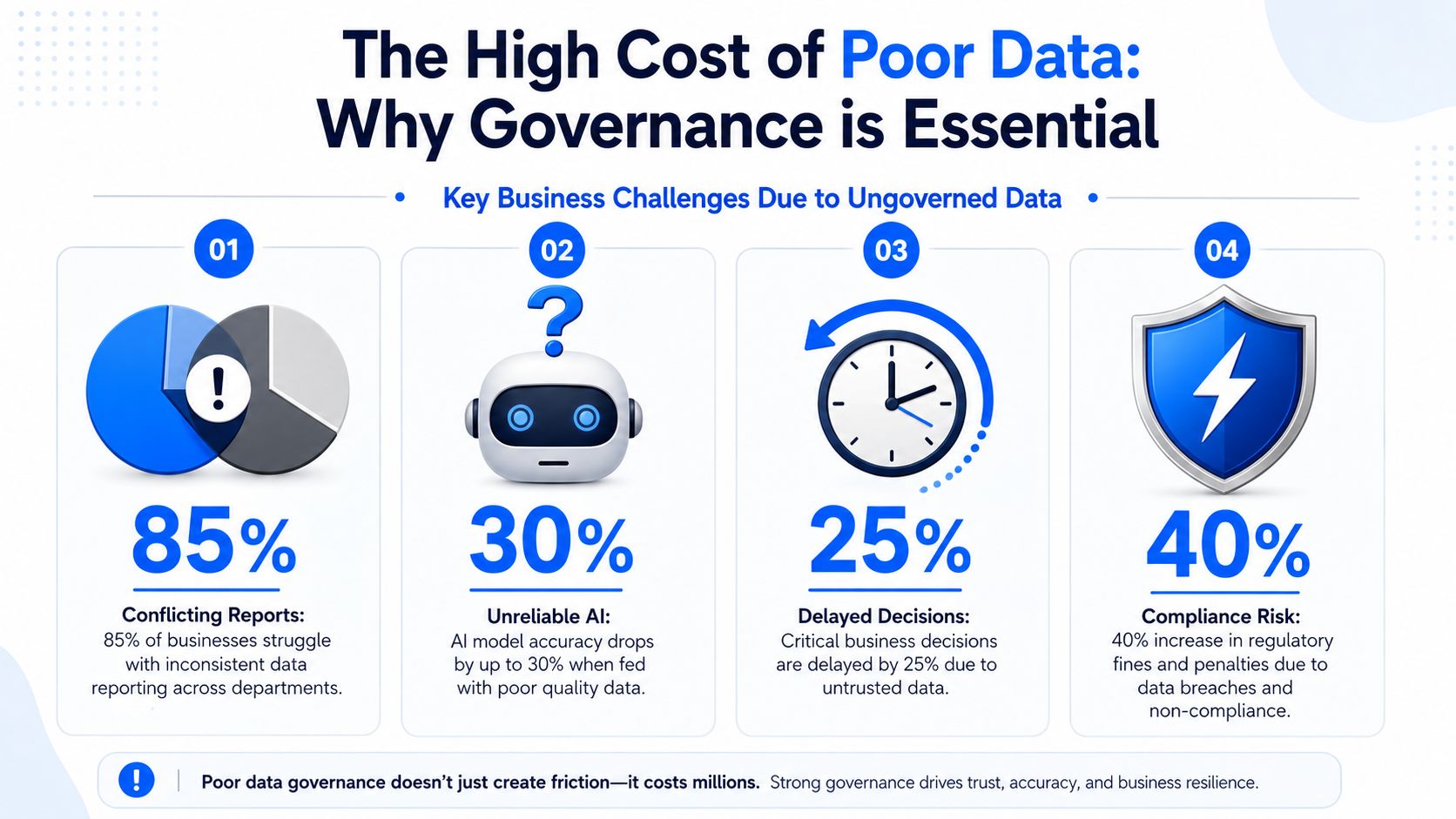
That's also why a generic definition of governance isn't enough. If you're dealing with conflicting reports, unclear ownership, unreliable AI inputs, or slow audit responses, you don't need another glossary-first exercise. You need controls that change day-to-day operations. A useful primer on the core discipline is this overview of what data governance is, but implementation is where teams usually win or lose.
The real cost shows up in operations
Poor governance rarely appears as one dramatic incident. It shows up as repeated business drag:
Analysts rechecking numbers: Teams waste time reconciling reports instead of answering business questions.
Engineers patching around bad inputs: Pipeline fixes become routine because schema shifts and late loads aren't caught early.
Compliance and security teams chasing evidence: Audit preparation turns into a manual search across tools, spreadsheets, and inboxes.
AI teams losing confidence in model inputs: Drift, stale features, and undocumented transformations break trust long before a model completely fails.
Governance becomes urgent when leaders realize they're not arguing about strategy. They're arguing about which data to trust.
In regulated environments, governance also intersects with records, retention, privacy, and access control. If your stack includes Microsoft 365, this guide to GDPR compliance using Microsoft 365 is useful because it shows how governance decisions affect operational tooling, not just policy language.
Laying the Groundwork for Governance Success
A weak start usually looks the same. The company forms a working group, writes broad principles, and tries to govern everything at once. Six months later, no one can point to one process that got easier.
A strong start is narrower and more disciplined.

Start with a business problem, not a framework
The first decision isn't DAMA, DCAM, or your policy template. It's which pain you're going to remove first. Governance works when it's tied to a business outcome that people already care about.
Good starting targets usually have three traits:
They're expensive when they fail: executive dashboards, finance reporting, regulated records, customer master data, or model input tables.
They cross team boundaries: one team alone can't solve the issue.
They can be measured: report defects, delayed loads, unresolved ownership questions, audit evidence gaps, or recurring validation failures.
The broader economic upside is real. Well-governed public and private-sector data can yield social and economic benefits worth between 1% and 2.5% of GDP, according to Snowflake's summary of OECD governance findings. But nobody secures executive support with a macroeconomic argument alone. You secure it by showing how one governed domain reduces friction in the business this quarter.
Scope the first domain tightly
Your first rollout should feel small enough to run well and important enough to matter. That usually means one domain, one sponsor, one owner group, and a short list of controls.
Start by defining:
The data domain
Pick customer, finance, product, claims, patient, or another high-impact subject area. Don't start with “all enterprise data.”The business event you need to protect
Month-end close. Regulatory reporting. Customer onboarding. Model scoring. Leadership KPI reporting.The minimum control set
Ownership, standard definitions, access rules, retention logic, quality checks, lineage visibility, and issue escalation.The proof you'll use
Fewer disputes over metrics, faster incident triage, better audit evidence, fewer broken downstream assets, or stronger trust in model inputs.
Practical rule: If the scope can't fit on one page, it's too broad for a first implementation.
Standardization belongs in the foundation too. Teams need shared definitions, consistent naming, and clear system-of-record decisions. In domains with established conventions, semantic standards reduce avoidable ambiguity. Healthcare teams often rely on standards such as HL7 and LOINC for exactly this reason.
Get executive backing in business language
Executives don't fund governance because they want cleaner metadata. They fund it when they see lower operational risk, better decision speed, stronger audit posture, and more reliable analytics or AI.
That means your opening business case should avoid abstract language like “improve data quality.” Use direct language instead:
Reduce conflicting dashboard metrics
Protect regulated data handling
Shorten issue investigation time
Stabilize model input reliability
Clarify who approves access and policy exceptions
The best sponsors are usually the leaders who already pay for data problems. A CFO funding repeated reconciliation work, a COO dealing with broken KPIs, or a chief data officer trying to support AI safely will understand the trade-off faster than a purely technical audience.
Establishing Your Governance Team and Model
Governance fails when everyone is “involved” but nobody is accountable. You need named decision-makers, a working forum for escalation, and a model that matches how your company already operates.
Put named people on critical datasets
For every critical dataset, assign both a data owner and a data steward. The owner approves policy, usage rules, and quality expectations. The steward handles operational follow-through. That division of labor is essential for clear decisions and consistent stewardship across domains, as outlined by Alation's implementation guidance on data owners and stewards.
If role boundaries are fuzzy, access requests stall, definitions drift, and quality issues sit unresolved because nobody is sure who can make the call. This practical guide to data owner responsibilities is useful when you need to formalize those decision rights.
Data Governance Roles and Responsibilities
Role | Primary Focus | Core Responsibilities |
|---|---|---|
Governance council | Direction and escalation | Set priorities, approve standards, resolve cross-domain conflicts, review risk and adoption |
Data owner | Accountability | Approve policies, define acceptable use, decide on quality thresholds, authorize exceptions |
Data steward | Operations | Maintain definitions, coordinate issue resolution, track controls, support audits and workflow execution |
IT or platform custodian | Technical enablement | Implement access controls, lineage capture, integration patterns, retention enforcement, monitoring support |
Legal, risk, or compliance lead | Regulatory alignment | Interpret obligations, review policy fit, define evidence requirements |
Domain analysts or data consumers | Usability and feedback | Surface reporting issues, validate definitions, flag trust problems in day-to-day use |
Choose a model that fits how your company actually works
There isn't one correct governance model. There's only the model your operating structure will support.
Centralized governance works when data standards must be tightly controlled and the organization already accepts shared authority. It's common in regulated functions, but it can become a bottleneck if every definition or exception requires a central queue.
Federated governance pushes responsibility into business domains. It works well when teams own their own pipelines and data products, but only if shared standards are still enforced somewhere. Otherwise, every domain invents its own version of “good enough.”
Hybrid is what many enterprises land on. A central group defines common policy, taxonomy, control expectations, and audit requirements. Domain teams own execution in their systems.
A simple decision test helps:
Choose centralized if consistency matters more than local speed.
Choose federated if domains are mature and autonomous.
Choose hybrid if you need both enterprise standards and domain accountability.
If you can't decide, hybrid is usually the safest starting point. It prevents fragmentation without pretending one central team can manage every operational detail.
From Static Policies to Automated Quality Workflows
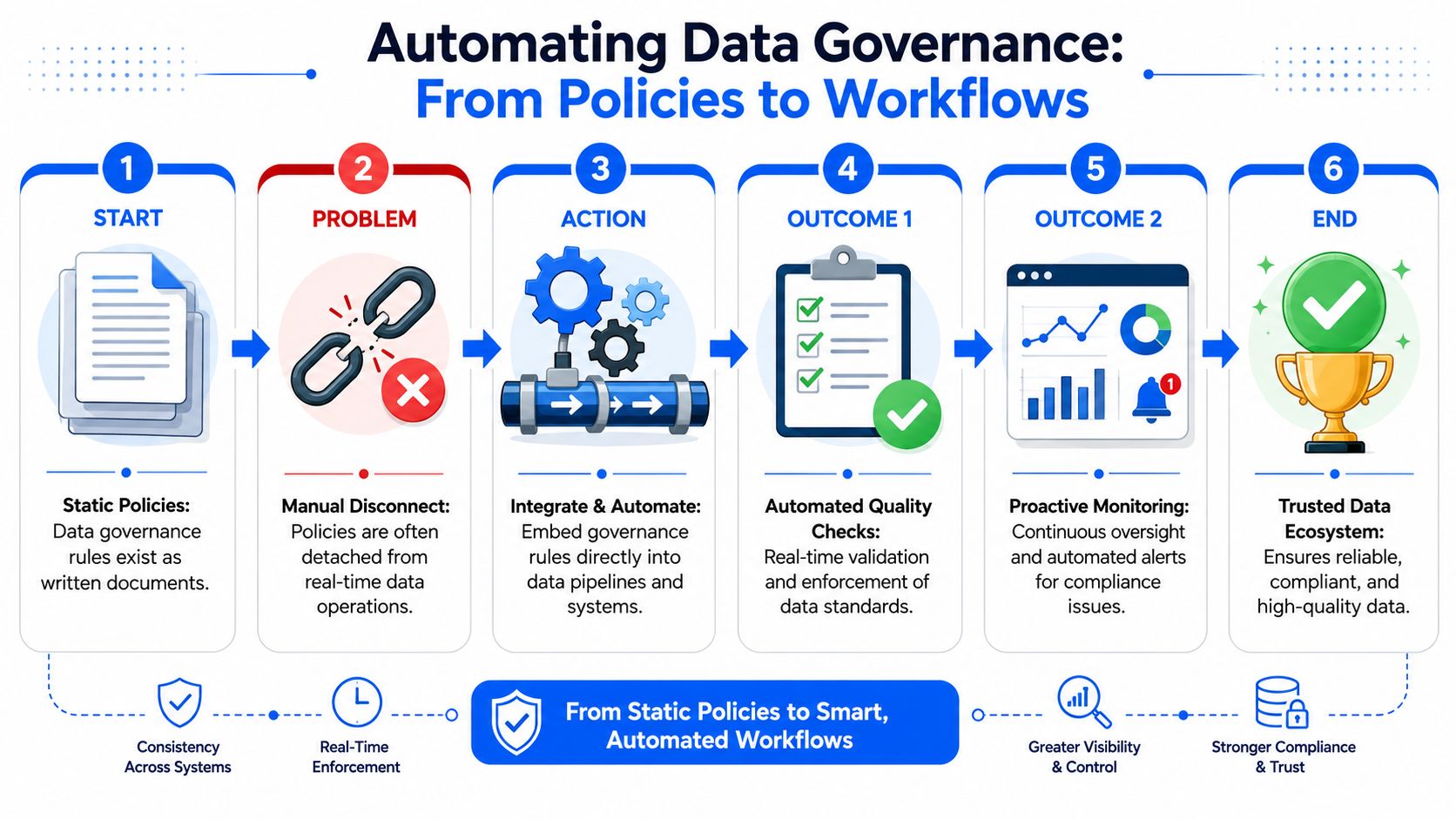
Most governance guides spend too much time on policy creation and too little on enforcement. That's where programs stall. A policy in Confluence or SharePoint may satisfy a documentation requirement, but it won't stop a late load, a schema break, or a malformed record from entering a critical table.
Why documents alone fail
One of the biggest reasons governance programs break down is the gap between policy creation and operational enforcement. Modern governance has to be embedded directly into pipelines through automated anomaly detection, validation, and timeliness monitoring, as described in Semarchy's implementation guidance.
That gap shows up in familiar ways:
A quality rule exists, but no system checks it automatically
A retention rule exists, but deletion or archival is still manual
A business definition exists, but dashboards and models still use conflicting logic
An access policy exists, but evidence of enforcement is scattered
A schema dependency exists, but no alert fires when a column changes
Static governance creates passive certainty. Teams think the control exists because the document exists. Operational governance creates active certainty because the system is checking the rule.
What operational enforcement looks like
The shift from static governance to real governance usually involves a small set of technical patterns.
Record-level validation
Making business rules executable, record-level validation enforces user-defined rules on individual records, which supports completeness governance and audit readiness for each transaction or entry, as explained in digna's discussion of why data governance supports compliance, AI, and business trust.Timeliness monitoring
Reports often fail because data arrives late, not because it's completely absent. Monitoring expected arrival windows helps teams detect stale data before leaders act on outdated metrics.Schema tracking
Silent schema changes are common in fast-moving environments. Added columns, removed columns, and type changes can break downstream transformations without obvious symptoms at the source.Anomaly detection
Some failures don't violate an explicit rule. A metric may stay within a valid range but still shift in an unusual way. Automated anomaly detection helps catch those pattern breaks without requiring teams to hand-code every threshold.Lineage and issue routing
When a control fails, teams need to know which upstream asset changed, who owns it, and who should respond. Without lineage, governance incidents become detective work.
A policy becomes real only when a system can enforce it, measure it, and route failures to a named owner.
Make governance AI-ready
This is the part most legacy governance approaches still underplay. AI and machine learning pipelines don't just need access controls and metadata. They need protection against drift, silent schema changes, and unstable feature inputs.
That's where modern observability matters. A platform such as digna's comparison of automation and data quality tools points to the stack teams now evaluate: anomaly detection, pipeline timeliness, record-level validation, and schema monitoring in one operating layer. digna is one option in this category. It runs analyses inside the customer's database environment and supports anomaly detection, validation, timeliness monitoring, and schema tracking without moving production data outside customer-controlled infrastructure.
For ML and analytics teams, the practical control questions are straightforward:
Which tables feed critical models or executive reporting?
What data conditions must hold at the record level?
What freshness window is acceptable before outputs become risky?
Which structural changes should block downstream use?
Who gets alerted, and what evidence is retained?
If you can answer those operationally, not just in policy text, your governance program has moved into production.
Choosing Your Architecture and Launching a Pilot
Once the operating model is clear, the next mistake is buying tools before deciding how they need to run in your environment. Architecture choices matter because governance touches sensitive data, regulated workflows, and production pipelines.
Pick architecture based on control and data movement
In regulated enterprises, the first question usually isn't feature depth. It's where processing happens and who can access the data.
Teams typically evaluate a few practical criteria:
Customer-controlled deployment
Private cloud and on-premise options matter when legal, security, or procurement teams won't allow production data to leave controlled environments.In-database execution
This approach reduces data movement and keeps checks close to the warehouse or lake. It also simplifies security reviews because validation and monitoring happen where the data already lives.Integration with the existing stack
Governance can't sit apart from your data warehouse, pipeline orchestration, BI layer, and model workflows. If it does, ownership and issue response get fragmented immediately.Usability across roles
Engineers need operational detail. Analysts need trust signals. Governance leads need evidence and trends. If every audience needs a separate tool, adoption gets harder.
Architecture decisions should reflect your constraints, not vendor defaults. Financial services, healthcare, telecom, and public sector teams usually care more about execution location, auditability, and access boundaries than glossy catalog features.
Design a pilot that earns trust
A pilot isn't a miniature version of an enterprise program. It's a proof that governance can solve one visible problem without adding bureaucracy.
The MVP pattern works because it stays narrow. Organizations using a Minimum Viable Project approach report 40% higher success rates in initial rollouts, with pilot projects achieving 85% adoption within 6 months by focusing on a single, high-impact data domain first, according to Profisee's governance implementation guidance.
Use a pilot when you need to answer four questions:
Can we detect issues earlier?
Pick a domain with recurring defects, stale reports, or unreliable handoffs.Can we route responsibility clearly?
Assign one owner, one steward, and one executive sponsor.Can we enforce a small set of meaningful controls?
For example, freshness checks, schema alerts, and a handful of record-level validations.Can we show business value quickly?
Shorter incident triage, fewer report disputes, better audit evidence, or stronger confidence in a model input pipeline.
A good pilot has a defined end state. Teams know which tables are in scope, which checks are active, who responds to failures, and what success looks like. A bad pilot turns into a vague “governance initiative” with meetings but no operating change.
Scaling Monitoring and Sustaining Your Program
The difficult part of governance isn't launching it. It's keeping it useful after the first win.
Mature programs tend to outperform because they keep governance tied to operations. Organizations with mature governance programs achieve 30% faster data quality improvements and a 25% reduction in compliance risks within 12 months, but only when they run regular data quality audits tied to governance KPIs and maintain cross-functional collaboration.
Scale by domain, not by decree
After the pilot, expand in waves. Add the next domain only after the first one has clear ownership, active controls, issue routing, and review habits that teams follow.
Use a phased pattern:
Extend shared standards carefully: reuse ownership templates, quality rule formats, escalation paths, and evidence artifacts.
Adapt local controls: finance, customer, and ML feature domains won't need identical checks.
Review KPIs regularly: track the controls that prove governance is operating, not just documented.
Keep domain teams involved: central teams set expectations, but local teams need room to execute.
Mature governance doesn't mean more policy. It means more controls that run reliably without constant manual intervention.
Treat audits and communication as operating work
Sustained governance depends on boring disciplines done consistently. That includes data quality checklists, policy templates, issue logs, stewardship reviews, and evidence that controls are functioning.
It also depends on communication. Teams need to hear where governance prevented a reporting issue, caught a schema break, or improved audit readiness. If they only hear from governance during approvals or escalations, the program will look like overhead again.
Keep the rhythm simple. Monthly domain reviews. Regular audit artifacts. Clear status for open issues. Ownership that survives org changes. Governance isn't a launch. It's an operating model.
If your team is trying to turn governance from policy documents into live controls, digna is built for that operating layer. It helps teams detect anomalies, validate records, monitor timeliness, and track schema changes inside customer-controlled environments, which is especially useful when you need governance that supports analytics, compliance, and AI reliability without moving production data outside your infrastructure.
To turn governance rules into record-level checks that run automatically where the data lives, see how digna Data Validation enforces user-defined business rules.
Frequently asked questions
How do you implement data governance step by step?
Start with one business problem rather than a framework, scope a single domain tightly, and win an executive sponsor in business language. Then assign owners and stewards, choose a governance model, turn policies into automated checks, run a focused pilot, and scale domain by domain once controls work.
What is the difference between a data owner and a data steward?
The data owner is accountable: they approve policies, define acceptable use, decide quality thresholds, and authorize exceptions. The data steward handles operations, maintaining definitions, coordinating issue resolution, tracking controls, and supporting audits. The article recommends assigning both roles to every critical dataset so decisions never stall.
Should data governance be centralized, federated, or hybrid?
It depends on your operating structure. Centralized suits cases where consistency matters more than local speed, federated fits mature, autonomous domains, and hybrid combines central policy with domain execution. If you cannot decide, the article calls hybrid the safest starting point because it prevents fragmentation without overloading one team.
Why do data governance programs fail?
Most fail in the gap between policy creation and operational enforcement. A rule written in Confluence or SharePoint will not stop a late load, a schema break, or a malformed record. Gartner, cited in the article, predicts 80% of governance initiatives will fail by 2027 without a crisis catalyst.
How big should a data governance pilot be?
Keep it to one domain, one owner, one steward, and one executive sponsor, with a small set of controls such as freshness checks, schema alerts, and a handful of record-level validations. Profisee reports that Minimum Viable Project approaches achieve 40% higher success rates and 85% adoption within six months.