Mastering Enterprise Data Architecture: Your 2026 Guide
|
6
min read

You're probably dealing with this already. Finance walks into a leadership meeting with one revenue number, Sales brings another, and both teams can defend their logic. The dashboard didn't fail because the chart was wrong. It failed because the underlying architecture let different definitions, pipelines, and controls grow in parallel until trust broke.
That's the moment when enterprise data architecture stops being an IT diagram and becomes an executive problem. If the architecture is weak, every downstream activity gets harder. Forecasting slows down. Compliance reviews become painful. AI work rests on unstable inputs. Engineering spends its time reconciling data instead of extending capability.
A strong architecture does the opposite. It gives the business a repeatable way to collect, govern, transform, and serve information so teams can move faster without improvising the basics every quarter.
Table of Contents
Why Your Data Architecture Defines Your Business
A new Head of Data usually inherits symptoms before causes. Teams complain that reports disagree, analysts keep rebuilding the same logic, and engineers hesitate to change upstream systems because they can't see what will break downstream. None of that is random. It's architecture expressing itself through daily friction.

In practice, enterprise data architecture is the operating model for information. It defines how data enters the organization, where it lives, how it's transformed, who owns it, which controls apply, and how people consume it. The technical stack matters, but the bigger question is whether the architecture produces trusted decisions at the speed the business needs.
When architecture is treated as a back-office concern, business units fill the gaps themselves. Marketing exports data into one tool. Finance curates a separate version. Product teams create their own event conventions. Every local fix feels rational, but the enterprise pays for the fragmentation later.
A company can tolerate messy data for a while. It can't scale messy decision-making.
The payoff of getting this right isn't abstract. A sound architecture supports cleaner handoffs between teams, clearer accountability for key datasets, and less rework when priorities change. It also changes the tone of executive discussions. Instead of debating whose spreadsheet is correct, leaders can debate what to do next.
That's why I advise Heads of Data to frame architecture in business language from the start:
Agility: Can teams launch new use cases without redesigning the platform every time?
Trust: Do leaders believe the numbers enough to act on them?
Control: Can legal, security, and audit teams see how sensitive data moves?
Innovation: Can data science and AI teams access reliable inputs without heroic cleanup?
If the answer is no, the architecture is already shaping business performance. Just in the wrong direction.
The Core Principles of a Resilient Architecture
A resilient architecture isn't defined by whether you chose Snowflake, BigQuery, Databricks, Kafka, dbt, or Airflow. Those choices matter, but they sit underneath a smaller set of principles that determine whether the system remains usable as the company grows and changes.
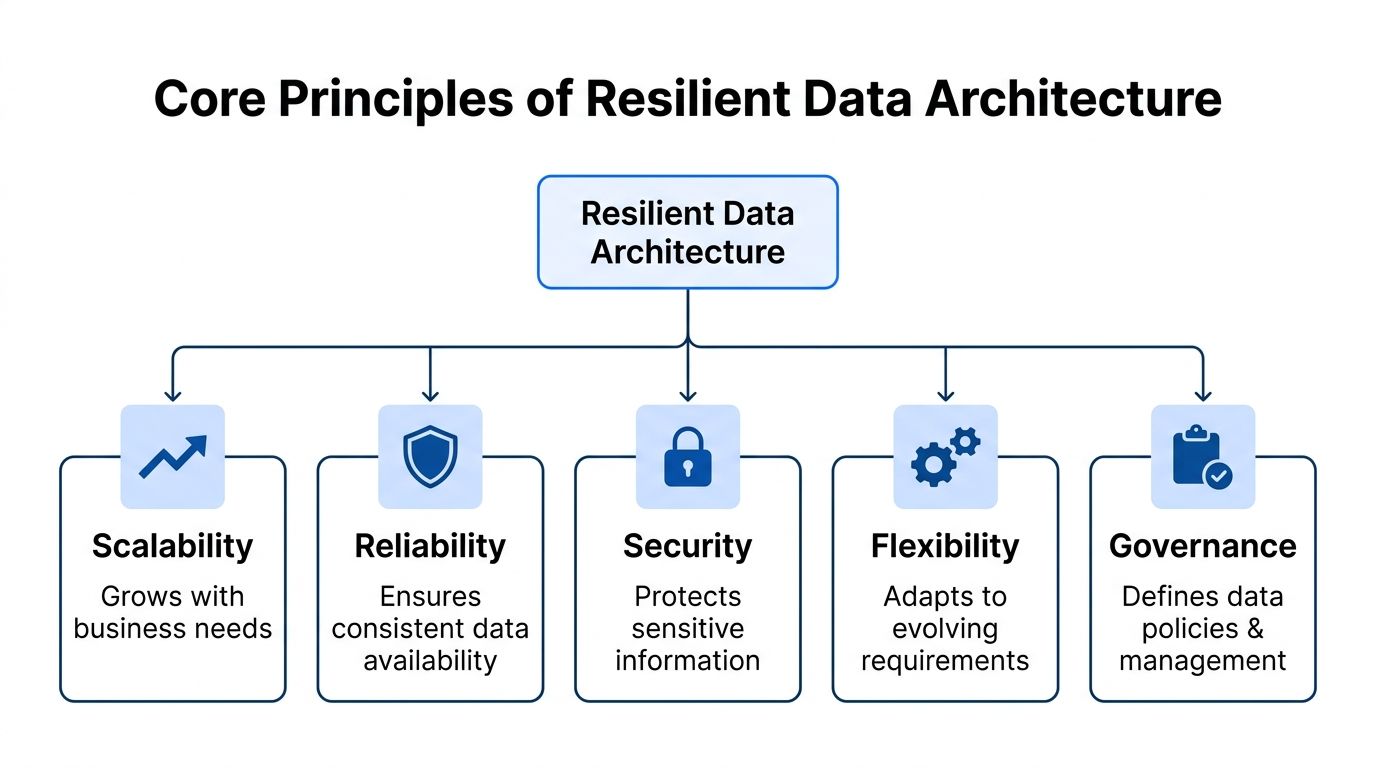
Scalability and flexibility
Scalability means the platform can support more sources, more users, and more workloads without turning every expansion into an architecture project. The practical test is simple. When a new business unit arrives, can your team onboard its data through existing patterns, or does every integration need custom engineering?
Why it matters: if scale depends on bespoke work, delivery slows and costs drift upward. Teams become dependent on a few engineers who understand the exceptions.
Flexibility is different. A scalable system can grow. A flexible system can change direction. That matters when the business adds a new product line, enters a regulated market, or shifts from batch reporting to operational analytics.
A rigid model often looks efficient at first because it standardizes everything. Later, it becomes the reason nothing new ships quickly.
Security and governance by design
Security works best when it's embedded in the architecture, not reviewed after pipelines are already in production. Sensitive data should move through defined controls, not through ad hoc exceptions and informal agreements between teams.
Why it matters: retrofitted security creates blind spots. You'll eventually discover datasets with unclear access rules, copies in the wrong environment, or transformations that no one can explain to audit.
Governance has the same dynamic. Good governance isn't a committee that publishes policies nobody uses. It's a practical system of ownership, metadata, naming, classification, lineage, and access rules that fits how teams work.
Practical rule: If engineers need to bypass governance to deliver on time, the governance model is poorly designed.
A resilient setup usually includes:
Clear ownership: Every critical dataset needs a named business owner and a technical owner.
Shared definitions: Revenue, active customer, booked pipeline, and similar terms can't vary by department.
Visible lineage: Teams need to know what depends on what before they change upstream logic.
Policy enforcement: Access controls should be systematic, not ticket-driven improvisation.
Observability as a built-in property
Often, architectures fail for this reason. They assume that if pipelines run and dashboards load, the system is healthy. It isn't. Data can arrive late, drift, change shape, or degrade in ways that traditional system monitoring won't catch.
Observability means the architecture is understandable in operation. Teams can tell whether data is fresh, whether distributions are changing unexpectedly, whether schemas have shifted, and which downstream assets are exposed.
Why it matters: without built-in observability, the business only learns about data problems after a broken report, a failed executive meeting, or a model behaving strangely in production.
That's why I treat observability as a design principle, not a tool category. If it isn't built in from day one, trust becomes a manual exercise.
Deconstructing the Blueprint Key Components
Think of enterprise data architecture like a factory line. Raw materials arrive from different suppliers. They're unloaded, checked, routed, refined, stored, packaged, and shipped to the people who need them. If one station is weak, the whole line becomes unreliable.

Ingestion and integration
This is the loading dock. Data enters from operational databases, SaaS tools, event streams, files, partner feeds, and legacy systems. Teams usually underestimate this layer because ingestion looks straightforward until source systems change, APIs behave inconsistently, or business logic gets embedded in connector code.
A mature ingestion layer handles both batch and real-time patterns without turning each source into a special case. It also separates extraction from business transformation wherever possible. That keeps source acquisition stable even when downstream logic evolves.
For smaller organizations that are still tightening fundamentals, these database tips for SMBs and e-commerce are a useful reminder that structural discipline at the source reduces a lot of downstream cleanup.
Storage and processing
Storage is where many architecture discussions get stuck because people debate platforms before clarifying usage patterns. The core question is what kinds of data you need to retain, how fast it must be accessed, and which workloads it must support. Raw landing zones, curated analytical stores, and serving layers each exist for different reasons.
Processing is the assembly stage where raw data becomes usable through standardization, joins, quality rules, enrichment, and modelled business logic. Tools like dbt, Spark, Flink, and native warehouse transformation frameworks can all play a role. What matters most is whether the transformation logic is maintainable, testable, and visible to other teams.
A useful mental model is to separate processing into layers:
Raw layer: Preserves source fidelity for traceability.
Refined layer: Standardizes structures and resolves common quality issues.
Business layer: Encodes the definitions people report on.
That layered approach is one reason many teams explore a dedicated enterprise data platform instead of stitching together isolated services over time.
Catalog, serving, governance, and security
Once data is processed, people still need to find it, trust it, and use it safely. That's where the rest of the blueprint matters.
A data catalog is the inventory system. It helps analysts, engineers, and governance teams discover what exists, who owns it, and whether it's approved for use. Without it, self-service turns into table-hunting and Slack archaeology.
Data serving is the shipping function. It covers dashboards, semantic layers, APIs, reverse ETL, feature access for ML, and any other mechanism that delivers curated data to a consumer. This layer should be optimized for clarity, not just speed. If consumers can access data but can't understand its meaning, the architecture still fails.
The fastest way to overload a data team is to publish more tables than the business can interpret.
The last two components are cross-cutting. Governance defines policy, stewardship, and lifecycle control. Security enforces identity, permissions, masking, retention, and environmental boundaries. They shouldn't sit beside the architecture as external review functions. They should shape each layer from ingestion through serving.
Common Architectural Patterns and When to Use Them
There isn't a single correct enterprise data architecture pattern. The right choice depends on the organization's operating model, data maturity, governance culture, and speed requirements. The mistake is copying a pattern because it's fashionable, then discovering your team structure can't support it.
Centralized warehouse
The traditional warehouse model centralizes storage, modeling, and reporting in a controlled analytical environment. This works well when the business needs consistent reporting, shared metrics, and strong central oversight. Finance-heavy organizations often benefit from this model because metric discipline matters more than local experimentation.
The trade-off is speed at the edge. Domain teams may wait on a central data function for changes, and semi-structured or rapidly evolving data can feel awkward in a warehouse-first setup.
Lakehouse
The lakehouse pattern tries to combine flexible storage with stronger structure for analytics and AI. It suits organizations that need to support mixed workloads across BI, data science, and large-scale transformation without maintaining separate ecosystems for every use case.
The upside is architectural consolidation. The downside is governance complexity if teams treat flexibility as permission to skip standards. A lakehouse can become disciplined and efficient, or it can become a more modern-looking swamp.
If your team is weighing the practical implications of orchestration and flow design inside these patterns, this guide to data pipeline architecture is a useful companion to the broader architecture decision.
Data mesh
Data mesh is less a platform choice and more an organizational model. It decentralizes ownership to domain teams, who publish and maintain data products for the rest of the business. This can work when the company already operates through strong domain accountability and has enough engineering maturity outside the central data team.
The failure mode is common. Companies adopt the language of mesh but keep weak governance, unclear product ownership, and inconsistent standards. Then they get decentralization without interoperability.
Data mesh works when domains are ready to own quality, contracts, and support. It fails when central leadership wants autonomy without accountability.
Event-driven architecture
Event-driven architecture focuses on streams and near-real-time reactions. It's useful when business processes depend on current state, such as fraud workflows, operational notifications, dynamic inventory decisions, or product telemetry.
It gives the business responsiveness, but it also raises the bar for schema discipline, contract management, and observability. Real-time systems amplify weak practices quickly.
Data Architecture Patterns Compared
Pattern | Best For | Governance Model | Team Structure |
|---|---|---|---|
Warehouse | Standardized reporting, finance, executive metrics | Strong central governance | Central data team owns most modeling |
Lakehouse | Mixed analytics and AI workloads, evolving data types | Central standards with flexible implementation | Platform team plus shared engineering practices |
Data mesh | Large organizations with strong domain ownership | Federated governance | Domain teams own data products |
Event-driven architecture | Operational use cases requiring timely reactions | Contract-driven governance | Platform team plus event-producing domains |
A practical selection test usually comes down to four questions:
Decision speed: Does the business need trusted periodic reporting, near-real-time action, or both?
Ownership model: Can domains own data products responsibly, or is central control still necessary?
Workload mix: Are you mostly serving BI, or also supporting ML, operational apps, and streaming use cases?
Governance maturity: Can standards survive outside a centralized team?
Most enterprises end up with a blended model. That's normal. What matters is choosing the dominant pattern intentionally, then defining where exceptions are allowed.
Building Trust with Integrated Data Quality and Observability
A dashboard can load on time and still be wrong. A model can score records without error and still be using degraded inputs. That's why data quality and observability belong inside the architecture itself, not in a later procurement cycle.

Why monitoring alone falls short
Traditional monitoring tells you whether infrastructure is up, jobs completed, or queries ran. It doesn't reliably tell you whether the data remained trustworthy. Silent failures are the expensive ones. A source starts delivering records later than usual. A schema change lands without coordination. A key field begins drifting because an upstream application changed behavior.
Those issues don't always break the pipeline. They break confidence.
That's the reason I push Heads of Data to treat freshness, schema stability, distribution shifts, and business-rule conformance as architectural concerns. If the design can't surface those conditions quickly, the system is operationally fragile even when compute and storage look healthy.
What trustworthy architecture actually requires
Integrated trust usually comes from a mix of practices, not a single control:
Timeliness checks: Teams need to know when expected data hasn't arrived, not after the morning dashboard is questioned.
Schema awareness: Structural changes should be visible before downstream jobs or reports absorb them unnoticed.
Anomaly detection: Unexpected changes in values, volumes, or patterns need automated attention.
Validation rules: Business-critical assertions belong close to the pipeline, not in manual audit routines.
Shared visibility: Engineers, analysts, and stakeholders should see the same operational picture.
For teams building this capability from scratch, a clear primer on what data observability is helps anchor the conversation in practical operating requirements rather than vendor language.
Trust isn't created by a dashboard certification badge. It's created when the architecture can prove the data is current, structurally sound, and behaving as expected.
The business impact is direct. Reliable observability shortens incident diagnosis, reduces avoidable executive escalations, and protects downstream analytics and AI from invisible degradation. Without it, teams end up doing detective work after the damage reaches decision-makers.
From Blueprint to Reality Deployment and Migration
Architecture decisions become real when you choose where the system runs and how you'll move from the current state to the target state. That's where strategy meets institutional constraint.
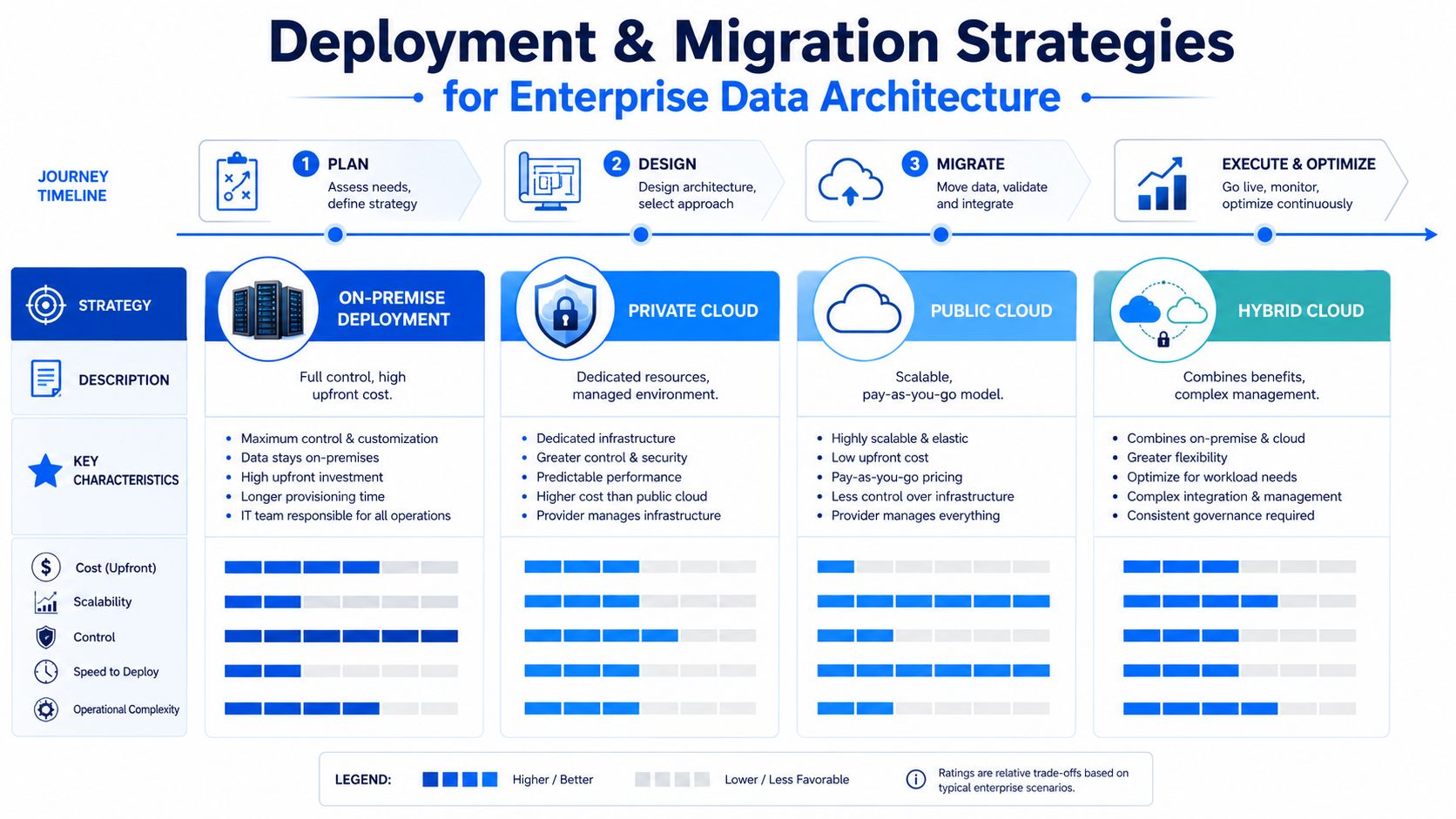
Choosing the deployment model
On-premise gives maximum control and often aligns with strict regulatory or operational requirements. It can fit environments where data residency, internal network boundaries, or legacy integration demands are mandatory. The trade-off is that platform evolution tends to be slower and internal teams carry more operational burden.
Private cloud offers a middle ground. You preserve tighter control over environment design while gaining some of the management benefits associated with cloud-style infrastructure. This often appeals to enterprises that need stronger isolation without fully owning every layer.
Public cloud usually wins on elasticity, service breadth, and speed of provisioning. It's often the fastest route for teams that need to scale quickly or experiment broadly. The trade-off is governance discipline. Cloud convenience can multiply sprawl if environments, storage zones, and access policies aren't tightly managed.
Hybrid cloud is the most common real-world outcome. It lets organizations keep some workloads close to regulated systems while shifting analytical or experimental work into more elastic environments. It also introduces complexity. Integration, identity, policy enforcement, and cost control all become harder when the architecture spans multiple environments.
A phased migration path that works
The migrations that fail usually aim for a clean break from day one. That sounds decisive, but it ignores how much hidden dependency lives in reports, interfaces, and undocumented jobs.
A more durable path looks like this:
Assess the current estate
Map critical data domains, system dependencies, ownership gaps, and known trust issues. Don't start with every dataset. Start with the ones the business can't afford to get wrong.Pick a pilot with political value
Choose a domain important enough to matter, but bounded enough to manage. A pilot should prove that the new architecture improves reliability or speed, not just modernizes tooling.Migrate in waves
Move by business capability, data domain, or workload type. Keep coexistence explicit. Teams need to know which platform is authoritative for what during transition.Institutionalize operating discipline
Bake in documentation, ownership, support processes, quality checks, and observability before the next wave. Otherwise you'll scale migration debt instead of solving it.
The right migration pace is the fastest one that preserves trust.
Stakeholder buy-in usually follows when leaders see risk removed from a painful business process. Technical elegance alone won't carry the program. Operational credibility will.
Your Architectural North Star Actionable Best Practices
The best enterprise data architecture decisions are usually boring in the right ways. They reduce ambiguity, clarify ownership, and make change safer.
Use these principles as a working filter:
Design for business decisions: Start with the processes, metrics, and risks the business cares about.
Standardize where it counts: Shared definitions, lineage, access models, and quality controls should not vary by team.
Allow flexibility at the edges: Domain-specific needs are real, but they need guardrails.
Treat observability as foundational: Freshness, schema change, anomalies, and validation must be visible in normal operations.
Choose patterns that match the org: Don't adopt mesh, streaming, or lakehouse models if the team structure can't support them.
Migrate in phases: Stable progress beats a dramatic cutover.
Document ownership relentlessly: If no one owns a dataset, no one will fix it fast when it matters.
For teams refining the execution layer, these data pipeline best practices are a practical extension of the architecture principles above.
If you're building an architecture that needs trustworthy pipelines, visible anomalies, schema awareness, and data quality controls from day one, digna is worth a close look. It's built for enterprise teams that need observability and validation inside customer-controlled environments, with support for private cloud and on-prem deployment.
For the operational side of treating observability as a built-in architectural property rather than a later procurement cycle, see how data platform observability with digna keeps freshness, schema changes and anomalies visible inside customer-controlled environments.
Frequently asked questions
What is enterprise data architecture?
In practice, enterprise data architecture is the operating model for information. It defines how data enters the organization, where it lives, how it is transformed, who owns it, which controls apply and how people consume it. The real test is whether it produces trusted decisions at the speed the business needs.
What are the key components of an enterprise data architecture?
The article compares it to a factory line: ingestion and integration act as the loading dock, storage and processing are split into raw, refined and business layers, a data catalog serves as the inventory system and data serving handles shipping. Governance and security are cross-cutting and shape every layer.
When should you choose a data mesh instead of a centralized warehouse?
Choose data mesh when domain teams are ready to own quality, contracts and support for their data products under federated governance. A centralized warehouse fits standardized reporting, finance and executive metrics under strong central control. Most enterprises end up with a blended model built around one intentionally chosen dominant pattern.
Why should observability be built into data architecture?
Pipelines can run and dashboards can load while data arrives late, drifts or changes shape, and traditional monitoring only shows whether jobs completed. The article therefore treats timeliness checks, schema awareness, anomaly detection, validation rules and shared visibility as architectural concerns, so problems surface before an executive report breaks.
How do you migrate to a new enterprise data architecture?
Migrate in phases rather than attempting a clean break. The article outlines four steps: assess the current estate, pick a pilot with political value, migrate in waves by capability, domain or workload, and institutionalize documentation, ownership, quality checks and observability before starting the next wave.