Data Governance Roles: A Practical Guide to the Modern Team
|
8
min read

You can have a charter, a council, and a polished governance slide deck, and still lose control the moment a bad load breaks a dashboard or a privacy review blocks a release. That's the part teams feel first. The document exists, the meeting happened, but nobody can say who owns the next action, who checks the evidence, or who fixes the data before business users notice.
That gap is why data governance roles matter more than org-chart labels. The job is to assign decision rights, escalation paths, and day-to-day stewardship so the work keeps moving when a policy turns into an incident. If you're building or cleaning up a governance program, the useful question isn't “what titles do we have?” It's “who owns the operational work, and how does that ownership show up in the catalog, monitoring, and review process?”
Table of Contents
Why Data Governance Roles Stop Working in Modern Teams
Why the role list isn't enough
The Four-Tier Model That Organizes Every Data Governance Role
Executive, strategic, tactical, operational
How to use the model in practice
Core Data Governance Roles and What Each One Owns
The chief data officer sets direction
The data owner is accountable for the domain
The data steward runs the business-facing work
The data custodian handles the technical controls
Engineering Roles and How They Fit Into the RACI Picture
Responsible does not mean accountable
Where the handoffs usually happen
A simple RACI snapshot
Connecting Roles to Observability and Data Quality Capabilities
Who owns the output of each control
Map the capability to the role
Why this changes daily work
KPIs, Job Description Anchors, and the Governance Council
Role-to-KPI Reference
What the council should actually do
How to Assign and Operationalize Roles Without Rebuilding the Org Chart
A practical sequence
Why Data Governance Roles Stop Working in Modern Teams
A governance program can look finished until the first real incident lands. The team has a charter, a council, and named owners, yet the issue that reaches production is operational, not ceremonial. A schema changes, a dataset arrives late, an access request needs evidence, and everyone asks the same question, who owns the work now?
That confusion starts because data governance roles are not just job titles. They are a layered accountability structure that connects strategy to execution, and that structure has to hold up during monitoring, triage, validation, and evidence collection. As outlined earlier, the European Commission frames governance in layered terms, separating executive, managerial, and operational responsibilities, with roles such as data owner, data steward, and data user distributed across governance bodies, security, legal, and management functions in its summary of governance models.
Why the role list isn't enough
Most failures begin when a team treats governance as a document instead of an operating model. A policy can say what should happen, but it does not say who watches for drift, who gathers evidence, or who approves exceptions when reality does not match the standard. That is why the role names alone do not solve the problem.
Practical rule: if no one owns the routine work, no one owns the program.
Industry writing from DATAVERSITY describes governance in four tiers of accountability, executive, strategic, tactical, and operational, which makes the same point in a different way. The model exists to assign who decides, who coordinates, who runs the process, and who handles exceptions (DATAVERSITY overview). When those layers blur, a steward gets pulled into strategy, an engineer gets stuck deciding policy, or a council ends up reviewing alerts that should have been handled earlier.
The useful shift is simple. Stop asking whether the company has the “right” titles. Start asking whether each role has an actual workload, a clear handoff, and a place where evidence lands when something goes wrong.
The Four-Tier Model That Organizes Every Data Governance Role
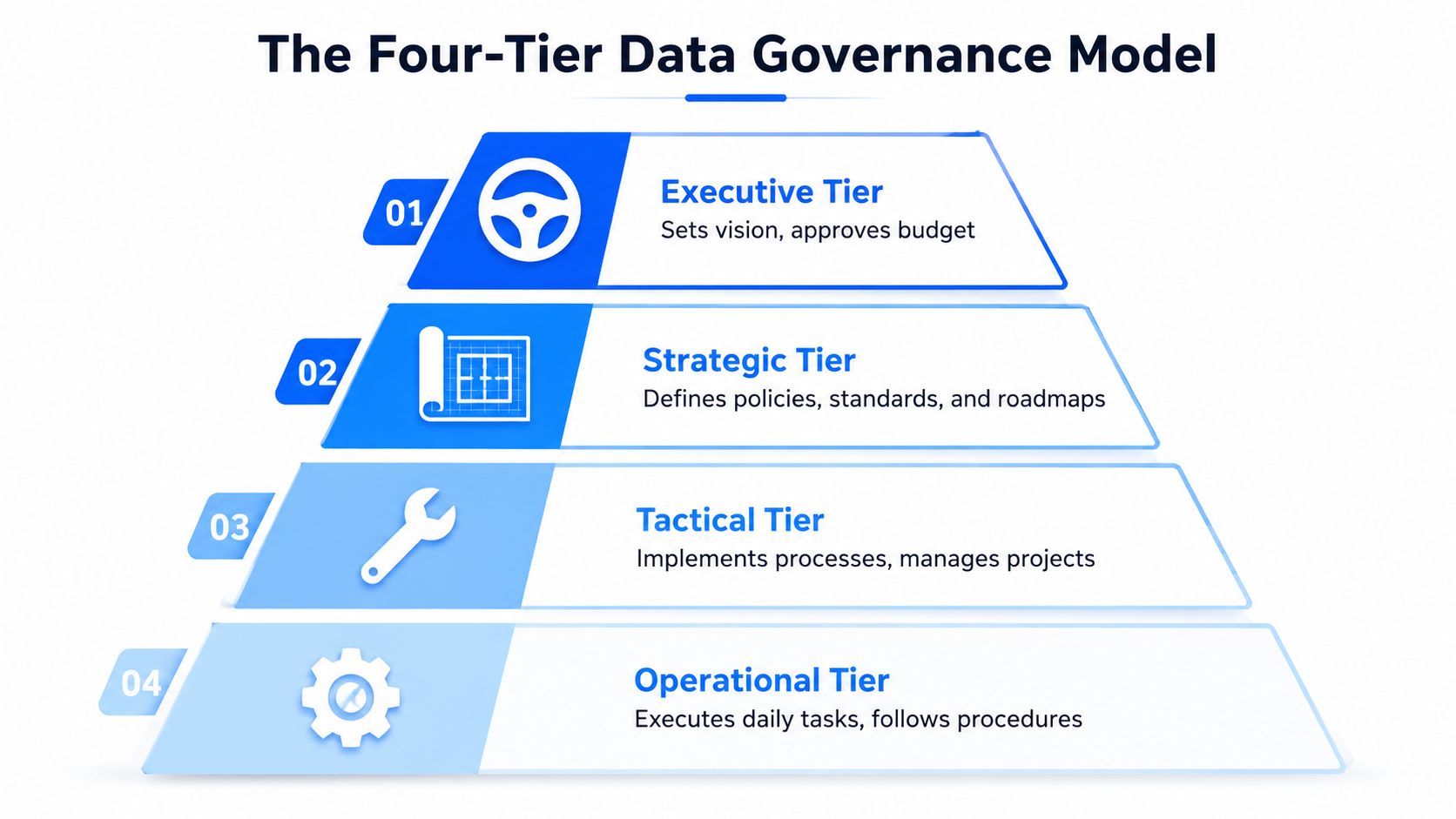
A governance title becomes easier to place once you know which tier it serves. A person who sets direction belongs near the top of the model. A person who runs checks, records evidence, or handles exceptions belongs lower down. Confusion starts when one title is expected to cover every layer at once.
Executive, strategic, tactical, operational
The executive tier sets direction, funding, and risk appetite. It answers a simple question, why does this governance program exist, and what trade-offs are acceptable?
The strategic tier turns that direction into policies, standards, and priorities. It decides the rules the business will follow and the outcomes the program should measure.
The tactical tier organizes the program. A governance office or program team coordinates standards, framework design, escalation paths, and cross-functional alignment. It is the layer that keeps the work from becoming a collection of disconnected decisions.
The operational tier handles the work that shows up every day. People in this tier manage access classification, definitions, monitoring, documentation, issue triage, and the evidence that shows controls are being followed.
As noted earlier in the overview of governance models, the European Commission uses a layered approach that separates responsibilities across executive, managerial, and operational levels, with supporting bodies and role holders spread across the enterprise. That matters because it shows this structure is a practical way to keep one title from carrying conflicting duties.
How to use the model in practice
If you are reading a job description or drafting a charter, place the role in one tier first. Then ask what work lands on that role every day. A data owner belongs closer to strategic accountability, while a data steward usually sits closer to tactical and operational execution, as outlined in this data steward definition. A data custodian lives in technical operations, and the Chief Data Officer sits above them, tying governance to business goals.
The model becomes useful when you connect it to real work, not just titles. A steward should know which issue queue they monitor, which definition disputes they triage, and which evidence they collect for audits. A custodian should know which controls they validate and which systems they inspect when something drifts. If you need a practical example of how knowledge moves across teams, the same logic appears in efforts to build a smarter team with better knowledge, where ownership only works when the handoff is clear.
Once you know the tier, the next step is much easier. You can write responsibilities that match the work, set handoffs without overlap, and avoid loading a single role with strategy, coordination, and daily execution at the same time.
Core Data Governance Roles and What Each One Owns
A lot of teams use the same four roles, but they describe them so loosely that nobody can tell where one ends and the next begins. That is risky, because the Chief Data Officer, Data Owner, Data Steward, and Data Custodian each answer a different question. If you blur them, you blur accountability.
The chief data officer sets direction
The Chief Data Officer, or CDO, is the senior leader who defines and executes data strategy, oversees governance policies and frameworks, ensures compliance with regulations and security standards, and aligns governance work with business objectives, as described by Actian (Actian on governance roles). The CDO does not own every dataset. The CDO owns the shape of the program and the business case for it.
That distinction matters in real organizations. A CDO should be able to answer questions about priorities, funding, and program escalation, but not be dragged into approving every access request or cleaning up every broken definition.
The data owner is accountable for the domain
The Data Owner is the person who is accountable for a domain's data and its fitness for use. In practice, that means approving policy for the domain, making risk trade-offs, and signing off when exceptions are needed.
A good way to think about the owner role is responsibility without day-to-day typing. The owner decides what good looks like, who can use the data, and what happens when quality falls short.
The data steward runs the business-facing work
The Data Steward lives in the business unit and works closest to the operational details. A stewardship role definition from Digna describes this role as the one that maintains definitions, clarifies how data should be used, and handles day-to-day governance work, which makes it a useful reference for drafting a practical charter (data steward definition).
A separate DATAVERSITY description says operational stewards create and approve data definitions, identify and classify access levels, and define how data will be used and managed (operational responsibilities overview). That is the role that gets pulled into evidence collection, issue follow-up, and the “what changed?” conversation after a data incident.
For teams that need a broader operating model, knowledge-sharing also helps. A resource like build a smarter team with better knowledge is useful because governance breaks down fast when people cannot find the latest definitions, decisions, or exception history.
The data custodian handles the technical controls
The Data Custodian owns the technical side, storage, access controls, backup, archival, and infrastructure. Industry role frameworks place custodians on the implementation side of the house, where technical control happens.
That means the custodian does not decide the policy. The custodian ensures the platform enforces it. If a steward says a dataset needs restricted access or a retention rule, the custodian is the one who makes the control real.
Use this test: if the work changes the rule, it belongs higher up. If the work applies the rule, it belongs lower down.
Engineering Roles and How They Fit Into the RACI Picture
Engineers often ask where they fit, because governance diagrams usually jump from owner to steward and skip the delivery layer. That leaves a real gap. Data pipelines, semantic models, and ML systems still need someone to implement controls, and those people are usually data engineers, analytics engineers, and ML engineers.
Responsible does not mean accountable
A clean RACI lens helps here. The Data Owner stays Accountable for the data domain. Engineering roles are usually Responsible for implementing the controls and checks that governance requires.
A Data Engineer is Responsible for building the pipeline controls the steward defines, including loading logic, validation hooks, and operational fixes. An Analytics Engineer is Responsible for modeling data in line with definitions and lineage expectations, so the business layer reflects the agreed meaning of the data. An ML Engineer is Responsible for feature and model governance, including lineage, bias checks, and validation rules.
None of those engineering roles should be treated as the owner of the domain itself. They can own a task, a pipeline, or a model, but the business accountability still sits with the Data Owner.
Where the handoffs usually happen
The handoff starts with a definition or policy decision, then moves into implementation. The steward clarifies the rule, the engineer encodes it, and the owner signs off when the domain needs an exception or a risk decision.
That division keeps governance practical. Engineers don't have to guess policy, and owners don't have to debug code. The system works because each person has a specific kind of responsibility.
In privacy-sensitive or AI-heavy environments, the handoff becomes even more important. Teams can't rely on broad access alone, so the governance role has to define what data can be seen, what checks need to run, and what evidence must be preserved. A governance-aware platform can help, and tools such as digna are built to run in the customer's own environment while validating records, tracking timeliness, detecting schema changes, and monitoring business and platform metrics.
A simple RACI snapshot
Role | In the RACI picture | Typical ownership |
|---|---|---|
Data Owner | Accountable | Domain risk, approval, exceptions |
Data Steward | Responsible | Definitions, rules, follow-up |
Data Engineer | Responsible | Pipelines, technical controls, fixes |
Analytics Engineer | Responsible | Semantic models, lineage, consistency |
ML Engineer | Responsible | Features, model checks, validation |
If you keep that split clear, the rest of the program gets easier to govern. If you don't, every issue becomes a debate about who should have noticed it first.
Connecting Roles to Observability and Data Quality Capabilities
Teams often buy observability for the signal, then forget to wire the signal into the role model. That's backwards. Observability capabilities exist so people can do their jobs faster and with better evidence, not so dashboards can sit in a separate corner of the stack.
Who owns the output of each control
A Data Steward defines what good looks like for a dataset, including the threshold for acceptable quality and the business meaning of the rules. The platform then watches for deviations through anomaly detection, timeliness monitoring, schema tracking, and record-level validation. Those capabilities are core to the way digna describes its data quality and observability modules, along with in-database execution and monitoring inside the customer's environment.
The engineer triages the root cause when the platform flags something. The owner signs off on remediation or exception handling when the issue affects business use. That sequence matters because observability doesn't replace accountability, it gives each role the evidence it needs to act.
Map the capability to the role
A useful way to think about it is by output, not by tool.
Anomaly detection surfaces unexpected behavior. The engineer investigates, and the steward decides whether the deviation breaks the rule.
Timeliness monitoring shows whether data arrived when expected. The operations owner or engineer responds first, while the steward confirms whether lateness affects downstream use.
Schema tracking catches structural drift. The custodian or engineer corrects the pipeline, and the steward checks whether definitions need to be updated.
Record-level validation proves that business rules hold at the row or record level. The steward owns the rule, and the engineer implements the check.
The platform should raise the alert, but people still have to decide what the alert means.
That line becomes even more important in regulated environments. If you need a practical example of how retention, sharing, and control language gets handled in a formal setting, review Formcarry's legal DPA. It's a helpful reminder that governance roles don't just define policy, they also support the evidence trail behind privacy and processing commitments.
The same logic appears in broader observability guidance. Digna's overview of what is data observability shows why monitoring is valuable only when the team knows who responds to the signal. That's the core workflow: define the rule, watch the data, investigate the exception, and record the resolution.
Why this changes daily work
A steward shouldn't watch every line of a dashboard all day. That's not stewardship, it's operational overload. The steward should receive clear evidence, decide whether the rule still fits the business need, and escalate when a repeated pattern suggests a governance change.
That separation keeps observability usable. The platform surfaces problems. The roles turn those problems into action.
KPIs, Job Description Anchors, and the Governance Council
A role without a measurable output tends to drift. The easiest way to keep governance grounded is to attach one KPI to each role and use those metrics in the council. For teams that need a broader metrics lens, Kogifi's hybrid cloud governance metrics guide is a useful reference point for thinking about control, performance, and accountability together.
Role-to-KPI Reference
Role | Primary KPI | Operational Output |
|---|---|---|
Data Owner | Percent of critical datasets with documented owners | Approved ownership and exception decisions |
Data Steward | Mean time to triage for data incidents | Issue review, rule clarification, escalation |
Data Custodian | Percent of pipelines with schema-change alerts | Control coverage and technical enforcement |
Data Engineer | Percent of monitored pipelines with validation checks | Working checks, fixes, and incident resolution |
Data Governance Office | Percent of governance standards with assigned workflows | Program coordination and framework maintenance |
The Governance Council is the place where cross-domain trade-offs get resolved. It is not a status meeting. It's where privacy and access, speed and control, and cost and quality are discussed with the right decision-makers in the room.
What the council should actually do
The council should set escalation paths, confirm decision rights, and review the KPIs that show whether the operating model is working. If a steward keeps escalating the same kind of issue, the council should ask whether the policy is wrong, the control is missing, or the ownership line is blurry.
A practical charter usually includes three things. First, which roles attend and who can make decisions. Second, what kinds of issues reach the council. Third, how exceptions are logged and reviewed later.
The meeting cadence matters less than the discipline. A regular, short review with real decisions is more useful than a long session that produces only notes. The council should leave behind named actions, assigned owners, and evidence requirements.
How to Assign and Operationalize Roles Without Rebuilding the Org Chart
The safest way to assign governance roles is to start with the work people already do. The New South Wales data governance toolkit recommends assigning responsibilities across the organisation, mapping them in a data catalogue, and formalising responsibilities where they already exist instead of assigning them to someone who isn't doing the work day to day (NSW governance toolkit). That's the right instinct for most enterprises.
A practical sequence
Start by identifying who already handles definitions, approvals, evidence, and incident follow-up. Then formalize those responsibilities instead of inventing a new layer of accountability. If the business already has a de facto steward, name that person or team explicitly.
Next, identify the gaps. Most programs need an executive sponsor and a council convener, and those should be named people, not loose committees. The sponsor gives the program authority, and the convener makes sure decisions don't disappear between meetings.
Then connect every role to the catalogue, the monitoring outputs, and the escalation path. If a person owns a domain, that ownership should show up in the catalogue. If a control fires, the alert should land with the right responder. If a decision is needed, the escalation path should be visible before the issue becomes urgent.
Finally, review the model quarterly using the KPIs from the council. That keeps the role design tied to actual behavior instead of wishful thinking.
A program doesn't need a fresh org chart to work. It needs clear ownership, visible evidence, and a way to move from alert to action without confusion. If you want a structured way to implement that operating model, see how to implement data governance and translate the roles into your own catalog, controls, and review cadence.
If you're defining or fixing data governance roles, digna can help you connect ownership to the actual monitoring work behind the scenes. It runs inside your environment, validates records, tracks timeliness, detects schema changes, and surfaces the evidence teams need to act. Visit digna to see how that fits into a real governance operating model.
Once a steward has defined what good looks like for a dataset, digna Data Validation is where engineers can turn those business rules into record-level checks that produce the evidence owners sign off on.
Frequently asked questions
What are the four tiers of data governance roles?
The model separates executive, strategic, tactical and operational tiers. Executives set direction, funding and risk appetite; the strategic tier writes policies and standards; the tactical tier, usually a governance office, coordinates escalation and alignment; and the operational tier handles classification, definitions, monitoring, triage and audit evidence every day.
What is the difference between a data owner and a data steward?
The data owner is accountable for a domain's data and its fitness for use, approving policy, making risk trade-offs and signing off exceptions. The steward sits in the business unit and does the day-to-day work: maintaining definitions, clarifying usage, collecting evidence and following up after incidents. Ownership means responsibility without day-to-day typing.
What does a data custodian do in data governance?
A data custodian owns the technical side: storage, access controls, backup, archival and infrastructure. The custodian does not decide policy but makes sure the platform enforces it. The article offers a simple test: if the work changes the rule, it belongs higher up; if it applies the rule, it belongs lower down.
Where do data engineers fit in a governance RACI?
Engineers are Responsible, not Accountable. Data engineers build the pipeline controls stewards define, analytics engineers model data in line with agreed definitions and lineage, and ML engineers handle feature and model checks. Accountability for the domain stays with the data owner, so engineers can own a pipeline without owning the data.
Which KPIs should be assigned to data governance roles?
Attach one primary KPI to each role and review them in the governance council. Suggested examples include percent of critical datasets with documented owners for data owners, mean time to triage for stewards, percent of pipelines with schema-change alerts for custodians, and percent of monitored pipelines with validation checks for engineers.