On Prem LLM Deployment: A Practical Enterprise Guide
|
0
min. Lesezeit

The worst advice about on-prem LLM deployment is that keeping the model inside your network makes it secure. It doesn't. If you can't prove who accessed what, what prompts were sent, what context was retrieved, and how outputs were approved, you've built a local black box, not a governed system.
That distinction matters more in regulated environments than in almost any other architecture decision. A language model can sit in your data center and still leak sensitive records through sloppy access control, weak retention rules, or missing audit trails. The genuine question isn't whether the model runs on your hardware, it's whether your team can defend every material decision the system makes.
Table of Contents
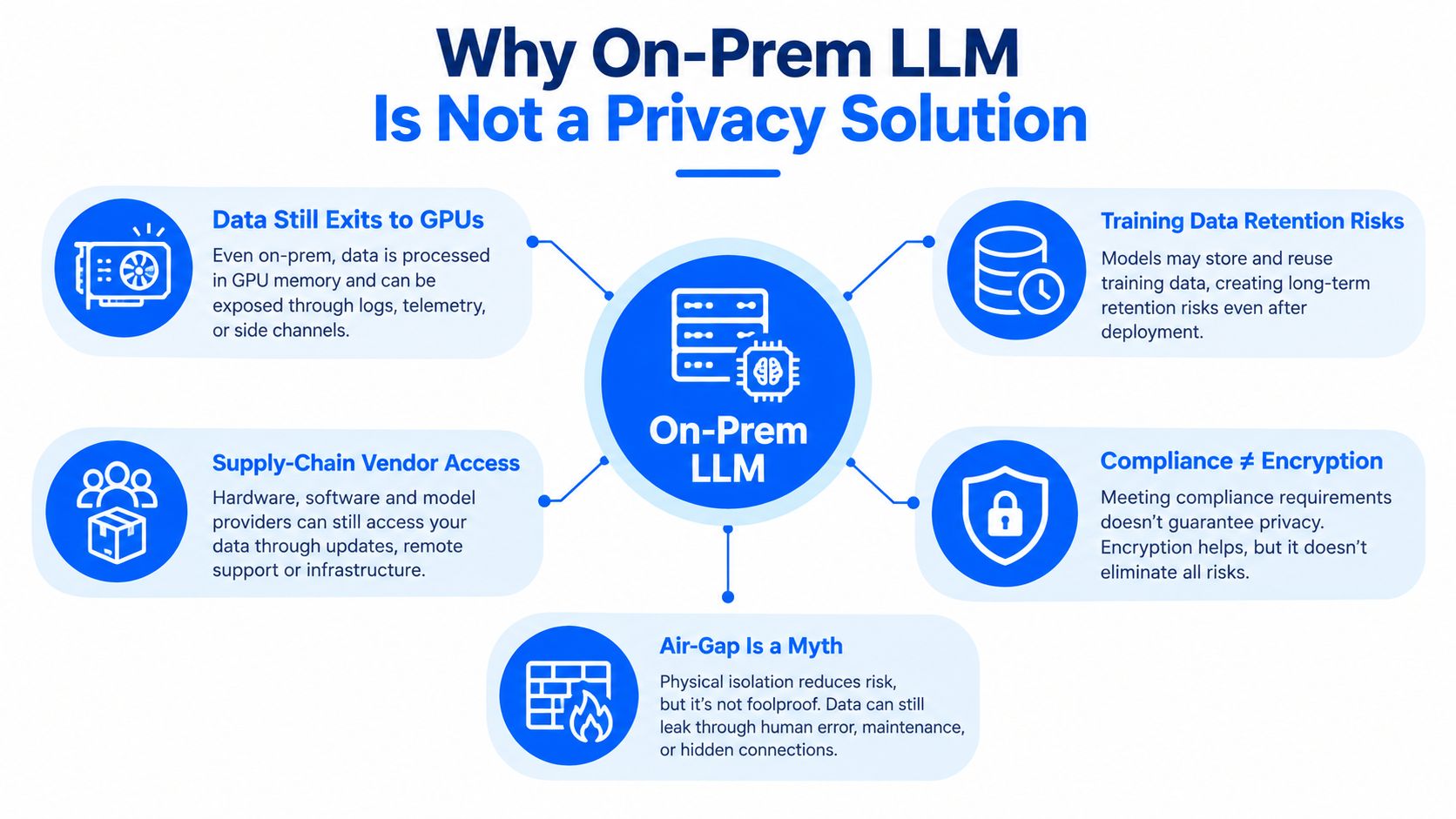
Why On-Prem LLM Deployment Is Not a Privacy Solution
A finance team once told me their plan was simple, put the model behind the firewall and the privacy problem goes away. It didn't. The team still had to answer who could retrieve sensitive records, whether prompts were retained, how retrieved documents were logged, and whether an analyst could reconstruct an answer after the fact.
That's the trap in on prem LLM deployment. Physical locality is only one control layer, and it's the easiest one to explain in a procurement meeting. The harder part is inside the perimeter, where identity, lineage, prompt content, retrieved context, model version, and human approval all need to line up in a defensible record. A 2025 analysis warned that once data enters an LLM without tracking mechanisms, organizations may not know what was exposed, who accessed it, or when, which is exactly why https://www.protecto.ai/blog/risks-of-hosting-llms-on-premise/ matters to regulated buyers.
Treat the model like a production data system
The same standard you apply to financial or clinical pipelines has to apply here. Record-level authorization, lineage for RAG sources, immutable audit logs, retention policies, red-team testing, and continuous evaluation for leakage and hallucination aren't optional extras. They're the evidence model that proves the system behaved correctly.
Practical rule: if your auditor asks what the model saw, what it retrieved, and who approved the output, your logs need to answer in minutes, not in a postmortem.
That's why sectors like financial services, healthcare, telecommunications, and government need to start with traceability, not hardware. The model can stay in a private cloud, a VPC, a data center, or colocation, but the organization still has to reconstruct the chain of custody for every meaningful output. For a useful compliance framing, see data sovereignty and compliance guidance.
Choosing the Right Model Hosting Approach
Not every on-prem setup needs a large distributed cluster. Some teams just need a single GPU server that answers internal questions and supports a narrow workflow. Others need a serving layer that can survive bursty traffic, long context windows, and multiple teams hitting the same model at once.
Match the hosting pattern to the workload
A lightweight local inference server works well for prototyping, batch processing, and small internal tools. It keeps the footprint low and the operational burden manageable, but it won't carry serious concurrency or long-context workloads without latency pain. Once the model starts serving live staff or customer-facing use cases, a containerized runtime with proper orchestration becomes the more durable option.
Distributed serving clusters make sense when the model doesn't fit on one accelerator, when the context window is large, or when request volume is high enough that one node becomes a bottleneck. That's where tensor parallelism, sharding, and multi-node networking stop being theoretical architecture topics and start becoming day-two survival topics. For a practical comparison of federated and centrally hosted approaches, this overview on what federated architectures change operationally is useful context.
Size the host around model behavior, not hype
Parameter count alone doesn't tell you what to buy. The release path from LLaMA to Llama 2, Llama 3, and Llama 3.1 opened the door to commercially usable open weights, but the hosting choice still depends on whether you're serving an 8B model, a 70B model, or something much larger. Meta's LLaMA family started the shift on February 24, 2023, Llama 2 on July 18, 2023 made commercial use practical, Llama 3 arrived on April 18, 2024, and Llama 3.1 on July 23, 2024 added 405B and a 128,000-token context window, which changed the infrastructure conversation for serious deployments.
That's where hardware reality bites. Smaller 7B to 8B models can fit into modest GPU environments, while 70B and 405B models need much more distributed infrastructure. If the workload is mostly internal drafting or structured Q&A, you can often start smaller. If it's a regulated serving environment with live users and long conversations, the platform needs to be built for predictability first and elegance second.
A model that fits is not the same thing as a model that serves well. Fit is a memory question. Serving is a latency and concurrency question.
Benchmarking Capacity Before Buying Hardware
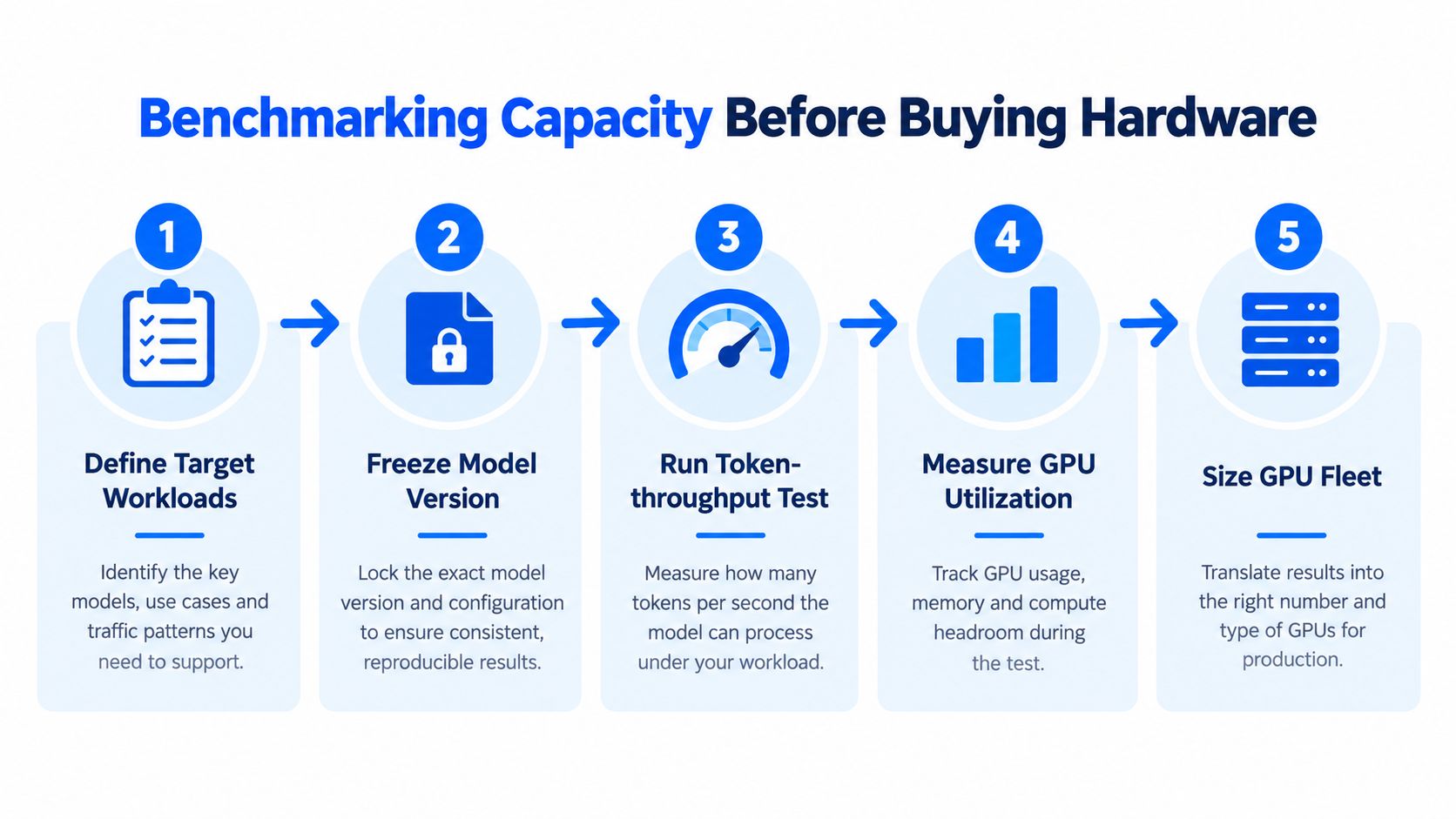
Never buy hardware from a parameter spreadsheet. That's how teams overbuy, underbuy, and then lose a quarter rebuilding the sizing model after the first real load test. The better pattern is to freeze the workload definition first, then benchmark the system under the conditions it will actually face.
Lock the workload before you touch infrastructure
Start by freezing the target model, quantization level, context length, output length, concurrency, and quality threshold. If any of those variables are still moving, the benchmark will lie to you. Then test both Server and Offline workloads, because they answer different questions, Server mode reflects live traffic, while Offline mode shows maximum batch throughput.
Record time to first token, time per output token, tokens per second, tail latency, GPU memory utilization, power, and failure or retry rates under the concurrency you expect in production. Repeat the run after enabling production features such as continuous batching, prefix caching, tensor parallelism, and retrieval augmentation, because a lab configuration is not a production configuration. A neutral MLPerf example shows why this matters, a single H100 running Llama 3.1 8B produced 5,777 tokens/s offline but 5,104 tokens/s in server mode, while a single L40S produced 1,642 and 1,207 tokens/s respectively, and MLPerf reports performance variation of roughly four orders of magnitude across inference systems, so peak numbers don't transfer cleanly to enterprise reality, as described in Red Hat's MLPerf inference write-up.
Use acceptance gates, not gut feel
A clean production gate is simple. Quality stays above the agreed evaluation threshold, p99 latency stays within the user-facing SLO at expected peak concurrency, and capacity retains headroom for failover and model-version rollout. If any one of those fails, the deployment isn't ready.
For teams that need to operationalize this beyond the benchmark notebook, there's a useful external reference on licensing operational datasets to AI labs that also highlights how carefully dataset choices should be documented before inference systems are wired to real workloads. The lesson applies here too: if you can't explain the data shape, you can't accurately size the system.
The Real Cost of On-Prem LLM Infrastructure
The hardware quote is the least interesting part of the bill. Power, cooling, rack density, staff time, idle capacity, and upgrade friction decide whether on-prem wins. Teams that ignore those costs usually discover the gap after procurement, when the platform is already locked in.
Utilization matters more than sticker price
On-prem only gets cheaper when the workload is sustained, predictable, and large enough to keep the GPUs busy. Deloitte notes that uncontrolled GPU consumption can create substantial cost and efficiency problems, and a 2025 report citing an enterprise AI study forecasts an 89% increase in generative-AI compute costs from 2023 to 2025, while also noting that self-hosted inference can become cheaper than third-party hosting at sufficiently large, predictable workloads (Deloitte AI infrastructure analysis). That combination tells you exactly what matters, workload shape, not ideology.
A utilization threshold framework beats a server quote every time. Ask what level of sustained demand justifies owning GPUs, what the peak-to-average ratio looks like, and how much idle reserve the team needs for failover and upgrades. If the workload is spiky or the model fleet serves multiple business units with different traffic shapes, the economics shift fast.
Don't forget power and facility constraints
The U.S. Department of Energy reported that U.S. data centers consumed approximately 176 TWh of electricity in 2023, equal to about 4.4% of national electricity consumption, and projected roughly 325–580 TWh by 2028, or 6.7%–12% of U.S. electricity use. It also said data-center electricity demand has tripled over the past decade, which makes power planning a first-class design input, not a facilities footnote (DOE data-center electricity report).
That's before you get to the rack. A 512-GPU H100 cluster may require roughly 3–5 MW of IT load before cooling overhead, according to an infrastructure market estimate cited by Deloitte, which is enough to turn a “simple AI rollout” into a serious site-planning exercise. If your data center can't handle the load, the model doesn't get to be clever. It gets to be delayed.
Integrating Data Observability Into LLM Pipelines
The cleanest way to run an on-prem model is to stop treating it like a chatbot and start treating it like a production data system. The same monitoring logic you use for ingestion pipelines, warehouse jobs, and transformation layers should apply to prompts, retrieval sources, and generated outputs. If the pipeline is opaque, the model becomes a blind spot inside your platform.

Expose the same metrics you trust in data engineering
Inference systems need token-level metrics, queue-level metrics, resource-level metrics, and sampled request logs. That means throughput, time-to-first-token, tail latency, queue depth, GPU memory pressure, and model-service error rate, not just average tokens per second. If a model serves multiple users at once, averages hide the moments that hurt the business.
The other half is data lineage. If a response is grounded in RAG, the team needs to know which documents were retrieved, which version of the model produced the answer, and whether the output passed a downstream rule before it reached the user. In-database observability matters here, because it keeps production data inside the customer environment while still calculating metrics and analysis where the data lives. That's also why an internal observability layer should live alongside the model registry, not somewhere off to the side in a dashboard no one checks.
Make quality checks part of the serving path
Prompt drift, schema drift in embedding pipelines, stale retrieval data, and output validation all need explicit checks. If a prompt template changes and nobody notices, the model can degrade without anyone noticing for weeks. If the retrieval layer starts returning poor context, the answer quality drops even though the model itself didn't change.
digna executes checks in-database, keeping production data inside the customer's environment while computing metrics and analysis natively. The platform supports deployment in private cloud, VPC, or data center, with modular licensing that starts with one module and expands across anomaly detection, timeliness, validation, and business monitoring. For teams building AI-serving observability into the same control plane as their data stack, the internal reference is data quality observability.
Governance, Auditability, and Compliance Controls
A secure network boundary doesn't satisfy an auditor by itself. The auditor wants evidence, who asked for the response, what data the model saw, what version generated the output, and who approved it if the answer was sensitive. If your logs can't reconstruct that chain, you've built a deployment, not a governed system.
Build the evidence model before production
Identity management has to sit in front of the inference API, and per-user or per-team permissions need to flow through the system. Prompt retention needs a policy, not an accident. Retrieval lineage needs to show which sources were eligible, which were used, and how long the artifacts were retained.
That matters because the common failure isn't a missing GPU, it's a missing trail. A regulator or internal audit team will ask how the system handled data minimization, access control, and retention, and the answer has to be concrete. If the response path is unclear, the control is weak regardless of whether the cluster is physically isolated.
Govern the output, not just the input
Red-team testing, leakage review, hallucination checks, and controlled rollout gates belong in the same release process as model updates. The model version, the retrieval corpus version, and the approval step for high-risk outputs should all be visible in the audit record. That's the difference between “it runs locally” and “it can survive a review.”
The most important question in regulated AI is not whether the model stayed inside the perimeter, it's whether the organization can prove what happened after the prompt entered the system.
For a sharper compliance posture, this AI governance and compliance reference is a practical companion because it frames governance as an operating discipline, not a checkbox. That's the mindset regulated teams need if they want the deployment to stand up six months later when the first incident review happens.
Practical Deployment Checklist and CI/CD Integration
Before production, lock the model version, validate the container image, confirm GPU driver consistency, test interconnect performance, and write the rollback path down. Then wire observability checks into CI/CD so inference quality degradation can block promotion instead of showing up in user complaints. If you're scanning deployments and pipelines before release, pre-deployment scanning with Foo Guard is a good example of the kind of upstream control that belongs in the same process.
The simplest decision rule is this, stay fully on-prem when the workload is tightly regulated or when external dependencies are unacceptable, and use hybrid or cloud bursting when the workload is bursty and the policy allows it. For the deployment glue around that decision, pipeline orchestration guidance helps anchor the handoff between build, validation, and rollout. Get those controls right before the first live query, because model quality is easy to demo and hard to govern.
If you're building on-prem LLM deployment into a real production stack, digna helps you keep the data side observable, auditable, and inside your environment. Visit digna to see how in-database checks, monitoring, and governance fit the same operational discipline your AI pipelines need.