Data Quality vs Data Governance: A Practical Guide
|
8
min read

A CFO opens a revenue dashboard on Tuesday morning and sees a 14% swing overnight. By lunch, three teams have already built three different explanations. Data engineering blames an upstream schema change that nobody documented, analytics blames the governance council for approving a definition nobody reads, and the source system owner says the vendor pushed a release. That's usually when people start using data quality and data governance as if they're interchangeable, even though the failure is rarely that neat.
The fastest way to untangle it is to treat governance as the control system and quality as the measurable output. Governance defines who owns the data, which rules apply, how changes get approved, and how issues get resolved. Quality tells you whether the data is fit for use. The two are linked, but they're not the same thing, and confusing them is how teams end up with polished policies and broken dashboards.
Criterion | Data Governance | Data Quality |
|---|---|---|
Core question | Who decides, controls, and accounts for the data | Is the data fit for its intended use |
Primary output | Policies, ownership, lineage, access rules, escalation paths | Measured records, validated rules, anomaly alerts, scores |
What gets managed | Decision rights and workflows | Dataset behavior and record-level integrity |
Best evidence | Coverage, adoption, audit readiness, MTTR | Accuracy, completeness, timeliness, consistency, validity, uniqueness |
Typical failure | Policy theater without enforcement | Good checks with no ownership or remediation path |
That distinction matters in regulated environments, in AI programs, and in ordinary operational reporting. It also explains why many teams can't answer a simple question after an incident: was the issue a broken control, or was the control fine and the data itself bad? One good way to see the difference is the practical framing in how to automate infrastructure governance, which makes clear that control design and operational execution are not the same job.
Table of Contents
Why These Two Terms Keep Getting Confused
A broken dashboard pulls both terms into the same meeting. The finance lead wants the number corrected, the platform team wants the source traced, and each side reaches for the label that makes its own work look less at fault. Governance gets blamed when a definition is unclear. Quality gets blamed when a metric is wrong. The issue is often the missing handoff between the two.
That confusion shows up because the failure mode is not always obvious. A definition change without approval is a governance problem, while a stable definition that loads partial rows is a quality problem. A control can be weak, and the data can still be clean enough to pass checks. The reverse happens too, which is why teams often argue about symptoms instead of the control layer versus the measured output.
Practical rule: if the question is about who approved the rule, think governance. If the question is about whether the data met the rule, think quality.
The distinction matters in operational work, not just in policy decks. Governance is the control system, the set of decisions and approvals that shape how data should behave. Quality is the reading on the instrument, the evidence that the data behaves that way. That is also why how to automate infrastructure governance is a useful reference point, because it separates control design from day-to-day execution.
Why the confusion persists in practice
Teams usually meet governance through catalog entries, approval workflows, access reviews, lineage diagrams, and ownership meetings. They meet quality through failed checks, stale loads, duplicate records, and business users asking why the same KPI changed twice in one week.
That overlap creates a shortcut, but it is a risky one. Governance can look mature on paper while quality stays weak, because policies do not clean data by themselves. Quality tooling can also look impressive while governance stays vague, because checks without ownership just produce faster alerts. The result is familiar in regulated programs and AI work, where a control may exist but nobody can say whether it is enforced.
The cleanest way to separate the terms is to ask one question every time a data issue appears. Is this about the rules and responsibilities around the data, or is it about the observed condition of the data itself? That answer tells you whether to look at governance controls, quality measures, or both. For teams comparing control scope with compliance boundaries, digna compliance vs governance is a useful starting point.
Defining Data Governance and Data Quality
A regulated customer table can fail two different ways. The stewards may not know who approved a schema change, or the records may be incomplete and inconsistent even though the approval trail is clean. Those are different problems, and they need different controls.
Governance is the control system
Data governance is the system of policies, roles, decision rights, and workflows that determine who can define, change, access, and retire data assets. In practice, it covers ownership, approvals, classification, lineage expectations, access rules, escalation paths, and retirement rules. The point is repeatable decision-making that people can audit and enforce, not a policy binder sitting untouched in a shared drive.
That control layer also needs executable checks. If a policy says a dataset must follow a specific specification, the platform has to test that requirement, not just document it. For teams building that control layer, digna's data governance overview is a useful reference for how policy, ownership, and enforcement fit together in one program. The standard ISO 8000-51:2023 points in the same direction, because it focuses on exchanging governance policy statements and on automated conformance testing against the data specifications those policies reference, as described in the official ISO standard record.
Quality is the instrument reading
Data quality is the measured fitness of data for its intended use. Teams usually assess it through completeness, accuracy, consistency, timeliness, validity, and uniqueness. The measurement vocabulary in ISO 8000 treats quality as something you assess inside quality management processes and systems, not just something you discuss abstractly, as reflected in the ISO 8000 measurement standard overview.
That framing matters because quality is contextual. A billing table may care most about accuracy and completeness. A streaming event feed may care more about timeliness and validity. A master customer table may care about uniqueness and consistency. The same dataset can also be governed well and still fail quality checks if upstream systems send bad values.
Governance asks, “Who owns the rule and the exception path?” Quality asks, “Did the data satisfy the rule in this dataset, right now?”
In a real platform rollout, I treat governance as the control plane and quality as the observable result. If a team wants to connect the two, the patterns in how to automate infrastructure governance are still useful, because they force the discussion toward enforceable controls, ownership, and testable outcomes. That same distinction shows up in digna modules as well, where governance controls and quality checks should be mapped separately so teams can see which control influences which outcome.
Side-by-Side Comparison Across Criteria
Ownership and artifacts are where the line shows up
The easiest way to separate data governance vs data quality is to compare what each one owns. Governance owns the decision framework. Quality owns the observed behavior of the data. That difference shows up in the artifacts each team creates, the cadence they run on, and the failure mode they're trying to prevent.
Criterion | Data Governance | Data Quality |
|---|---|---|
Primary objective | Establish accountability, traceability, and policy control | Prove that data is fit for use |
Primary owner | Data governance lead, domain steward, or control owner | Data quality lead, data engineer, or dataset owner |
Core artifacts | Policies, glossaries, lineage, access rules, stewardship workflows | Thresholds, validation rules, anomaly alerts, remediation tickets |
Measurable metrics | Catalog coverage, policy coverage, lineage coverage, access-review completion, MTTR | Accuracy, completeness, consistency, timeliness, validity, uniqueness, anomaly rates |
Cadence | Program and control cadence, often monthly or quarterly | Continuous or near-real-time monitoring |
Common failure mode | Controls exist but are not enforced | Problems are detected but not prevented or fixed fast enough |
Tooling category | Catalog, policy engine, stewardship workflow, lineage management | Validation engine, observability, profiling, rule monitoring |
The boundary case is important. A column-level constraint is both a governance rule and a quality check. A policy that says “this field must not be null” belongs to governance because it defines the rule, and it belongs to quality because it can be measured on records. The same is true for a classification rule on sensitive data. Governance sets the standard, quality verifies whether the data meets it.
Why governance metrics and quality metrics are not the same
Governance frameworks often focus on whether the control system is implemented, not whether every dataset is perfect. That's why program-level metrics like catalog coverage, policy coverage, lineage coverage, and access-review completion matter. They show whether the organization has built and enforced the control plane.
Quality metrics sit one layer lower. They show whether the data itself is behaving. A team can improve governance metrics by adding policy records and approving workflows, while data still arrives late, duplicates still appear, and downstream reporting still breaks. That gap is exactly why mature programs track both layers together.
If you want the shorthand, use this: governance proves control, quality proves fitness. The governance layer is the operating model. The quality layer is the evidence that the model is producing trustworthy data. For a practical view of the quality dimensions themselves, the dimensions of data quality are easier to reason about when they're tied to real dataset behavior instead of treated as abstract ideals.
How Governance Controls Actually Improve Quality
Control changes behavior only when it reaches the source
The causal chain is simple once you strip away the jargon. A named data owner changes who is responsible for the dataset. A stewardship workflow changes who reviews exceptions. A glossary changes how teams interpret a field. A lineage mandate changes how quickly you can trace a defect back to its source. Those are governance inputs, and they only improve quality when they influence the system where data is created, moved, or transformed.
A defined owner for customer records can lift completeness because someone is accountable for missing fields and stale records. A lineage requirement can shorten root-cause analysis when accuracy drops, because the team can trace the bad value through transforms instead of guessing. A controlled revenue definition can stop silent metric drift and protect consistency, because finance and analytics are working from the same approved meaning.
The gap appears when governance stops at documentation
Many programs stall at this stage. Policies get signed. Stewardship councils get formed. Tools get procured. The dashboard still fails, because governance wrote rules that never reached the source system and quality processes only discovered the mess after it had already spread downstream.
That's the governance-to-quality gap. Governance that isn't enforced at the point of creation becomes documentation. Quality that only detects issues becomes a late alarm. Neither one is enough on its own. Mature teams need both a control path that prevents predictable defects and a measurement path that catches residual risk.
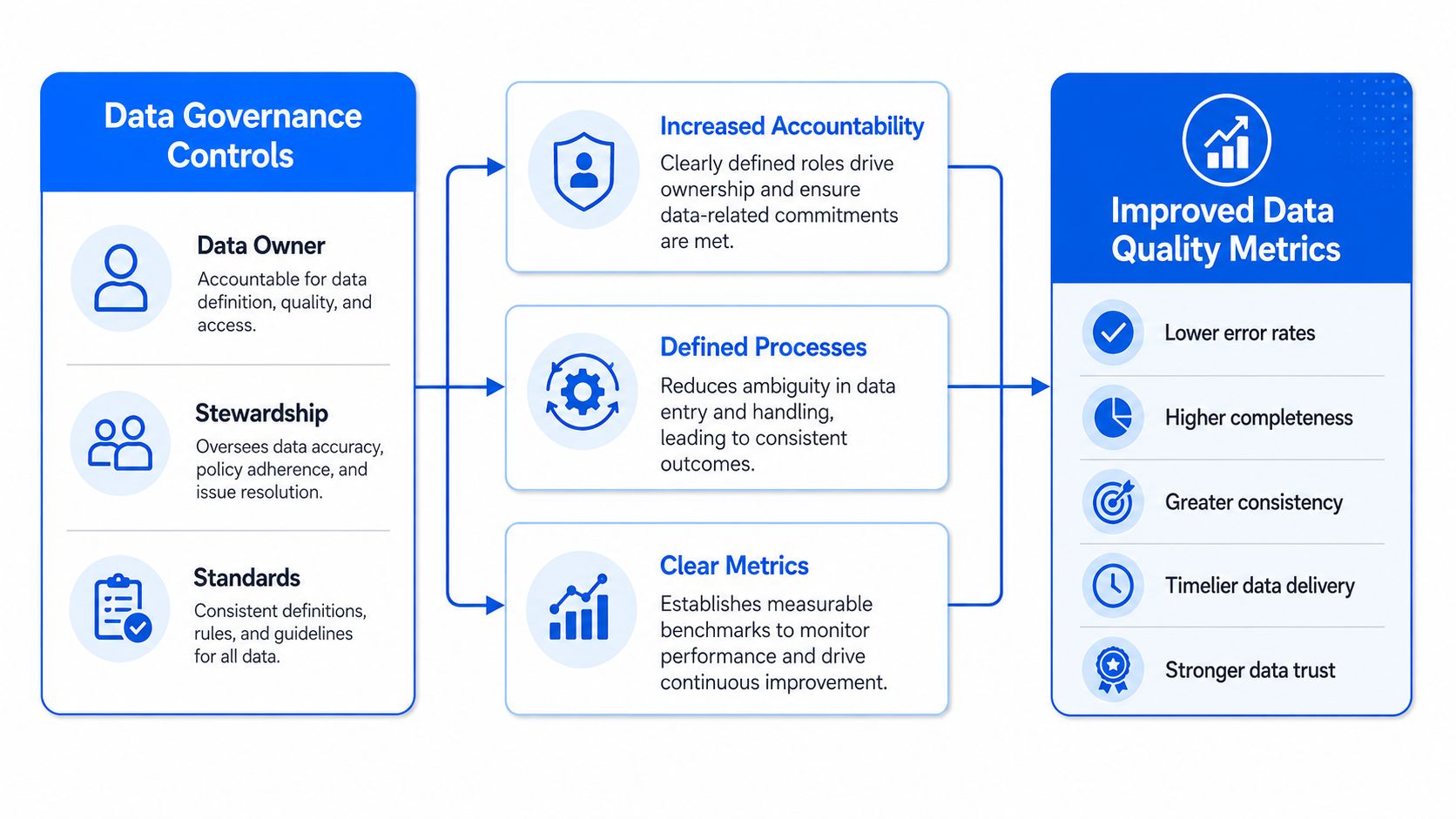
If the owner doesn't sit close enough to the source, governance becomes ceremony. If the checks don't feed remediation, quality becomes noise.
That's also why many governance maturity ladders plateau. More policy pages don't automatically produce cleaner data. Better governance only changes outcomes when it creates an enforcement loop, clear ownership, and a fast path from defect detection to remediation. For implementation patterns that connect the control layer to the operational layer, the framework in how to implement data governance is a useful reference point.
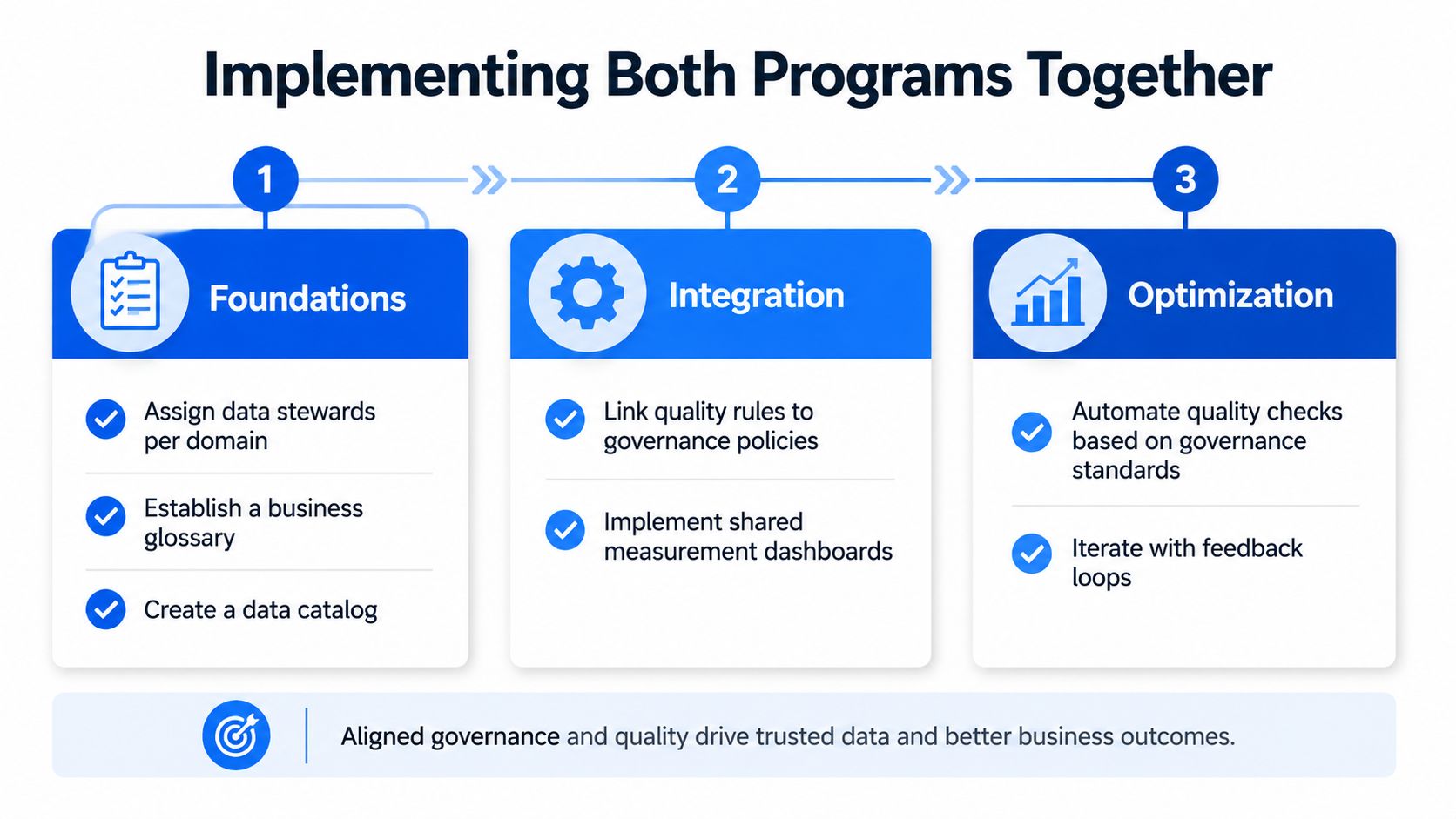
Implementing Both Programs Together
Start with ownership, glossary, and catalog basics
The first stage is plain work, and it usually pays off. Assign data stewards by domain, define a controlled vocabulary, and register the major assets in a catalog with descriptive metadata. Without those basics, teams end up arguing about names, definitions, and responsibility every time a report breaks.
A clean rollout usually starts with the following sequence:
Name stewards by domain. Make it explicit who answers for finance, customer, product, or operational data.
Define gold records. Decide which system or table is the reference when downstream copies disagree.
Publish the glossary. Tie business terms to technical fields so people stop using the same words differently.
Catalog the assets. Register key datasets, owners, and descriptions so users can find the right source faster.
Add enforcement, then automate measurement
Once the foundation exists, add classification, lineage, and policy enforcement. Sensitive fields should be flagged, contracts should be documented, and lineage should be captured where the data moves. That gives governance teeth at the point where data is created and changed, while quality checks can rely on known ownership instead of anonymous alerts.
The next stage is automation. Quality checks should monitor timeliness, schema drift, and rule violations without waiting for someone to inspect a sample by hand. SLA monitoring belongs here too, because “fresh enough” is a business expectation, not just a technical one. When quality incidents appear, the system should route them back to the steward or owner, not leave them in a queue.
Close the loop with reporting and remediation
The last stage is the one too many teams skip. Executive reporting should show trust KPIs, incident trends, and the open remediation backlog. The feedback path from quality issues back into governance keeps the policy layer honest. If a policy creates repeated exceptions, the policy needs revision. If a dataset keeps failing the same rule, the control needs strengthening.
A useful operating sequence is simple. Assign stewards, define gold records, classify data, codify lineage, set SLAs, automate checks, report quarterly, and feed lessons back into policy. That sequence holds up because it connects control and measurement instead of treating them as separate workstreams.
Where a Platform Like digna Fits
One engine for controls and measurements
A lot of teams stitch together a catalog, a quality tool, and a separate observability stack, then spend months reconciling mismatched metadata. A single in-database platform can remove that friction if it keeps governance and quality in the same workflow. In digna, the relevant modules map cleanly to both layers, which matters because the same dataset, owner, and incident history should not live in three disconnected systems.
Here's the practical split.
digna Module | Governance Role | Quality Role |
|---|---|---|
Data Catalog | Registers assets, ownership, and context | Helps teams scope checks to the right dataset |
Data Lineage | Shows dependency and transformation paths | Speeds root-cause analysis when checks fail |
Data Classification | Marks sensitive or regulated fields | Guides which rules and monitors apply |
Data Dictionary | Standardizes business meaning | Reduces ambiguity in validation logic |
Policy Enforcement | Applies access and handling rules | Prevents rule violations before they spread |
Data Contracts | Documents expected structure and behavior | Defines the conditions checks should verify |
Data Observability | Supports operational visibility | Tracks behavior, freshness, and drift |
Data Quality Rules | Encodes governance expectations | Validates records and business logic |
Validation | Enforces business and technical rules | Produces pass or fail evidence |
Anomaly Detection | Alerts on unusual behavior | Surfaces unexpected changes without manual rule setup |
SLA Monitoring | Measures adherence to timeliness commitments | Flags delays, missing loads, and freshness breaches |
Automated Quality Scoring | Provides an outcome view for control health | Summarizes data fitness over time |
The useful part is not the module list by itself. It's the fact that governance metadata and quality measurements live in the same engine and the same database, so a failed metric can be traced back to the governing policy and the accountable owner in one workflow. That's the difference between chasing tickets across teams and closing the loop in one place.
If you want a broader observability lens, the data observability overview helps frame how runtime behavior, not just static metadata, becomes part of trust operations. For teams deciding where to start, a platform that spans both layers is often easier to operationalize than a loose bundle of point tools.
Which Discipline to Invest In First
Match the starting point to the current pain
Teams early in maturity should start with governance foundations. Ownership, lineage, and catalog basics give them a structure before they chase quality scores that they can't explain. Teams under active regulatory audit usually need quality controls first, because they need auditable evidence that the data behaves as expected. Teams preparing for AI or advanced analytics should build governance and quality in parallel, because model trust depends on both control and fitness.
The trade-off is straightforward. Skip governance, and you get scattered quality wins that don't scale. Skip quality, and you get a polished framework with no measurable outcomes. Most organizations need both, but the sequence should follow the problem they're trying to solve.
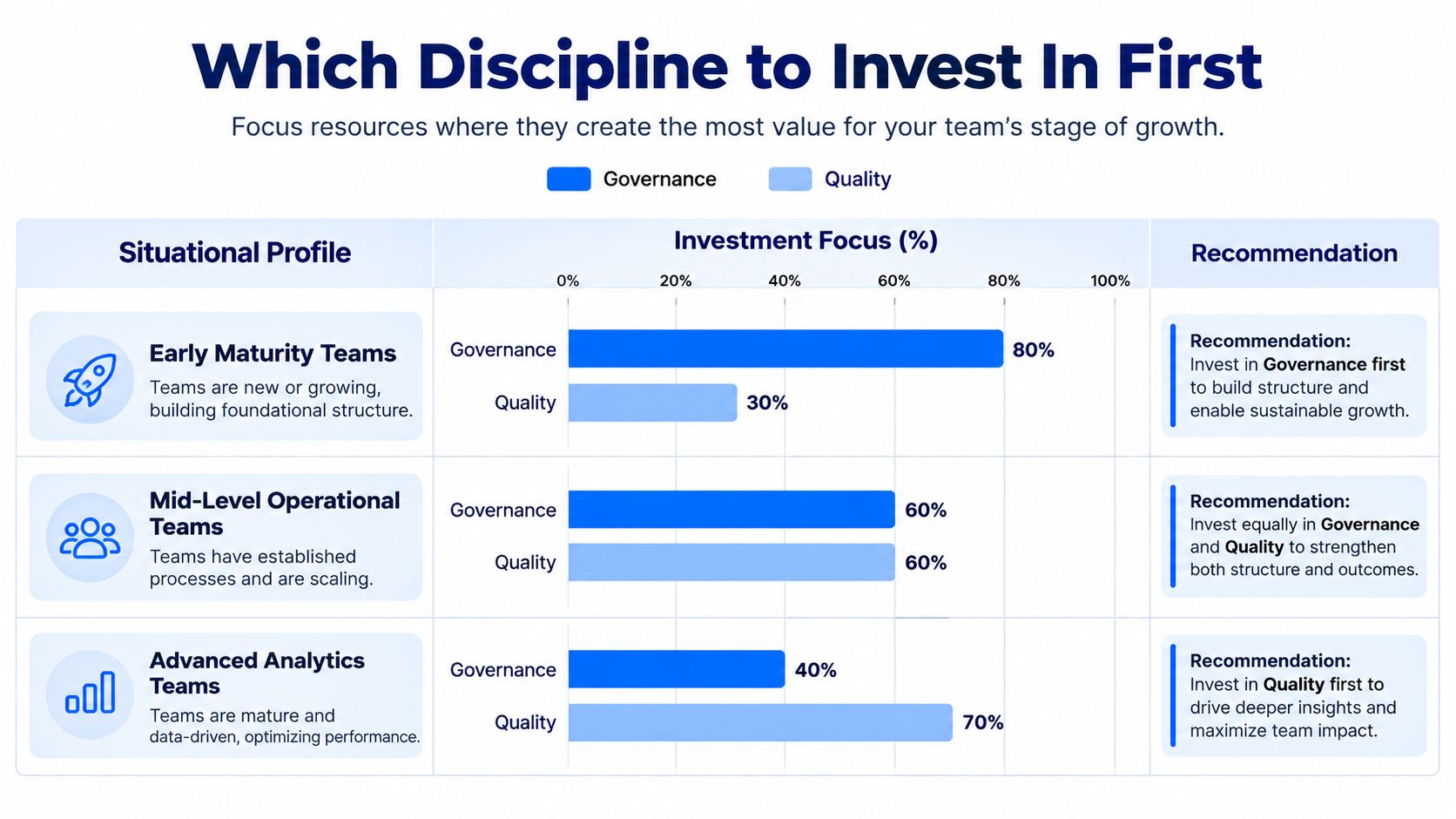
A simple decision heuristic works well in practice. If the pain is ownership confusion, start with governance. If the pain is broken evidence, start with quality controls. If the pain is AI readiness, do both together and keep the controls and measurements in the same operating loop.
digna gives teams one place to manage those loops inside their own environment, with modules for cataloging, lineage, classification, policy enforcement, validation, anomaly detection, and SLA monitoring. If you're trying to connect governance controls to measurable data quality outcomes without stitching together disconnected tools, visit digna and evaluate how a single in-database platform fits your data stack.
Frequently asked questions
What is the fastest way to separate the two?
Treat governance as the control system and quality as the measurable output. Governance answers who decides, controls and accounts for the data; quality answers whether the data is fit for its intended use.
What does each discipline produce?
Different artifacts. Governance produces policies, ownership, lineage, access rules and escalation paths. Quality produces measured records, validated rules, anomaly alerts and scores. Confusing the outputs is how a team ends up with one and assumes it has both.
What does each one manage?
Governance manages decision rights and workflows; quality manages dataset behavior and record-level integrity. That split explains why a governance program can be healthy while production data is not, and why the reverse also happens.
What counts as evidence for each?
For governance: coverage, adoption, audit readiness and MTTR. For quality: accuracy, completeness, timeliness, consistency, validity and uniqueness. Asking for the wrong evidence is why review meetings so often end without a conclusion.
Which should you invest in first?
Whichever failure is currently visible. A CFO seeing a 14% overnight swing in a revenue dashboard has a quality symptom, and the fastest untangling starts by measuring the output before rebuilding the control system around it.