Data Quality Governance: Principles, Process, and Practice
|
7
min read

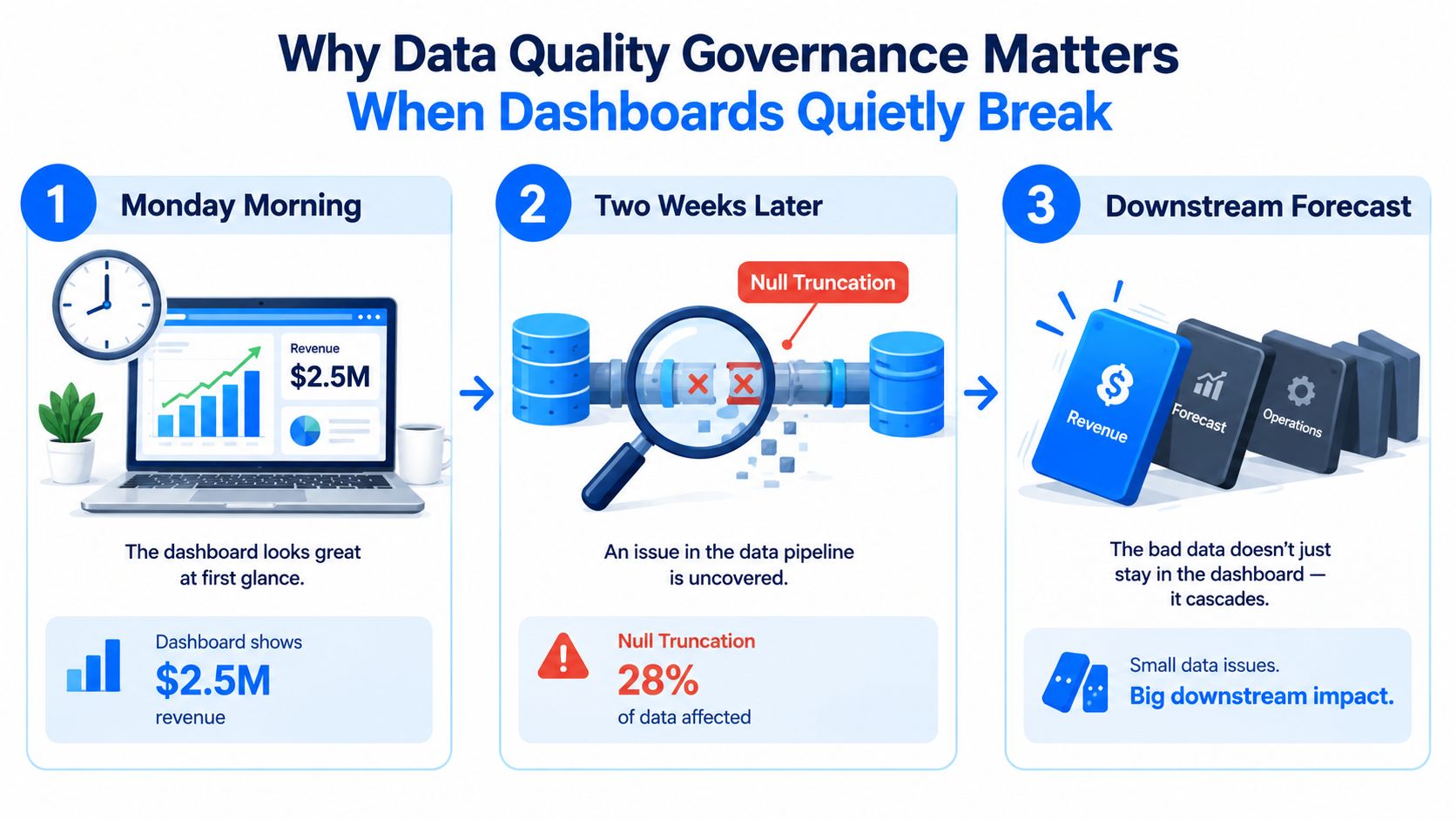
Monday morning, the dashboard looks calm. Revenue is green, the quarter feels on track, and nobody's asking awkward questions. Then finance finds the source pipeline truncated null values, the forecast was built on the wrong numbers, and the clean dashboard turns out to be a very expensive illusion.
That's the point where data quality governance stops sounding abstract. It's the discipline that would have caught the drift, raised an alert, assigned an owner, and kept a small upstream problem from becoming a business-wide correction. In practical terms, it connects raw pipelines to trusted decisions, so a dashboard doesn't just look correct, it stays correct.
The rest of the guide follows the way a real organization has to think about this: principles first, then roles, policies, controls, lifecycle, and observability. If you're already dealing with broken reports, stale feeds, or AI training data that doesn't quite add up, the practical question isn't whether governance matters. It's how to make it visible early enough to do something useful.
Table of Contents
Why Data Quality Governance Matters When Dashboards Quietly Break
Roles and Responsibilities in a Data Quality Governance Program
Why Data Quality Governance Matters When Dashboards Quietly Break
A broken dashboard rarely announces itself. It usually arrives as misplaced confidence first, confusion later. On Monday, the numbers look fine. Two weeks on, someone notices the source system was dropping null values, and every downstream forecast was built on fiction.
That is why governance cannot live only in documentation. Data quality governance is the control layer that watches for drift, ties a problem to an owner, and routes it before the damage spreads. In a governed environment, the pipeline is treated like a monitored business process, and modern observability tools give that discipline a way to operate inside the flow of data, not just on paper.
What breaks first
The first failure is usually trust. Analysts recheck reports, teams debate which version is right, and decision-making slows down because people stop believing the numbers in front of them. That wasted effort is one reason poor data quality has become so expensive at scale, with IBM's summary of a 2025 report noting that more than a quarter of organizations lose over USD 5 million annually and 7% report losses of USD 25 million or more.
The second failure is operational. A sales forecast built on truncated data can lead to overcommitment, a replenishment plan can overshoot inventory, and a model can inherit the same bad signal the dashboard did. The problem grows because no one catches the issue at the source.
A governance program is only as useful as its ability to spot the problem while there is still time to act.
Observability changes the story. A null-rate spike, an unexpected schema change, a late-arriving feed, or a missing record does not have to wait for finance to notice. AI-driven anomaly detection, timeliness monitoring, schema tracking, and record-level validation can surface the issue inside the pipeline, with the evidence already attached and the owner already clear.
For teams trying to connect governed data to live reporting, this overview of data quality dashboards shows how dashboards can move from static reporting to active control. That difference matters. A dashboard that only reflects the past can hide drift. One tied to monitoring and validation can flag it early enough to correct it.
The Core Principles That Define Data Quality Governance
At its simplest, data quality governance is the set of principles, roles, and controls that keep data fit for its intended use. The principles sound straightforward, but each one has to be tested in a real process, against a real dataset, by a real owner. If any layer is vague, the whole thing gets mushy fast.
The five dimensions that matter in practice
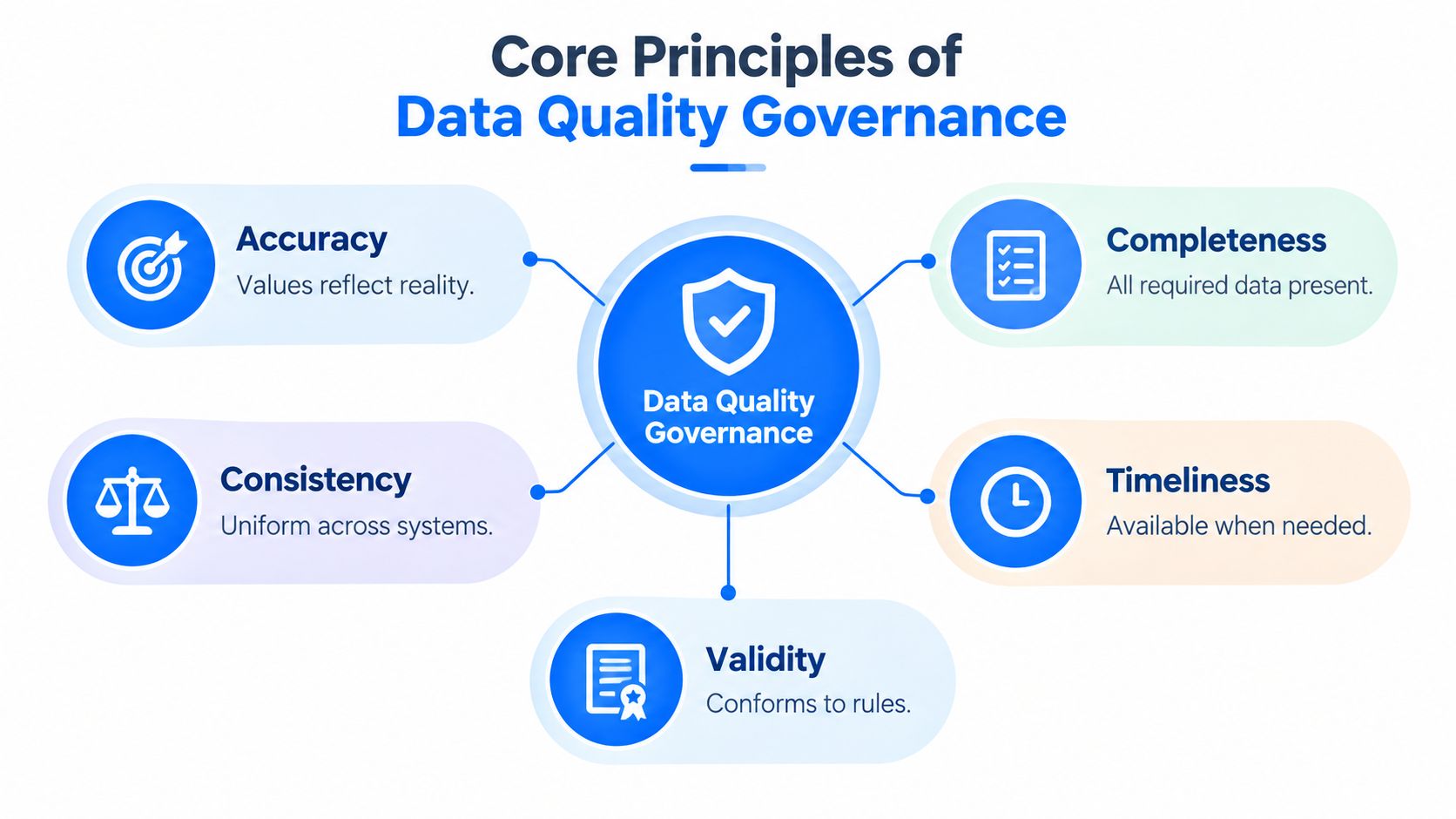
Accuracy means values reflect reality. A customer address that still points to an old apartment might pass a format check, but it's still wrong if a courier can't deliver to it.
Completeness means the required data is present. A signup record with no email or no consent flag can look structurally fine while still being unusable for the business process.
Consistency means the same thing means the same thing everywhere. If currency is stored one way in finance and another way in operations, reconciliation becomes a manual detective exercise.
Timeliness means the data arrives soon enough to support the decision. A stale inventory feed may be technically correct and still useless if the warehouse has already moved on.
Validity means the data conforms to the rules you set. An email address that doesn't match a valid pattern should fail early, not get discovered after a campaign bounces.
Two supporting attributes sit underneath those five. Reliability tells people they can depend on the data behaving as expected, and availability means the data is reachable when it's needed. Together, they turn a nice-sounding principle into a working operating model.
If you want a related framing from a different domain, the article ensuring church fund accuracy shows how careful record handling matters when the stakes are public trust and accountable reporting. The lesson transfers cleanly, even if the context changes.
For teams building this into a broader operating model, the DMBOK overview from digna is a practical reference point. It helps place quality controls inside the wider governance structure instead of treating them like isolated checks.
What Poor Data Quality Costs and Why Governance Exists
Poor data quality does not create a single expense. It starts with wasted analyst time, as people rerun queries, reconcile reports, and chase the same mismatch because no one trusts the first answer.
Then it reaches the business. A team that stocks too much inventory because a feed was wrong pays for that mistake in operations, not just in the data team's backlog. Governance exists to stop errors before they spread.
The cost ladder and the control that belongs to each rung
At the bottom of the ladder, validation rules catch obvious problems early. A missing required field, a malformed email, or an impossible value should fail before the record becomes someone else's cleanup job.
One step higher, anomaly detection and freshness SLAs catch changes that are technically valid but operationally wrong. A feed that arrives late every day, or a metric that jumps outside its normal range, needs attention even if the schema still looks fine. That is the bridge between policy and observability: the rule is written once, then the pipeline checks it continuously.
Higher up, audit trails and approval workflows matter when the issue affects disclosures, regulated reporting, or any process that needs proof of who approved what. If a change has to be explained later, the record of that decision needs to exist now.
At the top, end-to-end lineage and remediation ownership connect the bad record to the dashboards, reports, or models it touched. Without that trace, teams fix the symptom and miss the source, like patching a leak without finding the pipe.
Prevention is cheaper than correction because every downstream consumer multiplies the cleanup cost.
That economic logic is not abstract. A literature review cited 23 examples of poor-data costs, including maintenance, excess labor, re-input, loss of revenue, customer loss, and rework, which is why governance is more than tidy metadata. The same review also noted a Dun & Bradstreet model estimating that fixing a data issue costs about USD 1 per record before it enters the system, USD 10 per record after entry, and USD 100 per record after an event, so timing changes the economics. See the review on cost categories and per-record economics.
For a governance team, that is the practical case in plain language. Catch the issue early, and the problem stays local. Catch it late, and every team in the path helps pay for it.
Roles and Responsibilities in a Data Quality Governance Program
A governance program fails fastest when nobody knows who owns the bad record. The fix is a simple accountability model, usually built like a RACI, where one group is accountable, others are responsible, and no one gets to assume the issue belongs to someone else.
Who owns what
The data governance council or executive sponsor is accountable for the outcome and the risk posture. If quality breaks repeatedly in a domain, that's not just a technical nuisance, it's a leadership issue.
Data owners are usually senior business leaders. They decide what acceptable quality looks like for their domain, then approve remediation priorities when different fixes compete for attention.
Data stewards translate those rules into daily practice. They write business definitions, review anomalies, coordinate fixes, and make sure the rules mean the same thing to the people using them.
Data engineers implement the checks in pipelines and own the infrastructure that enforces them. If the control doesn't run where the data moves, it won't protect anything.
Platform and analytics engineers keep the tooling, workflow integration, and delivery paths stable enough for the controls to work without friction. Compliance partners step in when the evidence needs to hold up under audit or regulation.
Role | Primary Responsibility | Accountable For |
|---|---|---|
Executive sponsor or governance council | Set direction and resolve major risk tradeoffs | Program outcomes and risk posture |
Data owner | Define acceptable quality in the business domain | Domain decisions and remediation priority |
Data steward | Maintain definitions and coordinate fixes | Day-to-day quality management |
Data engineer | Build and run validation in pipelines | Technical enforcement of controls |
Platform or analytics engineer | Keep monitoring and delivery paths working | Operational reliability of the control stack |
Compliance partner | Review evidence and policy alignment | Audit readiness and regulatory defensibility |
For a fuller breakdown of those handoffs, this guide to data quality roles and responsibilities is a useful reference. The main thing to watch for is the classic failure mode, where everyone thinks someone else is watching the same problem.
Policies Standards and Machine Testable Conformance
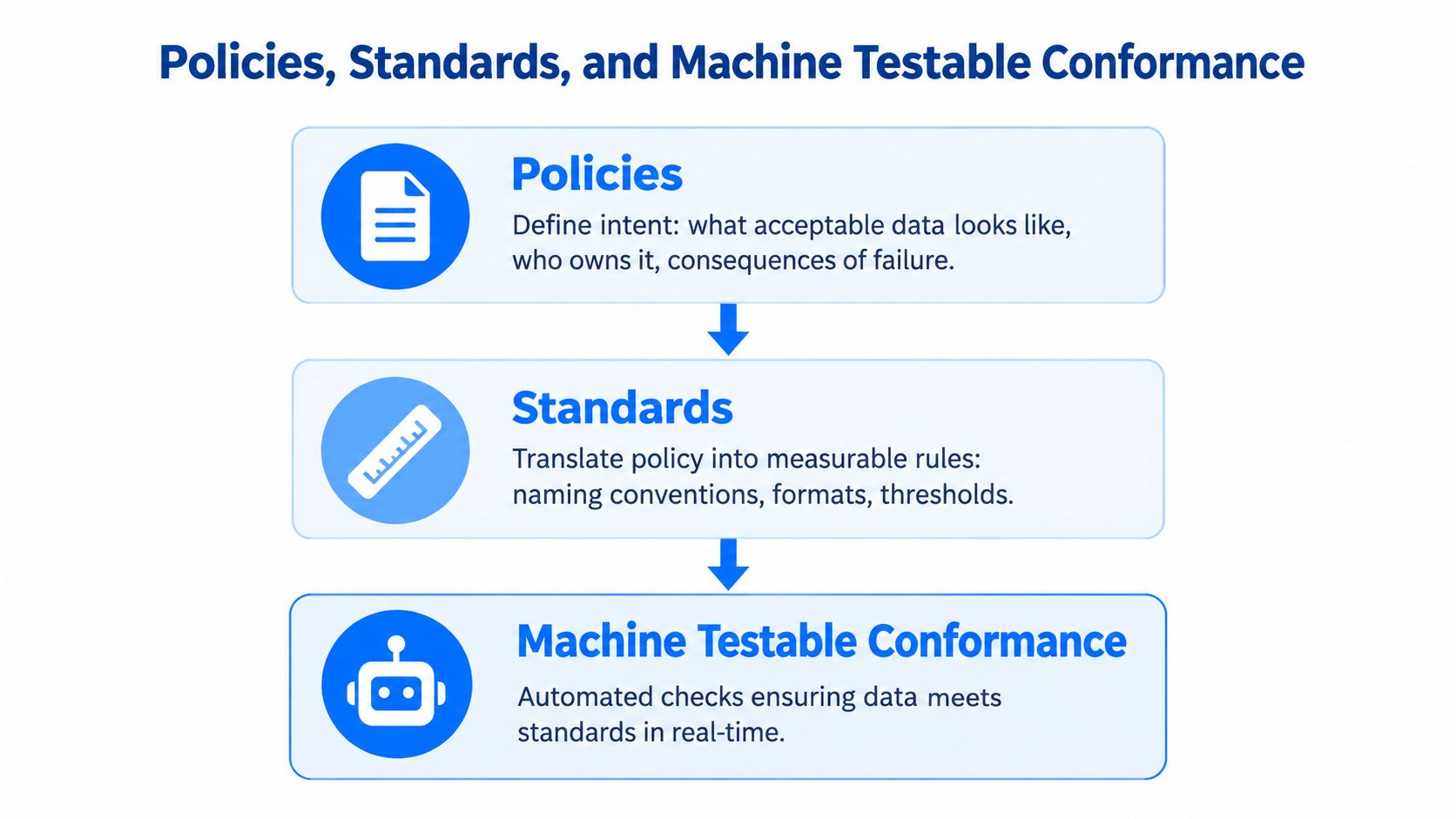
Policies are the written intent. Standards are the measurable version of that intent. Conformance is the part where the system proves the data met the standard, not just the policy memo.
Turning intent into something a pipeline can enforce
A policy might say core customer data must be trustworthy enough for operational use. A standard makes that concrete, such as requiring the customer table to land within a set freshness window, or requiring critical fields to stay within a defined null threshold.
That's the difference between a rule and a hope. A policy without a test is just aspiration. A test without a policy is just a technical check with no governance meaning.
ISO 8000-51:2023 makes this idea very concrete. It specifies requirements for exchanging data governance policy statements and for automated conformance testing of datasets against the specifications named in those policy statements, which links the written layer directly to machine-tested enforcement ISO 8000-51:2023.
What machine-testable conformance looks like
In practice, it shows up as assertions, schema checks, contract tests, and pipeline-level validators. One team may enforce a naming convention at ingest, another may check for required fields before a model trains, and another may block publication if the schema changes unexpectedly.
The UK Government's framework is useful here because it pushes organizations toward formal governance, agreed principles, and standards that make data reusable and interoperable Government Data Quality Framework. That's the same logic private-sector teams need when they want evidence, not just intent.
For a more detailed operating model, the data quality standards page from digna is a practical place to anchor the conversation. It keeps policy, standard, and enforcement from collapsing into one vague document.
Validation and Remediation as a Continuous Lifecycle
Quality work isn't a one-time cleanup. It's a loop. The loop starts when something unusual appears, and it ends only after the fix has been verified against the same control that caught the problem in the first place.
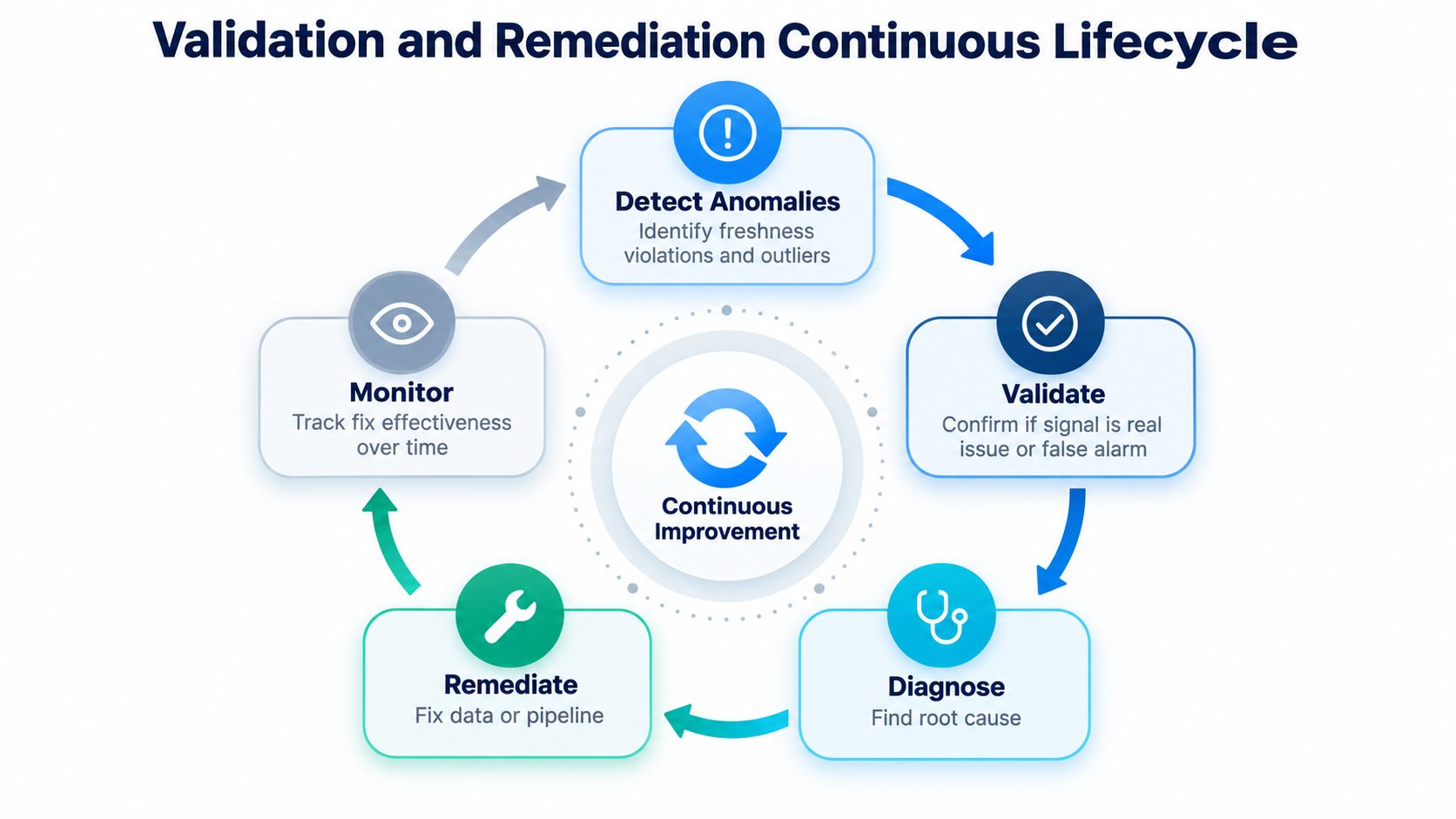
The five-stage loop
First, detect. AI-driven anomaly detection can surface statistical outliers, timeliness monitoring can flag late loads, and schema tracking can catch added, removed, or type-changed attributes before downstream users feel the break.
Second, validate. Not every alert is a defect. Some are expected drift, seasonal change, or a business event that needs context before anyone touches the pipeline.
Third, prioritize. The right question is not just “Is it broken?” It's “What's the impact, and what else depends on it?” Lineage matters here because one bad table can affect a long trail of reports and models.
Fourth, remediate. Fix the source if you can. If you can't, document the compensating logic and make sure the workaround is owned, visible, and temporary.
Fifth, verify. The correction should restore conformance without breaking consumers. That's where record-level validation matters, because row counts, referential integrity, and value distributions can prove the fix worked.
Good remediation closes the loop. Bad remediation just moves the problem to a different table.
Operational platforms such as Donely's integrations area are worth comparing if you're looking at how monitoring connects into existing tools and workflows. The point isn't the brand, it's the design pattern, controls should live close to the data flow, not several systems away from it.
How Observability Turns Governance Into Measurable Practice
Observability makes governance real because it turns principles into evidence. Instead of waiting for a monthly review, teams can watch freshness, volume, distribution, schema, lineage, and record validity as the data moves.
What a useful governance dashboard shows
A serious dashboard should show current conformance, trends over time, failed checks, unresolved exceptions, and the speed of detection and remediation. It should also make the alert readable in context, with the affected dataset, the business process, the pipeline run, the expected range, the severity, and the steward responsible for action.
That context matters because an alert without lineage is just noise. With lineage, the same alert tells you which report, model, or operational process will feel the problem if nobody acts.
Why trend analysis matters
A single incident may be a one-off. A recurring schema drift or repeated freshness failure usually points to a control weakness, not a random event. Trend analysis helps governance teams separate isolated mistakes from structural failures that need a policy or process change.
Immutable check results also matter. They give auditors evidence, they give stewards a history, and they give leadership something more useful than a vague assurance that “the numbers look better now.”
For teams putting this into production, digna's data observability view fits the operating pattern well because it combines anomaly detection, validation, timeliness monitoring, and schema tracking inside the workflow where the problem appears. That's the gap between policy on paper and control in motion.
Start with the critical data elements, then tier alerts by business risk. If everything screams at once, nobody hears the thing that matters.
The bigger shift is cultural. Observability doesn't replace governance, it gives governance facts fast enough for people to act on them.
Governing Data Quality for AI and Your Next Steps
AI raises the stakes because a model can amplify small defects into many decisions. Stale features, undocumented schema changes, inconsistent labels, and incomplete samples don't stay local once they enter training or inference.
A practical program starts with the datasets that feed important models. Assign an owner and steward, define fitness-for-purpose thresholds, and test the data before it reaches training or production scoring. The same logic applies to provenance, feature distributions, label quality, completeness, timeliness, and subgroup behavior across the model lifecycle.
A workable starting checklist
Inventory the data products that matter most: Identify which tables, feeds, and feature sets affect revenue, risk, service, or regulated reporting.
Set a few measurable controls first: Focus on the checks that would catch the failures you've already seen, not every theoretical issue.
Name the escalation path: Decide who gets paged, who decides, and who can approve an exception when the data is imperfect but still usable.
Document exceptions: If a team accepts a temporary workaround, write it down so the same shortcut doesn't become the new normal.
Review recurring defects: Use the history of failures, remediation time, and policy conformance to decide where the next investment belongs.
Human review still matters when automation can't tell whether data is semantically correct, fair, or appropriate for the use case. That's especially true in AI, where a clean schema can still hide a bad label set or a biased sample.
A broader industry view of the AI pressure points appears in this 2026 survey summary on data governance and AI, which highlights how often organizations struggle with training data quality and governance dependency. The lesson is simple, AI doesn't reduce the need for governance, it exposes where the governance was thin all along.
If you want to turn that idea into a working program, digna provides enterprise data quality and observability capabilities that monitor anomalies, validation, timeliness, and schema changes inside the customer's own environment. Visit digna to see how those controls can fit into your pipelines, your governance model, and the AI workflows you're responsible for.
Policies only become measurable once they map to numbers someone tracks weekly — start from a working set of data quality metrics.
Frequently asked questions
Why can't data quality governance live only in documentation?
Because a broken dashboard rarely announces itself. Governance that exists as written policy has no way to notice the quiet failure, which is exactly the failure mode it was created to prevent.
What breaks first when governance is only on paper?
Trust. The first failure is people no longer believing the numbers, and the second is operational, as effort shifts into re-checking work that should already have been dependable.
What does that wasted effort cost?
IBM's summary of a 2025 report notes that more than a quarter of organizations lose over USD 5 million annually from poor data quality, and 7% report losses of USD 25 million or more.
What makes a governance program actually useful?
Its ability to spot the problem while there is still time to act. A program that produces an accurate account of what went wrong last quarter is an audit, and audits arrive after the decision they would have changed.
In what order should you build it?
Principles first, then roles, policies, controls, lifecycle and observability. Starting with controls before roles produces checks nobody owns, and starting with policies before principles produces rules nobody can arbitrate.