DAMA DMBOK Explained: A Practical Guide to the Framework
|
8
min read

DAMA-DMBOK is a framework and reference guide for data management published by DAMA International, providing a common vocabulary, principles, and 11 knowledge areas for treating data as an organizational asset. If you've ever wondered why some teams talk about governance, quality, metadata, and architecture as if they belong in the same conversation, DAMA-DMBOK® is the map they're usually using.
The useful part isn't just the terminology. It's the way the framework helps a new team stop arguing about isolated tasks and start seeing data as something the business must manage on purpose, with clear ownership, shared definitions, and measurable controls. That's why the same framework keeps showing up in enterprise data management, even when organizations use different tools and operate in very different ways.
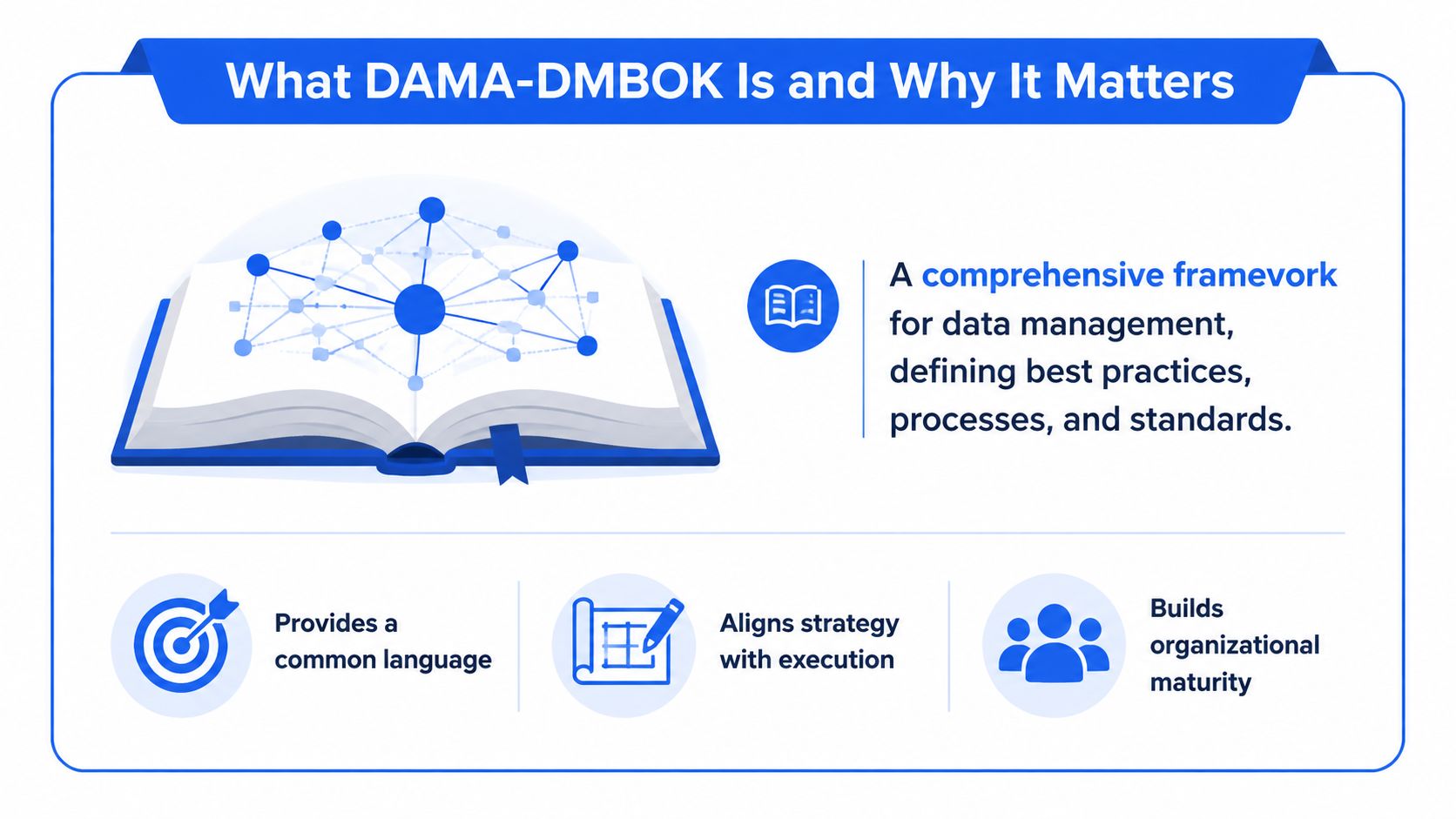
Table of Contents
What DAMA-DMBOK Is and Why It Matters
What makes a data team stop debating isolated tasks and start using the same vocabulary for governance, quality, metadata, and architecture? DAMA-DMBOK is the reference guide many teams turn to. DAMA stands for Data Management Association International, and DMBOK stands for Data Management Body of Knowledge. DAMA International describes it as a globally recognized framework that provides the principles, practices, and functions needed to build, scale, and govern data programs, and the second edition was released in 2017 after the first edition in 2009 (DAMA International, DAMA-DMBOK 2 PDF).
At a basic level, DMBOK gives organizations a way to describe data management as a coherent discipline instead of a loose collection of technical tasks. Without a framework, data work often gets split into disconnected pieces. One team talks about reporting. Another talks about master data. A third talks about privacy or retention. Each group may be doing useful work, but the organization still lacks a shared model for how those pieces relate.
That gap matters because data problems rarely stay inside one area. A reporting issue may trace back to weak definitions. A quality issue may really be an ownership issue. A security problem may be caused by poor metadata or unclear classification. DMBOK helps teams see those dependencies early. It creates a language that makes cross-functional coordination easier, especially in large organizations where data crosses departments, applications, vendors, and regulatory boundaries.
Another reason the framework matters is that it balances business and technical thinking. Many data discussions drift too far in one direction. They become either highly abstract, focused on policy language and committees, or highly technical, focused on pipelines, schemas, and platforms. DMBOK keeps both sides in view. It recognizes that data management succeeds only when business accountability and technical execution reinforce each other.
In practice, this means the framework is often used in several ways at once:
as a reference model for what data management includes
as a teaching tool for new data leaders and practitioners
as a maturity lens for identifying missing capabilities
as a planning structure for governance and operating model design
as a neutral vocabulary when multiple teams need to align
That last point is more important than it looks. In many organizations, debates about data become debates about terminology. Different teams use the same words differently, or different words for the same thing. DMBOK reduces that friction. It does not solve every disagreement, but it gives people a common starting point for discussing ownership, standards, controls, definitions, and processes.
Key terms at a glance
Term | Meaning |
|---|---|
DAMA | Data Management Association International |
DMBOK | Data Management Body of Knowledge |
DAMA-DMBOK | DAMA's framework and reference guide for data management |
Data governance | The decision-making and control layer inside the broader framework |
The second edition expanded the model to 11 knowledge areas, up from 10 in the earlier version, and it drew on contributions from more than 120 data professionals. That matters because it shows the framework is practitioner-built, not a one-person theory. It gives teams a common language for governance, architecture, modeling, storage, security, integration, master data, warehousing, metadata, and quality.
A practical way to read it is this. A data platform tells you where data lives and how it moves. DAMA-DMBOK tells you what disciplines need attention if that data is to be trustworthy, usable, and governed. For a broader intro to the subject, see digna's data management frameworks overview.
Practical rule: if your team cannot explain the difference between a data policy, a data standard, and a data control, the vocabulary DMBOK is meant to provide is missing.
Another useful way to understand DMBOK is to think of it as a map rather than a method. It does not force one implementation style. It does not require one org chart. It does not tell every company to adopt the same tools or sequence. Instead, it identifies the main domains of work that any serious data program eventually has to address. This flexibility is one reason it remains relevant across industries. A financial institution, hospital, retailer, and software company may have very different operating models, but all still need some combination of governance, quality, security, metadata, and integration discipline.
The Purpose of DMBOK in Modern Organizations
Organizations adopt DMBOK because it reduces confusion. Instead of treating quality, governance, metadata, and architecture as separate initiatives owned by separate teams, the framework gives them one shared roof and a shared set of responsibilities.
The deeper idea is data as an organizational asset. That phrase can sound abstract, but in practice it means leadership treats data the way it treats finance, equipment, or intellectual property. It gets managed, protected, documented, and improved, rather than left to whatever each system happens to produce. A team can use DMBOK to decide what belongs in scope, which roles must exist, and how different disciplines connect without forcing every group to work the same way.
This purpose becomes clearer when an organization starts scaling. Early-stage teams can often survive with informal habits and person-to-person knowledge. A few analysts know where the reliable tables live. Engineers know which jobs are fragile. A product manager knows which dashboard definitions people trust. That arrangement works until the company grows, systems multiply, compliance requirements increase, or staff turnover breaks the chain of tribal knowledge.
At that point, data management needs to become intentional. DMBOK supports that shift by asking structured questions:
Who has authority to define data rules?
Who owns critical data elements?
How are business terms documented?
How do systems share data consistently?
What controls protect sensitive information?
How is quality measured and escalated?
How does the organization know whether its data capabilities are improving?
These questions are simple, but they are often left unanswered until a failure exposes the gap. A bad regulatory report, inconsistent customer records, or conflicting revenue dashboards can force urgent action. DMBOK helps teams address those issues before they become expensive.
Another reason modern organizations use DMBOK is that data programs now sit at the center of transformation efforts. Cloud migration, AI initiatives, self-service analytics, customer 360 projects, and process automation all depend on data that is understandable and reliable. A team may think it is launching an AI or analytics strategy, but it quickly discovers that the real blockers are missing ownership, inconsistent definitions, poor metadata, and weak quality controls. DMBOK gives a framework for diagnosing those blockers at the capability level.
Why teams keep returning to it
Shared language: New analysts, stewards, architects, and governance leads can talk about the same concepts without translating everything from scratch.
Clearer scope: Leaders can separate governance concerns from architecture, quality, metadata, and integration work.
Capability mapping: Teams can identify what they already do well and where the gaps are.
Onboarding support: New hires ramp faster when the organization has a consistent framework for data management.
Cross-functional alignment: Business and technical teams can coordinate without reducing all problems to one function.
Better prioritization: Teams can tell the difference between a tooling problem, a design problem, and an ownership problem.
Long-term consistency: Programs survive personnel changes better when definitions and responsibilities are structured.
That's why DMBOK is often used as a reference point during operating model design and governance planning, not just as reading material. It gives the business and technical sides something neutral to align around, which is especially useful when ownership is spread across departments. For a governance-focused companion view, digna's data governance strategy resource is a useful next read.
A mature organization does not need to quote DMBOK every day to benefit from it. Often, its value is indirect. The framework shapes role definitions, program charters, governance councils, metadata standards, quality scorecards, and escalation paths. Once those operating habits exist, people may stop mentioning the framework by name, but they are still working inside its logic.
The Eleven DAMA-DMBOK Knowledge Areas
The framework is organized as a DAMA Wheel with 11 interconnected knowledge areas. Data Governance sits at the center, because the model treats governance as the coordinating function, not as a separate side project. The remaining areas surround it and connect technical controls with organizational accountability (DAMA-DMBOK framework summary).
Knowledge Area | Focus |
|---|---|
Data Governance | Direction, accountability, policies and decision rights |
Data Architecture | Data structures, flows and architecture |
Data Modeling & Design | Models and structures used to represent data |
Data Storage & Operations | Storage, databases and operational management |
Data Security | Protection of data and access management |
Data Integration & Interoperability | Moving and exchanging data between systems |
Document & Content Management | Management of documents and unstructured content |
Reference & Master Data | Consistent management of key shared data |
Data Warehousing & Business Intelligence | Analytical data and information delivery |
Metadata Management | Managing information about data |
Data Quality | Measuring, managing and improving data quality |
Each area corresponds to something a real enterprise has to do. Architecture shapes how systems fit together. Modeling makes business terms usable in databases and reports. Integration keeps data moving across systems without breaking meaning. Metadata gives people context, and quality keeps that context reliable. If you want a focused explainer on that last point, digna's metadata management page is a good practical companion.
To make the list more useful, it helps to look at what each area means in day-to-day work.
1. Data Governance
This is the decision and accountability layer. It defines who can make which data decisions, which policies apply, how exceptions are handled, and how compliance is monitored. Governance is where data ownership, stewardship, policy approval, and escalation often live.
2. Data Architecture
Data architecture describes the high-level design of data assets and flows. It connects business needs to structural choices such as source systems, shared platforms, integration patterns, and analytical environments. Good architecture reduces duplication and helps teams make consistent design decisions over time.
3. Data Modeling & Design
This area translates business concepts into formal structures that systems can use. It includes conceptual, logical, and physical models, as well as naming conventions and design standards. Strong modeling prevents ambiguity from creeping into applications, pipelines, and reporting layers.
4. Data Storage & Operations
This knowledge area covers the practical mechanics of storing, maintaining, backing up, and operating data environments. It includes database management, performance, recovery, availability, and operational support. Even the best governance model fails if storage and operational practices are weak.
5. Data Security
Security focuses on protecting confidentiality, integrity, and availability. It includes access controls, classification, encryption, handling requirements, and monitoring of sensitive data use. Security is tightly connected to governance because access decisions require policy and accountability, not just technical enforcement.
6. Data Integration & Interoperability
This area handles data movement and exchange. It includes interfaces, transformations, synchronization, messaging, APIs, and shared semantics across systems. Integration work becomes especially complex in organizations that grow by acquisition or operate across multiple platforms.
7. Document & Content Management
Not all information lives in structured tables. This knowledge area covers records, documents, files, and other unstructured content that still need classification, retention, versioning, access control, and lifecycle management.
8. Reference & Master Data
This area focuses on consistent definitions for key entities and codes used across the enterprise. Customer, product, supplier, location, and chart-of-account style data often fall here. Poor master data creates duplication, reporting conflicts, and operational inefficiency.
9. Data Warehousing & Business Intelligence
This knowledge area supports analytical use of data. It includes the structures, transformations, access patterns, and delivery mechanisms used for reporting and analysis. It is where many business users first experience the consequences of upstream data management quality.
10. Metadata Management
Metadata is information about data. It includes definitions, lineage, ownership, classifications, transformation logic, and usage context. Metadata management helps teams answer practical questions like what a field means, where it came from, and who is responsible for it.
11. Data Quality
Quality turns abstract trust concerns into measurable conditions. It defines dimensions, rules, thresholds, controls, issue handling processes, and improvement cycles. Without quality management, teams often notice problems only after business outcomes are already affected.
Data governance doesn't replace the other areas. It gives them a decision structure so the work doesn't fragment.
How the Knowledge Areas Work Together
One of the biggest misunderstandings about DMBOK is thinking of the knowledge areas as separate boxes. In practice, they overlap constantly. The value of the framework comes from recognizing those overlaps and managing them deliberately.
Imagine a company discovers duplicate customer records in downstream reports. That may look like a data quality problem, but the root cause could involve several knowledge areas at once:
Reference & Master Data may lack survivorship rules or shared identifiers.
Data Integration & Interoperability may be merging records inconsistently.
Metadata Management may not document which source is authoritative.
Data Governance may not have assigned ownership for customer data decisions.
Data Architecture may have allowed duplicate customer stores to proliferate.
Data Quality may not be monitoring duplication rates in the right systems.
This kind of example shows why isolated fixes fail. Teams patch the symptom in a dashboard or pipeline, but the organizational cause remains. DMBOK is useful because it helps teams analyze data problems as system problems, not just technical defects.
The same logic applies to data access. Suppose users complain they cannot get the data they need quickly enough. That might appear to be a governance bottleneck. But the real issue may involve poor metadata, weak classification, fragmented architecture, or manual security workflows. DMBOK helps teams ask better questions about where the friction really comes from.
A practical way to use the framework is to treat each knowledge area as a lens during project planning. Before launching a major data initiative, teams can ask:
What governance decisions are required?
Which critical data elements need quality rules?
What metadata must be captured for users to trust the outputs?
How will security and privacy requirements be enforced?
Does master or reference data need harmonization first?
What architectural choices could create long-term complexity?
This lens-based approach prevents common project failures, especially those caused by treating data as purely a delivery problem. Many projects can move data from one place to another. Far fewer establish the ownership, definitions, controls, and metadata required to make that movement sustainable.
How DAMA-DMBOK Addresses Data Quality
Data Quality is one of the 11 knowledge areas, and DMBOK treats it as a measurable management discipline. The core idea is fitness for use. Data is “good” only when it fits the business process, report, model, or decision that depends on it, as described in the DAMA NL research paper.
That definition is important because it keeps teams from chasing abstract perfection. In real organizations, quality is contextual. A dataset may be good enough for trend analysis but not good enough for financial close. It may be acceptable for aggregate planning but not acceptable for customer communications. DMBOK encourages teams to define quality expectations in relation to use, risk, and impact.
The framework breaks quality into dimensions such as Accuracy, Completeness, Consistency, Integrity, Timeliness, Currency, Reasonableness, Uniqueness/Deduplication, and Validity. That matters because one score can hide different problems. Data can arrive on time and still be stale. It can be current and still miss required fields. Each issue needs a different control.
Here is a simple way to think about several of those dimensions:
Accuracy: Does the value reflect reality correctly?
Completeness: Are required values present?
Consistency: Do values align across systems and reports?
Integrity: Are structural relationships intact, such as valid keys and references?
Timeliness: Is the data available when needed?
Currency: Is the data up to date enough for the use case?
Validity: Does the value conform to required formats or rules?
Uniqueness: Is the same entity represented once where that is expected?
Reasonableness: Does the value fall within plausible ranges or patterns?
For teams building monitoring programs, DMBOK gives the map, while your processes and technology do the measuring, alerting, and repair. If you want a practical view of those dimensions, digna's data quality dimensions resource is a useful reference.
Quality work under DMBOK usually involves more than defining dimensions. It also includes:
identifying critical data elements
setting rules and thresholds
assigning ownership for remediation
measuring defects over time
analyzing root causes
prioritizing fixes by business impact
preventing recurrence through process or design changes
That progression matters. Many organizations can detect quality issues, but far fewer can route them to the right owner or sustain improvement. A data quality dashboard without accountability becomes a passive reporting artifact. DMBOK's contribution is that it places quality inside a broader management system that includes governance, metadata, architecture, and operational discipline.
Consider a common example. A sales organization sees a drop in trust in its pipeline reports because opportunity stages are incomplete and inconsistent. A narrow response might focus only on validation rules in the CRM. A DMBOK-informed response would go further:
define the business meaning of each stage in metadata
assign ownership for sales data standards
add quality controls for completeness and valid transitions
monitor exception trends by team or region
review integration logic feeding analytics systems
update governance processes for policy changes
This is what makes DMBOK practical. It does not just say quality matters. It shows quality as part of a wider operating model.
DMBOK and Data Governance Explained
Data Governance is one knowledge area inside DMBOK, not a synonym for the whole framework. In DMBOK, governance is about exercising authority and control through planning, monitoring, and enforcement. That includes direction, accountability, policies, and decision rights, which is why it often becomes the place where ownership questions finally get resolved (DAMA-DMBOK 2 text reference).
This distinction is worth stressing because many organizations start their data journey by saying they need governance when what they actually need is a broader data management model. Governance is essential, but it is not enough by itself. A governance council can approve policies, but it cannot replace metadata practices, quality controls, architecture decisions, or master data processes.
Put differently, governance answers questions like these:
Who decides?
Who owns?
Which rules apply?
How are exceptions handled?
How is compliance monitored?
The rest of DMBOK answers different questions:
How is data structured?
Where does it move?
How is it protected?
How is it defined?
How is quality measured?
How do analytical environments consume it?
When teams blur these categories, they usually build governance programs that are too narrow or too abstract. They may spend months defining committees and policy templates without improving the data experience for users. Or they may buy a governance-oriented tool and assume the tool itself will create ownership and clarity. DMBOK helps prevent that mismatch by placing governance in context.
Why the distinction matters
If a team treats governance and DMBOK as the same thing, it usually underbuilds the rest of the stack. Metadata management provides the definitions, models, and data flows that help explain what happened when quality breaks. Governance then assigns responsibility and pushes the fix through the organization. Without that link, root-cause work gets fuzzy and escalation becomes political instead of practical.
The clean mental model is simple. DMBOK is the full map of data management. Governance is the control center inside that map. That's why governance tools alone don't “implement DMBOK.” They may support part of it, but the framework itself is broader and more balanced than any one workflow system.
This distinction also matters for sponsorship. Governance often needs executive backing because it touches policy, authority, and accountability. But several other DMBOK areas require operational leaders, architects, engineers, analysts, and stewards to work together. If the entire framework gets labeled governance, some technical teams disengage because they assume it is only about compliance and oversight. A broader DMBOK framing avoids that problem by showing each function where it fits.
How Organizations Use DMBOK in Practice
Most organizations don't implement DMBOK all at once. They adapt it to their structure, their maturity, and their most urgent data problems. A bank might start with governance, master data, and quality. A healthcare team might focus first on metadata, security, and integration. A product company may begin with architecture and quality controls around analytics data.
The practical use cases are predictable:
Data management operating model: define who owns what and how decisions move.
Governance responsibilities: assign owners, stewards, and escalation paths.
Quality programs: target high-value datasets with explicit rules and checks.
Metadata practices: document definitions, lineage, and business context.
Master data processes: maintain consistent records for shared entities.
Architecture improvements: align data flows, structures, and controls.
Capability gap analysis: spot what's missing before the next initiative begins.
DMBOK Concept | Practical Activity | Example Capability |
|---|---|---|
Data Quality | Define and monitor quality requirements | Data quality monitoring |
Metadata Management | Understand data definitions and context | Metadata management |
Data Governance | Define ownership and accountability | Governance workflows |
Data Integration | Monitor data movement between systems | Pipeline and observability tools |
Master Data | Maintain consistent critical entities | MDM platforms |
A useful bridge here is operational monitoring. Teams often pair governance with tools that help detect anomalies, validate records, and track timeliness so business owners can see issues before they spread. One example is digna's data quality implementation resource, which shows how those controls map to day-to-day practice.
In practice, organizations often use DMBOK in one of four modes.
1. As a diagnostic framework
A team reviews the 11 knowledge areas and asks which capabilities are strong, weak, missing, or informal. This is common when a company has repeated trust issues but no clear picture of why.
2. As an operating model blueprint
Leaders use the framework to define roles such as data owner, steward, architect, custodian, or governance lead. They also use it to separate responsibilities that were previously blurred.
3. As a transformation support model
Major programs such as ERP modernization, cloud migration, self-service analytics, or AI readiness use DMBOK to make sure data foundations are not ignored.
4. As an education and alignment tool
Teams use the framework to onboard new practitioners and create shared understanding across business and technical functions.
A strong sign that DMBOK is being applied well is that conversations shift from generic complaints to precise diagnosis. Instead of saying “our data is bad,” teams start saying “our customer master lacks ownership,” or “metadata for revenue definitions is incomplete,” or “timeliness controls are missing in one integration path.” That kind of precision improves prioritization and accountability.
A phased adoption approach
Most teams benefit from a phased rollout rather than a big-bang implementation. A practical sequence might look like this:
Phase 1: Define scope and ownership
Start with a limited business domain, such as customer, finance, product, or regulatory reporting. Clarify which data assets matter most, who owns them, and what business outcomes depend on them.
Phase 2: Establish governance basics
Create decision rights, escalation paths, policy principles, and stewardship roles. Keep the initial model simple enough that people can actually use it.
Phase 3: Document metadata and critical definitions
Capture key business terms, lineage, source systems, classifications, and ownership details for the most important data elements.
Phase 4: Apply measurable quality controls
Define rules, thresholds, and monitoring for high-impact datasets. Focus on defects that affect revenue, compliance, operations, or customer experience.
Phase 5: Expand into broader capabilities
Use lessons from the first domain to improve integration, master data, architecture standards, security controls, and analytical consistency.
This phased model works because it converts DMBOK from a theoretical framework into a delivery pattern. Teams build momentum with visible wins while creating structures that can scale.
Common mistakes when applying DMBOK
Organizations often struggle with DMBOK not because the framework is wrong, but because they apply it too literally or too broadly. Common mistakes include:
Trying to operationalize all 11 areas at once: this creates overhead and slows adoption.
Treating DMBOK like a certification checklist: the framework is meant to guide thinking, not encourage box-ticking.
Over-centering governance committees: too much committee design, too little operational follow-through.
Ignoring metadata: teams often want quality and trust without investing in definitions and lineage.
Assuming tools equal maturity: software can support processes, but it cannot create ownership or policy clarity by itself.
Lack of business sponsorship: data management weakens quickly when business leaders treat it as only an IT concern.
No prioritization by business value: not every dataset needs the same level of control.
A good implementation stays practical. It starts where business risk is real, makes ownership visible, and connects policy with measurable execution.
DMBOK Is a Framework, Not a Software Solution
Why do teams confuse DMBOK with a tool? The answer is simple. DMBOK defines concepts, disciplines, terminology, and good practices. It provides the map for data management, while dashboards, workflow engines, and quality engines are the vehicles that travel on it.
A framework tells you how to think. A platform helps you execute. A tool automates a slice of the work. Those roles connect, but they are not the same.
This distinction is important when organizations evaluate vendors. A catalog can support metadata management. A quality platform can support validation and monitoring. A governance tool can support workflow, attestation, or policy tracking. An MDM platform can support survivorship and golden record processes. But none of these products, alone or together, automatically define an effective data management model.
Modern data observability and data quality platforms can support parts of the DMBOK model through continuous data quality monitoring, data anomaly detection, data validation, data timeliness monitoring, data analytics, data reconciliation, and schema monitoring. That is how operational controls support the quality and monitoring practices inside the broader framework. digna is one option in that category, offering continuous monitoring, anomaly detection, validation, schema change tracking, and reliability controls inside the customer's own environment.
The boundary still matters. Tools do not define ownership, and they do not replace the governance decisions that make quality rules meaningful. They help teams apply those decisions consistently at scale.
A useful buying principle is this: choose tools based on the capabilities you need to operationalize, not because you expect one product to become the framework itself. DMBOK helps organizations separate those choices. First decide what disciplines matter most. Then evaluate which tools, processes, and roles support them.
Who Should Use DAMA-DMBOK
DMBOK is often associated with formal data governance or enterprise architecture teams, but its audience is much wider than that. The framework is useful for anyone responsible for making data understandable, reliable, controlled, or reusable.
Typical users include:
Chief data officers and data leaders who need a common model for building a data program
Data governance managers defining ownership, policy, and stewardship structures
Enterprise and data architects aligning platforms, flows, and standards
Data engineers who need clarity on definitions, controls, and accountability
Analytics leaders and BI teams trying to improve trust in reports and metrics
Data stewards responsible for business definitions and issue coordination
Security and privacy teams managing access, classification, and handling rules
Program managers overseeing transformation initiatives with major data dependencies
It is also useful for executives who do not work in data full time but sponsor data-heavy initiatives. DMBOK gives them a structured way to ask whether the foundations are in place. For example, before approving a customer 360 effort, a sponsor can ask whether customer ownership, master data rules, metadata definitions, integration patterns, and quality thresholds are defined. Those are better questions than simply asking whether the project has the right tool.
For smaller teams, DMBOK can still be valuable even if they never formalize every knowledge area. A startup or mid-market company may not need a large governance office, but it still benefits from understanding how quality, definitions, access, and architecture interact. In that sense, the framework scales down as well as up.
Frequently Asked Questions About DAMA-DMBOK
What is DAMA-DMBOK? It's a framework and reference guide for data management from DAMA International.
What does DMBOK stand for? Data Management Body of Knowledge.
What is DAMA International? The professional association that publishes and maintains the framework.
What are the DMBOK knowledge areas? Governance, architecture, modeling and design, storage and operations, security, integration and interoperability, document and content management, reference and master data, warehousing and business intelligence, metadata management, and data quality.
Why is DAMA-DMBOK important? It gives organizations a shared language and structure for managing data as an asset instead of treating data work as disconnected tasks.
Is DMBOK a data governance framework? Not exactly, it's broader. Governance is one of its knowledge areas.
How does DMBOK address data quality? It treats quality as a measurable discipline based on fitness for use and recognized dimensions like accuracy, completeness, and timeliness.
Is DAMA-DMBOK a software tool? No. It's a body of knowledge and framework.
Who uses DAMA-DMBOK? Data governance leads, architects, stewards, analysts, engineers, and enterprise teams building shared data practices.
What's the difference between DMBOK and data governance? DMBOK is the full framework, governance is one part of it.
What's the difference between DMBOK and data observability? DMBOK is the conceptual model, observability is an operational capability that can help implement parts of it.
Can small organizations use DMBOK? Yes. Smaller teams can use it as a light reference model to clarify ownership, definitions, quality expectations, and architectural priorities without adopting heavy process.
Do you need all 11 knowledge areas from day one? No. Most organizations start with the domains that align to their biggest risks or business priorities and expand over time.
Does DMBOK prescribe one implementation method? No. It provides a framework and common vocabulary, but organizations adapt it to their structure, maturity, and regulatory environment.
If you want a practical way to turn DMBOK from a reference guide into day-to-day control, visit digna and see how its data quality and observability capabilities fit into governance, metadata, and monitoring workflows. It's a straightforward way to connect framework language to operational execution without losing the accountability that makes the framework useful.
Frequently asked questions
What is DAMA-DMBOK?
DAMA-DMBOK is the Data Management Body of Knowledge published by DAMA International. It provides a common vocabulary, a set of guiding principles and eleven knowledge areas for treating data as an organisational asset rather than a by-product of systems.
What are the eleven DAMA-DMBOK knowledge areas?
They are data governance, data architecture, data modelling and design, data storage and operations, data security, data integration and interoperability, document and content management, reference and master data, data warehousing and business intelligence, metadata management, and data quality.
Why does DAMA-DMBOK matter for data quality?
It places data quality alongside governance, metadata and master data rather than treating it as an isolated testing activity. That framing is what connects a failed check to an owner, a definition and a business consequence instead of leaving it as a technical alert.
Is DAMA-DMBOK a standard or a framework?
It is a reference framework, not a certifiable standard. It describes what good data management covers and gives shared terminology, but it deliberately leaves the operating model, tooling and sequencing to each organisation.
How do you start applying DAMA-DMBOK in practice?
Do not attempt all eleven areas at once. Pick the knowledge areas tied to your most pressing risk, usually governance, data quality and metadata, agree the vocabulary, assign owners for critical datasets, then extend outward as the routines hold.