Data Product Management Guide for Reliable Data
|
0
min read
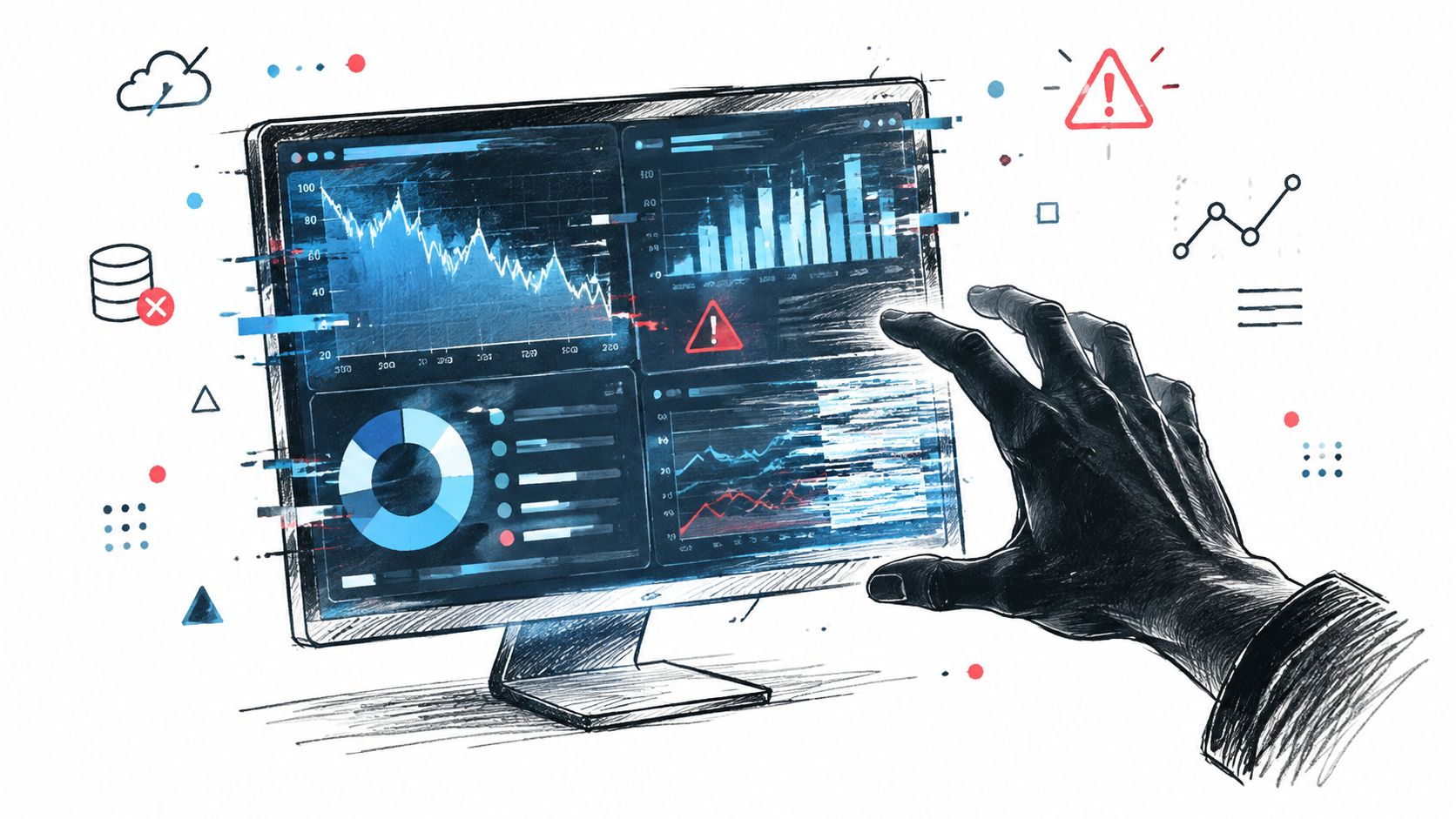
A revenue dashboard fails before a planning meeting. The refresh arrived late, one upstream field changed without notice, and the figures no longer match the finance report. At the same time, an AI feature starts producing unstable recommendations because the training data shifted. The visible problem is a broken chart or drifting model. The underlying problem is that nobody operated the data as something consumers could depend on.
That's where data product management matters. A data product isn't merely a table, pipeline, dashboard, or model. It's a managed data offering with a defined consumer, clear ownership, quality expectations, service levels, and a lifecycle that continues after release. This guide builds the idea from first principles, then connects roles, lifecycle decisions, reliability KPIs, governance workflows, and observability.
The approach also fits naturally beside DataOps practices for reliable data operations, particularly when engineers and analysts need to detect failures before they reach reports, applications, or AI systems.
Table of Contents
Governance Workflows and Observability That Keep Products Reliable
Real World Applications and Next Steps for Your Data Products
Introduction Why Data Needs Product Thinking Now
A pipeline may pass its first delivery test, then fail the teams that depend on it. A source field changes, a refresh arrives late, or two reports apply different definitions to the same metric. The output still exists, but its behavior is no longer predictable.
Thoughtworks' 2025 discussion frames data as a product with its own lifecycle, quality standards, and consumer needs. That framing shifts the question from “Did we publish the dataset?” to “Can people and systems use it safely and repeatedly?” The same discussion connects data product discipline with platform sprawl, as organizations report accumulating 10–15 or more platforms, creating fragmentation, duplicated effort, and integration problems. (Thoughtworks' 2025 discussion of data as a product describes this operating idea and its relationship to platform sprawl.)
Documentation can fall behind just as quickly. The guide cites a Product Excellence Report finding that only 41% of product professionals keep roadmaps up to date and aligned with stakeholder expectations, a warning for data teams whose priorities, schemas, and consumers change over time.
Practical rule: A data product earns trust through dependable behavior, not through a polished catalog entry.
That behavior requires operational controls. Timeliness checks show whether delivery meets expectations. Validation catches unexpected values. Schema tracking exposes breaking changes before consumers encounter them. Observability connects these signals so engineers and analysts can see whether a dataset remains usable for reports, applications, or AI systems. Teams applying DataOps practices for reliable data operations can treat these checks as part of delivery rather than emergency repair.
Product thinking therefore gives data work a reliability discipline: define the consumer, operate the interface, and preserve evidence after release.
What Data Product Management Really Means
Start with a familiar shelf analogy. A raw dataset is like an unlabelled ingredient in a storeroom. Someone may know where it came from, but a new consumer still has to ask what it contains, whether it's fresh, how to use it, and whom to contact when something looks wrong.
A data product is closer to a packaged item designed for repeat use. It has a clear name, an interface, instructions, quality expectations, and support. The package might be a governed SQL view, an API, an analytical model, a feature set, or a dashboard backed by stable semantic logic. The format matters less than the operating commitment around it.
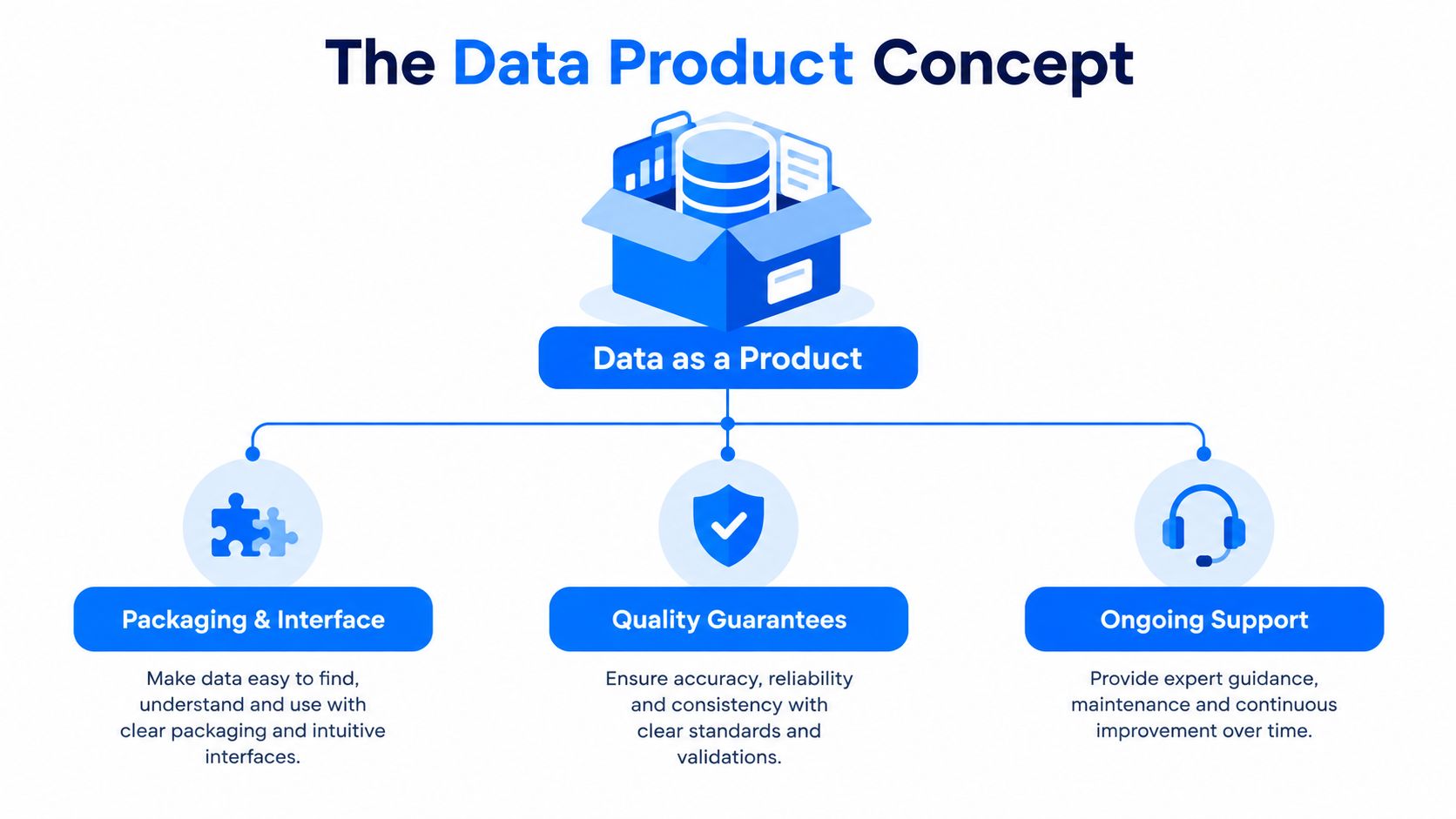
The four tests for product thinking
A useful data product should pass four tests:
Discoverability: Consumers can find it through a catalog, portal, or known interface without relying on personal contacts.
Addressability: Consumers know how to access it, whether through a query endpoint, API, governed share, or documented view.
Trustworthiness: The product publishes measurable quality expectations and monitors whether it meets them.
Self-description: Metadata explains definitions, ownership, lineage, sensitivity, permitted use, and known limitations.
These properties separate a product from a project deliverable. A project usually optimizes for a defined scope and completion point. A product has continuing responsibility for relevance, reliability, consumer feedback, controlled change, and eventual retirement.
The distinction becomes more important as technology stacks multiply. Platform expansion can give teams more capabilities while making it harder to identify the authoritative dataset, the current definition, or the responsible owner. Product management supplies the missing discipline. It asks who consumes the data, what decision it supports, what service level that decision requires, and how the team will respond when reality changes.
What the product manager actually manages
The manager isn't just arranging catalog fields. They manage a promise between producers and consumers. That promise includes the product's purpose, interface, quality controls, support path, roadmap, and retirement conditions.
A product might support regulatory reporting, customer operations, forecasting, or an AI workflow. Each use case creates different expectations for freshness, validation, access, and change safety. Product thinking makes those expectations explicit before engineers encode them into pipelines.
A short visual explanation can help teams align on the distinction between an output and a managed offering:
The central idea is simple: data becomes a product when consumers can rely on its behavior, not merely when a team gives an existing asset a new label.
Roles and Ownership in a Data Product Team
A data product team works best when accountability follows the product rather than the tool. The data product manager owns the product's direction and consumer success. Engineers make the product work. Analysts, scientists, governance specialists, and platform teams contribute distinct capabilities without blurring decision rights.

Responsibility should be visible
The data product manager is accountable for the vision, prioritization, consumer research, roadmap, and product outcomes. They translate a business problem into a product decision, decide which requests deserve investment, and keep stakeholders aligned when trade-offs appear.
The data engineer owns ingestion, transformation reliability, runtime behavior, and operational dependencies. The analytics engineer turns business definitions into governed models, reusable metrics, tests, and documentation. The data scientist may consume the product to build models or decision systems, while also providing feedback about feature stability, training data, and model readiness.
Governance and platform teams provide guardrails rather than replacing product ownership. Governance specialists define policies, access expectations, classification rules, and audit requirements. Platform engineers provide infrastructure, deployment patterns, permissions, and observability capabilities that let product teams operate safely.
A practical ownership map can look like this:
Vision and prioritization: Data product manager, with domain and executive input.
Business definitions: Analytics engineer and domain expert, with product approval.
Pipeline and runtime reliability: Data engineer, supported by platform engineering.
Quality and access controls: Governance lead and responsible engineering owner.
Consumer onboarding and feedback: Product manager, supported by analysts and domain leads.
Production incident response: Named operational owner, with escalation paths documented.
Ownership is the bottleneck when a product has a name but no person with authority to make decisions, fund maintenance, or retire the asset.
That problem is especially serious in regulated environments. A catalog may show an owner, yet the owner might not have the authority to approve a schema change or prioritize a failed freshness check. Effective ownership combines accountability with decision rights, operating capacity, and a clear support workflow.
A shared dashboard can give engineers, analysts, and stakeholders the same view of incidents, trends, and product status without moving data out of the customer environment. The broader data governance roles model helps teams make those handoffs explicit instead of leaving them in informal conversations.
The Data Product Lifecycle From Idea to Retirement
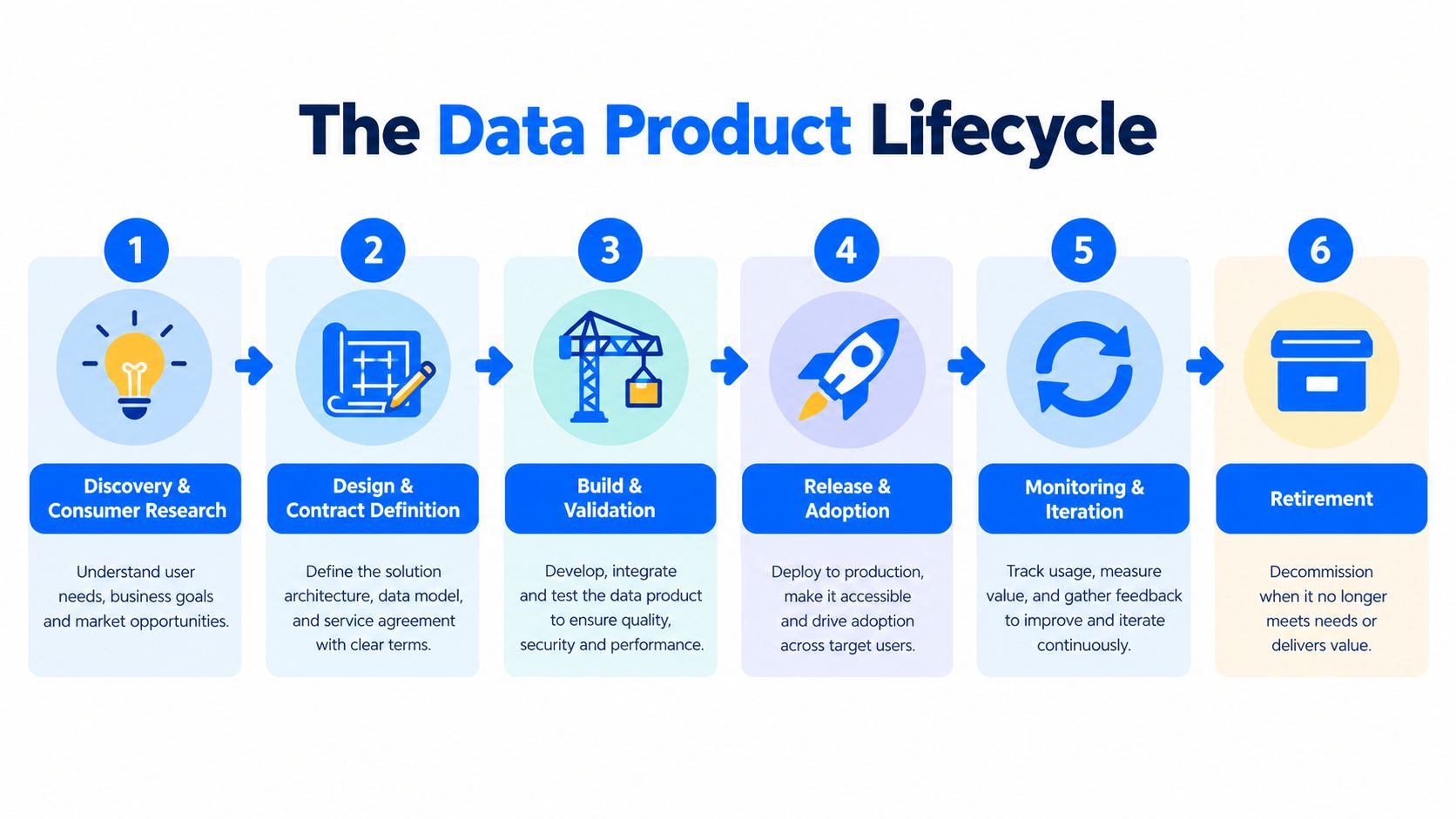
A data product's lifecycle starts before code and continues after release. Each stage answers a different question, and each decision gate prevents the team from carrying unresolved assumptions into production.
Discovery and consumer research
Begin with the decision, not the available source. Identify the consumer group, the business problem, the action the product should support, and the consequences of late or incorrect data. Interview analysts, operators, application teams, and governance stakeholders separately because each group sees different failure modes.
A useful discovery output includes a problem statement, a named owner, initial consumer journeys, data sensitivity, expected access pattern, and a rough definition of success. If users can't explain what they'll do with the product, the team should test the need before committing engineering capacity.
Design and contract definition
Next, define the product's interface and guarantees. Document entities, metrics, field meanings, permitted values, expected delivery behavior, access controls, and change-management rules. Data contracts should describe what producers provide and what consumers can safely assume.
The team should also decide which changes are backward compatible, which require a new version, and which require consumer notification. Analytics engineers and domain experts prevent semantic drift before it reaches dashboards or models.
Build and validation
Engineers then implement ingestion, transformation, tests, metadata, lineage, and operational checks. Validation shouldn't be postponed until the final review. Known business rules, structural expectations, and delivery behavior need checks throughout development and before release.
A product isn't ready because its query returns rows. It's ready when the team can demonstrate that the rows follow documented definitions, arrive within the agreed expectation, and produce a clear response when an upstream dependency fails.
Release and adoption
Release includes onboarding, examples, access instructions, support routing, and consumer education. A technically sound product can still fail if users don't understand the definitions or can't access it through their normal workflow.
The product manager should watch early feedback and distinguish between a discoverability problem, a usability problem, a trust problem, and a genuine lack of demand. Each requires a different response.
Monitoring and iteration
After launch, the team reviews quality signals, incidents, usage patterns, and feedback. Monitoring should lead to backlog decisions, not merely alert noise. If users need a different grain, delivery window, or interface, the roadmap should reflect that evidence.
Roadmap discipline matters because data products decay when stakeholder expectations move while the product remains frozen. The 2026 coverage referenced earlier links weak roadmap alignment with product-management difficulty, which makes communication and prioritization part of reliability rather than administrative overhead.
Retirement
Retirement is a controlled product decision. Define the reason, identify remaining consumers, communicate the replacement or archive path, preserve required evidence, and remove obsolete access. A clean retirement keeps the portfolio understandable and prevents engineers from maintaining outputs that no longer support a meaningful decision.
Measuring Success With KPIs That Prove Reliability
A product can have many consumers and still be unreliable. It can also have limited initial adoption because it serves a specialized workflow while meeting its service promise. That's why data product KPIs should connect consumer value with operational health, rather than counting dashboards, tables, or catalog records.
Expert guidance recommends tracking freshness SLA compliance, ownership coverage, data contract coverage, and impact detection before deployment because these measures connect reliability with change safety (data product governance guidance explains this operational approach). Governance frameworks also recommend adoption and support measures such as consumer reuse rate, active consumer growth, time to discover, issue routing to a named owner, and issues resolved within SLA (portfolio governance monitoring guidance connects these indicators with reuse and control outcomes).
Choosing Data Product KPIs by Outcome
Outcome You Want | Primary KPI | What It Signals |
|---|---|---|
Build consumer trust | Freshness SLA compliance | Whether delivery meets the expectation consumers rely on |
Make accountability visible | Ownership coverage | Whether each product and issue has a responsible owner |
Reduce change risk | Data contract coverage and pre-deployment impact detection | Whether structural changes are understood before release |
Increase reuse | Consumer reuse rate and active consumer growth | Whether the product solves repeatable needs across consumers |
Improve discoverability | Search-to-open or time-to-discover | Whether users can locate and understand the product efficiently |
Improve support | Issue routing to a named owner and resolution within SLA | Whether failures move quickly from detection to remediation |
These KPIs answer different questions. Freshness tells you whether a report or model receives data on time. Ownership tells you whether someone can act when it doesn't. Contract coverage shows whether consumers have protection against structural surprises. Reuse indicates that the product has a dependable interface rather than a one-off answer.
The causal chain matters. If delivery becomes unpredictable, consumers may create private copies. If ownership is unclear, incidents remain unresolved. If users can't discover certified products quickly, they return to manual requests. Over time, those behaviors increase duplication and weaken the value of governance.
Teams can use reliability measurement guidance to design a scorecard around their product's actual consumer commitments. The important discipline is to choose a small set of measures that trigger decisions. A KPI that never changes prioritization is a report, not a management instrument.
Governance Workflows and Observability That Keep Products Reliable
A reporting pipeline can deliver a file on schedule and still produce unreliable results. A renamed field may break a dashboard, a sudden distribution shift may distort a model, and a late delivery may leave analysts working from stale information. Governance becomes useful when its rules operate alongside delivery, validation, and incident response.
Data observability works like a control panel for a data product. It continuously monitors system health, quality, reliability, and performance across ingestion, storage, and analytics. Its core signals include freshness, volume, schema, distribution, and lineage, as described in research on data observability signals. Teams can also explore data observability practices to see how these signals support operational monitoring.
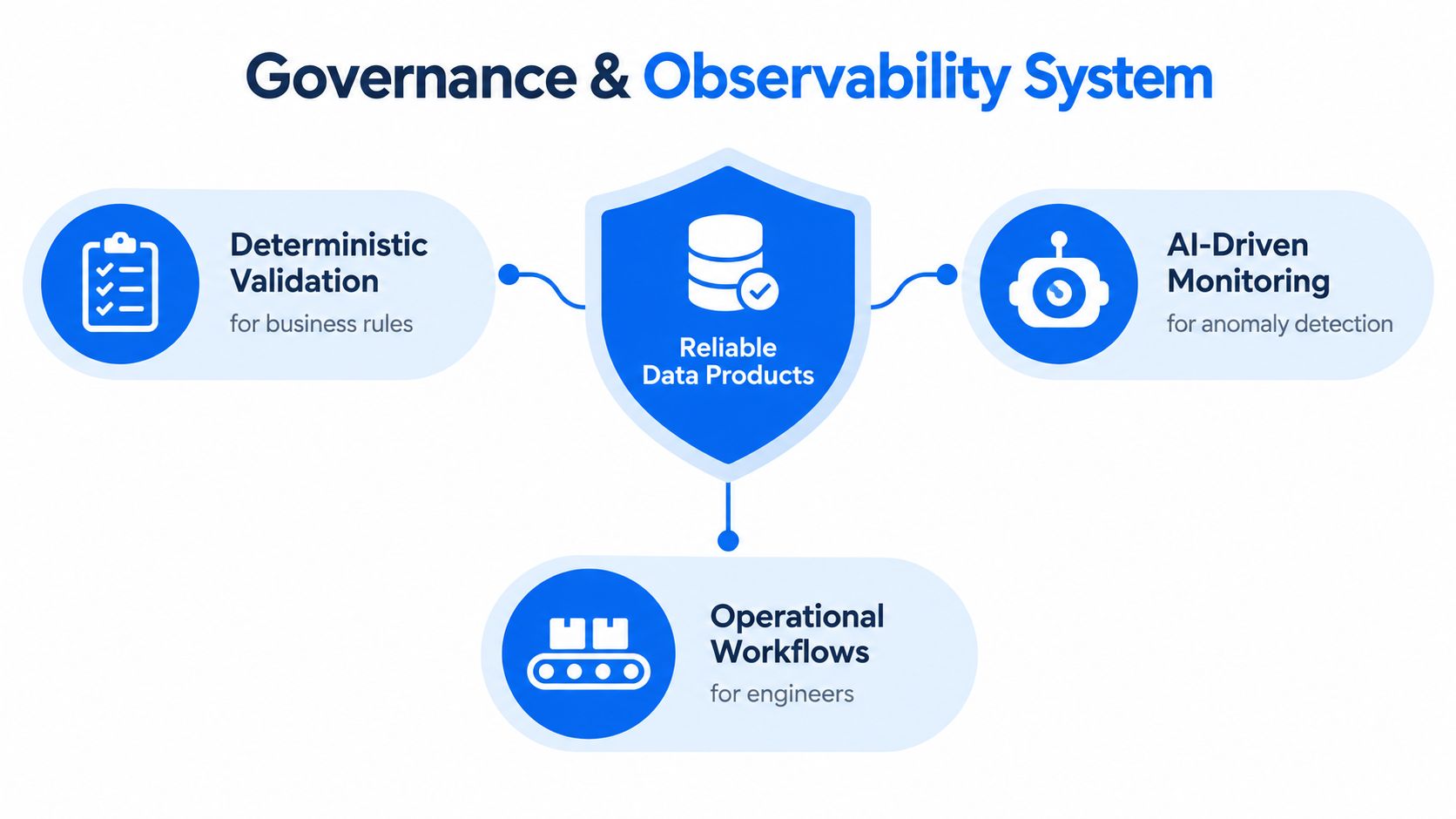
Four controls with different jobs
Deterministic validation checks rules the team already understands. Permitted status values, required identifiers, relationship rules, and conditions for regulatory reporting are common examples. Because each check points to a defined rule, its result can be explained and audited.
Anomaly detection looks for unfamiliar behavior that fixed rules may miss. Every row can pass a basic validity check while the overall distribution shifts sharply. Baseline monitoring helps teams spot unusual volume, value patterns, or usage behavior before consumers report a failure.
Timeliness monitoring measures the gap between the expected and actual availability of information. The data-quality metrics guide frames timeliness around accessibility and availability. Lateness therefore becomes a measurable control instead of a subjective complaint.
Schema tracking protects the product's structural contract. Added or removed columns, renamed fields, and changed data types can break transformations, dashboards, feature pipelines, and downstream applications even when delivery continues.
A useful operating pattern combines validation for known rules, anomaly detection for unfamiliar behavior, timeliness checks for delivery risk, and schema tracking for structural change. It should record missing, late, and unexpectedly early deliveries, then establish an expected delivery window from observed behavior, as described in the enterprise quality framework.
Turning signals into action
An alert becomes useful only when someone can act on it. Each event needs a named owner, severity, affected products, dependency context, escalation path, and resolution record. If a schema change threatens a consumer, the team should identify exposed reports, models, and applications before the change reaches production.
Platforms like digna implement this pattern by bringing anomaly detection, validation, timeliness, and schema tracking into one observability layer. This arrangement gives engineers, analysts, and stakeholders a shared view of incidents, trends, and status across data quality, business monitoring, and platform observability.
The operating loop is straightforward. Governance defines acceptable behavior, observability detects deviations, and workflow ownership turns those deviations into controlled remediation. That discipline makes reusable datasets dependable systems for analytics and AI.
Real World Applications and Next Steps for Your Data Products
In financial services, a transaction or risk data product needs validation, delivery tracking, and structural change monitoring so reporting teams don't discover failures after a filing deadline. In healthcare, clinical and operational data products need clear definitions, timeliness controls, and traceable quality evidence. Telecommunications teams can monitor high-volume customer and network data for unusual shifts, missing deliveries, and schema changes. Public-sector teams can apply the same discipline to datasets that require consistency, auditability, and dependable access.
The before-and-after difference is operational. Before product discipline, an analyst notices a strange number, searches through messages, finds several possible owners, and rebuilds a report from a familiar spreadsheet. Afterward, the product has a documented contract, automated checks, a visible owner, an incident route, and a known response process.
A practical assessment can start with these questions:
Consumer: Who uses this product, and what decision does it support?
Contract: What can consumers assume about schema, definitions, access, and delivery?
Ownership: Which person or team can approve changes and resolve incidents?
Controls: Do validation, anomaly, timeliness, and schema checks cover the important failure modes?
Lifecycle: What evidence would trigger improvement, replacement, or retirement?
Use the data quality team operating model to clarify how product, engineering, analytics, and governance responsibilities should work together. Prioritize the product whose failure would create the greatest decision risk, then make its promises observable before expanding the portfolio.
digna helps data teams monitor anomalies, validate business rules, track timeliness, detect schema changes, and review business and platform signals inside their own environment. Visit digna to see how an in-database observability approach can support reliable data products for analytics and AI.