Data Quality Team Guide for Analytics Reliability
|
7
min read

You know the moment. A dashboard that looked normal yesterday now shows a revenue gap, a weekly report lands late, and someone on Slack asks whether the numbers are wrong or just stale. In healthcare, that same moment can mean missing patient records in an analyst's extract. In public sector work, it can mean a submission file arrives with inconsistent fields and nobody can say who should fix it first. A data quality team exists for that exact moment, and for the quieter work that prevents it from becoming a recurring fire.
Table of Contents
Why Establish a Data Quality Team
The finance team spots an unexplained variance before quarter close. The healthcare analytics group spends the morning tracing missing records. A public sector reporting team finds that two submission streams no longer match, and each owner says the other side changed something. These are not isolated row-level mistakes. They point to a deeper failure in how the organization assigns responsibility for data trust.
A dedicated data quality team exists to close that gap. In O'Reilly's 2020 survey, 70% of respondents said their organizations did not have a dedicated data quality team, and almost 80% said they did not publish provenance or lineage information (O'Reilly 2020 survey). That pattern shows why so many organizations stay trapped in reactive cleanup. If no one owns lineage, validation, and escalation, each incident gets treated like a one-time surprise instead of a sign that the operating model is incomplete.
The useful shift is straightforward. A data quality team turns reliability into a managed function instead of a last-minute scramble. Engineers get one place to route schema drift alerts. Analysts get a clear answer when numbers look wrong. Business owners get a structured way to decide which datasets matter most and who must respond when quality slips. In environments where traceability and auditability matter as much as correctness, that split in responsibility keeps work from getting lost between technical teams and business teams.
Practical rule: If the same type of issue reaches BI, finance, or operations more than once, the problem is no longer just a broken record. It is a governance gap.
A good team does not remove every error. It changes the organization's response from, “Who can fix this today?” to, “Who owns this dataset, what check failed, and what is the escalation path?” That question matters because quality outcomes often break down at the handoff between people who build data systems and people who rely on them.
Understanding Team Purpose and Scope
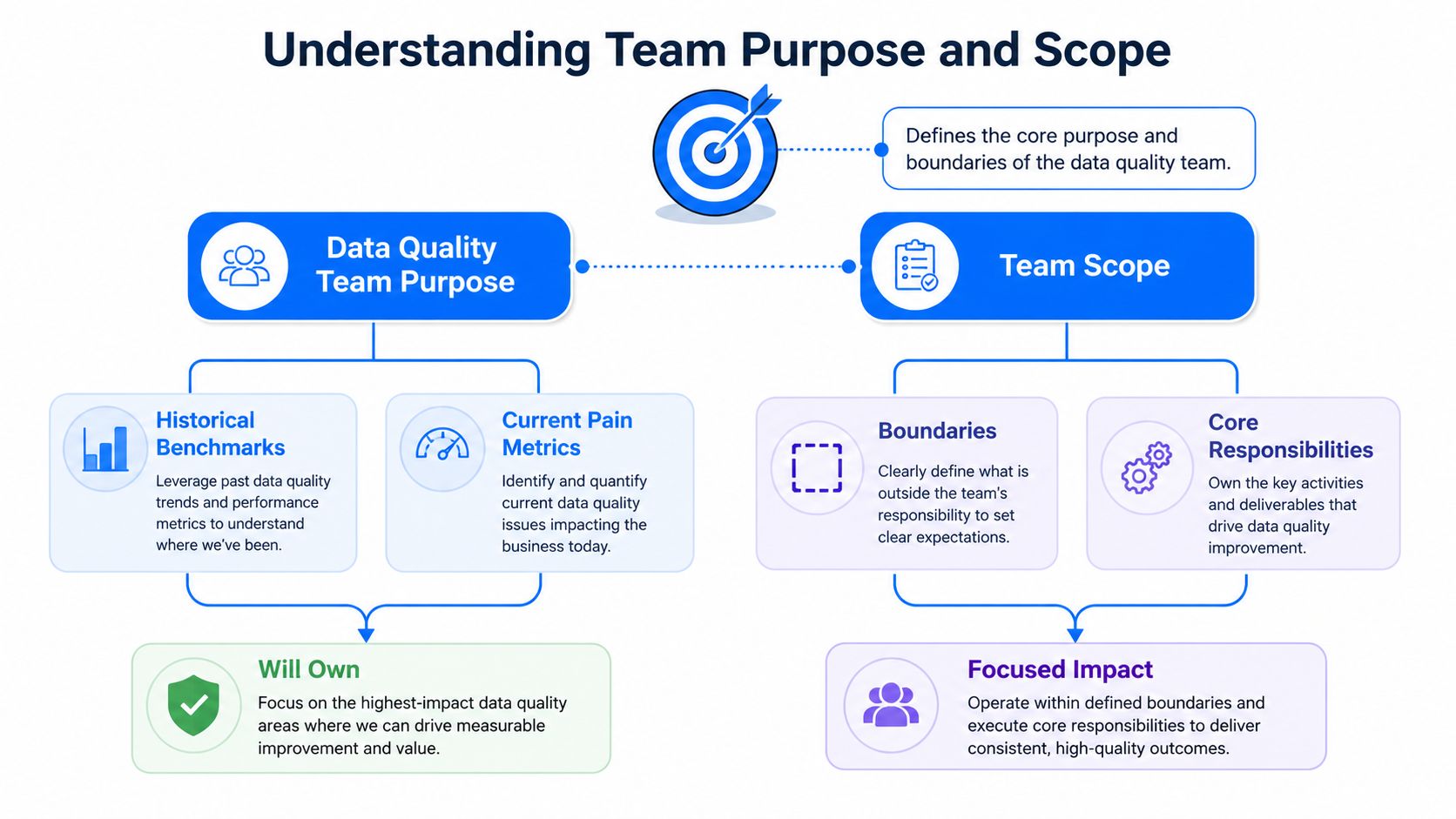
A useful way to define purpose is to start with the boundary of the team's work. A data quality team is the group that sets standards for important datasets, watches the checks that matter most, and routes problems to the right owners before those problems appear in dashboards, models, or operational processes. It does not function as a catch-all cleanup desk for every broken file or every one-off spreadsheet error.
That boundary matters because accountability often breaks between technical teams and business teams. Engineers may build pipelines, analysts may notice bad numbers, and business owners may feel the impact, yet no one clearly owns the final quality outcome. A data quality team exists to make that ownership visible and repeatable. The team can set the rules, but domain owners still need to own the data they depend on. A practical way to define those roles is to map them with a governance model, such as the one outlined in this guide to data governance roles.
A simple mission statement usually works best. Protect the reliability of the organization's most important data through monitoring, validation, incident response, and stakeholder reporting. In practice, that means the team watches for anomaly detection, schema tracking, validation, and timeliness monitoring, then turns those signals into action. The scope should start with the data that carries business risk, because a team that tries to monitor everything ends up protecting little.
The term business-critical needs a concrete definition. In finance, that often means transaction tables, settlement feeds, account balances, and risk reporting tables, because errors there can affect customers, controls, or compliance work. In healthcare, the equivalent might be patient admission records, medication orders, claims data, and care coordination tables, since mistakes in those datasets can disrupt operations or patient services. In retail, it may be order status, inventory snapshots, and pricing feeds, because those records shape revenue and fulfillment decisions. The right scope follows the consequences of bad data, not the size of the table.
Keep the scope tied to business-critical data. If a field does not affect compliance, reporting, or revenue, it can wait for a later phase.
The cleanest scope statement answers three questions. What data matters most. What signals show that data has gone bad. Who gets notified when it happens. That same clarity also helps hiring managers assign responsibilities across roles, which is why many teams use a guide for IT hiring managers to separate engineering ownership from analytics and business ownership. When leaders can answer those questions clearly, the team stops relying on vague ownership and starts operating with defined accountability.
Organizational Models and Key Roles
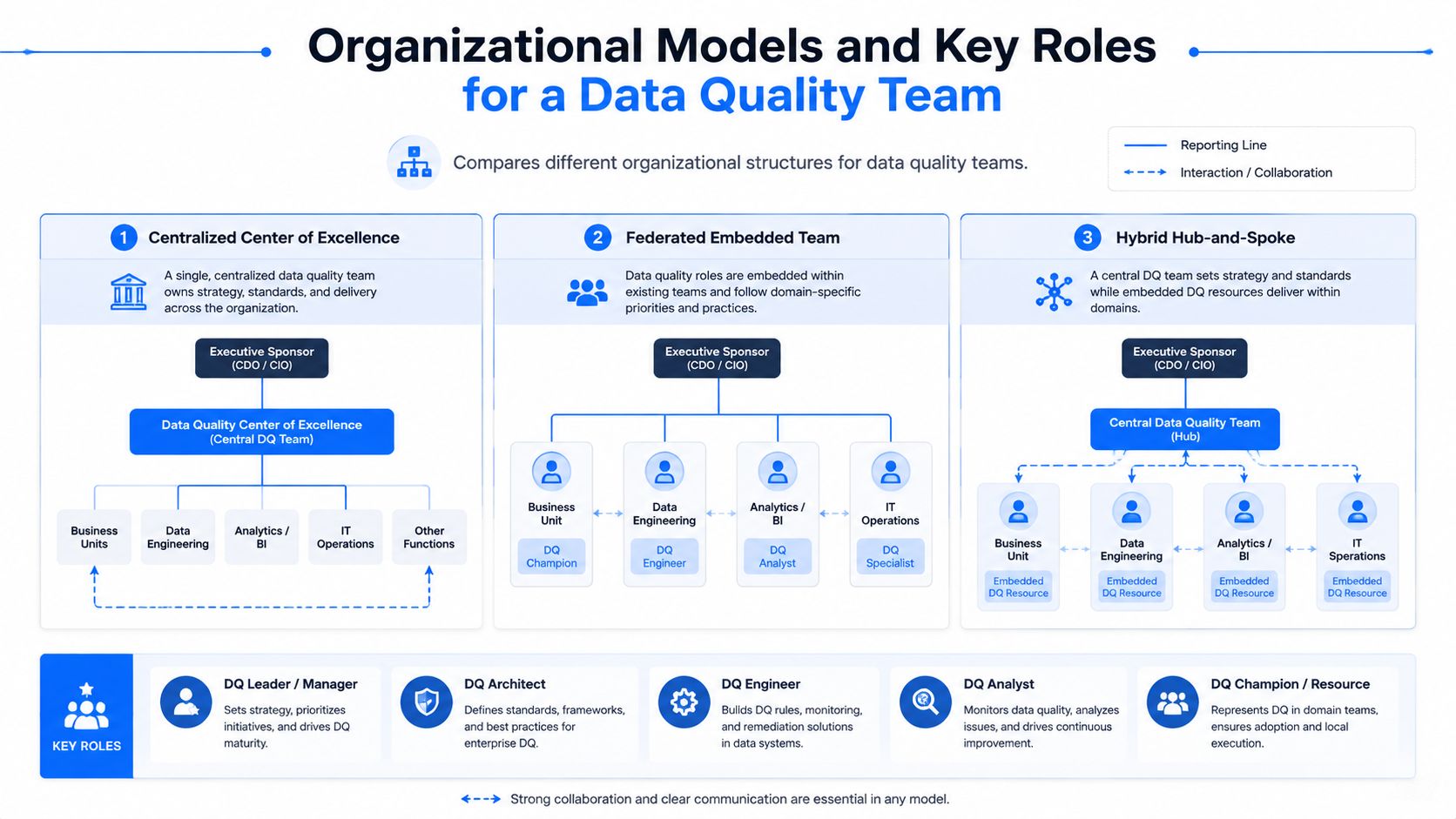
A data quality team can sit in the middle of the org chart or spread through it. The right model depends on scale, maturity, and how much autonomy different business units need.
Three structures that actually show up in practice
A centralized center of excellence works well when a small expert group sets standards, writes shared rules, and owns reporting. It's easy to govern, but it can become a bottleneck if every request has to route through the same team.
A federated embedded team places quality responsibility inside product, analytics, or domain groups. That model fits organizations that want local speed, but it only works when people still follow common rules and shared definitions.
A hybrid hub-and-spoke model gives you a central team that sets policy, common tooling, and escalation paths, while embedded owners handle domain-specific checks. For many enterprises, that's the most durable structure because it balances control with proximity to the data.
Gartner frames data quality around business use cases and risk, with accountability tied to issue resolution workflows and ownership signals (Gartner on data quality). That is the core design question. Not just what roles exist, but who is accountable when a check fails and who has authority to close the loop. A useful companion for org design is digna's guidance on data governance roles, which helps teams separate governance ownership from technical execution.
You'll also run into role overlap with analytics engineering and platform engineering. A helpful guide for IT hiring managers can clarify where analytics engineers differ from data engineers, which matters when you're deciding who should encode business rules and who should maintain pipeline reliability.
Role clarity beats role lists
The job titles matter less than the accountability map.
Data governance lead: owns policy, priorities, and escalation standards.
Quality engineer: writes checks, monitors incidents, and maintains validation logic.
Analytics engineer: translates business definitions into model-level rules.
Business steward: confirms whether a flagged issue is a business problem.
SRE or MLOps specialist: helps keep monitoring, alerting, and incident workflows dependable.
A good model avoids “everyone-and-no-one” ownership by assigning one clear owner per critical dataset and one shared responder path for incidents. If nobody can close the ticket, the structure isn't working.
Core Responsibilities Processes and KPIs
A data quality team works best when it treats quality as a set of testable dimensions, not as a vague promise. The common dimensions are accuracy, completeness, consistency, validity, uniqueness, and timeliness (data quality best practices). Those dimensions give engineers, analysts, and business stewards a shared checklist, so the conversation moves from opinion to evidence.
What each dimension means in daily work
Completeness is usually the easiest one to spot. If a required field is missing, the record is incomplete. Null checks and mandatory-field rules handle that gap.
Uniqueness catches duplicate rows, duplicate customer IDs, and repeated transactions that should appear only once. Teams usually treat it as a high-severity check because duplicate records can distort reporting fast.
Timeliness asks whether data is fresh enough to use. Freshness thresholds help teams catch delayed loads before an executive dashboard publishes stale numbers.
Accuracy, consistency, and validity are harder to see at a glance, so they need explicit business rules. A country code can be valid and still be inconsistent if it does not match the customer's billing region. A value can be present and still be inaccurate if it falls outside the expected business pattern.
That is why quality work needs a shared rulebook, not just a list of tests. A field can pass a syntax check and still fail the business meaning check, which is why technical owners and business owners need to review the same alert through different lenses.
A useful example comes from the Monte Carlo survey. It reported that data professionals spent 40% of their time checking data quality, and that poor data quality affected 26% of company revenue. It also found that 75% of respondents needed four or more hours to detect an incident, and that about half said resolution took an average of nine hours once identified. By 2026, average time to resolution had risen 166% to 15 hours per incident. Those figures show why the work needs process, not improvisation.
Practical rule: Put checks as close to ingestion and transformation as possible. A failed rule at the pipeline edge is cheaper to handle than a broken dashboard three layers downstream.
KPIs that tell you if the team is working
The team should track incident volume on critical tables, time to detect, time to resolve, and the rate of false alarms. It should also watch schema changes, because silent breakages often start there. Those measures make ownership visible, since each one points to a different handoff between technical teams and business reviewers.
For execution, industry guidance recommends source-level checks, automated monitoring, and business-specific thresholds rather than generic one-size-fits-all rules (Soda framework guidance). For operational monitoring, teams should watch freshness, volume, distribution, schema, and lineage, then connect those signals to clear incident workflows (Sparvi best practices). A good operating model works like a control room, one screen for the signal, one owner for the fix, and one business steward for deciding whether the issue changes the outcome.
For teams that want a practical reference on engineering habits around reliability, ThirstySprout's best practices are a helpful companion. The lesson is consistent. Build checks that reflect business reality, automate the repetitive ones, and assign each critical dataset to a named owner instead of a vague group.
Real World Examples of Team Success
A financial services team noticed reconciliation noise between its ledger and reporting layer. The data quality engineer had anomaly baselines on the key balance tables, and the business steward reviewed alerts before close. That setup caught a large mismatch early enough for the finance team to investigate before quarter-end reporting, which changed the conversation from panic to root cause analysis.
A healthcare provider took a different route. Its analytics group cared most about claims timeliness, because late records made operational reporting useless. The team put freshness checks at the arrival stage and routed failures to the ingestion owner, not to downstream analysts. That meant missing claims data surfaced quickly, and the people closest to the source could act before users discovered the gap in a dashboard.
A telecom operator faced another common failure mode, schema drift in ETL pipelines. The team embedded schema tracking into CI checks so new column changes or type changes had to be reviewed before release. That approach prevented silent breaks from reaching downstream consumers, and it gave platform engineers a clear line of sight into which deploy had changed the contract.
Each example had the same shape. One person owned the data, one signal detected the problem, and one business stakeholder decided whether the issue was material. That's what makes the function durable. It's not the tool. It's the handoff.
A quality program gets stronger when the first responder is clear. If the alert goes to five people, it usually gets owned by none of them.
These cases also show why rule maintenance matters. Checks that never change become stale, so teams need a review cycle that keeps validation aligned with business definitions and pipeline behavior.
Tooling and Integration Patterns
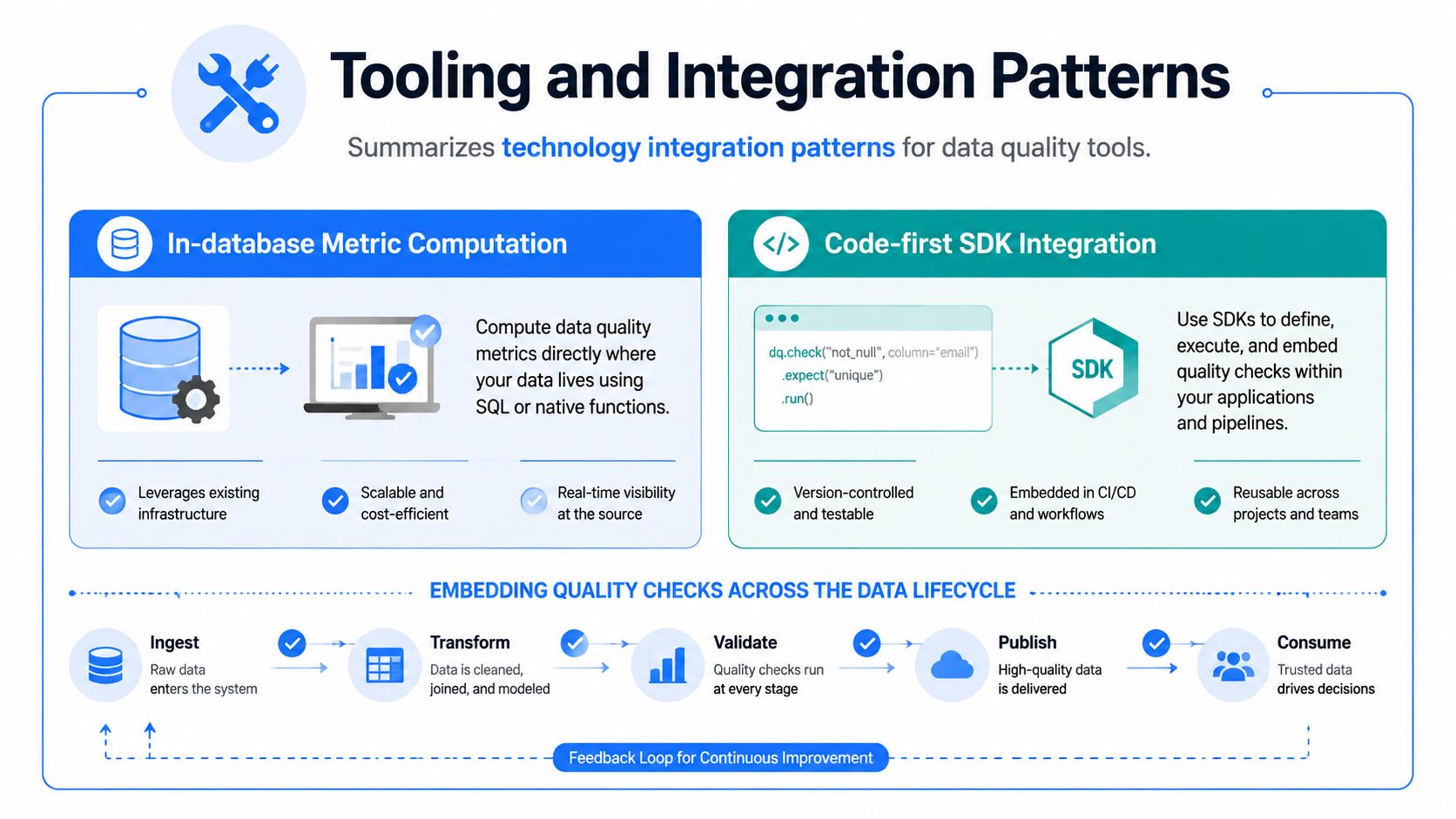
A tool stack should match where the data already lives and where people already work. If a warehouse holds the governed copy of record, in-database checks keep validation close to that system and avoid extra data movement. If engineers build and review logic in code, a code-first SDK fits better because the quality rules sit beside the rest of the pipeline.
Two Common Integration Patterns
In-database metric computation fits teams that want checks to run inside the warehouse. The benefit is simple, fewer copies to manage, less movement of sensitive data, and a cleaner fit with access controls and governance rules.
Code-first SDK integration works well for teams that want validation logic in their transformation or orchestration repositories. Engineers can version rules with the pipeline, review changes before release, and keep a clear history of what changed and why.
The wider platform choice should also bring anomaly detection, validation, timeliness monitoring, and schema tracking into one workflow. If those functions live in separate tools, one incident can turn into four different alerts, and no one gets a full view of the failure.
digna is one option for teams that want record-level validation, AI-driven anomaly detection, timeliness monitoring, and schema tracking inside the customer's own environment. Its data quality integration guidance explains how those checks can stay close to the data while the team keeps control of execution.
How to decide between batch and streaming
Batch works well when users can tolerate delay and the data naturally arrives in windows. Streaming matters when the business needs faster detection and shorter feedback loops. Both approaches can support the same governance model, but the alerting cadence and incident workflow need to match the pace of the system.
The operational goal is remediation, not just monitoring. Good practice calls for ongoing checks on freshness, volume, distribution, schema, and lineage, with clear incident workflows so breakages are found early and handled by the right owner. A well-integrated stack makes those signals visible where engineers and analysts already do their work.
A quality program also needs clear accountability across technical and business roles. The engineer who owns the pipeline, the analyst who understands the metric, and the business stakeholder who can decide whether the issue matters all need to see the same signal and know their part in the response.
Hire LATAM talent can be a practical route for teams that need that mix of technical and governance skills without limiting the search to one local market.
Hiring and Skill Requirements
A strong data quality team starts with clear accountability, not just technical skill. A pipeline engineer can build checks, an analyst can define the business rule, and a manager can decide whether the issue blocks reporting. If those roles are not spelled out, quality work turns into a shared problem with no clear owner.
Hiring should follow the same logic as a control framework. First define who owns detection, who owns investigation, and who has the authority to approve a fix or accept the risk. That structure helps a team move from “we found an issue” to “we know who responds, what happens next, and how the decision is recorded.”
The strongest candidates usually connect one technical skill to one governance skill. A quality engineer should be able to query data confidently and explain why a check matters to the business. A governance lead should be able to prioritize critical fields without turning the team into a bureaucracy. For teams building that operating model, the implementation guidance at data quality implementation guidance can help frame how roles, checks, and escalation paths fit together.
What to hire for first
Data quality engineers: automate checks, maintain alert logic, and investigate incidents.
Analytics engineers: encode business definitions into transformation logic.
Governance leads: decide which critical data elements need attention first.
SRE or reliability specialists: keep monitoring, alerting, and on-call processes stable.
Hiring should also reflect the split between technical ownership and business ownership. A data quality engineer may own the pipeline and the alert, while a business analyst confirms whether a spike in missing values breaks a report or changes a decision. That division keeps the team from guessing at impact, which is where many quality efforts slow down.
If you're building beyond your local talent pool, Hire LATAM talent can be a practical route for finding engineers who already work comfortably across analytics and data platform environments. That can help when you need people who understand both SQL and the workflow around issue triage, ownership records, and remediation follow-up.
Hiring test: Ask candidates how they would handle a missing-value spike on a critical table. The best answers cover detection, ownership, escalation, and whether the issue should block downstream use.
The right team is balanced, not oversized. You need enough technical range to automate checks and enough governance judgment to decide what should be fixed first.
Roadmap and Next Steps
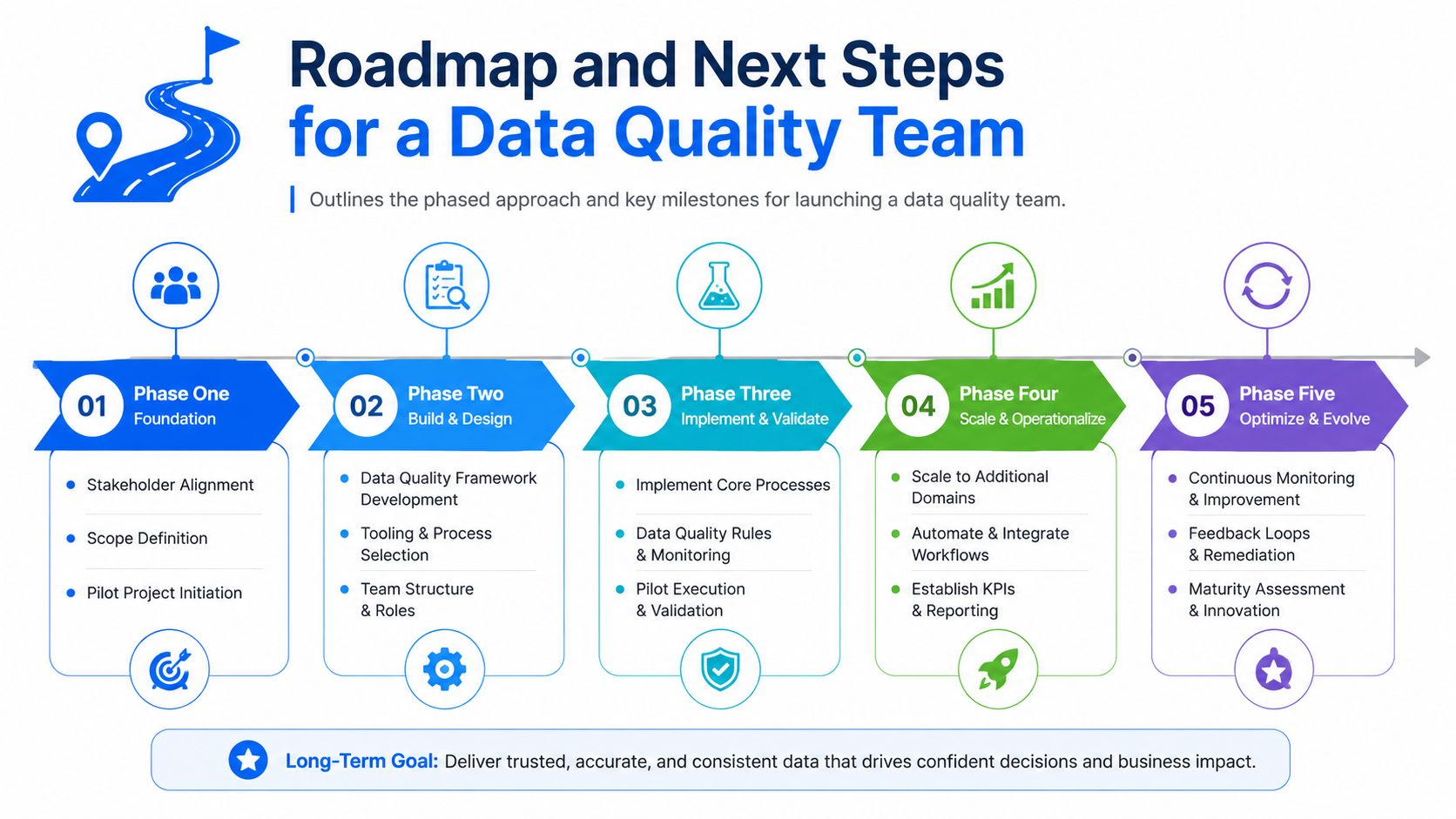
A data quality team works best when it grows in phases. If leadership tries to solve everything at once, the team ends up with broad responsibility and weak execution. If it starts too small, it can't prove value. The middle path is a phased rollout anchored in critical data and clear ownership.
Phase one starts with alignment and scope
Begin with stakeholder agreement, dataset prioritization, and a short list of critical data elements. Pick one or two tables that matter to reporting or operations, then define what “good” looks like in business terms. The main pitfall here is trying to monitor everything before anyone agrees on ownership.
Phase two turns the model into work
Hire or assign the core roles, then roll out recurring checks and issue workflows. This is the point where validation logic, alert routing, and ownership records become real. Teams that skip this stage often end up with a policy document that nobody uses.
Phase three is where scale begins
Once the first controls are stable, expand monitoring to adjacent tables and repeatable business domains. Automate routine checks, add root-cause analysis habits, and keep a changelog for schema and logic changes. The goal is to reduce manual triage without losing visibility into what the team is seeing.
Phase four and phase five focus on maturity
As the program stabilizes, improve dashboards, tighten thresholds, and standardize reporting for leaders. Mature teams also review whether the structure still matches the business, because ownership usually shifts as the data estate grows. If you want a practical implementation path for that rollout, digna's implementation overview shows how modular controls can be introduced without forcing a giant platform shift.
The core takeaway is simple. Build a team around accountability, not just inspection. Define who owns each critical dataset, automate the checks that matter most, and keep the business in the loop when an incident changes the meaning of a metric.
If you're building a data quality team and want a platform that runs checks in your own environment, tracks anomalies, validates records, and monitors timeliness and schema changes, visit digna to see how its modular approach fits enterprise data reliability work.
Frequently asked questions
Why establish a dedicated data quality team?
To close the gap that shows up when finance spots an unexplained variance before quarter close. Without a team that owns the gap, every such discovery becomes an individual favour rather than a process.
How common are these teams?
Uncommon. In O'Reilly's 2020 survey, 70% of respondents said their organizations did not have a dedicated data quality team, and almost 80% said they did not publish provenance or lineage information.
When does a data issue become a governance gap?
When the same type of issue reaches BI, finance or operations more than once. A single broken record is a defect; a recurrence means nothing in the process changed after the first one.
What should a good team be measured on?
Not the absence of errors. A good team does not remove every error, so judging it on a zero-defect standard guarantees the wrong incentives and hides the cases where fast detection did its job.
Which model should a team start with?
The one that matches where the failures land. A central team suits concentrated risk in shared assets, while embedded ownership suits domains whose meaning only the domain team understands, and most organizations end up with a mix.