Data Management in Banks: A 2026 Guide
|
7
min read

Major supervisory frameworks define bank data management through four measurable control dimensions, accuracy, integrity, completeness, and timeliness. In practice, that means the job is not just to store data, it's to prove that data stays reliable all the way into risk, finance, and reporting workflows.
Banks that treat this as a documentation exercise usually miss the point. The hard work is in operational controls, freshness checks, reconciliations, lineage, and auditability across the full data path, because stale or incomplete inputs spread fast once they enter downstream systems.
Table of Contents
Core Control Dimensions Regulators Measure
Four control dimensions give regulators a practical way to assess bank data quality: accuracy, integrity, completeness, and timeliness. Banks are expected to connect these dimensions to governance, integrated data architecture, and measurable quality controls, not leave them as policy language (BDO). The operational consequences are immediate. A delayed feed can distort risk aggregation, a missing field can weaken a finance control, and an inconsistent record can propagate errors into reporting layers that depend on shared data.
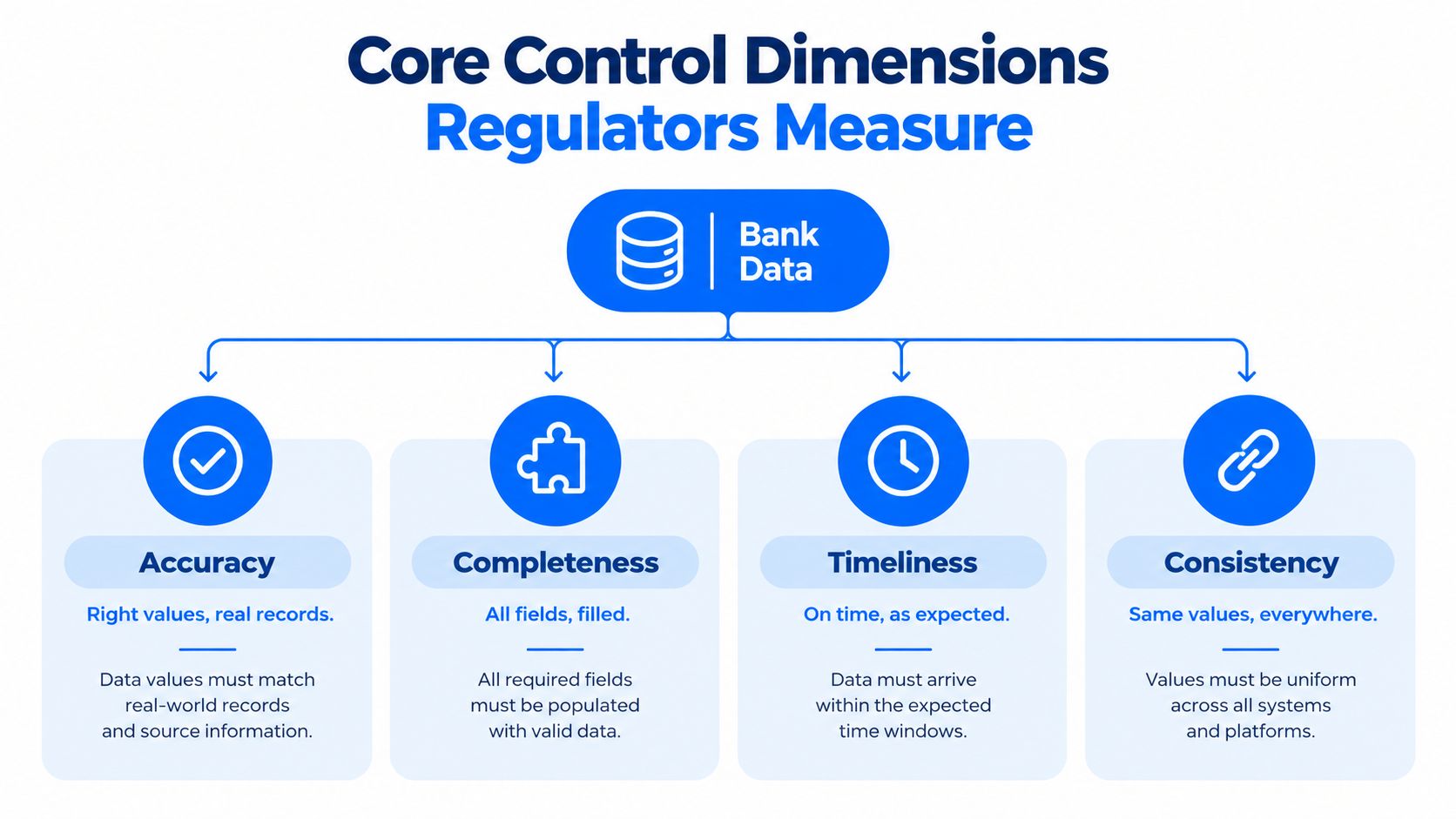
What each control dimension means in practice
Accuracy means that values match the authoritative source record they claim to represent. For a bank, balances, customer attributes, classifications, and reference data should agree with the approved system of record, rather than merely matching a warehouse copy that may already be outdated.
Integrity preserves relationships and meaning as records move between systems. It includes valid keys, complete audit trails, controlled transformations, and consistent definitions. Without those controls, a reported number may retain its format while losing the meaning it had at capture.
Completeness covers the fields, records, and attributes required for a business or regulatory control. A transaction feed can appear healthy while omitting a required component. Downstream reports may then look finished while concealing a material gap.
Timeliness identifies data that arrives too late for its intended use. A bank may possess the required records, but stale inputs cannot support current liquidity analysis, stress testing, risk aggregation, or regulatory reporting.
Practical rule: treat freshness checks and reconciliations as operational controls, not periodic cleanup tasks.
The ECB guide on effective risk data aggregation and risk reporting applies the same dimensions and calls for detailed KPIs for them (ECB guide). A useful KPI should show more than whether a rule passed. It should identify the affected source, pipeline, owner, downstream report, and time of detection.
That distinction exposes the gap between control design and execution. A bank may document a freshness threshold, yet still discover a failed feed only after a report is late. Modern observability tools can monitor delivery, schema changes, volume shifts, and rule failures across the pipeline. In-database validation can test balances, referential relationships, and business rules close to the data before defects spread.
Start by separating descriptive quality checks from control checks. Descriptive rules identify obvious anomalies. Control rules demonstrate that the pipeline is operating within defined expectations before data reaches risk, finance, or reporting processes.
Use a shared vocabulary for auditors, engineers, and business owners, then connect each rule to a business consequence. The data quality dimensions provide a useful reference for that vocabulary. Data management in banks becomes an operating discipline when teams can measure each dimension, trace failures to source, and produce evidence of remediation.
Practical Governance and Ownership Models
Good governance fails when nobody owns the data issue end to end. Banks need explicit ownership, clear escalation routines, and documented lineage so that quality defects get prioritized and remediated instead of just logged and forgotten (Dunnixer). That's the practical difference between a governance charter and a working control model. One creates accountability on paper, the other changes how incidents move through the organization.
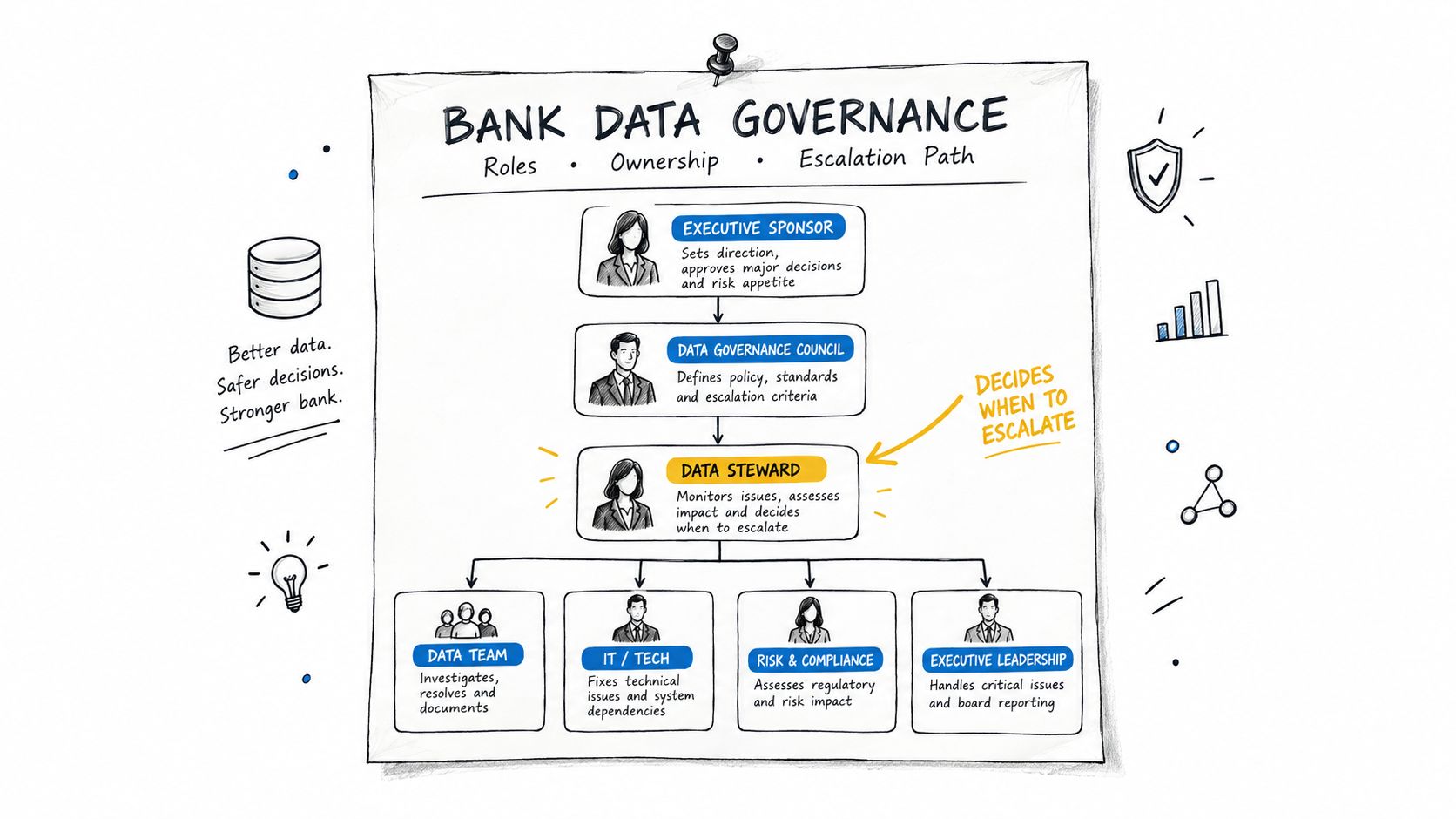
What working ownership looks like
A bank doesn't need more committees. It needs named owners for critical data domains, a documented path for escalation, and a shared definition of what “fixed” means. If a reference feed breaks, the steward should know who triages it, who approves the correction, and which downstream consumers must be informed.
The strongest programs also standardize critical definitions. When a customer, product, exposure, or balance means different things in different parts of the bank, every reconciliation gets harder and every audit takes longer. Standard definitions reduce arguments about semantics and shift attention toward actual defects.
Ownership is not a reporting line. It's the obligation to make sure the data keeps working after the meeting ends.
A current quality baseline matters for the same reason. If nobody knows what “normal” looks like, then a silent drift can sit in production for weeks before anyone notices. That's especially dangerous in banks that run mixed estates, where core platforms, marts, and reporting layers all interpret the same record slightly differently.
The internal guidance on finance data governance fits this model well, because governance only works when it connects policy, stewardship, and operational monitoring. In practice, the best banks create control ownership around the data path, not around a vague department boundary. That means the owner of the source system, the steward of the business definition, and the consumer of the report all have defined obligations.
The failure mode to avoid
The common failure pattern is simple. A quality issue gets logged, but nobody has the authority to fix the source, so the team applies a downstream workaround. The workaround keeps the report moving, but it hides the original problem and creates a second one in lineage.
That's why governance has to include escalation. If a defect hits a regulatory data set, the issue shouldn't wait for a monthly review cycle. It should move through a defined path that triggers action, evidence capture, and follow-up ownership.
Banks that do this well don't rely on heroics. They rely on role clarity, standard definitions, and the discipline to treat quality issues as operational incidents, not administrative noise.
BCBS 239 Requirements and Compliance Architecture
BCBS 239 remains the benchmark because it connects risk data aggregation with supervisory expectations. The framework defines 14 principles for effective risk data aggregation and risk reporting, helping banks produce accurate, timely, and complete risk information, including during periods of stress (BIS). Its requirements reach beyond the reporting team. They shape governance, architecture, control design, and the bank's ability to aggregate risk information consistently across legal entities and business lines.
Dimension | Requirement | Operational Impact |
|---|---|---|
Aggregation | Generate risk data through largely automated processes to reduce errors | Less manual handling, fewer conversion mistakes, faster production |
Coverage | Make data available across relevant business lines, legal entities, asset types, regions, and groupings | Clearer visibility into exposures, concentrations, and emerging risks |
Lineage | Trace data from capture through final reporting, including attribute-level traceability | Stronger auditability and faster isolation of defects |
Automation matters because every manual handoff creates another failure point. Staff can rekey values, delay a submission, or apply spreadsheet logic that never enters the formal control design. Automated workflows reduce those points of failure, but they do not replace control ownership. They make defined controls repeatable and measurable at scale.
Coverage creates a separate architectural test. Risk aggregation must represent the institution as a whole, including relevant legal entities, regions, asset groups, and reporting views. Excluding one of these areas can leave the bank with a polished report and an incomplete risk picture. The design therefore needs explicit scope, inclusion rules, and checks that identify missing populations before reporting.
Lineage is the evidence layer. Supervisory guidance associated with BCBS 239 emphasizes traceability from data capture to final reporting, including the ability to follow individual attributes (EY). A lineage diagram alone does not prove that the control works. Teams need execution evidence showing the source value, each transformation, the validation result, and the report output.
The ECB guide adds operational detail by requiring banks to define KPIs for monitoring data quality dimensions. That shifts compliance architecture from static documentation to continuous observation. Modern observability tools can expose freshness, volume, schema, and rule failures across fragmented pipelines, while in-database validation can test records close to the point where they are created or changed.
For implementation detail, see the guide to meeting BCBS 239 principles with AI-powered data quality.
Operational test: when a risk number changes, the team should identify its source, transformations, validation controls, and supporting evidence without manual reconstruction.
Banks often describe partial control coverage as BCBS 239 coverage. The distinction matters. Gaps in lineage, automation, or institutional scope can remain hidden until stress increases reporting volume or exposes inconsistent data. A resilient architecture should show those gaps through monitoring, not wait for a supervisory review or reporting incident to reveal them.
Why Controls Fail Without Source Accountability
The frustrating part of bank data management is that controls can look strong on paper and still fail in production. A 2025 European regulatory reporting study found that 90% of banks had at least three data quality controls and 66% had centralized data architecture, yet only 18% reported full BCBS 239 implementation and just 24% had extensive lineage documentation (Deloitte). The same study found that missing or incorrect source data remained the leading cause of reporting errors, cited by 56% and 50% of banks, respectively.
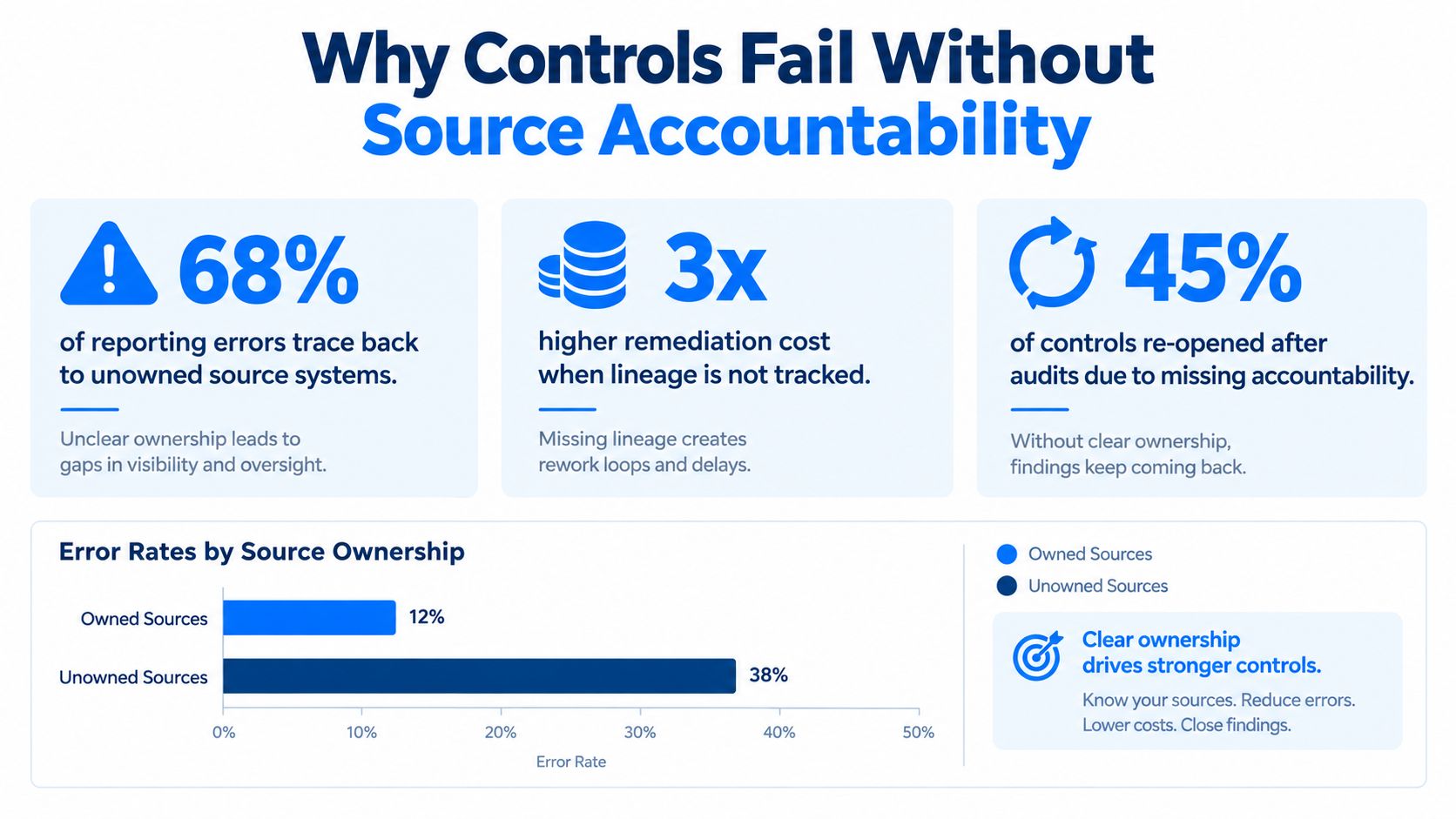
Why installed controls still miss the root cause
This is the contrarian lesson most banks need to hear. The limiting factor is often not a lack of controls, it's weak source-data accountability, fragmented flows, and insufficient lineage visibility. Teams can install validation rules, but if nobody owns the source system and nobody can trace a bad value back to origin, the same defect keeps resurfacing in different reports.
That's why incident management matters so much. Logging an issue is not the same thing as resolving it. If the defect lives upstream, the downstream team can only patch symptoms, not the cause.
The internal guide on data owner responsibilities fits this operational reality. Ownership has to reach back to the source, because that's where accountability starts and where fixability usually lives.
What fragmented flows do to remediation
Fragmented flows make remediation expensive in ways that are easy to underestimate. A bank may fix the visible report, but if lineage is missing, every downstream consumer has to revalidate the same issue separately. That multiplies review effort and delays closure.
It also weakens audit response. When auditors ask how a figure was produced, teams need a path from record capture to report output, not a loose collection of screenshots and ticket notes. If lineage is thin, the bank can prove that a control ran, but not that the right data passed through it.
If the team can only describe the symptom, the source problem is still running the bank.
A better diagnostic is to ask whether the organization can trace exceptions back to origin points. If the answer is no, then the controls are acting as filters, not as accountability mechanisms. That distinction matters because filters can reduce visible errors while leaving the production process unchanged.
Banks that break this pattern usually do two things differently. They assign ownership at the source, and they design controls that preserve evidence of the path the data took. That combination is what closes the gap between control design and execution.
The AI-Ready Operating Model Gap
Banks know data matters for AI, but many still can't move from ambition to execution. A recent KPMG banking survey found that 93% of respondents cited data privacy and risk, 89% data quality, and 81% legacy and integration complexity as top modernization challenges, while 68% said they have a target-state vision and 65% have a roadmap and funding model (KPMG banking survey). That gap tells you something important. The strategy exists. The operational backbone often doesn't.

Where AI programs stall
The first failure point is usually trust. If data quality is inconsistent, teams won't rely on it for model training, model monitoring, or GenAI retrieval. That slows experimentation before the first pilot produces anything useful.
The second failure point is integration. Legacy estates make it hard to move validated data between risk, finance, and AI workflows without creating new copies and new reconciliation work. The result is a stack that looks modern at the top and brittle underneath.
The third failure point is governance pressure. Banks don't just need data that works technically, they need data that can survive compliance review. If the model input can't be traced, explained, and validated, the bank may have a promising use case that never clears operational review.
The internal AI-ready data resource is relevant here because AI readiness is mostly about control strength, not hype. If the underlying data pipeline can't show freshness, structure, and traceability, then the AI layer inherits the weakness.
What a realistic operating model looks like
A realistic model doesn't start with the model. It starts with the data path. Banks need validation where the data lands, timeliness checks where feeds arrive, and lineage that stays intact when records are transformed or joined.
That's where observability becomes useful. Teams need to see when a feed changes, when a schema shifts, or when a source stops delivering on time, before the problem gets encoded into downstream analytics. The value isn't only speed. It's the ability to stop broken data from becoming a broken model.
AI readiness is a data operations problem first.
The practical takeaway is that target-state roadmaps aren't enough. Banks need operational controls that survive the jump from modernization slides to live pipelines. Otherwise the AI program becomes another initiative that looks committed on paper and fragile in production.
Building an Integrated Data Management Framework
An effective framework ties governance, architecture, lineage, and validation into one operating model. The point is not to add more review steps. The point is to make quality visible early enough that the bank can prevent bad data from reaching regulatory reporting, risk models, or AI workflows.
The strongest design starts with continuous monitoring at the data path level. Banks need to watch delivery freshness, schema shifts, and rule failures where the data enters the environment, not only after someone notices a bad report. That's where in-database validation matters, because checks that run close to the data reduce movement, preserve control evidence, and avoid turning every exception into a copy-and-compare exercise.
The framework that actually holds up
A practical bank framework usually has five layers.
Control definition: Each critical data set has explicit rules for accuracy, integrity, completeness, and timeliness.
Ownership: A named owner and steward are accountable for source behavior and remediation.
Lineage: The bank can trace data from capture through transformation to final reporting.
Monitoring: Freshness, validation, and schema changes are checked continuously, not periodically.
Response: Exceptions trigger escalation with evidence, not just a ticket number.
Those layers should sit on top of the actual bank architecture, not outside it. If controls live in separate tools that require manual synchronization, teams end up reconciling the controls themselves instead of the data.
The best control model is the one operators can trust without rechecking by hand.
That's also why observability tools matter more now. Supervisory expectations keep moving toward evidence, not intent. If the bank can show what arrived, what changed, what failed, and what was fixed, then the control model becomes auditable rather than aspirational.
digna is one option in this space because it combines data validation, timeliness monitoring, schema tracking, and in-database execution inside the customer's own environment. In a bank context, that kind of design fits the need to keep data in place while checking it continuously across warehouses, lakes, and pipelines.
The final test is simple. If the bank can detect broken inputs early, trace them to source, and prove what happened without manual stitching, then the operating model is doing real work. If not, the organization still has governance language, but not yet a resilient bank data management capability.
If you're modernizing bank data controls and want a practical way to monitor freshness, validate records, and preserve lineage inside your own environment, visit digna and review how its observability and validation modules fit regulated data operations. It's built for teams that need evidence, not just dashboards.
More than a decade after BCBS 239 was published, many banks still treat it as a documentation project rather than an upgrade to how they manage risk data. Our article on turning BCBS 239 compliance into business value looks at the principles on accuracy, timeliness and reporting, and how banks can turn that regulatory obligation into a competitive advantage.
Frequently asked questions
What are the four data quality dimensions regulators use for banks?
Regulators assess bank data on accuracy, integrity, completeness and timeliness. The ECB guide on risk data aggregation asks banks to define detailed KPIs for each one, and a useful KPI should name the affected source, pipeline, owner, downstream report and time of detection, not just whether a rule passed.
How many principles does BCBS 239 have?
BCBS 239 sets out 14 principles for effective risk data aggregation and risk reporting. Three requirements shape bank architecture most: largely automated aggregation to cut manual errors, coverage across legal entities, regions and asset types, and lineage that traces individual attributes from data capture through to the final report.
Why do banks still fail BCBS 239 despite having data quality controls?
Controls fail mainly because source data has no accountable owner. A 2025 Deloitte study found 90% of European banks run at least three data quality controls, yet only 18% report full BCBS 239 implementation and 24% have extensive lineage, while missing or incorrect source data remains the top cause of reporting errors.
What is holding back AI adoption in banking data?
Data trust and integration, more than strategy. In a KPMG banking survey, 89% named data quality and 81% legacy and integration complexity as top challenges, even though 68% already had a target-state vision. Without freshness checks, validation and lineage on the data path, AI models inherit the weaknesses of their inputs.
What should a bank data management framework include?
A workable framework has five layers: control definition, ownership, lineage, monitoring and response. Each critical data set gets explicit rules, a named owner and steward, traceability to the final report, continuous checks for freshness, validation and schema changes, and escalation that carries evidence rather than just a ticket number.