Finance Data Governance: Practical Framework
|
7
min read

You already know the feeling. A feeder file lands late, the dashboard still looks “mostly right,” and by the time someone notices the timing shift, the number has already moved from a reporting nuisance into a board conversation. In finance, that's how a small data defect becomes a capital question, a liquidity question, and sometimes a control failure that no one can comfortably explain after the fact.
Finance data governance exists to stop that chain reaction. Not with paperwork alone, but with ownership, lineage, access control, validation, and increasingly with machine-enforced controls that catch drift before it reaches official reporting.
Table of Contents
When a Late Dataset Becomes a Board Problem
A common failure mode in regulated finance is boring on the surface and expensive underneath. A feeder dataset arrives ninety minutes late three days in a row, the report still publishes, and nobody flags the timing shift because the number set is technically complete. By the time the issue is traced, that same dataset has already flowed into liquidity views, risk dashboards, and management reporting, which is exactly how one defect becomes several official disclosures.
That propagation is why governance in finance can't be treated like generic reporting hygiene. The broader industry has long recognized that bad data can reduce revenue by up to 12%, and that 60% to 73% of enterprise data is unused according to a commonly cited estimate, which makes the economic case for trustworthy data assets obvious rather than theoretical. In financial services, that loss shows up not just in missed opportunities, but in fraud exposure, reconciliation effort, and the risk of non-compliance when the same data feeds multiple downstream controls. Industry data governance estimate
The real issue is timing, not just accuracy
Late arrival is often the first visible symptom because finance stacks still carry a lot of manual handoffs between source systems and final packs. A report can be “correct” in the sense that every field is populated, while still being operationally wrong because the data was stale when decision makers used it.
Practical rule: if a dataset is critical enough to affect board, regulatory, or risk reporting, it needs a named owner, a freshness expectation, and an exception path before anyone trusts it.
That's the shift finance teams need to make. Governance is not an abstract compliance exercise, it's the discipline that treats data as a regulated production asset, with controls that protect the trustworthiness of every decision built on top of it.
What Finance Data Governance Actually Means
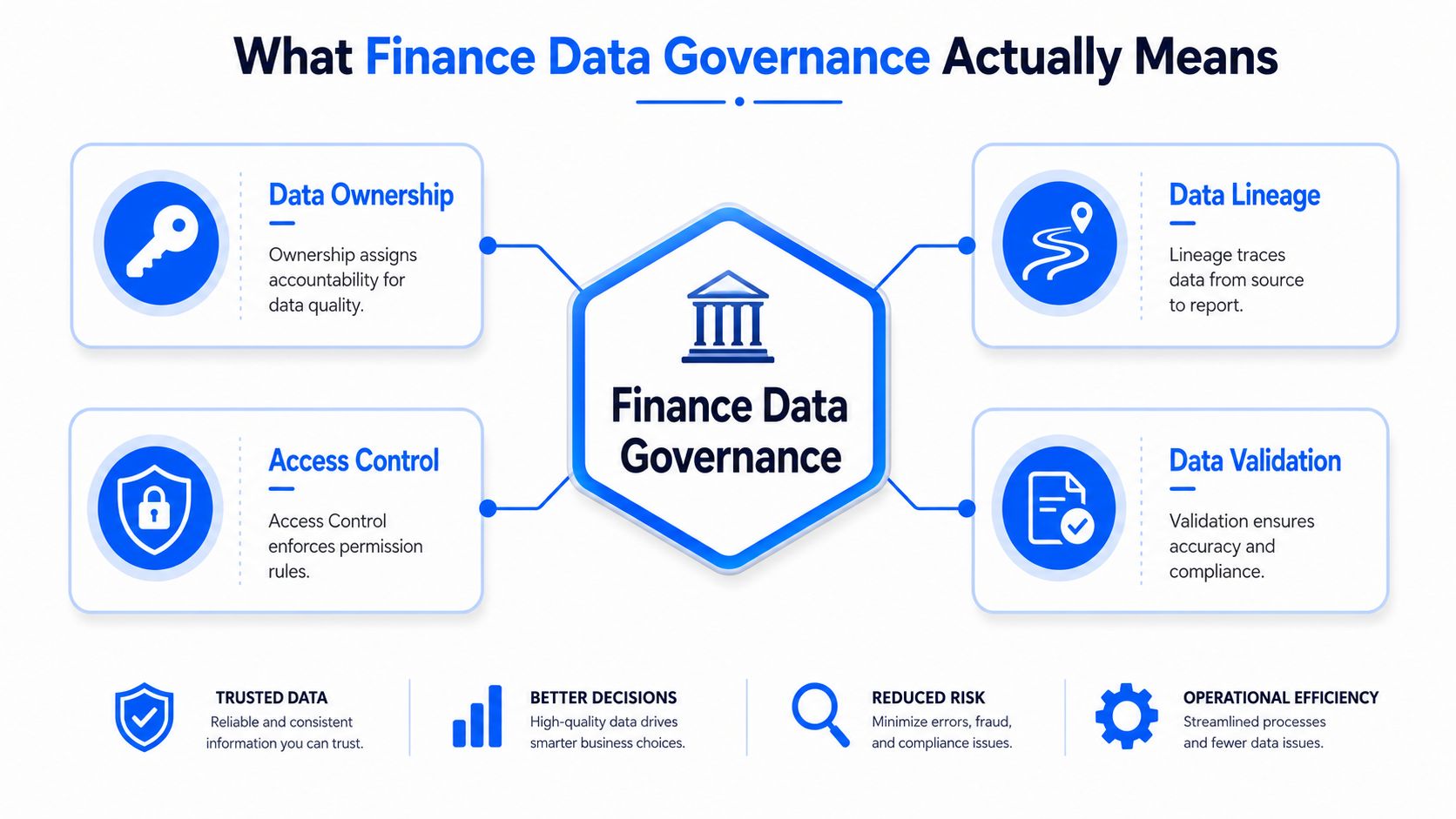
Finance data governance is the set of ownership, lineage, access control, and validation practices that let a firm satisfy regulatory reporting while reducing fraud, errors, and non-compliance risk. In plain terms, it answers four questions every regulator eventually asks, who owns the data, where did it come from, who touched it, and how do you know it's still fit for use.
The practical change is moving from spreadsheet oversight to documented control. A mature program defines ownership, metric definitions, and change management so trustworthy reporting can be traced from source systems to board packs. That matters because major banks and insurers don't use data once, they reuse the same governed data across regulatory capital, risk, finance, and management reporting, which means one defect can spread across all of them.
Why finance is different from generic enterprise governance
Generic governance often stops at cataloging and policy. Finance has to go further because regulators care about traceability and reproducibility, not just a clean final output. Europe's DORA framework explicitly pushes financial institutions to demonstrate traceability of data and operational resilience in the systems that produce and transform financial information, which forces governance closer to the pipeline itself. DORA and finance governance context
BCBS 239-style expectations raise the bar in a different way. The control objective isn't just “the report is right,” it's “the critical data elements are accurate, traceable, and reproducible across the reporting chain.” That's why finance governance programs focus on the mechanics of control, not just the existence of a policy.
Governance is the foundation for trustworthy reporting from source systems to board packs.
What gets governed first
The best finance programs don't try to govern everything equally. They focus on the few data domains that drive official disclosures, then build outward. A program that starts with critical data elements, named owners, and source-to-report lineage gives auditors something tangible to test, and it gives the business a control structure that survives production reality.
The Four Technical Controls Regulators Examine
Regulators and internal audit teams usually want proof of controls, not a slide deck about intentions. In financial institutions, that proof tends to sit in four places, automated data-quality checks, detailed access control with audit trails, complete source-to-report lineage, and policy rules embedded in system controls rather than left as paper procedures. Those are the controls that make reporting reproducible when someone asks how a number was built.
A useful way to think about the stack is layered control design. Preventive controls catch bad data at the point of entry, detective controls spot drift and rule violations during processing, and corrective workflows route exceptions to the right owner with a defined SLA. That layered pattern matters because manual review alone can't scale across warehouses, lakes, and multi-system finance pipelines.
One practical resource that pairs well with this view is Lighthouse Consultants' finance data guide, especially for teams that need a broader operating context before they instrument controls.
What the control stack looks like in practice
Preventive controls: schema enforcement and referential integrity stop obviously invalid records from entering the pipeline.
Detective controls: drift checks, quality rules, and threshold monitoring flag changes after ingestion.
Corrective controls: issue workflows, owner assignment, and SLAs force remediation instead of silent acceptance.
Audit controls: lineage capture and access logs show who changed what, when, and where it moved.
The pattern becomes operational here. Map each material data object to an accountable owner, then attach data-quality gates, lineage capture, and exception workflows to that same object so every material change leaves an audit trail. That approach reduces the gap between policy and execution, which is usually where finance programs fail.
Why “manual plus review” breaks down
Manual review still has a place, but not as the primary defense. High-volume reporting chains change too fast, and manual spot checks tend to miss the subtle failures that matter most, like delayed loads, type shifts, or a field that stops populating. Machine-enforced controls don't replace judgment, they preserve it for the exceptions that deserve human attention.
Ownership That Actually Holds Up in Audit
Ownership gets vague fast when nobody ties it to a business function. In finance, that vagueness turns into audit friction, because “the data team” isn't accountable in a meaningful way when a regulator asks who approved a change or who owns remediation. The cleaner model is functional ownership, with first-line and second-line accountability split by domain.
Guidehouse's governance framing is useful here. It says the first-line owner for customer and account data is typically the head of onboarding, while the second-line owner for transactional data is typically the head of AML. That's not a cosmetic distinction, it reflects where origination, surveillance, and risk responsibility sit. Guidehouse financial data governance framework
Assign the owner to the decision, not the dataset label
A data steward can help maintain definitions and chase issues, but a steward without authority can't force remediation. A named business owner can. That's why ownership split by business function works better than a generic steward model, especially when a schema change or threshold adjustment affects regulated reporting.
You can harden the model with a few concrete rules:
Map each critical object to one accountable owner: no shared ambiguity for core domains.
Document metric definitions: board numbers need consistent meaning across reports.
Route changes through the owner: source changes, threshold edits, and field additions should all leave traceable approval records.
Separate origination from oversight: the person closest to the source usually owns first-line quality, while risk and compliance oversight sits in the second line.
For teams formalizing this, the internal reference at digna's data owner responsibilities is a useful way to structure role clarity without overcomplicating the operating model.
If a control failure can't be assigned to a business function, it won't hold up well when audit asks who was responsible for fixing it.
What good ownership looks like on the ground
Good ownership feels slightly inconvenient at first because it removes the comfort of shared responsibility. That inconvenience is useful. It forces teams to decide who approves a metric definition, who responds to a validation failure, and who signs off on a change that could affect a regulatory submission.
From Document-Heavy Governance to Operational Observability
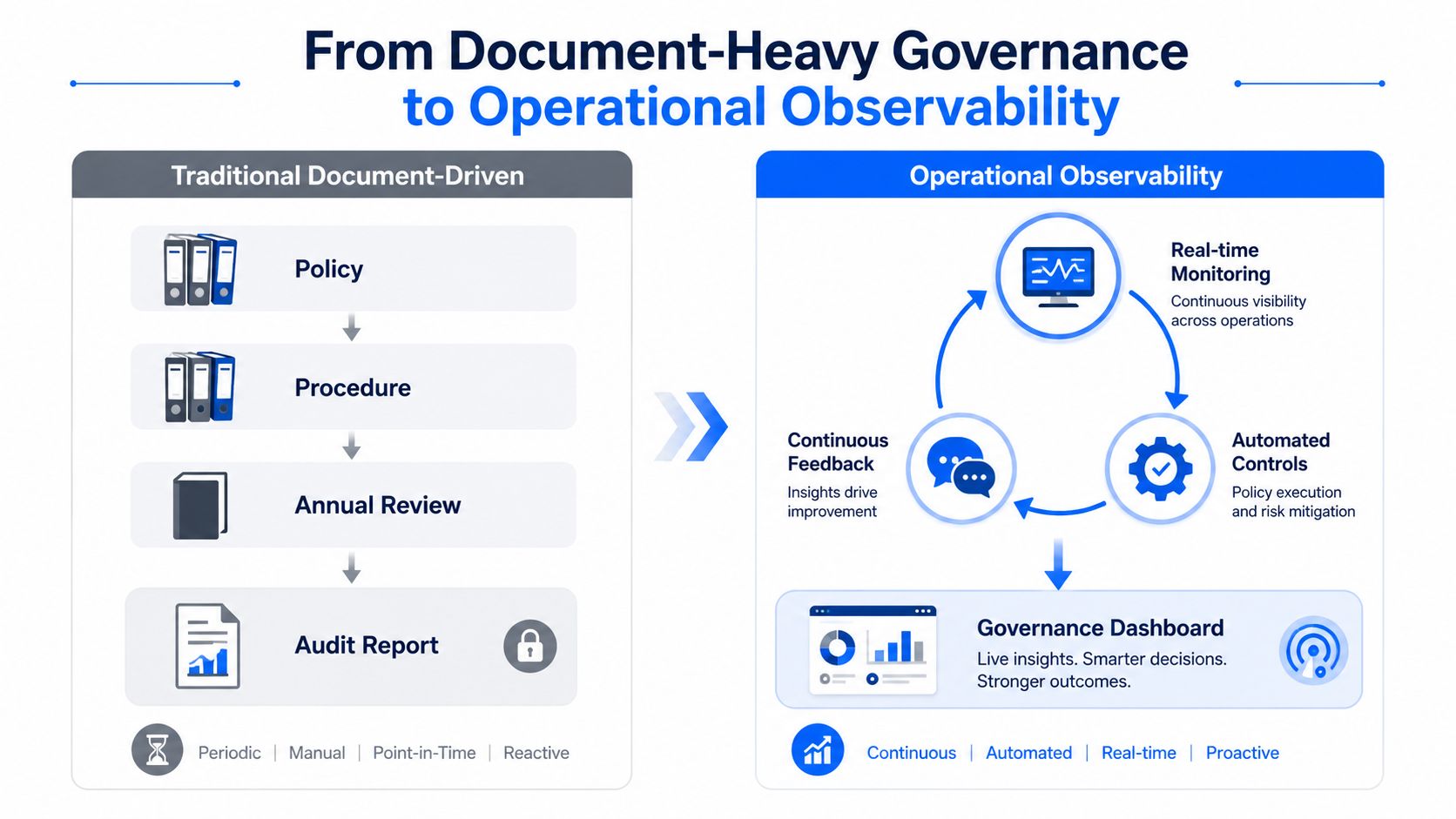
Traditional governance usually lives in policies, procedures, and annual attestation cycles. That model is useful for demonstrating intent, but it's too slow for modern finance pipelines where data moves continuously and defects often appear as small shifts before they become visible incidents. Operational observability closes that gap by watching lineage, access, timeliness, and quality in real time.
A big reason this matters is that finance failures rarely start with an obvious outage. They start with a late arrival, a distribution drift, or a silent schema change that no one notices until downstream reconciliation gets messy. That's why AI-driven anomaly detection, timeliness monitoring, and schema tracking have become core governance controls rather than nice-to-have monitoring features.
The difference between checking a policy and controlling a pipeline
Document-heavy governance asks whether a process exists. Operational observability asks whether the process is behaving as expected right now. That shift changes the entire failure model, because the control is no longer an annual review or quarterly sign-off, it's a live signal that can trigger response while there's still time to prevent a bad number.
The technical patterns that make this work are practical, not mystical:
Anomaly detection: surfaces unexpected changes without constant rule maintenance.
Timeliness monitoring: compares actual arrival against expected delivery patterns.
Schema tracking: flags added or removed columns and type changes before they break downstream logic.
Continuous feedback: routes recurring issues back into the control configuration.
These controls don't eliminate policy, they make policy executable. That matters in cloud-heavy and analytics-heavy finance stacks, where manual oversight can't see enough of the system to be reliable.
A short view from the operating floor
The first time teams move from annual review to live monitoring, they usually discover how much of their “stable” reporting depended on nobody touching anything. That's not a governance win, it's a hidden fragility. Operational observability turns those fragilities into visible signals while the issue is still small enough to fix.
Metrics, SLAs, and the Control Stack in Practice
Critical Data Elements, or CDEs, are where serious finance governance starts. A good gap analysis doesn't just list defects, it turns them into business risk, things like onboarding delays, surveillance gaps, duplicate identities, and inconsistent customer, account, or product records. Guidehouse recommends a risk heatmap output from that analysis, because not every defect deserves the same response.
The control stack gets real when each issue type has a different SLA. Schema-change detection should move fast, freshness breaches should be judged against the batch cadence, anomaly investigations should follow business-hour routing, and validation failures should be escalated to the named owner. That keeps operational noise from drowning out the failures that matter.
A layered control table that actually works
Layer | Control | Target Cadence | Accountable Owner |
|---|---|---|---|
Preventive | Schema enforcement, referential integrity | At ingestion | Data owner |
Detective | Drift checks, anomaly detection, timeliness monitoring | Continuous or per load | Domain owner |
Corrective | Exception workflow, issue triage, remediation SLA | Business hours or defined response window | Named business function owner |
Audit | Lineage capture, access trail, validation evidence | Continuous retention | Control owner |
This is also where platform architecture matters. Many regulated teams need in-database metric computation so the data stays resident in the customer environment, and they need private-cloud or on-prem deployment so the control stack doesn't create new data-exit risk. That's especially important when the governance layer is watching sensitive finance pipelines and the institution can't afford vendor access to production datasets. Finance governance and traceability practices
Why the operating model has to be measurable
If you can't define the SLA, you can't manage the exception. If you can't measure freshness, schema drift, or validation failure rates on the same cadence as the pipeline, you're not operating governance, you're documenting it.
Governance metrics should describe response speed, ownership, and reproducibility, not just whether a report looked clean last quarter.
For teams looking at tooling, digna is one option that runs anomaly detection, timeliness checks, validation, and schema tracking inside customer-controlled environments, which is useful when the regulated perimeter matters more than convenience.
An Implementation Roadmap That Survives Reality
Most finance governance programs don't fail because the controls are wrong. They fail because the team tries to start everywhere at once, avoids the ownership conversation, or buys a platform before deciding what must be governed. The sequence matters more than the slogan.
Phase one starts with assessment
Inventory the CDEs, owners, sources, and reconciliation points. Then produce a risk heatmap that ranks the gaps by business impact rather than by who shouted loudest in the meeting. That gives the program a defensible starting point and stops it from becoming a generic data cleanup effort.
Phase two narrows the scope
Pick the small set of board, regulatory, and risk metrics that drive the consequential decisions. Govern those first, because trying to cover every dataset equally usually spreads the team too thin to matter. This is also where the program gets political, since prioritization forces leaders to accept that some data matters more than the rest.
Phase three instruments the controls
Deploy data-quality checks, lineage capture, schema tracking, and timeliness monitoring on the prioritized CDEs. If the environment is regulated, favor in-database execution so the data remains resident and you don't introduce unnecessary movement across systems. How to implement data governance in practice
Phase four makes it operational
Set up dashboards, on-call rotations, exception workflows, and quarterly attestations. Then feed incident retrospectives back into the platform configuration so recurring problems stop being recurring. That feedback loop is what separates a real control program from a one-time project.
What usually goes wrong
Teams skip assessment and inherit chaos. Teams skip prioritization and never get enough coverage on the metrics that matter. Teams skip operationalization and end up with a dashboard nobody owns.
A governance program becomes credible only when the same people who own the data also own the exception path.
Operating the Program and Common Questions
Once the first rollout is done, governance either becomes a habit or it fades into an archive of good intentions. The working model is simple, quarterly owner reviews, exception trend analysis, annual control re-certification, and a direct feedback loop from incidents into platform rules and thresholds. That cadence keeps ownership current and stops yesterday's controls from hardening into today's blind spots.
One area mainstream governance content still undercovers is analytics and AI input governance. Sandboxes and AI-assisted workflows make lineage, ownership, and access boundaries harder to reconstruct, so they need explicit controls rather than assumptions. Test data handling, prompt access rules, and approved analytical spaces all deserve the same discipline as production reporting, especially when those environments influence decisions that later appear in finance or risk outputs. Why governance falls behind where it matters most
Common questions practitioners ask after the first ninety days
How do you start without a governance function? Start with one reporting chain, one owner, and one set of critical metrics. Governance grows from accountability, not from committee volume.
How do you handle third-party data? Treat external feeds as governed inputs, with clear validation, timeliness, and access rules before they reach official reports.
How do you balance democratization with control? Give broader access to trusted, well-defined data products, but keep sensitive or regulated domains behind explicit permissions and auditable use.
How do you know it's working? Look for fewer surprise breaks, faster exception resolution, cleaner ownership, and less manual reconciliation around board and regulatory numbers.
The broader lesson is simple. Finance data governance earns its keep when it turns regulated data into a trusted, observable asset instead of a documented promise.
If your finance team needs to move from policy-heavy oversight to machine-enforced controls, digna can help with anomaly detection, timeliness monitoring, schema tracking, and in-database validation inside customer-controlled environments. Visit digna to see how that kind of control layer fits into regulated finance stacks and whether it matches the reporting paths you need to harden.