10 Data Governance Framework Template: Resources for 2026
|
6
min read

A data governance framework template won't fix conflicting definitions, unowned datasets, or controls nobody checks. That popular advice confuses a framework diagram, an operating-model assessment, a policy document, a governance charter, and an implementation repository. Each produces a different artifact, and each solves a different starting problem.
The right resource depends on your immediate gap. Do executives need a shared view of scope? Do business teams need named owners and decision rights? Does legal need usable policy language? Does the governance office need a maturity baseline? Or does the delivery team need workflows, evidence, and rollout tasks?
That distinction matters because formal governance remains uneven. The cited 2026 adoption analysis reports that 23% of organizations use formal data governance or quality frameworks, with lower figures in financial services and fully on-premises organizations, as documented in the data governance framework adoption analysis. A template can accelerate standardization, but only if someone converts its language into accountable work.
The comparison below evaluates each resource by the artifact it helps create, its implementation depth, its sector or platform bias, its practical limitations, and the next step required to turn it into an operating program.
Table of Contents
1. Microsoft Governance Framework Template PowerPoint
Where it works and where it stops
2. Atlan Blueprint Governance Framework and Templates
Strong for modern programs, less neutral than it appears
3. Collibra Operating Model Diagnostic Template
Good for accountability design, weaker as a standalone control system
4. EDM Council DCAM
The best fit is regulated complexity
5. Robinson Ryan Data Governance Framework Template Word
Strong policy scaffolding, limited operational machinery
6. OvalEdge Data Governance Framework Template Free Download
Useful starting point, vendor-shaped language
7. Smartsheet Data Governance Policy Template Word
Don't mistake policy coverage for execution
8. U.S. Federal Data Governance Steering Committee Charter Template
Government clarity needs enterprise translation
9. SLDS Data Governance Charter Guide and Template
A good first document, not a technical control plan
10. Microsoft Purview Data Governance Masterclass GitHub Repository
Practical depth comes with platform commitment
Top 10 Data Governance Framework Template Comparison
Turn the Template Into a Working Governance System
1. Microsoft Governance Framework Template PowerPoint
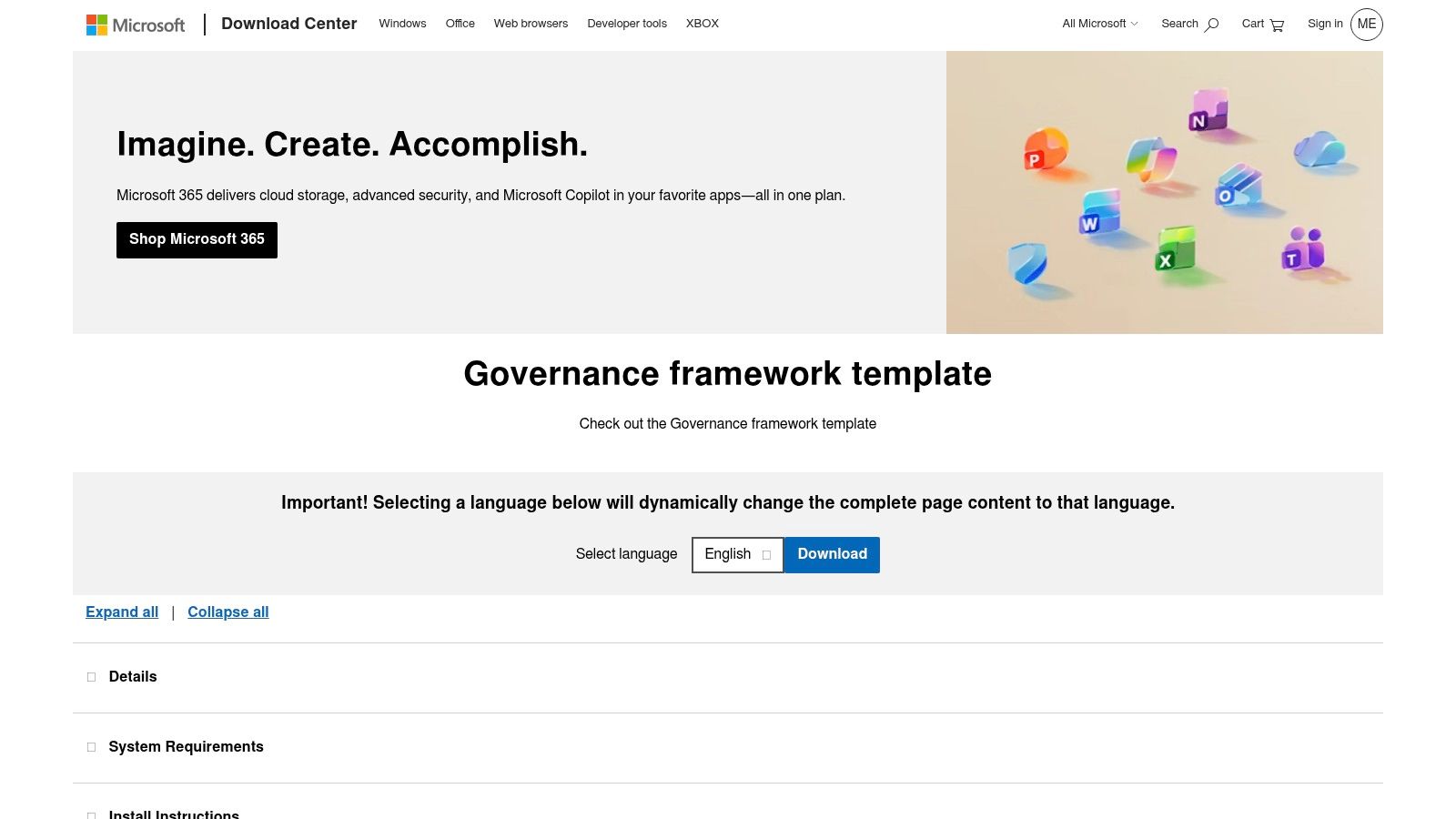
Microsoft's PowerPoint template is strongest when the immediate problem is executive alignment. It gives a governance team a visual structure for presenting scope, roles, processes, policies, standards, and controls without asking stakeholders to read a lengthy operating manual first. The familiar format also makes it useful for board briefings, steering committee discussions, and regional workshops.
The artifact it produces is an editable governance framework deck. Teams can use it to show how a governance council relates to data owners, stewards, technology teams, and control functions. It also provides a practical place to frame an operating model and rollout sequence before the organization commits to detailed procedures.
Where it works and where it stops
The main advantage is speed. A team can adapt the slides for different business units, regions, and governance scopes, then use one visual vocabulary to socialize decisions. It's also a free resource available directly from Microsoft's governance framework template page.
The trade-off is depth. PowerPoint can show a RACI, but it won't enforce one. It can display a policy hierarchy, but it won't manage approvals, exceptions, evidence, or review dates. The template isn't industry-specific, so regulated organizations must add their own control requirements and terminology.
Practical rule: Use the deck to secure agreement on the model, then move every approved responsibility into a controlled register with owners, workflows, review dates, and evidence requirements.
The next step is to connect the agreed structure to an implementation plan, including domain selection, stewardship activities, issue escalation, and measurable data controls. Teams that need a more detailed data governance implementation approach should treat the slides as the decision record, not the program itself.
2. Atlan Blueprint Governance Framework and Templates
Atlan's blueprint targets teams that must turn governance principles into active operating practices for data products, analytics, and AI. Its artifact set goes beyond presentation slides, covering assessments, prioritization tools, user-story patterns, policy workflow templates, data-product scoring rubrics, and adoption measures.
The main output is an implementation plan that connects governance decisions to delivery work. Teams can use it to define how ownership appears in workflows, rank initiatives by impact and effort, and observe adoption across user groups. It supports operating-model design more directly than a basic charter, though each organization still needs to set its own roles, controls, approval thresholds, and evidence requirements.
Strong for modern programs, less neutral than it appears
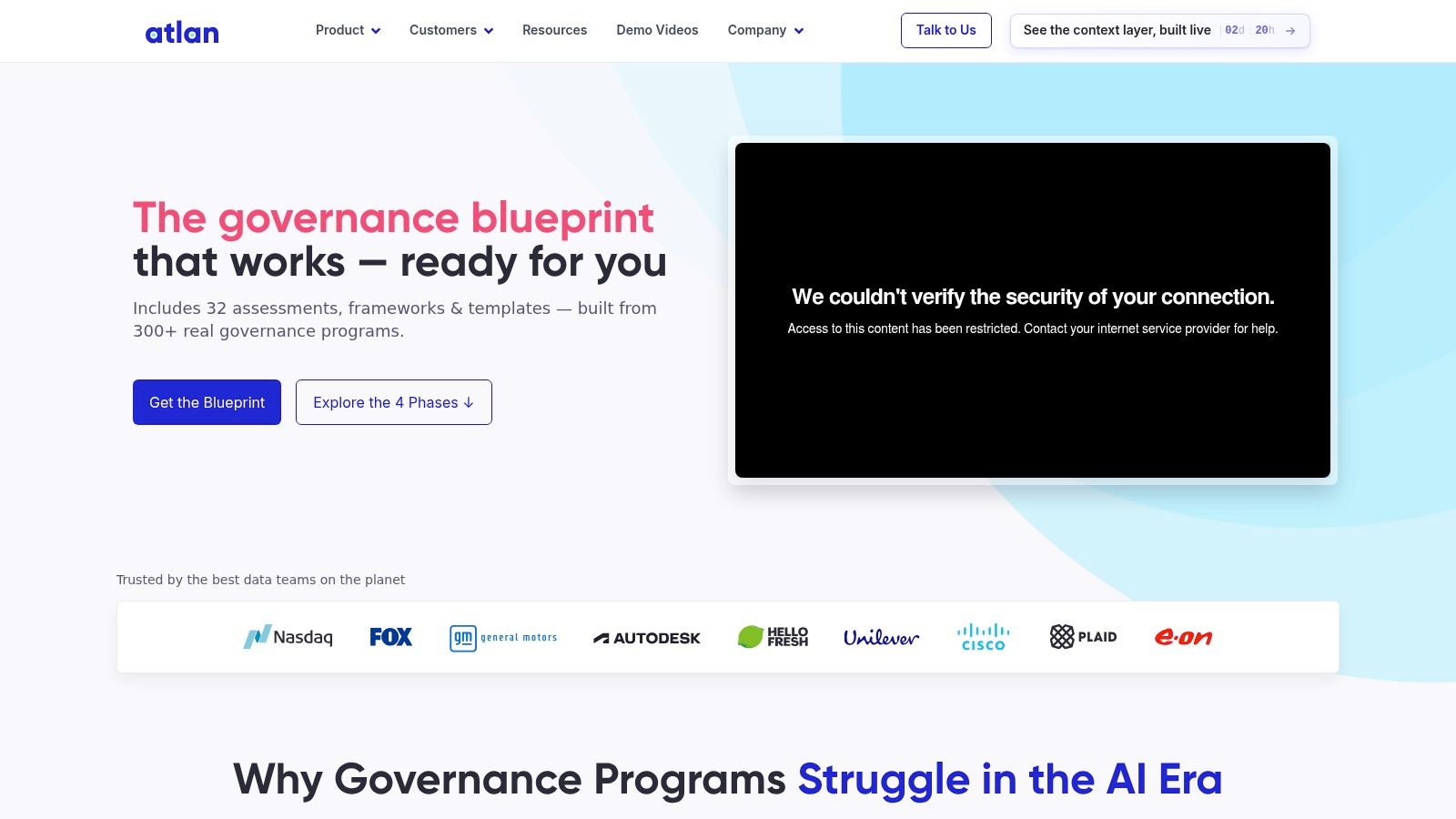
The blueprint organizes implementation into Assess, Plan, Implement, Adopt and Scale, according to Atlan's governance blueprint. The sequence helps a team establish a baseline, prioritize work, build controls into delivery, and check whether people use the resulting processes.
Its platform and sector bias shape where it fits best. The guidance is most natural for organizations using data products, federated ownership, analytics workflows, and AI-related governance. A centralized warehouse with a small reporting estate may require a lighter operating model. Teams should also separate vendor-specific implementation patterns from the governance practices they can apply in other tools.
The source reports that 73% of practitioners say current frameworks do not support modern AI and analytics, while 68% say governance initiatives fail to achieve adoption in the first year, as stated in the Atlan blueprint. These figures reinforce a practical requirement: include AI alignment, change management, and adoption evidence instead of treating governance as a signed policy.
The next step is to convert each artifact into platform-neutral requirements. Define approval, ownership, lineage, quality evidence, and adoption in your environment, then decide which Atlan patterns fit the operating program. The template supplies structure. Owners, workflows, review dates, escalation paths, and control evidence still require customization.
3. Collibra Operating Model Diagnostic Template
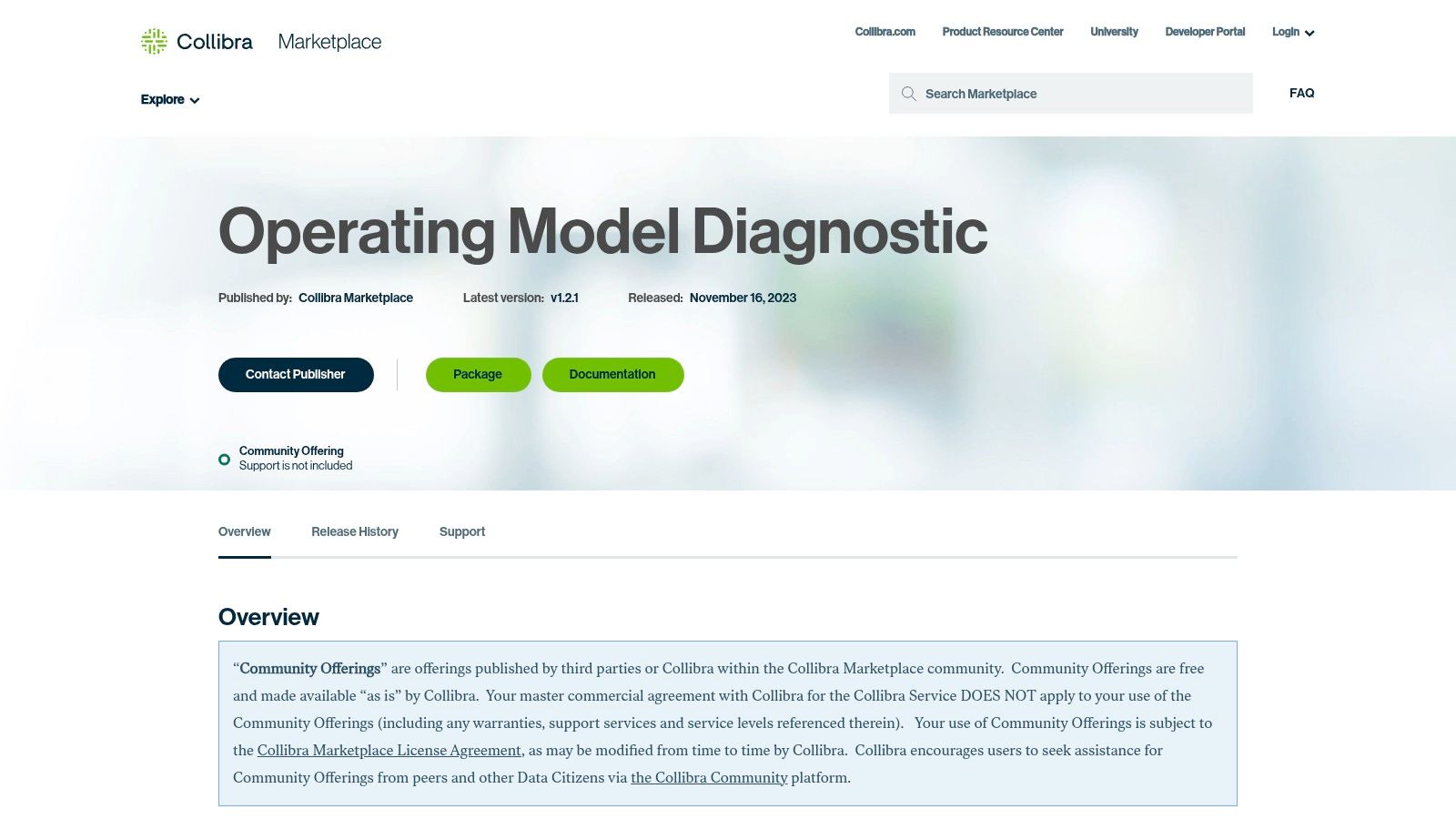
The Collibra Operating Model Diagnostic is an operating-model assessment and design aid. It helps teams examine responsibilities, relationships, governance activities, and data assets before they attempt to scale stewardship. That makes it more useful than a blank charter when the organization knows governance is fragmented but can't explain exactly where accountability breaks down.
Its central artifact is a structured diagnostic that can support role mapping, stewardship design, and stakeholder conversations. A governance lead can use the output to document which responsibilities belong to business owners, operational stewards, technical custodians, and governance functions. It's also useful before tool selection, because the organization can identify required relationships before configuring a catalog or workflow platform.
Good for accountability design, weaker as a standalone control system
The resource aligns naturally with Collibra Data Governance Center concepts, which can make stakeholder adoption easier in Collibra environments. Teams already using Collibra can often carry the diagnostic's vocabulary into roles, assets, workflows, and governance communities. The Collibra Operating Model Diagnostic therefore fits best when an organization needs to baseline its model and prepare for operational configuration.
The trade-off is platform bias. Non-Collibra teams may need to rename objects, redesign relationships, and rebuild workflow assumptions in another catalog or service-management tool. The diagnostic also won't, by itself, monitor whether stewardship tasks are completed or whether data quality remains within agreed limits.
A useful companion is a clear data governance roles model, especially when job titles and domain responsibilities differ across regions. The next step is to turn every role relationship into a live assignment. Add accountable owners, escalation paths, service expectations, review cadence, and evidence links. Without that handoff, the diagnostic remains a snapshot of intended accountability rather than a working operating model.
4. EDM Council DCAM
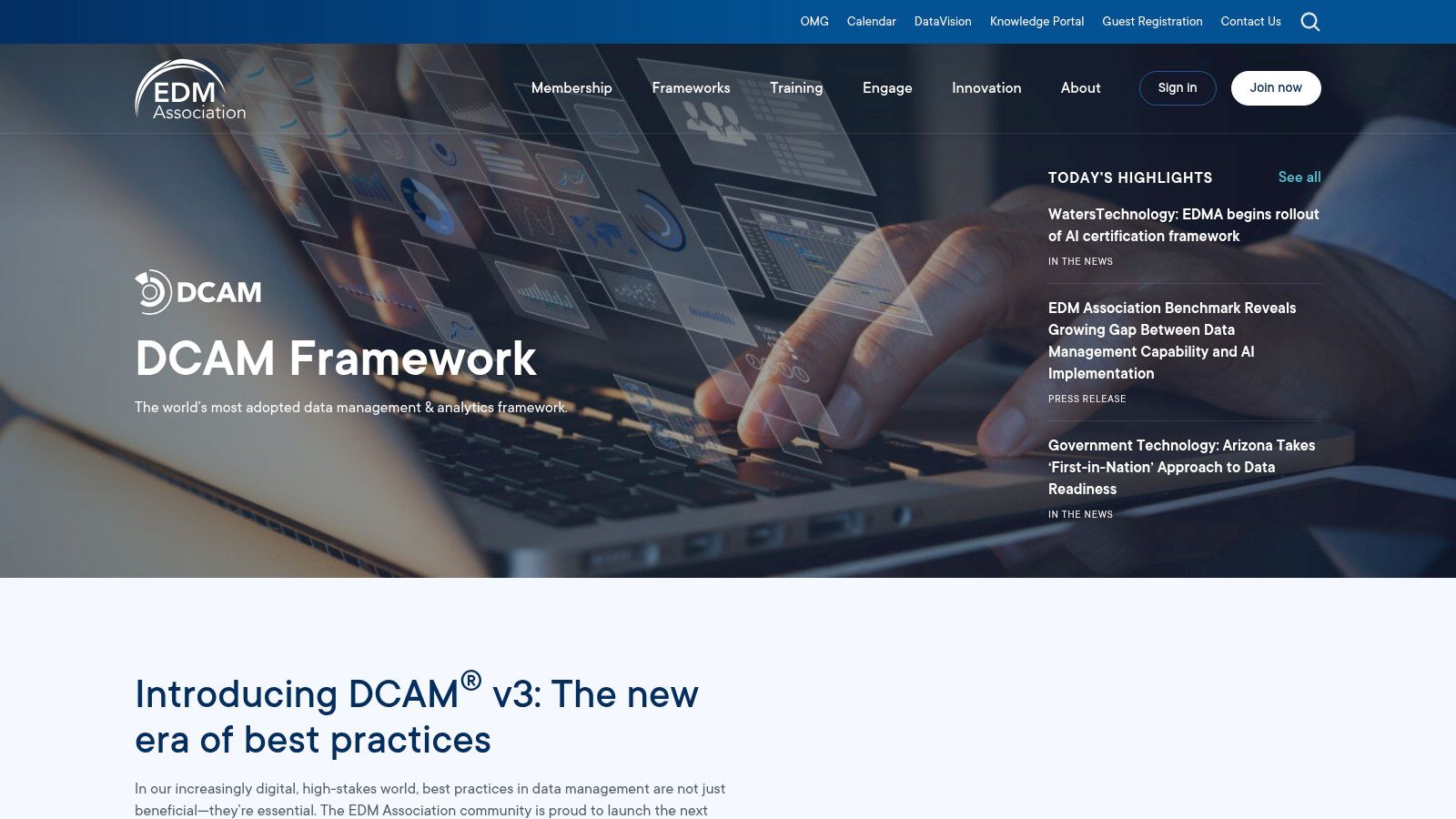
DCAM is the heavyweight option for organizations that need a capability assessment with defensible maturity evidence. The Data Management Capability Assessment Model provides structured capabilities, outcomes, assessment workbooks, and scoring guidance. It's particularly relevant to enterprises that must explain governance maturity to boards, auditors, regulators, or risk committees.
The artifact it produces is not a policy document. It's a capability baseline and improvement roadmap. Teams can use it to assess governance and data management practices, identify gaps, prioritize remediation, and create a common vocabulary for discussions that otherwise become subjective.
The best fit is regulated complexity
DCAM's depth suits financial services, healthcare, and other regulated sectors where governance must connect capabilities, controls, ownership, and evidence. The EDM Council DCAM framework is also useful when multiple business units need a consistent assessment method rather than separate local interpretations.
The cost is organizational weight. Full materials and workbooks commonly require membership or training, and the model can be more extensive than a small team needs for its first governed domain. A team that starts with DCAM without defining a narrow business outcome may spend too much time scoring and too little time fixing.
“A maturity score is useful only when it changes the next piece of work.”
Use the model to establish a baseline, but keep the improvement backlog concrete. Each gap should lead to a named owner, a target artifact, an implementation task, and proof that the control operates. A data management framework can help teams place DCAM alongside broader data management practices, but DCAM itself should remain the assessment backbone. The next step is to connect capability findings to data quality, access, lineage, retention, and incident processes in production.
5. Robinson Ryan Data Governance Framework Template Word
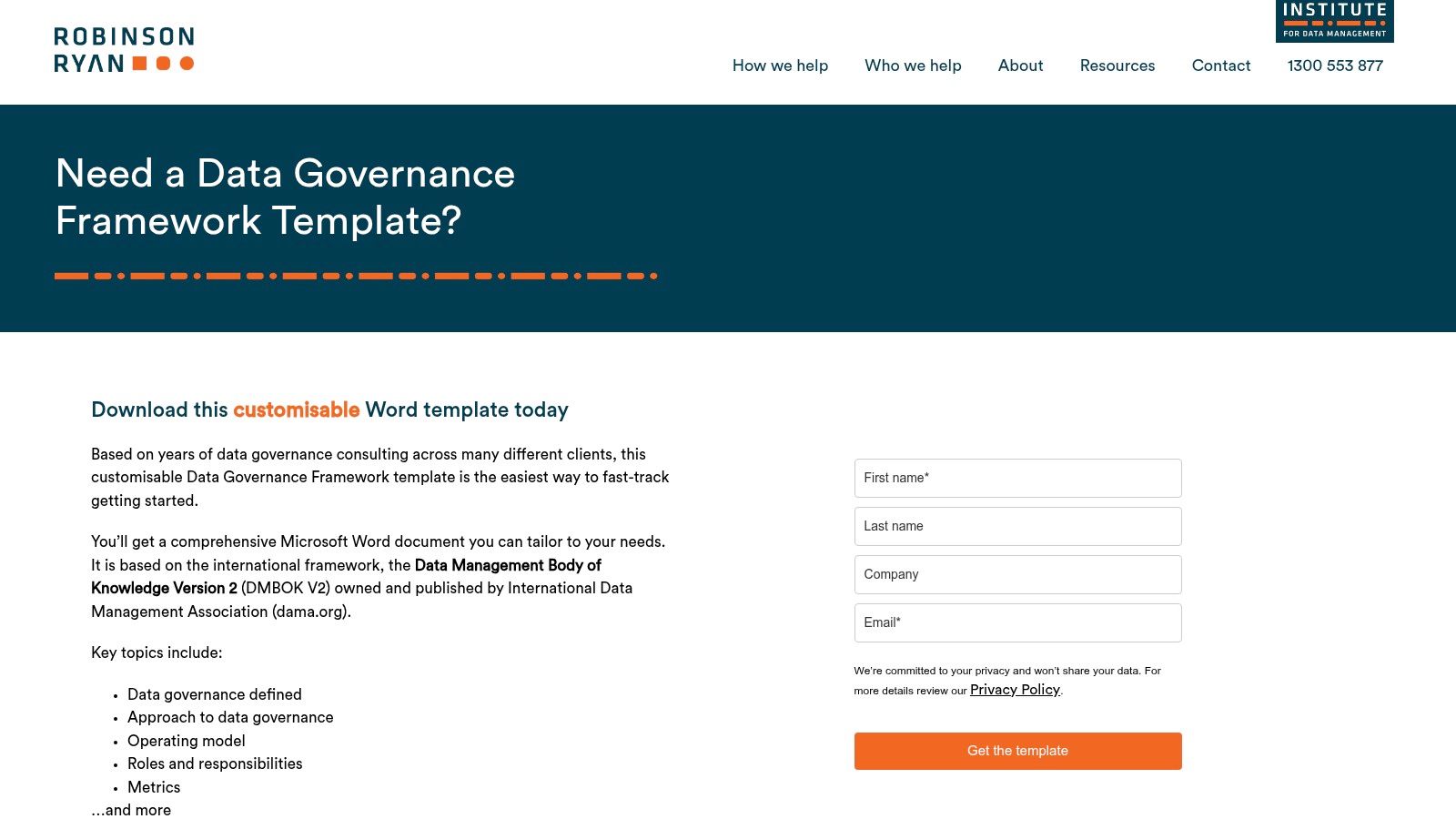
Robinson Ryan's Word template is the most direct choice for teams that need a draft governance document rather than a diagnostic or presentation. It provides editable sections for governance scope, principles, policy hierarchy, ownership, RACI assignments, and operating cadence. Practitioners can adapt the wording into a framework document that business, legal, compliance, and technology stakeholders can review.
The Word format has a practical advantage. It supports tracked changes, comments, formal approvals, and document-management conventions that many organizations already use for policies. It's a good starting point when a governance office has agreed on the general model but needs a coherent draft quickly.
Strong policy scaffolding, limited operational machinery
The Robinson Ryan data governance framework template is practical because it gives teams language they can edit instead of forcing them to write every section from a blank page. It's also suitable for a DAMA-aligned governance discussion, provided the organization checks that the final content reflects its own regulatory and operating context.
The limitation is that Word doesn't execute workflows. It won't route an access request, detect a policy exception, validate a critical record, or prove that an owner completed a review. Its usefulness depends heavily on customization. Generic roles and principles become decorative if they don't map to real job titles, domains, systems, and escalation routes.
Use the document as the controlled framework and create linked operational registers for policies, data assets, owners, issues, exceptions, and evidence. The next step is a review workshop with domain owners and technical custodians. Resolve ambiguous accountability before approval, then attach measurable controls to each policy section.
6. OvalEdge Data Governance Framework Template Free Download
OvalEdge's resource takes a start-small, scale-later approach. It helps teams produce an editable framework document that combines operating-model guidance, policies, metrics, framework comparisons, scope definition, and rollout advice. That combination makes it useful for an enterprise team that needs to frame an initial program and identify a manageable set of quick wins.
The most valuable output is a prioritized rollout outline. Rather than trying to govern every domain immediately, teams can use the material to define an initial scope, choose a business problem, assign ownership, select early metrics, and describe how the model can expand.
Useful starting point, vendor-shaped language
The OvalEdge data governance framework template is free and aimed at enterprise use, which lowers the barrier for teams that need a first draft. Its side-by-side framing of common governance approaches can also help stakeholders discuss whether they need a capability model, an ownership model, a policy structure, or a more technical implementation plan.
The trade-off is depth and neutrality. Some sections are marketing-oriented, the terminology may reflect OvalEdge's product, and access to the download may require contact information. Teams should inspect every recommendation before incorporating it into a policy or operating standard.
The next step is to remove product-specific assumptions and rewrite the framework around your own domains, systems, control objectives, and decision rights. Then pilot the document against one contained use case. A template that survives a real intake, quality issue, approval, and escalation cycle is more useful than one that looks complete in a workshop.
7. Smartsheet Data Governance Policy Template Word
Smartsheet's template belongs at the policy layer of a governance framework. It focuses on ownership, access, backup, protection, retention, and quality-related expectations, with complementary templates for procedures and change management. That makes it a practical choice when legal, compliance, or security teams need a readable policy draft that isn't tied to a catalog vendor.
The artifact is a shareable policy and procedure document. It can establish what employees and system owners are expected to do, define broad control expectations, and provide a reviewable foundation for governance approval. Word also makes collaboration with legal and compliance teams straightforward.
Don't mistake policy coverage for execution
The Smartsheet policy and procedure templates are non-vendor-specific, which is a meaningful advantage for organizations with mixed platforms. They can help a governance team create consistent language for access, retention, protection, and responsibilities before technical enforcement is designed.
The gap is operational. The template doesn't provide a complete operating model, embedded automation, workflow routing, metrics, or evidence collection. A policy can require quality monitoring, but it won't identify a late load or schema change unless another system performs that work.
Control test: For every policy requirement, name the system, owner, trigger, evidence, and escalation path that make compliance observable.
The next step is to map each policy statement to procedures and controls. For retention, define implementation and review ownership. For access, define approval and revocation workflows. For quality, specify validation, timeliness, and exception evidence. The policy should tell teams what must happen, while operational systems show whether it did.
8. U.S. Federal Data Governance Steering Committee Charter Template
The U.S. Federal Data Governance Steering Committee charter template is built for a narrower but important artifact, a decision-rights charter. It provides language for mission, scope, membership, meeting cadence, decision authority, and voting structures. Teams forming a cross-functional steering group can use it to prevent governance from becoming an informal forum with no authority.
This resource is strongest when executive alignment already exists but accountability remains unclear. A charter can establish who convenes the committee, what it may approve, how conflicts are handled, and which decisions require escalation.
Government clarity needs enterprise translation
The Data Governance Steering Committee charter template offers government-grade clarity around committee purpose and accountability. It can give a new enterprise council a credible structure for membership, voting, meeting records, and decision authority.
Its limitation is scope. It's written for a federal context, so enterprise teams must adapt references to public-sector strategy, authority, and administrative structures. It also doesn't supply a complete framework for data quality, metadata, lineage, privacy, or technical controls.
A public-sector data team should pair the charter with government data quality and public-sector governance guidance, then define the operational controls behind each committee decision. The next step is to publish a decision log and connect every approved standard or exception to an owner, implementation task, review date, and evidence record.
9. SLDS Data Governance Charter Guide and Template
The SLDS resource combines a charter template, development guide, and completeness rubric. That combination is valuable for organizations standing up governance for the first time because it explains how to fill the artifact rather than handing over a form with unexplained headings.
Its output is a structured charter covering vision, scope, roles, and governance purpose, supported by guidance that helps reviewers identify omissions. The education setting gives the resource a clear public-sector and education bias, but the underlying structure translates well to enterprise programs with multiple stakeholders and sensitive data domains.
A good first document, not a technical control plan
The SLDS data governance charter guide and template is particularly useful when stakeholders need help expressing the program's purpose and boundaries. The rubric can improve review quality because teams can assess whether the charter is complete enough to approve.
The resource doesn't go into technical controls. It won't define how pipelines validate records, how teams monitor arrival schedules, how schema changes are detected, or how lineage evidence is retained. Sector-specific examples also require careful rewriting for finance, healthcare, telecom, or commercial environments.
Use the charter to establish mandate and scope, then build the operating layer around it. A data governance strategy should connect the charter to policies, standards, roles, controls, metrics, and an implementation roadmap. The next step is to run the charter through a real domain workshop. Ask each proposed owner what decisions they can make, what evidence they need, and how issues reach the steering group.
10. Microsoft Purview Data Governance Masterclass GitHub Repository
The Microsoft Purview Data Governance Masterclass is the most implementation-oriented resource in this list for a Microsoft and Azure-centered data estate. It provides a repository with an implementation plan, role definitions, onboarding flows, sample artifacts, and references aligned with Microsoft Learn governance planning.
The artifact is an implementation repository, not merely a framework document. Teams can study the sequence of activities, adapt role definitions, use onboarding patterns, and borrow sample assets for a large-scale rollout. The repository format also encourages version control and collaboration among delivery teams.
Practical depth comes with platform commitment
The Microsoft Purview Data Governance Masterclass repository is a strong reference for teams that want working examples rather than abstract principles. Role definitions and onboarding flows can help a program move from an approved charter into repeatable implementation tasks.
The trade-off is clear platform dependence. The approach is tied to Microsoft and Purview concepts, so multi-cloud or tool-agnostic teams will need to abstract the governance process from the implementation details. Production use also depends on Purview and the surrounding Microsoft stack, which can make the resource less suitable as a neutral enterprise standard.
The next step is to extract platform-independent requirements first. Keep the roles, decision points, onboarding logic, evidence model, and review cadence. Then map those requirements to your own catalog, quality, access, workflow, and observability tools. For Azure-heavy organizations, the repository can become a delivery backlog. For others, it's better used as a reference architecture.
Top 10 Data Governance Framework Template Comparison
Template | Core features ✨ | UX/Quality ★ | Value / Price 💰 | Target audience 👥 | Best for / Unique selling point 🏆 |
|---|---|---|---|---|---|
Microsoft Governance Framework Template (PowerPoint) | Slide templates for roles, committees, RACI; visual governance maps | 3★ | 💰 Free download | 👥 Execs, program leads | 🏆 Rapid stakeholder alignment & board briefings |
Atlan Blueprint (Governance Framework + Templates) | Blueprints, assessments, approval workflows, data-product scoring | 4★ | 💰 Free downloads; highest value with Atlan platform | 👥 Data & analytics teams, data-product orgs | 🏆 Implementation-first guidance and practical artifacts |
Collibra Operating Model Diagnostic (Template) | Pre-defined operating-model structures, stewardship templates, diagnostics | 4★ | 💰 Marketplace package; best with Collibra | 👥 Collibra users; stewardship leads | 🏆 Vendor-aligned operating model for easier adoption |
EDM Council DCAM (Data Management Capability Assessment Model) | Structured capability model, assessment workbooks, outcomes & scoring | 5★ | 💰 Paid membership/training for full materials | 👥 Regulated enterprises; boards & auditors | 🏆 Industry-standard, auditor-recognized framework |
Robinson Ryan Data Governance Framework Template (Word) | Policy/RACI sections, editable scope, DAMA-aligned wording | 4★ | 💰 Free download | 👥 Policy authors, program owners | 🏆 Ready-to-adapt policy language for quick docs |
OvalEdge Data Governance Framework Template (Free Download) | Editable framework doc, framework comparisons, rollout tips | 3★ | 💰 Free (often gated) | 👥 Enterprises starting small, scaling teams | 🏆 Practical “start small, scale later” approach |
Smartsheet Data Governance Policy Template (Word) | Policy & procedure templates, roles, access, change-management templates | 4★ | 💰 Free download | 👥 Legal, compliance, ops teams | 🏆 Fast way to formalize non-vendor policy language |
U.S. Federal DGSC Charter Template | Charter language for mission, membership, cadence, decision authority | 4★ | 💰 Free public resource | 👥 Public sector, steering committees | 🏆 Government-grade clarity for accountability |
SLDS (US Dept. of Education) Charter Guide & Template | Step-by-step charter guidance, template sections, maturity rubric/checklist | 4★ | 💰 Free download | 👥 Education teams; governance beginners | 🏆 How-to charter development + maturity checklist |
Microsoft Purview Data Governance Masterclass (GitHub Repo) | Implementation plan, role defs, onboarding flows, sample artifacts | 4★ | 💰 Free GitHub repo (Purview tied for production) | 👥 Azure/Purview-centric implementers | 🏆 Code-backed, end-to-end implementation reference |
Turn the Template Into a Working Governance System
Choosing a data governance framework template is less important than choosing the correct starting artifact. A PowerPoint deck helps executives align on scope. An operating-model diagnostic exposes gaps in responsibilities and relationships. A maturity model creates a baseline. A charter establishes authority and decision rights. A policy template formalizes rules. An implementation repository turns approved decisions into rollout work.
A practical sequence combines those artifacts instead of forcing one resource to do everything:
Align scope first: Use a framework diagram or executive deck to define the business problem, domains, systems, stakeholders, and intended outcomes.
Assess capability and accountability: Apply an operating-model diagnostic or capability model to identify missing owners, weak processes, unclear relationships, and evidence gaps.
Authorize decisions: Create a charter that defines committee membership, decision rights, escalation, meeting cadence, and approval responsibilities.
Formalize controls: Adapt policy templates for classification, access, retention, acceptable use, quality, change management, and exception handling.
Manage implementation: Use a repository, backlog, or structured checklist to assign tasks, track dependencies, record decisions, and preserve evidence.
Operate and review: Add owners, service expectations, review dates, issue workflows, exception handling, and a defined method for measuring control performance.
Standards can strengthen this sequence. ISO/IEC 38505-1:2017, published in 2017, applies the governance model of ISO/IEC 38500 to data and frames governance as a responsibility for governing bodies and senior management. The ISO historical milestone described in the source material remains useful when a template needs durable sections for principles, oversight, acceptable use, and accountability. ISO's page identifies the standard as “to be revised,” which also reinforces the need for a reviewable framework rather than a document treated as final.
For policy-to-control mechanics, ISO 8000-51:2023 specifies requirements supporting the exchange of data governance policy statements and automated conformance testing of datasets against referenced data specifications, as described on the ISO 8000-51 standard page. That is a useful design test. If a policy statement can't be translated into a specification, validation, owner, or evidence record, it may be too vague to operate.
The ISO 8000 series also addresses data governance, data quality management, and maturity assessment, according to ISO 8000-1:2022. Teams can use that connection to keep governance, quality, and maturity work in one improvement model instead of maintaining disconnected programs.
Auditability needs equal attention. NIST SP 800-53 Rev. 5 includes an audit-record retention control requiring organizations to retain records for an organization-defined period consistent with records-retention policy, so investigations and regulatory requirements can be supported, as stated in the NIST SP 800-53 Rev. 5 publication. Your framework should therefore specify what evidence is collected, where it is stored, who reviews it, and how long it remains available.
The maintenance problem is often harder than the drafting problem. Board's 2025 enterprise governance report preview ranks stewardship and ownership at the top, followed closely by data quality, metadata management, compliance, access and privacy controls, and lineage or observability, as shown in the Board enterprise governance report preview. That ordering points to a practical conclusion: templates must include operational handoffs, not just role descriptions.
Modern programs also need AI and observability controls. Reporting in the Dynatrace State of Observability 2025 release identifies data quality, predictability, and privacy as leading AI reliability concerns. A current template should address training-data use, model-input quality, data versioning, AI lineage, drift, schema changes, incident triggers, and evidence.
A platform such as digna can fit here. Its in-database execution monitors data behavior inside the customer's environment, validates records against business rules, tracks timeliness, detects schema changes, and monitors business and platform metrics. Those capabilities don't replace a charter, policy, or ownership model. They provide an operational evidence layer that can show whether governed data continues to meet agreed expectations across warehouses, lakes, and pipelines.
Select one coherent set of artifacts, adapt the language to your organization, and pilot it against a real data domain. Don't copy disconnected sections from ten resources and call that a framework. Assign every control to a human owner, connect it to a measurable signal, define what happens when the signal fails, and schedule the review that keeps the program current.
If your team needs to turn a data governance framework template into ongoing evidence, digna provides in-database anomaly detection, validation, timeliness monitoring, business monitoring, and schema tracking inside your own environment. Visit digna to see how the platform can support reliable governance operations across critical data and AI workflows.
Frequently asked questions
What can a governance framework template not do?
Fix conflicting definitions, unowned datasets or controls nobody checks. A template produces an artifact, and the right resource depends on your immediate gap rather than on which framework is most complete on paper.
How should you compare these resources?
By five properties: the artifact each helps create, its implementation depth, its sector or platform bias, its practical limitations, and the next step required to turn it into an operating program. Page count tells you almost nothing useful.
When is an executive deck the right artifact?
When the immediate problem is executive alignment. Microsoft's PowerPoint template produces an editable governance framework deck quickly, and its trade-off is depth, so use the deck to secure agreement on the model rather than to run the program.
What is the step most teams skip?
Moving every approved responsibility off the slide and into a controlled register with owners, workflows, review dates and evidence requirements. Without that, the agreed model exists only in a deck that nobody consults after the meeting.
How common are formal governance frameworks?
A 2026 adoption analysis reports that 23% of organizations use formal data governance or quality frameworks, with lower figures in financial services and fully on-premises organizations. That unevenness is why template choice depends on the gap rather than on best practice.