Data Management Frameworks: Choose & Implement Guide
|
7
min read

Your dashboards say one thing, your analysts say another, and the business is still making decisions off stale extracts. Somewhere in that mess, someone insists the company already has a data management framework, but the data still breaks in the middle of the week and trust keeps slipping. That gap between policy and reality is where most programs get stuck.
A working framework isn't a document. It's the operating system for how data moves, gets checked, gets owned, and gets fixed before it reaches the people who rely on it.
Table of Contents
Why Most Data Management Strategies Fail
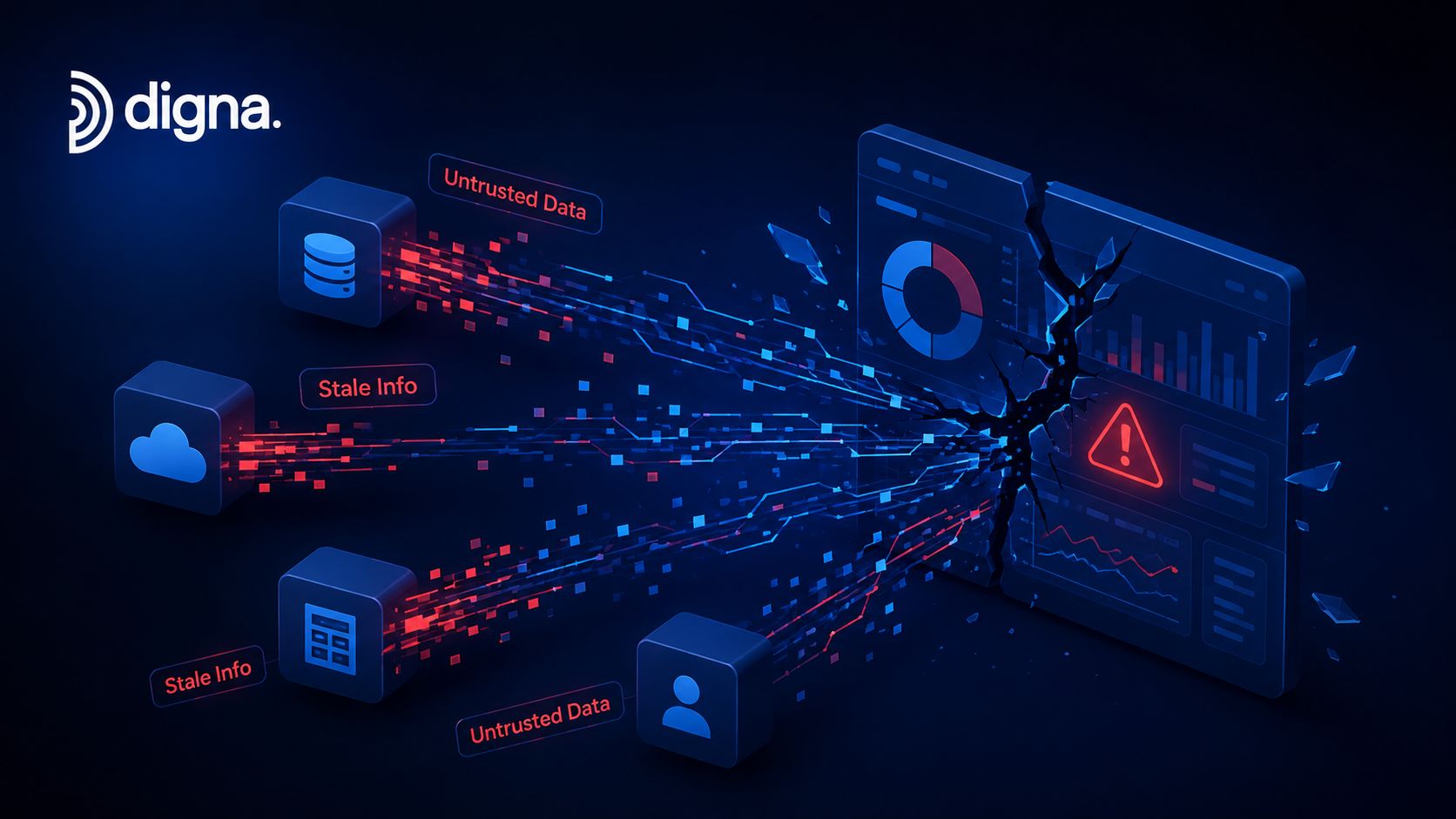
The failure mode is familiar. A finance team sees one number, operations sees another, and data engineering is chasing broken lineage, late feeds, and fields that changed shape overnight. The framework exists on paper, but the pipeline still behaves like a collection of one-off fixes.
The hard truth is that formal governance doesn't automatically create reliable data. In one 2026 statistics roundup, 85% of organizations said they had a formal data governance framework in 2023, yet only 3% of enterprise data meets basic quality standards, and poor data quality costs businesses an average of $12.9 million annually. That's a clear warning signal, having a framework doesn't mean the framework is operationalized (Gitnux data management statistics).
Paper governance breaks at the handoff
Organizations typically start with policies, naming conventions, and approval paths. The problem shows up when no one is responsible for enforcing them in the systems that move data. Ownership gets implied instead of assigned, and then every exception turns into a manual cleanup job.
The fix starts with a different operating model. A framework has to reach into ingestion, transformation, validation, and publishing, not sit above them. If a rule isn't enforced where the data is created or moved, it's just documentation.
Practical rule: if a control can't be observed in production, it isn't a control yet.
That's why the framework has to connect directly to the day-to-day work of data engineers and analytics teams. It needs measurable checks, clear owners, and fast escalation when data strays from expected behavior. If you want a deeper view of how that governance layer should be structured, the digna data governance strategy resource is a useful reference point for operational thinking.
A second failure point is over-centralization. When every decision flows through one committee, teams work around the process. The result is shadow pipelines, inconsistent definitions, and quality issues that show up downstream instead of at the source.
The Core Components of an Effective Framework
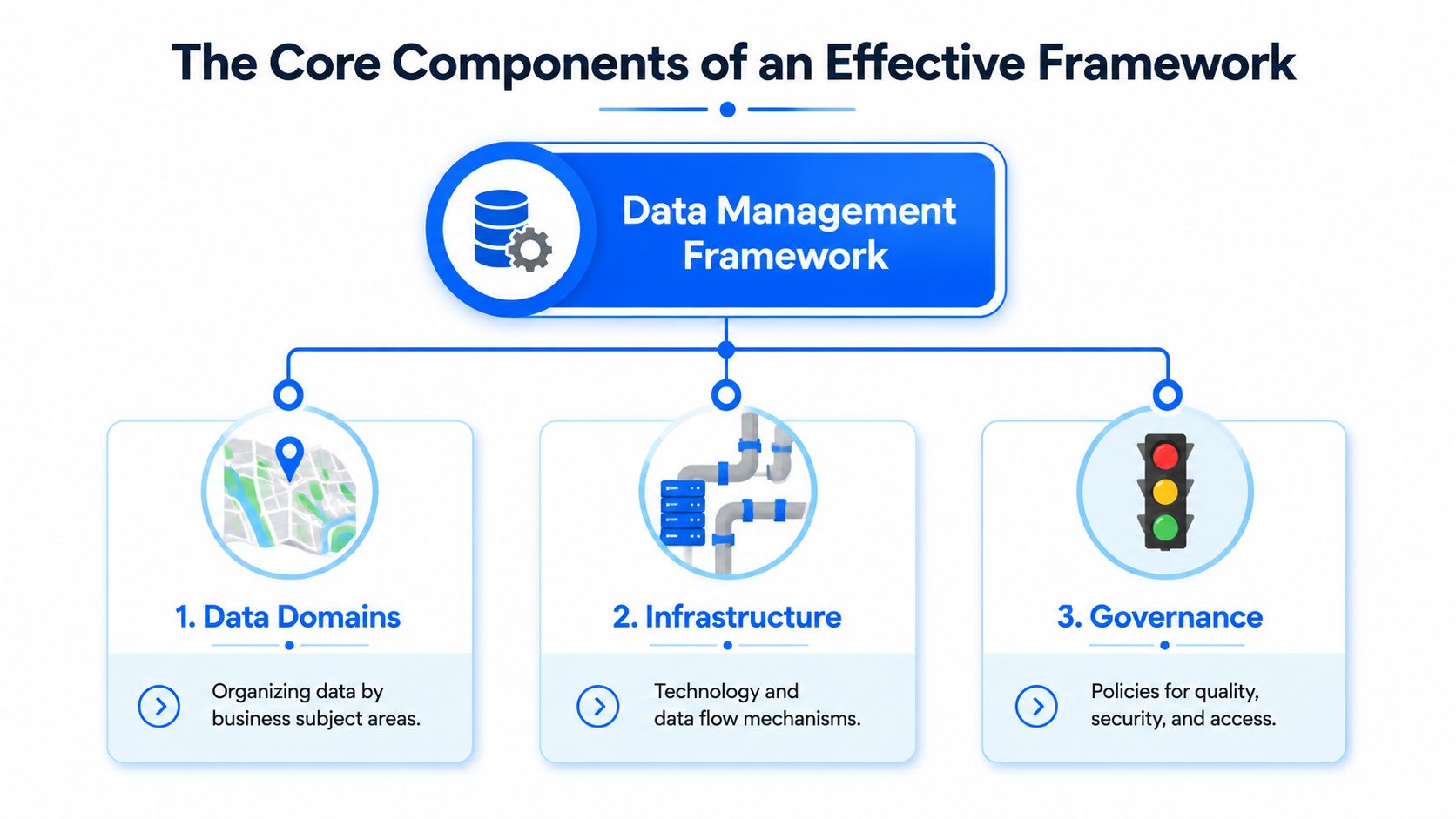
Think of a data management framework like a city plan. Data domains are the neighborhoods, infrastructure is the road, utility, and transit network, and governance is the traffic law that keeps everything usable. If one of those layers is missing, the city still exists, but it's harder to operate, easier to damage, and much more expensive to repair.
Governance, architecture, quality, security, metadata
The strongest frameworks consistently bring five pillars together. Data governance sets the decision rights. Data architecture defines how systems, pipelines, and products fit together. Data quality enforces the rules that keep records usable. Data security controls access and handling. Metadata management tells people what the data means, where it came from, and how it moves.
The mistake is treating those pillars as separate workstreams. They only matter when they reinforce one another. A quality rule without metadata is hard to interpret. Metadata without governance doesn't tell anyone who should act. Security without ownership becomes a ticket queue.
A sound framework also needs explicit accountability. Many frameworks fail because ownership, stewardship, and producer/consumer responsibilities are not formally assigned and enforced (Dataversity on the accountability crisis). That's the operational gap most slide decks skip. The people who create data, the people who consume it, and the people who steward it need different responsibilities, and those responsibilities need to be visible in the workflow.
Make accountability part of the design
Many teams encounter practical challenges. They appoint a data owner, but the owner has no authority over the systems or budget that shape the data. They name a steward, but the steward only hears about problems after reports fail. They publish a glossary, but nobody uses it when building pipelines.
Accountability works when the framework changes how work gets done, not when it just names roles.
For teams handling privacy-heavy systems, the operational layer matters even more. A practical resource such as IT staffing for data privacy solutions is useful because it points to the staffing and execution reality behind policy-heavy environments, especially where security and compliance can't be separated from the data platform itself.
What the framework has to define
A useful framework answers concrete questions, not abstract ones.
Which domains are in scope? Start with the datasets that move critical business decisions.
Who owns each rule? Tie each quality, privacy, and access rule to a named role.
What metadata is required? Define the minimum descriptors needed for discovery and traceability.
Which controls are mandatory? Make validation, lineage, and transport rules part of the pipeline itself.
Without those specifics, teams improvise. With them, the framework becomes operational rather than ceremonial.
Comparing Major Data Management Frameworks
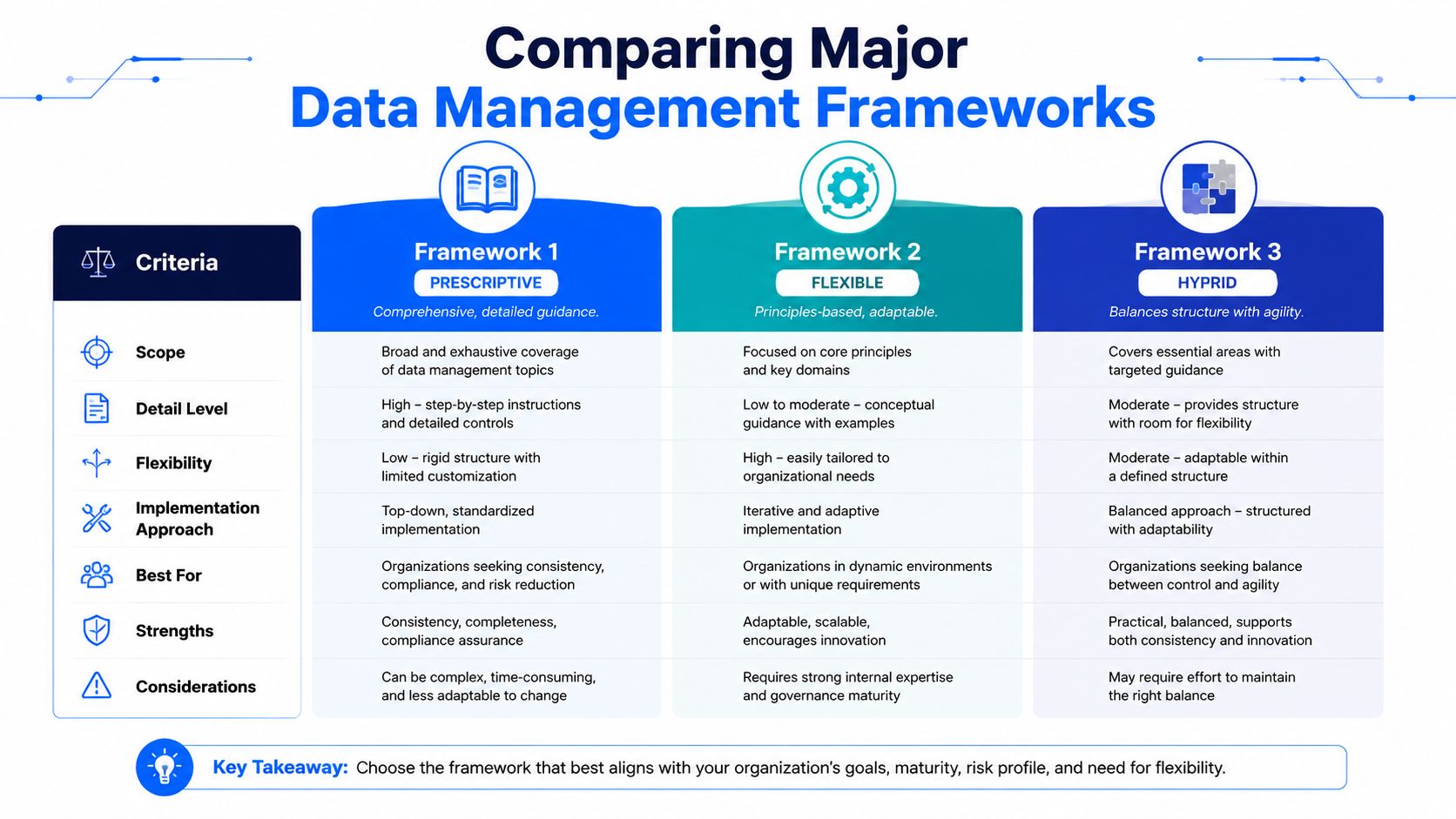
Different frameworks solve different problems. Some are broad bodies of knowledge, some are maturity models, and some are operating models. The wrong choice doesn't just slow progress, it makes teams argue about terminology instead of shipping controls.
Prescriptive and flexible frameworks serve different needs
DAMA-DMBOK 2 is usually the most familiar reference point for teams that want breadth. It gives a broad vocabulary across governance, quality, architecture, metadata, and stewardship. That breadth is useful when a program is young and needs shared language, but it can feel heavy if a team wants a quick path to operational control.
DCAM, short for the Data Management Capability Assessment Model, is more about maturity assessment and control discipline. In the EDM Council's 2026 benchmark, 49% of respondents using an industry standard data management model reported using DCAM, with adoption especially strong in Finance (62.6%) and Government (70.4%) (EDM Council 2026 benchmark). That pattern matters because regulated environments need auditable controls, standardized practices, and repeatable evidence.
Data Mesh takes a different stance. It pushes ownership toward domain teams and relies on shared standards rather than a single central team controlling everything. That works best when the organization already has technical maturity, product thinking, and domain-level accountability.
Data Management Frameworks at a Glance
Framework | Core Philosophy | Primary Use Case | Best For |
|---|---|---|---|
DAMA-DMBOK 2 | Comprehensive body of knowledge | Building shared language and broad governance foundations | Teams defining enterprise-wide practices |
DCAM | Maturity and capability assessment | Measuring and strengthening control environments | Regulated industries and audit-heavy programs |
Data Mesh | Decentralized ownership with shared standards | Scaling data ownership across domains | Larger organizations with strong platform teams |
A practical decision rarely comes down to ideology. It comes down to fit. If the business needs a common vocabulary, start with breadth. If auditability is the immediate pressure, focus on measurable capability. If platform teams are already centralized bottlenecks, a federated model may be the only structure that scales.
Practical rule: pick the framework that matches your current failure mode, not the one that sounds most advanced.
A useful way to evaluate the options is to ask where the framework will do the most work. If the biggest problem is inconsistent definitions, choose something that improves shared language. If the problem is weak controls, choose something that tightens evidence and accountability. If the problem is local teams waiting on central approval, choose something that pushes ownership closer to the domain.
The best framework is the one your organization can execute, not the one that looks strongest in a presentation. That's why many teams blend approaches, taking the vocabulary of one model, the maturity discipline of another, and the ownership model of a third.
How to Choose the Right Framework

The right choice starts with fit, not popularity. A framework that works in a heavily regulated bank can slow down a product-led SaaS team if it introduces too many approvals too early. A lightweight model can help a startup move faster, then become a liability once the organization needs traceability and repeatable controls.
Ask the questions that expose the real constraint
Start with business pressure. Is the priority compliance, speed, trust, or platform consistency? Then check the operating reality. Do data owners already exist, or are they only informal contacts? Can engineering enforce standards in pipelines, or would that require a platform change first?
Skills matter too. A team with strong analytics engineering and metadata tooling can absorb a more detailed framework. A team still cleaning spreadsheets by hand needs something much more practical, with fewer abstractions and more automatic checks.
The data stack also shapes the answer. Multiple warehouses, streaming feeds, and AI workloads create more moving parts than a single reporting layer. The more complex the environment, the more a framework needs to define how data is transported, what metadata travels with it, and which controls are essential.
Use a simple decision filter
Regulatory pressure is high when the business needs audit trails, access controls, and clear evidence.
Operational maturity is low when ownership is unclear and quality issues are handled manually.
Domain teams are capable when they can manage standards locally without losing consistency.
Platform sprawl is high when tools, pipelines, and definitions drift across teams.
Time to value is critical when leaders need early wins before broad rollout.
If most of the answers point toward control and evidence, choose a more structured model. If they point toward flexibility and distributed ownership, use a framework that can be adapted without creating bottlenecks. If the organization is somewhere in between, start small and plan to combine governance discipline with practical execution.
This is also the point where a vendor-neutral view helps. Some organizations need tooling that supports the framework rather than redefining it. If the framework has to prove itself in production, the platform has to help enforce it, not just document it. A monitoring layer such as digna data quality implementation fits that reality because it supports operational checks instead of relying on manual review alone.
Don't choose a framework for the organization you want in three years if the team can't run it this quarter.
The best selection process is blunt. Name the bottleneck, match it to the framework style, and only then decide how much adaptation is reasonable.
A Practical Roadmap for Implementation
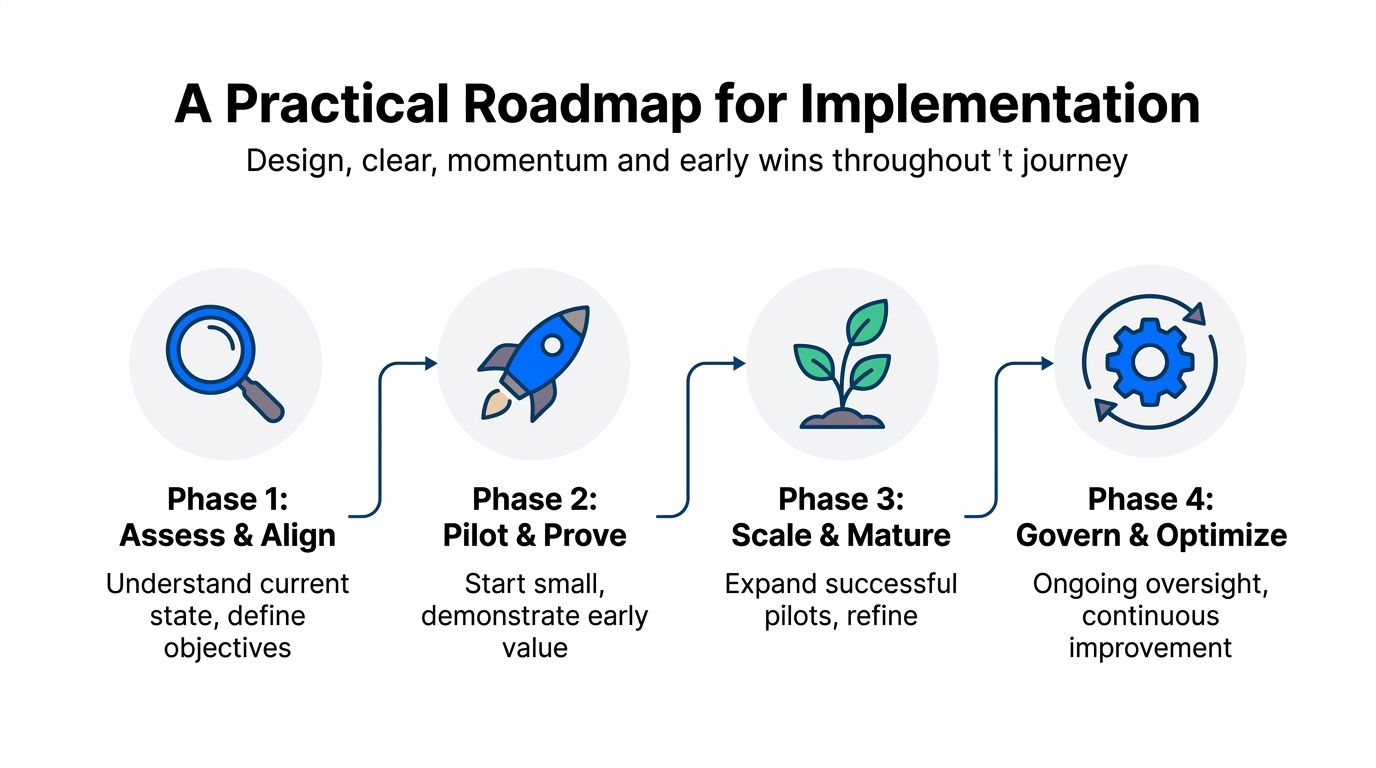
A framework comes alive only when the pipeline, the metadata, and the controls start working together. That means implementation should look like a sequence of managed changes, not a single enterprise transformation project. The goal is to create enough structure to improve reliability without freezing delivery.
Phase 1 Assess and align
Start with the data domains that cause the most pain. Look for the dashboards people argue about, the feeds that arrive late, and the datasets with the most downstream consumers. Then identify the owners, the stewards, and the technical systems that touch those domains.
This phase works best when teams document current behavior instead of ideal behavior. What arrives when, who changes it, and which reports depend on it? Those answers become the baseline for the framework, and they keep the design grounded in actual operating conditions.
Phase 2 Pilot and prove
Pick a narrow scope and define standards that can be enforced immediately. That means a small set of required metadata fields, a few high-value validation rules, and one or two transport rules that every pipeline in the pilot must follow. The point is not completeness, it's proof.
A research paper on big-data operations recommends combining a conceptual framework, an analytical tool inventory, minimal required metadata, transport specifications, and workflow-improvement rules so data movement can be governed systematically rather than ad hoc (Journal of Big Data). That guidance maps well to implementation, because the pilot has to show that controls can travel with the data.
Phase 3 Scale and mature
Once the pilot proves useful, expand it to adjacent domains. Don't copy the pilot blindly. Tune the rules where domain behavior differs, but keep the core control model intact. Training, stewardship, and issue triage then become part of the framework, not side work.
A few implementation habits make this phase cleaner:
Standardize required metadata so lineage and ownership don't disappear at the boundary.
Embed validation in pipelines so failures appear before dashboards break.
Document escalation paths so quality issues land with the right owner quickly.
Review exceptions regularly so bypasses don't become permanent shortcuts.
Phase 4 Govern and optimize
At scale, the framework needs ongoing review. Controls drift, business rules change, and new sources appear. The framework should absorb those changes without turning into a bureaucratic gate.
This is also the phase where automation matters most. Manual reviews don't scale across warehouses, lakes, and streaming systems. The more the framework depends on humans spotting issues by hand, the more it will lag behind the data itself. If you want the framework to stay useful, make sure the controls are explicit enough for systems to check them continuously.
Modernizing Frameworks with Data Observability
Traditional frameworks often go stale because they only describe the rules. They don't tell you whether the rules are working in production. That's a serious gap when data pipelines are dynamic, AI systems depend on shifting inputs, and schema changes can break consumers without warning.
Observability gives the framework a feedback loop
A modern framework needs evidence, not assumptions. As data becomes more unstructured and central to AI, frameworks have to evolve toward automated lineage and continuous monitoring of data behavior, timeliness, and quality signals in production (Alation on data management frameworks). That turns governance from a periodic review exercise into a live control system.
This is where observability platforms matter. They watch the data after it's been defined, modeled, and published. They catch anomalies, delayed arrivals, and schema drift before business users discover them in a failed report or a broken model. If you're evaluating how that layer fits into AI-heavy environments, the AI observability platforms guide is a helpful companion because it frames monitoring as part of the operating model, not an add-on.
The internal piece matters too. A data observability layer such as digna data observability aligns with that model because it monitors behavior, tracks timeliness, detects structural changes, and validates records inside the customer's own environment. That kind of feedback loop is what turns a static framework into something teams can trust in production.
Practical rule: if the framework can't tell you when it's failing, it's only half built.
Observability also closes the accountability gap. When the owner sees a clear incident, the steward sees the affected rule, and the engineer sees the exact break in behavior, remediation gets faster and less political. That's how a framework starts producing evidence instead of just policies.
Build the framework around the work your teams do, then reinforce it with controls that run in production. If you want a data quality and observability platform that stays inside your environment and supports anomaly detection, timeliness monitoring, validation, and schema tracking, visit digna and see how it fits into a framework that has to work, not just exist.
Frequently asked questions
What makes a data management framework work?
Not being a document. A framework that lives only as an approved artifact leaves the dashboards saying one thing, the analysts saying another and the business still deciding from stale extracts.
Does formal governance produce reliable data?
No, and the numbers make the gap visible. One 2026 statistics roundup found 85% of organizations said they had a formal data governance framework in 2023, yet only 3% of enterprise data meets basic quality standards and poor quality costs an average of $12.9 million annually.
Where does paper governance break?
At the handoff. The framework describes responsibilities correctly and then fails where one team's output becomes another team's input, because that is the point no document is executing.
How do DAMA and DCAM differ in practice?
By what they help you produce. One gives a body of knowledge to structure the discipline, the other a capability assessment model to score and sequence it, and choosing between them depends on whether your gap is vocabulary or prioritization.
What turns a framework into an operating model?
Executable controls attached to named owners. Until a framework's expectations run somewhere and page someone, it describes how data should be managed without changing how it is.