Data Governance Strategy a Practical Roadmap for 2026
|
7
min read

Monday morning, the dashboard is already on the screen, and the number everyone defended last week no longer matches the one in front of the executive team. The data team starts checking extracts, the BI lead checks refresh times, and someone asks whether the source system changed. No one has a clean answer, which is exactly why a data governance strategy stops being a policy exercise and starts becoming the operating system for trust, analytics, and AI.
The best programs treat governance as something you can measure, monitor, and improve, not something you file away after legal review. That shift matters more now that governance has moved from cataloging and access control into accountability for analytics, ML, and model risk, as framed by Gartner and the broader governance guidance from Dresner and TechTarget's 2022 State of Data Governance and Empowerment report. If a broken dashboard, stale model input, or late load sounds familiar, the next useful search result probably isn't another framework diagram. It's a practical way to connect decisions to observable behavior.
Table of Contents
When Data Starts Governing the Business
The meeting usually starts with a simple question, and ends with three people arguing over where the number came from. Finance says the dashboard was right yesterday, analytics says the upstream table refreshed on time, and engineering sees no obvious failure in the pipeline. The problem is that the data drifted without warning, and the organization discovered it only after the executive review had already turned into a credibility test.
That is where data governance strategy earns its keep. It is not there to slow the team down with paperwork, and it is not there to create a new committee for every column change. It exists so that when business users rely on a number, the organization can explain who owns it, what changed, and how to prove whether it still reflects reality.
Governance stopped being only about control
Older governance programs often focused on catalogs, access control, and cleanup. That model is too narrow for environments where analytics, ML, and AI decisions depend on data that changes by the hour. Gartner's governance framing treats governance as decision rights and accountability, while Dresner's market definition explicitly includes ML and AI models plus the data used to train them.
That shift matters because the failure mode changed. A bad table used to damage a report. Now it can distort a forecast, mislead an automated decision, or create model risk that is harder to trace than a broken ETL job. The governance conversation is no longer about whether data should be controlled. It is about how to control it without freezing delivery.
If the root issue is bad input data, teams also need to look at upstream hygiene, including understanding data sanitization methods, because governance and data cleanliness usually fail together.
Practical rule: if your governance program cannot explain a broken dashboard in plain language, it is still a document, not an operating model.
The strongest teams I've seen use governance to narrow ambiguity. They define ownership, instrument the signals that matter, and review those signals against a baseline instead of relying on intuition. That is what turns governance from a compliance layer into a business control system.
What a Data Governance Strategy Actually Is
A modern data governance strategy is a formal control framework that connects data policies, standards, and operating processes to business objectives and regulatory requirements. BDO's guidance frames it as an iterative sequence, assess, design, implement, monitor, govern, which is the right mental model for teams that want governance to evolve with the platform instead of freezing in a slide deck. IBM makes the same point by treating governance as iterative and incremental, with executive support, roles, policies, evaluation, and adaptation built into the strategy.
It behaves like a constitution, not a procedure manual
A useful analogy is the operating constitution of the data organization. The constitution is short, but every team borrows from it daily. It defines who decides, what rules bind the system, and how conflicts get resolved when speed and control collide.
That is why modern governance is not just about documentation. Snowflake's strategy guide ties governance to the policies, roles, technologies, and metrics needed for data quality, compliance, and responsible use, and it lays out a phased implementation path rather than a one-time launch. The strategy should tell a platform team how data is collected, stored, accessed, and used, while still leaving room for local execution.
It must cover analytics and AI workloads
Traditional frameworks feel outdated when they stop at relational databases and access reviews. Governance today has to address the data moving through cloud warehouses, streaming systems, BI models, and ML pipelines. Gartner and Dresner both reflect that broader scope, where decision rights and accountability extend to how analytics and AI are created, consumed, and controlled.
If governance only shows up after a problem reaches legal or audit, it is too late. The strategy has to live where data moves, where decisions happen, and where accountability can be assigned without drama.
The Four Pillars That Hold Governance Together
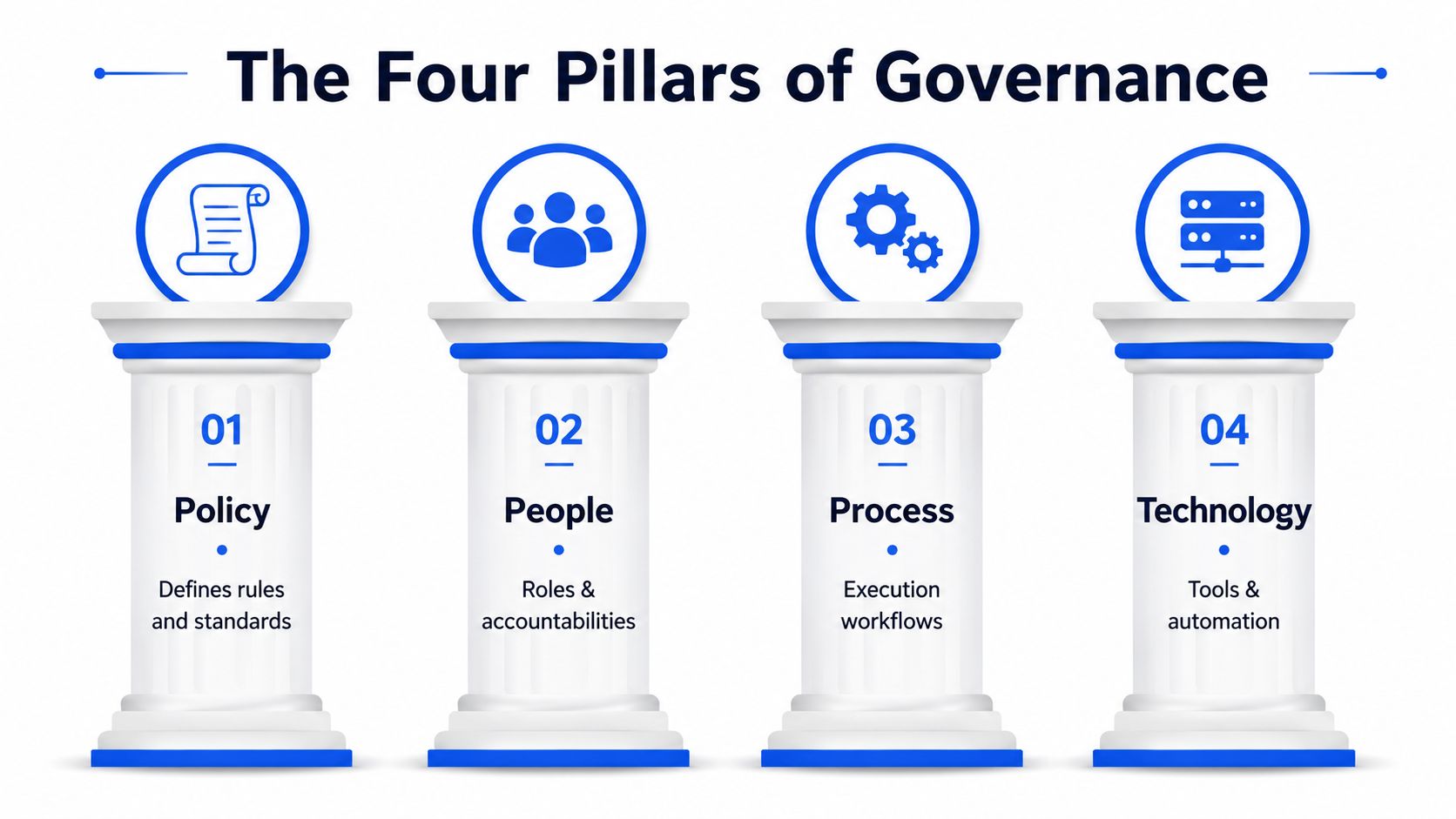
The familiar four pillars, policy, people, process, and technology, are only useful if they describe actual operating responsibilities. The trap is to treat them like presentation categories. The useful version turns each pillar into something a team can own on Monday morning.
Policy should fit on one page
A good policy layer is short enough for leaders to use and specific enough for engineers to implement. It usually covers decision rights, acceptable use, escalation paths, and the minimum standards for sensitive data. If a policy can't tell a steward what happens when a definition changes, it is not a governance policy yet.
People need named accountability
Roles matter more than org charts. A data owner is accountable for the domain, a data steward maintains definitions and day-to-day quality, and a custodian runs the platforms and controls that make enforcement real. The distinction keeps business ownership from being confused with technical administration.
Role | Primary responsibility | Common failure if missing |
|---|---|---|
Data Owner | Business accountability for the domain | No one can approve trade-offs |
Data Steward | Definitions, quality, and issue triage | Ambiguous metrics and slow resolution |
Custodian | Platform enforcement and access control | Good policy, weak execution |
For a practical breakdown of those responsibilities, the internal guide on data owner responsibilities is worth keeping close to the governance charter.
Process should feel like incident response
Good governance process looks a lot like production support. A quality issue gets detected, triaged, routed to the right owner, and either remediated or formally accepted. The point is not perfection, the point is repeatable escalation that keeps the team from re-litigating the same failure every week.
Practical rule: if your team cannot name the person who closes a data issue, the issue will eventually become a dashboard argument.
Technology should enforce, not just observe
Catalogs, lineage, validation, observability, and access controls work together. A catalog helps people find assets, lineage shows what breaks when a field changes, validation blocks bad records, observability spots drift, and access control limits exposure. The stack doesn't need to be from one vendor, but it does need to operate as one control plane.
A Phased Roadmap From Pilot to Enterprise
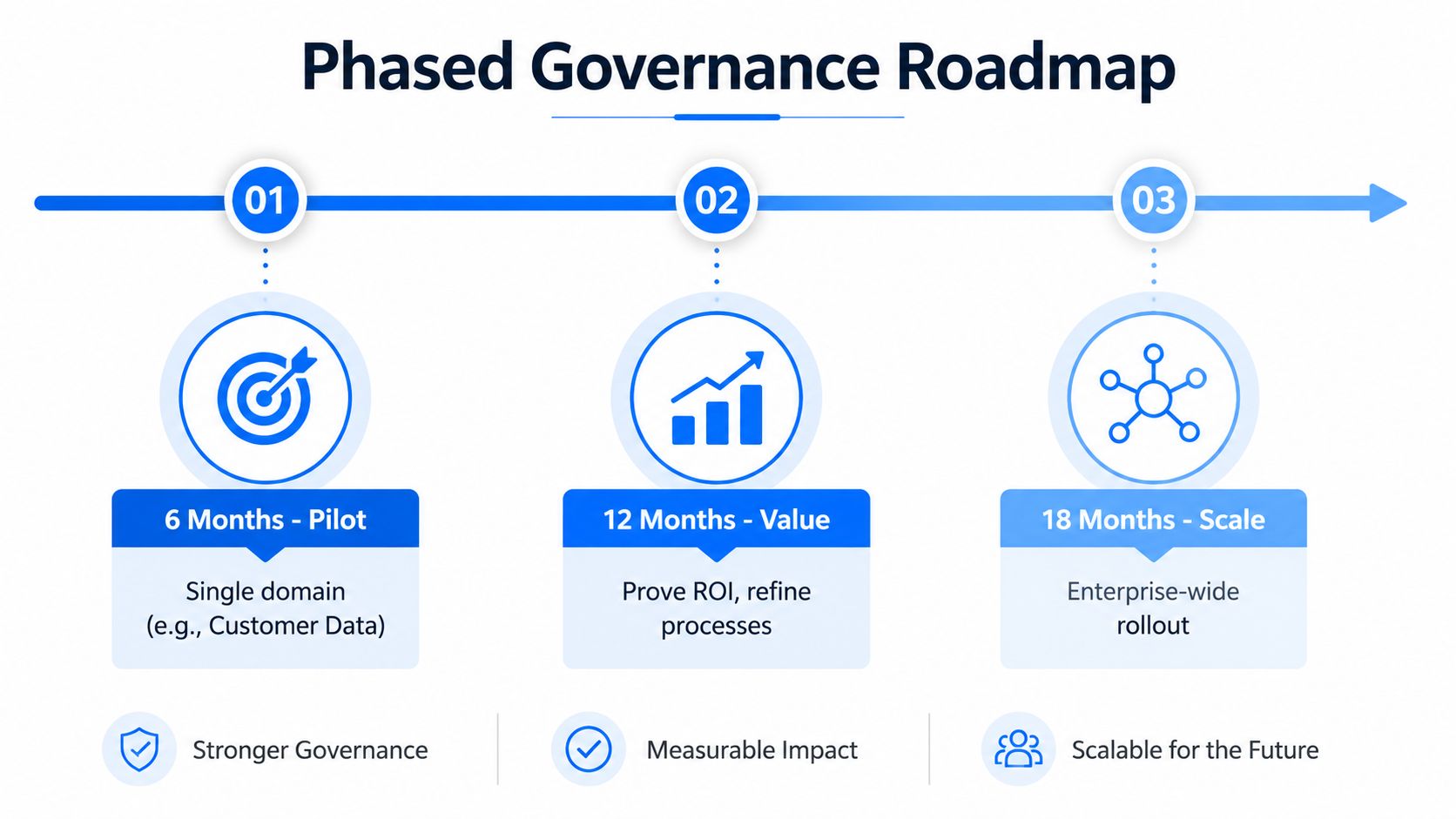
Most governance failures come from trying to scale before the organization has evidence. A better pattern starts with one high-impact domain, usually customer or finance data, then uses that pilot to prove value, refine the rules, and build confidence for wider rollout. That aligns with Snowflake's phased implementation sequence and Striim's pilot-first roadmap.
The first phase builds the foundation
In the early months, teams assess the current state, define governance objectives, assign ownership, and document the policies that matter for the chosen domain. The artifact here is not a giant manual, it is a working control set, a list of active owners, and a short set of standards the engineering team can enforce.
At this stage, the main risk is overdesign. If you spend the first quarter debating every future domain, you will never get to production controls. The smarter move is to pick one area with visible business pain and enough data movement to produce a meaningful signal.
The second phase proves value in the pilot
By the middle of the rollout, the team should have instrumentation, incident workflows, and a handful of KPIs tied to the pilot domain. Striim's roadmap explicitly uses 6, 12, and 18 month milestones, with the pilot serving as the proof point before broader expansion. That timeline matters because governance maturity rarely appears quickly, and shortcut plans usually break on ownership and adoption.
The deliverables in this phase are practical, not ceremonial. You want escalation routines, a visible baseline, and enough evidence to show that governance is changing behavior, not just generating meetings.
The third phase scales with controls intact
At the wider rollout stage, the governance model gets adapted for more domains, more teams, and more pipelines without dropping the operating rules that made the pilot work. The challenge is not adding more policy, it is keeping the control system consistent as the footprint grows. That is where programs tend to lose discipline and revert to local exceptions.
A strong roadmap ends with repeatable reviews, not a finish line. The team should know which controls are mandatory, which ones are domain-specific, and which metrics define a healthy state across the enterprise.
Embedding Observability Directly Into Governance
Static controls fail when the data moves too fast for manual review. That's why observability and quality tooling now sit inside the governance conversation, not beside it. In practice, they turn policy into enforcement by watching the flow of data, learning what normal looks like, and surfacing exceptions before they hit the dashboard.
The useful controls are the ones that run in the flow
digna is one example of how this works in a real stack. digna Data Anomalies learns normal behavior with AI and flags unexpected changes without manual rule maintenance, which is useful when governance would otherwise drown in rule sprawl. digna Timeliness watches arrival patterns and expected delivery times, so late-load failures show up before stale reports do.
digna Data Validation enforces record-level rules for business logic and audit needs, while digna Schema Tracker flags added columns, removed fields, and type changes that can break downstream jobs without warning. digna Data Analytics surfaces historical trends and volatility, which helps governance reviews focus on evidence instead of gut feel. One practical way to use that kind of stack is to map each control to a risk, stale reports, AI drift, schema breaks, audit prep, or trend-based prioritization.
The technical value is that governance no longer depends on someone remembering to check a report. The platform observes the pipeline, identifies deviation, and preserves the context needed to act quickly.
Practical rule: if a control can't be embedded where data moves, it will eventually become a manual checklist nobody trusts.
For a deeper implementation angle, the observability notes in digna's best practices guide are a useful companion to the governance plan. That's especially true in environments where schema volatility, freshness issues, and audit review all show up in the same week.

The governance win here is simple. Instead of asking teams to manually police every pipeline, you let the controls watch for the exceptions that matter and push the right issue to the right owner.
Choosing KPIs That Actually Prove Governance Works
A governance program earns executive patience when it can show change in the metrics that matter. Atlan's guidance recommends starting with 3 to 4 key metrics, collecting baseline data for at least one month, and then comparing the impact of changes over time. That sequence is important because a metric without a baseline is just a guess with a chart.
The categories themselves are broader than most teams start with. Governance metrics typically span data quality, security, usage, compliance, and training, and each one needs a representative signal that someone can act on. For example, policy conformance rate can tell you whether controls are being followed, issue-resolution time can show whether remediation is getting faster, and timeliness breach rate can reveal whether freshness is slipping.
Metric family | Example KPI | What it tells leaders |
|---|---|---|
Data quality | Policy conformance rate | Whether controls are holding |
Security | Access review completion | Whether exposure is being managed |
Usage | Adoption of governed assets | Whether users trust the system |
Compliance | Issue-resolution time | Whether risks are being closed |
Training | Completion of governance training | Whether roles understand the model |
The mistake is not picking the wrong metric first. The mistake is trying to prove everything at once, which usually means proving nothing. A steering committee can make better decisions when it sees a small set of signals tied to a baseline, a domain owner, and a specific change in control.
Common Pitfalls and How Real Teams Avoid Them
The biggest governance failures usually look responsible on paper. The team creates a steering committee, writes a policy library, and announces a rollout plan, but the business still can't tell whether anything improved. That's because the program was designed around activity, not value.
The first mistake is launching without executive sponsorship. The second is writing hundreds of rules before proving one domain. The third is treating governance like a one-time initiative instead of an operating model that needs ongoing measurement. McKinsey's guidance pushes teams to focus first on the domains where the organization most needs accuracy, which is exactly the right counterweight to blanket coverage thinking.
Governance Roadblocks and Counter-Moves | |
|---|---|
Pitfall | Practical Counter-Move |
No executive sponsor | Tie the first controls to a business decision leaders already care about |
Too many rules too early | Start with one domain and a narrow control set |
One-time project mindset | Run monthly review cycles against a live baseline |
Ignoring opportunity cost | Track decision delays, cleanup time, and downstream rework |
Teams also ignore the cost of not governing. That cost shows up as delayed decisions, broken AI inputs, and audit rework that eats into delivery capacity. If messy reporting is already slowing people down, a practical cleanup resource like Oviond helps fix messy reports can be useful context, but the larger point is that governance has to reduce repeated friction, not just satisfy a review board.
The programs that hold up are the ones that keep control and velocity in balance. They pick the right domain, measure the right behavior, and expand only after the evidence is clear.
Putting the Strategy Into Practice This Quarter
A workable data governance strategy for the next 90 days is simpler than many expect. Pick one domain, choose 3 to 4 metrics, instrument observability and quality controls, and assign named owners who can close issues without waiting for a committee. That gives you a baseline, a control loop, and a pilot that can produce evidence instead of opinions.
The long-term shape is clear enough now. Governance in an AI-first estate won't live in policy documents alone, it'll sit inside the pipeline, adapt to drift, and keep accountability attached to every critical data product. Teams that build that way move faster because they spend less time arguing about trust and more time using trusted data.
digna helps teams turn governance intent into operating controls by detecting anomalies, validating records, and monitoring timeliness and schema change inside the data flow. If you're building a governance program that needs measurable enforcement instead of another policy binder, visit digna and see how it fits into your data stack.