Apache Kafka Data Ingestion: A Practical Build Guide
|
6
min read

At 3:00 a.m., the alert usually doesn't say “your ingestion architecture is wrong.” It says consumer lag is rising, a sink task is retrying, or a downstream table has stopped refreshing. By the time someone traces the problem from the producer through Kafka and into the lakehouse, the original failure may be buried under rebalances, retries, schema mismatches, and duplicate records.
That's why Apache Kafka data ingestion needs to be designed as a full lifecycle. Kafka can provide a durable, high-throughput event backbone, but production reliability depends on what happens before records reach a broker and after consumers read them. Topic design, partitioning, delivery semantics, schema enforcement, sink behavior, and observability all determine whether the pipeline remains correct under pressure.
Table of Contents
The Real Challenge Behind Kafka Ingestion
Every early decision creates downstream work
Reliability includes the tail
Core Architecture Patterns for Ingestion Pipelines
Direct producer to broker
Gateway or REST proxy
Kafka Connect for source and sink integration
Streaming ETL with Kafka Streams or Flink
Building Producers and Consumers That Actually Work
Producer configuration should express the contract
Consumer configuration protects progress
Schema Handling and Error Recovery Strategies
Schema evolution needs an enforced boundary
Separate retryable and terminal failures
Delivery semantics versus workload
Tuning Partitions and Batching for Throughput
Benchmark before changing production topology
Tune for the workload, not a checklist
The Downstream Problem Nobody Talks About
Broker health can hide sink failure
Governance belongs at the exposure layer
Operational Habits and a Pre-Launch Checklist
Habits that prevent overnight pages
The week before launch
The Real Challenge Behind Kafka Ingestion
The first serious production failure I saw in a payments pipeline didn't begin with a broker outage. A schema-evolution rollout triggered a consumer rebalance at the wrong time. One consumer stopped making useful progress, the backlog grew, and the downstream lakehouse sink began landing duplicate rows as recovery logic retried work that had already reached storage.
The broker was healthy. Producer error rates looked ordinary. The incident still became a 3:00 a.m. page because the team had treated ingestion as a connection between an application and Kafka, rather than as a chain of stateful contracts. The practical definition of data ingestion is broader than transport alone, as the data ingestion meaning guide makes clear. Records must arrive, remain interpretable, be processed within an acceptable window, and reach their destination without degrading.
Every early decision creates downstream work
A topic's partition key determines ordering and load distribution. Its partition count limits consumer parallelism and affects rebalances. Producer acknowledgements and idempotence influence duplicate behavior. Consumer group sizing affects recovery time, while the sink's commit and retry model determines whether at-least-once delivery becomes visible as duplicate rows.
These choices also create dependencies outside Kafka:
Topic layout: Shared topics need clear ownership, naming, retention, and schema rules.
Partitioning key: A poor key creates hot partitions or breaks the ordering guarantee a business process depends on.
Delivery semantics: A ledger event and disposable telemetry shouldn't carry the same processing contract.
Consumer sizing: Adding consumers beyond available partitions doesn't create more useful parallelism.
Lakehouse writes: Continuous streams can create many small files, increasing compaction work and degrading query efficiency, a trade-off highlighted in guidance on delivering Kafka data to Iceberg streaming tables.
Practical rule: A Kafka pipeline isn't healthy because producers are receiving acknowledgements. It's healthy when downstream data remains complete, timely, correctly shaped, and recoverable.
Reliability includes the tail
In finance and healthcare, a record that arrives late or with a changed field can be as damaging as a dropped record. A payment event may be present but duplicated. A clinical event may be delivered but fail validation after a schema change. An operational feed may show low broker lag while its sink accumulates uncommitted files.
The sections that follow focus on those failure modes. The objective isn't to move bytes into Kafka. It's to prevent the next page by designing the entire path, from source behavior and partition assignment to schema governance, sink commits, and the evidence operators need during recovery.
Core Architecture Patterns for Ingestion Pipelines
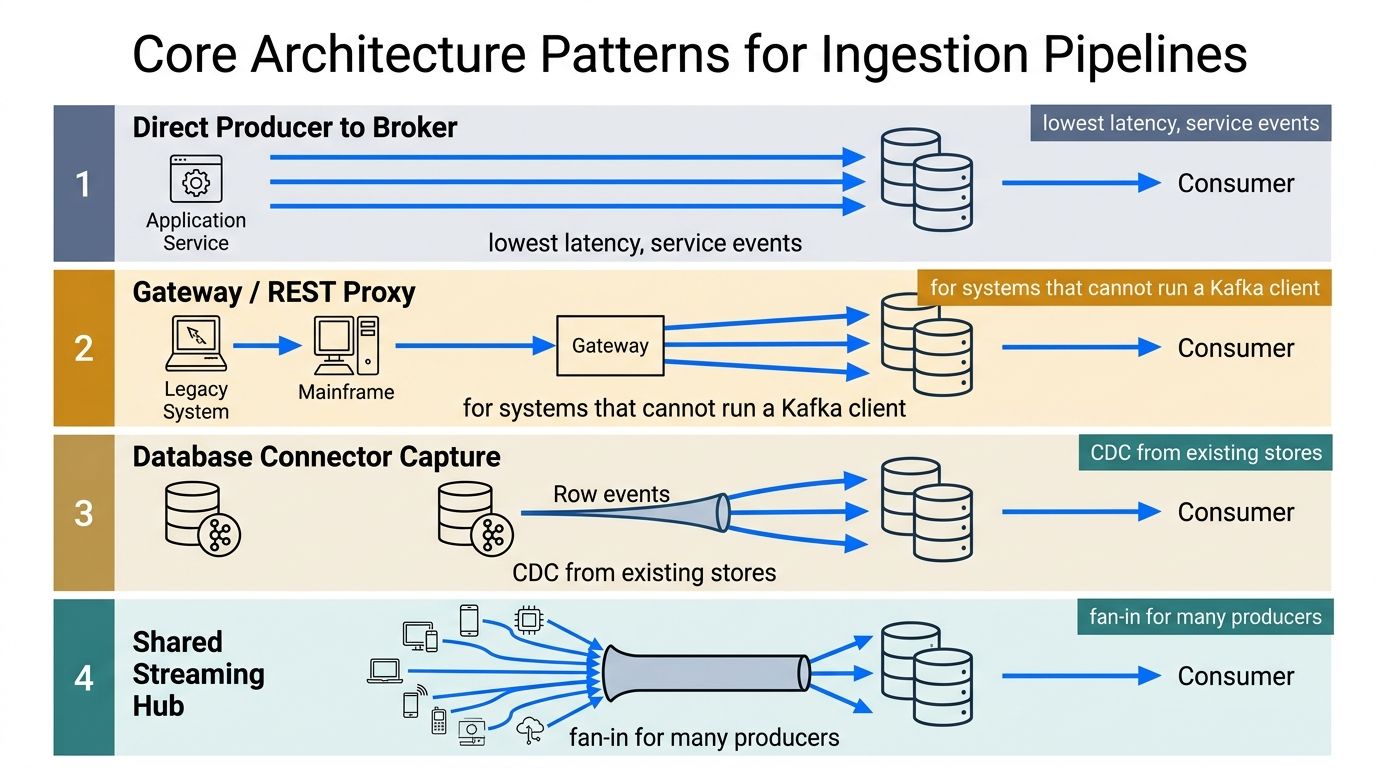
Choose the topology according to the source's capabilities and the downstream contract. A service that already speaks Kafka shouldn't be forced through an HTTP gateway, while a legacy mainframe shouldn't receive a Kafka client integration project it can't support.
Direct producer to broker
A Java, Go, or Python service can publish directly to Kafka using a native client. This is the right fit for service events, application activity, payment state changes, and telemetry where the producer controls message keys, batching, retries, and schema serialization.
The advantage is low latency and precise control. The cost is coupling. Every producing team must understand delivery callbacks, partition-key behavior, authentication, schema compatibility, and backpressure. A direct producer can also expose poor key design immediately, which is useful during testing but painful if the topic is already carrying production traffic.
Gateway or REST proxy
A gateway gives systems that can't run a Kafka client a simpler HTTP interface. Legacy applications, mainframes, partner integrations, and small utilities can submit records without managing Kafka protocol details.
The gateway centralizes authentication, validation, and rate limiting, but it can hide partition-key mistakes. If the gateway assigns keys or defaults to an unsuitable distribution strategy, the source team may not notice that related events are landing unevenly. It also adds another failure boundary, so operators need metrics for accepted requests, rejected requests, queued records, broker acknowledgements, and downstream delivery.
Kafka Connect for source and sink integration
Kafka Connect is practical for database capture, SaaS systems, files, and warehouse or lakehouse delivery. Source connectors can publish changes into Kafka, while sink connectors can move records into external systems without a custom consumer application.
Connect's offset model simplifies restart and recovery because connector tasks persist their progress. That convenience doesn't automatically provide exactly-once behavior. Connector retries, sink-side idempotence, external commits, and task restarts still need to be evaluated as one system. Connector deployments also carry operational overhead, including plugin compatibility, custom configuration, failed tasks, and maintenance, issues discussed in the comparison of Kafka Connect, Flink, and Spark.
Streaming ETL with Kafka Streams or Flink
Use Kafka Streams or Flink when records need enrichment, joins, deduplication, windowing, stateful processing, or event-time handling before they reach a sink. This topology keeps transformation logic in a controlled streaming layer instead of scattering business rules across producers and connectors.
The trade-off is operational depth. Stateful jobs introduce checkpoints, restore behavior, state growth, deployment compatibility, and more complex testing. A useful decision heuristic is straightforward: use direct producers for stable service contracts, gateways for constrained sources, Connect for mostly mechanical movement, and a processing engine when correctness depends on transformation state or cross-stream logic.
For a broader view of how producers, brokers, consumers, and destinations fit together, use this data pipeline architecture reference.
Building Producers and Consumers That Actually Work
A production producer should make duplicate publication unlikely, expose delivery failures, and stop retrying indefinitely. A consumer should process records deliberately, commit only after successful work, and isolate poison records before they block an entire partition.
Producer configuration should express the contract
A Java producer configuration might look like this:
acks=all makes the producer wait for the strongest configured broker acknowledgement. enable.idempotence=true prevents producer retries from creating duplicate records within Kafka's idempotent delivery model. A bounded linger.ms gives records time to form useful batches without turning latency into an uncontrolled queue.
A custom partitioner should reflect the business ordering requirement. Payment events commonly need all records for an account or transaction aggregate to remain ordered, while unrelated accounts should distribute across partitions. Don't call a custom partitioner “sticky ordering” unless the key really defines the ordering boundary.
Use delivery callbacks and inspect the exception. A timeout, leader election, or temporary network fault belongs in controlled client retry behavior. Set delivery.timeout.ms so the client has a defined upper bound instead of building a blind retry loop around send().
Consumer configuration protects progress
A Python consumer using confluent-kafka can make assignment and commit behavior explicit:
The cooperative-sticky assignor reduces unnecessary movement during group changes. Manual commits ensure the offset advances after the sink has accepted the record, not merely after the consumer has fetched it. A dead-letter topic prevents one malformed record from holding a partition hostage.
The poll loop must remain responsive even when the downstream system is slow. If lakehouse writes can block for a long time, separate polling from processing, bound the work queue, and tune max.poll.interval.ms to the actual processing contract. Otherwise, Kafka can interpret a slow but functioning consumer as dead and initiate another rebalance.
The native client matters too. librdkafka settings such as queue limits, fetch sizing, compression, socket behavior, and statistics intervals can change throughput and tail latency. Review those defaults instead of assuming the language wrapper has made the right choice. The relevant question isn't whether a setting is popular, but which failure it prevents and what resource it consumes.
A useful data ingestion software overview can help separate transport components from the validation and monitoring capabilities that belong around them.
Schema Handling and Error Recovery Strategies
Delivery semantics are a business decision disguised as a client configuration. At-most-once processing may be acceptable for disposable telemetry. At-least-once is often the practical baseline for analytics feeds. Financial ledger events usually need idempotent handling and a carefully designed exactly-once boundary.
Kafka distinguishes at-least-once and exactly-once processing. Exactly-once support began with version 0.11.0.0, using transactional producers and consumers to prevent duplication and loss across Kafka topics, as documented in Confluent's delivery semantics documentation. That capability doesn't make an arbitrary external sink transactional. The lakehouse, database, or API must participate in the correctness design.
Schema evolution needs an enforced boundary
Avro, JSON Schema, and Protobuf can all work. The format matters less than whether producers share a registry, compatibility policy, and release process. For shared topics, Schema Registry with backward and backward-transitive compatibility is the safest default because consumers need a predictable way to read new records while older consumers remain deployed.
Schema drift is more dangerous than a visible crash. An incompatible type change may stop a load, while an unvalidated field change can silently distort values. A registry provides compatibility checks, but operators still need alerts when a producer attempts a rejected version, when consumers fall behind after a deployment, and when a dead-letter topic begins growing.
Separate retryable and terminal failures
Network timeouts, temporary leader elections, and unavailable brokers are usually retryable. Deserialization failures, invalid business values, and poison pills aren't fixed by repeating the same operation. Route terminal failures to a dead-letter topic with the original payload, topic, partition, offset, schema identifier, error class, and processing timestamp.
For a transactional processing path, the important settings include:
The transactional.id must be stable per processing identity and managed carefully during deployment. Consumers using read_committed avoid exposing aborted transactional records, but exactly-once still requires atomic coordination between reading, processing, and writing. Idempotent producers are cheap insurance. True exactly-once is a deliberate architectural choice, not a default.
Delivery semantics versus workload
Workload | Delivery Semantics | Schema Strategy | Error Routing | Key Config |
|---|---|---|---|---|
Fire-and-forget telemetry | At-most-once where loss is acceptable | Versioned JSON or Protobuf with validation | Drop or sample invalid records only when the business owner accepts loss | Bounded delivery timeout |
Operational analytics | At-least-once with sink deduplication | Registry-managed Avro, JSON Schema, or Protobuf | Dead-letter topic for terminal failures |
|
Financial ledger events | Exactly-once across the defined processing boundary | Registry-managed schema with strict compatibility | Retry transient faults, quarantine poison records | Transactions, |
Healthcare clinical events | At-least-once or exactly-once according to the source and sink contract | Explicit compatibility policy and field validation | Dead-letter topic with audit metadata | Manual commits after validated persistence |
Use a clear schema taxonomy before creating topics. Schema types and their trade-offs are useful context, but the operational rule remains the same: every shared topic needs an owner, a compatibility policy, and a replay path.
Tuning Partitions and Batching for Throughput
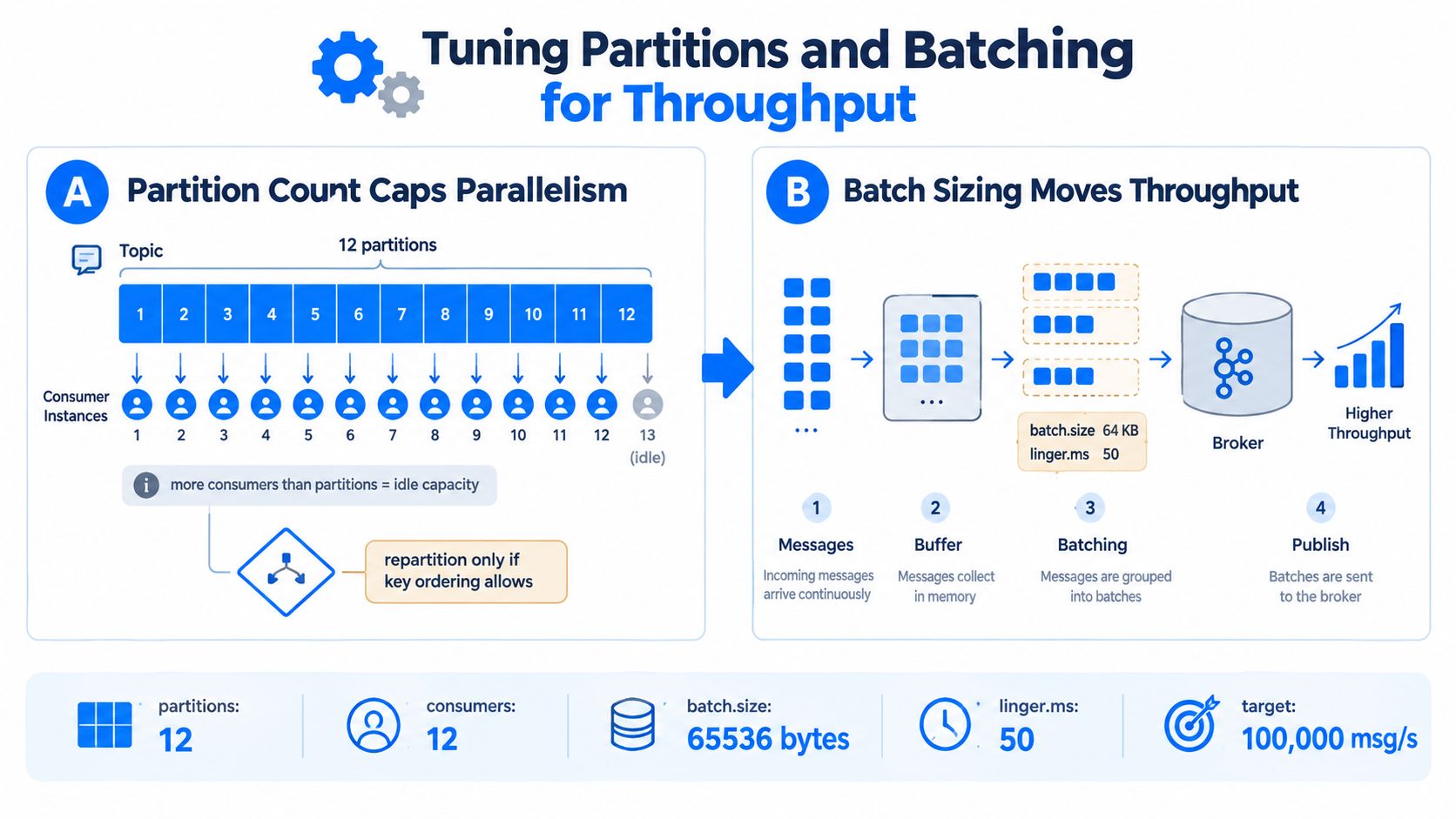
Two controls usually move Kafka ingestion throughput more than clever application code: partition count and batch size. Partitions provide parallelism, but they also create files, metadata, replication work, and assignment overhead. Once a topic is in production, reducing its partition count isn't a safe routine operation, so leave room for growth without creating an unnecessarily large cluster footprint.
A practical sizing model starts with expected peak throughput divided by the sustainable throughput of one partition under the intended key distribution. One tuning reference gives a rough sustained range of 10 to 30 MB/s per partition, but treat that as a starting hypothesis, not a guarantee. Benchmark with real payload sizes, compression, replication, broker hardware, and skewed keys.
Benchmark before changing production topology
Kafka's published and vendor benchmarks show why configuration matters. One empirical benchmark recorded about 420,000 messages per second on commodity hardware with one partition and replication factor one, while another study reported about 800,000 messages per second on a single properly configured broker. An Azure engineering case study cited around 2 GBps with 10 brokers and 16 disks per broker. These figures come from different environments and aren't interchangeable, so use them to establish scale, not to promise a result. See the Kafka history and performance reference for the historical and benchmark context.
Batching can have a dramatic effect. One benchmark reported that moving from a 16 KB batch size to 100 KB increased producer throughput by about 300%, while another measured 605 MB/s with a 1 MB batch.size, linger.ms=10 ms, 100 partitions, and 3x replication, as summarized in the Kafka throughput benchmark.
Tune for the workload, not a checklist
Start producer tests with increasing producer counts until p99 latency approaches the service-level target. Then increase partitions to match the desired parallelism and verify that keys distribute evenly. Oversized partition counts create metadata and coordination overhead, while too few partitions produce hot partitions and lag spikes during bursts.
For producers, test a bounded linger.ms in the 5 to 20 ms range and batch.size between 64 KB and 256 KB before considering larger batches. zstd or lz4 can reduce network and storage pressure for log-shaped payloads, but compression consumes CPU. Set buffer.memory above the expected burst rate so short sink or broker slowdowns don't immediately become producer failures.
For consumers, cap max.poll.records so processing fits within the poll interval. Tune fetch.min.bytes to amortize broker round-trips when latency permits, and use static membership when deployments would otherwise cause avoidable group churn. Remember that consumer throughput generally plateaus once consumer count exceeds partition count. More processes won't create work that the topic can't assign.
The Downstream Problem Nobody Talks About
Kafka ingestion continues after the broker accepts a record. The hard failures often appear when a sink converts an unbounded event stream into lakehouse tables, warehouse rows, or service calls. A pipeline can meet producer and broker targets while downstream data remains late, fragmented, malformed, or invisible to users.
High-throughput writes into Iceberg can create many small files. Those files increase metadata and compaction work, and queries slow as table layout fragments. Teams must choose how much freshness to accept before compaction and how to group writes without creating an unmanageable backlog. Treat the lakehouse sink as part of ingestion design, with file sizing, commit behavior, compaction capacity, and query-visible freshness monitored together.
Broker health can hide sink failure
Kafka consumer lag is the difference between a partition's latest produced offset, the log end offset, and the offset last committed by a consumer group. It is a per-partition signal, not a complete measure of end-to-end freshness, as explained in this consumer lag reference.
A sink may commit offsets while writes remain delayed, buffered, duplicated, or unavailable to queries. Monitor the full path:
Broker-side: Log end offset, committed offset, lag by partition, request latency, under-replicated partitions, disk utilization, and partition skew.
Consumer-side: Processing duration, records persisted, retry counts, rebalance events, deserialization failures, and dead-letter volume.
Sink-side: Commit latency, file creation rate, small-file accumulation, compaction backlog, rejected writes, transaction conflicts, and query-visible freshness.
Data-side: Arrival timeliness, row counts, null patterns, key uniqueness, business-rule failures, and schema changes.
Schema drift creates another silent failure path. A deprecated field may continue through the producer and broker while a downstream table ignores it or assigns the wrong meaning. Enforce compatibility at the topic boundary, record the schema version with each event, and assign an owner for changes and failure notifications.
Governance belongs at the exposure layer
New consumers should have defined identities, rate limits, permitted topics, schema access, retention expectations, and audit trails tied to an owning team or business purpose. Informal approvals and custom proxies make access difficult to review and revoke.
This matters in finance, healthcare, telecom, and public-sector systems. Operators need to show that records arrived in the expected shape, within the required window, and with a traceable recovery path. Consumer governance therefore includes access, usage, replay authority, and downstream data quality.
A pipeline is only as reliable as its slowest, least-monitored hop.
Operational Habits and a Pre-Launch Checklist
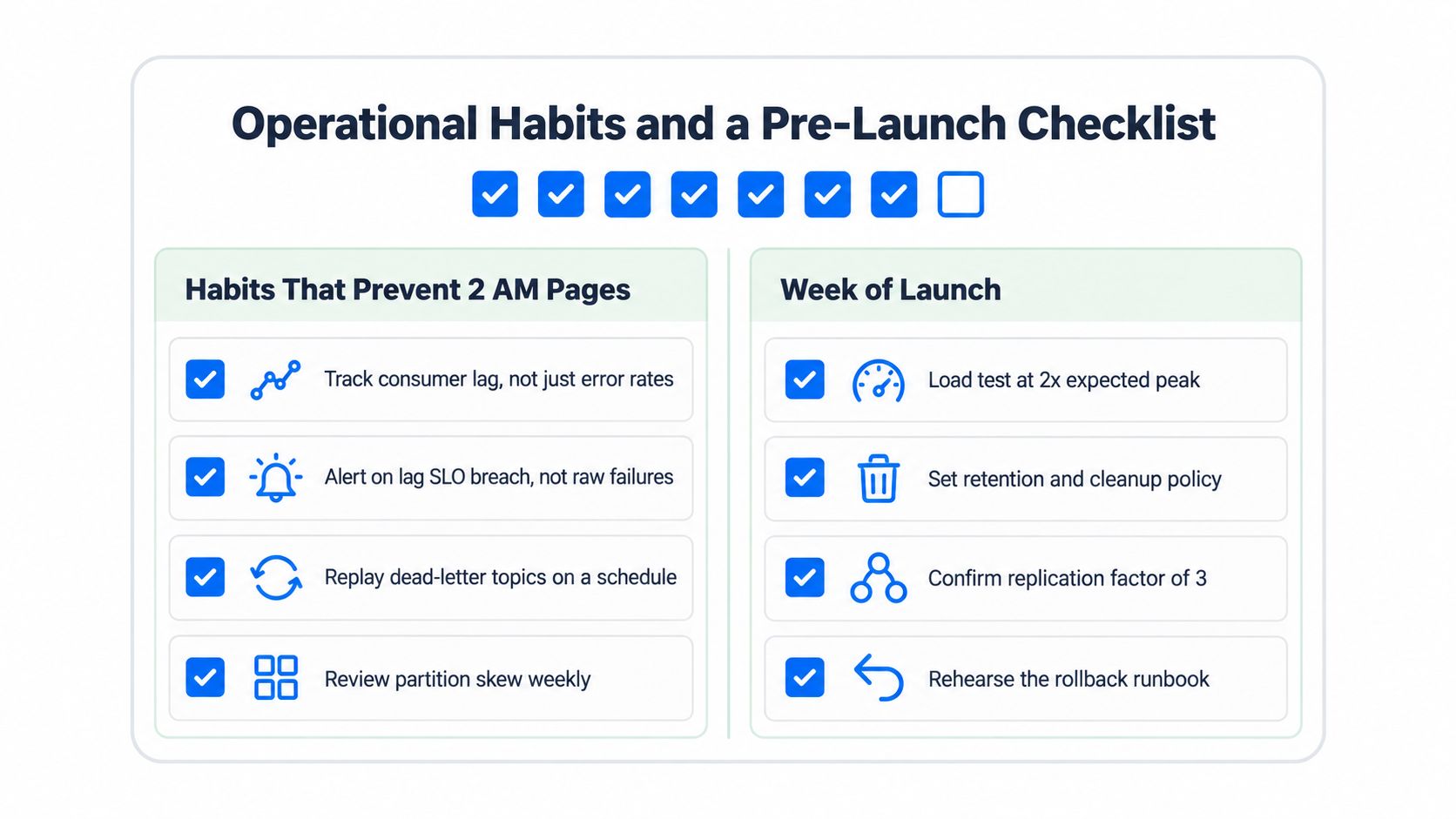
Reliable teams don't wait for launch day to discover that their key distribution is uneven or their sink can't keep up. They load test with realistic records, review dashboards weekly, and treat replay as a normal operating procedure rather than an emergency trick.
Habits that prevent overnight pages
Track consumer lag against an SLO, not just raw error rates. A consumer can report no exceptions while processing too slowly for the business deadline. Alert on lag breaches, partition skew, broker disk pressure, frequent rebalances, and dead-letter growth.
Review Grafana panels and JMX metrics weekly, including producer request latency, record batch size, consumer fetch rate, commit latency, bytes in and out, under-replicated partitions, and group rebalance activity. The review should identify trends before downstream dashboards expose them.
Dead-letter topics need ownership and a replay schedule. A DLQ that grows forever is not recovery. It's an undocumented quarantine.
The week before launch
Run the following checks against a staging environment that resembles production:
Load distribution: Test with realistic key distributions, including hot-key scenarios and bursty traffic.
Schema compatibility: Register representative versions and verify backward and backward-transitive behavior with Confluent Schema Registry.
Broker failure: Kill a broker during ingestion and confirm producer recovery, consumer recovery, and sink correctness.
Offset recovery: Confirm that offset retention exceeds the worst-case recovery window. Kafka retains consumer offsets for a configurable period after a group becomes inactive, controlled by
offsets.retention.minutes; Red Hat also documentsauto.offset.reset=earliestas a way to avoid missing data when a committed offset is no longer valid, as described in the Red Hat consumer configuration guidance.Runbooks: Document the top three failure modes, the owner for each, the rollback procedure, and the replay command or workflow.
Use pipeline orchestration guidance to clarify which system schedules recovery, which system validates the result, and which team closes the incident. Ingestion reliability is earned through repeated operational review, not a final configuration push.
digna provides in-environment data observability for Kafka-fed pipelines, including timeliness monitoring, record validation, anomaly detection, and continuous schema-change tracking across downstream data assets. Visit digna to see how its modular platform can help connect broker activity with the data quality and freshness signals your ingestion runbooks need.