Database Quality Management Explained Simply
|
7
min read

A trusted dashboard fails five minutes before an executive review. Revenue looks unusually low, a customer segment appears to have vanished, and the team starts checking SQL, dashboards, and pipeline logs at the same time. Nobody can immediately tell whether the source system sent incomplete records, a transformation changed the meaning of a field, a load arrived late, or the dashboard queried the wrong table.
That uncertainty is the database quality problem. A database can accept every row without an error and still support a misleading decision. Poor data quality affects reporting, analytics, operational processes, and AI systems, while the cost of cleaning and preparing data can consume up to 80% of data professionals' time, according to industry data quality statistics summarized by Integrate.io.
Database quality management gives teams a way to move from emergency investigation to continuous control. The practical path starts with the difference between valid storage and trustworthy meaning, then moves through quality dimensions, pipeline handoffs, timeliness, schema changes, business rules, ownership, and enterprise rollout.
Table of Contents
Introduction Why Database Quality Still Breaks Decisions
What Database Quality Management Really Means
Structural correctness
Business correctness
The Key Dimensions That Define Trusted Data
Intrinsic quality
Contextual quality
Representational quality
Accessibility quality
How Quality Fails Across Pipelines and Environments
The control pattern decision
Monitoring Timeliness Schema and Business Rules in Practice
Start with arrival expectations
Treat schemas as contracts
Validate meaning at record level
Building an Enterprise Database Quality Management Program
Putting Database Quality Management Into Action
Introduction Why Database Quality Still Breaks Decisions
An analyst opens a dashboard before an executive review and sees revenue far below expectation. The investigation spreads across SQL, pipeline logs, transformation code, and source extracts. A database administrator may confirm that tables are available, yet the team still cannot explain whether the data arrived late, changed meaning during a release, or came from an outdated source.
A field-level check can verify that every value is a valid date. It cannot confirm that those dates represent purchase events rather than ingestion times. A pipeline can also finish without an error while loading an old extract, applying a changed join, or mapping two source statuses to one warehouse value. Technical completion and business correctness are separate outcomes.
Database quality management therefore controls the full path from source to consumer. It covers checks inside databases, comparisons between environments, and observations across pipeline runs and releases. In-database observability closes the gap by recording what changed, when it changed, and which rule or handoff introduced the difference. This makes quality degradation visible before it reaches a report or operational decision.
The business exposure is broad. Poor data quality can affect reporting, operations, analytics, and decisions, rather than only producing broken tables. A guide to business decisions and data quality explains how unreliable information can distort choices and increase rework.
Practical rule: If a team cannot identify where a value changed, when it changed, and who owns the correction, it has periodic inspection, not quality management.
Use three questions to frame the work: Is the value structurally acceptable? Is it meaningful for the business? Can the movement from source to consumer be trusted? The answers connect table checks with pipeline controls, release validation, ownership, and evidence that a decision rests on current, correctly interpreted data.
What Database Quality Management Really Means
A release can finish successfully while a report still contains the wrong business meaning. For example, an ingestion job may store a valid timestamp, a transformation may apply a changed join, or a mapping may collapse two source statuses into one warehouse value. Database quality management addresses that gap between technical completion and data that people can safely use.
The discipline is the ongoing practice of keeping data fit for its intended use. A finance report, clinical workflow, customer model, and regulatory submission may rely on the same database, yet each expects different levels of accuracy, freshness, completeness, and interpretation. Quality control therefore follows data across pipelines and releases, not only through checks on individual tables.
Structural correctness
Syntactic correctness asks whether a value conforms to the database's allowed structure. A customer_id must exist, a date must match its data type, a numeric field must contain a number, and a relationship may require a matching parent record. Constraints, nullability rules, type checks, and referential integrity controls enforce these conditions.
They prevent clearly invalid values from entering or progressing through a system. They do not establish that a validly stored value describes reality.
Business correctness
Semantic correctness asks whether a stored value means what the organization says it means. An order may contain a valid timestamp that records ingestion rather than purchase time. A customer may have an allowed status that conflicts with the customer's actual lifecycle state. A transaction may pass a numeric check while belonging to the wrong account.
The distinction is central to the technical literature on data quality management, which treats quality as more than formatting and separates syntactic from semantic correctness.
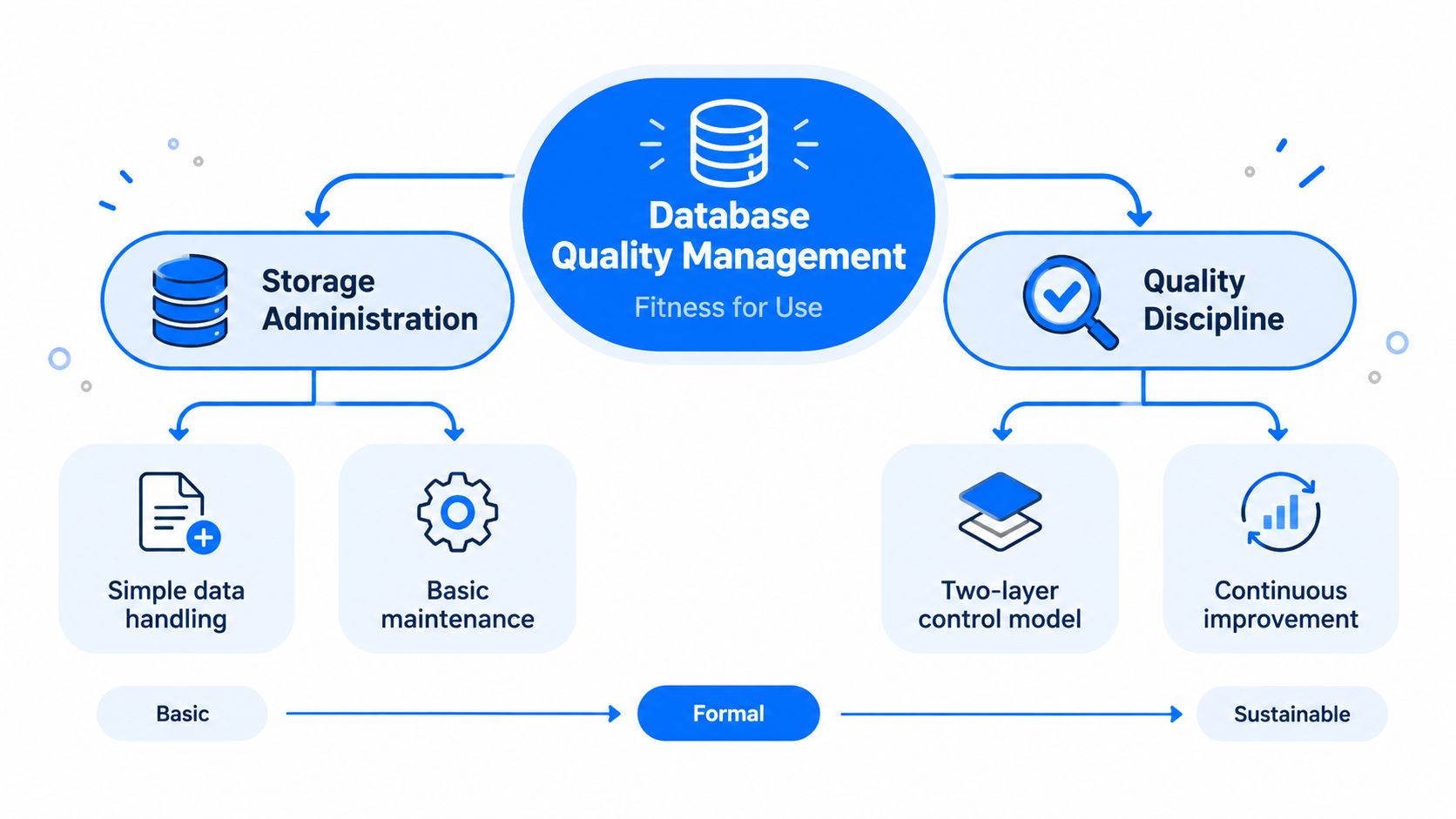
A library makes the difference clear. Storage administration maintains shelves, catalog numbers, and checkout records. Quality discipline also checks whether the catalog describes each book accurately, identifies the current edition, avoids duplicate entries, and lets authorized readers find the material they need.
A practical control loop follows:
Constrain incoming data with types, keys, required fields, and relationship checks.
Validate business meaning through rules for ranges, statuses, sequences, reference data, and relationships.
Record exceptions instead of discarding failures.
Assign ownership so a team can trace the source, transformation, or release that introduced a problem.
Measure recurring behavior to separate an isolated bad record from a degrading pipeline.
Quality management then covers ingestion, transformation, storage, delivery, and consumption. In-database observability connects those stages by recording changes, timing, rule failures, and handoffs across environments. Teams can use this explanation of data quality to connect technical controls with business fitness.
The Key Dimensions That Define Trusted Data
A decision can fail even when a table passes a basic check. Records may be present but stale, one field may be accurate while another system disagrees, or a valid structure may contain duplicate entities. Trusted data therefore requires several views of quality, applied across pipelines, releases, and environments rather than only at the final table.
The six core dimensions provide a practical starting point:
Accuracy: Does the data correctly reflect the world entity or event?
Completeness: Are required records and fields present?
Consistency: Do related systems and datasets agree?
Timeliness: Is the data available and current when users need it?
Validity: Does it follow defined types, formats, ranges, and rules?
Uniqueness: Are unwanted duplicate records absent?
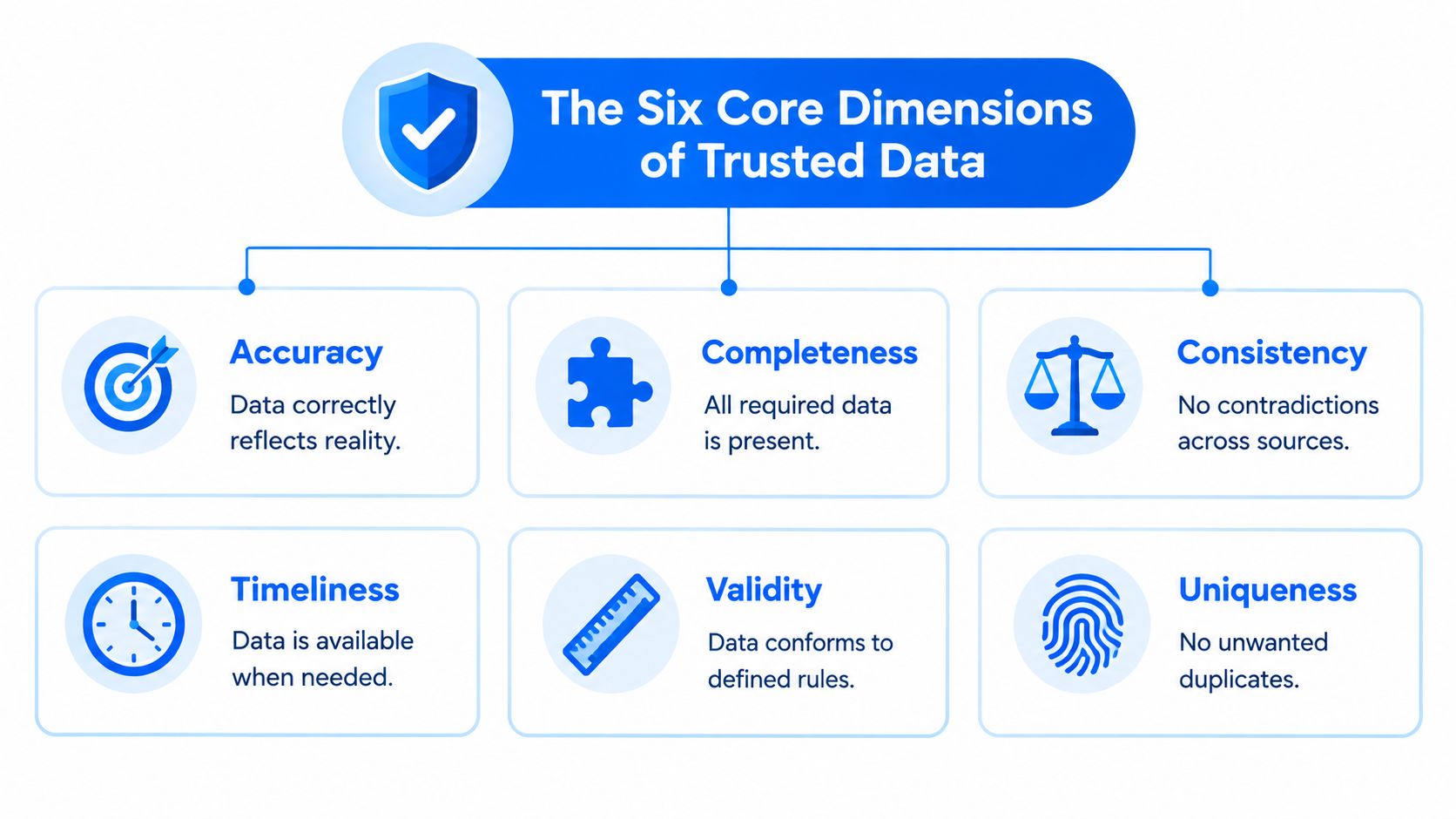
These dimensions can also be organized into four operational families discussed in total data quality management literature.
Intrinsic quality
Intrinsic quality describes properties within the data itself, especially accuracy and believability. A value can be present and correctly typed yet still fail if it does not represent the underlying customer, account, event, or measurement.
Contextual quality
Contextual quality asks whether data is relevant, complete, timely, and appropriate in amount for a specific use. Data suitable for a monthly trend may be unsuitable for a real-time operational decision. Fitness depends on the decision and its timing, not only on the table.
Representational quality
Representational quality covers interpretability and consistency of representation. Clear definitions, stable names, compatible formats, and documented transformations help consumers understand a field and compare it safely across datasets. A release that changes a meaning without changing a type can still reduce quality.
Accessibility quality
Accessibility quality concerns whether authorized users can reach and use data while access security remains intact. Accurate data that an approved workflow cannot retrieve does not fulfill its purpose.
Operational monitoring turns these categories into signals that teams can observe across environments. Freshness exposes timeliness problems. Schema tracking reveals structural changes between releases. Volume and distribution highlight unusual shifts in record counts or value patterns. Lineage connects a failure to an upstream source, transformation, or deployment. digna's overview of data quality dimensions links these expectations with practical monitoring signals.
Separate controls make diagnosis faster. A freshness alert points toward scheduling or delivery. A distribution anomaly suggests changed source behavior or transformation logic. A schema alert may indicate a release or contract break. An access failure directs attention to permissions or platform configuration. One score can summarize status, while distinct signals show where quality degraded and which team should investigate.
How Quality Fails Across Pipelines and Environments
A report can pass every check on its final table and still contain the wrong values. The source extract may change before ingestion, a transformation may alter meaning between environments, or a release may add a column that breaks a downstream consumer without violating the destination table's constraints. Quality therefore degrades at handoffs, not only at storage.
A 2026 global survey found that 47% of respondents linked data quality issues directly to transformation, while 77% of enterprises lacked formal database governance and quality processes and 39% relied on manual testing and deployment methods, according to Redgate's 2026 State of the Database Report. These findings point to handoff points as a central control problem. Teams need visibility across development, test, production, warehouses, lakes, and pipelines, rather than relying on checks inside one destination table.
The control pattern decision
Control Pattern | Best For | Trade Off |
|---|---|---|
Manual rules | Known, high-value checks owned by a specialist | Slow to scale, easy to overlook during releases, and dependent on human follow-up |
Deterministic validation | Stable contracts, required fields, ranges, relationships, and compliance conditions | Clear and reproducible, but it won't detect every unexpected behavioral shift |
Automated observability | Freshness, volume, distribution, schema drift, and patterns that are difficult to enumerate | Broad coverage requires baseline management and a workflow for investigating alerts |
Manual checks remain appropriate for a regulatory rule or financial reconciliation that needs an explicit, reviewable condition. Deterministic validation fits cases where the expected result is unambiguous. Automated observability covers changes that teams cannot reasonably describe with one rule for every possible behavior.
Protect each transition in sequence. Check source arrival, validate transformation output, compare schemas across environments, and monitor the final dataset used by reporting or models. In-database execution can reduce unnecessary movement by calculating metrics where data already resides. Lineage and release metadata then connect an incident to the change that preceded it.
A pipeline is only as trustworthy as its least-observed transition. The ETL data pipeline quality guidance frames checks around movement and transformation, while in-database observability closes the gap between what a pipeline produced and what each environment contains.
Monitoring Timeliness Schema and Business Rules in Practice
A deployment can pass table checks and still fail in use. The source may arrive late, a release may alter a field type, or a transformation may produce records that violate domain logic. Operational monitoring becomes manageable when each signal has a clear question and response. Timeliness asks whether data arrived when expected. Schema monitoring asks whether structure changed. Business-rule validation asks whether records still support their intended use.
Start with arrival expectations
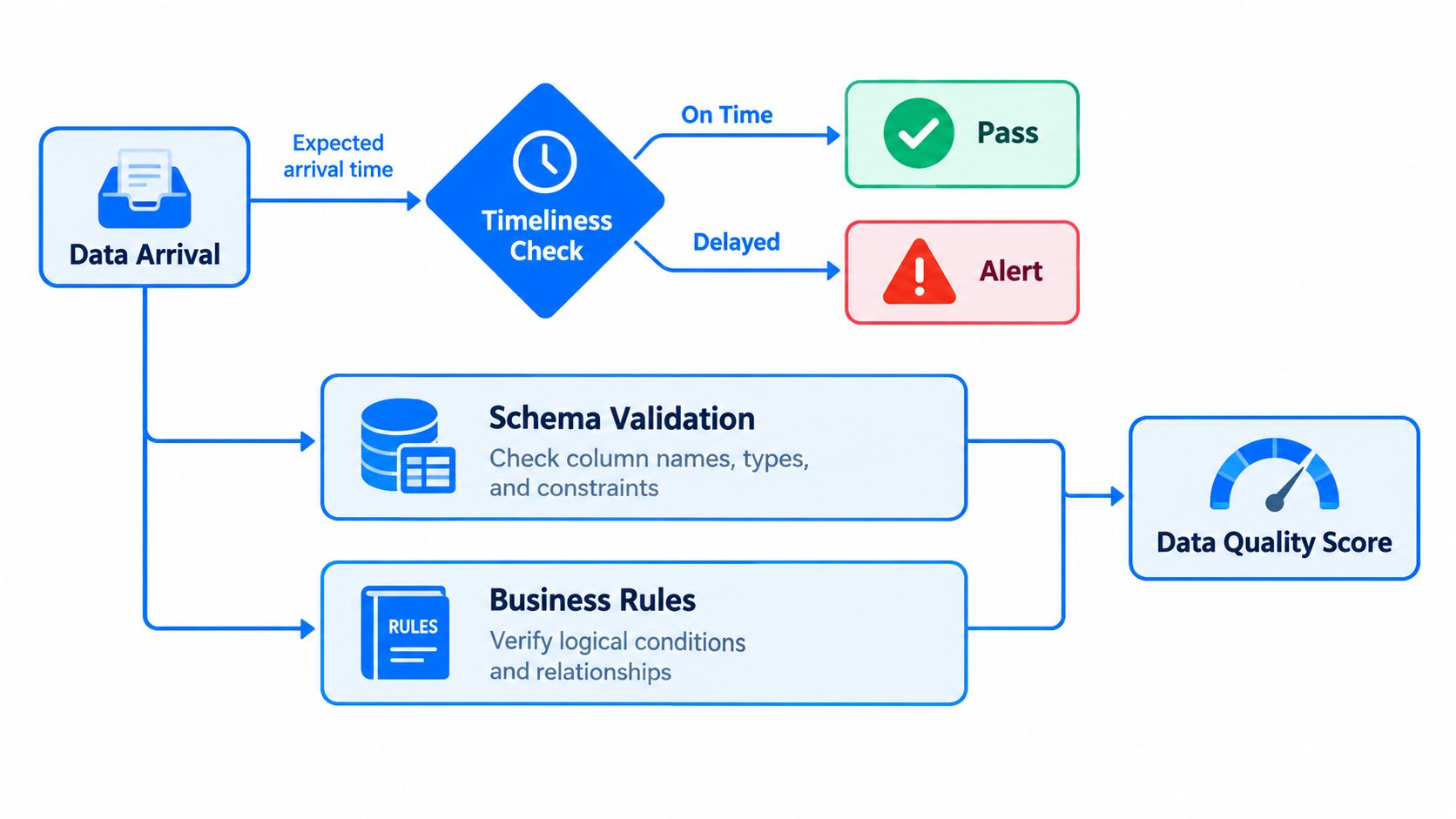
Timeliness monitoring compares the actual arrival or update time with an expected schedule or SLA window. Record-level timeliness measures whether an individual event arrived within an acceptable period. Dataset freshness measures how recently a table or partition was updated.
A team might define a delivery window for a daily source and alert when the table's last update exceeds the permitted threshold. That threshold depends on the domain and use case. A risk process, customer-facing workflow, and exploratory report will have different tolerances. For threshold-based alerting, see this guide to data timeliness metrics and monitoring. In-database observability can calculate these checks beside the data, making late arrivals visible across development, staging, and production rather than only at the pipeline boundary.
Treat schemas as contracts
Schema checks compare observed structure with the expected contract. Monitor new columns, removed columns, renamed fields, changed data types, nullability changes, and constraint changes. A new column may be harmless, while a removed identifier or numeric-to-text conversion can break joins, calculations, or downstream models.
Run schema checks before a release reaches production, then keep monitoring after deployment. Comparing the same contract across environments helps distinguish an approved migration from drift introduced by a source system or an incomplete release.
Validate meaning at record level
Business rules express conditions that a valid row must satisfy. Examples include an end date not preceding a start date, a payment linked to an existing account, a positive quantity for a completed sale, or a status transition allowed by the domain model.
Keep failed records available for investigation. A useful exception record includes the dataset, rule, value, ingestion or update time, environment, pipeline version, and owner. That context helps engineers separate bad source data from a faulty transformation and connect the failure to the release or environment where it appeared.
Operational advice: Alert on a condition only when the receiving team knows what decision it should make next. Otherwise, monitoring produces noise instead of control.
A combined quality view can show timeliness status, schema status, business-rule results, and affected downstream assets. The score then summarizes evidence from each environment and transition instead of presenting an unexplained grade.
Building an Enterprise Database Quality Management Program
An enterprise program connects people, process, and platform across pipelines, environments, and releases. Each part answers a different question: who owns the data, how should teams respond, and where do controls run? This model treats quality as a control problem across handoffs, not only as a set of table checks.
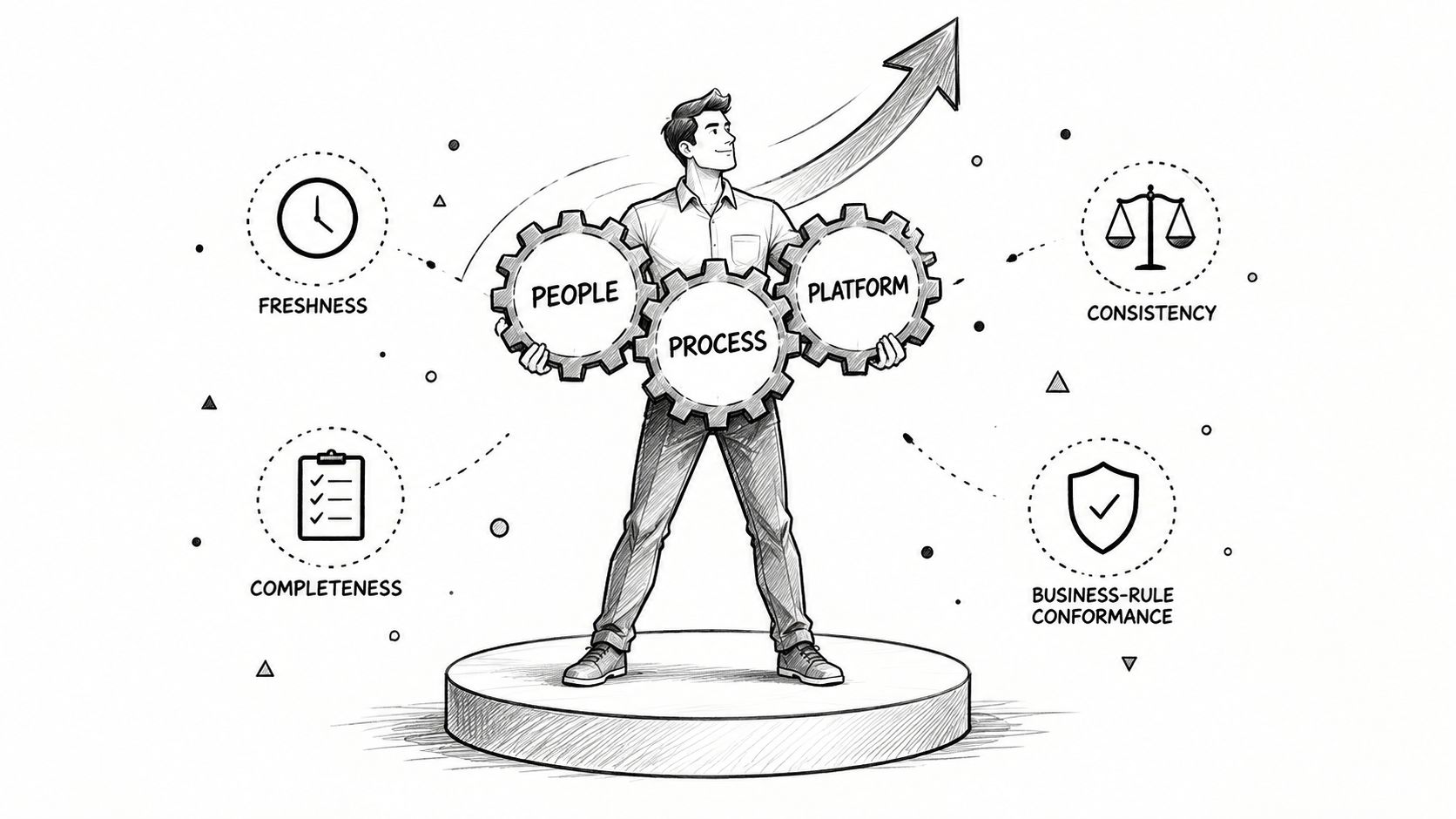
Start with measures tied to business use. Track freshness for delivery reliability, completeness for required fields, consistency across authoritative sources, and business-rule conformance for critical records. Run the same controls in development, testing, and production where possible. Comparing results across environments can reveal whether a release changed behavior before the issue reaches consumers. Add dimensions only when they support a decision, escalation path, or governance obligation.
Ownership should be explicit. Data engineering usually owns pipeline behavior and technical remediation. Analytics engineering and BI teams own trusted transformations and consumption logic. Domain stewards define meaning and acceptable exceptions. Governance teams establish standards, evidence requirements, and escalation policy. A shared dashboard lets these groups inspect the same incident while keeping their technical workflows distinct.
The business case should connect investment to outcomes leaders recognize:
Incident reduction: Detect missing loads, schema drift, and abnormal distributions before consumers report them.
Governance readiness: Preserve evidence of checks, failures, ownership, and remediation.
Platform efficiency: Reduce repeated manual investigation and focus engineering time on root causes.
AI reliability: Give models and retrieval systems data with observable freshness, structure, and meaning.
A 2025 enterprise study found that 84% of organizations struggle with inaccurate or duplicate data. It also identified budget pressure at 27%, lack of internal resources at 24%, and complex system environments at 19% as major barriers, according to Melissa's enterprise data quality survey. These constraints favor a modular rollout over a large organization-wide replacement.
The design can adapt by industry. Finance may prioritize reconciliation, risk data, and audit trails. Healthcare may emphasize clinical completeness, validity, and access controls. Telecom teams may need high-volume anomaly and delivery monitoring. Public-sector programs may prioritize traceability, consistency, and evidence. The control pattern remains modular while the rules change.
In-database observability closes the gap between a passing pipeline check and the data that consumers query. It can connect test results, release versions, environment changes, and downstream impact, giving incident owners evidence for the next action instead of another isolated alert.
This video provides additional context for connecting data quality operations with broader platform reliability:
Putting Database Quality Management Into Action
A practical rollout begins with the dataset that creates the greatest business risk or operational rework. Document its intended use, owner, delivery expectation, key fields, business rules, downstream consumers, and acceptable exceptions. Establish a baseline before adding more controls, so later improvements have something to compare against.
Use this decision checklist:
Trace the failure path: Follow data from source through transformation, environment, release, destination, and consumer.
Separate correctness layers: Pair structural constraints with semantic validation.
Select signals by risk: Monitor freshness, schema, volume, distribution, lineage, and business rules according to likely failure modes.
Make incidents actionable: Record ownership, severity, evidence, and the next response.
Expand by risk: Apply controls to the next critical dataset after the first workflow produces useful operational feedback.
Quality can change when source behavior, code releases, schedules, or business definitions change. Independent research reported an average of one data quality issue for every ten tables per year in its 2026 update, compared with about one issue for every fifteen tables in earlier measurements, as documented by Monte Carlo's data quality statistics. Persistent observation is therefore more reliable than occasional cleanup.
Choose a modular platform that runs checks inside the customer environment. Teams can start with one capability and extend it across warehouses, lakes, and pipelines. In-database checks keep data in place, while validation, timeliness, anomaly detection, and schema tracking cover different points in the quality lifecycle. Monitoring should also connect pipeline results with release versions, environment changes, and the data consumers query. That connection helps incident owners distinguish a failed test from a defect introduced later in delivery.
digna provides in-database data quality and observability capabilities for monitoring data behavior, validating records, tracking timeliness, detecting schema changes, and supporting reliable analytics and AI across warehouses, lakes, and pipelines. Visit digna to evaluate a modular approach against your environments, ownership model, and quality priorities.