Types of Schema Every Data Team Should Know in 2026
|
6
min read

You can inherit a pipeline that looks fine on paper and still spend the next morning chasing a blank dashboard, a drifting JSON payload, and a table nobody remembers documenting. That's usually where types of schema stop being an abstract term and start acting like the silent contract your whole data stack depends on. Once that contract slips, downstream consumers don't care whether the break came from a database table, a lakehouse file, or a structured-data tag, they just see missing rows, wrong joins, or unreadable metadata.
Table of Contents
Why Schema Types Matter More Than Most Teams Realize
A lot of teams first meet schema as a cleanup task. They open a new pipeline, find tables with no context, and realize the data model is the only thing standing between a reliable metric and a very expensive guessing game. Schema is the shared agreement that says what a field means, where it belongs, and how far a change can travel before something breaks.
That agreement looks different depending on the layer. In database design, conceptual, logical, and physical schemas separate business meaning from implementation detail, and AWS describes the schema as the logical structure that organizes data in a database, while IBM groups those same layers as the most common schema types (AWS, IBM). In web metadata, schema becomes a structured vocabulary, and schema.org now spans 823 types, 1,529 properties, 19 datatypes, 96 enumerations, and 535 enumeration members (schema.org). That's a reminder that schema isn't one thing, it's a family of modeling choices.
The first decision is what world you're in
If you're shaping a warehouse table, you care about joins, grains, and analytical access. If you're validating a payload, you care about whether the message can be trusted before it lands. If you're marking up a page for search or AI extraction, you care about whether the structured data matches the content and the search engine's rules.
Practical rule: start by naming the schema domain before you debate the implementation. Most confusion comes from people using the same word for database design, serialization contracts, and structured-data markup.
The rest of the work gets easier once you sort those worlds apart. You'll see how database schemas split into layers, how warehouse patterns shape analytics, how schema-on-read and schema-on-write trade flexibility for control, and how contracts in formats like JSON Schema, Avro, Protobuf, and XML Schema keep production systems from drifting. The last step is operational, because the core question isn't just “what type of schema is this?” but “what breaks when it changes?”
The Three Layers of Database Schema Design
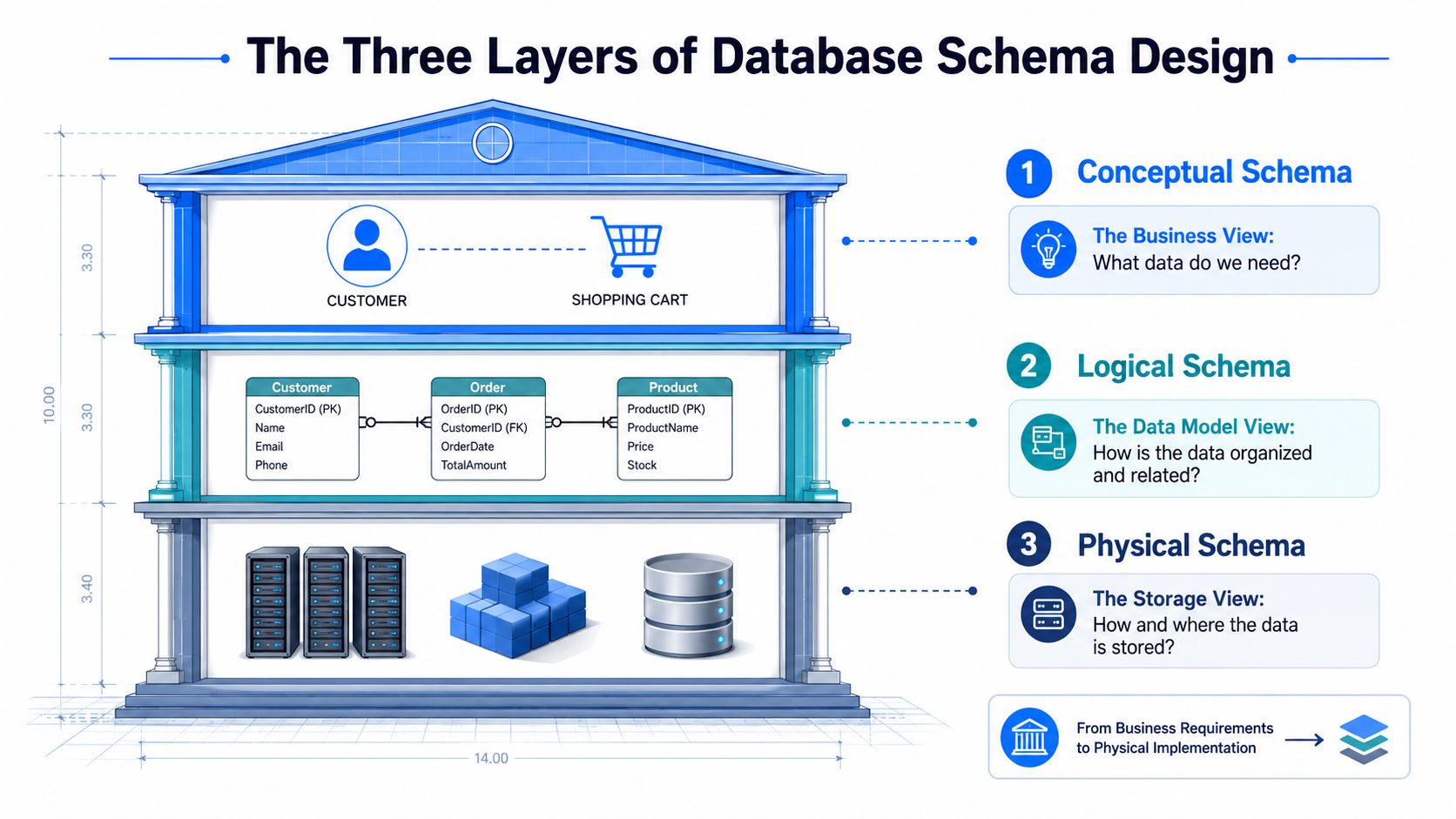
Think of database schema like a building plan. The architect's sketch says what rooms exist, the engineer's drawings say how the structure connects, and the construction plan says where the beams, wiring, and plumbing go. The same idea drives the classic split between conceptual, logical, and physical schemas, which AWS describes as different answers to different design problems (AWS).
Conceptual, logical, and physical each serve a different reader
The conceptual schema is the business view. It names the important entities, customers, orders, products, and the relationships that matter to the organization. Business stakeholders can read it without caring whether the system runs on PostgreSQL, Snowflake, or files in object storage.
The logical schema is the engineer-readable model. It defines entities, relationships, and integrity constraints, which is why teams use it to reason about keys, normalization, and consistency before they pick storage details. OLTP systems often lean on this layer through entity-relationship modeling, because transactional systems need clean rules more than they need analytical shortcuts (AWS).
The physical schema is where reality shows up. It includes storage format, file locations, partitions, and indexing strategy, which means it answers the practical question of how the database performs under load.
Why the split survives every redesign
Each layer maps to a different audience. Product teams need the conceptual view. Data modelers and analytics engineers need the logical view. Platform engineers need the physical view. The split survives because one schema can't serve all three well at once, and pretending it can usually creates brittle systems.
Database schema description and drift monitoring become easier when teams keep that separation clear, because a change in one layer doesn't have the same blast radius as a change in another.
For analytical workloads, the logical layer often shifts again. OLAP teams usually prefer star or snowflake schemas, because they make querying facts and dimensions practical at scale. That's the bridge into the warehouse patterns most teams run in production.
Warehouse and Lakehouse Schema Families
In analytics systems, the schema is less about a single table and more about how tables cooperate. A warehouse model usually chooses between a wide, easy-to-query shape and a more normalized one, and those choices have downstream costs in joins, ownership, and change management. IBM's schema taxonomy and the common warehouse patterns line up here, because operational design and analytical design are really the same question with different performance targets (IBM).
Star, snowflake, and galaxy answer different questions
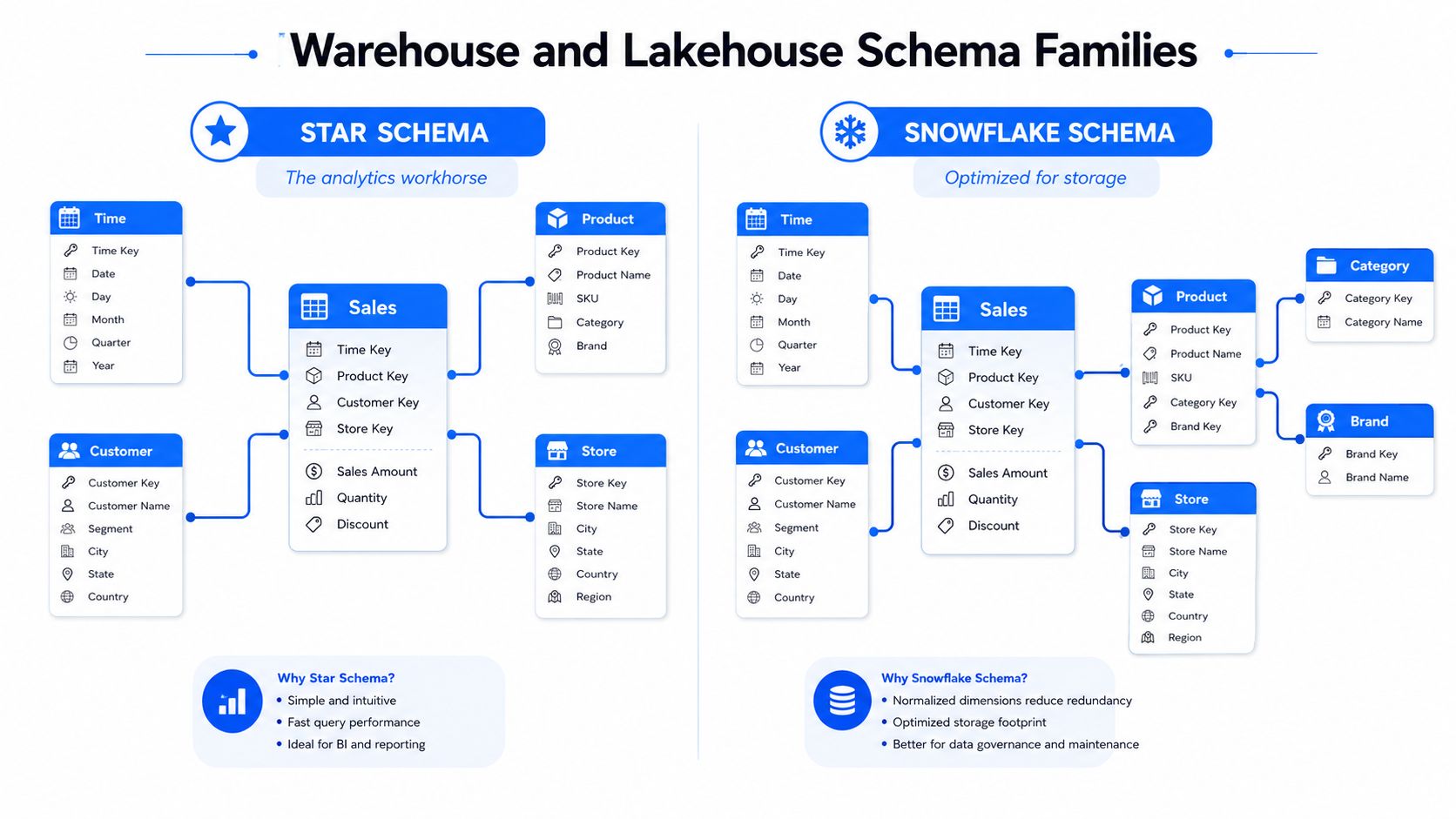
A star schema puts a central fact table in the middle and surrounds it with dimension tables. That shape is popular because it keeps analytics readable and fast to query. If a BI developer wants to slice sales by product, customer, and time, the star schema gives a clean path.
A snowflake schema normalizes the dimensions further. That adds joins, but it can reduce duplication and make some maintenance tasks cleaner. A galaxy schema goes further by allowing multiple fact tables to share dimensions, which helps when a platform needs more than one analytical process, such as sales, returns, and inventory, to live in the same semantic space.
Lakehouse teams usually mix patterns
Modern lakehouse teams rarely keep to one pattern forever. Bronze, silver, and gold layers often sit beside wide tables in columnar storage, and teams end up maintaining a hybrid logical model that balances reuse with performance. The right choice usually comes down to who owns the table and what kind of change causes the biggest blast radius.
Operational shortcut: if the table feeds dashboards, start with the query pattern. If the table feeds multiple teams, start with ownership. If the table feeds both, treat schema design as a governance problem, not just a modeling one.
The practical question is rarely “Which pattern is purest?” It's “Which pattern makes the next change survivable?” That's why warehouse schema families and lakehouse layering matter less as labels and more as operating decisions.
For teams that manage warehouse structures at scale, schema organization in data warehouse environments becomes a day-two problem, because the first model that works often isn't the one that survives the second quarter. Star schemas tend to be easier for analytics consumers, snowflake schemas can reduce duplication, and galaxy schemas help when multiple analytical subjects need shared dimensions.
Schema-on-Read vs Schema-on-Write
The core trade-off is simple. Schema-on-write checks data before it lands, while schema-on-read interprets data when someone queries it. One feels like moving into a house that's already built. The other feels like renting an apartment and deciding how to furnish it after you've arrived.
Schema-on-write gives stronger guarantees. Data gets validated at ingestion, reads are faster, and downstream consumers know what to expect. The price is flexibility, because change usually requires coordination across producers, storage, and consumers.
Schema-on-read gives the opposite profile. Raw and semi-structured data can land quickly, experimentation stays easy, and the model can evolve without forcing every upstream producer to freeze their output. The cost shows up later, because validation gets pushed downstream and bad structure can sit unnoticed until query time.
The hybrid is what mature teams actually run
Most production platforms end up with a split strategy. Critical paths get write-time contracts, especially when finance, compliance, or customer-facing dashboards are involved. Exploratory zones stay looser so analysts can inspect raw or partially shaped data without waiting on every upstream team to agree on a perfect model.
That's why teams should treat the choice as a policy decision, not a religion. A migration batch, a regulated metric, and a sandbox notebook don't deserve the same rigidity.
Schema-on-write protects the contract up front. Schema-on-read protects the speed of exploration. Mature teams place both where they belong.
Schemas as Contracts in Serialization Formats
Once data leaves a table and becomes a message, file, or API payload, the schema turns into a contract. That contract says not just what fields exist, but how the data can evolve without breaking the systems that depend on it. JSON Schema, XML Schema 1.1, Avro, and Protobuf each solve that problem in a different way, and Google's structured-data guidance also reinforces the idea that schema is a constrained vocabulary, not a free-form tag set (Google Article structured data, JSON Schema specification).
The main formats differ in how strict they are
Format | Schema Strength | Evolution Support | Typical Fit |
|---|---|---|---|
Avro | Strong, schema is carried with the data | Good for backward and forward compatibility when fields are added carefully | Streaming pipelines and event logs |
Parquet | Columnar file format with schema embedded in the file layout | Good for lakehouse storage, but changes need discipline across readers | Columnar lakes and analytics storage |
JSON Schema | Loose to moderate, used as a validation contract | Useful for validation and contract enforcement, especially for APIs | Web APIs and semi-structured payloads |
Protobuf | Strong, compact contract between services | Strong evolution rules when fields are managed carefully | Service-to-service communication |
XML Schema | Strong and explicit, common in legacy enterprise contexts | Mature validation model, still relevant in older integration stacks | Enterprise XML integrations |
Small changes matter because contracts outlive code
Avro makes the evolution story concrete. If you add a new nullable field and give it a default, older readers can still consume the record because they know how to handle the missing value. That is the point of a schema contract. You want change to be possible without turning every consumer into a rebuild project.
XML Schema still matters in legacy systems because those contracts are embedded in long-lived enterprise workflows. JSON Schema matters because many API teams need validation without forcing a rigid binary protocol. Protobuf matters when compactness and service contracts matter more than human readability.
The common thread is simple. A schema in a serialized format is not decoration, it's the rulebook that keeps producers and consumers speaking the same language.
How Schema Types Shape Validation and Observability
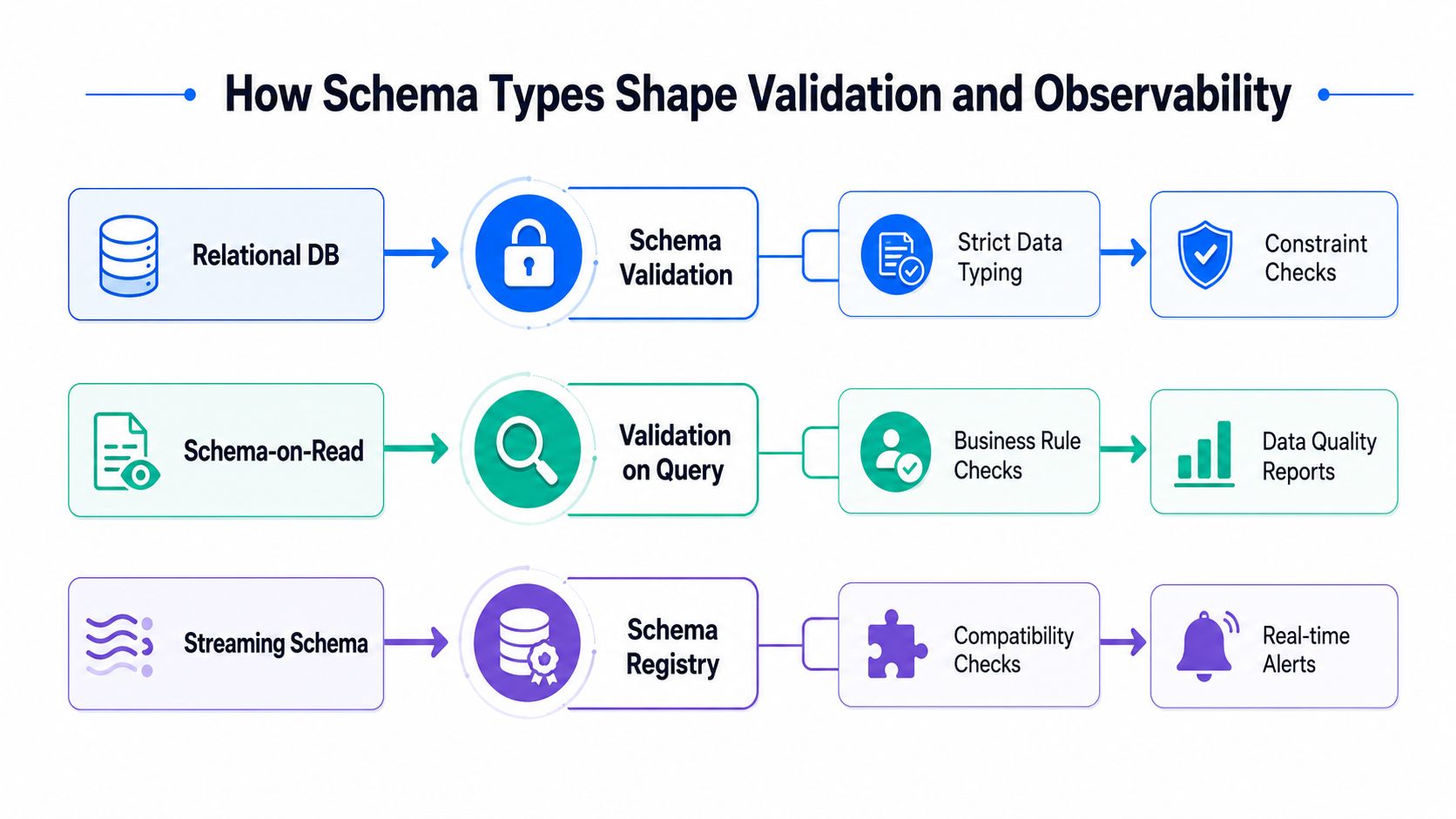
Validation and observability have to match the schema type. A relational warehouse needs business-rule checks that know about keys and constraints. A streamed payload needs contract tests. A lakehouse layer needs freshness and volume monitoring. Structured-data markup needs structural checks so search and AI systems can parse it correctly.
That's where the work becomes operational instead of theoretical. If the schema can change, the monitoring has to notice the change, interpret its impact, and tell a human whether the change was harmless or dangerous.
Different schema types need different checks
Relational DBs: validate constraints, data types, and business rules at write time.
Schema-on-read layers: check expectations when the query runs, then feed those results into quality reports.
Streaming schemas: compare payloads against a registry or contract so compatibility issues surface early.
For a practical walkthrough of rules, edge cases, and implementation patterns, best practices in data validation is a useful reference point because it frames validation as a system, not a one-off test.
Observability has four jobs
Anomaly detection watches behavior drift. Timeliness tracking watches whether data arrived when it should. Schema tracking watches for added, removed, or changed fields. Metric monitoring watches the health of the platform itself.
If a team runs multiple schema types in one environment, these functions can't live in separate point tools with separate alert queues. The warehouse, the event bus, and the API layer all need the same operational truth, even if they enforce it differently.
A unified view matters because a schema change often shows up in one place and fails somewhere else. The right observability layer links the structural change to the business impact instead of treating them as unrelated incidents.
A Schema Change That Silently Broke the Dashboard
The break rarely starts with drama. A developer renames a column, or tightens a type, or changes a field length because the upstream source “looked safe.” The pipeline still runs, the table still loads, and the dashboard still opens. Only one chart is wrong, and because the page isn't fully broken, nobody checks it until the reporting cycle exposes the gap.
That's the worst kind of failure, because it looks like a healthy system with one quiet lie in it. The cause is usually schema drift, and the blast radius comes from every consumer that assumed the contract hadn't changed. A good overview of that failure mode is the guide to schema mismatch, which focuses on how structural differences surface downstream.
The failure should have been visible in layers
The structural change should have triggered schema tracking first. A column rename or data type change is exactly the kind of event a tracker is meant to catch, and schema drift monitoring exists for that reason.
Then anomaly detection should have noticed the sudden drop in row counts. Timeliness monitoring should have flagged the delayed or missing load if the pipeline stalled during the change. Validation should have rejected records that no longer fit the contract, instead of letting them slide into a table that looked healthy but wasn't.
digna's modular platform fits this operational layer because it combines schema tracking, validation, timeliness, anomaly detection, and business metrics in one in-database setup. That matters when teams want the incident, the structural change, and the business impact in the same place rather than across disconnected tools.
Rule of thumb: the cost of a schema isn't paid when you design it. It's paid when you fail to see it change.
The lesson is simple. A schema is only as durable as the monitoring around it. If the platform can't detect the change, explain the change, and connect the change to user-facing impact, then the schema contract was never operational.
Choosing the Right Schema Strategy for 2026
The right choice is usually the one that makes the next change less dangerous. Start with the database schema layer your audience needs, then pick star, snowflake, or galaxy based on query shape and ownership. Use schema-on-write where correctness matters most, and schema-on-read where exploration needs room to move.
For serialized formats, treat every payload as a contract that evolves. For structured-data ecosystems, remember that schema.org's 823-type vocabulary sits closer to search and AI extraction than to warehouse design, which means metadata now has a direct visibility cost, not just a modeling cost (schema.org). And for production reliability, instrument critical schemas with validation, timeliness, anomaly detection, and schema tracking before the next silent change gets through.
A practical checklist for 2026
Match the layer to the reader: business users need conceptual clarity, engineers need operational detail.
Choose patterns by workload: analytics tables and multi-fact domains don't want the same shape.
Mix write-time and read-time enforcement deliberately: don't force one rule across every dataset.
Treat schema formats as contracts: evolution should be planned, not accidental.
Monitor the contract continuously: structural drift without observability is just delayed failure.
Revisit your schemas through an operational lens, not just a design lens. The teams that do that stop learning about breakage from a blank dashboard and start seeing it in time to fix it.
digna helps teams watch schemas the way production systems behave, with validation, timeliness, anomaly detection, and schema tracking in one modular platform that runs inside your environment. If you're reviewing warehouse models, lakehouse layers, or serialization contracts for 2026, visit digna and see how a schema change can be caught before it turns into a silent reporting failure.
Frequently asked questions
Why does schema type matter more than teams expect?
Because schema is an agreement, and the agreement looks different depending on the layer. Many teams first meet schema as a cleanup task and only later discover it was the contract that everything downstream was built against.
What is the first decision to make?
Which world you are in. Name the schema domain before debating the implementation, because most confusion comes from people using the same word for database design, serialization contracts and structured-data markup.
How does schema differ in a warehouse versus a payload?
By what it has to protect. Shaping a warehouse table means caring about joins, grains and analytical access; a serialization contract means caring about compatibility as producers and consumers version independently.
How big is the structured-data vocabulary?
schema.org now spans 823 types, 1,529 properties, 19 datatypes, 96 enumerations and 535 enumeration members. That scale is why web metadata deserves treating as its own schema domain rather than as a tagging afterthought.
What does schema choice do to data quality work?
It decides which checks are even expressible. A schema that does not declare a grain makes completeness ambiguous, and one that allows free-form payloads pushes validation from the structure into every consumer separately.