What Is ETL in Software Testing? Your 2026 Guide
|
8
min read

You're staring at a dashboard that should be boring, but the numbers don't line up. The ETL job finished, the scheduler shows green, and still a senior leader is asking why revenue, patient volume, or claims counts look off from what operations expected. That gap is exactly where ETL testing earns its keep, because the pipeline can “work” and still send bad data downstream.
In what is ETL in software testing, the point isn't to prove the job ran. It's to prove the data is trustworthy after it moves through Extract, Transform, Load. That matters because bad data is expensive, with Gartner's widely cited estimate putting the average organizational impact at $12.9 million per year and IBM's U.S. macro estimate for poor data quality at $3.1 trillion annually. Those costs are why teams test record counts, transformations, duplicates, missing values, and source-to-target reconciliation before analytics, BI dashboards, and AI models consume the data.
Table of Contents
When Good Pipelines Produce Bad Data
A finance leader opens the dashboard and sees a clean green status panel. Every pipeline says successful. The problem is that the numbers underneath don't match the ledger, and the mismatch is big enough to trigger a meeting no one wants. That's the painful reality of ETL testing failures, the system can execute correctly and still deliver the wrong truth.
The root cause is often not a broken job. It's a transformation rule that changed, a source system that introduced a subtle structure shift, or a batch that dropped rows on the floor. In practice, ETL means validating that data is extracted from source systems, transformed by business rules, and loaded into a target warehouse or database without loss or corruption, which is why the test focus has to stay on the data itself, not just the code path. The ETL testing overview from Datagaps ties that definition directly to the business cost of bad data.
That's why a “successful” pipeline can still be a failed business process. Analytics, BI, and AI don't care whether the orchestration layer turned green, they care whether the output is correct. In regulated environments like finance, healthcare, and the public sector, that distinction isn't academic, it's the difference between a defensible report and a trust problem that spreads across teams.
Practical rule: if the dashboard is wrong, the first question isn't “did the job run?” It's “did the data survive every stage correctly?”
The historical shift here matters. ETL became the standard warehousing pattern as analytics scaled, but by 2026, industry guidance treats ETL testing as part of broader data quality assurance across warehouses, lakes, and pipelines. That broader view reflects how modern organizations use data, as a shared asset that must stay correct after every movement, not a file transfer that can be checked once and forgotten.
Understanding the Three Stages of ETL
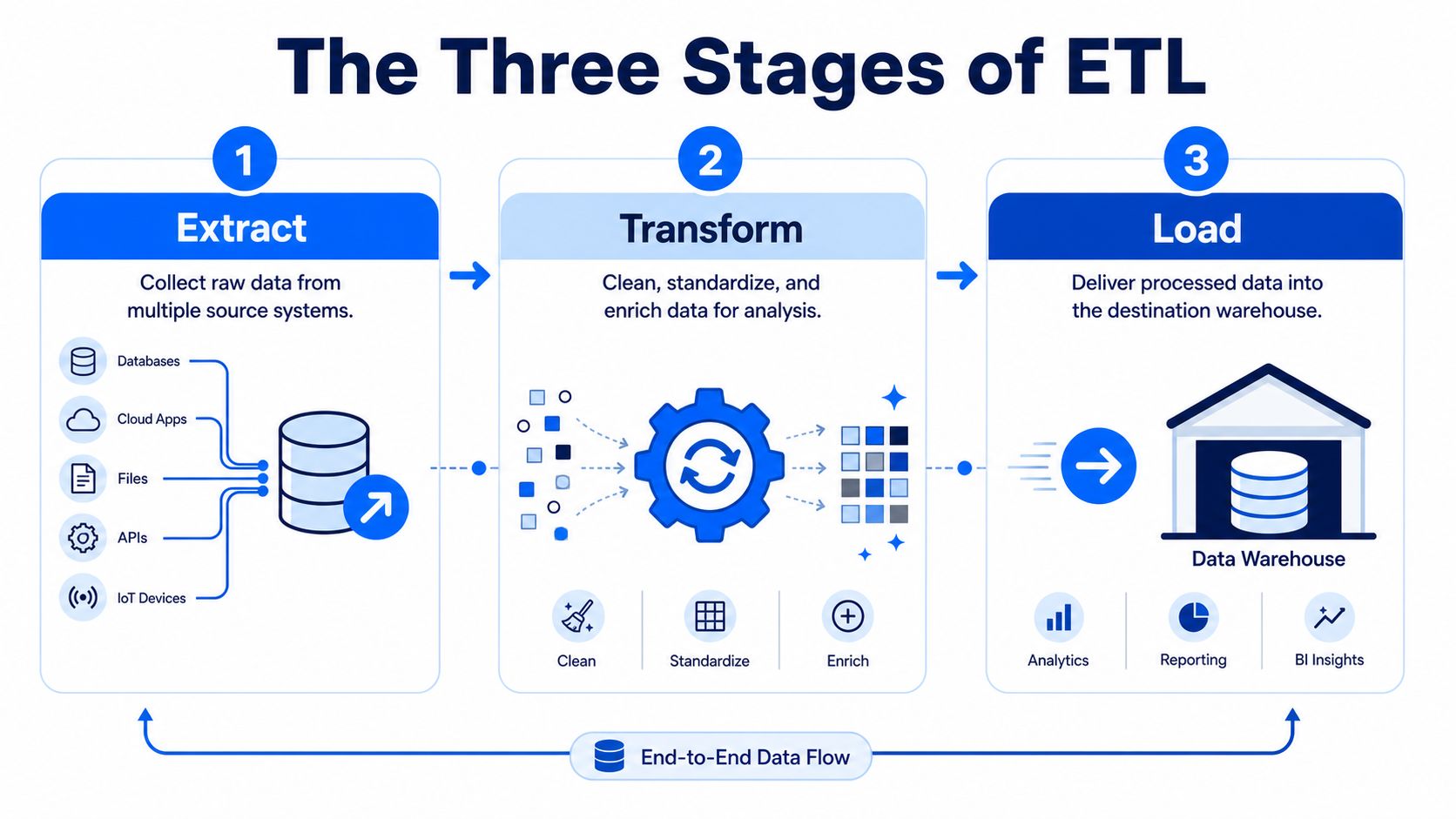
A useful way to think about ETL is a mail sorting facility. Mail arrives from many senders, gets sorted and labeled, then moves into the right destination bins. If a letter is misread or dropped during sorting, the facility may still “process” mail, but the recipient gets the wrong envelope, and that's exactly how data pipelines fail in real life.
The Extract stage pulls data from source systems such as databases, APIs, files, or event streams. The job here is simple in theory, collect the right records completely and without corruption, but it's where missing rows, partial pulls, and source connectivity issues can start. The Transform stage is where business rules, cleansing, standardization, enrichment, and calculations happen. The Load stage writes the finished data into the warehouse, lakehouse, or database where reporting and downstream apps rely on it.
Testing lines up with those stages for a reason. You're not validating one monolithic process, you're checking three different failure surfaces. A source system can be correct while the mapping is wrong. A transformation can be correct while the load rejects rows. A load can succeed while the final counts still don't match what was extracted.
For readers comparing team structures, the role descriptions in data science ETL developer roles are useful because they show how ETL ownership often sits between engineering, analytics, and data platform work. That's where test responsibilities get real, one person may build the pipeline while another proves the data came through intact.
A clean mental model helps here, but the testing mindset matters more. Extract verifies source access and completeness, Transform verifies business meaning, and Load verifies that the destination faithfully stores the result. If your team also owns ingestion, the internal reference on digna's data ingestion pipeline is a practical place to connect the movement of data with the checks that keep it reliable.
Why ETL Testing Is Critical for Data Trust

The most dangerous data incident is the one nobody notices at first. A dashboard drifts, a forecast gets built on stale values, or a compliance report goes out with a structural mismatch, and the pipeline logs still look fine. That's why modern ETL validation has to catch silent failures, not just obvious crashes.
Silent failures are the real problem
Analysis cited by AccelQ across 11 million+ active production tables shows that execution faults account for only 26.2% of incidents, while 73.8% are structural or data-behavior problems such as schema drift (27.6%) and operational deviations in source data (25.1%) that don't stop the job but still corrupt downstream analytics. That breakdown from AccelQ explains why simple pass/fail checks are so limited.
This is the core mindset shift. Old-school validation asked whether the batch completed. Modern validation asks whether the data still means what the business thinks it means. That includes schema changes, source changes, late or missing records, and transformation drift that never triggers an exception.
Trust is the actual deliverable
ETL testing is really about proving that downstream consumers can trust the output. If finance sees one number, operations sees another, and the warehouse contains a third version, the pipeline may still be “healthy” from a scheduler perspective, but the organization has already lost confidence. That's why ETL testing is so important in finance, healthcare, telecom, and government, where auditability and consistency matter as much as uptime.
Practical rule: if a test only confirms the job ran, it's a smoke alarm, not a data quality strategy.
The reason this keeps showing up in real systems is simple, source behavior changes faster than many validation scripts do. A schema drift event can alter column names or data types without causing a job failure. A source feed can arrive with unexpected values or missing partitions and still get loaded. ETL testing protects the business by catching those changes before BI teams, analysts, and machine learning models turn them into decisions.
A Deep Dive into Core ETL Test Types
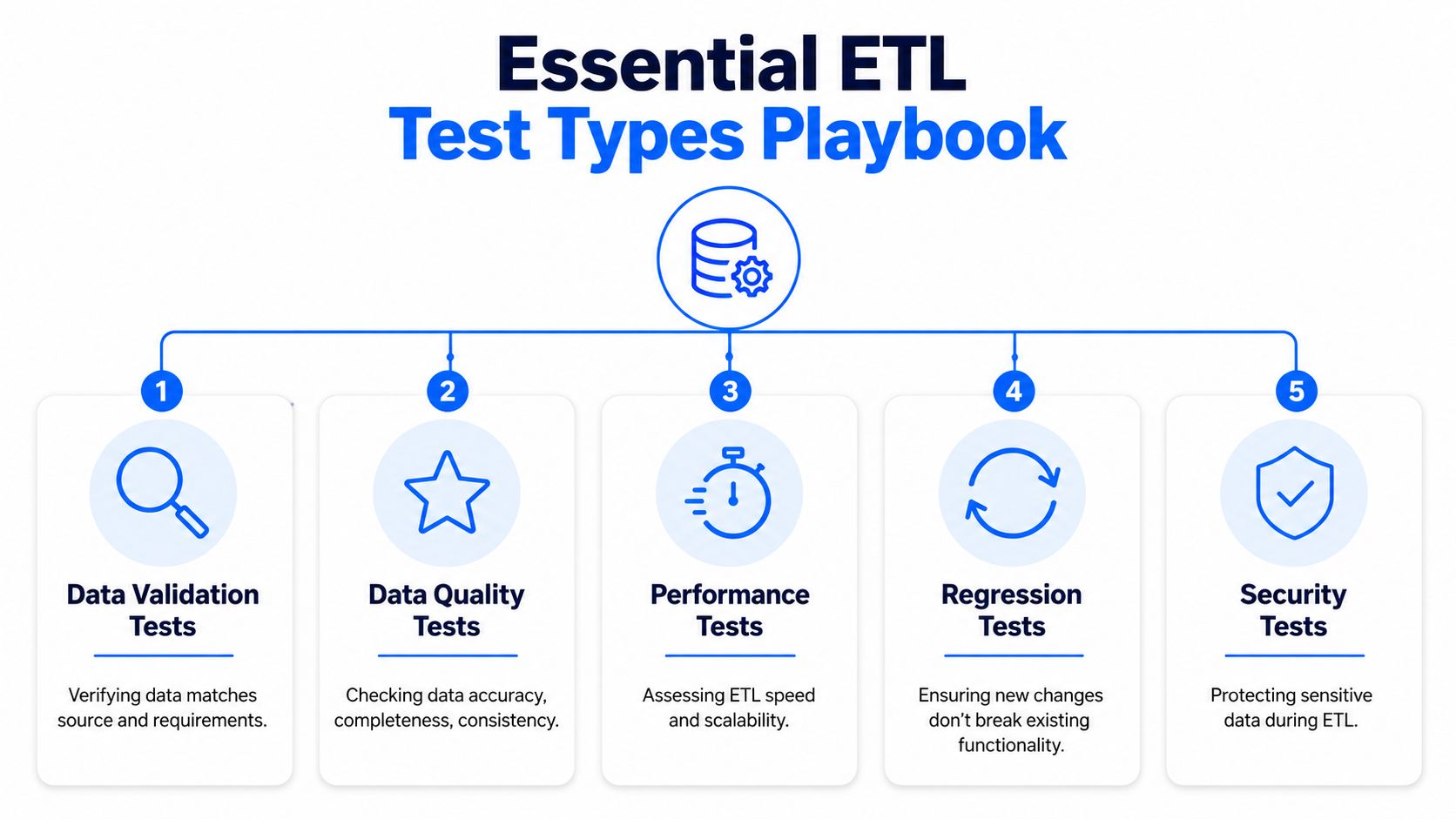
The fastest way to make ETL testing useful is to treat it like a playbook, not a checklist. Each test type answers a different risk, and each one catches failures that the others miss. If you only reconcile row counts, you'll miss a bad transformation. If you only validate business logic, you may miss duplicate loads or rejected rows.
Data Reconciliation
Reconciliation answers the question, “Did the intended data arrive?” The practical starting point is record-count reconciliation, where source and target counts are compared after extraction and load to confirm all intended rows moved. Matillion's ETL testing basics describe that as a core mechanic, and it's the first line of defense against accidental loss.
A simple SQL pattern looks like this in concept, source count, target count, rejected count, and a comparison on key fields where needed. If the counts diverge, the next step is to inspect rejects, duplicates, or filter logic rather than assuming the source was wrong. The business risk is obvious, unaccounted loss can distort revenue, inventory, patient, or claims reporting without any visible crash.
Business Logic Validation
This test checks whether the transformation did what the business asked for. If tax, status mapping, currency conversion, or name standardization is part of the pipeline, the test should prove the rule was applied consistently. A practical SQL assertion compares source values to transformed output for a known sample or checks that calculated fields follow the mapping document.
Schema Validation
Schema validation catches structure changes before they break downstream consumers. That means checking data types, lengths, nullable fields, and column presence against the contract or mapping file. It matters because a job can still succeed after a schema change, yet shift data into the wrong shape, without raising a flag.
Timeliness and Latency Checks
Data can be correct and still be useless if it arrives late. Timeliness checks compare expected delivery windows with actual arrivals so teams can spot stale loads before dashboards and alerts go blind. This is especially important in near-real-time systems where the data's value depends on freshness, not just correctness.
Performance and Regression Testing
Performance testing makes sure the pipeline can handle real volume without causing backlog or timeout issues. Regression testing then verifies that a new source, rule, or optimization didn't break something that used to work. In mature teams, these tests are part of every release because pipeline changes are normal, not exceptional.
Practical rule: if a transformation changes, retest the rows it touches, the rows it filters, and the rows it can accidentally duplicate.
For teams maintaining integrity across tables, the internal guide on database integrity testing is a useful companion because ETL output often becomes the input for relational constraints, not just dashboards.
From Manual Scripts to Automated Observability

Manual SQL scripts still have a place, but they age quickly when schemas change, sources multiply, and release cycles speed up. A script that hard-codes one mapping may catch a known defect, then miss the next one because nobody updated the check in time. Automation inside CI/CD has become the baseline, but it still only covers the cases you already expected.
The industry is shifting from batch ETL testing toward continuous pipeline observability. Recent guidance from Informatica on ETL testing points to wider use of monitoring for timeliness, schema drift, and anomaly detection across production data. That reflects a move away from purely manual, post-load validation toward proactive assurance. In practice, teams need to know when data starts behaving strangely, not only when a test script already knows what to look for.
Testing and observability solve different problems. Testing is strongest when the team knows the rule, such as a field that should never be null or a mapping that should convert A to B. Continuous pipeline observability catches the cases that do not show up in a checklist, such as a source changing shape, a batch arriving late, or a distribution shifting without a release note. Data observability helps close that gap because it watches production behavior continuously, not just during a scheduled validation run.
One platform in this space is digna, which monitors data behavior, validates records, tracks timeliness, detects schema changes, and surfaces business and platform metrics inside the customer's own environment. That matters for teams that need in-database checks and tighter governance, especially when data cannot move outside controlled infrastructure.
The trade-off is practical. Manual scripts are transparent, but brittle. Automation scales better, but it still depends on clear expected rules. Observability reduces blind spots by watching production behavior continuously, which is what modern data teams need when a pipeline can be “successful” and still be wrong.
Building Your ETL Testing and Observability Strategy
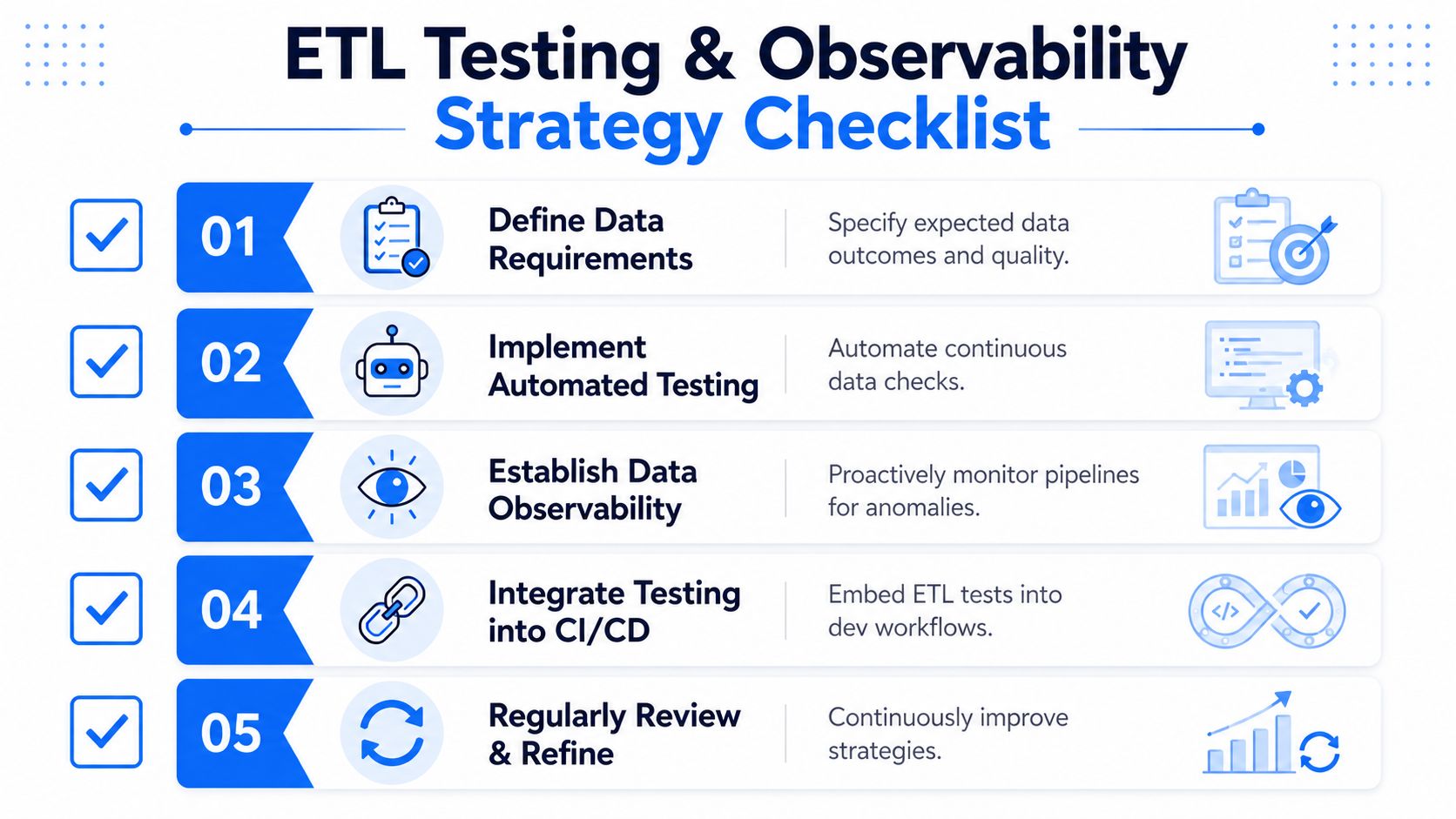
A good strategy starts small and gets stricter where the data matters most. Teams don't need to test everything equally on day one, but they do need a repeatable way to prove that critical pipelines are reliable. The right approach is layered, beginning with reconciliation and validation, then adding automation, then adding observability for the blind spots.
Define data requirements. Start with the business meaning of the data, expected counts, allowed nulls, transformation rules, and freshness targets. If the team can't describe the correct output, no test will be stable for long.
Automate the basic checks. Record counts, source-to-target comparisons, duplicate detection, and transformation assertions belong in repeatable jobs. These are the tests that catch regressions early and stop obvious damage from reaching reporting layers.
Integrate tests into CI/CD. Every pipeline change should trigger validation before promotion. That keeps ETL quality tied to delivery, not to a separate manual review that gets skipped when deadlines tighten.
Add observability for production behavior. Monitor timeliness, schema changes, and anomalies so the team can detect issues that no one wrote a specific test for. That's the difference between reacting to a complaint and catching the problem before users notice.
Review and refine. Test coverage should evolve with source systems, business rules, and data consumers. If a validation rule keeps failing for harmless reasons, it's a sign the rule or the pipeline changed, and either way the test suite needs maintenance.
Metrics should match that strategy. Track data uptime, time-to-detection, and resolution speed for critical assets. Then choose tools based on how your team works, a framework for SQL-driven validation, a CI-native testing layer, or a platform that combines testing with observability and auditability.
For teams that want a single place to watch schema drift, timeliness, anomalies, and validation behavior in controlled environments, digna offers a practical option to evaluate alongside your existing ETL checks. If your dashboards need to stay trustworthy as pipelines change, start with the tests that protect the most important data and extend from there.
Frequently asked questions
What is the point of ETL testing?
Not to prove the job ran. The point is to establish that the data survived every stage correctly, which is a different claim from the one a scheduler makes when it reports success.
What is the first question when a dashboard is wrong?
Not "did the job run?" but "did the data survive every stage correctly?" A finance leader can open a dashboard, see a clean green status panel, and still be looking at numbers that no longer reconcile.
Why can a successful pipeline be a failed business process?
Because the root cause is often not a broken job. Each stage can complete while altering the data in a way no stage checks, so the process ends with a green status and an output nobody can defend.
What does the failure cost?
Gartner's widely cited estimate puts the average organizational impact at $12.9 million per year, and IBM's U.S. work points the same direction. Those figures are why ETL testing is treated as a control rather than a QA formality.
Which test types matter most?
The ones tied to survival across stages: record counts and reconciliation between source and target, transformation logic against expected results, and validity and referential checks on the loaded output rather than only on the extract.