Data Ingestion Pipeline Guide from Sources to Scale
|
7
min read
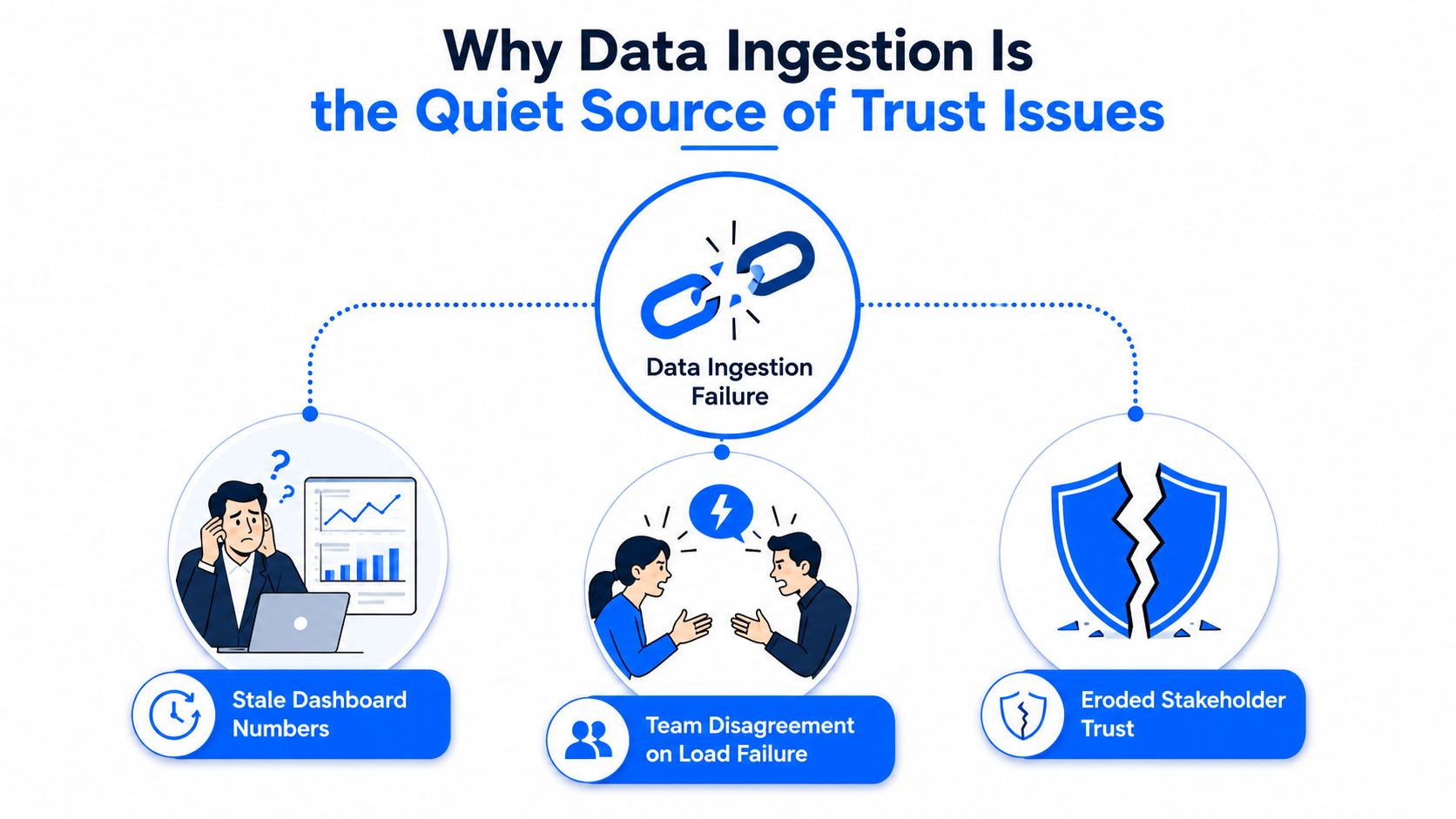
Your executive dashboard opens on Monday morning, and the numbers are last Thursday's. Finance says the warehouse load must've failed, analytics says the source team changed something, and engineering is staring at three different logs that don't line up. That's usually the moment people realize the problem isn't just “bad data.” It's the data ingestion pipeline, the layer that decides whether the business is looking at current, trustworthy information or a polished lie.
In mature environments, ingestion isn't a transport task. It's a contract-driven control plane between source systems and every downstream decision that depends on them. That matters because modern data volume forced ingestion to evolve from simple batch loaders into scalable pipelines that handle far more sources, tighter freshness expectations, and continuous validation, a shift that became unavoidable as the global datasphere moved toward 175 zettabytes by 2025 from 33 zettabytes in 2018 (historical context on data ingestion pipeline evolution).
Table of Contents
Why Data Ingestion Is the Quiet Source of Trust Issues
The dashboard looks fine at a glance. The charts render, the filters work, and the meeting starts on time. Then someone asks why the revenue view still shows Thursday when today is Monday, and the room splits into competing theories about which load failed, which transformation broke, and whether the source even sent the data.
That kind of confusion is why ingestion deserves more attention than it usually gets. The ingestion layer is where the business contract gets enforced, because it is the first place data is received, checked, and either allowed forward or blocked. IBM's pipeline framing is useful here, because it treats ingestion as the front end of a broader flow that ingests raw data, transforms it, and moves it into a store for analysis (IBM on data pipelines).
The trust problem starts before analytics
If a source file lands late, the dashboard does not just look stale. People make decisions on it anyway. A missed file, a delayed event stream, or a malformed payload can all create the same outcome, a report that is technically present but operationally misleading.
That is why pipeline health is commonly judged by throughput, latency, error rate, and freshness, because those signals tell you whether the data arrived, arrived on time, arrived correctly, and arrived soon enough to matter (pipeline monitoring guidance).
Practical rule: if your ingestion layer cannot tell you what arrived, when it arrived, and whether it matched the expected structure, your downstream analytics are already guessing.
The shift from “plumbing” to “product” changes the questions teams ask. Instead of asking whether the file landed, teams ask whether the records matched the contract, whether the delay was captured accurately, and whether malformed data was stopped before it polluted dashboards. That mindset keeps regulated teams from fighting the same incident every week, and it also prevents unit-cost growth when retries, reprocessing, and manual cleanup become the hidden price of weak ingestion controls.
Defining a Data Ingestion Pipeline in Plain Terms
A simple way to think about ingestion is a sorting facility. Packages come in from many trucks, someone inspects the labels, the facility routes each parcel to the right destination, and only then do other systems use the contents. That's also how a data ingestion pipeline works. It receives raw data, validates it, and routes it to a warehouse, lake, database, or another downstream system.
What counts as a source and what counts as a destination
Sources are the systems that emit data. In practice, that includes databases, APIs, event streams, files, and IoT devices. Destinations are the places the data is made available for use, such as a data warehouse, data lake, lakehouse, search index, or feature store. The point is not to memorize labels, it's to understand where the data starts and where ingestion hands it off.
That handoff is the main boundary. An ingestion layer owns the front door, it does not own every transformation or report. The broader pipeline can include cleaning, modeling, enrichment, and serving, but ingestion is the part that collects, lands, and validates before the rest of the stack takes over (data ingestion overview).
The front door has rules
Modern guidance also treats ingestion as more than raw transfer. It often includes automated validation, transformation, and loading into a central target such as a warehouse, lake, or streaming platform. That's why schema checks and error handling matter so much at the front door, not after the data has already contaminated downstream tables (historical pipeline framing).
Ingestion ends when trustworthy data is landed and checked, not when bytes finish copying.
A good mental model is this. If a tool only moves files, it's a transfer mechanism. If it can receive, inspect, route, and prove the data met expectations, it belongs in the ingestion layer.
Batch, Micro-Batch, and Streaming Compared
The cleanest way to choose an ingestion cadence is to start with the business question, not the technology. If the business can tolerate waiting until morning, batch is often enough. If a team needs updates during the day but not second-by-second, micro-batch usually fits better. If a decision changes immediately when the event happens, streaming enters the picture.
For large-scale batch ingestion, Microsoft guidance recommends landing data in ADLS or Blob as Parquet where possible and batching payloads into roughly 100 MB to 1 GB uncompressed chunks, while also distinguishing queued ingestion for throughput from streaming ingestion for low-latency use cases (Microsoft guidance on ETL ingestion). That's a useful reminder that cadence isn't just about speed, it's about operational fit.
Ingestion cadence trade-offs
Dimension | Batch | Micro-Batch | Streaming |
|---|---|---|---|
Freshness | Coarser, often scheduled | Near real-time in short intervals | Lowest latency, event-driven |
Throughput | Efficient for large loads | Good compromise | Can be efficient, but operationally sensitive |
Cost | Usually simplest to run | Moderate complexity | Usually the hardest to keep predictable |
Complexity | Lowest | Medium | Highest |
Operational risk | Easier to reason about | Needs careful scheduling and retries | Needs idempotency, backpressure handling, and tight monitoring |
Cadence should follow the SLA
A freshness SLA doesn't need to be fancy. It can be expressed in plain business terms, like “the finance dashboard must reflect yesterday's close by 8 a.m.” Once that expectation is clear, the cadence follows from it. If you can meet the SLA with batch, don't make the system real-time just because it sounds modern.
That's especially true in enterprises where batch and real-time systems coexist. Current guidance still says many pipelines should remain batch or micro-batch unless latency directly affects a decision, which is a more realistic rule than “stream everything” for many organizations (modern ingestion trade-offs).
Core Components of an Ingestion Architecture
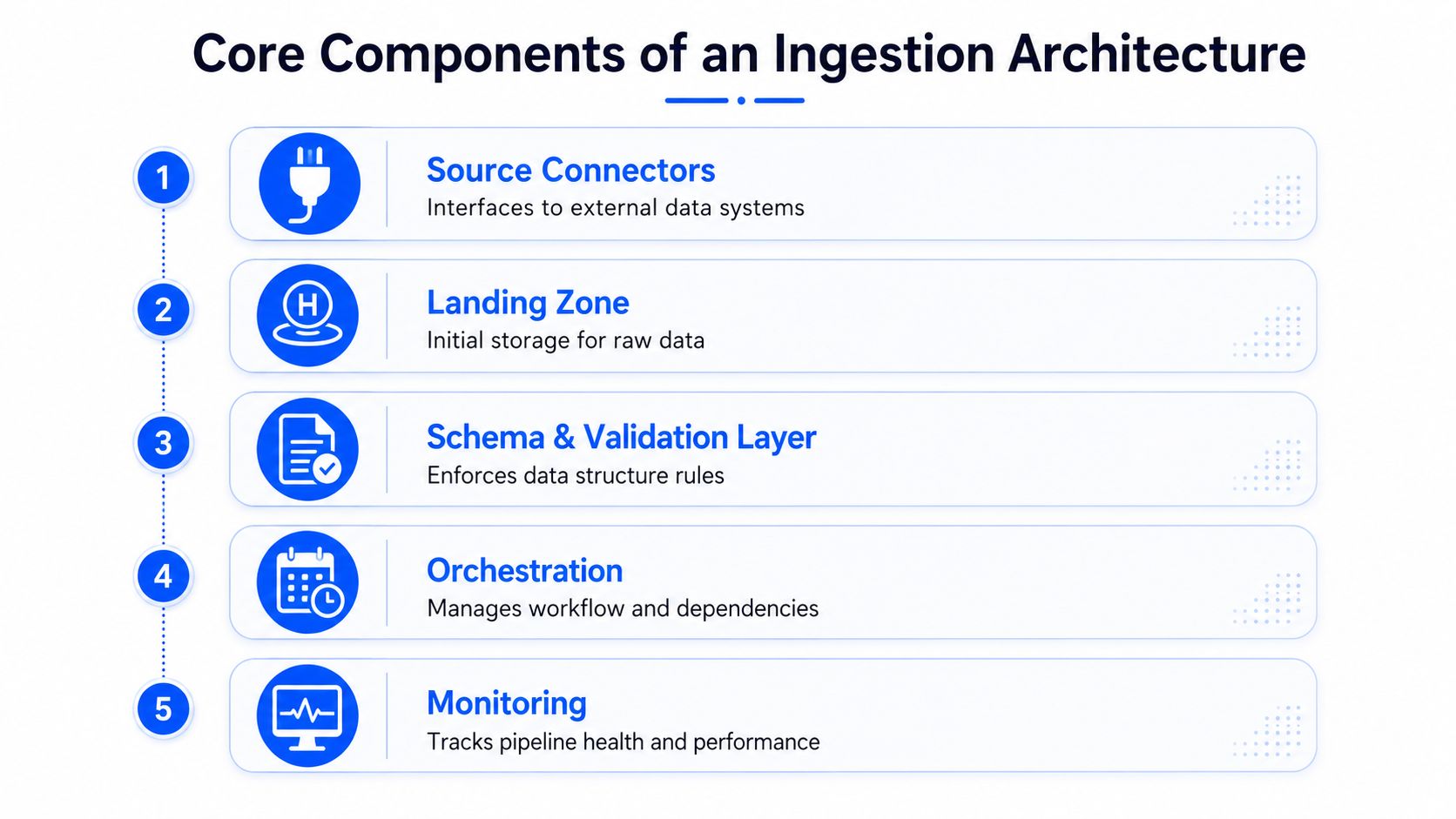
A production ingestion stack has a few parts that each carry a specific risk. When one is weak, the failure mode is usually obvious to the people who get paged and invisible to everyone else until the dashboard goes stale. The five pieces worth naming are source connectors, landing zone, schema and validation layer, orchestration, and monitoring.
Where each layer fails when it's weak
A brittle source connector breaks when an API changes or a database credential expires. A weak landing zone creates cost and recovery headaches because raw data isn't stored in a format that can be replayed cleanly. A missing schema and validation layer lets bad structures through and forces downstream teams to discover the problem after the fact.
Orchestration is the part that keeps dependencies honest. Without it, one source can arrive before another, and downstream jobs start with partial inputs. Monitoring closes the loop by showing whether the pipeline is healthy, how fast records moved, and whether the load stayed within the expected freshness window.
What to recognize in a real stack
You'll see these responsibilities spread across tools rather than bundled into one perfect product. A connector might be built with Kafka Connect or Debezium, the landing zone might be object storage or a warehouse staging area, validation might live in SQL, Spark, or a data quality platform, and orchestration might sit in Airflow, Dagster, or a cloud scheduler. The names vary, but the control questions don't.
For teams comparing software, the practical filter is whether the tool helps enforce source expectations before data lands broadly. One option in that category is digna's data ingestion software, which focuses on validation and observability around incoming data rather than just moving records downstream.
If a component can't answer “what changed, where did it land, and who needs to know,” it's not ready to own production ingestion.
Design Principles That Decide Whether the Pipeline Holds Up
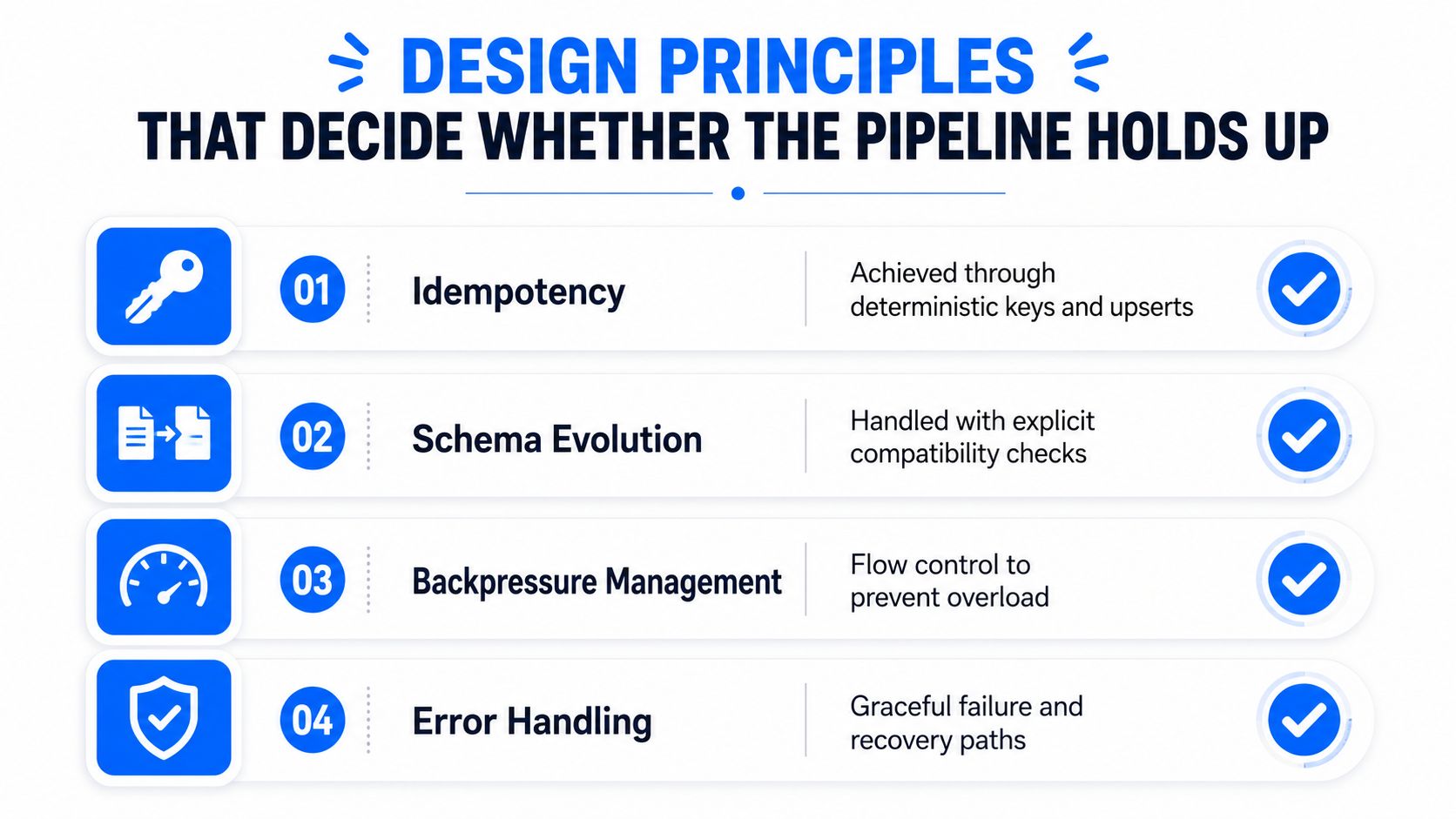
The first mistake teams make is treating robustness as a checklist after the pipeline exists. The stronger pattern is to build the rules into the flow from the start. That means designing for idempotency, explicit schema evolution, backpressure, and failure handling that assumes partial success is normal.
Build for retries without double counting
Idempotency is not a luxury. If a job retries after a network blip, you don't want duplicate records turning into double counts. Deterministic keys and upserts are how ingestion stays safe when retries happen, which they will.
Schema evolution deserves the same discipline. A team adding a nullable column is one thing, a team removing a field that downstream code expects is another. If compatibility rules aren't explicit at ingestion time, the broken shape shows up later as a mysterious dashboard issue or a model input failure.
Treat time as a feature, not metadata
High-performance ingestion should capture both event time and ingestion time, and store timestamps in UTC so comparisons stay meaningful across regions and systems (design guidance). That's how teams separate “the event happened late” from “the pipeline was slow.” It also makes late-arrival behavior measurable instead of anecdotal.
Backpressure belongs in the same conversation. If upstream producers can outrun the landing layer, the system needs flow control instead of silent overload. A pipeline that absorbs too much without signaling strain is usually the one that fails in the least helpful way.
Contracts belong at the boundary
Data contracts work best when they live at ingestion, not after the warehouse is already polluted. Define the expected schema, validation rules, and change-handling path before data is accepted. That's the governance move that keeps the front door from becoming a revolving door for incompatible records.
Operational rule: if a schema change would surprise a downstream consumer, it must be caught before the load is considered complete.
Observability and Data Validation in Practice
A pipeline can move data on time and still fail the business. That is the part teams learn after the first few incidents. Observability needs to show whether the flow is healthy, whether the contract still holds, and whether the numbers feeding dashboards and models can be trusted. Throughput tells you how much moved. Latency tells you how long it took. Error rate shows where the flow broke. Freshness shows whether the data still matters when people open it. Those signals belong on the ingestion dashboard because they connect operations to what analysts and operators feel.
Validate at more than one layer
Schema checks at the entry point catch the obvious breaks, like missing columns or changed data types. Record-level rules catch business logic problems, such as impossible dates or invalid state transitions. Trend checks catch behavioral drift, where the shape of the data still looks valid but the values are moving away from normal.
Threshold alerts only cover the loud failures. They miss the slow drift that keeps a pipeline appearing healthy until an analyst questions the report. Learned baselines and anomaly detection are better at catching those quieter shifts early, before they turn into a dashboard fire drill or a bad downstream decision.
Put validation where the data already lives
Teams often want validation outside the pipeline, but that adds lag and more data movement. In-database execution is cleaner when the platform supports it, because the checks run close to the data and the results stay in the customer environment. That same control-plane idea is what makes it easier to monitor timeliness, schema change, and anomalies without copying data into a separate system first.
A practical companion reference is TruTec's guide on ensure accurate paving estimates, which is useful because it treats validation as a method choice instead of a vague quality slogan. The same thinking applies to ingestion. Choose checks that match the failure you are trying to stop, whether that failure is a late batch, a drifting field type, or a record that should never have passed the boundary.
For teams building a dedicated monitoring layer, digna's data observability fits the same control-plane model, with checks for timeliness, anomalies, and schema change inside the customer environment. That matters when regulated data has to stay inside controlled boundaries and when the team needs a record of what changed, not just a red alert.
Thresholds tell you something is broken. Baselines tell you something is drifting before it breaks.
Reference Architectures for Enterprise Warehouses and Lakes
Warehouse-centric and lake-centric pipelines solve the same problem with different trade-offs. The warehouse pattern is cleaner when the organization wants tight governance around modeled data. The lake pattern is better when multiple processing styles need to coexist and raw data must be preserved for flexible reprocessing.

Warehouse-centric ingestion
In a warehouse-centric design, data usually flows from sources into connectors, then into a landing zone, then through dbt-style transformations, and finally into curated marts. This pattern works well when the business wants a defined modeling layer and strong consistency before broader consumption.
Governance hooks sit at the source contract, in the landing area, and in the transformation layer. Lineage needs to follow each model so analysts can trace what changed and why. Security should be present at every handoff, with encryption in transit and at rest, private networking, and access controls that match the sensitivity of the data.
Lake-centric ingestion
A lake-centric design keeps more of the raw shape visible. Data moves from sources into connectors, then into a raw zone, a processed zone, and a curated zone. That makes it easier to support both batch and streaming inputs without forcing everything into one modeling style.
The governance posture has to be stricter at the edge because more raw data is preserved. Schema tracking needs to happen near the lake boundary, lineage has to span the zones, and access control needs to be applied at each layer so raw data doesn't become an uncontrolled sprawl. This is the pattern that often fits finance, healthcare, telecom, and public-sector environments when residency and control matter as much as flexibility.
The architectural choice is less about elegance and more about what the organization needs to prove. If auditors want a crisp story about who changed what, the warehouse-centric model is easier to reason about. If engineers need to replay raw events or support multiple processing styles, the lake-centric model usually absorbs that complexity better.
Putting It All Together and What Maturity Looks Like
A pipeline gets easier to trust when the order is right. Pick the cadence from the SLA. Define contracts before connectors. Treat timestamps as a feature. Observe before you alert. That sequence cuts rework because each choice narrows the space for surprises later.
Data ingestion pipelines typically progress through three maturity levels. First, pipelines that run, which means data arrives but failures are handled manually. Next, pipelines that are observed, where teams can see freshness, latency, error rate, and drift before users complain. Finally, pipelines that are governed, where contracts, validation, and change management are part of the operating model rather than emergency fixes.
That last step is where ingestion stops being invisible infrastructure and starts earning its budget. It doesn't ship a flashy feature, but it prevents the kinds of incidents that undermine trust, consume engineering time, and create quiet cost growth across sources and loads.
If you're mapping your own stack, start with schema tracking, anomaly detection, timeliness monitoring, and cost governance, then make each one answer a concrete operational question. The best ingestion practice is the one that keeps bad data out, keeps costs legible, and keeps the business from arguing about which load failed.
If you're ready to make ingestion less fragile, digna helps teams validate records, monitor timeliness, track schema changes, and detect anomalies inside private cloud or on-prem environments. Visit digna to see how a contract-driven observability layer fits into your pipeline, and use it to cut the gap between a source change and a business-facing incident.