Schemas in Data Warehouse: A Complete 2026 Guide
|
7
min read

You know the feeling. A dashboard looks fine in the morning, then an executive review starts, and one chart is suddenly blank because someone renamed a column upstream. The warehouse didn't “fail” in the abstract, a downstream contract broke, and nobody caught the impact early enough.
That's the primary reason schemas in data warehouse systems matter. They aren't just table layouts, they're the structure that tells every consumer how to read the business safely, whether that consumer is a BI tool, a semantic layer, or an ML pipeline. Oracle's broader definition of a schema as a collection of database objects, including tables, views, indexes, and synonyms, helps separate the general database concept from the dimensional warehouse pattern that analysts query (Oracle schema definition).
Table of Contents
What a Schema in a Data Warehouse Really Means
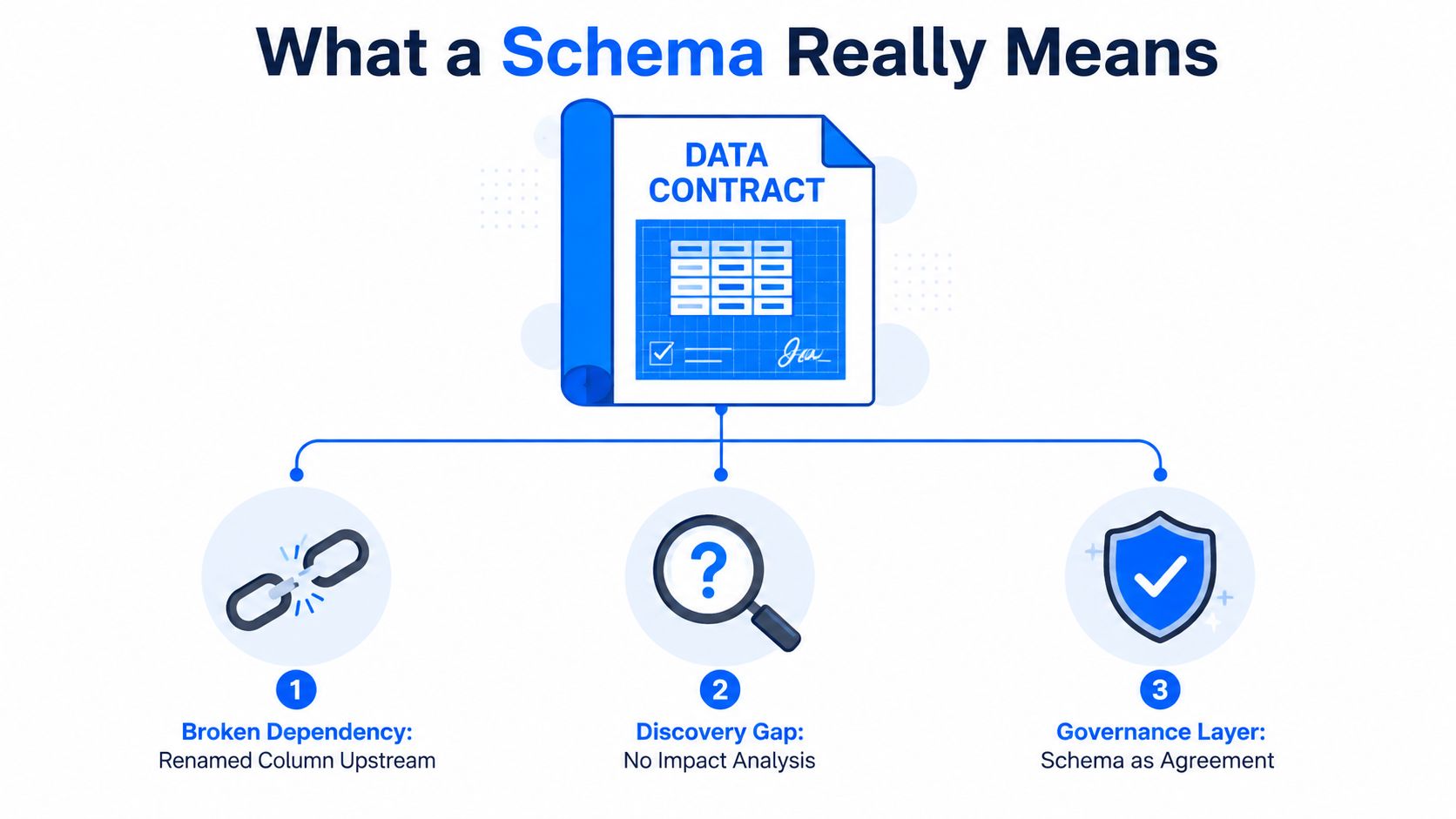
A warehouse schema is the way you encode meaning, not just the way you place tables. In practice, it is the logical arrangement of tables, keys, relationships, and constraints that lets a warehouse answer business questions consistently, even when the raw source systems are messy. That is why dimensional warehouse schemas exist at all, they turn operational data into a semantic model that supports analytical reading and keeps the business meaning attached to each row.
Table layout is not the whole story
A transactional system schema and a warehouse schema solve different problems. The source system cares about fast writes, tight integrity, and day-to-day updates. The warehouse cares about historical reads, repeatable joins, and stable reporting across many dimensions. A warehouse schema behaves like an interface contract, because analysts and BI tools depend on the meaning of each table and key staying stable enough to query with confidence.
That distinction matters when a column gets renamed or a key changes. If the warehouse treats the schema like a contract, teams can assess impact before they ship a change. If they treat it like a loose table layout, downstream BI breaks first and governance notices later. The same idea applies to ML features and reverse ETL feeds, because any consumer that reads from the warehouse depends on the structure staying recognizable from one version to the next.
Practical rule: a warehouse schema should tell consumers what a row means before they ever write SQL.
Why the broader database definition still matters
Oracle's definition is useful because it reminds teams that a schema is an owned collection of database objects, not just a diagram. In a warehouse, that broader object set may include views, constraints, indexes, and synonyms alongside dimensional tables, which means schema thinking has to include access patterns and governance, not just modeling style (Oracle schema definition).
That broader view is also what makes schema tracking useful. If a table, view, or key changes shape without being recorded, downstream consumers can lose the dependency they relied on, even when the query still compiles. A data contract schema acts as a governance layer that makes those dependencies visible before they break, and the infographic here shows that relationship clearly An infographic showing that a data contract schema acts as a governance layer preventing broken data dependencies.
The clearest way to think about it is this. A schema is the warehouse's agreement about meaning, structure, and change. When that agreement is tracked carefully, analysts get consistent numbers, BI dashboards stay readable, and engineering changes can move forward without surprising the people who depend on the warehouse.
The Star Schema and the Dimensional Modeling Mindset
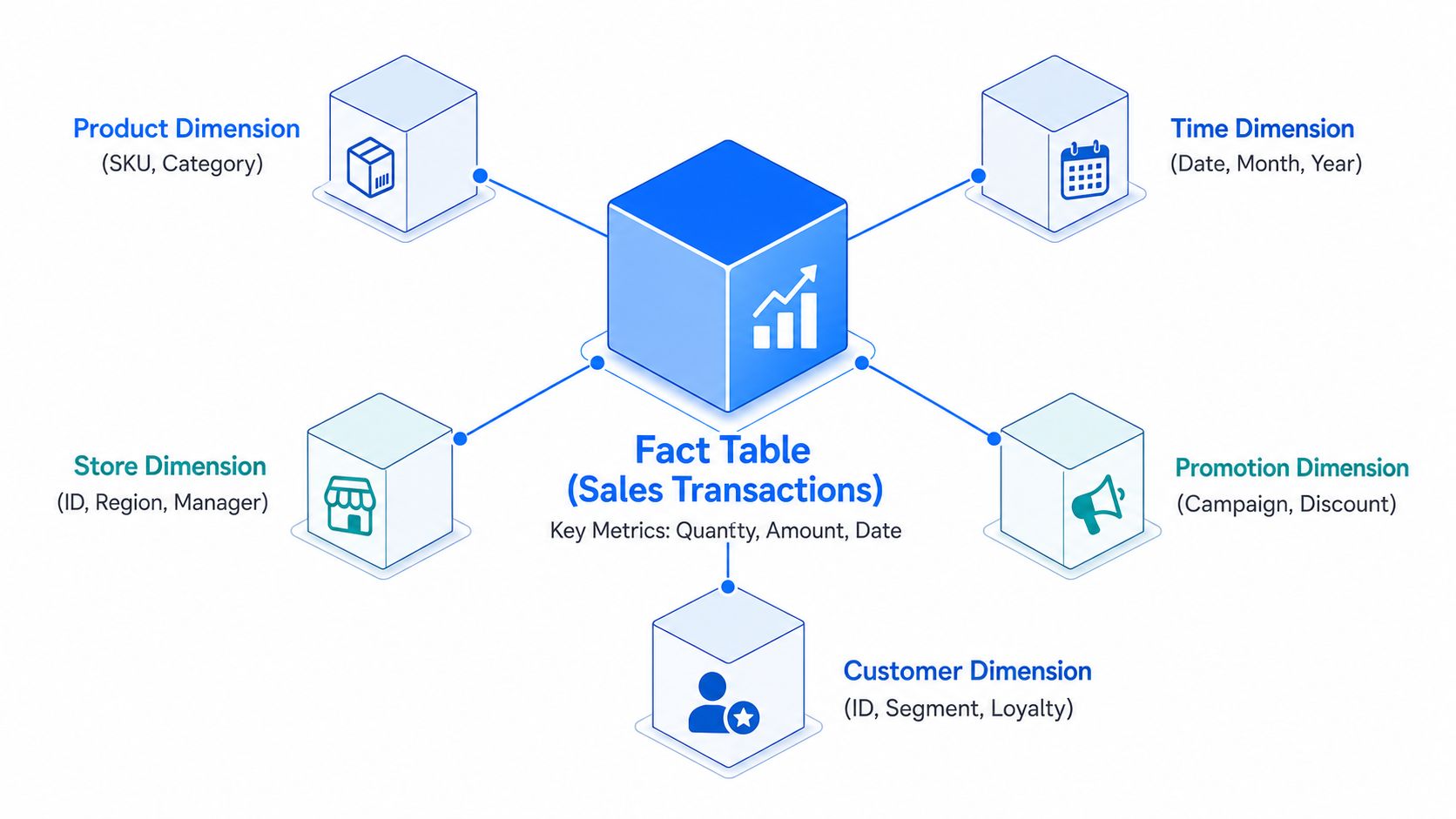
A warehouse team usually feels the difference as soon as a model reaches BI users. Queries get simpler, the joins become predictable, and the conversation shifts from "where is this field stored?" to "what business event does this row describe?" The star schema is the clearest expression of dimensional modeling because it keeps that answer visible. A central fact table holds the business event, and the surrounding dimension tables provide the context. MotherDuck's guide describes the pattern clearly, each fact row represents a business event, while dimensions answer the who, what, where, when, and why questions (MotherDuck star schema guide).
Start from the business event
Ralph Kimball's dimensional approach still shapes modern warehouse design because it starts with the question engineers need to settle first, what does one row mean? The sequence begins with the business process, then the grain, then the dimensions, and finally the facts at that grain. That order keeps the team from arguing about column names before the model has a stable unit of analysis.
A warehouse floor with one hub and several spokes is a useful mental model here. The hub is the fact table, the spokes are the dimensions, and every join follows a familiar path. BI teams usually find that easier to work with than a normalized structure because the relationship pattern stays visible, and the measures stay anchored to the event they describe.
Measures, facts, and slowly changing context
A fact is the business event, and it usually carries one or more numeric measures. Sales quantity is additive, account balance is semi-additive because it depends on the period you inspect, and unit price is non-additive because summing it usually makes no sense. Classic dimensional modeling also accounts for slowly changing dimensions, which is how a warehouse preserves history when descriptive attributes like customer city or store manager change over time (Conceptual Design of Data Warehouses from ER Schemes)).
A star schema works like an interface contract for analytics. It defines which event is being exposed, which descriptors are available, and how changes should be handled so downstream consumers do not have to guess. That is why it matters for schema tracking as well as modeling. If a dimension attribute or key changes shape without being recorded, BI reports and ML feature pipelines can lose the dependency they were built on, even when the SQL still compiles.
A star schema is not “wide tables for convenience.” It is a deliberate model for stable analytical meaning.
The pattern stays popular because it fits aggregation and consumption. digna's star schema overview shows the same core idea in a simple layout, and the star format keeps joins easy to follow for BI queries without asking analysts to understand every operational detail first.
Comparing Star, Snowflake, and Galaxy Schemas
A warehouse team usually chooses among star, snowflake, and galaxy, also called fact constellation, when it decides how much structure to expose to downstream users. The useful question is not which name sounds cleaner. It is which structure behaves like a stable interface contract for the workload you have, with the least surprise for BI and ML consumers as the model changes over time (Exasol warehouse schema overview).
Use the workload as the diagnostic
Start with the shape of the work, not the naming. A warehouse with one clear business domain and many dashboard users usually fits a star schema because the central fact table and its directly attached dimensions keep the query path simple. A warehouse that shares the same descriptive attributes across several related tables may fit a snowflake schema better, since the extra normalization reduces repeated attribute storage. A warehouse that needs several fact tables to share dimensions across business processes points toward the galaxy pattern, where reuse across subject areas matters more than keeping every query as short as possible (Exasol warehouse schema overview).
A quick diagnostic helps. Count the fact tables, then ask how often they need to be combined. One domain with repeated slicing and dicing usually points to star. Several domains with shared dimensions point toward galaxy. If dimension maintenance is the main pain, snowflake can help by separating changing attributes into related tables, but only if the added joins do not create more friction than they remove.
Schema Family | Structure | Main Tradeoff | Best Fit |
|---|---|---|---|
Star | One central fact table with directly linked dimensions | Simplicity over normalization | Single-domain BI and reporting |
Snowflake | Dimensions are split into related sub-tables | Storage efficiency over query simplicity | Dimensions that need more structural maintenance |
Galaxy | Multiple fact tables share dimensions | Reusability over upfront modeling simplicity | Enterprise warehouses spanning several business processes |
What each design buys you
A star schema keeps the contract easy to read. Analysts can trace a metric back to the fact table and then out to the dimensions without stepping through many joins, which is why it stays common in BI-oriented warehouses. A snowflake schema keeps more of the dimension hierarchy separate, so the model can mirror the source structure more closely and make some maintenance tasks cleaner. The cost is query complexity, since every additional table adds another join point the consumer has to understand.
Galaxy schemas solve a different problem. They help when a business wants the same dimension definitions to support more than one analytical process, such as sales, inventory, and fulfillment. In that setting, the model is less about convenience and more about keeping metrics aligned across teams and tools. For a compact comparison of the star and snowflake forms, use digna's star and snowflake schema guide.
The choice is usually a tradeoff between query simplicity, shared meaning, and upkeep. If analysts need repeatable SQL with minimal join logic, star is usually the cleanest fit. If shared dimensions are changing often and the warehouse team wants to keep the structure closer to the source, snowflake can reduce duplication. If several fact tables must stay consistent across business areas, galaxy gives that shared foundation without forcing each team to build its own version of the same dimension model.
Schema-on-Write and Schema-on-Read in Modern Warehouses
A warehouse schema is not just a table layout. It is the contract that tells every downstream consumer what shape the data will have, and that contract can be enforced before data lands or interpreted later at query time. Schema-on-write applies the rules up front, while schema-on-read lets the structure be applied when the data is queried. Databricks describes warehouse-style systems as the place for structured, governed analytics, while lake-style systems apply schema at read time and lakehouse designs try to bridge both approaches (Databricks data warehouse types).
Where enforcement happens
Schema-on-write systems define the table shape before ingestion starts. Data types are checked, records that do not fit are rejected early, and analysts query information that has already been shaped for a known use. That fits teams that care more about consistency, auditability, and repeatable reporting than about preserving every raw payload exactly as it arrived.
Schema-on-read follows a different path. Raw data is stored first, and the query engine interprets structure only when someone asks for it. That makes it useful for exploration, sandbox work, and some ML workflows, especially when the team is still learning what the data contains.
The tradeoff is straightforward. Schema-on-write gives predictability. Schema-on-read gives flexibility. Most enterprise platforms use both, with a curated warehouse layer for governed reporting and a raw or sandbox layer for experimentation and feature engineering.
Why most teams end up with both
The lakehouse pattern exists because neither extreme covers every need. Databricks describes modern lakehouse architectures as combining warehouse-style governance with lake-style flexibility, which fits teams that need raw history and trusted marts in the same broader platform.
Governed BI belongs on the contract-enforced side. Exploration belongs on the flexible side.
That split keeps the analytical warehouse dependable while still giving data scientists access to raw inputs. It also stops the semantic layer from absorbing every experimental table that lands in the platform. If a workload supports executive reporting, schema-on-write is usually the safer default. If it is about finding patterns or building features from raw events, schema-on-read is often the better fit.
Schema choice also affects observability. A contract is only useful if teams can see when it changes, compare the old shape with the new one, and warn downstream consumers before dashboards or models break. That is where schema tracking and related checks matter, because they turn schema design into something operations can monitor instead of something developers only discover after a failed query.
For teams looking at broader strategies for IT project change, the lesson is the same. The schema has to change in a controlled way, with visibility for the people and systems that depend on it.
Schema Evolution and Safe Change Management
The strongest warehouse schema is not the one that looked simplest on day one. It's the one that can change predictably without breaking the people and systems that depend on it. That means thinking about the schema as an interface contract, not just a storage structure. The contract is consumed by dashboards, semantic layers, and automated pipelines, and those consumers can fail without warning when the shape changes.
Breaking and non-breaking changes
Some changes are easy to absorb. Adding a nullable column, adding a new table, or extending a view can often happen without disturbing existing consumers. Other changes are dangerous. Renaming a column, dropping a field, or tightening a type can break a query that worked yesterday and still compiles today.
That's why safe change management starts with compatibility, not convenience. If a downstream report expects a field called customer_id, renaming it to client_id without a compatibility layer turns a metadata change into a production incident. The mechanics of the change matter less than the impact on consumers.
Patterns that reduce blast radius
Teams usually keep change risk down with a small set of patterns. Column aliasing can preserve old names while introducing new ones. View-based compatibility layers can present a stable interface while the underlying table evolves. Dual writes and versioned table suffixes can give consumers time to migrate without forcing a hard cutover. Each pattern buys time, and time is what keeps the warehouse from becoming brittle.
For teams working through broader change discipline, strategies for IT project change can be a useful framework, because warehouse evolution often fails for the same reason platform changes fail in general, unclear ownership and weak communication.
A practical migration checklist
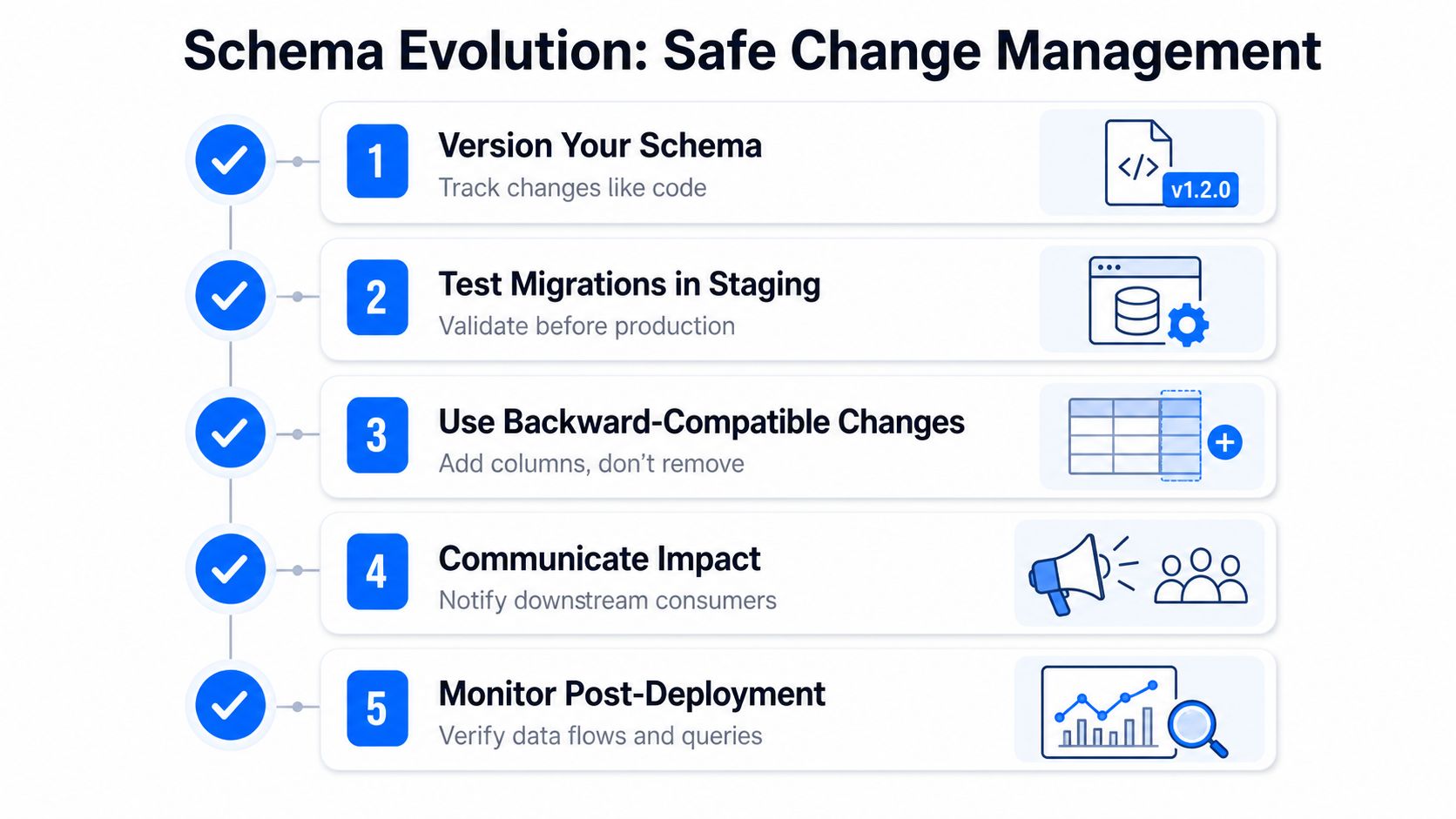
Version the schema: Track changes like code, so you can explain what changed and when.
Stage migrations first: Validate the new shape before production consumers see it.
Prefer backward-compatible changes: Add before you remove.
Communicate impact: Tell BI, analytics engineering, and ML owners what will break.
Monitor after deployment: Confirm that queries, loads, and dashboards still behave as expected.
That's the mental shift modern teams need. Schema design is lifecycle work, not diagram work. If the model can't evolve safely, its initial elegance won't save you later.
Observability Practices That Protect Schema Integrity
A finance report returning zeros two days after a deployment is a classic silent failure. The load jobs passed, no one paged on ingestion, and the only visible symptom came much later when a business user trusted the number. That kind of drift is exactly why schema integrity has to be monitored, not assumed.
Watch for the failure mode, not just the pipeline
A schema change can look harmless from the source system's point of view. A string becomes an int, a column moves, or a field disappears from one environment and appears in another. The warehouse still loads, but the meaning no longer matches what downstream consumers expect.
That's where schema tracking earns its place. digna's Schema Tracker continuously monitors table structure and detects changes such as added or removed columns and datatype modifications. It's useful because it spots structural drift before BI users discover it in a review cycle. digna also supports cross-environment schema comparison, which helps teams compare Dev, Test, and Production before a release goes live.
Map each observability practice to a different risk
Continuous schema detection handles structural drift. Timeliness monitoring catches missing or delayed loads. Record-level validation checks business rules, so a technically valid record that violates expected logic still gets flagged. AI-driven anomaly detection adds another layer by watching data behavior, not just metadata, which helps teams notice when a metric moves in an unexpected way even if the schema didn't change.
These practices work together. Schema tracking tells you the structure changed. Timeliness tells you data didn't arrive when expected. Validation tells you the record is wrong by business rules. Anomaly detection tells you the behavior looks unusual even when the row technically exists.
The warehouse doesn't guarantee trust by itself. Trust comes from watching the warehouse like a production dependency.
If you want a concrete reference point for this mindset, digna's observability best practices show how schema tracking, validation, timeliness, and anomaly monitoring fit together in one operational model.
Don't stop at the alert
The point isn't to collect more alerts. It's to reduce the time between drift and discovery. That's why observability has to be tied to ownership, escalation, and a known rollback path. For teams in regulated environments, this is especially important. If you're thinking about secure operational data handling in another context, the WhisperAI guide on secure transcription is a good example of how tightly governed workflows depend on dependable data controls.
Enterprise Checklist and Recommendations
Enterprise teams should treat schema work as a governance discipline, not a modeling preference. Start with a clear business process, declare the grain, choose the dimensions, and define the facts at that grain. Then decide how you'll preserve compatibility, how you'll monitor drift, and who owns each schema change when the warehouse evolves.
A working enterprise checklist
Design phase: Start with a star schema unless the workload clearly demands normalization or shared dimensions.
Modeling discipline: Declare grain early, and document the slowly changing dimension strategy for every descriptive attribute that can change.
Implementation: Use data contracts, idempotent migrations, and version control for schema changes.
Operational control: Track schemas, validate records, monitor timeliness, and detect anomalies in the same operational view.
Governance: Keep change history, impact analysis, and compliance mapping attached to critical tables.
For regulated industries, the schema itself becomes evidence. Financial services, healthcare, telecom, and public sector teams need to know what changed, when it changed, and which downstream systems saw it. That means the warehouse isn't only a reporting asset, it's part of the audit trail.
What to standardize first
The first standard should be compatibility. The second should be visibility. A schema that changes without a review path will eventually break trust, even if query performance looks fine. A schema that is observable, versioned, and documented can evolve without turning every release into a gamble.
Start simple, then plan for change as if the warehouse will be consumed for years, because it will be.
digna provides enterprise data quality and data observability capabilities that track schema changes, validate records, monitor timeliness, and detect anomalies inside the customer's environment. If you're building a warehouse where BI, ML, and governance all depend on stable contracts, visit digna to see how that approach fits your stack.
Frequently asked questions
What does a warehouse schema really encode?
Meaning, not just the way you place tables. Treating it as table layout is what lets a rename or a key change pass review as cosmetic while altering what a downstream metric actually counts.
Why can't you reuse a transactional schema?
Because the two solve different problems. A transactional schema optimizes for correct writes against one record at a time, while a warehouse schema optimizes for questions asked across many records at once.
When does the distinction bite?
When a column gets renamed or a key changes. At that moment the layout view says nothing has broken, because the tables still join, while the meaning view can see that the number a report produces has moved.
How do star, snowflake and galaxy models differ?
By how much structure they normalize and share. A star keeps dimensions flat around one fact table, a snowflake normalizes those dimensions further, and a galaxy shares conformed dimensions across several fact tables.
What does schema evolution need to stay safe?
Observability at the point of change. Tracking additions, removals, renames and type changes against a baseline is what gives producers and consumers a chance to coordinate before a structural change reaches a dashboard.