ISO 8000 Data Quality: A Practical Guide for Modern Teams
|
8
min read

A dashboard can look perfectly reasonable until someone notices that a customer count doubled. A regulator asks how the number was produced, and the team offers a spreadsheet with undocumented corrections. Meanwhile, a model starts producing unstable results because an upstream column changed type without warning. Everyone involved may have worked carefully, yet the organization still lacks a shared way to define, test, assign, and prove data quality.
That's the problem ISO 8000 data quality addresses. It gives data teams a standards-based language for quality, master data, exchange requirements, measurement, maturity, and accountability. The practical value isn't a one-time cleansing exercise. It's a repeatable operating discipline that connects business meaning to technical controls and evidence.
Table of Contents
Why Data Quality Breaks Down Without a Standard
Why local fixes don't scale
What ISO 8000 Actually Is
Where ISO 8000 fits
The Three Dimensions of Data Quality
Syntactic quality asks whether the value has the right shape
Semantic quality asks whether the value means the right thing
Pragmatic quality asks whether the data serves its purpose
Key Parts of the ISO 8000 Series You Should Know
Maturity and Roles The Part Most Teams Skip
Process maturity versus assigned responsibility
Assessing and Aligning Your Data Practices to ISO 8000
Start with the data that matters
Test the process, not only the records
Mapping ISO 8000 Controls to digna Capabilities
From quality dimensions to operating controls
Keeping data in the customer environment
A Practical ISO 8000 Alignment Checklist
Why Data Quality Breaks Down Without a Standard
A data quality failure rarely begins with an obvious disaster. More often, a supplier uses a different country code, an analyst interprets an identifier incorrectly, or a pipeline delivers yesterday's file under today's filename. Each individual issue looks manageable. The trouble starts when different teams apply different assumptions to the same data.
An engineer may validate whether a field contains text. A business owner may care whether that text identifies the correct legal entity. A finance team may need the value to arrive before a reporting process runs. Those are different quality questions, and a single “passed validation” label can hide the difference.
Why local fixes don't scale
Ad hoc rules often live in transformation scripts, dashboard logic, spreadsheets, and team knowledge. One group corrects a product code during ingestion, another corrects it in a reporting model, and a third keeps a manual exception list. The organization may improve one output while leaving the underlying record inconsistent for every other consumer.
One-off cleanup has the same weakness. It can remove duplicate records or repair malformed dates today, but it doesn't explain who owns the rule, how the defect will be detected next time, or what evidence proves the control worked.
Practical rule: A quality control should identify the requirement, the responsible owner, the detection method, and the evidence produced.
ISO 8000 provides that structure. It treats quality as something organizations define and manage across the data life cycle, not as a final inspection step after data has already moved through several systems. That distinction matters for manufacturing, finance, healthcare, telecom, and public-sector environments, where downstream consumers may rely on the same master data for operations, analytics, and compliance.

The standard doesn't replace engineering practices, governance policies, or quality-management systems. It gives those practices a common reference point, so a schema check, a reference-data rule, and an ownership record can form part of one defensible quality process.
What ISO 8000 Actually Is
ISO 8000 is an international standard series for data quality and master data. It was first proposed in 2002, and its first components were approved in 2009, according to this history of ISO 8000 and its development. The series has expanded into parts that address overall frameworks, master-data exchange, measurement, maturity, and organizational responsibility.
It helps to understand the series as a family rather than as one long document.
ISO 8000-1:2022 provides the overall framework for improving data quality, identifying relevant quality characteristics, specifying requirements, offering improvement guidance, and applying controls across the data life cycle. See the official ISO 8000-1:2022 scope.
ISO 8000-110:2021 focuses on master-data exchange. It defines requirements for messages containing characteristic data, with requirements that can be checked by computer between organizations and systems. The official ISO 8000-110:2021 description explains that exchange focus.
ISO 8000-150:2022 addresses organizational responsibility, including roles, responsibilities, documentary evidence, and a functional model for data quality management. Its scope appears in the official ISO 8000-150:2022 page.
The publication history shows how the standard matured. The 2009 publication of ISO 8000-110 established computer-checkable requirements for exchanging master data. ISO 8000-1:2022 later replaced ISO/TS 8000-1:2011 and supplied a broader framework for data quality.
Where ISO 8000 fits
ISO 8000 isn't the same as ISO 9001, which addresses quality management more generally. It also isn't a complete data governance operating model. Governance defines how an organization makes decisions about data, while ISO 8000 helps make quality requirements, exchanges, controls, and responsibilities more explicit.
The distinction is useful: governance may say that product data needs an accountable owner, while ISO 8000 helps the team define the characteristic requirements, exchange conditions, and evidence needed to manage that product data consistently.
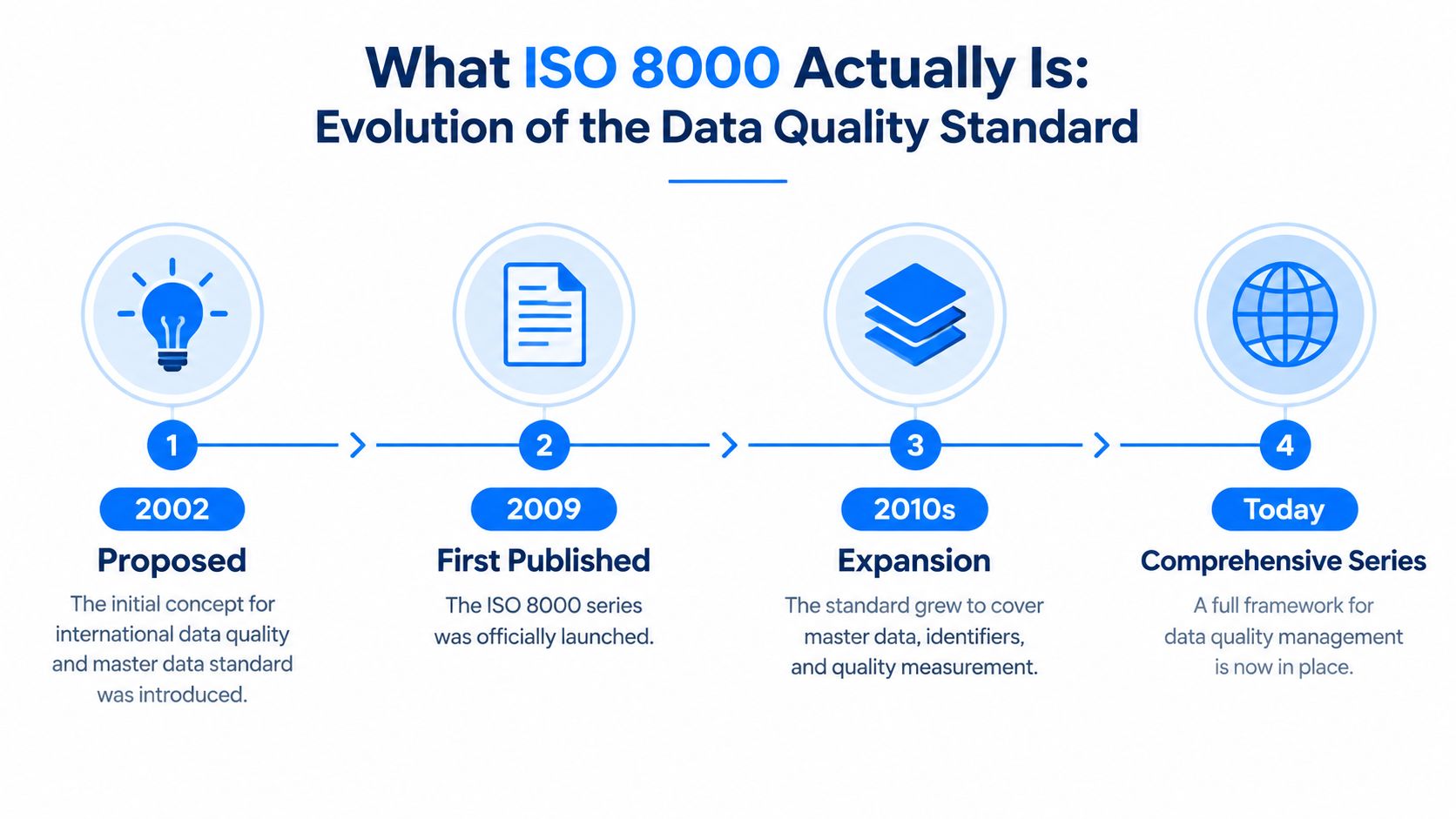
ISO also notes that standards are reviewed every 5 years, which is important here because data practices, platforms, and exchange patterns change. ISO 8000's continued expansion, including parts such as ISO 8000-115:2024 and ISO 8000-210:2024, reflects a maintained framework rather than a static definition.
For a broader comparison of standards and their practical role, teams can consult digna's data quality standards guide.
The Three Dimensions of Data Quality
ISO 8000-8 gives teams a diagnostic model. It separates data quality into syntactic, semantic, and pragmatic quality, as described in the ISO 8000-8 measurement foundation. The point isn't to create three labels for a dashboard. The point is to choose a control that matches the defect.
Syntactic quality asks whether the value has the right shape
A date such as 2026-09-07 may satisfy an expected date format, while 07/09/26 may fail if the receiving system requires a different representation. A country field may also need to match an approved code list. These are syntax and conformance questions.
The right controls include schema validation, data-type checks, format checks, permitted-value lists, and machine-readable specifications. They're effective because syntax defects are visible in the structure of the value itself.
Semantic quality asks whether the value means the right thing
A well-formatted identifier can still point to the wrong entity. A customer ID may resolve to a supplier, or a product code may refer to an obsolete item in the receiving system. The value looks valid, but its meaning is wrong in context.
Semantic controls therefore depend on reference data, master-data relationships, dictionaries, and business rules. ISO 8000 emphasizes provenance, accuracy, and completeness for master data, and its exchange requirements are designed to be checked by computer at the message and record level. A team might validate that a product exists in the approved catalog and that its classification agrees with the reference model.
Pragmatic quality asks whether the data serves its purpose
Data can be syntactically valid and semantically correct yet unsuitable for a particular decision. A sales measure might be appropriate for revenue reporting but not for fraud detection if the use case requires a different time window, level of detail, or tolerance for delay.
Pragmatic controls include purpose-specific thresholds, business monitoring, timeliness expectations, and decision-level review. The control should reflect how the data will be used, not just whether it passed a technical test.
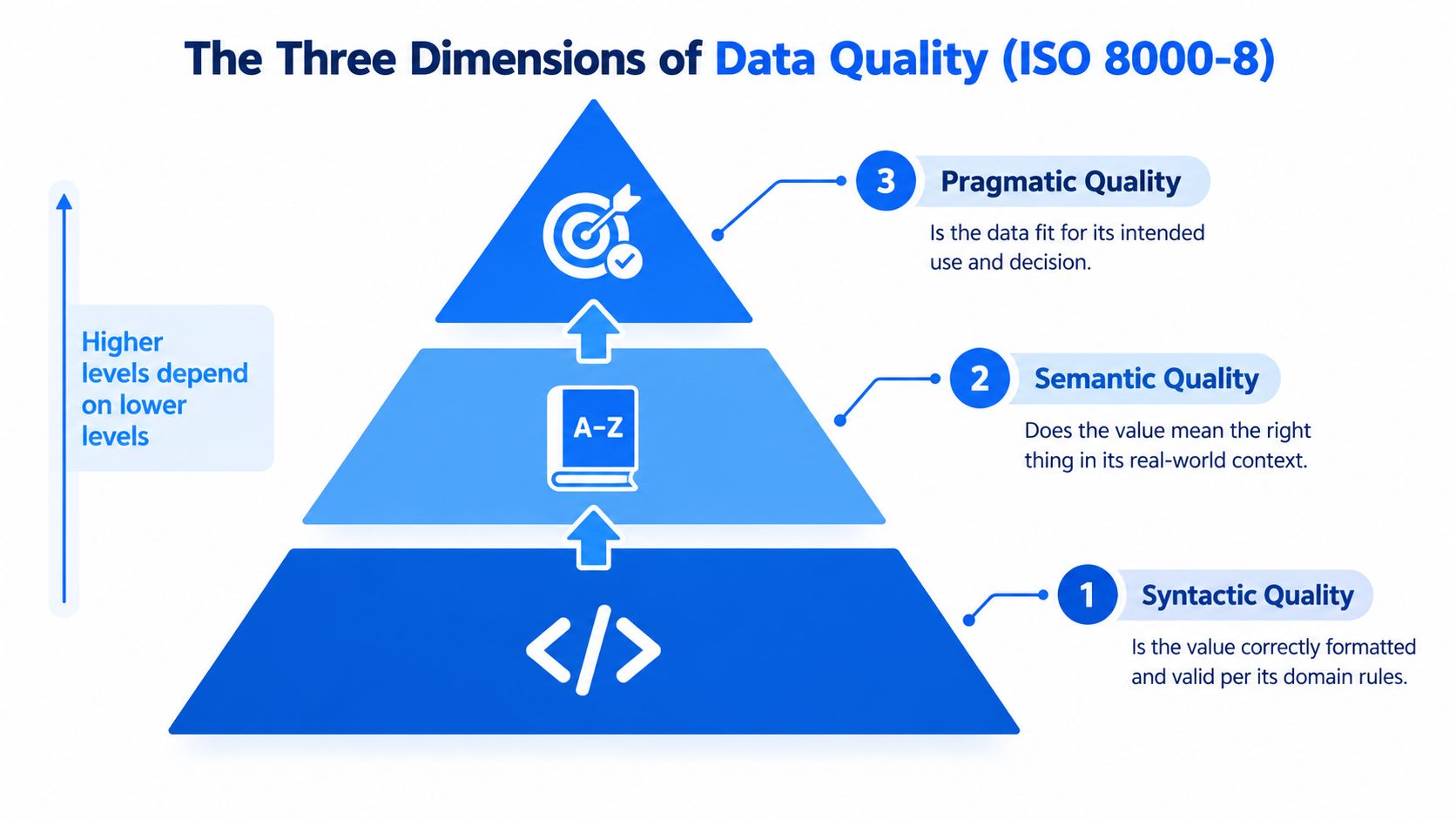
A useful operational sequence is shape, meaning, purpose. If a team skips that distinction, it may spend time repairing formatting while missing the more consequential problem, the data represents the wrong entity or cannot support the decision.
For a plain-language treatment of these layers, see digna's guide to data quality dimensions.
Key Parts of the ISO 8000 Series You Should Know
A working team doesn't need to memorize every part of ISO 8000 before improving quality. It needs a practical map of the parts that answer recurring operational questions.
ISO 8000-1:2022 answers, “What does the series cover, and how should we think about quality across the life cycle?” It defines the series-wide framework, including relevant data characteristics, requirements, improvement guidance, and life-cycle application.
ISO 8000-110:2021 answers, “How can two systems exchange master data without relying on informal interpretation?” It addresses characteristic data in exchange messages and makes the requirements suitable for computer checking between systems and organizations.
ISO 8000-8 answers, “How do we measure quality in a way that distinguishes structure, meaning, and use?” Its syntactic, semantic, and pragmatic model helps teams connect defects to controls.
ISO 8000-64:2022 answers, “How mature are our data quality processes?” It defines process-maturity assessment, moving attention from isolated corrections to the repeatability of ingestion, validation, monitoring, and response practices.
ISO 8000-150:2022 answers, “Who is accountable, and what evidence shows that responsibility exists?” It covers roles, responsibilities, documentary evidence, and a functional model for organizational data quality management.
Part | Focus | Practical question it answers |
|---|---|---|
ISO 8000-1:2022 | Overall framework and life-cycle application | What counts as quality, and where does it apply? |
ISO 8000-110:2021 | Computer-checkable master-data exchange | How do systems exchange data reliably? |
ISO 8000-8 | Quality measurement and dimensions | Which control fits the defect? |
ISO 8000-64:2022 | Process-maturity assessment | Can we repeat and improve our quality processes? |
ISO 8000-150:2022 | Roles and responsibilities | Who owns the requirement, control, and evidence? |
The parts work together. A product-data exchange can have defined requirements under ISO 8000-110, quality characteristics interpreted through ISO 8000-8, life-cycle context from ISO 8000-1, process assessment through ISO 8000-64, and assigned accountability under ISO 8000-150.
That combination is more useful than treating the standard as a glossary. It turns quality language into operating decisions.
Maturity and Roles The Part Most Teams Skip
Many ISO 8000 discussions focus on definitions and master-data requirements. That emphasis can leave teams with carefully written rules but no reliable way to assess whether the organization applies them consistently. ISO 8000-64:2022 addresses process-maturity assessment, while ISO 8000-150:2022 addresses roles, responsibilities, and evidence.
Maturity asks whether a process works repeatedly. Can the team identify a failed ingestion, apply the relevant validation, record the incident, resolve the root cause, and demonstrate that the improvement remained in place? A successful cleanup proves that someone fixed a problem. It doesn't prove that the organization can manage the same class of problem over time.
Process maturity versus assigned responsibility
These two concerns are related but not interchangeable.
Concern | ISO 8000-64:2022 | ISO 8000-150:2022 |
|---|---|---|
Primary question | How capable and repeatable is the process? | Who performs and owns each responsibility? |
Evidence focus | Assessments of process capability and improvement | Documentation showing roles and responsibilities are implemented |
Typical application | Ingestion, validation, incident response, monitoring | Data ownership, stewardship, governance, escalation |
Failure when skipped | Teams can't show sustained improvement | Teams assume someone else will act |
A team without maturity measurement may describe an informal process as “working” because problems are eventually resolved. A team without assigned roles may maintain a quality policy that nobody feels authorized to enforce. In both cases, audit evidence becomes a collection of intentions rather than proof of operating control.
The most useful quality program is repeatable enough to survive staff changes, system changes, and audit questions.
This is why ISO 8000 is better understood as a management discipline, not merely a data-definition standard. Definitions matter, but they only create value when teams apply them through repeatable processes and accountable roles.
The gap is particularly serious in finance, healthcare, telecom, and the public sector, where governance teams need measurable controls and evidence. A spreadsheet can document an owner, but it won't automatically show that a rule ran, a delivery arrived on time, or a schema change was reviewed. Those organizations need operating evidence connected to the data process itself.
For a structured way to examine capability, teams can use digna's data quality maturity model.

Assessing and Aligning Your Data Practices to ISO 8000
A practical assessment starts with business decisions, not with a catalog of every table. The question is, which data can change an important operational, financial, regulatory, or analytical outcome?
Start with the data that matters
Inventory critical datasets. List the customer, product, supplier, asset, transaction, regulatory, and operational datasets that support material decisions. Record the systems involved, the consumers, the expected delivery pattern, and the person accountable for the decision.
Classify the risk by dimension. For each important field or dataset, ask whether the primary risk is syntactic, semantic, or pragmatic. A malformed date needs a format control. An identifier that maps to the wrong entity needs a reference or master-data control. A valid figure that arrives too late needs a timeliness or business-use control.
Test the process, not only the records
Benchmark repeatability. Use an ISO 8000-64 lens to examine ingestion, validation, monitoring, incident response, remediation, and evidence collection. Look for documented triggers, consistent execution, defined escalation, and records that show what happened.
Assign responsibility. Use ISO 8000-150 to name the data owner, steward, technical operator, reviewer, and escalation contact. Avoid a single vague label such as “the data team.” Accountability should identify who defines the requirement and who acts when the control fails.
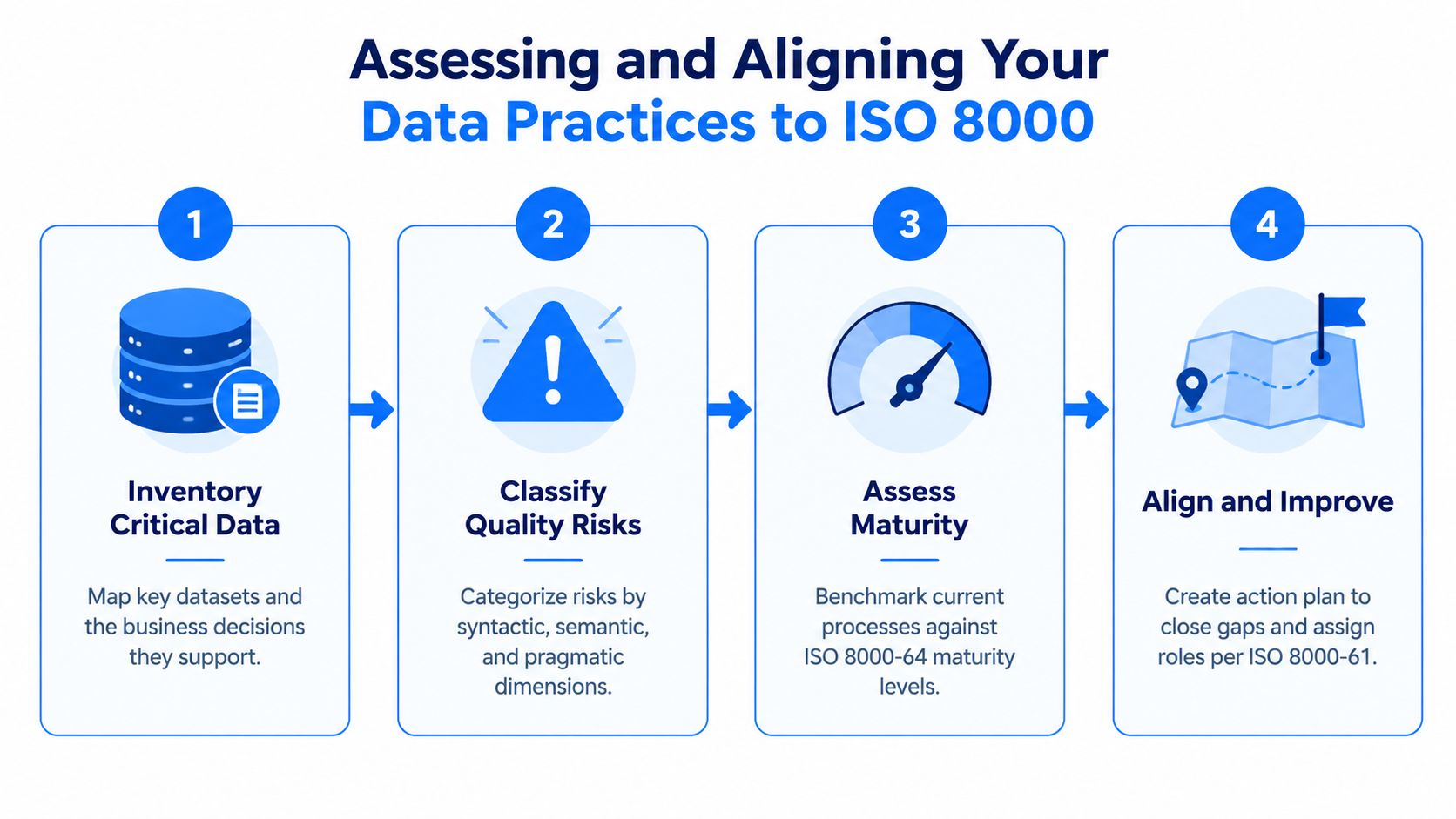
Alignment doesn't require replacing every existing tool. Map current schema checks, business rules, anomaly alerts, timeliness monitoring, dictionaries, and incident workflows to the ISO 8000 vocabulary. That translation lets engineering, governance, and audit teams discuss the same control without forcing each group to abandon its working methods.
A team can begin with one critical domain, document its requirements, test the process, and use the evidence to refine the wider operating model. The assessment becomes useful when it produces decisions, owners, controls, and a visible path for improvement.
Teams that need audit-oriented quality workflows can review digna's approach to auditing data quality.
Mapping ISO 8000 Controls to digna Capabilities
A platform can support ISO 8000 alignment when it connects quality requirements to observable controls and retained evidence. digna provides one example of that mapping through modules for anomalies, analytics, timeliness, validation, schema tracking, and in-database execution.
From quality dimensions to operating controls
Data Anomalies and Data Analytics use baseline-aware detection to identify unusual behavior, trends, volatility, and statistical patterns. That supports semantic and pragmatic quality work where the defect isn't a simple format violation. For example, a field can retain its expected data type while its behavior shifts enough to affect a business process or analytical output.
Timeliness monitors expected delivery patterns and flags missing, delayed, or early loads. It can calculate expected delivery time, giving a team evidence for whether a dataset arrived in line with its operational expectation. That connects directly to pragmatic fitness when a report, model, or workflow depends on data being available at the right time.
Data Validation applies record-level business rules. A team can use it for syntactic checks such as data types and formats, or semantic checks such as approved master-data references, country lists, and product catalogs. The resulting validation records help show which requirement was tested and what happened.
Schema Tracker detects structural changes, including added or removed columns and data-type modifications. This protects downstream consumers from silent contract changes, especially when a pipeline continues to run while the meaning or shape of its input has changed.
Keeping data in the customer environment
In-database execution computes metrics and runs analysis inside the customer's own databases. Data remains in place, which can support security, governance, and regulatory requirements where moving production data into an external service would create additional review concerns.
The mapping also supports the broader life-cycle scope of ISO 8000-1:2022. Monitoring can begin at ingestion, continue through validation and delivery, and provide evidence during downstream use. Roles from ISO 8000-150 still need to be defined by the organization, but the platform can make the associated control activity and status visible to engineers, analysts, and governance stakeholders.
This is the important boundary. A tool doesn't establish accountability by itself. It can make controls executable, incidents visible, structural changes traceable, and evidence easier to review. The operating model still needs owners and decisions.
A Practical ISO 8000 Alignment Checklist
Use the following checklist as a starting point for a governance ticket, control register, or working session:
Define critical datasets: Record the datasets that support important decisions and name the decision owner for each one.
Classify quality risks: Separate syntactic, semantic, and pragmatic risks so each receives an appropriate control.
Document data requirements: Maintain data dictionaries, permitted values, reference data, and exchange formats aligned with ISO 8000-110.
Assign explicit roles: Identify owners, stewards, technical operators, reviewers, and escalation contacts under ISO 8000-150.
Assess process maturity: Benchmark ingestion, validation, monitoring, incident response, and remediation using an ISO 8000-64 lens.
Monitor anomalous behavior: Use continuous detection for unexpected shifts in critical datasets and business measures.
Track delivery reliability: Monitor missing, delayed, and early loads against expected delivery patterns.
Validate records: Enforce business rules at record level and retain evidence of failed and passed checks.
Track schema changes: Detect added columns, removed columns, and data-type modifications before downstream consumers fail.
Protect data location: Run quality metrics and analysis in the customer's database where governance requirements call for data to remain in place.
The central shift is from “we cleaned the data” to “we operate a repeatable quality process.” ISO 8000 gives teams a common structure for requirements, measurement, exchange, maturity, and ownership. A modern observability platform can make those controls practical across warehouses, lakes, and pipelines, but the organization still has to define what matters and who acts.
For teams turning that model into an operating program, digna's data quality implementation guide provides a practical starting point.
digna helps teams monitor data behavior, validate records, track timeliness, detect schema changes, and run analysis inside their own data environment. Visit digna to see how its modular controls can support an ISO 8000-aligned data quality program.