10 Information Governance Software Options
|
8
min read

The most popular advice about information governance software is to compare feature lists. That's the wrong starting point. A catalog, policy engine, lineage graph, or privacy module only creates value when it fits the way your organization assigns ownership, controls access, manages retention, investigates incidents, and verifies that operational data remains reliable.
The better question is where governance work breaks down in your environment. Do teams need a shared catalog and stewardship model, stronger privacy controls, hybrid deployment, sensitive-data discovery, or continuous evidence that data is timely and structurally stable? Those priorities change which platform fits, especially for finance, healthcare, telecommunications, and public-sector organizations with strict infrastructure and audit requirements.
This comparison evaluates ten options by governance operating model and deployment reality, not feature count alone. It considers catalog and stewardship depth, metadata and lineage, privacy and classification, hybrid and on-premises execution, data quality, observability, implementation effort, and licensing considerations. That distinction matters because unmanaged systems, shadow IT, and disconnected data stores can expand compliance exposure before a governance team sees the problem. See this practical explanation of how shadow IT creates risks for the broader control challenge.
Table of Contents
1. digna
Where digna fits best
2. Collibra Data Intelligence Platform
Catalog governance versus runtime reliability
3. Informatica Data Governance and Privacy
A broad platform with a demanding implementation path
4. Alation Data Governance
Adoption is a control, not a cosmetic benefit
5. OneTrust
Strong privacy foundations, wider implementation scope
6. BigID Data Governance
Discovery first, governance second
7. Microsoft Purview
Ecosystem alignment changes the economics
8. IBM Cloud Pak for Data with IBM Knowledge Catalog
Control comes with platform weight
9. Ataccama ONE
A broad trust platform
10. erwin Data Intelligence by Quest
A balanced governance and literacy choice
Top 10 Information Governance Software Comparison
Match the Platform to the Governance Job
1. digna
digna is the strongest fit when governance must operate inside the customer's environment and prove that production data is reliable, not merely documented. It runs in a private cloud, VPC, or on-premises environment, while metric computation happens in-database. The vendor doesn't access production data, and the platform avoids moving large data volumes into an external processing layer.
Its operating model is observability-led. Data Anomalies uses statistical methods and machine learning to learn normal behavior and identify unusual changes without requiring teams to write every rule manually. Timeliness learns delivery patterns, flags delayed or missing loads, and calculates expected delivery times. Data Validation checks records against business rules, while Schema Tracker identifies structural changes such as added or removed columns and modified data types. Data Analytics gives teams historical views of volatility, trends, and metric behavior.
That combination addresses a gap in many governance programs. A catalog can tell you who owns a table, but it won't necessarily tell you that the table arrived late, changed shape, or began violating a business rule. Microsoft defines data quality rules through checks such as freshness, unique values, string format, data type, duplicate rows, and blank fields in its Unified Catalog guidance, while IBM describes rules as conditions used to evaluate and measure data quality over time. digna places those controls alongside anomaly detection, timeliness monitoring, and schema tracking.
Where digna fits best
The platform suits data engineers, analytics teams, heads of data quality, and governance leaders who need auditable, in-place evidence across warehouses, lakes, and pipelines. Its shared interface is intended for engineers and stakeholders, with a scheduler, catalog, integrations, and collaboration features included from the initial module selection.
The trade-off is operational. Deployment inside your infrastructure and in-database execution strengthen control, but they require database access, configuration, and internal ownership. Licensing is modular, with a base fee plus per-active-table, per-module pricing. That avoids API, scan, and alert-volume charges, but large estates still need a detailed quote because costs can rise with table count and module scope.
digna is especially compelling when stale dashboards, silent schema drift, delayed pipelines, or inconsistent record logic create more risk than an incomplete glossary. Its recent 2026.06 release indicates active development, but buyers should still validate infrastructure prerequisites, supported systems, and rollout ownership before committing.
2. Collibra Data Intelligence Platform
Collibra is designed for organizations that need a formal governance operating model connecting business owners, data stewards, policies, technical metadata, and issue workflows. Its center of gravity is the enterprise catalog and the collaborative processes around it, rather than production observability.
The platform brings together a business glossary, domains, lineage, stewardship assignments, role-based access controls, and policy workflows. That separation between business meaning and technical metadata helps large organizations create a common language without forcing every participant to work directly in engineering systems. It's a strong model when governance depends on approvals, accountable owners, and cross-functional issue resolution.
Catalog governance versus runtime reliability
A catalog is useful only when people trust and maintain it. Teams evaluating Collibra should test whether stewards can keep ownership current, whether workflows match existing approval structures, and whether analysts use the catalog during day-to-day data work. The platform's breadth can support mature programs, but enterprise complexity usually means enablement and implementation planning are part of the purchase.
Buyers should also distinguish governance evidence from data-health evidence. Collibra can establish who owns an asset, what policy applies, and how data flows through systems. It isn't primarily positioned as an in-database observability layer for detecting freshness problems, volatility, or schema changes in production.
For organizations building a formal governance council, business glossary, and policy framework, Collibra is a credible choice. Pricing is quote-based and can become premium at scale, so the evaluation should include workflow configuration, connector requirements, stewardship effort, and ongoing administration, not just subscription cost. Its Data Intelligence Platform fits best when governance maturity depends on coordinated ownership and policy execution.
For teams still separating discovery from operational control, it's useful to understand what a data catalog does. The distinction helps prevent a catalog project from being mistaken for a complete reliability program.
3. Informatica Data Governance and Privacy
Informatica's governance suite within IDMC is built for large estates that want metadata, lineage, quality, privacy, and policy control connected through one broader data-management ecosystem. Former Axon and Enterprise Data Catalog capabilities sit within a platform approach that emphasizes automated discovery and integration across hybrid and cloud environments.
Its governance model combines central policies, business glossaries, stewardship workflows, cataloging, lineage, data quality, and a marketplace for governed data products. That makes it suitable for enterprises that don't want governance isolated from data integration and quality operations. The linkage to adjacent Informatica services can reduce fragmentation when the organization already operates within that ecosystem.
A broad platform with a demanding implementation path
Informatica is most persuasive when the buying problem spans multiple capabilities. A governance leader can connect ownership and policy work to discovery and lineage, while data teams can use related quality services to evaluate the condition of assets. That breadth also creates a planning burden. Licensing and packaging can be complex, and implementation commonly requires specialized expertise.
Organizations should map their estate before selecting modules. Include cloud platforms, on-premises databases, business applications, BI tools, and regulated repositories. Then identify which systems need automated scanning, which require manual stewardship, and where lineage must be validated by subject-matter experts.
Metadata management is central to this operating model because technical context, ownership, and lineage must remain connected as systems change. A practical overview of metadata management can help buyers separate metadata collection from the governance workflows that act on it.
Informatica's Data Governance and Privacy offering fits enterprises that want a mature, integrated platform and have the personnel or implementation partner needed to manage its scope. It's less attractive for a narrow use case where the immediate need is only anomaly detection, delivery monitoring, or record-level validation.
4. Alation Data Governance
Alation takes an adoption-oriented approach to governance. It builds governance applications on a data catalog designed for search, business context, stewardship, and collaboration, making it a natural fit when analysts and business users need to participate rather than leave governance to a central office.
Its capabilities include a policy center, guided governance workflows, business glossary management, stewardship assignments, access-request guidance, and natural-language experiences such as Alation Chat. The user experience is a major part of its operating model. Instead of treating governance as a compliance queue, Alation aims to place definitions, ownership, and policy guidance in the path of data discovery.
Adoption is a control, not a cosmetic benefit
A governance platform can have strong technical features and still fail if users bypass it. Alation's usability gives it an advantage where data literacy and self-service discovery are central. The relevant test is whether users can find trusted assets, understand their meaning, identify owners, and follow access guidance without switching across several systems.
The limitation is that technical control depth depends heavily on integrations. Buyers should verify how the platform connects to their specific warehouses, pipelines, BI tools, and access-management processes. They should also test whether lineage and policy actions remain accurate when data moves across hybrid systems.
Alation's pricing isn't public, and larger footprints can become costly. That makes adoption measurement important during procurement. Define which user groups must participate, which workflows need formal approval, and which metadata must be automated rather than maintained manually.
The Alation Data Governance offering is well suited to organizations prioritizing catalog use, stewardship, and data literacy. It's less directly suited to teams whose first governance requirement is continuous production monitoring for freshness, schema drift, or business-rule failures.
5. OneTrust
OneTrust is the clearest choice in this list when information governance sits inside a broader privacy, consent, risk, and regulatory control program. Its platform connects data discovery and classification with privacy operations, policy libraries, consent and preference management, and data-subject request workflows.
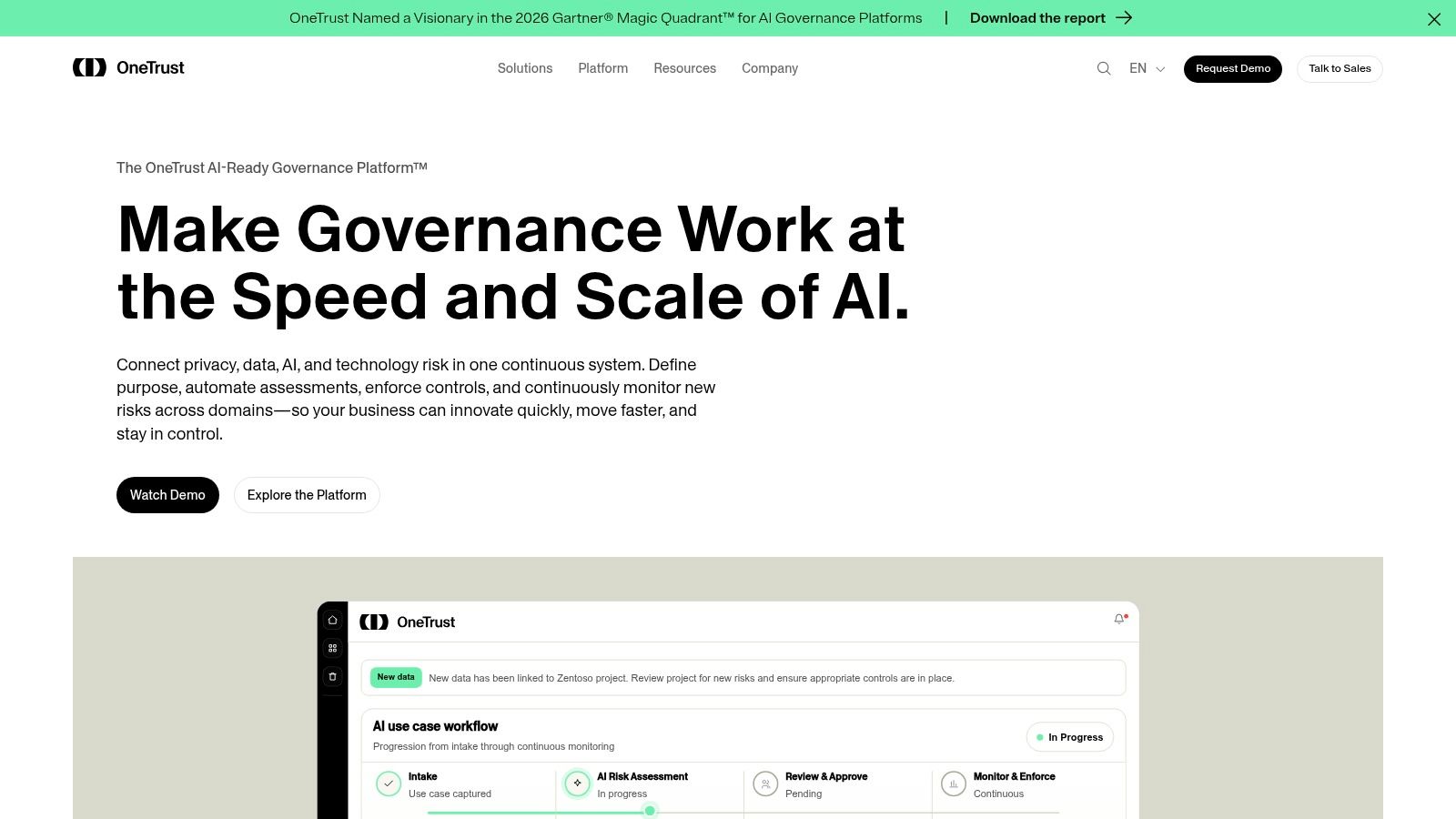
The platform can map sensitive data, apply classification, manage controls aligned to regulations, automate DSAR processes, and support privacy governance across systems. AI and machine-learning-assisted capabilities extend discovery and governance workflows. This makes OneTrust attractive to privacy officers and risk teams that need a shared control environment rather than a standalone data catalog.
Strong privacy foundations, wider implementation scope
The trade-off is scope. OneTrust can be complex when an organization expands beyond privacy into broader data governance, records, third-party risk, or AI governance. Each additional module and connector can increase both capability and implementation effort, so buyers should define the first operational outcome before purchasing a broad package.
A useful distinction is between privacy classification and data reliability. OneTrust can help identify what data is sensitive, where it resides, and which privacy controls apply. It isn't primarily an observability platform for determining whether a dataset is late, statistically abnormal, structurally changed, or valid according to a business rule.
That distinction matters in regulated environments. Privacy compliance describes how data should be handled, while operational monitoring helps determine whether the data remains fit for reporting, analytics, and automated decisions. A concise guide to data compliance helps clarify why those functions complement rather than replace one another.
OneTrust's tiered packaging can let organizations start with a focused use case and expand. The expansion path should be tested carefully against connector coverage, ownership, internal privacy processes, and the cost of administering multiple modules. Review related MCP server privacy terms when AI-enabled systems and external tool access form part of the privacy discussion.
6. BigID Data Governance
BigID starts with a different question: where is sensitive data, and what is happening to it across silos? Its data intelligence platform combines discovery, classification, cataloging, lineage, policy, and access insights across structured, unstructured, cloud, and SaaS sources.
That makes BigID particularly useful when governance begins with risk visibility. Automated discovery and classification can establish a foundation for privacy, security, retention, and access decisions. Teams can then expand into catalog, lineage, quality, and risk intelligence capabilities as governance needs become clearer.
Discovery first, governance second
BigID's modular approach is valuable for organizations that don't yet have a reliable inventory of sensitive information. It can help answer practical questions about data location, classification, ownership, and exposure before the organization designs more elaborate stewardship workflows.
The buyer should still examine the transition from discovery to action. Finding sensitive data is only the beginning. Governance teams need clear owners, policy decisions, remediation workflows, access controls, and evidence that changes took effect. Advanced capabilities may require multiple modules, and pricing depends on source count and deployment type.
BigID also offers deployment flexibility, which helps organizations with cloud, hybrid, and distributed data estates. That flexibility should be evaluated against the actual systems in scope, especially unstructured repositories and SaaS applications where discovery methods can differ from database scanning.
The BigID Data Governance platform is a strong fit for privacy-led governance and sensitive-data intelligence. It may be more than necessary for a team whose central problem is data delivery reliability or schema change detection. Conversely, it can provide a valuable starting point where governance efforts are blocked because nobody knows the full location or sensitivity of the estate.
7. Microsoft Purview
Microsoft Purview is compelling for organizations already invested in Microsoft 365, Azure, and Fabric, particularly when governance needs to span cloud, on-premises, and SaaS sources. Its operating model combines automated data mapping, cataloging, classification, lineage, labeling, and compliance controls within the Microsoft ecosystem.
The platform's Unified Catalog includes data-quality rule types such as freshness, unique values, string-format matching, data-type matching, duplicate rows, and empty or blank fields, according to Microsoft's documentation on data-quality rules. Those checks show how catalog governance can extend toward operational data condition, although teams still need to determine which rules matter for each business domain.
Ecosystem alignment changes the economics
Purview's strongest argument is integration. Microsoft-centric teams can connect governance with identity, productivity, cloud data, and analytics services instead of assembling a completely separate control layer. Its metered pricing model can appear transparent, but consumption-based costs require careful sizing and monitoring.
Buyers should model scans, sources, users, storage, and enabled services against realistic workloads. A platform can be technically affordable at pilot scale and less predictable across a large, changing estate. Teams should also verify which advanced capabilities are optimized for Microsoft technologies and where third-party systems need additional configuration.
Implementation still depends on governance ownership. A data map without accountable stewards, agreed classifications, and remediation workflows won't create trusted data. Microsoft's guidance on how to implement data governance is useful context for sequencing operating-model work alongside tool deployment.
Purview is a practical choice when Microsoft is already the architectural center. It's less decisive when the primary requirement is vendor-neutral in-database observability across heterogeneous platforms, or when the organization needs a pricing model tied to active tables rather than metered consumption. Visit Microsoft Purview for the platform's governance and compliance positioning.
8. IBM Cloud Pak for Data with IBM Knowledge Catalog
IBM Cloud Pak for Data with IBM Knowledge Catalog fits organizations that need hybrid or on-premises governance inside a broader data and AI platform. Built on OpenShift, it combines cataloging, glossaries, lineage, policies, privacy services, data products, and governance automation.
The platform is well suited to regulated workloads where data location, deployment control, and integration with existing enterprise infrastructure influence the buying decision. Its data-fabric orientation connects governance artifacts with broader AI and data services, which can help organizations avoid running catalog, privacy, and data-product processes as disconnected programs.
Control comes with platform weight
IBM's flexibility is also its main implementation consideration. A platform-level deployment on OpenShift can be heavier than a SaaS-first governance product. Organizations need infrastructure expertise, lifecycle ownership, security coordination, and a clear plan for which services they'll operate.
The right evaluation therefore goes beyond catalog functions. Test deployment architecture, upgrade responsibility, integration with existing clusters, identity management, data access patterns, and the skills available to maintain the platform. Regulated buyers should also examine how audit evidence moves from policy definition to actual data operations.
IBM Knowledge Catalog is a good match when governance must coexist with an enterprise AI and data platform. It's less efficient for a small, narrowly defined catalog initiative or a team that wants immediate observability without adopting a larger platform architecture.
Its pricing and licensing vary by services and editions, so the business case should model the selected platform components and operational burden. The IBM Cloud Pak for Data product page provides the relevant platform context, but buyers should request an architecture-specific proposal rather than rely on a generic package description.
9. Ataccama ONE
Ataccama ONE is built around the idea that governance, data quality, and observability should share one operating surface. It combines cataloging, stewardship, profiling, quality rules, remediation, data-health metrics, governed data products, and AI-assisted workflows.
That integrated model appeals to teams that don't want to connect separate systems for business definitions, quality assessment, issue management, and observability. Its deployment options include cloud, hybrid, and on-premises environments, giving it relevance for enterprises with mixed infrastructure.
A broad trust platform
Ataccama's strength is the connection between governance intent and data condition. Profiling and rules can help teams examine whether assets meet stated expectations, while observability and health metrics provide an operational view of data behavior. This is closer to a data-trust platform than a catalog-only product.
The breadth can exceed the needs of a narrow project. If the first requirement is only a business glossary, privacy classification, or one source inventory, a larger platform may introduce unnecessary configuration. Conversely, organizations trying to consolidate governance and quality may find the broader architecture useful.
Buyers should test remediation workflows and ownership handoffs, not just dashboards. IBM describes data rules as conditions that validate sources and support quality measurement over time, which is a useful standard for evaluating whether a platform turns quality findings into repeatable controls.
Ataccama's pricing is quote-based, and total cost depends on enabled modules. The Ataccama ONE platform is a strong candidate for organizations seeking a single governance, quality, and observability layer, especially where hybrid deployment matters. Its main risk is buying more platform than the organization can operationalize.
10. erwin Data Intelligence by Quest
erwin Data Intelligence by Quest combines cataloging, business and technical metadata, lineage, data literacy, marketplace functions, and integrations with modeling, ETL, and BI ecosystems. Its distinctive operating model links governance to data modeling and semantic understanding, rather than treating the catalog as an isolated inventory.
That pairing makes sense for organizations already standardizing on the Quest and erwin stack. Data modelers, stewards, analysts, and engineers can work from related definitions, lineage, and marketplace experiences. The platform also supports cloud and on-premises deployment options, which helps organizations with mixed estates.
A balanced governance and literacy choice
erwin's value is strongest where governance includes education and shared interpretation. A technical lineage graph shows movement, but data literacy tools and business glossaries help users understand what assets mean and how they should be used. The marketplace can then support governed discovery and reuse.
The limitation is ecosystem momentum. Its user community is smaller than the two largest market leaders identified in the product plan, and pricing is not public. Enterprise buyers should validate connector coverage, implementation resources, roadmap fit, and the skills available to maintain models and glossary content.
erwin Data Intelligence is less focused on continuous anomaly detection, timeliness, or record-level validation than digna. It can document relationships and definitions, while an observability platform can verify whether data continues to behave as expected in production. Those functions can coexist, but they shouldn't be confused during selection.
Organizations assessing their current position can use a data governance maturity model to determine whether they need foundational inventory, formal stewardship, policy enforcement, or operational reliability. The erwin Data Intelligence suite is a sensible fit for Quest-aligned teams that want modeling, lineage, literacy, and governance in one environment.
Top 10 Information Governance Software Comparison
Product | Core capabilities (✨) | Deployment & data control | UX & adoption (★) | Target audience (👥) | Pricing & value (💰) |
|---|---|---|---|---|---|
digna 🏆 | ✨ AI baseline anomaly detection; timeliness; record‑level validation; schema tracker; in‑DB analytics | Runs inside customer infra (private cloud/VPC/on‑prem); vendor never touches prod; in‑database execution | ★★★★☆, rapid time‑to‑value; shared dashboard for engineers & stakeholders | 👥 Data engineers, BI/analytics, data governance, regulated industries | 💰 Transparent: base + per‑active‑table per‑module; usage‑stable |
Collibra Data Intelligence Platform | ✨ Governance workflows, catalog, lineage, stewardship | Cloud/managed with broad integrations | ★★★★☆, deep governance but needs enablement | 👥 Governance teams, large enterprises | 💰 Quote‑based; premium at scale |
Informatica Data Governance & Privacy | ✨ Central policies, automated discovery, cataloging, lineage; DQ integration | Hybrid/cloud; tight Informatica ecosystem integration | ★★★★☆, mature automation; complex implementation | 👥 Large enterprises with hybrid estates | 💰 Complex licensing; quote |
Alation Data Governance | ✨ Policy center, business glossary, search & NL UX, stewardship | Cloud/hybrid; user‑friendly UX | ★★★★☆, high adoption and data literacy focus | 👥 Analysts, stewards, BI teams | 💰 Not public; can be costly |
OneTrust (Data Discovery, Privacy & Governance) | ✨ Data discovery/classification, DSARs, privacy & consent | Cloud; privacy‑centric governance & compliance | ★★★☆☆, strong privacy features; broader deploy complexity | 👥 Privacy, risk, legal, compliance teams | 💰 Modular pricing; costs grow with modules/connectors |
BigID Data Governance | ✨ Sensitive‑data discovery & classification, catalog, lineage | Cloud/on‑prem; broad connectors | ★★★★☆, modern UX; fast time‑to‑value | 👥 Privacy/security, governance teams | 💰 Source/module‑based pricing |
Microsoft Purview | ✨ Automated catalog, classification, lineage, policy enforcement | Multi‑cloud/on‑prem; native MS 365/Azure/Fabric integration | ★★★☆☆, effective for MS stacks; metered model | 👥 MS‑centric IT, governance teams | 💰 Consumption‑based (metered); can be variable |
IBM Cloud Pak for Data (Knowledge Catalog) | ✨ Enterprise catalog, glossary, policies, privacy on OpenShift | On‑prem/hybrid via OpenShift; enterprise focus | ★★★☆☆, powerful but heavier platform | 👥 Regulated enterprises, hybrid ops | 💰 Variable by edition/services |
Ataccama ONE | ✨ Unified governance, data quality, observability; AI assistance | Cloud/hybrid/on‑prem | ★★★★☆, single platform; AI‑assisted workflows | 👥 Teams needing integrated quality & governance | 💰 Quote‑based; module dependent |
erwin Data Intelligence (Quest) | ✨ Catalog, lineage, data literacy, modeling integration | Cloud/on‑prem; strong modeling ties | ★★★☆☆, good modeling + governance pairing | 👥 Modeling teams, governance, BI practitioners | 💰 Quote; enterprise sales |
Match the Platform to the Governance Job
The right platform depends on the job governance must perform first. Catalog and stewardship point toward Collibra, Alation, erwin Data Intelligence, or the catalog capabilities of Informatica and Microsoft Purview. These products help organizations define terms, assign owners, document lineage, and guide users toward approved assets. Their success depends less on the number of screens than on whether business owners accept responsibility and whether teams use the workflows during ordinary data work.
Lineage and policy control favor platforms that connect metadata with formal governance processes. Collibra and Informatica are strong candidates for mature enterprise programs, while Microsoft Purview can be efficient in Microsoft-centered estates. IBM Cloud Pak for Data is more appropriate when the organization needs governance embedded in a hybrid data and AI platform.
Privacy and sensitive-data discovery require a different evaluation. OneTrust is strongest when privacy operations, consent, regulatory controls, and governance must share a program. BigID is particularly relevant when the first problem is discovering and classifying sensitive data across structured, unstructured, cloud, and SaaS sources. Buyers shouldn't assume that catalog visibility automatically creates privacy compliance. Classification, access decisions, remediation, retention, and evidence still need owners and workflows.
Hybrid and controlled deployment narrows the field. IBM, Ataccama, digna, Informatica, Microsoft Purview, and erwin can address mixed infrastructure in different ways, but deployment claims aren't interchangeable. Ask where metadata is processed, where credentials are stored, whether production data leaves the environment, who operates upgrades, and how the system connects to restricted sources.
Practical rule: Test the control path from detection to owner to remediation to evidence. A dashboard without that path is an observation, not governance.
Operational data reliability is the dividing line most feature comparisons miss. Data rules can validate requirements, but production systems also change through delayed loads, unusual distributions, missing records, and schema drift. Schema drift includes added, removed, renamed, retyped, and reordered fields, changes that can break downstream consumers even when a catalog still shows the asset as present.
digna is most relevant when regulated teams need data quality, timeliness, validation, schema tracking, and observability inside their own infrastructure. Its in-database execution keeps data in place, while anomaly baselines and module-specific controls help teams detect silent failures and produce operational evidence. The trade-off is that customers must provide the infrastructure access and database configuration needed for in-environment execution, and modular pricing must be modeled against active tables and selected modules.
Use a disciplined selection sequence. First, define the primary governance job. Next, map required sources, controls, ownership, and deployment constraints. Then test a representative workflow with the people who will steward, investigate, approve, and remediate data. Finally, model licensing against the actual estate, including connectors, modules, metered usage, implementation services, infrastructure, and ongoing administration.
Market direction supports treating this as an enterprise software decision, not a records-management afterthought. One 2026 estimate valued the global data governance market at USD 4.12 billion in 2025 and projected USD 16.51 billion by 2034, implying a 16.68% CAGR from 2026 to 2034; another estimate placed the market at USD 5.38 billion in 2025 and forecast USD 24.07 billion by 2034, with North America representing 43.50% of global value in 2025 (market estimates). The estimates differ, but both point to sustained investment in governance as organizations manage cloud growth, regulation, security, and AI readiness.
Cloud packaging is also expanding. The cloud-based information governance market was valued at USD 3.2 billion in 2024 and projected to reach USD 8.19 billion by 2033, an 11.0% CAGR (cloud governance market analysis). A separate estimate valued data governance software at USD 3.5 billion in 2023 and projected USD 25.6 billion by 2033, a 22% CAGR (data governance software estimate). Those projections don't identify a universal winner. They reinforce the need to buy for operating reality rather than market momentum.
digna offers in-environment data quality and observability through anomaly detection, timeliness monitoring, record-level validation, schema tracking, and in-database execution. Visit digna to assess whether its modular platform can strengthen the operational reliability and governance evidence of your critical data estate.